There is a distinct difference between what’s been happening in two Trump Cases. The one about mishandling and stealing National Security Documents is being handled in Florida by Judge Ailen Cannon. The case in DC is being handled by Judge Tanya Chutkan. This is the case where Trump is indicted for illegally conspiring to overturn his loss to President Biden in the election. Both are the result of work done by Special Counsel Jack Smith. Both cases have also had ongoing issues with Trump harassing court officials and possibly committing witness tampering. The Prosecution has been arguing that Trump has been undermining confidence in the Judicial System and scaring off potential jurors.
U.S. District Judge Tanya Chutkan is chugging along with jury selection in Donald Trump’s federal election subversion case, despite attempts to delay the proceedings by the former president’s legal team.
On Thursday, Chutkan endorsed a set of jury procedures that note prospective jurors will fill out a preliminary questionnaire on February 9, just over three months away. (As a reminder, Trump’s trial is scheduled to begin on March 4, 2024, one day before Super Tuesday.)
Certain language in the court order also hints that Chutkan is getting wise to Trump’s antics.
After slapping Trump with a gag order in the D.C. trial for leveraging his platform on social media and at speaking arrangements to lambaste prosecutors and office clerks associated with the case, Chutkan’s legal outline reads more like a warning to his defense to keep the former president from trash-talking his own jury.
“The parties must ensure that anyone permitted access to sensitive juror information understands that he cannot publicly disclose the information, and no party may provide jurors’ identifying information to any other entity (e.g., the defendant’s campaign) that is not part of the defense team or Government team assisting with jury selection,” Chutkan wrote.
The date, just three months from now, breezes past concerns over other possible Trump-induced delays in the trial. In October, Trump’s legal team claimed presidential immunity in the D.C. case charging him with plotting to overturn the 2020 presidential election results, in an attempt to argue that Trump’s actions fell within his White House responsibilities.
First, on Thursday, Judge Chutkan gave us some idea of what the schedule in D.C., where Trump is scheduled to go to trial in March, looks like. She has ordered the lawyers to confer in advance of January 9 and submit proposed jury questions to her by that date. She will resolve any conflicts (there are bound to be quite a few) between the parties about what questions should be asked, and on February 9, she will begin the process of selecting a jury.
Hundreds of District of Columbia residents will be summoned to the E. Barrett Prettyman Federal Courthouse on February 9 to fill out the jury questionnaire the judge finalizes. That leaves plenty of time to select a jury in advance of the March 4 start date for Trump’s trial. In D.C., Trump will stand trial alone, although the indictment includes mention of conduct by unnamed and unindicted co-conspirators. We still don’t know if any of them will be testifying as cooperating witnesses for the government, including those like Sidney Powell and Kenneth Chesebro who previously pled guilty in Fulton County, Georgia.
Second: late Thursday evening, Trump appealed the gag order—readers of Civil Discourse know that it’s actually a (very) limited restraining order—to the Court of Appeals for the District of Columbia. And, he asked that court to suspend the gag order for as long as the appeal takes, something Judge Chutkan had previously declined to do.
Trump is actually asking the court to take several steps. He wants the court to enter a stay, which would mean the gag order won’t be in place during the the appeal. That could be take a while since Trump indicates his intent to appeal to the Supreme Court if he loses in the court of appeals. He asks the court to rule on his request by November 10, just over a week away. Finally, while the court decides whether to enter that stay, Trump wants them to enter a brief administrative stay immediately, so that he can get out from under the gag order pronto.
Of course, they hate the gag order. Trump cannot control his flagrant, abusive outbursts on all things related to every case. The restrictions imposed by Chutkan and Judge Engoran in the New York Trump Fraud Case have been nearly tailored to ensure Trump does not harass potential jurors, witnesses, or court employees. Trump harassment usually leads to the need for protection and arrests of crazed Trump fans. You may read about the specifics of the gag orders and Trump’s legal team’s argument at Vance’s Substance. Let’s return to the third reason, which dovetails into the decisions made by Judge Cannon in the other case.
The real question is, how long it will take the appellate courts to sort this out? The clock is ticking, and Trump is increasingly transparent about his desperation to delay his criminal trials until after the election. While the appeal of the gag order shouldn’t slow things down, what’s coming behind it are the four motions to dismiss Trump has filed (presidential immunity plus three others, which we will take up next week), some of which he can appeal before trial if he loses. With the gag order, Trump has asked the court to decide a motion in a week. It’s certain that if he returns to the appellate court seeking rulings on some of those motions, he’ll be content to see the courts take up as much time as possible, and preferably until after election day in 2024, to render their decision and return the case for trial. Delay when it helps him, speed when it harms him. Certainly the courts can see through that?
That’s the question raised by tonight’s third development. In the Mar-a-Lago case, the Special Counsel’s office filed a pleading entitled “Notice of Defendant’s Motion To Stay Proceedings In The District Of Columbia.” Interesting that they felt they needed to give Judge Aileen Cannon in Florida insight into what Trump was doing in the D.C. case.
The pleading referenced a hearing Judge Cannon held the previous day. In that hearing, Trump’s lawyers argued that the May trial date for the Mar-a-Lago case was too soon. Part of their argument was that because of the March 4, 2024, date in D.C., if the Mar-a-Lago case went to trial as scheduled on May 20, 2024, Trump would be required to be in two places at once.
Leave aside for the moment the Special Counsel’s estimate the trial in the District of Columbia will take four to six weeks, which would give Trump and his lawyers at least a five-week grace period in between the two trials. Here’s what the Special Counsel’s office wanted to make sure Judge Cannon was aware of: Trump’s lawyers failed to disclose to her that shortly after her hearing concluded, Trump asked Judge Chutkan in D.C. to delay his trial there for as long as it took the courts to decide his motion to dismiss that indictment on presidential immunity grounds. (If you need a refresher on Trump’s presidential immunity motion, here.)
The timing of Trump’s motion to delay the D.C. trial meant it had been in the planning stages for at least several days—lawyers don’t produce legal briefs like that in the space of an hour without advance planning. Most lawyers, consistent with the obligation to be candid to the court, would have alerted Judge Cannon that they were about to file a motion to delay the D.C. case. That didn’t happen here.
That raised eyebrows in the Special Counsel’s office, so lead Mar-a-Lago prosecutor Jay Bratt filed the notice to ensure that the record in the Mar-a-Lago case includes what many judges would view as a disingenuous, if not deceitful, strategy by the Trump camp. Bratt took it straight to the Judge in no uncertain terms, urging her not “to be manipulated in this fashion.” We’ll see if Cannon, who has spent the lion’s share of her orders lately criticizing the Special Counsel’s office, has any criticism to spare for Trump’s lawyers. Read the Special Counsel’s pleading here.
As the two federal criminal cases against Donald Trump make their way toward trial, they are bringing into focus a tale of two judges.
In the case taking place in Washington, D.C., where Trump is accused of plotting to overturn the 2020 election, Judge Tanya Chutkan, a former public defender appointed by Barack Obama, is taking a tough line with the former president and his legal team.
Trump, in turn, is assailing her.
In another courtroom in Fort Pierce, Fla., where Trump is under indictment for mishandling classified documents after leaving office and obstructing efforts to retrieve them, Judge Aileen Cannon, a former federal prosecutor named by Trump, has been more of a cipher but has been sympathetic at times to arguments from the former president’s lawyers.
Trump has pointedly avoided aiming any of his fire at her.
The contrast has been especially apparent in recent days.
The examples provided are startling but not unexpected.
When Judge Cannon asked Bratt if he was aware of any other situation in which a criminal defendant was confronting trials in multiple jurisdictions and could encounter the “unavoidable reality that the schedules might collide,” he sidestepped the question.
“I’m having a hard time seeing, realistically, how this work can be accomplished in this compressed period of time,” she told Bratt.
Twisting the knife a little further, she went on: “I’m not quite seeing in your position a level of understanding of our realities.”
On his social media site, Trump has been silent about Judge Cannon, sparing her from the vitriol he directs constantly at other judges, prosecutors and potential witnesses in the cases against him.
By contrast, after Judge Chutkan reimposed the gag order on him on Sunday night, Trump went after her once again, calling her a “very biased, Trump hating judge” and questioning the constitutionality of her decision.
Judge Aileen Cannon has not yet released a ruling describing how much she’ll bow to Trump’s manufactured claims of classified discovery delays in the stolen documents case, but she made clear that she will delay the trial somewhat. As reported, at least, that delay will come because of the competing schedule in DC.
Trump’s lawyers argued that they need a delay in the documents case because preparations for it will clash with the federal election case, which is slated to go to trial on March 4 and could last several months.
Trump’s indictment in the election case — which came days after Cannon set her initial timeline for the document case — “completely disrupted everything about the schedule your honor set,” Trump lawyer Todd Blanche told Cannon.
Another Trump lawyer, Chris Kise, personified the crunch the former president’s attorneys are facing, phoning into the hearing from a New York courthouse where Trump is undergoing a civil trial targeting his business empire.
“It’s very difficult to be trying to work with a client in one trial and simultaneously try to prepare that client for another trial,” Kise said. “This has been a struggle and a challenge.”
Note: as DOJ pointed out, Kise’s NY trial schedule was already baked into Cannon’s schedule.
Having secured that delay, Trump turned to delaying his DC trial, with a motion to stay all other DC proceedings until his absolute immunity claim is decided, a 3-page motion Trump could have but did not submit when he was asking for a delay before submitting his other motions. Everything he points to in that 3-page motion, the completed briefing on the absolute immunity bid, was already in place on October 26. But he waited until he first got Cannon to move her trial schedule.
As I laid out the other day, Trump is not making legal arguments sufficient to win this case — certainly not yet. He is making a tactical argument, attempting to run out the clock so he can pardon himself.
Update: LOL. Trump filed the DC motion too soon, giving DOJ a chance to notice the cynical ploy in DC before Aileen Cannon issues her order.
“Cynical ploy’ is an excellent description of this checkers-level move. But again, it’s just another delay tactic so Trump can argue his case in the Public Arena and dance around gag orders.
Glenn Kirschner also brings the skills and analysis of a career spent prosecuting cases in varying courts. He suggests that a motion to recuse Judge Cannon may be in order. What will Jack Smith decide?
Judge Aileen Cannon's pro-Trump bias shines though in latest ruling; discusses postponing classified documents trial. Time to revisit a motion to recuse. Because #JusticeMattershttps://t.co/FfA8A5Dotp
Trump is totally Looney Tunes in his responses to the decisions of all the relevant Judges but Cannon. You would think she would be embarrassed.
Honestly, this looks just like obstruction of justice… seriously… obstruction of justice, from the court… at what point does the Circuit Court take note of what's in public view… justice is justice… obstruction is obstruction… needs to be addressed… also this… pic.twitter.com/W9hM8PDvvn
This article in Newsweek is about the analysis of Former FBI General Counsel Andrew Weissmann gave on the Cannon decision on who could access the documents. “Aileen Cannon’s ‘Snarky’ Trump Ruling Called Out by Former Prosecutor.”
The judge overseeing Donald Trump‘s classified documents case has been criticized by a former prosecutor after she ruled in favor of the former president’s co-defendants in the case.
Former FBI general counsel Andrew Weissmann was reacting to the ruling from Judge Aileen Cannon that two people charged alongside Trump in the federal investigation—aide and valet driver Walt Nauta and Mar-a-Lago maintenance worker Carlos De Oliveira—should be allowed to review some of the classified evidence provided to the defense under discovery, which forms the center of the case.
Trump has pleaded not guilty to 40 charges over allegations he illegally retained top secret and sensitive materials after he left the White House in January 2021, and then obstructed the federal attempt to retrieve them. Nauta and de Oliveira have also denied allegations they sought to conspire with the former president to obstruct the investigation into Trump’s possession of classified documents at his Mar-a-Lago resort.
While sharing Wednesday’s ruling which criticized arguments from Special Counsel Jack’s Smith’s team on X, formerly Twitter, Weissmann said the decision “goes straight for the capillaries” while condemning the language used by the judge.
“Almost pointless discussion, when so many real issue are left undecided,” Weissmann wrote. “And her language is far too snarky for a federal judge.”
The ruling from Cannon hit out at the federal prosecutor’s attempts to restrict Nauta and de Oliveira from reviewing the classified discovery while citing section 3 of the Classified Information Procedures Act [CIPA]. The section requires Cannon court to issue an order to protect against the disclosure of any classified information disclosed by the government “to any defendant in any criminal case.”
The ruling from Cannon hit out at the federal prosecutor’s attempts to restrict Nauta and de Oliveira from reviewing the classified discovery while citing section 3 of the Classified Information Procedures Act [CIPA]. The section requires Cannon court to issue an order to protect against the disclosure of any classified information disclosed by the government “to any defendant in any criminal case.”
“So again, we are left with the [special counsel’s] broad and unconvincing theory, which is that the Court must change the meaning of the word ‘defendant’ to mean, essentially, ‘defense attorney to the exclusion of defendant.’ The Court declines to do so,” Cannon wrote.
“‘Defendant’ means what it says—defendant—and although providing discovery to a defendant reasonably contemplates the defendant’s retained or appointed agent reviewing the information too, it does not support the very different proposition that ‘defendant’ means ‘not defendant.’
Cannon also said in her ruling that Smith’s office “[lacks] merit,” and reaffirmed the protective orders regarding classified information that were previously issued in the case.
Meanwhile, Trump continues to blurt out things on his Truth Social page that really should disturb all the Judges in all the Court Cases that involve him. This is from Liz Dye at Public Notice. “Trump’s Truth Social page is a riot of witness intimidation. Even his lawyers can’t really defend it.” Trigger Warning Obscene, Racist, and Violent Language.
On August 6, Alabama man Arthur Ray Hanson, II, left a voicemail threatening Fulton County District Attorney Fani Willis with violence if she charged Donald Trump with interference in the 2020 election.
“I would be very afraid if I were you because you can’t be around people all the time that are going to protect you,” he said on the recorded call. “When you charge Trump on that fourth indictment, anytime you’re alone, be looking over your shoulder … What you put out there, bitch, comes back at you ten times harder, and don’t ever forget it.”
That same day, Hanson left a similar message for Fulton County Sheriff Patrick Labat:
If you think you gonna take a mugshot of my President Donald Trump and it’s gonna be ok, you gonna find out that after you take that mugshot, some bad shit’s probably gonna happen to you … I’m warning you right now before you fuck up your life and get hurt real bad … whether you got a fucking badge or not ain’t gonna help you none … you gonna get fucked up you keep fucking with my president.
The threats didn’t work, and on August 24, Trump surrendered at the Fulton County Jail. Trump raised $7.1 million off his mugshot, but Hanson fared much worse. This week he was indicted for using interstate communications to threaten to kidnap or injure a person.
The day before Hanson’s calls to officials in Georgia, a Texas woman named Abigail Jo Shry left a voicemail for federal judge Tanya Chutkan, who is presiding over Trump’s election interference case in DC.
“Hey you stupid slave n—– …. You are in our sights, we want to kill you,” she said. “If Trump doesn’t get elected in 2024, we are coming to kill you. So tread lightly, bitch … You will be targeted personally, publicly, your family, all of it.”
Shry was indicted in September and, like Hanson, was charged with making threats via interstate communication. But while Hanson and Shry were exceptionally careless about covering their tracks, they certainly weren’t alone in menacing the targets of Trump’s ire. Judges and prosecutors in every one of Trump’s cases have been subjected to threats and harassment for simply doing their jobs.
Dye follows with rationale, showing how Trump lawyers cannot possibly explain away the impact his posts have on his crazy followers. Judge Chutkan has been assigned extra security. The barrage at his former attorney, Michael Cohen, is incredible, too. He refers to himself in the third person, which is always weird to read, and calls Cohen a “sleazebag.” This was during Cohen’s testimony last month in the Trump Family Fraud Trial in New York City. You may recall BB provided an article that showed how Trump’s rhetoric is getting more violent and fascist. You can see it in these examples.
Trump’s escalation of hate is only going to get worse. What is also evident is the misogyny and racism in the taunts. This only further encourages his crazies. These trials need to start now and roll over him before we get any nearer to Election Day. The only Judge who doesn’t get this is Judge Cannon. Someone needs to do a deep dive into what is driving her evident special treatment of this particular alleged criminal.
I guess he’s just an ‘excitable boy’.
What’s on your reading and blogging list today?
Did you like this post? Please share it with your friends:
Donald Trump has now been indicted three times, and there could be a fourth indictment coming soon in Georgia. Trump was arraigned for his conspiracies to overturn the 2020 election on Thursday.
At the end of that hearing, U.S. Magistrate Judge Moxila Upadhyaya warned him not to commit further crimes by attempting to influence witnesses with threats or bribes.
Trump swore he would follow instructions, but a little later he reneged.
One day later, Trump issued a threat on Truth Social, writing in all-caps ““IF YOU GO AFTER ME, I’M COMING AFTER YOU!”
That’s a threat, made by a defendant in a criminal case, after being warned by a judge that there were consequences for violating conditions of release. Trump may think he can be cute and deny it if confronted. Maybe he’ll use his usual line: it’s just a joke. But we can all see… pic.twitter.com/kEjF1dfls1
Today, Donald Trump issued what can only be construed as a shot across the bow, after the Magistrate Judge Moxila Upadhyaya admonished him during arraignment yesterday that he must not commit any new crimes while on a pre-trial bond—the thing that’s keeping him out of jail before trial—and that efforts to influence or intimidate witnesses, jurors or others involved in the case were illegal….
It couldn’t be more clear that this is a threat to Jack Smith and the prosecutors and investigators involved in the case against him. It’s readily construed as a threat against state court prosecutors like Alvin Bragg in New York and Fani Willis in Georgia and could even be seen as a threat to people like E. Jean Carroll who have the temerity to hold him accountable for civil misconduct.
That’s a threat, made by a defendant in a criminal case, after being warned by a judge that there were consequences for violating conditions of release. Trump may think he can be cute and deny it if confronted. Maybe he’ll use his usual line: it’s just a joke. But we can all see it for what it is.
Girl with Cat, by Berthe Morisot, 1892
The special counsel’s office alerted the Judge to the post tonight, as part of its motion seeking a protective order for the discovery materials it will be releasing to Trump in the case.The government wants assurances, in the form of a protective order, that Trump won’t make the discovery materials public.
There is good reason for this. Some of the discovery contains personal identifying information for witnesses. If publicly disclosed, that could put them at risk of doxxing, identity theft or other harm. There is also grand jury testimony from witnesses, who might be put at risk if they find themselves suddenly in the public spotlight. As the government explains in its motion, “If the defendant were to begin issuing public posts using details—or, for example, grand jury transcripts—obtained in discovery here, it could have a harmful chilling effect on witnesses or adversely affect the fair administration of justice in this case.”
Prosecutors haven’t asked the court, at least not yet, to revoke Trump’s bond. That, of course, would be a step that would trigger prolonged litigation and possibly delay the trial. That seems to be the one thing Jack Smith is trying to avoid at all costs. He has made strategic decisions, for instance, only indicting Trump and leaving the co-conspirators unindicted, that streamline the process. He clearly wants his trial before the election.
Trump continued his threatening behavior during a speech in Alabama last night.
Former President Donald Trump said in a speech in Montgomery Friday night that he wears his recent indictment on charges of attempting to subvert the 2020 presidential election as “a badge of honor.”
In a nearly-hourlong speech at a fundraising dinner for the Alabama Republican Party, Trump attacked Florida Gov. Ron DeSantis, his rival for the Republican nomination for president and President Joe Biden, who he accused of using the Department of Justice as a political weapon.
“They want to take away my freedom because I will never let them take away your freedoms. They want to silence me because I will never let them silence you,” Trump said.
Raminou, 1922, by Suzanne Valadon
The speech was the former president’s first extended public remarks since a federal grand jury Tuesday indicted the former president on four counts, including conspiracy to defraud the United States; conspiracy to obstruct an official proceeding; obstruction of, and attempt to obstruct, an official proceeding; and conspiracy against rights….
In his speech Friday, Trump called U.S. Department of Justice Special Counsel Jack Smith, who brought the indictment, “deranged.” At times he called prosecutors “communists” and “corrupt Marxist prosecutors.” He called the indictment “fake charges” that are an “outrageous criminalization of political speech,” even as he suggested it would help his presidential campaign.
“This is a ridiculous indictment against us — it’s not a legal case. It’s an act of desperation by a failed and disgraced crooked Joe Biden and his radical left thugs,” Trump said.
Trump also repeated election lies and claimed that Biden rigged the election in 2020 and suggested that the current president will interfere with the next election.
Prosecutors on Friday night called a judge’s attention to a social media post from Donald Trump — issued hours earlier — in which they say the former president appeared to declare that he’s “coming after” those he sees as responsible for the series of formidable legal challenges he is facing.
Attorneys from special counsel Jack Smith’s team said the post from Trump “specifically or by implication” referenced those involved in his criminal case for seeking to subvert the 2020 election.
In a court filing just before 10 p.m. Friday, Senior Assistant Special Counsels Molly Gaston and Thomas Windom alerted the judge in Trump’s latest criminal case — U.S. District Court Judge Tanya Chutkan — to a combative post Trump sent earlier in the day.
“If you go after me, I’m coming after you!” Trump wrote in all caps Friday afternoon on Truth Social, which is run by a media company he co-owns.
Cat with her Kittens (1913) by Julius Adam
The prosecutors said Trump’s post raised concerns that he might improperly share evidence in the case on his social media account and they urged that he be ordered to keep any evidence prosecutors turn over to his defense team from public view.
“All the proposed order seeks to prevent is the improper dissemination or use of discovery materials, including to the public,” Gaston and Windom wrote. “Such a restriction is particularly important in this case because the defendant has previously issued public statements on social media regarding witnesses, judges, attorneys, and others associated with legal matters pending against him. … And in recent days, regarding this case, the defendant has issued multiple posts—either specifically or by implication—including the following, which the defendant posted just hours ago.”
Smith’s office has not sought a gag order in either of the criminal cases it is pursuing against Trump: one in Florida focused on his retention of classified documents and the other in Washington over his efforts to interfere with the certification of the 2020 presidential election. The filing Friday night does not make any request to bar Trump or his attorneys from discussing the D.C. case publicly or with the media.
However, prosecutors in that case have indicated they’re prepared to share a “substantial“ volume of evidence with Trump as soon as Chutkan approves an order governing the handling of evidence. Chutkan is slated to bring attorneys for both sides to court on Aug. 28 to discuss setting a trial date. It’s unclear if Trump’s post will prompt her to seek more immediate efforts to implement a protective order or to impose a gag order, which can be issued under D.C. federal court rules.
Trump then got an anonymous “spokesperson” to put up a mealy-mouthed excuse for the threatening post.
The Judge in the January 6 case, Tanya Chutken has ordered Trump to respond to the prosecutors’ request for a protective order:
WASTING NO TIME:
Judge Tanya Chutkan orders Trump and defense to respond by Monday to special counsel motion seeking order that Trump not post or disseminate evidence (including grand jury transcripts) from his 2020 election conspiracy case pic.twitter.com/SSoD60uhus
America now faces the prospect of an ex-president repeatedly going on trial in an election year in which he’s the Republican front-runner and is promising a new White House term of retribution. He is responding with the same kind of extreme rhetoric that injected fury into his political base and erupted into violence after the last election. Ominous and tense days may be ahead….
The entire day was surreal, but given its historic implications – after Trump became the first ex-president formally charged in relation to alleged crimes committed in office – also sad.
Thursday was a day when the country crossed a point of no return. For the first time, the United States formally charged one of its past leaders with trying to subvert its core political system and values.
It was Trump who forced the country over this dangerous threshold. A man whose life’s creed is to never be seen as a loser refused to accept defeat in a democratic election in 2020, then set off on a disastrous course because, as Smith’s indictment put it, “he was determined to stay in power.”
Trump is steering a stormy course to an unknown destination. If he wins back the White House, the already twice-impeached new president could trigger a new constitutional crisis by sweeping away the federal cases against him or even by pardoning himself. Any alternative Republican president could find themselves besieged by demands from Trump supporters for a pardon that, if granted, could overshadow their entire presidency. And if Trump is convicted, and loses a 2024 general election, he risks a long jail term, which would likely become fuel for him to incite his supporters to fresh protest.
Conservative legal scholar J. Michael Luttig tweeted after Trump’s latest indictment on Tuesday that it was a day made “all the more tragic and regrettable because the former president has cynically chosen to inflict this embarrassing spectacle on the Nation – and spectacle it will be.” Luttig warned that the world would no longer consider American democracy to be the same inspiration as it has been for almost 250 years.
In accusing former President Donald J. Trump of conspiring to subvert American democracy, the special counsel, Jack Smith, charged the same story three different ways. The charges are novel applications of criminal laws to unprecedented circumstances, heightening legal risks, but Mr. Smith’s tactic gives him multiple paths in obtaining and upholding a guilty verdict.
“Especially in a case like this, you want to have multiple charges that are applicable or provable with the same evidence, so that if on appeal you lose one, you still have the conviction,” said Julie O’Sullivan, a Georgetown University law professor and former federal prosecutor.
Study of Cats Flowers and Woman-1910-14, by Odilon-Redon
That structure in the indictment is only one of several strategic choices by Mr. Smith — including what facts and potential charges he chose to include or omit — that may foreshadow and shape how an eventual trial of Mr. Trump will play out.
The four charges rely on three criminal statutes: a count of conspiring to defraud the government, another of conspiring to disenfranchise voters, and two counts related to corruptly obstructing a congressional proceeding. Applying each to Mr. Trump’s actions raises various complexities, according to a range of criminal law experts.
At the same time, the indictment hints at how Mr. Smith is trying to sidestep legal pitfalls and potential defenses. He began with an unusual preamble that reads like an opening statement at trial, acknowledging that Mr. Trump had a right to challenge the election results in court and even to lie about them, but drawing a distinction with the defendant’s pursuit of “unlawful means of discounting legitimate votes and subverting the election results.”
While the indictment is sprawling in laying out a case against Mr. Trump, it brings a selective lens on the multifaceted efforts by the former president and his associates to overturn the 2020 election.
“The strength of the indictment is that it is very narrowly written,” said Ronald S. Sullivan Jr., a Harvard Law School professor and former public defender. “The government is not attempting to prove too much, but rather it went for low-hanging fruit.”
For one, Mr. Smith said little about the violent events of Jan. 6, leaving out vast amounts of evidence in the report by a House committee that separately investigated the matter. He focused more on a brazen plan to recruit false slates of electors from swing states and a pressure campaign on Vice President Mike Pence to block the congressional certification of Joseph R. Biden Jr.’s victory.
Read the rest at the NYT. It’s interesting, and Savage is a serious writer–not a both-sideser.
I was dying…It was just a matter of time. Lying behind the wheel of the airplane, bleeding out of the right side of my devastated body, I waited for the rapid shooting to stop.
—Former Representative Jackie Speier in her memoir Undaunted: Surviving Jonestown, Summoning Courage, and Fighting Back recounting her experience after being shot five times during an ambush during her fact-finding visit to Jonestown, Guyana where Jim Jones and his cult, Peoples Temple, had built a compound.
It, combined with everything else that was going on, made it difficult to breathe…Being crushed by the shield and the people behind it … leaving me defenseless, injured.
—Metropolitan police officer, Daniel Hodges, describing being crushed in a doorway during the January 6, 2021, attack by Trump supporters on the U.S. Capitol.
Horatio Henry Couldery, Curiosity
In both of the examples above, the individual speaking was the victim of extreme violence perpetrated by followers of a single person whose influence had spread to hundreds of people (in the January 6th case, thousands of people). In fact, Speier’s experience with the Jim Jones followers was part of the single greatest loss of American life (918 people) prior to 9/11/2001. These followings have been given an umbrella name, cult, and have involved what has been traditionally called “brainwashing.” The cult leader receives seemingly undying support as the Dear Leader or Savior. However, the term brainwashing suggests that indoctrinated members are robots without free will – behavioral scientists argue that this is not the case. It’s an oversimplification.
Rather than being seen as passive victims to an irresistible force, psychiatrist Robert Lifton argues that there is “voluntary self-surrender” in one’s entrance into a cult. Further, the decision to give up control as part of the cult process may actually be part of the reason why people join. Research and experience tell us that those who are “cult vulnerable” may have a sense of confusion or separation from society or seek the same sort of highly controlled environment that was part of their childhood. It has also been suggested that those who are at risk for cult membership feel an enormous lack of control in the face of uncertainty (i.e., economic, occupational, academic, social, familial) and will gravitate more towards a cult as their distress increases. I would argue that many of these factors are at play when we see the ongoing support of Trumpism and MAGA “theology.”
Psychologist Leon Festinger described the phenomenon of cognitive dissonance in which there is a disconnect between one’s feelings, beliefs, and convictions and their observable actions. This dissonance is distressing and, in order to relieve the anxiety, people may become more invested in the cult or belief system that goes against who they are individually. As such, cult members become more “dug-in” and will cling to thoughts and beliefs that contradict available evidence. In other words, they are no longer able to find a middle ground or compromise.
Norrholm argues that the Trump cult has changed our politics drastically–that there is no longer a “middle ground” between Republicans and Democrats/Independents.
Although members of the GOP still refer to themselves as a political party with principled stances, the reality is they have now morphed into a domestic terror organization and to use the umbrella term, a cult – the largest and most dangerous cult in American history.
Cult thinking includes ardent adherence to group thinking such as – clinically speaking, in the face of distorted thinking we ask about one’s strength of conviction by querying, ”Can you think of other ways of seeing this?” Sadly, what we are seeing publicly is ‘No’ from those who still subscribe to Trumpism/MAGA.
Read the rest at Raw Story. Norrholm really knows what he’s talking about.
What is happening in this country is really frightening, but I continue to believe that we will get through this somehow.
Did you like this post? Please share it with your friends:
Today I’m highlighting the work of Scottish artist Agnes Miller Parker. She is best known for her wood engravings of animals, often used as book illustrations. She was also a woman’s right activist. “The Uncivilized Cat” was an illustration for the book “Love’s Creation,” by Marie Stopes, published in 1928, the year women won the right to vote in the UK. The the image is filled with symbols of women’s liberation. Read about them at this link.
We are still waiting for the expected indictment of Donald Trump in the January 6 case. Special Counsel Jack Smith is till conducting grand jury interviews in the investigation, so maybe it won’t happen right away–or maybe it will come next week. Meanwhile, there is some Trump legal news.
The federal judge overseeing former President Donald J. Trump’s prosecution on charges of illegally retaining dozens of classified documents set a trial date on Friday for May 2024, taking a middle position between the government’s request to go to trial in December and Mr. Trump’s desire to push the proceeding until after the 2024 election.
In her order, Judge Aileen M. Cannon said the trial was to be held in her home courthouse in Fort Pierce, Fla., a coastal city two and a half hours north of Miami that will draw its jury pool from several counties that Mr. Trump won handily in his two previous presidential campaigns.
Judge Cannon also laid out a calendar of hearings, throughout the remainder of this year and into next year, including those concerning the handling of the classified material at the heart of the case.
The scheduling order came after a contentious hearing on Tuesday at the federal courthouse in Fort Pierce where prosecutors working for the special counsel, Jack Smith, and lawyers for Mr. Trump sparred over when to hold the trial.
The timing of the proceeding is more important in this case than in most criminal matters because Mr. Trump is now the front-runner for the Republican presidential nomination and his legal obligations to be in court will intersect with his campaign schedule.
The date Judge Cannon chose to start the trial — May 20, 2024 — falls after the bulk of the primary contests. But it is less than two months before the start of the Republican National Convention in July and the formal start of the general election season.
Mr. Trump’s advisers have been blunt that winning the presidency is how he hopes to beat the legal charges he is facing, and he has adopted a strategy of delaying the trial, which is expected to take several weeks, for as long as possible.
When the trial date for Donald Trump’s Manhattan hush money case was set for March — during the GOP presidential primary schedule — the former president and leading 2024 Republican candidate shook his head.
The Republican Party as a whole might have that reaction to Trump’s latest trial date.
U.S. District Judge Aileen M. Cannon on Friday set Trump’s Florida classified documents case to begin on May 20, 2024. Cannon wound up more or less splitting the difference between the government’s request to begin in December and Trump’s lawyers’ preference to begin after the 2024 election.
The date could still be pushed back, especially given that Cannon has labeled the case “complex.” But it means we’re currently looking at this for a schedule of Trump’s upcoming trials:
Oct. 2: New York civil fraud trial
Jan. 15: Second E. Jean Carroll civil defamation trial
March 25: Manhattan hush-money trial
May 20: Federal classified documents trial in Florida
That’s a lot of legal issues to face in the heart of a campaign, keeping Trump or at least his lawyers in court for a huge chunk of time he’s supposed to be on the trail. But Trump’s most serious bit of legal jeopardy — at least for now, with potential Jan. 6-related indictments looming federally and in Georgia — won’t fully play out until the end of the primary season.
Nomination contests are often effectively wrapped up by March or April at the latest, with the final contests held in June but generally not consequential to the outcome. Republican National Committee rules effectively require every state to hold its contest by May 31, meaning a two-week classified documents trial would place the meat of the proceedings beyond the window for any GOP voters making their decisions.
Donald Trump received some no good, extremely bad legal news on Friday, when The Guardianreported that Fani Willis, the Fulton County district attorney criminally investigating his attempt to overturn the 2020 election in Georgia has “developed evidence to charge a sprawling racketeering indictment next month,” according to people familiar with the matter. Obviously, being charged with racketeering would be exactly as bad as it sounds—and yet somehow, that wasn’t even the worst news the ex-president received today.
Instead, it was likely the decision by Aileen Cannon—a federal judge Trump himself appointed—to set a trial date of May 20, 2024, for Trump to face off with the federal government in the classified-documents case, that had staffers and aides hiding in hallways and coat closets to avoid Trump’s ire (and whatever ketchup bottles he could get his hands on). While the spring date is several months later than prosecutors had requested, it is very much well before the postelection one Team Trump had been angling for in the hopes of putting it off until the ex-president could have won a second term and made all of his legal problems—on the federal level, that is—go away.
Of course, just because Cannon issued a ruling that Trump will undoubtedly be very unhappy about today does not mean she won’t, as many fear, blow up the case in his favor when the trial finally kicks off. (As The Washington Post notes, “In her role, Cannon can have a significant impact on the case, including by ruling on what evidence can be included and deciding on any potential motions challenging the charges.”) On the other hand, the government’s indictment against Trump is said to be extremely strong: After the charges were unveiled last month, former attorney general Bill Barropined: “I was shocked by the degree of sensitivity of these documents and how many there were, frankly. If even half of it is true, he’s toast.” As one Fox News legal analyst noted, “All the government has to do is stick the landing on one count, and he could have a terminal sentence. We’re talking about crimes that have a 10- or 20-year period as a maximum.” (Trump, along with his alleged co-conspirator, has pleaded not guilty.)
The Fulton county district attorney investigating Donald Trump’s efforts to overturn the 2020 election results in the state of Georgia has developed evidence to charge a sprawling racketeering indictment next month, according to two people briefed on the matter.
The racketeering statute in Georgia requires prosecutors to show the existence of an “enterprise” – and a pattern of racketeering activity that is predicated on at least two “qualifying” crimes.
In the Trump investigation, the Fulton county district attorney, Fani Willis, has evidence to pursue a racketeering indictment predicated on statutes related to influencing witnesses and computer trespass, the people said.
Willis had previously said she was weighing racketeering charges in her criminal investigation, but the new details about the direction and scope of the case come as prosecutors are expected to seek indictments starting in the first two weeks of August.
The racketeering statute in Georgia is more expansive than its federal counterpart, notably because any attempts to solicit or coerce the qualifying crimes can be included as predicate acts of racketeering activity, even when those crimes cannot be indicted separately.
The specific evidence was not clear, though the charge regarding influencing witnesses could include Trump’s conversations with Georgia’s secretary of state, Brad Raffensperger, in which he asked Raffensperger to “find” 11,780 votes, the people said – and thereby implicate Trump.
For the computer trespass charge, where prosecutors would have to show that defendants used a computer or network without authority to interfere with a program or data, that would include the breach of voting machines in Coffee county, the two people said.
The breach of voting machines involved a group of Trump operatives – paid by the then Trump lawyer Sidney Powell – accessing the voting machines at the county’s election office and copying sensitive voting system data.
Georgia Gov. Brian Kemp (R) has been contacted by the federal special counsel investigating former President Trump’s attempts to overturn the 2020 election, Kemp’s office confirmed Friday.
Former Arizona Gov. Doug Ducey (R) was also contacted for the investigation, according to CNN reports.
Special Counsel Jack Smith is investigating Trump’s efforts to overturn the election and his actions related to the Jan. 6 insurrection. He served Trump a target letter on Sunday, informing the former president that he is the target of the probe.
By Agnes Miller Parker
The move shows overlap between Smith’s federal investigation and Fulton County District Attorney Fani Willis’s investigation into the same conduct in Georgia.
Smith’s probe in Arizona is questioning lawsuits brought by the Trump campaign against the state which alleged that the election was fraudulent. Smith subpoenaed the Arizona Secretary of State’s office earlier this month and subpoenaed state lawmakers in February.
Trump called Ducey multiple times to pressure him to overturn Arizona’s election results. President Biden won Arizona, the first time the state voted for a Democratic presidential candidate since 1996.
Mark Meadows joked about the baseless claim that large numbers of votes were fraudulently cast in the names of dead people in the days before the then-White House chief of staff participated in a phone call in which then-President Trump alleged there were close to 5,000dead voters in Georgia and urged Secretary of State Brad Raffensperger to overturn the 2020 election there.
In a text message that has been scrutinized by federal prosecutors, Meadows wrote to a White House lawyer that his son, Atlanta-area attorney Blake Meadows, had been probing possible fraud and had found only a handful of possible votes cast in dead voters’ names, far short of what Trump was alleging. The lawyer teasingly responded that perhaps Meadows’s son could locate the thousands of votes Trump would need to win the election. The text was described by multiple people familiar with the exchange.
The jocular text message, which has not been previously reported, is one of many exchanges from the time in which Trump aides and other Republican officials expressed deep skepticism or even openly mocked the election claims being made publicly by Trump, according to people familiar with the investigation, who spoke on the condition of anonymity due to the sensitivity of the criminal investigation.
Special counsel Jack Smith, who is leading a Justice Department investigation of Trump’s activities in the weeks leading up to the Jan. 6, 2021, attack on the U.S. Capitol, has focused on exploring whether Trump and his closest advisers understood that claims of fraud in the election were baseless, even as they pressed state officials and others to overturn Biden’s victory and convinced Trump’s millions of supporters that the election had been stolen, people familiar with the probe have said.
The text message is a small part of a broader portrait of Meadows that Smith appears to be assembling as he weighs the actions of not just Trump but a number of his closest advisers, including Meadows.
After an overhaul to Florida’s African American history standards, Gov. Ron DeSantis, the state’s firebrand governor campaigning for the Republican presidential nomination, is facing a barrage of criticism this week from politicians, educators and historians, who called the state’s guidelines a sanitized version of history.
Siamese cats, Agnes Miller Parker
For instance, the standards say that middle schoolers should be instructed that “slaves developed skills which, in some instances, could be applied for their personal benefit” — a portrayal that drew wide rebuke.
In a sign of the divisive battle around education that could infect the 2024 presidential race, Vice President Kamala Harris directed her staffers to immediately plan a trip to Florida to respond, according to one White House official.
“How is it that anyone could suggest that in the midst of these atrocities that there was any benefit to being subjected to this level of dehumanization?” Ms. Harris, the first African American and first Asian American to serve as vice president, said in a speech in Jacksonville on Friday afternoon.
Ahead of her speech, Mr. DeSantis released a statement accusing the Biden administration of mischaracterizing the new standards and being “obsessed with Florida.”
Florida’s new standards land in the middle of a national tug of war on how race and gender should be taught in schools. There have been local skirmishes over banning books, what can be said about race in classrooms and debates over renaming schools that have honored Confederate generals.
Vice President Harris, taking aim at Gov. Ron DeSantis’s “war on woke” on Friday in his home state, blasted Florida politicians for making changes to the public school curriculum that she said amounted to little more than a “purposeful and intentional policy to mislead our children,” especially when it comes to slavery.
Harris never mentioned DeSantis (R) by name, referring only to “extremists” and people who “want to be talked about as American leaders.” But her fiery speech in Jacksonville focused squarely on the policies of the Florida governor and presidential candidate, as well as on the state’s Board of Education and its Republican-controlled legislature.
Florida’s new standards on Black history lay out numerous benchmarks, but one has especially caught critics’ attention — a statement that “slaves developed skills which, in some instances, could be applied for their personal benefit.” Since the guidelines were approved on Wednesday, many civil rights leaders have denounced the notion that slavery benefited its victims in some ways.
“Come on — adults know what slavery really involved,” Harris said. “It involved rape. It involved torture. It involved taking a baby from their mother. It involved some of the worst examples of depriving people of humanity in our world.”
By Agnes Miller Parker
She added, “How is it that anyone could suggest that in the midst of these atrocities, that there was any benefit to being subjected to this level of dehumanization?”
Since DeSantis announced his bid for the presidency in May, polls have cast him as former president Donald Trump’s top competition for the Republican nomination, at least for now. As DeSantis makes his pitch in early-voting primary states, he has blasted what he calls “woke indoctrination” in schools and said recent legislative changes in Florida could be a model for the rest of the nation.
Harris’s trip to the governor’s home state to rip into his policies could be a pivotal moment both for the Biden campaign, which has generally resisted going after the GOP presidential hopefuls, and for the vice president, who has sometimes seemed to cast about for a resonant issue.
Read more at The WaPo.
Bidenomics News
It’s difficult to understand why President Biden isn’t more popular. He has really delivered on his promises. What more do voters want? Are people really stupid enough to fall for GOP propaganda about the economy?
Morgan Stanley is crediting President Joe Biden’s economic policies with driving an unexpected surge in the U.S. economy that is so significant that the bank was forced to make a “sizable upward revision” to its estimates for U.S. gross domestic product.
Biden’s Infrastructure Investment and Jobs Act is “driving a boom in large-scale infrastructure,” wrote Ellen Zentner, chief U.S. economist for Morgan Stanley, in a research note released Thursday. In addition to infrastructure, “manufacturing construction has shown broad strength,” she wrote.
As a result of these unexpected swells, Morgan Stanley now projects 1.9% GDP growth for the first half of this year. That’s nearly four times higher than the bank’s previous forecast of 0.5%.
“The economy in the first half of the year is growing much stronger than we had anticipated, putting a more comfortable cushion under our long-held soft landing view,” Zentner wrote.
The analysts also doubled their original estimate for GDP growth in the fourth quarter, to 1.3% from 0.6%. Looking into next year, they raised their forecast for real GDP in 2024 by a tenth of a percent, to 1.4%.
“The narrative behind the numbers tells the story of industrial strength in the U.S,” Zentner wrote.
Morgan Stanley’s revision came at a pivotal time for the Biden White House. The president has spent the summer crisscrossing the country, touting his economic achievements. “Together we are transforming the country, not just through jobs, not just through manufacturing, but also by rebuilding our infrastructure,” Biden said Thursday during a visit to a Philadelphia shipyard.
Read more at CNBC.
Have a fabulous Caturday and a great weekend, everyone!!
Did you like this post? Please share it with your friends:
The world is shifting towards a superheated climate not seen in the past 1m years, prior to human existence, because “we are damned fools” for not acting upon warnings over the climate crisis, according to James Hansen, the US scientist who alerted the world to the greenhouse effect in the 1980s.
Hansen, whose testimony to the US Senate in 1988 is cited as the first high-profile revelation of global heating, warned in a statement with two other scientists that the world was moving towards a “new climate frontier” with temperatures higher than at any point over the past million years, bringing impacts such as stronger storms, heatwaves and droughts.
The world has already warmed by about 1.2C since mass industrialization, causing a 20% chance of having the sort of extreme summer temperatures currently seen in many parts of the northern hemisphere, up from a 1% chance 50 years ago, Hansen said.
“There’s a lot more in the pipeline, unless we reduce the greenhouse gas amounts,” Hansen, who is 82, told the Guardian. “These superstorms are a taste of the storms of my grandchildren. We are headed wittingly into the new reality – we knew it was coming.”
Hansen was a Nasa climate scientist when he warned lawmakers of growing global heating and has since taken part in protests alongside activists to decry the lack of action to reduce planet-heating emissions in the decades since.
He said the record heatwaves that have roiled the US, Europe, China and elsewhere in recent weeks have heightened “a sense of disappointment that we scientists did not communicate more clearly and that we did not elect leaders capable of a more intelligent response”.
“It means we are damned fools,” Hansen said of humanity’s ponderous response to the climate crisis. “We have to taste it to believe it.”
This year looks likely to be the hottest ever recorded globally, with the summer already seeing the hottest June and, possibly, hottest week ever reliably measured. Conversely, 2023 may in time be considered an average or even mild year, as temperatures continue to climb. “Things will get worse before they get better,” Hansen said.
“This does not mean that the extreme heat at a particular place this year will recur and grow each year. Weather fluctuations move things around. But the global average temperature will go up and the climate dice will be more and more loaded, including more extreme events.”
Read the rest at The Guardian.
Now on to the Trump Crimes:
The news that Trump received a target letter from Jack Smith warning him he is about to be indicted in the January 6 case has pushed the stolen documents case in Florida into the background. Judge Cannon can dither about setting a date for the stolen documents trial all she wants; the January 6 case will be tried in Washington DC, will likely be on a fast track, and will be higher profile. Trump could be indicted for the third time as early as Friday.
Tao Fung Shan (2019), by Stephen Wong Chun Hei (Hong Kong b. 1986),
Special counsel Jack Smith has informed former President Donald Trump by letter that he is a target in his investigationSp into efforts to overturn the 2020 election, sources familiar with the matter tell ABC News.
The target letter mentions three federal statutes: conspiracy to commit offense or to defraud the United States, deprivation of rights under color of law, and tampering with a witness, victim or an informant, sources familiar with the matter told ABC News.
There are no additional details in the letter and it does not say how the special counsel’s office claims Trump may have violated the statutes listed, sources said.
Trump, appearing Tuesday night at a town hall in Cedar Rapids, Iowa, told Fox News’ Sean Hannity that he received the letter on Sunday.
“It bothers me,” said the former president. “I got the letter on Sunday night. Think of it, I don’t think they’ve ever sent a letter on Sunday night. And they’re in a rush because they want to interfere, it’s election interference, never been done like this in the history of our country and it’s a disgrace what’s happening to our country.”
Target letters are typically given to subjects in a criminal investigation to put them on notice that they are facing the prospect of indictment.
The letter mentions three federal statutes: Conspiracy to commit offense or to defraud the United States; deprivation of rights under color of law; and tampering with a witness, victim, or an informant. It does not offer further details, nor does it detail how the special counsel believes Trump may have violated the statutes, the source tells Rolling Stone.
The letter does not mention statutes on sedition or insurrection, according to the source….
The source said the statutes listed likely refer to the prosecutor’s interest in charging Trump with obstructing the election certification process, including Trump efforts to pressure Mike Pence to stop the certification of President Biden’s 2020 victory.
A federal judge on Wednesday rejected Donald Trump’s request for a new trial in a civil case brought by E. Jean Carroll, where a jury found the former U.S. president liable for sexually abusing and defaming the writer and awarded her $5 million in damages.
In a 59-page decision, U.S. District Judge Lewis Kaplan in Manhattan said the jury did not reach a “seriously erroneous result,” and the May 9 verdict was not a “miscarriage of justice.”
Carroll had accused Trump of raping her in a Manhattan department store dressing room in the mid-1990s, and then branding the incident a hoax in an October 2022 post on his Truth Social platform.
Trump had argued that awarding Carroll $2 million in compensatory damages for sexual assault was “excessive” because the jury found he had not raped her, while the award for defamation was based on “pure speculation.”
The judge also found that Trump did rape Carroll, despite his claims of being exhonerated of that charge, according to the “common definition.”
JUST IN: Judge Kaplan rejects Trump's bid to throw out the verdict in the Carroll sexual assault lawsuit — and he says the Carroll jury did, in fact, find Trump raped her, based on the common definition of the word. https://t.co/3i62YnLA6Mpic.twitter.com/UqPd2VTFQE
Attorney General Dana Nessel is leveling felony charges against 16 Republicans who signed a certificate falsely stating that Donald Trump won Michigan’s 2020 presidential election, launching criminal cases against top political figures inside the state GOP.
Each of the 16 electors, including former Michigan Republican Party Co-Chairwoman Meshawn Maddock and Shelby Township Clerk Stan Grot, have been charged with eight felony counts, including forgery and conspiracy to commit election law forgery, according to Nessel’s office.
Moonlight Dance, by Paul Batch,, 1979
The revelation capped six months of investigation and produced the most serious allegations yet in Michigan over the campaign to overturn Trump’s loss to Democrat Joe Biden in 2020. Biden won the state by 154,000 votes or 3 percentage points, but Trump and his supporters maintained false and unproven claims that fraud swung the result.
As part of the push to undermine Biden’s victory, Trump supporters gathered inside the then-Michigan Republican Party headquarters on Dec. 14, 2020, and signed a certificate, claiming to cast the state’s 16 electoral votes for Trump.
Eventually, the false certificate was sent to the National Archives and Congress. The document inaccurately claimed the Trump electors had met inside the Michigan Capitol. However, they hadn’t. Biden’s electors convened inside the Capitol, and the building was closed to others on Dec. 14, 2020.
“The false electors’ actions undermined the public’s faith in the integrity of our elections and, we believe, also plainly violated the laws by which we administer our elections in Michigan,” said Nessel, a Democrat, in a statement.
“My department has prosecuted numerous cases of election law violations throughout my tenure, and it would be malfeasance of the greatest magnitude if my department failed to act here in the face of overwhelming evidence of an organized effort to circumvent the lawfully cast ballots of millions of Michigan voters in a presidential election.”
Special counsel Jack Smith’s team has contacted former Arizona Gov. Doug Ducey, who Donald Trump pressured to overturn the 2020 election, a source familiar with the outreach confirmed first to CNN.
A spokesman for Ducey confirmed the outreach from Smith’s team, which has not been previously reported.
Phil Greenwood (UK ,Wales. b.1943), Moon Lights, etching and aquating
“Yes, he’s been contacted. He’s been responsive, and just as he’s done since the election, he will do the right thing,” Ducey spokesman Daniel Scarpinato told CNN.
Trump narrowly lost Arizona to Joe Biden by less than 11,000 votes. Trump publicly attacked Ducey, a former ally, over the state’s certification of the results. As Ducey was certifying the election results in November 2020, Trump appeared to call the governor – with a “Hail to the Chief” ringtone heard playing on Ducey’s phone. Ducey did not take that call but later said he spoke with Trump, though he did not describe the specifics of the conversation.
Ducey, behind closed doors, said that the former president was pressuring him to find fraud in the presidential election in Arizona that would help him overturn the election, a source with knowledge told CNN earlier this month after The Washington Post first reported the news. There was no recording made of that call, a source familiar with the matter said.
Then-Vice President Mike Pence also spoke with Ducey in the wake of the 2020 election.
Federal prosecutors examining former President Donald Trump’s attempt to hold onto power following the 2020 election requested surveillance and other security footage recorded at Atlanta’s State Farm Arena, according to a subpoena obtained by The Atlanta Journal-Constitution.
In a grand jury subpoena dated May 31, the Georgia Secretary of State’s office was directed to hand over “any and all security video or security footage, or any other video of any kind, depicting or taken at or near” State Farm and “any associated data.”
The subpoena, which was obtained by The AJC through an open records request and had not been previously reported, shows the widening interest in Georgia from Justice Department special counsel Jack Smith, who sent a so-called “target” letter to Trump on Sunday.
It also demonstrated the growing areas of overlap between the DOJ probe and the Fulton County investigation of interference in Georgia’s 2020 elections, which is expected to result in indictments against Trump and others next month.
Previous subpoenas and grand jury appearances show that Fulton and federal prosecutors are both interested in the appointment of a slate of “alternate” Trump electors in swing states like Georgia, as well as the pressure the former president placed on Georgia Secretary of State Brad Raffensperger.
The federal judge overseeing former President Donald J. Trump’s classified documents case expressed skepticism on Tuesday about the government’s request to go to trial as early as December, but she also seemed disinclined to accede immediately to Mr. Trump’s desire to have the trial put off until after the 2024 election.
Appearing for the first time at a hearing in the case, the judge, Aileen M. Cannon, came to no decision about when to schedule the trial, saying she would issue a written order “promptly.”
George Wesley Bellows (USA 1882-1925), A Fresh Breeze, 1913
The question of the trial’s timing could be hugely consequential, given that the legal proceeding is intertwined with the calendar of a presidential campaign in which Mr. Trump is now the front-runner for the Republican nomination.
For nearly two hours in Federal District Court in Fort Pierce, Fla., Judge Cannon, a Trump appointee, peppered prosecutors and the former president’s lawyers with questions that suggested she was in command of her courtroom and well-versed in the facts of the case.
Her decision about when to schedule the trial will be an early test for the judge, who came under widespread criticism last year after she rendered some decisions in a related case that were favorable to Mr. Trump at an early stage of the investigation.
At one point, Judge Cannon directly asked one of Mr. Trump’s lawyers, Christopher Kise, if he wanted to put off the trial until after the election. When Mr. Kise said he did, Judge Cannon told him that she wanted to focus on near-term issues like the amount of discovery evidence the defense had to review and the types of motions the lawyers planned to file.
As the hearing came to end, Todd Blanche, another one of Mr. Trump’s lawyers, asked Judge Cannon if the defense could return to court in November and reassess the trial schedule then. Appearing to pick up on the judge’s desire to create what she called “a road map” for the case, Mr. Blanche said that if a trial date absolutely had to be chosen, he would ask for one in mid-November 2024, after the election.
Timing is particularly important in this case because if the trial is delayed until after votes are cast and Mr. Trump wins the race, he could try to pardon himself or have his attorney general dismiss the matter entirely.
I imagine the Special Counsel would appeal to the 11th Circuit if Cannon has the nerve to schedule the trial after the election, as Trump wants.
Former New York City police commissioner Bernie Kerik is in talks to be interviewed by special counsel Jack Smith’s team investigating efforts to overturn the result of the 2020 presidential election, Kerik’s attorney said Tuesday. Kerik worked with Rudy Giuliani after the election to find evidence of voter fraud and later provided documents about a plan to keep Donald Trump in power to the House Jan. 6 committee. Tim Parlatore, a lawyer who quit Trump’s legal team in May and who now represents Kerik, was asked by Kaitlan Collins on CNN if he expected the former commissioner to receive a letter like the one Trump received informing him that he was a target of Smith’s investigation. Parlatore said Kerik hasn’t received a target letter and does not expect him to at any point. But when asked if Parlatore is “in talks” about Kerik having an interview with the special counsel, the attorney said: “Yeah sure, absolutely. Mr. Kerik has nothing to hide. He’s happy to sit down and explain everything to them.”
Finally, news broke of another astonishing Trump crime yesterday–theft of valuable Israeli antiquities.
Trump’s Mar-a-Lago bathrooms and ballrooms were not just filled with top secret government documents. He apparently has also been hoarding temporarily loaned Israeli antiquities there for four years.
Haaretzreports that Israel lent the Trump White House antiquities, including ancient ceramic lamps from its national treasures collection, for a Hanukkah candle-lighting event in 2019. Israel Hasson, the then-director of the Israeli Antiquities Authority, approved the loan of the antiquities so long as they were returned within weeks.
Hasson told Haaretz that “we wanted our man to go and bring it back, but then Covid broke out, and everything got stuck.” So Hasson’s agency had asked Saul Fox, a major Jewish-American donor to the Antiquities Authority, to keep the items in tow until they could be brought back to Israel. But, Haaretz reports, Israeli authorities discovered several months ago that the antiquites instead ended up at Mar-a-Lago, “where they still remain.”
Eli Eskozido, the new Antiquities Authority head, has asked the Israeli government and Trump’s former U.S. ambassador to Israel to coordinate a return of the antiquities, but to no avail. One source told Haaretz that he wouldn’t be surprised if “the items Israel seeks are also eventually found in some bathroom.”
Republicans have bent over backward to show their inextinguishable support for Israel, but it’s unclear whether they will question why Trump has been harboring Israeli antiquities. After all, they had barely any criticism for his stealing of U.S. national security documents.
The extent of Trump criming is breathtaking, but his comeuppance is coming. As we say in the Midwest, he is up shit creek.
Have a wonderful Wednesday, Sky Dancers!!
Did you like this post? Please share it with your friends:
After all the excitement the last two weeks, today feels like a somewhat slow news day. It’s a long weekend, so that might have something to do with it. Anyway, I have found several interesting stories to share with you.
Sitting at her bedroom desk, nursing a cup of coffee on a quiet Tuesday morning, Lauren Davila scoured digitized old newspapers for slave auction ads. A graduate history student at the College of Charleston, she logged them on a spreadsheet for an internship assignment. It was often tedious work.
She clicked on Feb. 24, 1835, another in a litany of days on which slave trading fueled her home city of Charleston, South Carolina. But on this day, buried in a sea of classified ads for sales of everything from fruit knives and candlesticks to enslaved human beings, Davila made a shocking discovery.
On page 3, fifth column over, 10th advertisement down, she read:
“This day, the 24th instant, and the day following, at the North Side of the Custom-House, at 11 o’clock, will be sold, a very valuable GANG OF NEGROES, accustomed to the culture of rice; consisting of SIX HUNDRED.”
She stared at the number: 600.
A sale of 600 people would mark a grim new record — by far.
Until Davila’s discovery, the largest known slave auction in the U.S. was one that was held over two days in 1859 just outside Savannah, Georgia, roughly 100 miles down the Atlantic coast from Davila’s home. At a racetrack just outside the city, an indebted plantation heir sold hundreds of enslaved people. The horrors of that auction have been chronicled in books and articles, including The New York Times’ 1619 Project and “The Weeping Time: Memory and the Largest Slave Auction in American History.” Davila grabbed her copy of the latter to double-check the number of people auctioned then.
It was 436, far fewer than the 600 in the ad glowing on her computer screen.
She fired off an email to a mentor, Bernard Powers, the city’s premier Black history expert. Now professor emeritus of history at the College of Charleston, he is founding director of its Center for the Study of Slavery in Charleston and board member of the International African American Museum, which will open in Charleston on June 27.
If anyone would know about this sale, she figured, it was Powers.
Yet he too was shocked. He had never heard of it. He knew of no newspaper accounts, no letters written about it between the city’s white denizens.
“The silence of the archives is deafening on this,” he said. “What does that silence tell you? It reinforces how routine this was.”
Davila eventually approached ProPublica with her find. A reporter did further research, and eventually learned the source of the ad.
A ProPublica reporter found the original ad for the sale, which ran more than two weeks before the one Davila spotted. Published on Feb. 6, 1835, it revealed that the sale of 600 people was part of the estate auction for John Ball Jr., scion of a slave-owning planter regime. Ball had died the previous year, and now five of his plantations were listed for sale — along with the people enslaved on them.
The Ball family might not be a household name outside of South Carolina, but it is widely known within the state thanks to a descendant named Edward Ball who wrote a bestselling book in 1998 that bared the family’s skeletons — and, with them, those of other Southern slave owners.
“Slaves in the Family” drew considerable acclaim outside of Charleston, including a National Book Award. Black readers, North and South, praised it. But as Ball explained, “It was in white society that the book was controversial.” Among some white Southerners, the horrors of slavery had long gone minimized by a Lost Cause narrative of northern aggression and benevolent slave owners.
Based on his family’s records, Edward Ball described his ancestors as wealthy “rice landlords” who operated a “slave dynasty.” He estimated they enslaved about 4,000 people on their properties over 167 years, placing them among the “oldest and longest” plantation operators in the American South.
Read the rest at ProPublica, if you’re interested in this history.
Robert Bowers, the gunman who killed 11 worshippers at Pittsburgh’s Tree of Life synagogue in 2018, was convicted by a federal jury Friday on all 63 charges against him.
Bowers, 50, now faces the possibility of the death sentence at the hands of the same jury for the deadliest attack ever on Jewish people in the US.
Asked to individually confirm their verdicts, each juror answered “yes” without hesitation. Some were forceful in their replies. They deliberated for about five hours over two days.
Bowers was convicted of 11 capital counts of obstruction of free exercise of religious beliefs resulting in death and 11 capital counts of use of a firearm to commit murder during and in relation to a crime of violence, among other charges.
Bowers was also convicted of 11 counts of hate crimes resulting in death.
The convictions mean the trial will move to a separate penalty phase, with the jury weighing further evidence to decide whether to sentence him to death or life in prison without the possibility of parole.
For much of the past two-plus weeks, many of the federal government’s 60 witnesses described the horror when a gunman entered the Tree of Life synagogue in Pittsburgh in 2018 and killed 11 worshippers – the deadliest attack ever on Jewish people in the United States.
A federal jury convicted the gunman Friday on all 63 charges against him, including 22 capital charges. On June 26, the same jury will again hear horrible details of the massacre and what those losses mean to families, as it decides the fate of Robert Bowers….
Other witnesses included medical, firearms and computer experts….
The president of the Jewish Community Center of Greater Pittsburgh said Friday that survivors have taken the witness stand to provide important testimony despite the immense difficulty of that task. They will continue to do so in the next phase of the trial, Brian Schreiber said.
“We look forward to hearing the direct victim-impact testimony. They will be able to tell, in their own words, what that loss feels like,” said Schreiber, who lost friends in the attack.
Schreiber did not take an official stance on a potential death sentence for the gunman.
“It’s going to be gut-wrenching,” said Jeff Finkelstein, president of the Jewish Federation of Greater Pittsburgh. “It’s going to reopen wounds that keep getting reopened for us here in our Pittsburgh community – not just the Jewish community, but this greater Pittsburgh region. And I just encourage everyone to seek the support that they might need.”
The Jewish Community Center of Greater Pittsburgh has been providing support for those affected by the shooting through its 10.27 Healing Partnership program, which Schreiber said will continue to offer resources. The name of the program is a nod to the date, October 27, 2018, when the attack took place.
The Justice Department on Friday released a damning account of systemic abuses and discrimination by the police in Minneapolis, the result of a multiyear investigation that began after the murder of George Floyd in police custody ignited protests across the country.
In an 89-page report, investigators laid out repeated instances of the police engaging in unlawful discrimination against Black and Native American people, as well routinely failing to take arrestees’ health complaints seriously and violating the First Amendment rights of demonstrators and journalists at protests.
“The patterns and practices we observed made what happened to George Floyd possible,” said Attorney General Merrick B. Garland, who ordered the investigation in April 2021.
The Justice Department found there was “reasonable cause to believe” that police officers engaged in a “pattern or practice of conduct that deprives people of their rights under the Constitution and federal law.”
Among many other examples of discrimination by officers, investigators outlined an episode in which an officer said his goal was to wipe the Black Lives Matter movement “off the face of the earth.” Mr. Garland added that officers often used some version of the line, “You can breathe, you’re talking right now,” when placing citizens in chokeholds.
The city has agreed to negotiate a court-enforced agreement that, if enacted, would require a sweeping overhaul of the city’s police force, which has faced an exodus of officers and a lack of community support since the death of Mr. Floyd, a 46-year-old Black man, in May 2020.
Read details of the agreement and reactions to the report in Minneapolis at the NYT link.
Special counsel Jack Smith’s team is asking the judge in the classified documents case against Donald Trump to bar the former president and his defense team from publicly disclosing some of the materials shared in the criminal case as part of the discovery process.
In a new filing on Friday, Smith’s team said that among the unclassified materials that prosecutors are set to turn over to the defense is “information pertaining to ongoing investigations, the disclosure of which could compromise those investigations and identify uncharged individuals.”
The filing, which includes a proposed protective order, is an expected, procedural step now that Trump has entered his not guilty plea and the proceedings are moving forward. Lawyers for Trump and his co-defendant Walt Nauta do not oppose the requested protective order, according to the filing.
US Magistrate Judge Bruce Reinhart, citing local court rules. Reinhart approved the search warrant the FBI executed at Mar-a-Lago last year.
Smith’s team said in the filing that the “government is ready to provide unclassified discovery to the defense.”
“The discovery materials include sensitive and confidential information,” including personal and financial data, information that reveals “sensitive” investigative techniques and information about potential witnesses, according to the filing. Some of that information could be in grand jury transcripts or recordings of witness interviews.
“The materials also include information pertaining to ongoing investigations, the disclosure of which could compromise those investigations and identify uncharged individuals,” the filing said.
The federal prosecutors overseeing the classified documents case against former President Donald J. Trump said in court papers on Friday that the evidence they are poised to give the defense as part of the normal process of discovery contained information about “ongoing investigations” that could “identify uncharged individuals.”
The court papers — a standard request to place a protective order on the discovery material — contained no explanation about what those other inquiries might be or whether they were related to the indictment detailing charges against Mr. Trump of illegally retaining dozens of national defense documents and obstructing the government’s efforts to get them back. The papers also did not identify who the uncharged people were.
Still, the reference to continuing investigations was the first overt suggestion — however vague — that other criminal cases could emerge from the work that the special counsel Jack Smith has done in bringing the Espionage Act and obstruction indictment against Mr. Trump in Miami last week.
Mr. Smith is also overseeing the parallel investigation into Mr. Trump’s efforts to reverse his election loss in 2020 and the ensuing assault on the Capitol by a mob of his supporters on Jan. 6, 2021.
Some witnesses close to Mr. Trump have been questioned by Mr. Smith’s team in connection with the both the documents and election interference inquiries.
An active duty U.S. Marine is in federal custody after being arrested for allegedly firebombing a [Costa Mesa, CA] Planned Parenthood clinic in 2022.
Chance Brannon, 23, a Marine corporal, and Tibet Ergul, 21, were arrested Wednesday in the April 2022 attack, the U.S. Attorney’s Office announced in a press release. They are each charged with using an explosive or fire to cause property damage.
According to the criminal complaint, Brannon and Ergul attacked the clinic in the early morning hours of March 13, 2022. Prosecutors say they threw a Molotov cocktail — an incendiary device made up of a glass bottle containing a flammable substance, such as liquid gasoline, that is lit and then thrown, shattering on impact and igniting the liquid — at the clinic entrance. The fire damaged the building and, according to the Justice Department, caused the healthcare clinic to close the next day and cancel some 30 appointments.
Prosecutors say that a witness called in a tip to the FBI that Ergul had sent a text message describing the attack.
“BOOM [fire emoji],” the message from Ergul to the witness said in describing the impact of the Molotov cocktail on the building of the “Costa Mesa health center/Planned Parenthood clinic,” according to the complaint. Ergul allegedly told the witness that he wished he “could’ve recorded the combustion.”
The witness also identified Brannon to the FBI, in part through a picture Ergul sent the witness on March 14, 2022, appearing to depict the Molotov cocktail. The witness said the picture looked like it was taken inside Brannon’s car.
Both defendants are scheduled to be arraigned on July 24.
I’ll end with a little comic relief about the endless efforts of Republicans to prove that President Biden is corrupt.
There’s a new wrinkle in the Republicans’ totally legitimate investigation into Joe Biden: One of their informants is apparently dead, according to Rudy Giuliani.
Republicans have spent all week accusing the president of accepting a massive bribe from Ukraine (conveniently at the same time that Donald Trump was arrested for allegedly stealing and hiding classified documents), and have referred a number of times to a set of recordings that they claim prove his guilt. The GOP learned about these supposed recordings as part of the House Oversight Committee’s months-long investigation into the Biden family, which has yet to produce any actual evidence linking the president to wrongdoing.
House members were allowed last week to see a redacted version of an FD 10-23, a form the FBI uses to note unverified information from confidential sources. Several Republican lawmakers say that not only does the FBI form they saw last week mention this bribe but that a Burisma executive has audio recordings of Biden and Hunter Biden accepting the money. Both Anna Paulina Luna and Marjorie Taylor Greene said that the executive is Burisma owner Mykola Zlochevsky.
But according to Rudy Giuliani, the executive is actually the wife of Burisma co-founder Mykola Lisin. Giuliani told Newsmax over the weekend that Lisin died under suspicious circumstances. He seemed to imply the businessman left the recordings to his wife, but she died before the FBI could interview her.
The FBI “followed up on none of the evidence I gave them,” Giuliani said. “I gave them one witness that any investigator would jump through hoops to go to. Gave them a witness who is a woman, who is the chief accountant at this crooked company Burisma.”
“She was the wife of the former owner, who died under suspicious circumstances. And she was willing to give up all of the offshore bank accounts, including the Bidens’!”
Oh my goodness me! How very incriminating. Except there is simply no evidence that any tapes involving Biden actually exist.
Ohio Republican Congressman Jim Jordan pointed out “we don’t know” if the tapes Republicans claim implicate President Joe Biden “exist” when he was asked about impeaching the president.
Republicans like Sen. Chuck Grassley (R-IA) and Rep. James Comer (R-KY) are having a rough time with the media in their promotion of an FBI form they say details allegations against Biden and his son Hunter Biden — the latest wrinkle being the claim that an informant’s source claims to have over a dozen audiotapes implicating Biden.
Several Republicans have pumped the brakes by pointing out the tapes may not even exist, including Grassley, Comer, and Wisconsin Sen. Ron Johnson.
On a recent edition of The Chris Salcedo Show, Jordan pointedly brought up the uncertainty in the context of impeaching Biden over the tapes, telling host Chris Salcedo that “we don’t know for sure if these tapes exist.” [….]
When reached for comment, White House counsel spokesman Ian Sams told Mediaite, “Everything in their so-called investigation seems to be mysteriously missing: informants, audio tapes, and most importantly of all – any credible evidence. Maybe it’s time for House Republicans to join the President to focus on real issues that matter to the American people like fighting inflation and creating jobs instead of these sad sideshow stunts.”
That’s it for me today. I hope you are all having a nice long weekend.
Did you like this post? Please share it with your friends:
The Sky Dancing banner headline uses a snippet from a work by artist Tashi Mannox called 'Rainbow Study'. The work is described as a" study of typical Tibetan rainbow clouds, that feature in Thanka painting, temple decoration and silk brocades". dakinikat was immediately drawn to the image when trying to find stylized Tibetan Clouds to represent Sky Dancing. It is probably because Tashi's practice is similar to her own. His updated take on the clouds that fill the collection of traditional thankas is quite special.
You can find his work at his website by clicking on his logo below. He is also a calligraphy artist that uses important vajrayana syllables. We encourage you to visit his on line studio.

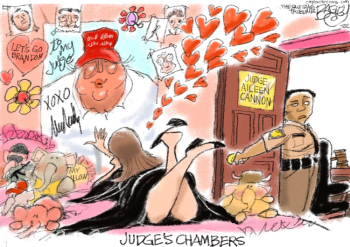 Good Day, Sky Dancers!
 Trump is indeed introducing similar cases that caused Judge Aileen Cannon to slow the process way down. Former Federal Prosecutor and Law
 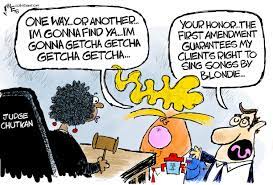 Of course, they hate the gag order. Trump cannot control his flagrant, abusive outbursts on all things related to every case. The restrictions imposed by Chutkan and Judge Engoran in the New York Trump Fraud Case have been nearly tailored to ensure Trump does not harass potential jurors, witnesses, or court employees. Trump harassment usually leads to the need for protection and arrests of crazed Trump fans. You may read about the specifics of the gag orders and Trump’s legal team’s argument at Vance’s Substance. Let’s return to the third reason, which dovetails into the decisions made by Judge Cannon in the other case.
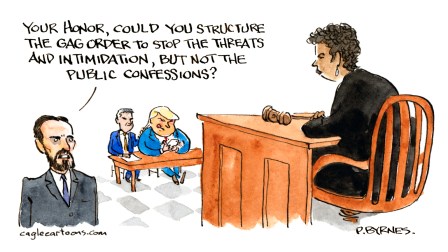 Vance’s explanations and rationale are always helpful on all things related to Trump and his Federal Court cases.
 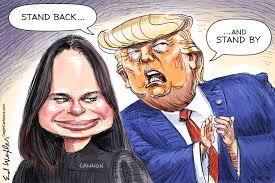 The examples provided are startling but not unexpected.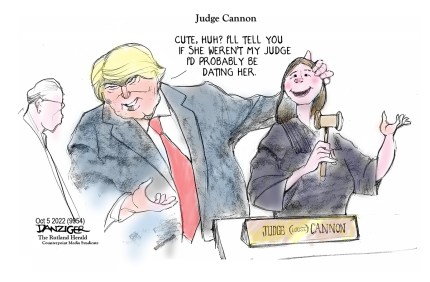
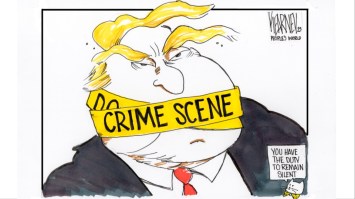 Meanwhile, Trump continues to blurt out things on his Truth Social page that really should disturb all the Judges in all the Court Cases that involve him. This is from Liz Dye at











 Finally, news broke of another astonishing Trump crime yesterday–theft of valuable Israeli antiquities.
 Davila eventually approached ProPublica with her find. A reporter did further research, and eventually learned the source of the ad.
 Steve Almasy at CNN:
  “The patterns and practices we observed made what happened to George Floyd possible,” said Attorney General Merrick B. Garland, who ordered the investigation in April 2021.
 The court papers — a standard request to place a protective order on the discovery material — contained no explanation about what those other inquiries might be or whether they were related to the indictment detailing charges against Mr. Trump of
  House members were allowed last week to see a redacted version of an FD 10-23, a form the FBI uses to note unverified information from confidential sources. Several Republican lawmakers say that not only does the FBI form they saw last week mention this bribe but that a Burisma executive has audio recordings of Biden and Hunter Biden accepting the money. Both Anna Paulina Luna and Marjorie Taylor Greene
 peej
peej Carissa
 bostonboomer
 dakinikat
 ecocatwoman
 mablue2
 Mama Lopez
 peggysue22
 quixote
 skydancingguestblogger
 Mona (aka Wonk the Vote)



 Sky Dancing
Recent Comments