
Monday Reads
Posted: August 6, 2012 Filed under: morning reads | Tags: A knight's grave, Bain Capital, Bush v. Gore, Graham Nash, Irony, Sandra Day O'Connor, SCOTUS, Social Security, the brain, ToM, vulture capitalists 33 Comments Good Morning!
Retired Justice Sandra Day O’Connor is speaking out on America’s declining opinion of the Supreme Court.
Former Supreme Court Justice Sandra Day O’Connor suggests that declining public approval of the court dates back to the controversial Bush v. Gore decision, which decided the 2000 presidential race.
“That was one that was widely talked about at the time, as you know, and involved the public in a presidential election,” O’Connor said in an interview aired Sunday on CBS’s “Face the Nation.” “And that could be something that triggered public reexamination.”
She said she wasn’t sure if people thought the court had become too political.
“But I suppose that’s part of it, yes,” she said. “And of course, anytime you’re deciding a case involving a presidential election, it’s awfully close to politics.”
She cast the deciding vote in the case, but she demurred on taking responsibility.
“I don’t see how you can say anybody was the deciding vote,” she said. “They all counted.”
O’Connor said she has no regrets about her vote.
“No, I mean it was a tough deal; i[t] was a closely fought election; and it’s no fun to be part of a group of decision makers that has to decide which side the ball is going to fall on,” she said.
I think if I were her that I’d feel a lot of remorse for that decision considering the decline that the Bush administration has brought to this country in every possible, thinkable positive category of national endeavor.
This should make people appreciate Social Security. A lot of Americans with ” virtually no assets”. What would so many do without it and Medicare?
It is a central worry of many Americans: not having enough money to live comfortably in old age. Now an innovative paper co-authored by an MIT economist shows that a large portion of America’s older population has very little savings in bank accounts, stocks and bonds, and dies “with virtually no financial assets” to their names.
Indeed, about 46 percent of senior citizens in the United States have less than $10,000 in financial assets when they die. Most of these people rely almost totally on Social Security payments as their only formal means of support, according to the newly published study, co-authored by James Poterba of MIT, Steven Venti of Dartmouth College, and David A. Wise of Harvard University.
That means many seniors have almost no independent ability to withstand financial shocks, such as expensive medical treatments that may not be covered by Medicare or Medicaid, or other unexpected, costly events.
“There are substantial groups that have basically no financial cushion as they are reaching their latest years,” says Poterba, the Mitsui Professor of Economics at MIT.
Here’s a great article from AlterNet: “How Mitt Romney Got Rich Destroying American Jobs and Promoting Sweatshop Capitalism”.
Right now, a man whose predatory career has claimed the jobs of countless Americans is trying to wrap himself in the flag and call himself a “job creator” and “wealth creator.”
Does he mean miserable jobs in Chinese factories? Wealth for the 1 percent? Apparently that’s exactly what he means.
Republicans claim that Mitt Romney’s entrepreneurial activities at Bain Capital have been good for Americans. The truth is that Romney has spent his career offshoring and outsourcing American production processes — and associated jobs — to countries like China where human labor is valued in the market at a very low wage rate.
Mitt Romney’s tenure as Bain’s CEO has long linked him to offshoring and outsourcing. Even today, although he is no longer in that position, Romney still makes a nice profit on undertakings done long after he left the day-to-day management of the firm.
Those profits continue to pour in because of Bain’s practice of vulture capitalism. This isn’t Schumpeter’s creative destruction. It’s not even what good equity capital companies achieve. It’s piracy pure and simple.
Here’s a great interview with Graham Nash. According to TD: “Graham Nash Still Really Gives a S#!*”
Fish: So where are they then? Where are the songwriters who try to remind us that human beings are precious and fragile and deserving of a world that is environmentally sound, just as an example? Where are the poets to make beautiful the notion that we should not be victimized by the shitty foreign and domestic policies of our governments? Such subject matter seems much less apparent in contemporary popular music.
GN: It’s less apparent because it’s not being shown. It’s less apparent because the people who own the world’s media you can count on one hand. It’s less apparent because [corporations] don’t want protest songs on their radios and their TVs and in their movies. They don’t want to stir up the sheep. They want you to fucking lie there and buy another pair of sneakers and another Coca-Cola, shut the fuck up while we rob you blind. That’s what’s going on—“Bread and circuses, Part II.”
Fish: Which, I guess, brings us to the significance of the Occupy Wall Street movement.
GN: Right, it’s important for people to realize that they’re not alone and that they’re not crazy for thinking we’re fucked. [The movement] is about recognizing the division between the haves and the have-mores—it’s not even between the haves and have-nots. It’s between the haves and have-mores. That’s what’s going on here and people recognize that and they’re getting infuriated.
Fish: And it’s so obvious, this victimization of the 99 percent, that the whole thing came about as a mass realization, like you said. It didn’t require the emergence of a leader or a prophet to arrive on the scene and convince people of something they weren’t aware of.
GN: Exactly, there is no leader, which is a good thing. What happens with movements, historically, is there is usually a face, a leader, for the movement, and an enemy, if he’s smart, will attack that leader.
So, here’s something in my continuing legacy of sharing my fascination with really old graves with you. This is from the UK Telegraph: “Skeleton reveals violent life and death of medieval knight , 620-year-old skeleton discovered under the floor of Stirling Castle has shed new light on the violent life of a medieval knight.”
Archaeologists believe that bones found in an ancient chapel on the site are those of an English knight named Robert Morley who died in a tournament there in 1388.
Radio carbon dating has confirmed that the skeleton is from that period, and detailed analysis suggests that he was in his mid-20s, was heavily muscled and had suffered several serious wounds in earlier contests.
The knight was laid to rest under the stone-flagged floor of a chapel near the castle’s royal apartments and his skeleton was excavated along with 11 others in 1997.
However, it was only recently re-examined following advances in laser scanning techniques that not only revealed the nature of the three wounds, but also showed that the knight had lost teeth, probably from another blow or from falling from his horse.
Gordon Ewart, of Kirkdale Archaeology, which carried out the excavation for Historic Scotland, said: “This is a remarkable and important set of discoveries.
“At first we had thought the arrow wound had been fatal but it now seems he had survived it and may have had his chest bound up.”
Mr Ewart said that Morley was by far the most likely candidate. His skeleton also shows the effects of riding on the ankles and muscle injuries caused by lifting heavy loads.
Talk about your short brutal lives.
Using magnetic resonance imaging, scientists seem to have located a part of the brain centrally involved in grasping irony.
The
French research team that made the latest contribution to this effort presents its findings in the current issue of the journal NeuroImage. Referring to a part of the brain known as the “ToM network,” the researchers write, “We demonstrate that the ToM network becomes active while a participant is understanding verbal irony.”
This isn’t just one of those “shot in the dark” MRI studies, where you see what brain regions happen to light up when people engage in a particular mental activity. The ToM network has been the focus of previous work on irony apprehension, and enough is known about it to give us some ideas about the particular role it could play in that apprehension.
Here’s how the experiment worked. The researchers prepared short written stories, and each story came in two versions. Both versions contained a sentence that could be read either literally or ironically, with the correct reading depending on how the context had been set earlier in the story. In one story, for example, one opera singer says to another, “Tonight we gave a superb performance,” and whether the sentence is ironic or literal depends on whether the performance had been described earlier in the story as a failure or as a success. The researchers had correctly predicted that the ToM network would show more activity when the sentence, read in context, was ironic than when it was literal.
ToM stands for “theory of mind,” which in turn refers to the fact that we naturally attribute beliefs and intentions and emotions to people we interact with. That is, we develop a “theory”–though not necessarily a theory we’re consciously aware of–about what’s going on in their minds. (An inability to do this is thought to play a role in autism.) And this “theory” in turn shapes our interpretation of things people say. The “ToM network” is a brain region–or, really, a network of different brain regions–that seems to play an important role in the construction of these theories.
It makes sense that parts of the brain involved in theorizing about other people’s minds would be involved in grasping irony. After all, detecting irony means departing sharply from the literal meaning of a sentence, something it’s hard to do without having a “theory” about the intent behind the sentence.
I’m sure we’ll begin to hear the horrible news about the murder of Sikhs in Wisconsin today as well as other things. Hopefully, this little bit of interesting stuff will get your day started out okay! What’s on you reading and blogging list today?
Thursday Reads
Posted: May 24, 2012 Filed under: Catfood Commission, Democratic Politics, morning reads, U.S. Economy, U.S. Military, U.S. Politics | Tags: Alan Simpson, austerity, Barack Obama, Bush tax cuts, CBO, Charles P. Pierce, CIA leak case, Corey Booker, education policy, Emptywheel, eurozone crisis, fiscal cliff, Iraq War, Joe Wilson, John Maynard Keynes, Mark Halperin, Massachusetts public schools, Mitt Romney, Patrick Fitzgerald, Scooter Libby, Social Security, unemployment, Valerie Plame 55 Comments
Good Morning!! I’ve got a potpourri of interesting links for you today, so I’ll get right to it.
Yesterday Mitt Romney gave an interview to Mark {Gag!} Halperin of Time. Halperin asked the putative Republican nominee to say specifically what the unemployment rate would be after his first year as POTUS. You may recall that not long ago, Romney stated that unemployment should be below 4 percent and that anything higher than that is unacceptable. But now he’s singing a different tune.
Romney: I can’t possibly predict precisely what the unemployment rate will be at the end of one year. I can tell you that over a period of four years, by virtue of the policies that we’d put in place, we’d get the unemployment rate down to 6%, and perhaps a little lower. It depends in part upon the rate of growth of the globe, as well as what we’re seeing here in the United States, but we’d get the rate down quite substantially, and frankly, the key is we’re going to show such job growth that there will be competition for employees again. And wages – we’ll see the end of this decline we’re having. The median income in America is down 10% in just the last four years. That’s got to stop. We’ve got to start seeing rising wages and job growth.
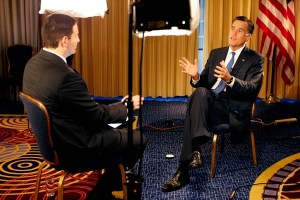
Romney gave no specifics about how he would achieve this with the policies he has been promoting–cutting taxes on the rich, raising them on people with lower incomes, and cutting everything except defense spending, which he would increase substantially. Halperin did ask for more specifics, but Romney just babbled a bunch of nonsense:
Halperin: One more question generally about jobs. For people out there, for voters who want to know what you’re about in terms of job creation, is there some new idea, some original idea, that hasn’t been part of the debate in American politics before, that you have that you think would lead to a lot of new jobs?
Romney: Well the wonderful thing about the economy is that there’s not just one element that somehow makes the whole economy turn around, or everybody in the world would have figured that out and said there’s just one little thing we have to do – you know, Greece is settled, and France and Italy are all back and well again. No, it’s a whole series of things. It’s a system of factors that come together to make an economy work. What is it that makes America’s economy the strongest in the world, the most robust, over a century? It’s a whole series of things – everything from our financial service sector, to the cost of our inputs, our natural resources, to the productivity of our workforce, to our labor and management rules and how they work together, to our appreciation for fair trade and free trade around the world, and negotiating trade arrangements that are favorable to us. It is a whole passel of elements that come together to create a strong economy, and for someone who spent their life in the economy, they understand how that works. And it’s very clear, by virtue of the President’s record, that he does not, and he is struggling. Look at him right now. He just doesn’t have a clue what to do to get this economy going. I do. I laid out a 59-step plan that encompasses a whole series of efforts that will together get this economy going and put people back to work.
But from what I could make out in wading through all the blather, it really comes down to the confidence that will wash through all of us once we know that Mr. Fixit, Willard Mitt Romney is going to save us.
Romney: Well actually if I’m lucky enough to be elected the consumers and the small-business people in this country will realize that they have a friend in the White House, who is actively going to encourage economic growth, and there will be a resurgence in confidence in this country and a willingness to take risks, to invest, to add employees. I think it will be very positive news to the American economy. Will I be able to get done between January 1 and January 20 the things that I’d like to do? Of course not, I’m not in office. But I believe that we will be able to have a grace period, which allows us to tackle these issues one by one and put in place a structure, which is very much designed to get America working again.
Romney also gave a speech about education policy in which he proposed to further privatize America’s education system:
Mitt Romney proposed a series of steps to overhaul the public education system, reigniting the debate over school choice as his campaign intensifies its effort to introduce the presumptive Republican presidential nominee to a general-election audience.
The education plan, detailed in a speech today in Washington, would create a voucher-like system to give low- income and disabled students federal funds to attend charter schools, private institutions and public schools outside their district.
“I don’t like the direction of American education, and as president, I will do everything in my power to get education on track for the kids of this great land,” Romney told a gathering of Latino business owners at the U.S. Chamber of Commerce.
No new ideas there. To be perfectly honest, I strongly doubt that Romney knows the first thing about American public schools. But let me refer you to an expert on Willard’s past history in dealing with public education, the one and only Charles P. Pierce. Pierce writes about what Romney did to the public education system of Massachusetts during his one term as Governor:
Read the rest of this entry »
Tuesday Reads
Posted: April 24, 2012 Filed under: 2012 presidential campaign, Barack Obama, Civil Liberties, Health care reform, Media, Medicaid, Medicare, morning reads, Patriot Act, Republican presidential politics, The Media SUCKS, U.S. Economy, U.S. Politics | Tags: "liberal media" Allen West, bigotry, Bill O'Reilly, Communist Party, Democracy Now, domestic spying, Mitt Romney, NAACP, National Security Agency (NSA), red baiting, Robert Reich, Social Security, Tom Harkin, William Binney 16 Comments
Good Morning!! Let’s see what’s in the news today.
Mitt Romney has been whining about the “liberal media” giving him a hard time, but a new Pew survey has found that the “liberal media” are friendlier to Mitt Romney than President Obama. Adam Serwer at Mother Jones:
The Liberal Media has consistently given more positive coverage to likely Republican Presidential candidate Mitt Romney compared to President Barack Obama, according to a new survey of media coverage from the Pew Research Center’s Excellence in Journalism Project.
During the early weeks of 2012, Romney’s media coverage was slightly negative—between January 2 and February 26, 33 percent of the stories about the ex-Massachusetts governor were positive and 37 percent were negative, according to Pew’s analysis. But Romney has received mostly positive coverage since then (47 percent positive to 24 percent negative). By contrast, according to the report, President Barack Obama “did not have a single week in 2012 when positive coverage exceeded negative coverage.”
Check out the full report at the Pew link.
Florida Rep. Allen West was booted from an NAACP fund-raiser because of his claim that around 80 Democrats in the House of Representatives are card-carrying members of the Communist Party.
Rep. Allen West (R-Fla.) was supposed to be the keynote speaker at a fundraiser for his district chapter of the National Association for the Advancement of Colored People (NAACP) this past Saturday. But days before the event, the group canceled the gathering and asked West not to come back when they rescheduled. Why?
“There’s a certain statement he made about Communists,” Jerry Gore, president of the Martin County NAACP, told Scripps Treasure Coast Newspapers. “That statement alone … we do not represent that type of atmosphere.”
But that didn’t keep West from making more ludicrous remarks. Yesterday, he claimed that the Muslim Brotherhood is “being allowed to influence strategy.”
Rep. Allen West (R-Fla.) criticized the FBI on Monday for removing nearly 900 pages of training material it deemed to be offensive, saying it showed extremist Muslim groups were influencing national strategy.
The FBI made the move after Sen. Dick Durbin (D-Ill.) complained about some passages, including one that advised agents to “never attempt to shake hands with an Asian” and another that said agents should expect “outbursts” from Arab minds.
West said that by removing such passages, the FBI was committing “cultural suicide” and allowing groups like the Muslim Brotherhood to influence U.S. policy.
“We have to understand that when tolerance becomes a one-way street it leads to cultural suicide,” West told “Fox and Friends” on Monday. “We should not allow the Muslim Brotherhood or associated groups to be influencing our national strategy.”
When asked if he believed those groups were influencing U.S. strategy, West responded, “Oh, absolutely,” and cited the Fort Hood, Texas, shooting report that didn’t mention the suspect’s Muslim faith as a potential motive for the killings.
In another throwback to the McCarthy era, a few days ago Bill O’Reilly accused Robert Reich of being a communist.
Yesterday, Reich responded: Communist Accusations Matter.
For the record, I’m not a communist and I don’t secretly adore Karl Marx.
Ordinarily I don’t bother repeating anything Bill O’Reilly says. But this particular whopper is significant because it represents what O’Reilly and Fox News, among others, are doing to the national dialogue….
O’Reilly based his claim on an interview I did last week with Jon Stewart on the Daily Show, in which I argued that because America’s big corporations were now global we could no longer rely on them to make necessary investments in human capital or to lobby for public investments in education, infrastructure, and basic R&D. So, logically, government has to step in.
Since when does an argument for public investment in education, infrastructure, and basic R&D make someone a communist or a secret adorer of Karl Marx?
Since the Tea Party crazies crawled out from under their rocks and took over the Republican Party, I guess. I sure wish they’d crawl back where they came from.
Now this is refreshing. Sen. Tom Harken defended Social Security in the Huffington Post yesterday, and proposed some solutions to future problems:
To strengthen America’s retirement system, my proposal would increase Social Security benefits and greatly improve the financial stability of the program. It does so by:
• Increasing the amount of earnings covered by higher replacement rates in order to increase benefits by approximately $60-70 per month
• Changing the way the COLA is calculated so that it better corresponds to the typical expenses of seniors
• Removing the cap, currently $110,100, that unfairly protects the highest earning Americans from paying into Social Security like the majority of hardworking Americans.All told, according to the Social Security Actuary, this proposal would extend the life of the Social Security Trust Fund to 2052 while cutting the long term funding deficit in half.
I’m sure Mitt Romney will explain to Senator Harkin why it would be wrong to try to raise payroll taxes on high income “job creators.”
Speaking of Willard, the LA Times had an interesting story on Romney’s health care plan–they call it “revolutionary,” and not in a good way.
In public, Romney has only sketched the outlines of a plan, and aides have declined to answer questions about the details. But his public statements and interviews with advisors make clear that Romney has embraced a strategy that in crucial ways is more revolutionary — and potentially more disruptive — than the law Obama signed two years ago.
The centerpiece of Romney’s plan would overhaul the way most Americans get their health coverage: at work. He would do so by giving Americans a tax break to buy their own health plans. That would give consumers more choices, but also more risk.
Critics and independent analysts say the impact would probably leave a larger number of Americans without insurance.
In addition,
While offering consumers more choices, Romney’s plan would give companies strong incentives to stop providing insurance to workers. It also would overhaul the 46-year-old Medicare and Medicaid programs for the elderly, poor and disabled.
The plan could swell the federal deficit; a similar plan backed by Sen. John McCain (R-Ariz.) during the 2008 presidential campaign would have cost more than $1 trillion over 10 years, on par with the price tag for the Obama healthcare law.
Romney keeps claiming he’s going to cut the deficit. Somehow I don’t think privatizing Social Security, Medicare, and Medicaid will do that. Maybe he thinks he can end those programs completely.
Democracy Now has been running a series on NSA spying. A good starting point is this article at Alternet: Whistleblower: The NSA is Lying — The U.S. Government Has Copies of Most of Your Emails
National Security Agency whistleblower William Binney reveals he believes domestic surveillance has become more expansive under President Obama than President George W. Bush. He estimates the NSA has assembled 20 trillion “transactions” — phone calls, emails and other forms of data — from Americans. This likely includes copies of almost all of the emails sent and received from most people living in the United States.
While you’re at Alternet, here’s another article you should read: How Obama Became a Civil Libertarian’s Nightmare
When Barack Obama took office, he was the civil liberties communities’ great hope. Obama, a former constitutional law professor, pledged to shutter the military prison at Guantanamo Bay, Cuba, and run a transparent and open government. But he has become a civil libertarian’s nightmare: a supposedly liberal president who instead has expanded and fortified many of the Bush administration’s worst policies, lending bipartisan support for a more intrusive and authoritarian federal government.
Please go read the whole thing and then check out Glenn Greenwald’s take on the story.
As I’m sure everyone here knows, we don’t live in a democracy anymore.
So what are you reading and blogging about today?
Beltway Bob Rationalizes Obama’s Blunders, while Michael Tomasky Sees a “Scared President”
Posted: September 19, 2011 Filed under: Medicaid, Medicare, Social Security, Team Obama, U.S. Economy, U.S. Politics, voodoo economics | Tags: "grand bargain", Bagdad Bob, Barack Obama, Beltway Bob, Confidence men, deficit reduction speech, Ezra Klein, John Boehner, Medicaid, medicare, Michael Tomasky, Ron Suskind, Social Security, Tea Party 25 Comments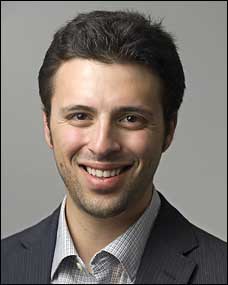
Beltway Bob
Okay, I realize that is a silly title, but after reading Beltway Bob’s Ezra Klein’s latest post and then reading the transcript of Barack Obama’s Rose Garden speech from this morning, I was feeling a little bit punchy.
Dakinikat recently called Ezra Klein “Beltway Bob,” or the Bagdad Bob of the Beltway. That’s a perfect name for Klein, who is apparently way too young to remember anything about politics before about 1990. The guy is naive beyond belief. Lately he seems to see his role as explaining away all of Obama’s blunders, usually by arguing that the President is just too good and moral for the rough and tumble of politics.
This morning, Klein set out to explicate the “deficit reduction plan” that Obama announced in his speech this morning. Specifically, Klein wanted to explain “why the White House changed course.”
President Obama’s deficit-reduction plan (pdf)
is most interesting for what’s not in it. It does not cut Social Security by “chaining” the program’s cost-of-living increases. It does not raise the eligibility age for Medicare from 65 to 67. Nor does it include any other major concessions to Republicans. Rather, the major compromise it makes is with political reality — a reality that the White House would prefer not to have had to acknowledge.Since the election, the Obama administration’s working theory has been that the first-best outcome is striking a deal with Speaker John Boehner and, if that fails, the second-best outcome is showing that they genuinely, honestly wanted to strike a deal with Speaker John Boehner.
That was the thinking that led the White House to reward the GOP’s debt-ceiling brinksmanship by offering Boehner a “grand bargain” that cut Social Security, raised the Medicare age, and included less new revenue than even the bipartisan Gang of Six had called for. It was also a theory that happened to fit Obama’s brand as a postpartisan uniter and his personal preferences for campaigning on achievements rather than against his opponents. But though it came close to happening, the “grand bargain” ultimately fell apart. Twice.
The collapse of that deal taught them two things: Boehner doesn’t have the internal support in his caucus to strike a grand bargain with them, and the American people don’t give points for effort.
Very likely you’re asking yourself, “What the heck does that mean?” I certainly was when I first read it. Is this guy trying to tell us that no one in the White House understood until recently that Boehner had a bunch of looney-tunes tea party reps to deal with? Is he really trying to convince us that–after all those years in Illinois politics and his admittedly short time in national politics–that Obama and/or his advisers actually did not understand that voters expect results, not “just words?”
The answer is “yes.” Beltway Bob does expect you to believe that. The rest of his column is devoted to explaining in great detail that Obama and his advisers actually believed that voters would be thrilled if he made nice with Republicans even if it meant selling out every Democratic ideal–that if the President “looked like a nice guy,” the voters–especially Independents, I guess–would rush to the polls to reelect him.
But now, according to Beltway Bob, the White House staff and the President understand that they made a huge mistake: “the second-best outcome isn’t necessarily looking like the most reasonable guy in the room. It’s looking like the strongest leader in the room.” So that’s why Obama threatened to veto any plan that cuts Medicare or Medicaid and he has for now supposedly taken Social Security off the table. It’s all so sad, according to Beltway Bob–poor Barack has had to go back on all his ideals (those ideals apparently being that he wanted to a great compromiser, while caring nothing about the effects of his compromises) and accept “politics as usual.” Boo-hoo-hoo.
Rather than emphasizing his willingness to meet Boehner’s bottom lines, which was the communications strategy during the debt ceiling showdown, he’s emphasizing his unwillingness to bend on his bottom lines.
That isn’t how the White House would prefer to govern. It’s not how they would prefer to campaign. It is, let’s admit it, politics-as-usual. It’s the triumph of the old way of doing things, an admission that Washington proved too hard to change. But it’s also the only option they have left.
Ezra Beltway Bob can’t seem to recall the hundreds of times that Obama has vowed to draw lines in the sand and then quickly backtracked–not to mention all the Campaign promises he went back on. But why on earth should anyone with a functioning memory believe this hogwash?
Frankly, IMHO, if Obama has in fact taken Social Security, Medicare, and Medicaid changes off the table–which I strongly doubt–it’s probably because he’s scared silly that Americans are finally seeing through his lies.
If you read the transcript of Obama’s speech, you’ll see that he sounds defensive, hesitant, scared of his own shadow. This morning he called for the wealthy to pay at least 20% of their income in taxes. We are supposed to buy that that is a tax increase. Yet under Bush, the wealthiest Americans were supposed to pay 35%, already an unconscionably low rate–why not make them pay that much at least?

Michael Tomasky
Because our President is a scaredy cat, that’s why! I think the change–if it’s real–has everything to do with the news that has come out about Ron Suskind’s new book Company Men, which will be released tomorrow. The news reports about the book make Obama sound like a weak, passive, detached executive who lets his underlings push him around. Michael Tomasky at the Daily Beast calls him “The Scared President.”
Tomasky notes that he was persuaded by what Suskind wrote about the Bush administration in a previous book.
I’m on record as taking Suskind at his word in such matters. In early 2004, when Suskind and Bush Treasury Secretary Paul O’Neill produced The Price of Loyalty, I reviewed it for The New York Times and found it persuasive.That book was the first to confirm what everyone knew anyway: that the Bush White House was run according to politics, not policy. Confidence Men also confirms what we knew about Obama’s White House: that the president appointed the wrong economic team from the start, failed to crack down on the banks, and was Solomonic to a fault when formulating responses to the financial crisis (oh, and news flash: Larry Summers is hard to work with!).
That would be interesting without being shocking. But the indictment goes one mortifying step deeper: Geithner and Summers and Rahm Emanuel, and perhaps others, sometimes ignored Obama, refused to carry out his orders, and, in Summers’s case, mocked him, saying at one point to then-Budget Director Peter Orszag that “there’s no adult in charge” in the White House. And while I don’t yet know whether Suskind emphasizes this point, let’s carry the critique one step further: They did so, as far as we know, without suffering any consequences at all.
No matter how much the White House tries to deny the details that have come out on Suskind’s book, the overall takeaway is that Obama is weak and indecisive. And that is the impression that most Americans have about him already, so why should they disbelieve it? Tomasky:
That’s the problem the book reveals. Adam Moss and Frank Rich of New York magazine did get an early copy and read it, and in an online dialogue posted over the weekend, they home in on what Rich calls Obama’s “intellectual blind spot.” Obama even recognized it himself, telling Suskind he was too inclined to look for “the perfect technical answer” to problems; Rich quotes Suskind as writing that Obama always favored policies that were “respectfully acknowledging opponents’ positions, even those with thin evidence behind them, that then get stitched together into some pragmatic conclusion—but hollow.”
That sounds awfully apt to me. Obama was afraid to be the president. He listened to a dozen viewpoints and tried to come up with something that made everyone happy. Unfortunately, “everyone” included people on his team who were looking out for the banks more than for the public (or for their own boss), and it included people on Capitol Hill whose clear agenda was Obama’s political destruction. It’s the central—and depending on how the next election turns out, possibly decisive—paradox of this president: In trying way too hard to look presidential in the sense of “statesmanlike,” he has repeatedly ended up looking unpresidential in the sense of not being a leader.
Obama wasn’t ready to be President in 2008, and he still isn’t. Tomasky claims to have hopes that Obama can turn it around, but I think it’s just too late. There have been too many lies, too many betrayals of campaign promises, too many sellouts to Wall Street and the Republicans, and too many reversals of supposed lines in the sand.
Perhaps if Obama were capable of followingJames Carville’s advice and fired most of his staff and stood up to Wall Street and the Republicans, as Tomasky hopes. But Obama simply can’t do it. He’s too weak and inexperienced.
Whether you look at Obama through the eyes of Beltway Bob and conclude that this President is just too good and holy for “politics as usual” or through the eyes of Tomasky and conclude that Obama is scared of his own advisers and of Republicans in Congress, this man is simply not qualified for the office he holds. Obama must go. There is no other realistic solution to the country’s problems.
Friday Reads
Posted: September 16, 2011 Filed under: morning reads | Tags: bigotry, Elizabeth Warren, Isalmaphobia, religious indoctrination at the FBI and in the Air Force, Social Security 28 Comments Good Morning!
It’s one of those mornings where I could really use room service. I’m getting to that age where rush deadlines do me in. Fortunately, Bostonboomer helped me with some great links so I’m going to share them with you! This first one is from Boston as well as Bostonboomer and it’s about the Elizabeth Warren campaign and some interesting local dynamics. Senator John Kerry has committed to supporting another candidate in the primary.
In the video announcing her candidacy released this morning, Warren eschews the ivory tower in favor of a populist pitch.
“I’m going to do this,” she declares. Middle-class families, says Warren, have been “chipped at, hacked at, squeezed and hammered for a generation now, and I don’t think Washington gets it.”
She adds: “The pressures on middle class families are worse than ever, but it is the big corporations that get their way in Washington. I want to change that. I will work my heart out to earn the trust of the people of Massachusetts.”
Not since the Weld-Kerry race in 1996 could Massachusetts see a general election campaign like this.
As in that battle royale between two bluebloods, then-Governor William F. Weld and still-Senator John Kerry, the candidates would be well-financed, nationally supported, and adept at debating.
Like Brown, Weld had tremendous personal appeal, with voters seemingly entranced by his devil-may-care attitude and his decidedly non-Cantabrigian persona.
And like Warren, Kerry was viewed as too stiff to connect, especially in contrast with Weld.
But Kerry ended up besting Weld on the strength of his personal campaigning, the experience of the large cadre of Democratic operatives, and an electorate that still tilted to the left despite being in the outset of electing Republican governors for 16 consecutive years.
Warren’s first challenge, though, is to overcome a field of a half-dozen challengers who are incensed the party establishments in both Washington and Boston have largely pooh-poohed campaigns in which they have put their lives on hold to stump around the state and beg for money to finance their travels.
Here’s an item from Wired that’s bound to make you mad. It seems the FBI is profiling all muslim believers as radicals and terrorists. What on earth has the last ten years done to our civil liberties?
The FBI is teaching its counterterrorism agents that “main stream” [sic] American Muslims are likely to be terrorist sympathizers; that the Prophet Mohammed was a “cult leader”; and that the Islamic practice of giving charity is no more than a “funding mechanism for combat.”
At the Bureau’s training ground in Quantico, Virginia, agents are shown a chart contending that the more “devout” a Muslim, the more likely he is to be “violent.” Those destructive tendencies cannot be reversed, an FBI instructional presentation adds: “Any war against non-believers is justified” under Muslim law; a “moderating process cannot happen if the Koran continues to be regarded as theunalterable word of Allah.”
These are excerpts from dozens of pages of recent FBI training material on Islam that Danger Room has acquired. In them, the Constitutionally protected religious faith of millions of Americans is portrayed as an indicator of terrorist activity.“There may not be a ‘radical’ threat as much as it is simply a normal assertion of the orthodox ideology,” one FBI presentation notes. “The strategic themes animating these Islamic values are not fringe; they are main stream.”
The FBI isn’t just treading on thin legal ice by portraying ordinary, observant Americans as terrorists-in-waiting, former counterterrorism agents say. It’s also playing into al-Qaida’s hands.
Focusing on the religious behavior of American citizens instead of proven indicators of criminal activity like stockpiling guns or using shady financing makes it more likely that the FBI will miss the real warning signs of terrorism. And depicting Islam as inseparable from political violence is exactly the narrative al-Qaida spins — as is the related idea that America and Islam are necessarily in conflict. That’s why FBI whistleblowers provided Danger Room with these materials.
Over the past few years, American Muslim civil rights groups have raised alarm about increased FBI and police presence in Islamic community centers and mosques, fearing that their lawful behavior is being targeted under the broad brush of counterterrorism. The documents may help explain the heavy scrutiny.
Sam Stein at HuffPo thinks that Obama won’t include social security in the list of program cuts in the catfood commision redux movement.
Jilted by Republican leadership during the deficit-reduction talks that accompanied the debt ceiling debate, the Obama administration is now pulling back an offer to put Social Security reform on the negotiating table.
The president will not include changes to that program in the series of deficit reduction measures that he will offer to the congressional super committee next Monday, administration officials confirm.
During talks with House Speaker John Boehner (R-Ohio) this past summer, President Barack Obama had discussed changing the way that Social Security benefits were paid so that a lower level of benefits were paid over time. Boehner walked away from that deal, which was part of a much broader package, because of concern over a corresponding tax increase. Now, Obama is putting off support for that idea of changing the inflation formula of Social Security to chained consumer price index (CPI).
“The president’s recommendation for deficit reduction will not include any changes to Social Security because, as the president has consistently said, he does not believe that Social Security is a driver of our near and medium term deficits,” said White House spokeswoman Amy Brundage. “He believes that both parties need to work together on a parallel track to strengthen Social Security for future generations rather than taking a piecemeal approach as part of a deficit reduction plan.”
“There will be no Social Security in the recommendations,” Brundage added.
The White House’s decision to take Social Security reform off the table for the time being, which was first reported by the Wall Street Journal, is largely consistent with the president’s viewpoint that the program is not a contributor to the deficit and should be dealt with in separate discussions. The administration brought it in to the “grand bargain” talks with Boehner, an official relayed, because the president was a party to those talks. With respect to the super committee’s negotiations, he will have no seat at the table and is merely outlining his preferences for reform.
The move also makes obvious political sense. Democrats have long worried that they would upset their base should they be seen as the ones chipping away at retirement benefits, certainly after House Republicans took heat for passing a budget that would convert Medicare into a voucher-based program.
Many radical christianists have infiltrated places like the armed services and law enforcement in hopes of gathering steam come the great war against whatever the end war is supposed to be. I’ve never been much for fiction reading and the left behind series seems like as bad as fiction can get. There’s been complaints at the Air Force academy for years. One of my cousins who is a devote catholic was told be students in her math class that she needed to come to prayer services and become a real christian. That was back in the early 90s and I don’t think it’s got much better. Evidently, one top air force general is switching the air force back to neutral.
A top US Air Force official, in an attempt to ensure the Air Force adheres to the Constitution as well as its own regulations and policies, issued guidelines that calls on “leaders at all levels” to take immediate steps to maintain “government neutrality regarding religion.”
In his policy memorandum dated September 1, but sent Tuesday to all major commands, Air Force Chief of Staff Gen. Norton A. Schwartz said, “Leaders … must balance Constitutional protections for an individual’s free exercise of religion or other personal beliefs and its prohibition against governmental establishment of religion.”
The First Amendment establishes a wall of separation between church and state and Clause 3, Article 6 of the Constitution specifically prohibits a “religious test.”
The memo was issued a month after Truthout published an exclusive report revealing how, for two decades, the Air Force used numerous Bible passages and religious imagery to teach nuclear missile officers about the morals and ethics of launching nuclear weapons, a decision that one senior Air Force officer told Truthout last month should have “instantly” resulted in the firing of the commanders who allowed it to take place.
The Air Force immediately suspended the mandatory Nuclear Ethics and Nuclear Warfare training immediately following the publication of Truthout’s report. David Smith, a spokesman for the Air Education and Training Command told Truthout last month the ethics training “has been taken out of the curriculum and is being reviewed.”
“The commander reviewed it and decided we needed to have a good hard look at it and make sure it reflected views of modern society,” Smith said.
The decison angered Sen. John Cornyn (R-Texas) who fired off an angry letter to Secretary of the Air Force Michael B. Donley criticizing the move and demanding Donley provide him with a report detailing “actions taken” by the Air Force that led to the suspension of the ethics training.
One more interesting political piece via the Christian Science Monitor that says that Romney may actually be a “tougher foe” than Governor Goodhair for Obama. My guess is because he sounds sane compared to Perry, but here’s what the CSM says.
Cal Jillson, a political scientist at Southern Methodist University in Dallas, frames Obama’s prospects this way: “He’s eminently beatable, and Republicans smell this. But in electoral politics, it’s always compared to whom.”
As of now, the GOP race seems to have boiled down to a choice between Texas Gov. Rick Perry and former Massachusetts Gov. Mitt Romney. That, of course, could change, especially if a major new prospect enters the race. But for the sake of argument, let’s say either Governor Perry or Mr. Romney will get the nod.
Polls show that GOP voters believe Perry is electable, but polls of general election voters show Romney faring better than Perry against Obama. The Real Clear Politics average gives Obama a four-point lead over Perry but just a one-point lead over Romney.
Among independent voters, Romney has the clear advantage. In the latest survey by the Democratic firm Public Policy Polling (PPP), Perry’s favorability with independents is just 23 percent (with 51 percent seeing him unfavorably). Romney is seen favorably by 44 percent of independents, and unfavorably by 39 percent.
I’ve just got a bad case of noodley brain today, so do let us know what’s on your reading and blogging list this morning and I’ll head back to the coffee pot?

 peej
peej Carissa
 bostonboomer
 dakinikat
 ecocatwoman
 mablue2
 Mama Lopez
 peggysue22
 quixote
 skydancingguestblogger
 Mona (aka Wonk the Vote)



 Sky Dancing
Recent Comments