
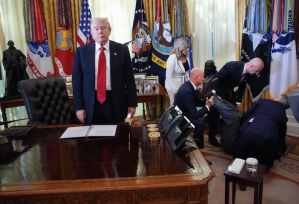



Senate Republicans have largely backed President Donald Trump’s agenda since he returned to office — but many refuse to support his campaign to scrap the filibuster.
Trump asked Republican senators at a meeting at the White House on Wednesday to end the government shutdown by getting rid of the filibuster and reiterated his demand Thursday at a news conference.
By Tatyana Rodionova
The filibuster, a long-standing Senate rule, allows a single senator to block most legislation unless 60 senators vote to cut off debate. Democrats have used the filibuster to block Republicans’ government funding bill for more than a month despite Republicans’ 53-seat Senate majority.
Some Senate Republicans returned from the White House saying they were open to ending the filibuster. But doing away with the rule would require the support of almost every Republican senator — and Senate Majority Leader John Thune (R-South Dakota) and many other Republicans say they are implacably opposed to it.
“There’s nothing that could move me on the filibuster,” Sen. Thom Tillis (R-North Carolina) told reporters Wednesday after the White House meeting.
Mostly Monday Reads: Life in the Time of Cruelty
Posted: November 10, 2025 Filed under: #FARTUS, #We are so Fucked, court rulings, Democratic Politics, presidential pardons | Tags: @johnbuss.bsky.social John Buss, Donald Trump only cares about himself, Hasten Down the Wind, Kim Davis, Obergefell v. Hodges, same sex marriage judicial decisions, SCOTUS, Senate Democrats Cave, Trump Pardons, Warren Zevon 10 Comments
“The end is nigh. Gas prices haven’t dropped, electric bills have gone up, groceries are ridiculous, a year later, Putin is still killing Ukrainians, there is no peace in the Middle East, tariff costs are still passed on to consumers, America is once again the laughing stock of the world, need I say more?” John Buss, @repeat1968
Good Day, Sky Dancers!
There has been another bit of good news to complement last week’s. However, we cannot let our guard down or our actions slacken. Even a few battles won will not end a war. Today, the Supreme Court dismissed a case to overturn its landmark decision legalizing same-sex marriage.
There is a distinct possibility that a stronger attempt may be underway, so vigilance is necessary. More analysis is likely to come out as court watchers ponder the decision.
This is from the AP’s Mark Sherman. “Supreme Court rejects call to overturn its decision legalizing same-sex marriage nationwide.” The dissenting voices hint that more compelling cases may come before them.
The Supreme Court on Monday rejected a call to overturn its landmark decision that legalized same-sex marriage nationwide.
The justices, without comment, turned away an appeal from Kim Davis, the former Kentucky court clerk who refused to issue marriage licenses to same-sex couples after the high court’s 2015 ruling in Obergefell v. Hodges.
Davis had been trying to get the court to overturn a lower-court order for her to pay $360,000 in damages and attorney’s fees to a couple denied a marriage license.
Her lawyers repeatedly invoked the words of Justice Clarence Thomas, who alone among the nine justices has called for erasing the same-sex marriage ruling.
Thomas was among four dissenting justices in 2015. Chief Justice John Roberts and Justice Samuel Alito are the other dissenters who are on the court today.
Roberts has been silent on the subject since he wrote a dissenting opinion in the case. Alito has continued to criticize the decision, but he said recently he was not advocating that it be overturned.
Justice Amy Coney Barrett, who was not on the court in 2015, has said that there are times when the court should correct mistakes and overturn decisions, as it did in the 2022 case that ended a constitutional right to abortion
But Barrett has suggested recently that same-sex marriage might be in a different category than abortion because people have relied on the decision when they married and had children.
 The basis of Davis’ complaint may be the reason why the religious fanatics placed on SCOTUS by extreme right-wing theocrats might have been encouraged to wait for a more direct call to overrule Obergfell. This is explained in this NBC News analysis by Lawrence Hurley.
But reconsidering Obergefell was not the main legal question presented in Davis’ appeal.
Although the court has a 6-3 conservative majority, none of the other justices joined Thomas’ opinion.
Just last month, Justice Samuel Alito, who authored the abortion ruling, indicated he was not pushing for Obergefell to be overturned.
Davis, represented by the conservative group Liberty Counsel, refused to issue any marriage licenses in the immediate aftermath of the Obergefell decision. She said that as a conservative Christian who opposed same-sex marriage, she should have a religious right not to put her name on marriage licenses involving same-sex couples.
Her office in Rowan County, Kentucky, denied licenses to several such couples, including David Moore and David Ermold, who subsequently filed a civil rights lawsuit.
Davis was ordered to issue a license for Moore and Ermold, but defied the court injunction and still refused to do so. The judge then held her in contempt, and she was jailed for six days.
While she was jailed, Moore and Ermold were able to obtain their marriage license.
Subsequently, the state changed the law in order to address the controversy, allowing for a license to be issued without the clerk’s name on it.
But Davis’ case continued, with Moore and Ermold seeking damages for the initial refusal.
After lengthy litigation, a jury awarded $100,000 in damages. Davis was also required to pay $260,000 in attorney’s fees, according to her lawyers.
Davis then appealed, claiming that she should have been able to cite as a defense her right to the free exercise of religion under the Constitution’s First Amendment.
After losing an appeal at the Cincinnati-based 6th U.S. Circuit Court of Appeals in March this year, Davis turned to the Supreme Court, raising that question, as well as the much more contentious issue of whether Obergefell should be overturned.
While the Supreme Court has for now given no indication it would seek to overturn Obergefell, it has in other rulings in the last decade strengthened religious rights at the expense of LGBTQ rights, including by expanding the ability of people to seek exemptions from laws they object to because of their faith.
 Are they just waiting for a better case to come along? That is the question from me and others. Only time will tell.
The other big headline is the end of the government shutdown. The circumstances surrounding the resolution are far from ideal. There are a large number of articles expressing anger and disgust at the actions of eight Democrats in cutting this deal. It’s quite challenging to keep up with the decline of the world’s once-great democracy. This is the headline from Politico‘s Katherine Tully-McManus. “The 8 Senate Democratic Caucus members who voted to end the shutdown. There are few obvious threads connecting the group who broke the partisan impasse.”
Eight members of the Senate Democratic Caucus broke ranks Sunday and voted to advance a deal to reopen the federal government.
That’s fewer than the 10 Democrats who broke ranks in March to advance a previous GOP-led stopgap funding bill — a move that sparked a huge backlash against Minority Leader Chuck Schumer.
There are few obvious threads connecting the group who broke the partisan impasse this time. Some of them helped broker the agreement with Republicans over the opposition of Schumer and most other Democrats, who wanted a guaranteed extension for expiring federal health insurance subsidies.
Most, but not all, previously held state-level office — including four former governors. Most, but not all, come from presidential swing states. Two have announced they are retiring from the Senate after their current terms end, and two are senior members of the Senate Appropriations Committee.
None are up for reelection in 2026.
 More on these eight senators at the link. There are numerous punditry thoughts on what is being called “The Great Cave-in.” This first take is from MSNBC’s Steve Benen. “As the Senate advances a plan to end the government shutdown, what happens now? As the shutdown continued, the pieces were in place for Democrats to stand firm in support of a popular cause. Eight senators folded anyway.”
As the ongoing government shutdown was poised to begin in late September, three members of the Senate Democratic caucus — Nevada’s Catherine Cortez Masto, Pennsylvania’s John Fetterman and Maine’s Angus King — broke party ranks and voted with the Republican majority to prevent the breakdown. That gave GOP leaders 55 votes, five short of the 60-vote threshold.
At that point, the Republican plan, in a nutshell, could be summarized in one word: wait.
GOP leaders, in the White House and on Capitol Hill, assumed that just enough Senate Democrats would cave under pressure. Those assumptions proved true. MSNBC reported overnight:
After nearly six weeks of a painful shutdown, a critical number of Senate Democrats backed a Republican funding bill to reopen government — with little to show for holding out so long. The breakthrough, which came together suddenly on day 40 of the shutdown, offers Democrats few new concessions beyond what Republicans had already proposed.
There’s quite a bit to this, so let’s unpack the details.
Is the shutdown over?
Not yet. The Sunday-night vote in the Senate was a procedural vote to advance a bill intended to end the shutdown. It received 60 votes, but the underlying legislation still needs to pass.
Who caved?
In addition to Cortez Masto, Fetterman and King, who’ve consistently voted with Republicans to end the shutdown, five other Senate Democrats sided with the GOP on the procedural vote: Dick Durbin of Illinois, Maggie Hassan of New Hampshire, Tim Kaine of Virginia, Jackie Rosen of Nevada and Jeanne Shaheen of New Hampshire. (Durbin and Shaheen, it’s worth noting for context, are retiring at the end of their current terms.) Republican Sen. Rand Paul of Kentucky, meanwhile, voted with most Democrats against the package.
Did they get anything in exchange for their votes?
Not much. The deal, to the extent that it can fairly be described as such, includes three full-year appropriations bills to fund some federal departments through the end of the fiscal year and money to fully fund the Supplemental Nutrition Assistance Program (SNAP). It also reverses Donald Trump’s shutdown layoffs (also known as “reduction in force” notifications, or RIFs).
What about the Affordable Care Act, which was largely the point of the shutdown?
Republicans promised Democrats there will soon be a vote on extending the expiring ACA subsidies.
For health care advocates, does this offer some reason for hope?
Not really. Even if there is a vote, there’s no reason to assume it will pass the GOP-led chamber. And even if it were to pass, there’s no guarantee that the Republican-led House would care.
So why in the world did these eight senators cave?
According to King, it was time to surrender because the status quo “wasn’t working.”
 This final analysis is by Sarah Ewall-Wice, writing at The Daily Beast. “Dems Skewer ‘Trainwreck’ Schumer for Caving Over Shutdown. WHAT THE CHUCK?! The Senate minority leader is facing calls to resign despite his “no” vote.”
Democrats from across the political spectrum are livid with Minority Leader Chuck Schumer after a group of Senate Democrats caved and reached a deal with Republicans to end the government shutdown.
Schumer, 74, came out against the bipartisan plan and voted against moving it forward in the Senate on Sunday night.
However, eight Democrats joined Republicans in a 60-40 vote to proceed, sparking turmoil within the party.
“Tonight is another example of why we need new leadership. If @ChuckSchumer were an effective leader, he would have united his caucus to vote ‘No’ tonight and hold the line on healthcare,” wrote Democratic Rep. Seth Moulton, who is challenging Massachusetts Senator Ed Markey in the primary.
He called on Markey to join him in a pledge not to vote for Schumer as Senate leader.
Democratic Rep. Jared Moskowitz posted an image of Schumer photoshopped into the Amy Schumer movie ‘Trainwreck’ with the caption “Different Schumer, same title.”
“Senator Schumer is no longer effective and should be replaced,” wrote progressive Rep. Ro Khanna. “If you can’t lead the fight to stop healthcare premiums from skyrocketing for Americans, what will you fight for?”
He replied that he was a “fan” of Sen. Chris Van Hollen in response to political commentator Krystal Ball’s suggestion that he should become the leader.
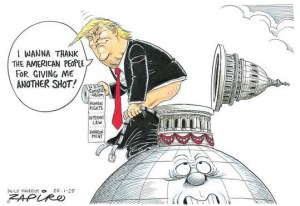 We know what or who the basic problem is. Who wouldn’t love a Substack titled “Are you f’ng kidding me?” That’s a daily question around here these days. This is the brainchild of JoJoFromJerz. The title is even hotter. “Portrait of a Man Who Doesn’t Give a Fuck. Starring: indifference, ego, and forty-two million people he is actively fighting to starve.” Yup, are president is the ultimate example of Anti-social Personality Disorder.” He comes replete with a lifetime of examples. And there’s that photo that keeps showing up everywhere, including this blog when I peeled it on Monday.
This photo should be hung in the Louvre of moral decay.
Look at it. The tableau is so absurd it feels storyboarded by Voldemort and Liberace’s real estate LLC. A man collapses on the floor where presidents once ended wars and launched moon missions. Now the room has all the gravitas of a Vegas timeshare bathroom, festooned with Chinese-made American flags marinated in Drakkar Noir. It’s as if history’s most consequential decisions are now being made in the world’s tackiest escape room.
Aides kneel. Hands reach. Chaos unfolds.
And Donald Trump just stands there — bored, irritated, visibly put-out — like the collapse in front of him is a personal scheduling conflict. His face isn’t concern. It is inconvenience.
His jaw hangs open in that dopey, defeated pout you only see when a chain-steakhouse diner learns their “Buy One Get One Ribeye” coupon expired yesterday. His eyes aren’t searching for a pulse; they’re searching for the nearest camera.
He’s not seeking help. He’s seeking a close-up.
If Dante were alive today, he wouldn’t write The Inferno. He’d pitch a reality show called Keeping Up With the Collapse and hiss to the crew, “We don’t need CGI. Just let him talk.”
The entire scene looks like Norman Rockwell painted The Death of Empathy, directed by Jeffrey Dahmer and executive produced by Satan. Hang this next to The Scream and the painting would lean over and whisper, Is that guy okay.
It feels like someone pitched, What if Succession had a baby with Idiocracy and then handed the baby the nuclear codes. It should not be funny. But it is. It should not be real. And yet here we are.
Because this photo is not merely symbolic of who he is.
This is who he is.
A convicted felon. Found liable for sexual abuse in a court of law. A man whose closest approximation to empathy is jabbing the close door button in an elevator while someone sprints toward it.
This is who Donald Trump is.
He doesn’t give a fuck about anyone but himself.
A man collapses behind him. Just as our country has been collapsing behind him for the entirety of this second so-called term.
And he doesn’t give a fuck.
He is not thinking, Is that man okay. He is thinking, How dare he steal my scene.
This is who Donald Trump is.
He doesn’t give a fuck about anyone but himself.
He isn’t numb to suffering—he feeds on it. Suffering is his currency, his spotlight, his scepter. Every ounce of pain around him inflates his sense of importance. He doesn’t create, build, or inspire; he only knows how to conquer by making others smaller, hungrier, emptier. His power is measured in what he can take away. He is a parasite of misery, thriving on the wounds he inflicts.
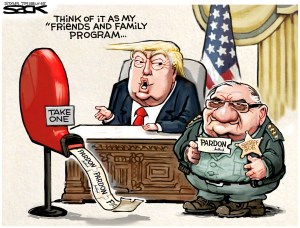 Go read the entire post. She’s right. He doesn’t give a fuck about anyone but himself. And here’s more evidence, as Trump pardons all of those election-denying cronies while possibly looking forward to handing one to that miserable sex-trafficking ghoul Gislane Maxwell. The first article comes from Politico‘s Kyle Cheney. “Trump pardons top allies who aided bid to subvert the 2020 election. Pardon recipients include Rudy Giuliani, Mark Meadows, John Eastman and dozens more.” I weep for justice in my country today.
President Donald Trump has pardoned a long list of prominent allies who backed his effort to subvert the 2020 election, according to Justice Department Pardon Attorney Ed Martin, who posted the relevant document Sunday night.
Among those who received the “full, complete and unconditional” pardons were Rudy Giuliani, who helped lead an effort to pressure state legislatures to reject Joe Biden’s victories in key swing states; Mark Meadows, Trump’s chief of staff in 2020 and a crucial go-between for Trump and state officials; John Eastman and Kenneth Chesebro, two attorneys who helped devise a strategy to pressure then-Vice President Mike Pence to overturn the election on Jan. 6, 2021; Boris Epshteyn, a longtime Trump adviser; and Sidney Powell, a conservative attorney who launched a fringe legal assault on election results in key swing states.
The pardons are largely symbolic — none of those identified were charged with federal crimes. The document posted by Martin is also undated, so it’s unclear when Trump signed it. The White House and Justice Department did not immediately respond to requests for comment.
Giuliani, Eastman and Powell were among those identified by former special counsel Jack Smith as Trump’s co-conspirators, though he never brought charges against them. The pardons would preclude any future administration from potentially pursuing a criminal case against them.
The language of the pardon is broad, applying to “all United States citizens for conduct relating to the advice, creation, organization, execution, submission, support, voting activities, participation in or advocacy for or of any slate or proposed slate of presidential electors … as well for any conduct relating to their efforts to expose voting fraud and vulnerabilities in the 2020 presidential election.”
Though Trump has long insisted he has the power to pardon himself for federal crimes — an untested proposition — it appears he is not yet prepared to test that theory. Though the pardon document indicates it could apply to others who fit the same criteria, it explicitly excludes Trump.
In addition to his inner circle, Trump pardoned dozens of GOP activists who signed paperwork falsely claiming to be legitimate presidential electors, a key component of the bid to pressure Pence.
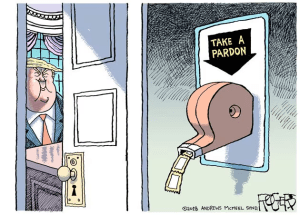 Regarding the potential pardon for Maxwell, this information comes from Scott MacFarlane of CBS News. “Ghislaine Maxwell plans to ask Trump to commute prison sentence, House Democrats say.”
Ghislaine Maxwell, Jeffrey Epstein’s sex trafficking co-conspirator, is planning to apply for a commutation of her federal prison sentence, which is set to run through 2037, according to documents obtained by Democrats on the House Judiciary Committee and seen by CBS News.
In a letter to President Trump on Monday, also seen by CBS News, Judiciary Committee Democrats wrote that Maxwell “is preparing a ‘Commutation Application’ for your Administration to review, undoubtedly coming to you for your direct consideration. The Warden herself is directly helping Ms. Maxwell copy, print, and send documents related to this application.”
The letter says the information received demonstrates “either that Ms. Maxwell is herself requesting you release her from her 20-year prison sentence for her role as a co-conspirator in Jeffrey Epstein’s international child sex trafficking ring, or that this child sex predator now holds such tremendous sway in the second Trump Administration that you and your DOJ will follow her clemency recommendations.”
The letter also alleges that Maxwell is receiving preferential and lenient treatment at the Bryan federal prison camp in Texas, where she was transferred over the summer after meeting with Deputy Attorney General Todd Blanche to discuss the Epstein case.
“Federal law enforcement staff working at the camp have been waiting on Ms. Maxwell hand and foot,” says the letter signed by Rep. Jamie Raskin, the ranking Democrat on the committee.
It appears that something needs to be done to address the fundamental nature of the Presidential Pardon. It’s supposed to be the last chance at justice for the wrongly accused. It was never supposed to be an article of power handed to an autocrat to rewrite the guilt and punishment of evil minions.
I’ve also been crying and listening to Warren Zevon songs since his induction into the Rock and Roll Hall of Fame, as featured on David Letterman. I love his lyrical melodies and his strong rhythms and beats. His lyrics tell stories that are both funny and sad, full of vivid characters. I have finally uncovered the underlying sadness behind most of his lyrics and can no longer unhear them. They’ve burrowed into my heart. And so, I cry, which is quite uncharacteristic for me. But then, it seems American life these days requires tears.
What’s on your Reading, Action, and Blogging list today?
Lazy Caturday Reads
Posted: November 8, 2025 Filed under: just because | Tags: ACA subsidies, Broadview ICE facility, Chicago, Donald Trump, government shutdown, ICE, immigration, Inside Trump's Head, Justice Ketanji Brown Jackson, Michael Wolff, SCOTUS, Senator Chuck Schumer, SNAP benefits, Steve Vladeck, Trump polls 6 CommentsGood Afternoon!!

Raphael Balme, Three cats and wallpaper.
I’m feeling slightly more optimistic after Tuesday’s Democratic sweep of theoff-year elections on Tuesday. According to the polls, Trump is very unpopular, and I have to believe that his efforts to avoid giving food to starving Americans are not going to help him. Democracy is still in danger, but it is beginning look as if there’s still hope for saving it.
Julia Manchester at The Hill: Trump approval drops as Dems show more motivation for midterms: Poll.
President Trump’s approval rating is dropping as Democrats signal more motivation than the GOP ahead of next year’s midterm elections, according to a new Emerson College Polling survey released on Friday.
Forty-one percent of voters said they approved of the job Trump is doing as president, a four-point drop from Trump’s October approval rating of 45 percent. Forty-nine percent of voters said they disapproved of Trump’s job in office, up from 48 percent last month.
Meanwhile, the same poll found that 71 percent of Democratic voters said they were motivated to vote in next year’s midterm elections compared to 60 percent of Republicans. Forty-two percent of Independents said the same.
Fifty-seven percent of all voters said they were more motivated to vote than usual, while 12 percent said they were less motivated. Thirty-one percent said they were motivated as usual ahead of the midterms.
The polling comes after Republicans suffered losses to Democrats in Tuesday’s off-year elections, which were seen as a referendum on the first year of Trump’s second term in office….
The same poll found that 43 percent of voters said their vote in the midterms would be an expression of opposition to Trump, while 29 percent said their vote would be an expression of support.
The Emerson College national poll was conducted Nov. 3-4 among 1,000 active registered voters. The margin of error is plus or minus three percentage points.
Here’s the full report from Emerson College polling.
I’ve been listening to/watching regularly a Daily Beast podcast called Inside Trump’s Head.” The show consists of interviews with journalist Michael Wolff, who has written 3 books about Trump. You can watch it on YouTube. Wolff is not only an expert on Trump (and Jeffrey Epstein), but also has numerous current sources inside the Trump circle. In addition, he is often funny.
Robert Davis at Raw Story:
Controversial journalist Michael Wolff made a bold prediction about the future of the second Trump administration on Thursday during a new podcast interview.
Wolff joined The Daily Beast’s Joana Coles on a new episode of “Inside Trump’s Head” that aired on Thursday, where the two discussed what Tuesday’s election results mean for President Donald Trump. Democrats won a spate of key races, including two governor’s offices and a host of statewide offices.
By Timothy Matthews
Trump and Republicans like Speaker Mike Johnson (R-LA) have tried to brush off the Democratic victories. Wolff argued that they reveal a troubling trend for the Trump administration.
“Let’s look at that in the context of we are not today in an autocracy and [with] a measure of optimism, which is that we’ve just spent a year since last Election Day with Trump as this omnipotent figure in politics,” Wolff said. “And while I would not say that today spells in any way the end of Trump, I would say that the end of Trump could well happen.”
Leading up to Tuesday’s election, Trump shared multiple social media posts attempting to help his preferred candidates win. However, Trump-aligned and Trump-backed candidates did not fare well in the election.
“That’s what happens in American politics,” Wolff continued. “That’s one of the great things in American politics. Reversals, landslides. Things that you would not dream of happening, happen.”
“This has been a horrifying year of Trump, and without any sense that anyone could stand in his way,” he continued. “But in American politics, that’s what happens. You think these people are permanent, and it turns out that they are fleeting.”
Late last night, Justice Ketanji Brown Jackson allowed Trump to continue withholding full SNAP benefits to the states after an appeals court ordered the payments to begin immediately.
Jennifer Ludden at NPR: Supreme Court temporarily blocks full SNAP benefits even as they’d started to go out.
The U.S. Supreme Court temporarily granted the Trump administration’s request to block full SNAP food benefits during the government shutdown, even as residents in some states had already begun receiving them.
The Trump administration is appealing a court order to fully restart the country’s largest anti-hunger program. The high court decision late Friday gives a lower court time to consider a more lasting pause.
The move may add to confusion, though, since the government said it was sending states money on Friday to fully fund SNAP at the same time it appealed the order to pay for them.
Shortly after U.S. District Judge John McConnell Jr. issued that decision Thursday afternoon, states started to announce they’d be issuing full SNAP benefits. Some peoplewoke up Friday with the money already on the debit-like EBT cards they use to buy groceries. The number of states kept growing, and included California, Oregon, Wisconsin, Pennsylvania and Connecticut among others.
The Supreme Court’s decision means states must, for now, revert back to the partial payments the Trump administration had earlier instructed them to distribute. While the U.S. Court of Appeals for the First Circuit rejected the administration’s request for an administrative stay, the appeals court said it would consider the request for the stay and intends to issue a decision as quickly as possible.
SCOTUS whisperer Steve Vladeck quickly published an explainer at One First: SNAP WTF?.
Basically, Vladeck thinks that Jackson knew that if she didn’t issue the hold, the 5 right wing justices would go along with Trump’s wish for an administrative hold, and it might take a long time for them to get around to making a final decision on the SNAP payments.
I wanted to put out a very brief post to try to provide a bit of context for Justice Jackson’s single-justice order, handed down shortly after 9 p.m. EST on Friday night, that imposed an “administrative stay” of a district court order that would’ve required the Trump administration to use various contingency funds to pay out critical benefits under the Supplemental Nutrition Assistance Program (SNAP).
Willem den Ouden (NL 1928) Ferry with cat
It may surprise folks that Justice Jackson, who has been one of the most vocal critics of the Court’s behavior on emergency applications from the Trump administration, acquiesced in even a temporary pause of the district court’s ruling in this case. But as I read the order, which says a lot more than a typical “administrative stay” from the Court, Jackson was stuck between a rock and a hard place—given the incredibly compressed timing that was created by the circumstances of the case.
In a world in which Justice Jackson either knew or suspected that at least five of the justices would grant temporary relief to the Trump administration if she didn’t, the way she structured the stay means that she was able to try to control the timing of the Supreme Court’s (forthcoming) review—and to create pressure for it to happen faster than it otherwise might have. In other words, it’s a compromise—one with which not everyone will agree, but which strikes me as eminently defensible under these unique (and, let’s be clear, maddening and entirely f-ing avoidable) circumstances.
Everyone agrees that, among the many increasingly painful results of the government shutdown, the U.S. Department of Agriculture (USDA) can no longer spend the funds Congress appropriated to cover SNAP—a program that helps to fund food purchases for one in eight (42 million!) Americans. Everyone also agrees that there are other sources of appropriated money that the President has the statutory authority to rely upon to at least partially fund SNAP benefits for the month of November. The two questions that have provoked the most legal debate is whether (1) he has the authority to fully fund SNAP; and (2) either way, whether federal courts can order him to use whatever authorities he has.
The dispute in the case that reached the Supreme Court on Friday involves a lawsuit that asked a federal court in Rhode Island to order the USDA first to partially fund SNAP for November, and then, as circumstances unfolded, to fully fund it. Having already ordered the USDA to do the former, yesterday, Judge McConnell issued a TRO ordering it to do the latter (to fully fund SNAP for November)—and to do so by the end of the day today.
I won’t quote any more, but I hope you’ll go read the explanation. Vladeck thinks that Jackson did the right thing under the circumstances, because she wants to make sure that the full court debates the case and makes a decision quickly. Vladeck also notes that Trump could just approve payment of the SNAP benefits. There’s no need of a court order. Democrats should make sure people understand that Trump is willing to starve children and old people in order to get his way on the shutdown and the cruel cuts in his big ugly bill.
Meanwhile, Democrats have offered a new proposal to reopen the government. NBC News: Democrats make a new offer to end the shutdown, but Republicans aren’t buying it.
Senate Democrats made an offer Friday to reopen the government, proposing a one-year extension of expiring Affordable Care Act subsidies alongside a package of funding measures in order to secure their votes.
By Kichisaburou Hirota
The offer, rolled out on the floor by Senate Minority Leader Chuck Schumer, D-N.Y., includes a “clean” continuing resolution, which would reopen the government at current spending levels, and a package of three bipartisan appropriations bills to fund some departments for the full fiscal year.
“After so many failed votes, it’s clear we need to try something different,” Schumer said, calling it “a very simple compromise.”
The short-term health care funding extension would prevent a massive increase in insurance costs for millions of Americans on Obamacare next year. In addition, Democrats proposed creating a bipartisan committee to negotiate a longer-term solution.
“This is a reasonable offer that reopens the government, deals with health care affordability and begins a process of negotiating reforms to the ACA tax credits for the future,” Schumer added. “Now, the ball is in the Republicans’ court. We need Republicans to just say yes.”
Senate Majority Leader John Thune, R-S.D., called the Democratic offer a “nonstarter.”
“The Obamacare extension is the negotiation. That’s what we’re going to negotiate once the government opens up. … We need to vote to open the government — and there is a proposal out there to do that — and then we can have this whole conversation about health care,” he said.
Yeah, no. Republicans can’t be trusted to honor their promises.
Trump has started trying to get Republicans to get rid of the filibuster in order to reopen the government. Theodoric Meyer at The Washington Post: Trump wants to abolish the filibuster. GOP senators aren’t on board.

Senate Republicans’ unwillingness to scrap the filibuster underscores the limits of Trump’s influence in his second term, during which lawmakers have been reluctant to defy him.
There is quite a bit of immigration news out there today.
A federal judge in Oregon on Friday issued a permanent injunction barring the Trump administration from deploying the National Guard on the streets of Portland in response to protests against the president’s immigration policies.
“This Court arrives at the necessary conclusion that there was neither ‘a rebellion or danger of a rebellion’ nor was the President ‘unable with the regular forces to execute the laws of the United States’ in Oregon when he ordered the federalization and deployment of the National Guard,” U.S. District Judge Karin J. Immergut, who was appointed by President Donald Trump in his first term, wrote in her ruling.
The Trump administration can appeal the ruling if it wants to.
Oregon Gov. Tina Kotek responded to the ruling Friday, calling Trump’s move to federalize the guard “a gross abuse of power.”
“Oregon National Guard members have been away from their jobs and families for 38 days. The California National Guard has been here for just over one month. Based on this ruling, I am renewing my call to the Trump Administration to send all troops home now,” Kotek said.
California Attorney General Rob Bonta, whose justice department argued in the case objecting over his state’s National Guard’s deployment, called the decision “a win for the rule of law, for the constitutional values that govern our democracy, and for the American people.”
There are a number of immigration stories coming out of the Broadville neighborhood in Chicago where there is a large ICE facility.
Adrian Carrasquillo at The Bulwark: ICE Has Created a ‘Ghost Town’ in the Heart of Chicago.
DHS’S IMMIGRATION ENFORCEMENT ACTIONS continue to land like hammer blows on communities across the United States. Families are being torn apart, protesters are catching pepperballs, businesses are at risk, and, increasingly, entire neighborhood economies in areas with large Latino populations are grinding to a halt.
The worst consequences occur when these different aspects of the Trump administration’s deportation regime overlap. Case in point: Chicago’s food scene, specifically the capital of the Mexican Midwest, Little Village, where I got both a firsthand look at the compounding harms of ICE’s actions and the best gorditas I’ve ever had in my life.
By Cindy Revell
The first sign of how different things are come well before you take a bite of the gordita. It’s when you look around and realize that there is now an eerie emptiness to a once-vibrant place.
As I pulled into Little Village for dinner with some local Chicagoans, we experienced no traffic and had our pick of parking spots. “Traffic used to be bumper to bumper for decades and start blocks away, I’ve never experienced it like this,” Chicago food writer Ximena N. Beltran Quan Kiu told me. In a TikTok about the neighborhood, she noted that Little Village is the second-largest shopping district in the city after Michigan Avenue, which is home of the “Magnificent Mile” of luxury stores.
Our destination that day last month was Carniceria Aguascalientes, which sits on the main thoroughfare of 26th Street. We passed through a glittering Mexican grocery store at the street side to get to the large diner-style restaurant lined with tables and booths. Only two or three of roughly thirty tables were in use when we sat down. As we enjoyed our food, the largely vacant dining room became less and less comprehensible.1
When I told our friendly waitress, Michelle Macias, 24, what I do and why I was in town, she was eager to share what had happened to the restaurant. Aguascalientes, a staple of “La Villita,” has welcomed customers for half a century. But lately, its business has plummeted. Sales are down a staggering amount: more than 60 percent compared to last year.
Everything has been turned on its head, Macias explained. While in past years Fridays, Saturdays, and Sundays were bustling, lately Mondays have become the restaurant’s busiest day—perhaps a result of people trying to avoid the usual crowds of the weekend. The restaurant announced this year that it would be closing an hour earlier, a money-saving measure. And as I had noticed, there’s now parking readily available, a fact that shocks longtime patrons accustomed to the gridlock that formerly surrounded the popular eatery.
Everything has been turned on its head, Macias explained. While in past years Fridays, Saturdays, and Sundays were bustling, lately Mondays have become the restaurant’s busiest day—perhaps a result of people trying to avoid the usual crowds of the weekend. The restaurant announced this year that it would be closing an hour earlier, a money-saving measure. And as I had noticed, there’s now parking readily available, a fact that shocks longtime patrons accustomed to the gridlock that formerly surrounded the popular eatery.
The bleak reality facing Carniceria Aguascalientes weighs on its forty employees—especially Macias, whose parents own the restaurant.
As I took it in, I couldn’t help but think back to when Trump’s mass-deportation policy was just getting underway, and the many conversations I had then with Democratic lawmakers who wondered aloud about where we would be in three years. Forget three years: In the Latino enclaves of Little Village, and in Back of the Yards, in Pilsen, and on the North Side, they’re wondering how they will get through the next three weeks.
“Everyone is staying home, everyone is scared,” Macias told me. “There’s so much uncertainty. COVID was bad, but this is way worse.”

It sounds like what happened in Washington DC. Read the whole thing at the Bulwark link.
Charles Thrush at Block Club Chicago: Feds Tell Faith Leaders ‘No More Prayer’ Outside Broadview Facility.
BROADVIEW – Federal authorities told demonstrators Friday that there would be “no more prayer” in front of or inside the Broadview ICE facility, in a move that mystified local leaders and raised legal questions.
A federal representative delivered the news to a huddle of faith leaders and activists standing outside the Immigration and Customs Enforcement facility Friday, speaking after faith leaders were denied entry to the building for the third time Friday.
By Miroslaw Hajnos
Broadview Police Chief Thomas Mills, whose department helped facilitate the phone call, said that he was “trying to figure out” in discussions with Mayor Katrina Thompson and an attorney if a federal agency could legally ban religious gatherings on land owned by the village. Religious groups previously have been allowed to practice outside the facility, he said.
“I’m just a messenger,” an anonymous voice stuttered over the phone to a huddle of faith leaders and activists standing outside the Broadview immigration processing facility on Friday.
During the call, which took place with a Block Club reporter present, the anonymous representative told a group of faith leaders and activists that “There is no more prayer in front of building or inside the building because this is the state and it’s not [of a] religious background.”
“I’m dumbfounded,” the police chief told Block Club. “Every time I talk with [federal officials], it feels like their rules keep changing. We don’t really know what’s happening, I’m sorry I can’t say more. We just want to keep people safe and let them peacefully protest without getting hurt.”

That sounds like a violation of the First Amendment to me.
Chicago Sun-Times: 14 suburban moms arrested in sit-in protest outside Broadview ICE facility.
A group of moms from the western suburbs were arrested Friday morning during a protest against the separation of families outside of the U.S. Immigration and Customs Enforcement facility in Broadview.
Fourteen mothers jumped over the barricades and sat in a circle on Beach Street to “demand an end” to the immigration raids that have swept through the Chicago area since the Trump administration launched “Operation Midway Blitz” in September.
Less than a minute later, the women were arrested by Cook County sheriff’s deputies. The women were charged with obstruction, disorderly conduct and pedestrian walking on highways.
“We want to encourage other people who feel strongly about ICE’s actions to step off the sidelines and take our cities back,” said Teresa Shattuck, a mother from Oak Park. “We want to use our collective power and our white privilege in the way it should be used.”
Meghan Carter, another mother from Oak Park, said the women who were arrested understood the risks when they chose to take a stand, adding their experiences paled in comparison to what the detained immigrants inside the facility were enduring.
Carter said the suburban moms were a group of parents “fed up” with seeing immigration agents “terrorizing” their communities.
One more immigration/deportation story from NBC News: ‘Mega detention centers’: ICE considers buying large warehouses to hold immigrants.
The Trump administration is exploring buying warehouses that were designed for clients like Amazon and retrofitting them as detention facilities for immigrants before they are deported, a move that would vastly expand the government’s detention capacity, according to a Homeland Security Department official and a White House official.
By Timothy Matthews
The precise warehouses that Immigration and Customs Enforcement may buy have not yet been determined, but the agency is looking at locations in the southern U.S. near airports where immigrants are most often deported, the DHS official and the White House official said. Selecting such warehouses would “increase efficiency” in deportations, the DHS official said.
A deal to purchase the warehouses, which on average are more than twice the size of current ICE detention facilities, is past the early stages but not yet final, the DHS official and the White House official said. The DHS official described the warehouses as future “mega detention centers.”
Amazon would not be a part of any deal and would not profit from it as the warehouses were built by developers for Amazon but never used or leased by the company, the officials said.
An Amazon spokesperson said that the company is not involved in any discussions with DHS or ICE about warehouse space and that it leases and does not own the vast majority of its warehouse space.
It was not immediately clear who owns the warehouses that the government may buy and the DHS official and the White House official did not know how much the deals could be worth. The DHS official said some of the warehouses under consideration were built by developers with Amazon in mind but never used.

That’s it for me today. I hope everyone is having a relaxing weekend. I’m working on it.
Finally Friday Reads: Will no one rid us of this Turbulent Pest?
Posted: May 16, 2025 Filed under: "presidential immunity", #FARTUS, #MAGAnomics, Civil Liberties, Civil Rights, Corrupt and Political SCOTUS, democracy is threatened, Democratic Backsliding, kakistocracy, Polycrisis | Tags: @johnbuss.bsky.social John Buss, Big Beautiful Bill attacks Abortion, Birthright citizenship, FEMA not ready for Hurricane Season, ICE Barbie, Medicaid, SCOTUS, Walmart earnings call 11 Comments
“True,” John Buss, @repeat1968
Good Day, Sky Dancers!
It’s not often I quote the Daily Mail, but it has that British humor touch that just puts the right tone on what should be a Monty Python Sketch. I used to have an apron that said, “Who invited all these tacky people?” Well, it’s Yam Tits and all those Republican Senators that approved the cast of this freak show. Every headline these days about the Regime of Orange Caligula and his cabinet of crazies is outrageous and depressing. Today, we’ll discover both categories. And, btw, I send apologies out to Henry II for messing with his lament. We’ve become the worst caricature of ourselves.
“ICE Barbie Kristi Noem is backing insane reality TV show where immigrants compete for fast-tracked citizenship.” Doesn’t that just have that perfect mixture of cruelty, inhumanity, and pathos that makes the news cringeworthy these days?
She’s been called ‘ICE Barbie’ for treating her Cabinet position like a TV production, but now Homeland Security Secretary Kristi Noem is pushing for an actual reality show pitting immigrants against each other ‘for the honor of fast-tracking their way to U.S. citizenship’.
It may sound like a joke, but the idea is for real and is outlined in a 35-page program pitch put together in coordination with the DHS secretary, DailyMail.com can exclusively reveal.
Noem is even offering up officials from the U.S. Citizenship and Immigration Services to tally votes for the made-for-TV contest.
The pitch comes from Rob Worsoff, a writer and producer known for Duck Dynasty, the A&E reality show about a Louisiana family and its hunting empire, and Bravo’s Millionaire Matchmaker.
The proposed series is called The American, named after the train that contestants would ride around the country, competing in regionally specific ‘cultural’ contests such as rolling logs in Wisconsin.
It would lead to a grand finale with the winner getting sworn in on the steps of the U.S. Capitol.
‘Along the way, we will be reminded what it means to be American – through the eyes of the people who want it most,’ reads Worsoff’s pitch.
Worsoff – who himself was born in Canada – said: ‘I’m not affiliated with any political ideology. As an immigrant myself, I am merely trying to make a show that celebrates the immigration process, celebrate what it means to be American and have a national conversation about what it means to be American, through the eyes of the people who want it most.’
Tricia McLaughlin, the top spokesperson for DHS, acknowledged that agency staff are reviewing this pitch and had a call with the producer last week. She insisted Noem is yet to be briefed on the initiative.
However, DailyMail.com has confirmed that Noem supports the project and wants to proceed.
And McLaughlin said: ‘I think it’s a good idea.’
Worsoff’s project comes as Noem is wanting to showcase what it means to become an American, amid the Trump administration’s crackdown on illegal immigration.
She and her agency have been working for weeks to get such a project greenlit from Netflix or another streaming or cable service, sources tell DailyMail.com.
But while past outreach has fallen flat, they’re hoping this one has a real chance.
In his pitch, Worsoff, 49, expresses confidence that The American would be a commercial hit and ‘lends itself to enormous corporate sponsorship opportunities’.
At the same time, there’s concern among some in DHS about the possible optics of turning the plight of immigrants into a reality game show, sources say.

“If you read the speech bubble using RFK Jr’s halting, raspy, tinny voice, it helps get past the grossness.” John Buss, @repeat1968
Isn’t that what brought us here? Illiterate, unhappy people who believe that “reality” shows are real? Cosplay Barbie isn’t alone for being out of her league, but melodramatic enough to keep the big guy happy. Yesterday, I listened to the most surreal edition of a Supreme Court hearing I’d ever seen. How on earth did this thing make it to the docket, and what’s next? This is from Slate. “The Supreme Court May Pick the Worst Possible Case to Cede More Power to Trump.” This analysis is provided by Dahlia Lithwick and Mark Joseph Stern. As usual, the Women on the Bench Rule and the guys drool.
During one of the term’s biggest sets of oral arguments on Thursday, everyone at the Supreme Court seemed to agree that the United States is in the midst of an emergency. But there was far less agreement about what specifically that emergency is. During debate over three nationwide injunctions currently protecting birthright citizenship from President Donald Trump’s attacks, the justices were deeply split over what manner of legal crisis the court—and the country—truly faces. And the growing gender divide emerged once again: The four women seemed concerned that the president is trying to undo the final restraints on his exercise of unconstitutional power, and doing so in ways that include breaking norms and defying courts. The five men, in contrast, sounded irked at allegedly monarchical district court judges who dare issue broad orders blocking the White House’s policies, even when they’re blatantly unconstitutional.
These five men, of course, make up the majority of the Supreme Court. And, as they keep reminding us, they can do anything they want with their authority. But there is reason to believe that one or two of these justices might balk at the mayhem they could unleash by limiting lower courts’ power to constrain the executive branch. And not onejustice even hinted that they think Trump should eventually win on the merits and get the green light to start stripping birthright citizenship from immigrants’ children. What they spent two and a half hours debating, in painstaking detail, is whether nationwide or universal injunctions are the way to stop that from happening.
It’s anybody’s guess how the court will come down on that question. It seems the majority wants to have it both ways, reining in lower courts that are—across all political and ideological lines—battling Trump’s lawlessness, and somehow doing so without itself blessing that lawlessness as the administration would like to deploy it against American children of noncitizens. That may well be an impossible task, and their attempt to pull it off in this case could provoke destabilizing confusion across the judiciary. In trying to resolve one perceived emergency, the majority may end up provoking many more.
During one of the term’s biggest sets of oral arguments on Thursday, everyone at the Supreme Court seemed to agree that the United States is in the midst of an emergency. But there was far less agreement about what specifically that emergency is. During debate over three nationwide injunctions currently protecting birthright citizenship from President Donald Trump’s attacks, the justices were deeply split over what manner of legal crisis the court—and the country—truly faces. And the growing gender divide emerged once again: The four women seemed concerned that the president is trying to undo the final restraints on his exercise of unconstitutional power, and doing so in ways that include breaking norms and defying courts. The five men, in contrast, sounded irked at allegedly monarchical district court judges who dare issue broad orders blocking the White House’s policies, even when they’re blatantly unconstitutional.
These five men, of course, make up the majority of the Supreme Court. And, as they keep reminding us, they can do anything they want with their authority. But there is reason to believe that one or two of these justices might balk at the mayhem they could unleash by limiting lower courts’ power to constrain the executive branch. And not onejustice even hinted that they think Trump should eventually win on the merits and get the green light to start stripping birthright citizenship from immigrants’ children. What they spent two and a half hours debating, in painstaking detail, is whether nationwide or universal injunctions are the way to stop that from happening.
It’s anybody’s guess how the court will come down on that question. It seems the majority wants to have it both ways, reining in lower courts that are—across all political and ideological lines—battling Trump’s lawlessness, and somehow doing so without itself blessing that lawlessness as the administration would like to deploy it against American children of noncitizens. That may well be an impossible task, and their attempt to pull it off in this case could provoke destabilizing confusion across the judiciary. In trying to resolve one perceived emergency, the majority may end up provoking many more.
If you squint, you can see the logic of what SCOTUS did here. Maybe the justices thought they could issue a compromise decision that would give Trump a procedural victory by trimming the nationwide injunctions while teeing up a someday defeat for him on the merits in the near future. This was the kind of Solomonic “grand bargain” that some commenters hoped would come with last year’s Jan. 6–related cases, in which the majority ultimately allowed the once and future president to run the table. It became painfully clear during Thursday’s oral arguments that any such vision here was a mirage: There is no clean way to separate the merits of the 14th Amendment’s guarantee of citizenship to everyone born in the United States from the effort to claw back broad injunctions. To allow the states and plaintiffs to lose on the latter is to give away the farm on the former.

“Pretty sure this one’s headed to the trump library too..” John Buss, @repeat1968
Slate’s Mary Ziegler at Slate has another example of the sneaky, backdoor way the Project 2025 Klan has of making things worse for everyone. “Trump’s ‘Big Beautiful Bill’ Is a Sneak Attack on Abortion.”
“With Donald Trump’s “big beautiful bill” of tax and Medicaid cuts up for consideration, abortion might be the last thing on anyone’s mind. But a provision buried in the bill is Republicans’ latest attempt to stop losing on reproductive rights. The current version of the GOP budget reconciliation bill includes language denying Medicaid funding to any “large provider of abortion services.” This marks a big change in the GOP’s recent approach to abortion policy. Through the early months of the Trump administration, Republicans in Congress have been remarkably reluctant to do anything big on abortion. But now they are using the president’s signature legislation to wade back into the fight.
What made this bill different? The idea seems to be that Republicans can reframe unpopular attacks on reproductive rights as more acceptable government cost-cutting measures by relying on the Department of Government Efficiency to do their dirty work. If Americans like saving money, and are prepared to believe Elon Musk’s arguments about fraud and waste, the theory goes, maybe Republicans can deliver for their socially conservative constituents without the plan backfiring. But the GOP’s latest gambit is a reminder that there’s still no magic bullet for conservatives when it comes to reproductive rights.
It’s no surprise that anti-abortion leaders themselves have seized on this strategy. Trump has made some moves to placate abortion opponents, like announcing that no one will be prosecuted for violating the Freedom of Access to Clinic Entrances Act, which protects access to clinics and places of worship, and pardoning several defendants convicted of violating it. But for the most part, he has frozen out the anti-abortion movement. The Department of Justice hasn’t started enforcing the Comstock Act as an abortion ban. When conservative state attorneys general sued to force a shift, the Trump administration just last week asked the court to dismiss the suit for procedural reasons.
At the same time, if voters actually are paying less attention, it’s probably because less seems to be happening. Republicans in Congress have sat on their hands. Trump has yet to make a big move. The truth is that plenty is still going on, with cases moving through state and federal courts, states poised to pass stringent new bills, and Trump’s future moves still shrouded in uncertainty. The minute one of these events makes news, there’s no reason to believe voters will be any happier with Republicans’ position than they ever were.
 I don’t know about you, but I feel like running for the Canadian border. Why would anyone want to come here under these circumstances? I’m also very afraid of this year’s hurricane season. This is from ABC News. “FEMA ‘not ready’ for hurricane season, internal review finds. The acting agency head told staff that planning is about 80-85% complete.” The season starts on June 1st. There have already been disturbances reported. This administration seems hellbent on killing people. This might make Heckuva Job Brownie look like an efficiency expert.
The acting head of the Federal Emergency Management Agency told staff members on Thursday that he believes President Donald Trump is a bold man with a bold vision for the agency — but that FEMA doesn’t yet have a full plan to tackle hurricane season.
“I would say we’re about 80 or 85% there,” Acting FEMA Administrator David Richardson told staff on a conference call, parts of which were obtained by ABC. “The next week, we will close that gap and get to probably 97-98% of a plan. We’ll never have 100% of a plan. Even if we did have 100% of a plan, a plan never survives first contact. However, we will do our best to make sure that the plan is all-encompassing.”
The conference call came after an internal document prepared for Richardson as he takes the helm of the agency responsible for managing federal disasters indicated the agency was ill-prepared for the upcoming hurricane season, which starts on June 1.
“As FEMA transforms to a smaller footprint, the intent for this hurricane season is not well understood, thus FEMA is not ready,” according to the document, which was obtained by ABC News.
In the conference call, Richardson said he and staff sat down for “about 90 minutes” and started to come up with a plan for this year’s disaster season.
He said the plan would be ready soon.
“Listen closely: The intent for disaster season 2025 (is to) safeguard the American people, return primacy to the states, strengthen their capability to respond and recover, and coordinate federal assistance when deemed necessary, while transforming to the future of FEMA,” Richardson said.
Richardson was placed at FEMA by Department of Homeland Security Secretary Kristi Noem after former acting Administrator Cam Hamilton was fired last week because of his testimony in front of a House panel, according to a source familiar with the matter, which went against the shuttering of the agency.
The acting administrator said this version of FEMA will look different than the agency of the past.
 Meanwhile, the Tariff turbulence is coming to fruition. This is from CNBC. “Walmart CFO says price hikes from tariffs could start later this month, as retailer beats on earnings.” Melissa Repko has the story.
Walmart on Thursday fell just short of quarterly sales estimates, as even the world’s largest retailer said it would feel the pinch of higher tariffs.
Even so, the Arkansas-based discounter beat quarterly earnings expectations and stuck by its full-year forecast, which calls for sales to grow 3% to 4% and adjusted earnings of $2.50 to $2.60 per share for the fiscal year. That cautious profit outlook had disappointed Wall Street in February. Wall Street was also underwhelmed by the results Thursday, as shares closed slightly lower.
Walmart also marked a milestone: It posted its first profitable quarterfor its e-commerce business both in the U.S. and globally. The business has benefited from the growth of higher-margin moneymakers, including online advertising and Walmart’s third-party marketplace.
In an interview with CNBC, Chief Financial Officer John David Rainey said tariffs are “still too high” – even with the recently announced agreement to lower duties on imports from China to 30% for 90 days.
“We’re wired for everyday low prices, but the magnitude of these increases is more than any retailer can absorb,” he said. “It’s more than any supplier can absorb. And so I’m concerned that consumer is going to start seeing higher prices. You’ll begin to see that, likely towards the tail end of this month, and then certainly much more in June.”
 Reuters reports the bottom line here. There’s only so long you can eliminate loss leaders, lower earnings, and try to slow things down. We will feel it everywhere, and it will be next month. Jennifer Saba has this headline: “Walmart can discount tariffs only so much.” So this is your friendly economist speaking, stock up and hunker down. It’s going to get real real soon.
Walmart (WMT.N), opens new tab wheeled its trolley cart right into President Donald Trump’s ankles. The largest U.S. retailer and a bellwether for consumers said on Thursday that tariffs would force it to raise prices, just a month after it expressed confidence that it would keep them low. Boss Doug McMillon may be able to do both at once, on a relative basis, but it also sends a clear signal to the White House that shelves are stocked with only so many ways to shield shoppers.
Flagship U.S. Walmart locations open for at least a year generated 4.5% sales growth for the three months ending April 30 from the same stretch in 2024, a second consecutive quarterly slowdown. McMillon warned that import levies are starting to take a toll. Supply-chain pressure began in late April and accelerated in May. The $750 billion company is trying to hold the line on food even as the cost of bananas, coffee, avocados and flowers increases, but it is unwilling to eat them everywhere.
McMillon and his deputies took a markedly different tone a few weeks ago. The CEO told investors that U.S. duties, which at the time were 145% on Chinese goods, remained a question mark, but that Walmart would focus on “managing our inventory and our expenses well.” Following news that those levies would be slashed to 30%, at least temporarily, McMillon cautioned of a challenging environment, implying that he can squeeze suppliers only so much.
He’s not alone either. JPMorgan boss Jamie Dimon warned, opens new tab on Thursday that recession remains a threat despite Trump’s trade truce. Taiwanese contract manufacturing giant Foxconn, which assembles iPhones and makes Nvidia servers, also slashed its full-year outlook this week, blaming the stronger Taiwan dollar and “rapid changes” in U.S. tariff policy.Equity investors took comfort from the lower duty rates, pushing the S&P 500 Index up 5% this week, to higher than where it started the year. Business leaders are clearly less impressed. Sustained gloom from industry titans like Walmart will keep pressure on the president to reconsider his own pricing power.
Every day I read the headlines, all I can think is that we shouldn’t be in this position. But, here it is. Don’t even get me started on Drunk and rapey Pete Hegseth. (Must Read. VF: “VF editors are joined by special correspondent Gabriel Sherman to discuss Pete Hegseth’s tumultuous tenure atop the Department of Defense, and why the president is reluctant to break with his friend from Fox.)
What’s on your reading and blogging list today?
Mostly Monday Reads: Which Century are we in?
Posted: May 5, 2025 Filed under: American Fascists, kakistocracy, religious extremists, Republicans against democracy, SCOTUS, tariffs, Threats to Democracy, Treason and Sedition Republican Style, Unitary Executive Authority | Tags: @repeat1968, Camp Alcatraz, Crazy #FARTUS Policies, Donald Trump, John Buss, misogyny, SCOTUS, Social Security, Theory of Unitary Executive, Trump Tariffs, unemployment 13 Comments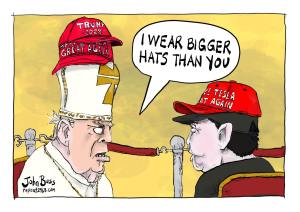
“Size matters.” John Buss, @repeat1968
Good Day, Sky Dancers!
Every time I get the grocery list together these days, I think about what I need to bulk order. It’s really hard to look at a finished consumer good and find all the value-added producers along with their various locations. I wonder how the distributors are going to sort this all out. I noticed prices creeping up in the usual items. I’m pretty sure my sister has hit Costco by now and filled up the pantry. I also watched the last of the Jazz Festers leave with relief. I bet this was their last jaunt of the year. You can see it in the numbers.
USA Today had this analysis by Betty Lin-Fisher. “How will Trump’s tariffs affect grocery store prices? We explain.”
While higher tariffs could still be coming after a 90-day-pause, the baseline 10% tariff on all goods, plus higher duties on Chinese products already in effect are a big increase in food costs for American’s budgets, said Thomas Gremillion, director of food policy at The Consumer Federation of America.
“The 10% ‘default’ tariffs alone represent a truly historic federal tax increase, maybe the largest in my lifetime, with a highly regressive impact,” Gremillion said.
The tariff only applies to the value of the product at the border, Ortega said. Then there are additional costs to the product, which are accrued domestically, like transporting the goods to the store, distribution, wholesale costs and retail markups. Those things are not subject to the tariff, Ortega said.
So that doesn’t mean that the price of a particular product will go up by 10% or whatever the tariff is, Ortega said.
Overall, 15% of the U.S. food supply is imported, including 32% of fresh vegetables, 55% of fresh fruit, and 94% of seafood, according to the Consumer Federation of America, citing the U.S. Food and Drug Administration. Some products, like coffee and bananas, are almost exclusively grown abroad.
Tariffs are causing uncertainty from families checking off their grocery lists to companies importing food, he said.
“For consumers, this can mean added difficulties in managing a food budget. For food companies, this means havoc on supply chains that could lead to more food waste and more food safety risk,” Gremillion said.
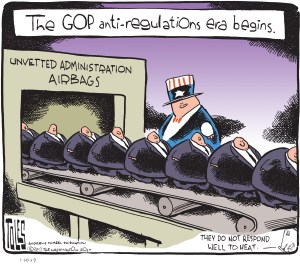
 Yup. And the FDA will not be looking around for that food safety risk now. It’s also upending Health Care, but we can rest knowing that all those generic names for medicine and things will be gender neutral now. I know I can’t even properly pronounce most of them, let alone identify their sexual preferences. MEDTECHDIVE has this headline: Trump policies are upending healthcare technology. “Track the effect on the medtech industry here. Policies and actions reshaping the healthcare industry began pouring out of President Donald Trump’s White House nearly from day one. Follow the changes affecting the medical device industry.”
Did I mention the youngest son-in-law is a biomedical engineer who is in charge of designing medical, surgical, and prosthetic devices? Plus, the oldest daughter and son-in-law are doctors. It’s just me and my youngest daughter out here trying to figure out what the economy and financial markets are experiencing. The others are just trying to deal with that, and the usual helpful regulations are being replaced with crazy ones.
Since Trump took office in late January, multiple Food and Drug Administration webpages were removed (and then restored); employees were fired from the Center for Devices and Radiological Health (and some were asked back); and the Department of Health and Human Services unveiled a plan to lay off approximately 10,000 employees, including about 3,500 at the FDA.
Meanwhile, the economy has whipsawed due to an unpredictable and aggressive tariff strategy. Later, however, pieces were delayed or walked back.
The Trump administration has reshaped the medtech industry in significant ways, and potentially long-term, in just a few months. Now that Trump has settled into power, new questions have arisen about what the many changes will mean for companies and patients, and what’s coming next.
Tom Toles Editorial Cartoon
Also, lucky us, Medicare and Medicaid modernization with be the goal of TV snake oil salesman Dr. Mehmet Oz as he takes over both. This is also from the MEDTECHDIVE.
Dr. Mehmet Oz was sworn in as the Centers for Medicare and Medicaid Services administrator on April 18, cementing his role as head of the agency that provides insurance coverage to millions of Americans.
During a ceremony at the Oval Office, Oz, a physician and former TV personality, said he wanted to “save” the nation’s public health programs and focus on reducing chronic disease, “modernizing” Medicare and Medicaid, and targeting fraud, waste and abuse in government insurance offerings.
President Donald Trump reiterated that Republicans wouldn’t cut Medicare or Medicaid. “Just as I promised, there will be no cuts. We’re not going to have any cuts. We’re going to have only help,” he said during the ceremony.
As I’ve spent most of this year being poked, prodded, pricked, shocked, MRI’d, Ultrasound’d, and EMG’d, I sure don’t feel good about any of this. I fret about someone disappearing all of that, plus my Social Security.
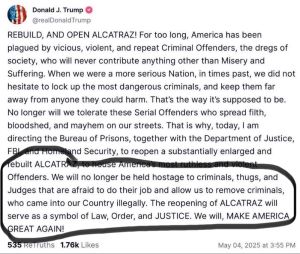 Speaking of crazy policy, I happened on this last night. This is from NBC News. “Trump says he will reopen ‘enlarged and rebuilt’ Alcatraz prison. Alcatraz Island hasn’t been used as a federal penitentiary since 1963. It had a capacity of roughly 300 people.” I’m actually thinking this is another one of his threats to Judges since it’s way too small to hold many prisoners. I suppose that’s one way to destroy a national park and the US Constitution in one sweep.
Alcatraz Island, a former military fortress and prison in San Francisco Bay, was turned into a federal penitentiary in 1934 and over the course of 29 years housed more than 1,500 people “deemed difficult to incarcerate elsewhere in the federal prison system,” according to the National Park Service.
According to aNational Park Service study, it was initially deemed unfit to serve as a federal institution because of its small size, isolated location and lack of fresh water. However, Sanford Bates, the director of the Bureau of Prisons in 1933,later found it “an ideal place of confinement for about 200 of the most desperate or irredeemable types.” It was formally opened as a federal penitentiary the next year.
Trump suggested in his post that he’d like to restore the facility to that purpose.
 This is from Ed Mazza writing for HuffPo. This sounds a lot like his real estate deals to me. “‘Clearly Unhinged’: Critics Sink Trump’s ‘Asinine’ Plan To Reopen Alcatraz Prison. The president wants to turn the site back into a penitentiary despite the fact that it would cost a fortune.”
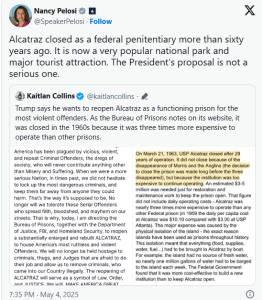
Alcatraz is currently part of Golden Gate National Recreation Area and has about 1.2 million visitors per year. Those who tour the island in San Francisco Bay see facilities in various states of decay. The prison was crumbling even as it was still in operation, and the high cost of maintaining it was a key reason it was shuttered in 1963.
Given those realities, restoring Alcatraz and then expanding it, as Trump called for on his Truth Social platform, would likely cost a fortune ― and then another pile of cash would be needed to maintain it.
Reopening it as a prison would also mean the loss of the tourism revenue the island currently generates as well as a loss of habitat for its thriving bird population.
The president, however, said Alcatraz’s return to use as a prison would “serve as a symbol of Law, Order, and JUSTICE.”
His critics fired back that the idea would be an expensive boondoggle:
 This just really sounds like how he’d run his business. Also, he now wants tariffs on all incoming films. This is about as insane as it gets. “Trump threatens a 100% tariff on foreign-made films, saying the movie industry in the US is dying.”
President Donald Trump is opening a new salvo in his tariff war, targeting films made outside the U.S.
In a post Sunday night on his Truth Social platform, Trump said he has authorized the Department of Commerce and the Office of the U.S. Trade Representative to slap a 100% tariff “on any and all Movies coming into our Country that are produced in Foreign Lands.”
“The Movie Industry in America is DYING a very fast death,” he wrote, complaining that other countries “are offering all sorts of incentives to draw” filmmakers and studios away from the U.S. “This is a concerted effort by other Nations and, therefore, a National Security threat. It is, in addition to everything else, messaging and propaganda!”
The White House said Monday that it was figuring out how to comply with the president’s wishes.
“Although no final decisions on foreign film tariffs have been made, the Administration is exploring all options to deliver on President Trump’s directive to safeguard our country’s national and economic security while Making Hollywood Great Again,” said spokesperson Kush Desai.
It’s common for both large and small films to include production in the U.S. and in other countries. Big-budget movies like the upcoming “Mission: Impossible — The Final Reckoning,” for instance, are shot around the world.
 Philip Bump–writing at WAPO–has an interesting Op-Ed up today. “America’s least American president. Donald Trump isn’t making America great again. He’s making it into something else entirely.”
On Sunday, NBC News aired an interview with Trump in which he expressed ignorance of the black-letter standards of justice established in the country’s founding document.
“The Constitution says every person, citizens and noncitizens, deserve due process,” “Meet the Press” host Kristen Welker pointed out. So why not bring Abrego García back to the U.S. and use legal avenues to potentially remove him?
“Well,” Trump replied, “I’ll leave that to the lawyers, and I’ll leave that to the attorney general of the United States.”
Welker noted that Secretary of State Marco Rubio had admitted that even immigrants had due process rights. Trump again downplayed the idea, saying that holding hearings would mean “we’d have to have a million or 2 million or 3 million trials.” This isn’t as big a hurdle as it may sound. In fiscal 2024, there were more than 900,000 immigration hearings completed. So far in fiscal 2025, there have been more than 460,000. More could be cleared if Trump hadn’t moved to fire a number of immigration judges.
Finally, Welker noted that Trump didn’t really have a choice.
“Even given those numbers that you’re talking about,” she asked, “don’t you need to uphold the Constitution of the United States as president?”
“I don’t know,” Trump replied. “I have to respond by saying, again, I have brilliant lawyers that work for me, and they are going to obviously follow what the Supreme Court said.”
You may recall that, in January, Trump put his hand on a Bible and affirmed to Chief Justice John G. Roberts Jr. that he would “faithfully execute” his role as president and to the best of his “ability, preserve, protect and defend the Constitution of the United States.” But this has never been an oath he has appeared to actually take to heart.
Trump’s dismissiveness of the Constitution has manifested itself in a lot of ways. You may recall his lack of interest in leaving office when he lost the 2020 presidential election. You may be aware that he has readily, if not giddily, accepted personal income from foreign governments while serving as president. He views the law as a cudgel, not a constraint, issuing pardons for various political allies ensnared in criminal activity while directing federal law enforcement to fish for potential criminal charges against those who work against his political power.
At its heart, Trump’s approach to his role is rooted in his parochial sense of patriotism. He didn’t come to the White House after having worked his way up through lower offices, building consensus and working to appeal to a broad range of constituents. He had no appreciation for how legislation is crafted or for the hard work of reaching compromise. Perhaps most importantly, he has never indicated any robust understanding of American history or of the debates and agreements that led to the country’s creation.
In 2011, for example, Trump was asked by Stephen Colbert if he knew what the 13 stripes on the American flag represent. He said he didn’t.
More recently, Trump was asked by ABC News journalist Terry Moran what the Declaration of Independence (a copy of which the president recently had installed in the Oval Office) means to him personally.
“It means exactly what it says. It’s a declaration,” Trump replied. “A declaration of unity and love and respect, and it means a lot. And it’s something very special to our country.”
It is special to the country, of course, but not because it is a declaration of “love,” much less “unity.” As the name would suggest, it is precisely the opposite.
Trump doesn’t have the Declaration of Independence in the Oval Office because he wants its message to serve as a guidepost for his administration. He doesn’t even appear to know its message. He has it there because it is A Famous American Thing, another decoration in the newly gilded room meant to send a message about his power, not the nation’s.
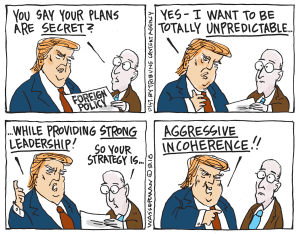 Dan Froomkin–writing for Press Watch–suggests we need to keep track of all Trump’s oddities. “We need a way to aggregate what Donald Trump is doing to this country.”
News organizations, along with good-government groups and other interested parties, are doing a commendable job of chronicling the damage the Trump regime is doing to the government, the country, and the world.
But none of them, individually, is in a position to give the public the full picture. It’s just too much.
This is a feature of Trump’s strategy of “flooding the zone.” No one entity can possibly keep up.
And as we go forward, how can any one organization keep tabs on all the fallout? It’s not possible.
What we need is a central repository of information so that the full extent of the damage can be found in one place and assessed by the public — and so that there’s a comprehensive record of what needs to be fixed and restored when the time comes to do so. (Sort of like a truth commission, but in real time.)
To aggregate all the existing information, organize it, and collect new data, we need a place, a process, and people.
 It makes sense to me since Trump seems to want to undocument more than just people. Who knows how many things Doge has destroyed in the wake of having all-access to every government database and more. He’s disappearing people, children, scientific research, due process, and entire agencies and programs.
This is a site that I was just sent to by a Blue Sky Link. This DNYUZ link has an article by the NYT’s by Jack Goldsmith of Lawfare fame and Harvard Law School. This has been an issue for many people in modern times, with both parties playing the role of enablers. “It’s Not Just Trump. The Presidency Has Become Too Powerful.” So, I need to put this example of both siderisms into perspective. “Mr. Goldsmith, a former assistant attorney general under George W. Bush, is an author, with Bob Bauer, of a newsletter about presidential and executive power.”
Donald Trump’s wrecking-ball second term has revealed the full latent power of the presidency. His administration has done this most clearly in its comprehensive elimination of legal and norm-based checks inside the executive branch, its systematic disrespect of judicial process, its extortionate abuse of government power to crush foes and its destructive rhetoric and nastiness.
Yet it is important to recognize that many of Mr. Trump’s efforts to expand the powers of the office build substantially on the excesses of recent presidencies. The overall pattern of presidential action over the past few decades reveals an escalation of power grabs that put the country on a terrible course even before Mr. Trump took office again.
The presidency needs reform, and Americans must consider ways — however implausible they may seem in the context of today’s politics — to get there.
Expansionist presidential acts go all the way back to George Washington, who invited charges of monarchism with his use of the Constitution’s broad yet undefined “executive Power.” From there the presidency, with its loose design, grew and grew, with major surges during the Civil War and New Deal era. That trend continued through the 20th century, aided by the rise of mass communication, substantial delegations of power from Congress and an approving Supreme Court.
Mr. Trump’s radical second presidency is, to an underappreciated extent, operating from a playbook devised by his modern predecessors.
His use of emergency powers to impose broad tariffs is similar to a move made in 1971 by President Richard Nixon. His claims of untouchable national security authority echo arguments made after the Sept. 11 attacks by the George W. Bush administration, in which I served.
Presidents for decades have issued pardons as political or personal favors or to avoid personal legal jeopardy. Mr. Trump took this practice to new extremes in his first term, and then President Joe Biden pre-emptively pardoned his son and family as well as members of his administration and Congress, in a similar pattern. Mr. Trump in his second term has already issued many self-serving pardons.
Mr. Trump’s executive-order program is an heir of the strategy used by President Barack Obama for large-scale and sometimes legally dubious policy initiatives, including some (involving immigration) where Mr. Obama had earlier admitted he lacked authority to act. Mr. Biden also confessed a lack of power but then acted unilaterally in seeking to forgive student loans.
Mr. Trump has disregarded statutory restrictions to fire officials in independent agencies including the Federal Trade Commission, the National Labor Relations Board and the Merit Systems Protection Board. But in 2021, Mr. Biden extended the Supreme Court’s unitary executive case law to fire the statutorily protected commissioner of the Social Security Administration. Mr. Biden was “the first unitary executive,” noted the legal writer Mark Joseph Stern in 2021.
Mr. Biden also purged the executive branch of Trump holdover officials who were not protected by statute, including members of arts and honorary institutions, the Administrative Conference of the United States and the Department of Homeland Security Advisory Council. The Biden administration’s defense of these firings resulted in judicial precedents that Mr. Trump is now wielding to clean house on a broader scale.
The Trump administration has also built on past presidencies in not enforcing federal law — for example, in letting TikTok live on despite a congressional ban. This practice finds its modern roots in the Obama administration, which asserted broad nonenforcement discretion in high-profile cases involving immigration, marijuana and Obamacare, in effect changing the meaning of those laws.
Something similar has happened with spending. As one recent paper noted, “The past several presidents have all taken significant unilateral actions intruding on Congress’s control over federal spending.” The Trump 2.0 version greatly enlarges this unilateralist pattern.
 There are a lot of examples here, and it’s worth thinking about. The Unitary Executive Theory has been around for a while, and since the Reagan years, it has picked up steam in the Supreme Court. Here is a recent article from Democracy Docket explaining the theory and relating to it to Yam Tits. The analysis is written by Jacob Knutsen. “What Is Unitary Executive Theory? How is Trump Using It to Push His Agenda?”
Since taking office, President Donald Trump has executed a whirlwind of dismissals across the federal government that violated federal statutes and decreed numerous executive orders, including one that blatantly defied the plain language of the Constitution.
Behind the seemingly scatter-shot opening acts of his second administration, legal analysts see a common goal: to test a once-fringe legal theory which asserts that the president has unlimited power to control the actions of the four million people who make up the executive branch.
If courts — specifically the Republican-appointed majority of the Supreme Court — uphold arguments based on the so-called “unitary executive theory,” it would give Trump and subsequent presidents unprecedented power to remove and replace any federal employee and impose their will on every decision in every agency.
Rulings in favor of the Trump administration would also further jeopardize the independence of key regulatory agencies that are susceptible to conflicts of interest and political interference, like the Federal Election Commission, which oversees federal elections and campaign finance laws.
Trump and his administration have furthered the theory by repeatedly invoking Article II of the Constitution, which vests executive power in the president, to justify the recent dismissals of federal officials. They have framed the article as allowing the president to use the whole of the executive branch for his political ends.
For example, the White House Feb. 18 invoked the article to rationalize an executive order signed that same day that asserted the president’s authority over almost all regulatory agencies that were created by Congress to act independently, or semi-independently, from the president.
Frank Bowman, a scholar of constitutional and criminal law at the University of Missouri School of Law, told Democracy Docket he believes the executive order is a step toward “an open declaration of dictatorship.”
“In essence, what he’s saying is, ‘I am the law. My will is the law. My view of what the law is the only view that can ever be expressed,’” Bowman said.
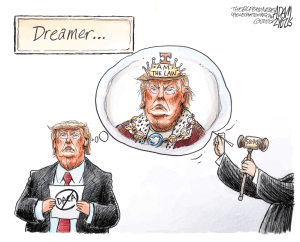 I think this take on executive power is one we should get more familiar with since it’s really taken a powerful rise. The Center for American Progress features an analysis in its series on Project 2025. This one was written back in October.”Project 2025 Would Destroy the U.S. System of Checks and Balances and Create an Imperial Presidency. Far-right extremists have a plan to shatter democracy’s guardrails, giving presidents almost unlimited power to implement policies that will hurt everyday Americans and strip them of fundamental rights.” It is an imperative read. Trump knows that he can be both pope and king.
Project 2025 takes an absolutist view of presidential authority
To wholly reshape government in ways that most Americans would think is impossible, the Project 2025 blueprint anchors itself in the “unitary executive theory.”22 This radical governing philosophy, which contravenes the traditional separation of powers, vests presidents with almost complete control over the federal bureaucracy, including congressionally designated independent agencies or the DOJ and the FBI. The unitary executive theory is designed to sharply diminish Congress’ imperative role to act as a check and balance on the executive branch with tools such as setting up independent agencies to make expert decisions and by limiting presidents’ ability to fire career civil servants for purely political purposes.
The road map to autocracy presented in Project 2025 extends far beyond the unitary executive theory first promoted by President Ronald Reagan, and later espoused by Vice President Dick Cheney, largely designed to implement a deregulatory, corporatist agenda.23 Instead, as discussed further below, Project 2025 presents a maximalist version that does not nibble around the edges but aims to thoroughly demolish the traditional guardrails that allow Congress an equal say in how democracy functions or what policies are implemented. One noted expert at the conservative think tank American Enterprise Institute, Philip Wallach, said, “Some of these visions … start to just bleed into some kind of authoritarian fantasies where the president won the election, so he’s in charge, so everyone has to do what he says—and that’s just not the system the [sic] government we live under.”24
If Congress is robbed of its imperative role as a check and balance on a president’s power, and the judicial branch is willing to bestow a president with almost unlimited authority, autocracy results. And presidents become strongman rulers—free to choose which laws to enforce, which long-standing norms to jettison, and how to impose their will on every executive branch department and agency.
Well, all these pithy reads should keep you busy for the day. I hope your week goes well. I’ve got 2 doctors’ appointments, but gladly no more procedures. And I’d like just to add if they come for professors, that I’d rather be in the gulag that holds the country’s political cartoonists. To think, I used to just use wonderful paintings.
Happy Cinco de Mayo to all the wonderful folks of Mexican descent and to those of us who just enjoy the holiday!
What’s on your Reading and Blogging list today?
Funereal Friday Reads: Life as a Dank Meme
Posted: April 26, 2024 Filed under: just because | Tags: "presidential immunity", @repeat1968, Emergency Pregnancy Health Care, John Buss, SCOTUS, The Caravan of Fools, The Evil Twins: Donald and Alito 9 Comments
The Supreme Court hears arguments on Trump’s immunity claim, John Buss, @repeat1968.
Good Day, Sky Dancers!
I got the cutest picture of the granddaughters today. The girls were smiling and looking at each other with adoration. Both were pretty in pink. All I can think of is what kind of country they may inherit.
I watched and listened to trials and hearings that were so surreal that I was pretty sure we’d entered the Evil Spock Timeline. I remember when the Supreme Court protected everyone’s rights. Now, rights are confined to those who brought the men there and paid for their holidays. It was like watching a Skeleton Dance. Not one TV Lawyer could find anything constitutional about the show they put on yesterday. We all laughed at him when he said,‘ I Could … Shoot Somebody, And I Wouldn’t Lose Any Voters’ Evidently, he can do worse than that, and the Supreme Court would make up something to cover his farty, diapered ass.
This is a must-read from Slate: “The Last Thing This Supreme Court Could Do to Shock Us There will be no more self-soothing after this.” This is written by Dahlia Lithwick and Mark Joseph Stern.
For three long years, Supreme Court watchers mollified themselves (and others) with vague promises that when the rubber hit the road, even the ultraconservative Federalist Society justices of the Roberts court would put democracy before party whenever they were finally confronted with the legal effort to hold Donald Trump accountable for Jan. 6. There were promising signs: They had, after all, refused to wade into the Trumpian efforts to set aside the election results in 2020. They had, after all, hewed to a kind of sanity in batting away Trumpist claims about presidential records (with the lone exception of Clarence Thomas, too long marinated in the Ginni-scented Kool-Aid to be capable of surprising us, but he was just one vote). We promised ourselves that there would be cool heads and grand bargains and that even though the court might sometimes help Trump in small ways, it would privilege the country in the end. We kept thinking that at least for Justices Brett Kavanaugh and Neil Gorsuch and Chief Justice John Roberts, the voice of reasoned never-Trumpers might still penetrate the Fox News fog. We told ourselves that at least six justices, and maybe even seven, of the most MAGA-friendly court in history would still want to ensure that this November’s elections would not be the last in history. Political hacks they may be, but they were not lawless ones.
For three long years, Supreme Court watchers mollified themselves (and others) with vague promises that when the rubber hit the road, even the ultraconservative Federalist Society justices of the Roberts court would put democracy before party whenever they were finally confronted with the legal effort to hold Donald Trump accountable for Jan. 6. There were promising signs: They had, after all, refused to wade into the Trumpian efforts to set aside the election results in 2020. They had, after all, hewed to a kind of sanity in batting away Trumpist claims about presidential records (with the lone exception of Clarence Thomas, too long marinated in the Ginni-scented Kool-Aid to be capable of surprising us, but he was just one vote). We promised ourselves that there would be cool heads and grand bargains and that even though the court might sometimes help Trump in small ways, it would privilege the country in the end. We kept thinking that at least for Justices Brett Kavanaugh and Neil Gorsuch and Chief Justice John Roberts, the voice of reasoned never-Trumpers might still penetrate the Fox News fog. We told ourselves that at least six justices, and maybe even seven, of the most MAGA-friendly court in history would still want to ensure that this November’s elections would not be the last in history. Political hacks they may be, but they were not lawless ones.
On Thursday, during oral arguments in Trump v. United States, the Republican-appointed justices shattered those illusions. This was the case we had been waiting for, and all was made clear—brutally so. These justices donned the attitude of cynical partisans, repeatedly lending legitimacy to the former president’s outrageous claims of immunity from criminal prosecution. To at least five of the conservatives, the real threat to democracy wasn’t Trump’s attempt to overturn the election—but the Justice Department’s efforts to prosecute him for the act. These justices fear that it is Trump’s prosecution for election subversion that will “destabilize” democracy, requiring them to read a brand-new principle of presidential immunity into a Constitution that guarantees nothing of the sort. They evinced virtually no concern for our ability to continue holding free and fair elections that culminate in a peaceful transfer of power. They instead offered endless solicitude for the former president who fought that transfer of power.
However the court disposes of Trump v. U.S., the result will almost certainly be precisely what the former president craves: more delays, more hearings, more appeals—more of everything but justice. This was not a legitimate claim from the start, but a wild attempt by Trump’s attorneys to use his former role as chief executive of the United States to shield himself from the consequences of trying to turn the presidency into a dictatorship. After so much speculation that these reasonable, rational jurists would surely dispose of this ridiculous case quickly and easily, Thursday delivered a morass of bad-faith hand-wringing on the right about the apparently unbearable possibility that a president might no longer be allowed to wield his powers of office in pursuit of illegal ends. Just as bad, we heard a constant minimization of Jan. 6, for the second week in a row, as if the insurrection were ancient history, and history that has since been dramatically overblown, presumably for Democrats’ partisan aims.
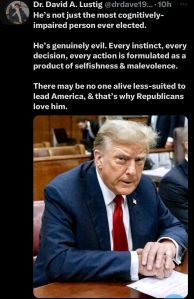 All this with the husband of an insurrectionist sitting on the bench. I heard Nicole Wallace give the best explanation of anything I’ve heard on why these men act out their grievances in court decisions last night. Two of the guys that sit on the bench are sex pests and were publicly shown to be so. Alito is just perpetually mad at everything but mostly at being branded a bigot because he has issues with women and gay people. His hateful take on religion basically focuses on controlling the objects of his hatred. Protecting his religious practice means he should get away with whatever. Nicole Wallace argued that they love Trump because they are all angry and aggrieved. They identify with Trump because they feel they’re in a similar situation. Civil rights are all about not letting white boys be white boys. They all want absolute immunity. We have to rely on Amy and John to be reasonable. Amy’s line of questions actually gave me a bit of hope.
It’s a weird timeline for me to quote Bill Kristol and Andrew Egger. This is from the Bulwark. “ Trump Melts Institutions, SCOTUS Edition. The Supreme Court’s no-win situation and the healthy liberalism we need.”
… reading the tea leaves of oral arguments is always an exercise in guesswork. Hopefully SCOTUS won’t be long in unveiling their opinion on the matter.
But one other thing is worth saying: It’s completely understandable that so many people’s first instinct was to roll their eyes at the Court’s apparent interest in using this case to trace out the complex contours of any newly explicit presidential right to official-act immunity—given the remarkable hubris of Trump’s bringing those arguments in the first place.
After all, here’s a guy who, during his second impeachment, explicitly arguedthat prosecuting an ex-president was the role of the criminal courts: “a president who left office is not in any way above the law,” his lawyers argued, “as the Constitution states he or she is like any other citizen and can be tried in a court of law.”
Now Trump articulates just the opposite position: No act that is “official” in form—which, his lawyers have had to admit during arguments, would include such acts as ordering the military to carry out a coup—can be criminally prosecuted after he leaves office unless he was first convicted in an impeachment trial for that conduct. How any president enjoying such expansive power could ever be impeached by a Congress he could apparently order murdered without consequence remains unclear.
It’s a ridiculous exercise, a transparent stalling tactic. For Team Trump, just getting the argument in front of SCOTUS was a victory in and of itself, further diminishing the odds of a jury getting to rule on Trump’s stolen-election charges before the November election. “Literally popping champagne right now,” one lawyer close to Trump told Rolling Stonewhen the court announced it would consider the immunity claim in February. This week, RS quoted another Trump source that it hardly matters what the court does now: “We already pulled off the heist.”
At the same time, no matter how transparent Trump’s run-out-the-clock motivations in bringing the petition to the Court, it’s true that the claims of presidential immunity at hand have never been litigated. The justices are highly unlikely to endorse Trump’s theory that every presidential act that is official “in form” is exempt from prosecution—but are some presidential acts immune? What is the line between a president acting in his capacity as president and acting in his capacity as a candidate or private citizen? And could it be true—as Trump’s lawyers have argued—that opening up too broad a swath of presidential actions to post-presidency prosecution could hamper a president’s ability to run the country effectively?
Evidently, Kavanaugh’s love of beer causes him to be delusional and totally out of it.
One last SCOTUS send-up and I’m changing the topic. This is from Adam Sewer, who is writing for The New Republic. ” The Trumpification of the Supreme Court. The conservative justices have shown they are ready to sacrifice any law or principle to save the former president.”
The notion that Donald Trump’s supporters believe that he should be able to overthrow the government and get away with it sounds like hyperbole, an absurd and uncharitable caricature of conservative thought. Except that is exactly what Trump’s attorney D. John Sauer argued before the Supreme Court yesterday, taking the position that former presidents have “absolute immunity” for so-called official acts they take in office.
“How about if a president orders the military to stage a coup?” Justice Elena Kagan asked Sauer. “I think it would depend on the circumstances whether it was an official act,” Sauer said after a brief exchange. “If it were an official act … he would have to be impeached and convicted.”
“That sure sounds bad, doesn’t it?” Kagan replied later.
The Democratic appointees on the bench sought to illustrate the inherent absurdity of this argument with other scenarios as well—Kagan got Sauer to admit that the president could share nuclear secrets, while Justice Sonia Sotomayor presented a scenario in which a president orders the military to assassinate a political rival. Sauer said that might qualify as an official act too. It was the only way to maintain the logic of his argument, which is that Trump is above the law
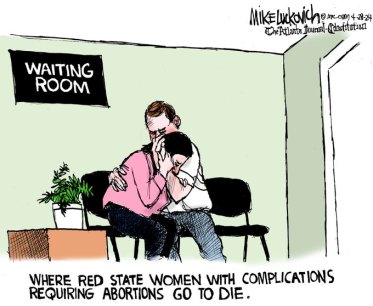 This Mike Luchovich cartoon is brutal and true. I am shifting to the other SCOTUS shit show this week. CNN has “Takeaways from the Supreme Court’s oral arguments over emergency abortions.” Again, thank goodness my youngest daughter is in Denver. Who knows what her outcome may have been? Dr. Daughter is getting more colleagues in Washington State because of Idaho. Pregnant women are gestational containers there. This analysis was provided by Tierney Sneed and John Fritze.
In a Supreme Court hearing on the Biden administration’s challenge to aspects of Idaho’s strict abortion ban, US Solicitor General Elizabeth Prelogar sought to appeal to conservative justices who just two years ago ruled that states should have the ability to prohibit the procedure.
The dispute, stemming from the Justice Department’s marquee response to the high court’s reversal of Roe v. Wade in 2022, turns on whether federal mandates for hospital emergency room care override abortion bans that do not exempt situations where a woman’s health is in danger but her life is not yet threatened.
To prevail, the Biden administration will need the votes of two members of the court’s conservative bloc, and with Justice Brett Kavanaugh signaling sympathies toward Idaho, the case will likely come down to the votes of Chief Justice John Roberts and Amy Coney Barrett. The two justices had tough questions for both sides of the case.
The court’s far-right wing, perhaps in an attempt to keep those two justices on their side, framed the case as a federal overreach into state power. The court’s liberals, meanwhile, focused on the grisly details of medical emergencies faced by pregnant woman that were not covered by the limited life-of-the-woman exemption in Idaho’s ban.
So, back to Pecker and the man who has to pay for sex coming and going. There’s been a whole of objecting accompanied by “sustained.”
More will be coming once the print journalists get their stories in. I wish I could be Pollyanna and play the glad game, but I can only come up with the bad news. We get to see this continually, which is also the thing I’m glad about. I m feel like a total masochist every time I turn the TV on or read a magazine article, but just think how awful it would be if we didn’t know about this. I’m not sure what will become of Donald, but I’m certain that we still have time to make certain he doesn’t get back into the White House. We have time to stop the MAGAdons that want to clone that agenda into every state and the U.S. Congress. We’ll see and read nothing else but propaganda if we don’t stop them now.
What’s on your reading and blogging list today?
Guess who John Prine wrote this about?

 peej
peej Carissa
 bostonboomer
 dakinikat
 ecocatwoman
 mablue2
 Mama Lopez
 peggysue22
 quixote
 skydancingguestblogger
 Mona (aka Wonk the Vote)



 Sky Dancing
Recent Comments