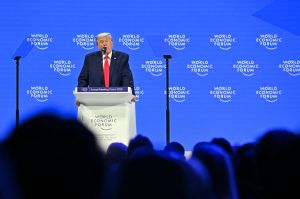
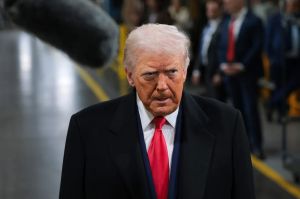
This morning I woke up and turned on the TV to see our “president,” easily the stupidest president in American history, walking hunched over and tired in Davos to give another long, rambling, nonsensical, insulting “speech” to the assembled political and business leaders. He spoke for 70 minutes and it seemed much longer.
I watched the speech for awhile, but it was the same old garbage he talks about off the cuff to the assembled press in the oval office. He went on and on in his old man voice, attacking allies, demanding that Greenland be handed over to him, ranting about windmills–all to complete silence from the audience. How could they sit there and watch this embarrassing display of abject stupidity?
I don’t expect this post to make much sense, because I’m just soooo angry!
The big headline, according to the legacy media is that Trump announced he won’t “take Greenland by force.”
President Donald Trump ruled out military force to acquire Greenland in his remarks Wednesday to the World Economic Forum in Davos, Switzerland, providing a momentary sense of relief to Europe after weeks of worry that the U.S. would enter a confrontation with NATO.
“We probably won’t get anything unless I decide to use excessive strength and force, where we would be, frankly, unstoppable, but I won’t do that,” Trump said. “That’s probably the biggest statement I made, because people thought I would use force, but I don’t have to use force. I don’t want to use force.”
Trump said Wednesday that he wants to see negotiation to acquire what he called “a piece of ice.”
The president, though, warned Denmark that if it doesn’t give up Greenland to the U.S., “we will remember.”
He argued in his remarks that the U.S. can protect “this giant mass of land” better than Europe can, insisting that taking over Greenland wouldn’t be a threat to NATO but would instead enhance security for the alliance. While the president’s obsession with Greenland has accelerated in recent weeks, his pledge to not use force to acquire the island marks a shift in his rhetoric.
“I don’t want to use force,” he added. “All the United States is asking for is a place called Greenland, where we already had it as a trustee but respectively returned it back to Denmark not long ago after we defeated the Germans, the Japanese, Italians and others in World War II. We gave it back to them.”
He added that it was “stupid” for the U.S. to not keep the island after the war. Still, Trump downplayed the significance of his threats against Greenland, arguing it’s a trade-off for the years of support the U.S. has given to NATO allies.
“What I’m asking for is a piece of ice, cold and poorly located,” he said. It’s a very small ask, compared to what we have given them for many, many decades.”
What does that mess of words really mean? Nothing. Trump is the world’s worst liar and he’s insane. Not to mention stupid. Nothing he says can be believed.
The choice is impeachment and removal or calamity for the United States. I don't see how anybody watching Trump's speech in Davos can draw any other conclusion. He's a senile madman.
“Denmark’s investment in U.S. Treasury bonds, like Denmark itself, is irrelevant,” U.S. Treasury Secretary Scott Bessent told reporters Wednesday at the World Economic Forum in Davos, Switzerland.
It comes as Trump’s threats to impose 10% tariffs on eight European countries as part of his push to take over Greenland spooked markets. The levies would come into force on Feb. 1, Trump said, and later rise to 25%.
Danish pension operator AkademikerPensionsaid Tuesday it was selling $100 million in U.S. Treasurys. The decision was driven by “poor [U.S.] government finances,” said Anders Schelde, AkademikerPension’s investing chief.
When Bessent was asked how concerned he is about European investors pulling out of Treasurys, Bessent said at a news conference at the World Economic Forum: “Denmark’s investment in U.S. Treasury bonds, like Denmark itself, is irrelevant.”
“That is less than $100 million. They’ve been selling Treasurys for years, I’m not concerned at all.”
Really? I’d like to hear what Daknikat has to say about this.
No one can be watching this Davos speech and reach any conclusion but that the President of the United States is mentally disturbed and that something is deeply wrong with him. This is both embarrassing and extremely dangerous.
Prime Minister Mark Carney of Canada delivered a stark speech in Davos, Switzerland, on Tuesday, prompting global political and corporate leaders in the audience to rise from their seats for a rare standing ovation.
He described the end of the era underpinned by United States hegemony, calling the current phase “a rupture.” He never mentioned President Trump by name, but his reference was clear.
The speech came as President Trump doubled down on his threats to take Greenland away from Denmark, saying he would slap fresh tariffs on European powers as punishment for their support of Greenland’s sovereignty.
Global leaders have been scrambling to find a unified response.
“Every day we’re reminded that we live in an era of great-power rivalry,” Mr. Carney said. “That the rules-based order is fading. That the strong can do what they can, and the weak must suffer what they must.”
And he warned, “The middle powers must act together because if we’re not at the table, we’re on the menu.”
He would know.
Mr. Trump started his second presidential term making claims on Canada as the 51st state and threatening Canada’s previous leader, Justin Trudeau, whom Mr. Trump publicly derided, with unilaterally scrapping agreements that have governed the relationship between the neighboring countries for over a century….
Mr. Carney chastised other leaders too, many of whom would have been following his speech in Davos, for not standing up for their interests.
“There is a strong tendency for countries to go along to get along,” he said. “To accommodate. To avoid trouble. To hope that compliance will buy safety. It won’t.”
Mr. Carney made clear he is choosing a different path.
He wrote his own speech, according to a government official, who spoke on condition of anonymity to discuss the inner workings of his team, which is a departure since speeches of this magnitude are usually prepared by high-level staffers with the leader’s input.
Mr. Carney, a former investment executive who has served as the governor of Canada and England’s central banks, has attended the global gathering about 30 times, according to his office….
Mr. Carney spoke not long after Mr. Trump had posted an altered image on social media that featured a map of American flags superimposed over both Canada and the United States, as well as Greenland.
Well worth a listen from Canadian PM Mark Carney at Davos summit.
President Trump said in Davos on Wednesday that Canada should be “grateful” to the U.S. for the “freebies” it receives because of the two nations’ relationship.
Why it matters: Trump’s dig at Canada came a day after Prime Minister Mark Carney delivered his own warning at the World Economic Forum over the “rupture” of the world order.
Driving the news: “Canada lives because of the United States,” Trump said Wednesday before taking a direct jab at Carney. “Remember that, Mark, the next time you make your statements.”
Trump said Carney “wasn’t so grateful” in his address.
Carney avoided naming Trump in his speech — a strategy a Canadian official previously told Axios was deliberate. However, the official indicated that Carney’s remarks were aimed squarely at the president’s recent actions.
Zoom out: As Trump pushes a vision of hemispheric dominance — coupled with threats of the U.S. making its northern neighbor the “51st state” — Ottawa has reportedly started preparing for how to repel a U.S. invasion.
Growing up, I never really understood Aesop’s fable about the goose that laid the golden egg. It’s a cautionary tale about greed and hubris: A farmer with a miraculous goose that lays a solid-gold egg every morning gets fed up with passive wealth generation and figures killing the bird will speed things along. But alas: He finds no store of eggs within and realizes he butchered his meal ticket for nothing. The moral’s straightforward, but it never really worked for me as a story. Like, come on: Nobody’s that stupid.
Well, almost nobody, I guess.
As long as I live, I don’t think I’ll get over this pure, dumb fact: Trump told his fans he had to blow up the liberal order because it was the only way to secure the very benefits the liberal order was already bringing us.
Trump insists America needs Greenland as a strategic positioning ground from which to restrain Russia and China in the Arctic. But thanks to the liberal order, this was something we already enjoyed. Through the magic of multilateral cooperation, we were able to treat someone else’s territory as though it were our own for the purposes of military positioning—not by bribing or intimidating them, but because they agreed their interests and our interests aligned.
Trump insists America needs to blow up America’s preexisting economic relationships to ensure America gets an advantageous position in international trade. But America already had such an advantageous position: an orderly world economic system that had lavished previously unimaginable prosperity on America and to the entire globe, with us at the proverbial (and very profitable) head of the table.
It’s not just that Trump had the hubris to think he could hero-ball the country to a better deal by canceling a century of history and starting over. It’s that his own broken personality—his miserable meanness, his dispositional inability to cooperate with and trust others—has always prevented him from understanding what was good about the deal we had to begin with. The idea that multipolar agreements could be better for America, in some cases, than outright ownership—that, say, we already have everything we need from Greenland—he rejects as ridiculous. Ownership, he told the New York Times, is “what I feel is psychologically needed for success. . . . I think that ownership gives you a thing that you can’t do, whether you’re talking about a lease or a treaty.”
He really is determined to burn everything down if he can’t get his own way on everything.
1/ Jonathan Lemire writes, "Trump's lust for Greenland is about increasing American dominance in the Western Hemisphere 7 redrawing the maps of the world. The island is roughly 836K square miles, which would make it the largest territorial addition in US history." Gift link.
Franklin D. Roosevelt famously illustrated with a simple metaphor the need for a healthy transatlantic alliance. Justifying his decision to lend Great Britain warships and other military supplies in the early days of World War II, Roosevelt likened it to loaning a neighbor a garden hose to put out the fire consuming his house. Sure, Roosevelt charitably wanted to help a neighbor in need. But it was self-interested too; if the neighbor could extinguish the blaze, it wouldn’t spread to FDR’s home. The United States benefited from the friendship—and the buffer—that allies could provide.
Today, Donald Trump will fly to Europe. Ukraine is already ablaze. And now the president is ready to set a bunch of new houses on fire.
The president will speak at the World Economic Forum in Davos, Switzerland, tomorrow, and he appears prepared to shatter the nearly 80-year-old NATO alliance in order to seize Greenland. In his quest to claim a strategically located island of ice and rock, Trump has turned against his nation’s most stalwart friends. He has antagonized and mocked panicked European leaders, threatened punishing tariffs on countries that object to his plans, and pointedly not ruled out using military force. Trump’s thirst for Greenland—even if he stops short of ordering an armed invasion—threatens to unravel the partnership born from the ashes of World War II that has, in the decades since, ensured the spread of peace, prosperity, and democracy on both sides of the Atlantic.
Today marks one year since Trump’s return to office, and in that time, he has fundamentally reshaped the United States’ relationship with the rest of the world. But nothing has upended the global order more than what would happen if he follows through on his threats toward Greenland. The island, of course, belongs to Denmark, which says that it is not available for the taking. Troops from Europe have been dispatched to the territory, and Greenland’s prime minister warned his populace to prepare for an invasion. If Trump were to persist, Denmark could trigger NATO’s Article 5 mutual-defense pact, and then the unthinkable could occur: American soldiers firing on Europeans while Russian President Vladimir Putin’s dream of NATO’s self-immolation is thoroughly realized.
The annual meetings in Davos, normally a clubby gathering of business titans and political leaders, have been consumed by talk of what Trump may or may not do. European leaders have found themselves scrambling on strategy—appeasement? Defiance? Compromise? Early this morning, Trump posted screenshots of text messages that revealed the dilemma facing those leaders. (Lesson to everyone: Be careful what you text the guy unless you want the world to see.)
In one message, Mark Rutte—the secretary general of NATO, who has prized warm relations with Trump—praised the president’s foreign policies, then vowed that he is “committed to finding a way forward on Greenland.” But in another, French President Emmanuel Macron, whose relationship with Trump has been turbulent, admitted: “I do not understand what you are doing on Greenland.” In fact, Trump couldn’t be more clear, as he demonstrated once again by circulating a pair of presumably AI-generated images on social media. In one, he’s planting an American flag in Greenland. In the other, he’s lecturing European leaders in the Oval Office with a map behind him that depicts Greenland as part of the United States. (Canada and Venezuela too.)
Trolling close U.S. allies has seemingly been an unofficial policy of Trump’s second administration since its first days, beginning with Vice President Vance lecturing Europe in Munich on the virtues of free speech. But this time feels different for those nervously waiting in snowy Switzerland. The president’s address to the forum tomorrow is poised to be a defining moment, and Trump plans to make the unequivocal case that the United States should have Greenland, a senior White House official told me.
Pretty good predictions, except for Trump’s claim he won’t use force.
A few non-Davos stories:
Did you watch Lawrence O’Donnell last night? He still insists that Trump’s Greenland obsession is really a way to distract the press from the Epstein files. I think he could be right. If you didn’t see it, I recommend watching it now.
Three hundred and sixty-five days after Donald Trump swore his oath of office and completed an extraordinary return to power, many historians, scholars and experts say his presidency has pushed American democracy to the brink – or beyond it.
The scale and velocity of what he has been able to accomplish in just a year have stunned even longtime observers of authoritarian regimes, pushing the debate among academics and Americans from whether the world’s oldest continuous democracy is backsliding to whether it can still faithfully claim that distinction.
“In 2025, the United States ceased to be a full democracy in the way that Canada, Germany or even Argentina are democracies,” Steven Levitsky and Daniel Ziblatt, the prominent Harvard political scientists and authors of How Democracies Die, and the University of Toronto professor Lucan Way, wrote in Foreign Affairs last month. They argued that the US under Trump had “descended into competitive authoritarianism”, a system in which elections are held but the ruling party abuses power to stifle dissent and tilt the playing field in its favor.
There is no universally accepted definition of democracy. Some argue the US is a “flawed” or “illiberal” democracy, or a democracy facing substantial “autocratization” – a process that began long before Trump came to power a decade ago but which his presidency has rapidly accelerated. Still, others believe the concerns are overblown, or reflect an intense partisan dislike of the current president.
Since Trump’s first term, scholars have warned that it can happen here. But many now say this moment is different – not only because Trump’s approach is more methodical and his desire for vengeance more pronounced, but because he now faces far fewer internal constraints.
Read more at the link.
Hunter Walker at Talking Points Memo: Trump Marks First Year In Office With Unhinged Racist Rant Targeting ‘Very Low IQ’ Somalis.
President Donald Trump spent the first anniversary of his second term on Tuesday pitching himself to the American people from behind the White House briefing room podium. In nearly two hours of remarks, Trump seemingly sought to address his cratering approval by running through a list of his supposed accomplishments. His remarks also included a series of vicious, racist remarks about Somali people and other immigrants.
I think Trump likes this photo.
“They all ought to get the hell out of here, they’re bad for our country,” Trump said of the Somali population at one point during the extraordinary rant.
At multiple points during his remarks, Trump indicated he felt the need to make his case directly because his team was not up to the task. A slew of anniversarypolls show the president’s numbers are currently underwater with notably steep declines in voter approval of the president’s handling of his signature issues: immigration and the economy. Those figures have come amid slow job growth and violent raids staged by Trump’s Immigration and Customs Enforcement agency.
“Maybe I have bad public relations people, but we’re not getting it across,” Trump said as he argued the economy is particularly strong since he returned to office.
Trump came equipped with a couple of binders including one labeled “ACCOMPLISHMENTS.” Yet as he read through the provided list, Trump repeatedly raged against the Somali population, including suggesting that they are of inferior intelligence. Trump first turned to the topic as he alluded to the ongoing ICE raids in Minnesota, which have been met with massive protests. The state is home to the country’s largest Somali population and the federal crackdown has come amid a wave of right-wing influencers making exaggerated claims about alleged daycare fraud in the community.
“Nineteen billion dollars at a minimum is missing in Minnesota, given to a large degree by Somalians. They’ve taken it,” Trump said. ”Somalians, can you imagine? And they don’t do it — a lot of very low IQ people. They don’t do it. Other people work it out and they get them money and they go out and buy Mercedes Benzes.”
The Supreme Court will consider Wednesday whether President Trump can fire Lisa Cook from the Federal Reserve board, in a case that tests the longstanding independence of the central bank, with potentially major consequences for the economy.
The court’s conservative majority has repeatedly allowed Mr. Trump to oust leaders of other independent agencies as he moves to expand presidential power and seize control of the federal bureaucracy. But the justices have signaled that the Fed may be different and uniquely insulated from executive influence because of its structure and history.
Lisa Cook
The case lands as the administration has dramatically escalated its attacks on the Fed, apparently aimed at remaking its board and lowering interest rates. The Justice Department this month opened a criminal investigation into whether Jerome H. Powell, the Fed chair, lied to Congress about cost overruns related to the Fed’s renovation of its headquarters.
Mr. Powell, whose term as chair ends in May, forcefully pushed back on the threat of criminal charges, saying it was a result of the Fed setting borrowing costs “based on our best assessment of what will serve the public, rather than following the preferences of the president.”
The investigation prompted a backlash from Republicans, international policymakers, Wall Street and some Trump allies, who warned that the central bank’s independence and credibility was at risk.
It also threatened to complicate Mr. Trump’s plans to name Mr. Powell’s replacement as chair — and, legal experts said, the Supreme Court case being heard on Wednesday.
The justices agreed to hear Ms. Cook’s case on an expedited basis, and are likely to rule quickly on her status as litigation continues in the lower courts. The outcome of the case could determine how much latitude Mr. Trump and future presidents have to influence the direction of the powerful central bank, which Congress intentionally tried to insulate from political pressures.
Police agencies in the United States kill more than 1,000 people each year. After many of those deaths, the agencies involved put out statements. Those statements often use what’s known as the exonerative voice to minimize officers’ involvement. The first statement from the Minneapolis Police Department after George Floyd’s death, for example, said that the officers at the scene “noted that he appeared to be suffering from medical distress.” Quite the understatement. These communications often cast events in a light most favorable to the officers involved, sometimes to the point of deception. Too often, they’ll try to smear the deceased by citing a criminal record or suggesting a drug addiction or gang affiliation.
Renee Good
I have been covering policing for more than 20 years and have read and parsed a lot of these statements. The Department of Homeland Security’s response after the Immigration and Customs Enforcement agent Jonathan Ross shot and killed Renee Good in Minneapolis this month is something else entirely.
For all their flaws, typical communications from police officials usually include a modicum of solemnity. There are assurances that there will be a fair and impartial investigation, even if those investigations too often turn out to be neither. There’s at least the acknowledgment that to take a human life is a profound and serious thing.
The Trump administration’s response to Ms. Good’s death made no such concessions. There were no promises of an impartial investigation. There was no regret or remorse. There was little empathy for her family — for her parents, her partner or the children she left behind. From the moment the world learned about her death, the administration pronounced the shooting not only justified but an act of heroism worthy of praise and celebration.
It isn’t just the lying; it’s that the lies are wildly exaggerated and easily refutable. All the evidence we’ve seen so far, including a meticulous Times forensic analysis of the available footage, makes clear that at worst, Ms. Good mildly obstructed immigration enforcement, disobeyed ambiguous orders or perhaps attempted to flee an arrest. None of those are capital crimes, nor do law enforcement officers get to dole out punishment in such cases. At one point, President Trump justified her shooting by claiming she’d been “very disrespectful” to immigration officers. That isn’t a crime at all.
The lies this administration is telling about Ms. Good aren’t those you deploy as part of a cover-up. They’re those you use when you want to show you can get away with anything. They’re a projection of power.
For the past decade or so, since the protests in Ferguson, Mo., America has engaged in a high-stakes dialogue about police abuse and accountability, the militarization of law enforcement and the push and pull between public safety and civil liberties. Those discussions, while occasionally heated, have been based on a shared understanding that the primary job of domestic law enforcement is to serve the public. What Mr. Trump is doing with federal immigration forces has rendered those debates obsolete.
Those are my recommended read for today. What do you think?
Did you like this post? Please share it with your friends:
I’m still in my “avoiding the news” phase. Of course, I can’t help hearing about big events–I’m just not spending huge swaths of time reading Substacks and social media posts. Unread emails pile up as I fritter away my time indulging my guilty TV pleasures–animal shows and true crime dramas. So this morning I’ve been looking around to see what’s been happening while I was checked out. Here are the stories that grabbed my attention.
Hopeful Signs?
Democrats are continuing to do well in off-year elections. Yesterday, there were big wins in Florida and Georgia.
MIAMI — Democrats can now add a major city in Donald Trump’s home state — and one set to host his future presidential library — to its list of off-cycle election wins.
In a Tuesday runoff, Miamians elected Eileen Higgins as mayor, the first woman in the city’s history to hold the job and the first Democrat in 28 years. Higgins, a former county commissioner, defeated Republican Emilio González, an ex-city manager who had the endorsement of Trump and Gov. Ron DeSantis, with 60 percent of the vote.
Eileen Higgins
“Miami chose a new direction,” Higgins said during her victory speech at the Miami Woman’s Club. “You chose competence over chaos, results over excuses and a city government that finally works for you.”
Though the race and the job of mayor are nominally nonpartisan, the election generated sizable interest from national Democrats and Republicans. Higgins’ win adds to the slew of victories and close calls Democrats have seen this year, including last week’s strong performance in a House special election in Tennessee.
The election could boost messaging for Florida Democrats, who’ve faced setbacks in recent election cycles and have a 1.4 million registered voter disadvantage in this former swing state.
“Tonight’s victory shows that the pendulum is swinging in our favor and that when we commit to relentless, year-round organizing and invest in a long-term strategic field program, we can, in fact, win,” FDP Chair Nikki Fried said in a statement Tuesday night.
Democrats continued their run of successes in special elections by flipping a state House seat in Georgia Tuesday, according to a projection from the CNN Decision Desk.
The Democratic victory, in a district that voted for President Donald Trump by about 12 percentage points last year, comes ahead of next year’s critical midterms, when Georgians will vote in closely watched races for Senate and governor.
Eric Gisler
Eric Gisler, a Democrat who owns a local olive oil store, will defeat Republican Mack “Dutch” Guest in the 121st House District, in the northeastern part of the state, near the college town of Athens.
Between regularly scheduled elections in Virginia and New Jersey and special elections held on newly redrawn maps in Mississippi, Democrats flipped about 20 state legislative seats on Election Day last month. Those victories came after Democrats flipped two seats in Iowa and one in Pennsylvania during special elections earlier in the year.
Republicans still control a significant majority in the Georgia House, but Tuesday’s results come just a month after Democrats won two statewide elections to flip two seats on the state’s Public Service Commission….
The Democratic Party of Georgia congratulated Gisler in a statement Tuesday evening, “This isn’t just a win for Georgia Democrats – it’s a win for every family in Oconee and Clarke Counties who has been struggling to get ahead under 22 years of failed Republican leadership.”
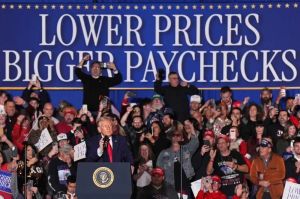
Trump’s “Affordability” Speech in Mount Pocono, Pennsylvania
He mocked the word “affordability,” touted how high the stock market had risen and said Americans didn’t need so many pencils. He launched into a number of digressions to disparage the country of Somalia, the concept of climate change and the news media in the back of the room.
Trump spoke from a 1,200-capacity ballroom at the Mount Airy Resort and Casino in the Pocono Mountains for what White House officials have suggested would be a kickoff to promote Trump’s economic policies — and an attempt to wrangle an issue that has become a political liability ahead of the 2026 midterm elections.
Instead, the 90-minute speech was a greatest hits of his campaign trail appearances — complimenting the power of his chief of staff, Susie Wiles, and “the lips that don’t stop” of White House press secretary Karoline Leavitt — with occasional nods to the current economic anxieties. He promoted his trade policies, without speaking to the impact they’ve had on consumer prices, and he promised lower energy costs.
“We inherited the highest prices ever, and we’re bringing them down,” he said several times.
“We’re getting inflation — we’re crushing it, and you’re getting much higher wages,” he said. “I mean, the only thing that is really going up big, it’s called the stock market and your 401(k).”
While suggesting prices were no longer going up, Trump also ridiculed Democrats for suggesting that voters cared about affordability, an issue that was a focus of their successful campaigns last month in New Jersey, Virginia and New York City.
“They said, ‘Oh, he doesn’t realize prices are higher.’ Prices are coming down very substantially,” Trump said. “But they have a new word. You know, they always have a hoax. The new word is affordability. So they look at the camera and they say, ‘This election is all about affordability.’”
Trump talks affordability in PA.
The election may very well be about people’s ability to afford basics–food, clothing, and housing. Trump has never had to worry about those things, so he mocks people who do.
Later, he attempted to clarify.
“I can’t say affordability is a hoax because I agree the prices were too high. So I can’t go to call it a hoax because they’ll misconstrue that,” he said. “But they use the word affordability.And that’s the only word they say. Affordability. And that’s their only word. They say, ‘Affordability.’ And everyone says, ‘Oh, that must mean Trump has high prices.’ No. Our prices are coming down tremendously from the highest prices in the history of our country.”
“You know, you can give up certain products. You can give up pencils,” he said, suggesting that he was focused on promoting American-made steel while China was focused on providing multiple pencils to its citizens.
“You always need steel. You don’t need 37 dolls for your daughter,” he said. “Two or three is nice, but you don’t need 37 dolls. So, we’re doing things right. We’re running this country right well.”
“Affordability” is another word like “groceries” to Trump–words for things outside his own experience. He doesn’t have to worry about getting enough to eat or staying warm in his home–so other people shouldn’t care about those things either. Just deal with it while he has fun with his tariffs.
Last night Donald Trump gave an important speech on the economy in Pennsylvania — supposedly in a working-class area, although the actual venue was a luxury casino resort. The event was initially touted as the start of an “affordability tour,” the first of a series of speeches intended to reverse Trump’s cratering approval on his handling of inflation and the economy. A number of news analyses suggested that he would use the occasion to blame Democrats for the economy’s troubles.
King Trump doesn’t care about your affordability concerns.
That was never going to happen. Trump did, of course, take many swipes at Joe Biden, as well as attacking immigrants, women and windmills. But to blame Democrats for the economy’s problems he would have to admit that the Trump economy has problems. And the speech was important because it revealed that he won’t make any such admission, and will continue to gaslight the public.
On Monday Politico interviewed Trump, asking him, among other things, what grade he would give the current economy. His answer: “A-plus-plus-plus-plus-plus.”
In fact, until very recently Trump wouldn’t even accept the reality that ordinary Americans don’t share his triumphalism. When Fox News’s Laura Ingraham asked him a month ago why people are anxious about the economy, Trump replied
“I don’t know they are saying that. The polls are fake. We have the greatest economy we’ve ever had.”
Scott Bessent, billionaire
Since then Trump and his minions seem to have come around to admitting that Americans are, in fact, unhappy with the state of the economy. But if the economy is A+++++, why don’t people see it? The problem can’t possibly lie with him — so it must lie with you. “The American people don’t know how good they have it.”
I put that line in quotes because it isn’t a caricature or a paraphrase. It is, in fact, literally what Scott Bessent, the Treasury secretary, said the other day:
“We’ve made a lot of gains, but remember, we’ve got this embedded inflation from the Biden years, where mainstream media, whether it’s Greg Ip at the Wall Street Journal, toxic Paul Krugman at New York Times or former Vice Chair, Alan Blinder, all said it was a vibecession. The American people don’t know how good they have it.”
Krugman’s response:
I may not be a political strategist, but I don’t think “You’re all a bunch of ingrates” is a winning message. It was, however, really the only message Trump could deliver, given his utter lack of empathy or humility.
At this point I could bombard you with a lot of data showing that the economy is not, in fact, A+++++. But it isn’t a disaster area, at least not yet. So why are Americans feeling so down? The main culprit is Trump himself.
First, during the 2024 campaign Trump repeatedly promised to bring consumer prices way down beginning on “day one.” We’re now 11 months in, prices are still rising, and voters who believed him feel, with reason, that they were lied to. Last night Trump insisted that prices are, in fact, coming way down. Again, “Who you gonna believe, me or your lying eyes?” is a self-destructive political strategy.
Second, Trump would be in much better political shape right now if he had basically continued Biden’s policies, with only a few cosmetic changes. When he took office inflation was on a declining trajectory. Consumer sentiment was relatively favorable at the start of 2025. Americans were still angry about high prices, but the inflation surge of 2021-3 had happened on Biden’s watch and was receding into the past. My guess is that many voters would have accepted Trump’s claims that high prices were Democrats’ fault and given him the benefit of the doubt about the economy’s future if he had simply done nothing drastic and left policies mostly as they were.
Instead, he brought chaos: Massive and massively unpopular tariffs, DOGE disruptions, masked ICE agents grabbing people off the street, saber-rattling and war crimes in the Caribbean. Many swing voters, I believe, supported Trump out of nostalgia for the relative calm that prevailed before Covid struck. They didn’t think they were voting for nonstop political PTSD.
And there’s more to come. Health insurance costs are about to spike, because Republicans refuse to extend Biden-era subsidies. Inflation may pick up in the next few months as retailers, who have so far absorbed much of the cost of Trump’s tariffs, begin passing them on to consumers.
In a speech that the White House billed as an address on the economy, amid a backlash driven in part by Mr. Trump’s sweeping tariffs, Mr. Trump veered between assurances that life was better than ever under his administration and blaming immigrants for the country’s economic woes.
Mr. Trump revived what had been an effective campaign message, promising that sending immigrants home would mean “more jobs, better wages and higher income for American citizens,” though the early stages of his mass deportation campaign have so far coincided with widespread economic anxiety.
“I didn’t say ‘shithole,’ you did!” Mr. Trump replied with a grin. He then recounted his use of the term at a White House meeting in 2018 to describe countries that he was balking at accepting immigrants from. Mr. Trump had then denied saying that after it was publicly reported. Nearly six years later, he appeared proud of the remark.
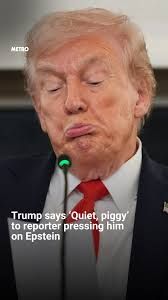
Quiet, Piggy!
Throughout the speech, Mr. Trump doubled down on a barrage of incendiary attacks that he has unleashed against immigrants since the shooting of two National Guard members near the White House last month. The day after the shooting, Mr. Trump floated the possibility of stripping naturalized American citizens of their citizenship (which is only done in rare cases) and vowed to deport all immigrants that he saw as “non-compatible with Western civilization.”
During his xenophobic tirade, Mr. Trump made little distinction between unauthorized migrants and those who followed all the correct procedures to enter the country and eventually become American citizens. He described Somali immigrants as lazy, murderous and “garbage,” and said the home countries of many immigrants were “filthy, dirty, disgusting.”
Americans are struggling with affordability pressures that are squeezing everything from their everyday necessities to their biggest-ticket expenses
Nearly half of Americans said they find groceries, utility bills, health care, housing and transportation difficult to afford, according to The POLITICO Poll conducted last month by Public First. The results paint a grim portrait of spending constraints: More than a quarter, 27 percent, said they have skipped a medical check-up because of costs within the last two years, and 23 percent said they have skipped a prescription dose for the same reason.
The strain is also reshaping how Americans spend their free time. More than a third — 37 percent — said they could not afford to attend a professional sports event with their family or friends, and almost half — 46 percent — said they could not pay for a vacation that involves air travel.
While President Donald Trump gave himself an “A-plus-plus-plus-plus-plus” grade on the economy during an exclusive interview with POLITICO’s Dasha Burns, the poll results underscore that voters’ financial anxieties have become deeply intertwined with their politics, shaping how they evaluate the White House’s response to rising costs.
Trump insists that “prices are all coming down,” as he told Burns, but the results pose a challenge for Trump and the Republican Party ahead of the 2026 midterms, with even some of the president’s own voters showing signs that their patience with high costs is wearing thin.
POLITICO reporters covering a variety of beats have spent the past few weeks poring over the poll results. We asked some of them to unpack the data for us and tell us what stood out most.
The Pentagon was in a bind. The military had plucked two survivors from the Caribbean Sea in mid-October after striking a boat that U.S. officials said was carrying drugs, and it needed to figure out what to do with them.
On a call with counterparts at the State Department, Pentagon lawyers floated an idea. They asked whether the two survivors could be put into a notorious prison in El Salvador to which the Trump administration had sent hundreds of Venezuelan deportees, three officials said.
The State Department lawyers were stunned, one official said, and rejected the idea. The survivors ended up being repatriated to their home countries of Colombia and Ecuador.
A little under two weeks later, on Oct. 29, Pentagon officials convened another session about boat strike survivors, a video conference involving dozens of American diplomats from across the Western Hemisphere. The message was that any rescued survivors should be sent back to their home countries or to a third country, said three other officials, who, like others interviewed for this article, spoke on the condition of anonymity to discuss internal deliberations.
Behind that policy was a quieter goal: to ensure survivors did not end up in the U.S. judicial system, where court cases could force the administration to show evidence justifying President Trump’s military campaign in the region.
The previously unreported calls demonstrate the haphazard and sometimes tense nature of the process within the Trump administration to weigh what to do with the survivors of U.S. attacks on boats that the military asserts — without presenting evidence — are drug-smuggling vessels posing an immediate threat to Americans.
Pentagon officials largely kept State Department counterparts in the dark about strike operations, then scrambled to try to enlist diplomats to help deal with survivors, whom military officials referred to by specific terms that included “distressed mariners.” That phrase is usually used in a peacetime and civilian context.
The talks took place after the first attack on Sept. 2, when the U.S. military killed two survivors with a second strike. Pentagon officials have not fully explained the process for handling survivors to other agencies or Congress, even as the campaign has continued, killing at least 87 people in 22 attacks.
As the US military has undertaken a campaign of attacks against alleged drug boats in the Caribbean Sea and eastern Pacific Ocean, at least five people have survived initial strikes ending up in the water after explosions killed fellow crew members and disabled their ships.
But what happened next to the survivors varied greatly – two were detained by the US Navy only to be returned to their home countries, one was left to float in the ocean and is presumed dead, and two more have been at the center of intense scrutiny in recent weeks following reporting that the US military conducted a second strike killing them as they clung to their flipped and damaged boat on September 2.
The contrast in treatment has happened while policy on how the military will handle survivors remains steady, according to defense officials….
Democratic lawmakers have demanded answers about the follow-up strike with some suggesting that the US military may have violated international law by killing the survivors.
Last week, Adm. Frank “Mitch” Bradley met with lawmakers on Capitol Hill in closed-door meetings to explain the attack. Bradley was the commander of Joint Special Operations Command at the time of the strike and oversaw the attack; Secretary of Defense Pete Hegseth and the White House have said Bradley was ultimately the official who directed the follow-on strikes, and that they support his decision.
Bradley told lawmakers he ordered a second strike to destroy the remains of the vessel, killing the two survivors, on the grounds that it appeared that part of the vessel remained afloat because it still held cocaine, CNN has reported. The survivors could hypothetically have floated to safety, been rescued, and carried on with trafficking the drugs, the logic went.
People briefed on the follow-up strike said they were concerned that it could violate the law of armed conflict, which prohibits the execution of an enemy combatant who is “hors de combat,” or taken out of the fight due to injury or surrender.
I hope this post will make some kind of sense, but I’m not that confident about it. I’m completely stressed out and exhausted. Last night I did not sleep at all. Now I’ll have to try to make it up with naps today.
I’ve had insomnia for years now, beginning after menopause. It got worse after Trump was elected in 2016, and now we’ve had nearly 10 years of this horrible man and his endless stupidity, my sleepless nights come more often.
Obviously, Trump’s second term has been much much worse than the first. He’s now surrounded by sycophants and not the so-called “adults in the room” who tried to check some of his worst impulses in his first term. He is openly enriching himself and his fellow billionaires. He’s pardoning violent criminals. Everything is awful. We are beginning to resemble Orban’s Hungary and Putin’s Russia. I don’t see how we ever repair this country’s reputation in the free world.
France’s gift to America has stood majestically in New York harbor since 1886. The original idea for the Statue of Liberty grew out of the desire to exemplify the American ideals of liberty and freedom. Lady Liberty’s spiked crown was meant to symbolize rays of sun beaming out to the world. Her tablet was inscribed with July 4, 1776. Sculptor Frédéric-Auguste Bartholdi placed a broken shackle and chains at her feet to represent the end of slavery.
For more than 140 years, she has held her torch high, providing a beacon to the world, an expression of freedom and a welcome to those in trouble. So has been the inspiring poem of Emma Lazarus, “The New Collossus,” etched in bronze and placed at the pedestal: “Give me your tired, your poor/Your huddled masses yearning to breathe free.” Millions of arriving immigrants saw this symbol of compassion and hope for a better life with their own eyes. Millions more yearned to see it and experience its promise for themselves.
I have always taken pride in America’s commitment to immigration and its burgeoning diversity. I have done so knowing that our history has been fraught with conflict as bigotry and competition have often pitted Americans against newcomers. I’m still moved by Hakeem Jeffries’ first speech after becoming House Minority Leader in 2023. “We believe that in America our diversity is a strength. It is not a weakness. An economic strength, a competitive strength, a cultural strength,” he said, adding, “Out of many we are one. That’s what makes America a great country.”
I won’t recount now the myriad ways the current cruel and hostile regime is exploiting its power to try and force millions of migrants out of the country without due process. The daily stories of masked men without proper identification grabbing people off the streets and taking them away in unmarked cars is an intolerable horror.
Add to this the Supreme Court ruling yesterday, enabling the Trump administration to revoke temporary legal status for more than 530,000 immigrants from Haiti, Cuba, Nicaragua and Venezuela—a humanitarian program created by the Biden administration in 2023 to address the peril they faced in their home countries. It’s hard to overstate the heartbreak and fear this ruling will cause, as all the previously protected people (adults and children) now face the possibility of being deported back to danger. We are all paying for decades of failure to pass comprehensive immigration reform, which has provided the conditions for a hateful demagogue to target migrants as a key reason for all that ails us.
Beschloss urges us to hold on to hope and not to give in to fear and despair. He asks us to think about what we hope for America.
…it’s important that we don’t lose sight of what we’re fighting for; this tyrannical regime is hoping to replace our dreams with their nightmares. The more we keep alive the vision of the future we want, the more we will be motivated to make it happen.
I’m trying to hold on to hope. I really am. But it’s hard.
Here’s what I’m thinking about today: Elon Musk is leaving government and politics–supposedly.
Yesterday Elon Musk appeared in the Oval Office with a black eye and several other small bruises on his face. He appeared to be stoned on something–he was doing that weird thing where he rolls his head around over and over again. He was also wearing a t-shire and rumpled jacket and a DOGE baseball cap. He was there because he is supposedly ending his role in the government and returning to running his own companies.
During an Oval Office send-off Friday marking the end of his formal role with the Trump administration, Elon Musk lashed out when asked about a New York Times report alleging he was a frequent user of the drug ketamine during the 2024 campaign.
“The New York Times. Is that the same publication that got a Pulitzer Prize for false reporting on the Russiagate?” Musk asked while standing alongside President Trump, cutting off a question from Fox News reporter Peter Doocy about the Times. “Let’s move on.”
Musk’s remarks came on the same day that the Times reported he used ketamine — which can be used both recreationally and medically — as often as once a day in 2024. Musk has told people he took ketamine so frequently that it affected his bladder, and he has also used ecstasy and magic mushrooms at times, the paper said, citing unnamed sources….
Musk has said publicly he has a prescription for ketamine. But he told journalist Don Lemon last year he uses it infrequently, taking a “small amount once every other week” to help him get out of a “depressive mindstate.” He told Lemon he doesn’t feel he’s abused the drug, saying, “if you use too much ketamine, you can’t really get work done…and I have a lot of work.”
Yeah, right. He talks like every addict under the sun: “I can quit any time…”
The Wall Street Journal reported last year that some Musk associates worry his reported drug use could harm his businesses, which include Tesla, SpaceX, social network X and several other firms. The billionaire has brushed off any concerns about the impact on his companies, telling Lemon, “what matters is execution.”
After 130 days spent fighting the federal government, Elon Musk turned up with a black eye at the White House on Friday for his last day as a “special government employee.” If you squinted, you could see it: His right eye socket was puffy and empurpled. No doubt about it, that was a big, fat shiner.
His project in Washington more or less finished, he never came close to cutting the $1 trillion from the federal government he had promised. His businesses and his public image got somewhat battered, and now, apparently, so had his face.
Did somebody beat him up?
The list of possible suspects seemed long. An abridged lineup of people and constituencies currently unhappy with Mr. Musk includes: at least two of the many women with whom he has fathered children; pretty much the entire federal bureaucracy; his neighbors in a suburb of Austin, Texas; Tesla shareholders; old friends of his; Republicans on Capitol Hill; his 20-year-old daughter; all those people who have lit Teslas on fire; and even some Trump voters.
But Musk claimed his 5-year-old son did it.
“I was just horsing around with little X, and I said, ‘Go ahead, punch me in the face,’ and he did,” Mr. Musk explained after a reporter asked him if he was OK.
It was an odd moment in a news conference that was quite odd to begin with. Moments earlier, Mr. Musk had angrily refused to engage with a question put to him about a new report in The New York Times detailing his drug use. Mr. Trump remained mostly mute as Mr. Musk batted back that question. Now the tech mogul was explaining why he looked beaten up….
Mr. Trump has spent a considerable amount of time around the little slugger over these last 130 days. He and Mr. Musk have even brought the child to sit ringside with them at Ultimate Fighting Championship matches. Mr. Trump thought about the explanation that was being offered for the black eye. “X could do it,” he concluded, sounding almost impressed. “If you knew X, he could do it.” The way the president said this, you’d never guess he was talking about a 5-year-old.
Elon Musk‘s swift departure from his signature Department of Government Efficiency and the White House was escalated by an outburst that turned violent, according to a high-profile insider.
Former Chief Strategist Steve Bannon told DailyMail.com that Musk’s turbulent time in the White House was marred when he physically ‘shoved’ 62-year-old Treasury Secretary Scott Bessent after he was confronted over wild promises to save the administration ‘a trillion dollars’.
‘Scott Bessent called him out and said, ‘You promised us a trillion dollars (in cuts), and now you’re at like $100 billion, and nobody can find anything, what are you doing?” the prominent MAGA figure revealed.
‘And that’s when Elon got physical. It’s a sore subject with him.
‘It wasn’t an argument, it was a physical confrontation. Elon basically shoved him.’
Catzilla
Bannon said the physical altercation came as the two billionaires moved from the Oval Office to outside Chief of Staff Susie Wiles’ office, and then outside the office of the then National Security Advisor, Mike Waltz.
‘Trump 100%’ sided with Bessent after the clash, he added. ‘I don’t think Bessent has any bad blood, but he’s got a job to do and he’s going to do it’.
The revelation of a confrontation between the pair was confirmed by White House press secretary Karoline Leavitt on Friday….
The revelations of the Musk-Bessant clash follow an explosive New York Times report that alleged Musk was using a cocktail of drugs on the campaign trail including ketamine, ecstasy and psychedelic mushrooms.
he former chief strategist in Trump’s first administration said the mounting issues with DOGE and the China briefings led to Musk losing face in the White House.
I can’t believe that Elon Musk is leaving Doge, the government department he named after a tired and basic meme that most of the internet had moved on from around a decade ago. “As my scheduled time as a Special Government Employee comes to an end,” Musk wrote this week (capital letters: model’s own), “I would like to thank President @realDonaldTrump for the opportunity to reduce wasteful government spending.” Oh man. “Thank you for the opportunity”?! At some level you have to salute Donald Trump’s ability to turn even the world’s richest man into an Apprentice candidate who leaves in week four after completely wiping out in the hotdog stand task.
Musk arrived in government promising to slash spending by $2tn. He leaves it a mere $1.86tn short of that target, even by his own estimations. Meanwhile, the president’s new tax bill is set to add $2.3tn to the deficit. I imagine Musk thought his government finale would be a spectacular extravaganza – “you’re welcome, Washington!” – involving 2,000 chainsaw-wielding chorus girls. Instead, it’s a tweet. And yes – we DO all still call them tweets.
Ironically, the thing that Musk has been most stunningly effective at slashing is his own reputation. Think about it. He arrived in Trump’s orbit as a somewhat mysterious man, widely regarded as a tech genius, and a titan of the age. He leaves it with vast numbers of people woken up to the fact he’s a weird and creepy breeding fetishist, who desperately pretends to be good at video games, and wasn’t remotely as key to SpaceX or Tesla’s engineering prowess as they’d vaguely thought. Also, with a number of them apparently convinced he had a botched penile implant. Rightly or wrongly convinced – sure. I’m just asking questions.
Catzilla
But look, it’s good news for Tesla investors, who have managed to end Musk’s practice of WFWH (working from White House), and are now demanding he puts in a 40-hour week to save the company whose stock he has spent the past few months tanking. As the world order dramatically seeks to rearrange itself in the new era of US unreliability, no one should ever be able to unsee the president of the United States’s decision to turn the White House lawn into a car sales lot for his sad friend. Did it work? It seems not. Musk spent a lot of this week airing his hurt feelings about his brrm-brrm cars. “People were burning Teslas,” he whined to Jeff Bezos’s Washington Post. “Why would you do that? That’s really uncool.”
Well, one thing we will no longer have to endure is this guy’s decrees on what is or isn’t cool. The timeworn thing about money and power is that they allow nerds to reinvent themselves as cool. You see it on Wall Street, where sea-beast financiers get manscaped by trophy wives who are no longer out of their league. You see it in Hollywood, where weird little guys become alpha movie producers. You see it in Bezos’s transformation from puffy-chinos-wearing, dress-down-Friday dweeb to Bilderberg Vin Diesel impersonator. What you rarely see is the alchemy of that process in reverse, live and in real time. But we got that with Elon, and we have to take our laughs where we can. In some other businesses, Musk could have convinced himself it wasn’t happening, but politics is a place where pollsters literally ask real people what they think of public figures every single week. Elon’s approval ratings are underwater.
More at the link.
For what it’s worth, I don’t believe that Musk is really leaving. Even Trump kept saying that yesterday, and Musk said he’ll continue advising Trump. From Josh Marshall at Talking Points Memo (I don’t have a link, because I gots this on my email): Don’t Fall For Elon Inc.’s Press Campaign.
We’re in the midst of a storm of articles — variously encomiums, valedictories, friendly morality tales — about Elon Musk’s purported departure from service in the federal government. I’m going to note a couple quite unflattering pieces in a moment. But for now, I want to focus on the bulk of them, which tend to portray Musk as someone who tried to tame government spending but was simply over-matched by “Washington’s ways” and finally failed. You get the image of a guy who is chastened, heading back to his regular life, no match for Sodom any more than most of us would be.
Let me take this opportunity to say that this all has the look and feel of a well-orchestrated crisis communications job. If reporters out there really want to land a story, get me that story and I will be duly impressed. The point here is to start the project and process of unwinding the brand damage Musk has done to himself and all his companies by his antics over the last six months. After all, if he’s really cut his ties to Trump … well, maybe the whole bad story is just in the rearview mirror? And if he was really “defeated” by Washington, then maybe that’s punishment enough, right? I’m not saying that anyone really pissed at Musk or who now has a super low opinion of him buys that. But good crisis communications work recognizes the limits of the craft. An effort like this is more focused on laying the groundwork for a softening of feelings and impressions over time.
Catzilla, by Catzilla Studios at Deviant Art
You see it in the carefully planted stories and apparently tossed off quotes. Elon won’t be doing any more political giving. Elon doesn’t even like the Big, Beautiful bill. Elon agrees that Elon is chastened. I mean, our boy Elon is practically a Never Trumper now, right? It’s all fairly transparent.
I don’t, for starters, buy that Musk is really leaving government service at all, though the fact that a couple of his top lieutenants are also signing out of DOGE adds a bit more credibility to the claim. (We’ll have to keep on eye on that.) Musk was always the juice behind DOGE. Fear of him was what allowed twenty-something goofs to show up at government departments and be granted the keys to each kingdom. DOGE is probably institutionalized now to some degree. But not that much. And it’s not just the good guys who oppose DOGE. There are lots of factions on Team Bad Guy who want to take a slice out of him too. Remember, he used DOGE to scoop up lots of contracts. I doubt he wants to lose those. But others would like them, too. That means he’ll have to remain involved.
The bigger problem with this storyline is the idea that Musk failed. I so wish that were true. But it’s simply not. To believe that you’d need to buy the idea that the goal was to streamline the government and save a bunch of money as opposed to gut the parts of the government that Trump world and the Silicon Valley right view as enemies and do so in an at best extra-constitutional fashion because it would never be possible through constitutional means. He succeeded at doing quite a lot of that, at least for now. He wrecked whole sections of the government and scooped up a ton of government contracts which not only further feathered his nest but advances the privatization of the government. He also engaged in a still-too-little-understood effort to create a vast store of integrated private information on U.S. citizens. He accomplished a huge amount.
That makes sense to me. I wish Musk would go off into the sunset, but I don’t think we seen or heard the last of him.
That’s my contribution for today. There’s lots of other news, so feel free to post about it in the comments.
Did you like this post? Please share it with your friends:
The Sky Dancing banner headline uses a snippet from a work by artist Tashi Mannox called 'Rainbow Study'. The work is described as a" study of typical Tibetan rainbow clouds, that feature in Thanka painting, temple decoration and silk brocades". dakinikat was immediately drawn to the image when trying to find stylized Tibetan Clouds to represent Sky Dancing. It is probably because Tashi's practice is similar to her own. His updated take on the clouds that fill the collection of traditional thankas is quite special.
You can find his work at his website by clicking on his logo below. He is also a calligraphy artist that uses important vajrayana syllables. We encourage you to visit his on line studio.






A little under two weeks later, on Oct. 29, Pentagon officials convened another session about boat strike survivors, a video conference involving dozens of American diplomats from across the Western Hemisphere. The message was that any rescued survivors should be sent back to their home countries or to a third country, said three other officials, who, like others interviewed for this article, spoke on the condition of anonymity to discuss internal deliberations.







 peej
peej Carissa
 bostonboomer
 dakinikat
 ecocatwoman
 mablue2
 Mama Lopez
 peggysue22
 quixote
 skydancingguestblogger
 Mona (aka Wonk the Vote)



 Sky Dancing

Recent Comments