
Tuesday Reads
Posted: October 26, 2021 Filed under: Afternoon Reads | Tags: abortion, Build Back Better plan, Climate change, Federal Spending, Joe Manchin, nor'easter, Roe v. Wade, Supreme Court, weather 18 Comments
The Northeaster, by Winslow Homer
Good Afternoon!!
A huge nor’easter is moving up the coast and will likely hit us this afternoon. New Jersey and New York have already declared states of emergency. It has already been pouring rain here for the past two days and it will continue into tomorrow. We are expecting 70 mph wind gusts, maybe a bomb cyclone, and, of course, power outages. I just hope I don’t lose power. I need to get a better flashlight.
The Washington Post: Intensifying nor’easter lashing Northeast with flooding rain and high winds.
A storm offshore the Mid-Atlantic explosively intensified Monday night, and it is buffeting the Northeast with strong winds and flooding rains.
Flash flood watches are up from extreme northern Delaware and New Jersey through eastern Pennsylvania and most of southern New England. Up to five inches of rain are possible, falling on soils that are largely saturated following an exceptionally wet summer. Parts of New Jersey have already seen more than 4 inches, with rainfall rates topping an inch per hour….
Wind advisories also stretch from the nation’s capital to the coastline of Maine, with a high-wind warning up for the shorelines of Massachusetts and Rhode Island, where gusts could top 70 mph. The nor’easter is the first of two sprawling storm systems that will bring inclement weather to the East Coast this week. Its rate of intensification is expected to qualify it as a “bomb cyclone,” or a storm that strengthens with unusual haste.
The storm is the final act of a destructive ensemble that brought tornadoes to the Ozarks and Midwest on Sunday and a line of strong thunderstorms to parts of the Mid-Atlantic overnight Monday, which unloaded 1 to 3 inches of rain from Washington to Philadelphia. By Tuesday, rain and downpours were exiting offshore of the Delmarva Peninsula, spiraling into a new developing low pressure center taking shape off the East Coast.
But nearly half of Americans are deluded about what causes climate change, according to a new poll.
Vice News: 45% of Americans Don’t Believe Humans Cause Climate Change, VICE News/Guardian Poll Shows.
This year was marked by several unprecedented natural disasters, including a “heat dome” marked by sweltering temperatures of up to 113 F that plagued the Pacific Northwest, killing hundreds, and record-breaking wildfire seasons that razed entire towns and displaced thousands. Experts linked the string of natural disasters to the climate crisis, and yet, many Americans are still struggling to understand whether and why the generation-defining crisis is happening.
Emil Carlsen, Nantasket Beach Nor’easter, 1882
The poll, which surveyed 1,000 Americans on behalf of VICE News, the Guardian, and Covering Climate Now, by YouGov, comes less than a week before leaders and delegates from around the world meet in Glasgow, Scotland, for COP26, the United Nations’ climate change conference. The data shows that climate change is a top voter issue in the U.S., behind health care and social programs. For college grads and Democrats, climate change jumped to top spot (for Democrats it was tied with health care).
But while 69.5 percent of respondents believe global warming is happening, they were divided on what’s causing it. Forty-five percent don’t think humans are mostly to blame for global warming, opting instead to blame “natural changes in the environment” or “other,” and 8.3 percent denied global warming is happening altogether.
That’s mostly due to Republicans (55.4 percent) and independents (33 percent) though, who were far more likely than Democrats (17.2 percent) to believe “natural causes” have led to global warming. Young people and educated folks too were significantly more likely to believe humans are to blame for climate change.

Republicans aren’t satisfied with destroying U.S. democracy and killing as many people as possible with Covid-19; apparently they are also determined to hasten the end of the human race. Of course Republican are getting help with their goal of ending democracy and doing nothing about climate change–from a so-called Democrat.
John Nichols at The Nation: Joe Manchin’s Surefire Strategy to Ensure That Democrats Lose in 2022.
If Joe Manchin gets what he wants in negotiations with the Biden White House and his fellow Democratic senators regarding climate policy, which now seems likely, it could have a devastating impact on the planet—and on Democrats’ prospects in 2022.
How so? Let’s answer that question by asking and answering two other questions.
First: Name an issue that young people—an increasingly important and frequently decisive voting bloc—are passionate about? When the US Conference of Mayors surveyed potential voters between the ages of 18 and 29 in 2020, 80 percent said the climate crisis was “a major threat to human life on earth as we know it.” By a 3-1 margin, young people said “bold measures” needed to be taken to address that threat.
Greg Cartmell, October Nor’easter
Second: Name the issue that Democrats are now talking about downplaying in the ”Build Back Better” agenda in order to secure the West Virginia senator’s support? The Biden administration is by all accounts preparing to cut from the budget plan the Clean Electricity Performance Program (CEPP), a key climate initiative that would use a combination of incentives and mandates to get utilities to embrace renewable energy.
Much of the serious reporting on the issue has focused on the devastating impact that losing those clean-energy provisions could have on upcoming climate negotiations at the United Nations Climate Change Conference in Glasgow, Scotland. Without them, it will be tougher for Biden to convincingly pledge a 50 percent reduction in US carbon emissions by 2030. That could undermine negotiations on the issue, according to Michael Mann, director of the Earth System Science Center at Penn State. So serious is the threat that Mann greeted the news of Manchin’s push to abandon the CEPP by declaring, “Joe Manchin just launched a hand grenade at Glasgow.”

Read the rest at The Nation.
More depressing articles on Biden’s shrinking “Build Back Better” legislation:
The Washington Post: Additional Medicare, Medicaid benefits may be whittled or cut as Democrats woo moderates.
Democrats’ sweeping plans to bolster Medicare and Medicaid benefits have been scaled back amid an assault from industry groups and opposition from centrists like Sen. Joe Manchin III (D-W.Va.), with popular coverage expansions likely to be narrowed in hopes of reaching a deal this week.
Meanwhile, drug-pricing reforms have come under sustained attack from pharmaceutical lobbyists, with some Democrats now balking at empowering Medicare to negotiate the price of prescription drugs. Scaling back that proposal, which was expected to cut government spending by more than $700 billion over a decade, would complicate Democrats’ ambition to subsidize their coverage expansions.
Manchin told reporters on Monday that he had concerns about some of Democrats’ signature proposals, underscoring the fragile state of negotiations. “You’ve got to stabilize” Medicare’s long-term finances before adding new benefits, the senator said, adding that he thought the Medicaid proposal was “unfair” to states like his, which have already expanded the program under the Affordable Care Act.
The infighting over health care also prompted Democratic leadership this month to consider a plan to delay some of the party’s health agenda to next year, including a plan to repeal a Trump-era ban on prescription drug rebates, hoping that election-year deadlines would force lawmakers to seal deals that are currently proving elusive, said three people with knowledge of the negotiations, who spoke on the condition of anonymity because of the sensitivity of the negotiations.
That won’t excite Democrats about voting in 2022. And Bernie Sanders is fighting back. The Hill: Sanders draws red lines on Medicare expansion, drug pricing plan in spending bill.

Karol Wyckoff, Nor’easter
Robert Reich at The Guardian: Is Biden’s entire agenda about to shrink into nothingness?
This week, Democrats either reach an agreement on Biden’s social and climate agenda or the agenda may shrink into meaninglessness. The climate measures in particular need to be settled before Biden heads to Scotland for the UN climate summit this weekend, so other nations will see our commitment to reduce carbon emissions.
On Sunday, Biden met with key Democrats to work out spending and tax provisions. Yet every senate Republican and at least two senate Democrats continue to assert that Biden’s agenda is too costly.
Too costly? Really? Compare the Biden’s social and climate package’s current compromise tab of $2tn (spread out over the next 10 years) with:
The $1.9 trillion Trump Republican tax cut that went mostly to the wealthy and large corporations.
Americans were promised that its benefits would “trickle down” to average workers. They didn’t. Corporations used them to finance more stock buybacks. The wealthy used them to buy more shares of stock (and shares of private-equity and hedge funds).
The Trump Republican tax cut should be repealed to pay for Biden’s social and climate package. There is no good reason to retain it. But no senate Republican will vote for its repeal, nor will Arizona’s Kyrsten Sinema – making it a political non-starter in a chamber where Democrats have just half the votes.
The $2.1 trillion that America’s 750 billionaires have raked in just since the start of the pandemic.
You might think that at least a portion of this windfall should help pay for Biden’s agenda since much of it has been the result of monopoly power (for example, Amazon’s dominance over e-commerce during the pandemic).
Oregon Senator Ron Wyden, chair of the Senate Finance Committee, is proposing a “Billionaires Income Tax,” to be paid by the roughly 750 Americans with $1bn in assets or $100m in income for three consecutive years. It would be a yearly tax on the increasing value of their assets – such as stocks and bonds – regardless of when they sell. They could still write off losses every year. Interestingly, neither Sinema nor West Virginia Senator Joe Manchin, the other holdout, has voiced opposition to Wyden’s proposal.
The nearly $8 trillion we’ll be spending on the military over the next 10 years.
The United States already spends more on our military than the next 10 biggest military spenders in the world combined.
Last week, the Senate Appropriations Committee unveiled a nearly $726bn budget for the Defense Department in 2022. That was about $20bn more than Biden requested. Some $14bn in other funds are set aside for the Pentagon in separate military construction and energy appropriations bills, bringing the total budget to about $740 billion. Over ten years, that comes close to $8tn.
More at the link. Also see this from The Washington Post Editorial Board: Build Back Better is getting worse and worse.

Karen Blackwood, A Nor’easter Coming
I’ll end with this piece by Erin Gloria Ryan at The Daily Beast: These Aren’t Justices. They’re Used Car Salesmen, and They’re Coming for Your Abortion Rights.
One of the oldest sales tricks in the book is the one where the salesperson presents the potential buyer with an extremely crappy option first, and follows that up with an only moderately crappy second option. The potential buyer, dazzled by the jump in quality between options one and two, won’t scrutinize option two as much, because it’s so much better than option one. This has been employed by slimy realtors, wedding planners, and used car salesmen.
And now, we’ve reached the point in the American experiment where the Supreme Court’s new conservative majority has resorted to a cheap sales tactic in an attempt to rehabilitate its image. Lower the customer’s expectations enough, conventional wisdom goes, and they’ll thank you for ripping them off.
The high court agreed to hear the Biden administration’s challenge to the law on Nov. 1, on an expedited schedule. Legal observers predict that the court will toss the law out. I—and many wary pro-choicers—predict that after tossing the law out, the media will fawn over the court’s newfound social moderation, and the Susan Collinses of the world will crow that they were right, the hysterical feminists were wrong, and the Supreme Court was never going to toss abortion rights on—as Mike Pence would say—“the ash-heap of history.”
The following month SCOTUS will hear oral arguments in the case of Dobbs vs. Jackson Women’s Health, testing the constitutionality of a Mississippi law that directly confronts Roe v. Wade by banning abortion after 15 weeks’ gestation. Roe established in 1973 that the government has no right to interfere with abortion access prior to fetal viability—around 24.5 weeks’ gestation (a full-term pregnancy takes 40 weeks). Dobbs is the direct challenge to Roe that conservative activists have had a hard-on for since Reagan.
Ryan argues that, using the “smokescreen” provided by the ridiculous Texas law, the right wing justices will use the Alabama law to overturn Roe v. Wade.
Sorry this post is so full of woe. Hope you all have a pleasant Tuesday; I’ll be taking a news break for the next few hours at least.
Thursday Reads: SCOTUS=American Taliban
Posted: September 2, 2021 Filed under: abortion rights, just because, morning reads, SCOTUS | Tags: abortion, American Taliban, Roe v. Wade, US Supreme Court, women's bodily autonomy, women's reproductive rights 24 Comments
American Taliban
Good Day, Sky Dancers.
As far as I’m concerned, the most important story today is that the corrupt U.S. Supreme Court is signaling the approaching death of reproductive rights for American women. I was so angry that I couldn’t sleep last night, and I’m not thinking too clearly this morning. As I’m sure you know, the Court allowed the insane Texas abortion ban to take effect around midnight on Tuesday, without explanation or comment. Late Wednesday night, the court released the justices’ opinions. The New York Times summarized all of them: Supreme Court, Breaking Silence, Won’t Block Texas Abortion Law.
The vote was 5 to 4, with Chief Justice John G. Roberts Jr. joining the court’s three liberal members in dissent.
The majority opinion was unsigned and consisted of a single long paragraph. It said the abortion providers who had challenged the law in an emergency application to the court had not made their case in the face of “complex and novel” procedural questions. The majority stressed that it was not ruling on the constitutionality of the Texas law and did not mean to limit “procedurally proper challenges” to it.
But the ruling was certain to fuel the hopes of abortion opponents and fears of abortion rights advocates as the court takes up a separate case in its new term this fall to decide whether Roe v. Wade, the landmark 1973 decision establishing a constitutional right to the procedure, should be overruled. It also left Texas abortion providers turning away patients as they scrambled to comply with the law, which prohibits abortions after roughly six weeks.
The “conservatives” were too cowardly to explain their votes, but the other four justices filed dissenting opinions
“The court’s order is stunning,” Justice Sonia Sotomayor wrote in her dissent. “Presented with an application to enjoin a flagrantly unconstitutional law engineered to prohibit women from exercising their constitutional rights and evade judicial scrutiny, a majority of justices have opted to bury their heads in the sand.”
“The court has rewarded the state’s effort to delay federal review of a plainly unconstitutional statute, enacted in disregard of the court’s precedents, through procedural entanglements of the state’s own creation,” Justice Sotomayor wrote. “The court should not be so content to ignore its constitutional obligations to protect not only the rights of women, but also the sanctity of its precedents and of the rule of law.”
Chief Justice Roberts wrote that he would have blocked the law while appeals moved forward.
“The statutory scheme before the court is not only unusual, but unprecedented,” he wrote. “The legislature has imposed a prohibition on abortions after roughly six weeks, and then essentially delegated enforcement of that prohibition to the populace at large. The desired consequence appears to be to insulate the state from responsibility for implementing and enforcing the regulatory regime.”
The chief justice underscored the tentative nature of the majority’s ruling. “Although the court denies the applicants’ request for emergency relief today,” he wrote, “the court’s order is emphatic in making clear that it cannot be understood as sustaining the constitutionality of the law at issue.”
Justice Elena Kagan criticized the court’s practice of deciding important issues in rushed decisions without full briefing or oral argument — on what Supreme Court specialists call its “shadow docket.”
“Today’s ruling illustrates just how far the court’s ‘shadow-docket’ decisions may depart from the usual principles of appellate process,” she wrote. “That ruling, as everyone must agree, is of great consequence.”
“Yet the majority has acted without any guidance from the court of appeals — which is right now considering the same issues,” she wrote. “It has reviewed only the most cursory party submissions, and then only hastily. And it barely bothers to explain its conclusion — that a challenge to an obviously unconstitutional abortion regulation backed by a wholly unprecedented enforcement scheme is unlikely to prevail.”
“In all these ways,” Justice Kagan wrote, “the majority’s decision is emblematic of too much of this court’s shadow-docket decision making — which every day becomes more unreasoned, inconsistent and impossible to defend.”
“Today’s ruling illustrates just how far the court’s ‘shadow-docket’ decisions may depart from the usual principles of appellate process,” she wrote. “That ruling, as everyone must agree, is of great consequence.”
“Yet the majority has acted without any guidance from the court of appeals — which is right now considering the same issues,” she wrote. “It has reviewed only the most cursory party submissions, and then only hastily. And it barely bothers to explain its conclusion — that a challenge to an obviously unconstitutional abortion regulation backed by a wholly unprecedented enforcement scheme is unlikely to prevail.”
“In all these ways,” Justice Kagan wrote, “the majority’s decision is emblematic of too much of this court’s shadow-docket decision making — which every day becomes more unreasoned, inconsistent and impossible to defend.”
 Justices Breyer and Kagan joined Roberts’ dissent, and Breyer also wrote his own dissent. Zoe Tillman at Buzzfeed News:
Breyer — who has spent the past year fending off calls from the left to step aside and let President Joe Biden appoint a successor while he has a Democratic majority in the Senate — wrote that it was true that the lawsuit raised difficult threshold questions about how this type of case could be handled by the courts. But he wrote that there had to be a way for courts to deal with an imminent violation of a party’s legal rights.
“There may be other not-very-new procedural bottles that can also adequately hold what is, in essence, very old and very important legal wine: The ability to ask the Judiciary to protect an individual from the invasion of a constitutional right — an invasion that threatens immediate and serious injury,” Breyer wrote.
Amber Phillips at The Washington Post: What to know about the Texas abortion law.
The law, which was passed in May and went into effect Wednesday, says that any pregnancy in which a heartbeat is detected cannot be aborted. That effectively means if you’re six weeks pregnant, you cannot have an abortion in the state of Texas, because that is around when most fetal cardiac activity can be detected. (Doctors opposed to this legislation say that is misleading language, and that the fluttering detected isn’t always necessarily a heartbeat so early in a pregnancy.)
The law makes no exceptions for rape, sexual abuse or incest.
The law does something else novel: It effectively incentivizes the public to police abortions. It allows people — anyone living in the state of Texas — to sue an abortion provider or anyone else they suspect is “aiding and abetting” abortions after that six-week mark. And the law sets a $10,000 award for any successful lawsuit to stop an abortion.
Taken together, those decisions allowed Texas lawmakers to essentially end abortions in their state, abortion rights activists say.
 On the SCOTUS decision:
The court announced that a five-person conservative majority had decided to let the ban stand. The court’s most conservative justices, including the three President Donald Trump nominated, such as Amy Coney Barrett, decided to let the law stand. In a one-paragraph statement, these justices said there are “serious questions regarding the constitutionality of the Texas law,” but indicated that the way the law was set up, the court is unsure how to stop if from going into effect.
The three liberal justices, joined by Chief Justice John G. Roberts Jr., dissented. Roberts said he would stop the law from going into effect because it is so novel and far-reaching.
The justices didn’t say anything about whether the statute is constitutional. They just said it will stay in place while that question is litigated.
That was an unexpected move that could signal the court is ready to strike down Supreme Court precedent created nearly 50 years ago in Roe v. Wade that guarantees a woman access to abortion services in the first half of her pregnancy before the fetus would be viable outside the womb,said Lisa Soronen, executive director of the State and Local Legal Center, which supports municipalities in cases before the Supreme Court.
“The justices know that this Texas law violates Roe v. Wade. They all know that,” she said. To keep the law in place, “that still doesn’t overturn Roe v. Wade, it just makes a really big statement about what they think of it.”
Phillips notes that other Republican-controlled states are likely to quickly pass similar laws effectively banning abortion. Read about it at the WaPo link.
Joan Biscupic at CNN: In the shadows: Why the Supreme Court’s lack of transparency may cost it in the long run.
Supreme Court justices tout judicial integrity and the importance of public confidence in their decisions, but the court’s midnight silence Tuesday while letting a Texas law that curtails abortion rights take effect — followed by a midnight order Wednesday — offers the latest and most compelling example of its lack of transparency and the cost.
The justices’ secretive patterns have gained new attention as confidence in all government institutions has waned. Witnesses before a bipartisan commission set up by President Joe Biden to consider court revisions — most visibly, the options of term limits and the addition of more seats — have targeted the justices’ secrecy and how it contributes to public distrust of the high court, along with the lopsided advantage the court gives to some litigants.
Such lack of transparency is only part of the context behind the Supreme Court’s silence in the closely watched Texas case. The emboldened conservative majority already is poised to reverse or at least undercut Roe v. Wade, the 1973 landmark ruling that declared women’s constitutional right to end a pregnancy. The court announced last spring that it would take up in the 2021-22 session a dispute over Mississippi’s ban on abortions after 15 weeks. The Texas law goes much further, making it illegal to terminate a pregnancy when a fetal heartbeat is detected, which may be typically around six weeks.
Both laws sharply conflict with Roe v. Wade, which forbade states from interfering with a woman’s abortion decision before the fetus would be viable, that is, able to live outside the womb, at about 22-24 weeks.
The justices have made plain their concerns regarding public mistrust and misunderstanding of the Supreme Court. Chief Justice John Roberts regularly declares that judges differ from elected lawmakers, and Justice Stephen Breyer protested in a speech at Harvard last spring that they should not be regarded as “junior-varsity politicians.” Breyer cited the court’s long-standing preservation of abortion rights as evidence of its nonpartisan, nonideological character.
Separately last spring, Justices Sonia Sotomayor and Neil Gorsuch emphasized in a joint appearance, advocating civics education, the deep reasoning that underlies their opinions. They criticized those who would look only for a bottom-line judgment.
Yet no judgment — or word of any sort — came late Tuesday night, with the clock ticking, anxiety rising among both sides in Texas and a national audience watching.
Read the rest at CNN.
More opinions:
Gail Collins at The New York Times: Texas Is Trying to Overturn Roe v. Wade All by Itself.
Mark Joseph Stern at Slate: The Supreme Court Overturned Roe v. Wade in the Most Cowardly Manner Imaginable.
Dana Millbank at The Washington Post: Opinion: Texas shows us what post-democracy America would look like.
Michelle Goldberg at The New York Times: Republicans Are Giving Abortion Opponents Power Over the Rest of Us.
Any man who expresses “concerns” about women in Afghanistan needs to explain why they aren’t concerned about women in Texas and ultimately the entire U.S. Or they need to STFU!
Hang in there Sky Dancers!!
Tuesday Reads: The End of Roe?
Posted: May 18, 2021 Filed under: abortion rights, misogyny, morning reads, religious extremists, SCOTUS | Tags: 2016 presidential election, Abortion in art, Dobbs v. Jackson Women's Health Organization, Donald Trump, Hillary Clinton, Joe Biden, Mississippi abortion law, Roe v. Wade, Supreme Court, viability 16 Comments
Illustration by Victor Juhasz
Good Morning!!
Today I want to follow up on what Daknikat wrote yesterday about the Supreme Court and abortion rights. Thanks to all the Bernie Bros and Hillary Haters, we ended up with Donald Trump in 2016, and he was able to appoint three right wing nuts to the Supreme Court.
We could have had the first woman president, and she could have nominated three liberals to the court. But misogyny and anti-Clinton propaganda won Trump enough electoral votes to take the White House even though he lost the popular vote. Now women will face the consequences.
https://twitter.com/AngryBlackLady/status/1394417965437636611?s=20
Mark Joseph Stern at Slate: The Supreme Court Is Taking Direct Aim at Roe v. Wade.
On Monday morning, the Supreme Court announced that it will reconsider the constitutional prohibition against abortion bans before fetal viability. This decision indicates that the ultra-conservative five-justice majority is prepared to move aggressively against Roe v. Wade rather than tinker around the edges of abortion rights. The court will take on state laws that seek to outlaw abortion at early—and perhaps all—stages of pregnancy. It seems likely that the justices took this case for the express purpose of overturning Roe and allowing the government to enact draconian abortion bans that have been unconstitutional for nearly half a century.
Dobbs v. Jackson Women’s Health Organization, the case that SCOTUS took up on Monday, is not a subtle threat to Roe. It is, rather, a direct challenge to decades of pro-choice precedent. In 2018, Mississippi passed a law forbidding abortions after 15 weeks. This measure had two purposes: to restrict abortion, yes, but also to contest Supreme Court precedent protecting abortion rights. In Roe and later decisions—most notably Planned Parenthood v. Casey—the Supreme Court held that the Constitution forbids bans on abortion before the fetus has achieved viability. Since there is no doubt that, at 15 weeks, a fetus is not viable, even with the most heroic medical interventions, Mississippi’s law was clearly designed as a vehicle to let SCOTUS reevaluate (and reverse) Roe.
The lower courts understood this plan. Judge James Ho, a very conservative Donald Trump nominee, all but endorsed it when the case came before the 5th U.S. Circuit Court of Appeals. Ho urged the Supreme Court to overturn Roe—while acknowledging that, as a lower court judge bound by precedent, he could not uphold Mississippi’s abortion ban. Now the justices have vindicated Ho by accepting Mississippi’s invitation. (The court will hear arguments in the case next fall and issue a decision by the summer of 2022.) It is not difficult to guess what will happen next. But it is worth pointing out three reasons why the Supreme Court appears poised to seize upon Dobbs to eviscerate the constitutional right to abortion.
How do we know the conservatives on the Court are planning to reverse Roe v. Wade?
First, there is no split between the lower courts on the question presented in Dobbs. The Supreme Court typically takes up cases that have divided courts of appeals so the justices can provide a definitive answer that applies nationwide. Here, however, no court has claimed that, under current precedent, a state may outlaw abortions at 15 weeks. Even Ho had to admit that binding precedent “establishes viability as the governing constitutional standard.” There is no reason for the Supreme Court to hear Dobbs unless it wants to abolish this standard, which has been the law of the land for almost 50 years.
Abortion by Anil Keshari
Second, Mississippi gave the justices several options for a more limited ruling; its petition to the court included a question that would’ve let the court modify the standard for abortion restrictions without overtly killing off Roe. But the justices rejected that alternative and agreed to consider the central question in the case: “Whether all pre-viability prohibitions on elective abortions are unconstitutional.”
This action suggests that the conservative majority is no longer interested in gradually eroding abortion rights until they are, in reality, nonexistent….
Third, and relatedly, Barrett’s impact on this case cannot be understated. Just last summer, the Supreme Court struck down laws targeting abortion clinics in Louisiana by a 5–4 vote, with Chief Justice John Roberts joining the liberals (with qualifications) to affirm the bottom-line rule that states may not place an “undue burden” on the right to abortion before viability. Less than three months later, Justice Ruth Bader Ginsburg died, and Trump put Barrett—a foe of abortion rights—in her seat. By doing so, Trump shored up a far-right five-justice majority that, by all appearances, is committed to ending Roe.

Greg Stohr of Bloomberg via The Washington Post:


Read the whole thing at the WaPo.
According to The New York Times, anti-abortion activists are celebrating: ‘A Great Sense of Inspiration’: Anti-Abortion Activists Express Optimism.
Anti-abortion activists across the country expressed optimism on Monday that they might be on the cusp of achieving a long-held goal of the movement: overturning Roe v. Wade, the 1973 Supreme Court decision that extended federal protections for abortion.
The Supreme Court announced on Monday morning that it would consider in its next term a case from Mississippi that would ban abortion after 15 weeks of gestation, with narrow exceptions….
It is the first abortion case under the court’s new 6-3 conservative majority, and activists expressed hope that this case would be the one to remove federal protections for the procedure. Such a ruling would give the right to regulate abortions at any point in pregnancy back to the states, many of which in the South and Midwest have imposed tough restrictions.
“There’s a great sense of inspiration across the country right now,” said Mike Gonidakis, president of Ohio Right to Life. “This is the best court we’ve had in my lifetime, and we hope and pray that this is the case to do it.”
In a statement, Marjorie Dannenfelser, president of Susan B. Anthony List, a national anti-abortion organization, called the court’s move “a landmark opportunity to recognize the right of states to protect unborn children,” and noted that state legislatures have introduced hundreds of bills restricting abortion in this legislative season.
At The Daily Beast, Emily Shugerman writes that Biden is being criticized for not doing enough to protect abortion rights: Abortion Is on SCOTUS’ Radar—and Biden Is Getting Heat.
Abortions rights advocates cheered when Joe Biden was elected, heralding his win as a “seismic shift” and a “welcome change.” Now, with the nationwide right to an abortion on the line, they’re getting a little impatient.
After Abortion, by Zois Shuttie
On Monday, the Supreme Court announced it would take on a Mississippi case that has the potential to overturn Roe v Wade, the 1973 decision making abortion legal across the country. If that happens, nearly half of the U.S. would move to prohibit the procedure, according to the Center for Reproductive Rights.
Advocates see the decision to take on the case as a massive threat to abortion rights—and one Biden may not be taking seriously enough.
“He turned his back on people who have abortions as soon as he got into office,” said Renee Bracey Sherman, executive director of the abortion advocacy group We Testify. “What happened this morning at the Supreme Court is what happens when you turn your backs on us and ignore the restrictions we’re facing every single day.”
Pressure on Biden to act more decisively began mounting April 29, when more than 140 organizations called on the administration to prioritize changes to U.S. sexual and reproductive rights law recommended by the United Nations. The day before, nearly 60 women’s rights organizations—including Planned Parenthood and NARAL, which spent tens of millions of dollars to help elect the president—sent a letter to the administration asking them to increase funding for abortion and remove “unnecessary barriers” to access.
“The Biden-Harris administration and Congressional leadership must prioritize these policies for women and women of color,” they wrote, in a letter calling for multiple changes on behalf of American women. “We need to build back better for women and create lasting political, social and economic change.”

Click the link to read the rest.
There is much more news, and I’ll post more links in the comment thread, but to me this is the biggest issue right now. Women are on the verge of losing the rights we have been fighting for since the late 1960s.
As always, treat this as an open thread.
Tuesday Reads
Posted: September 18, 2018 Filed under: morning reads, U.S. Politics, Women's Rights | Tags: "presidential alert", Amy Coney Barrett, Anita Hill, attempted rape, Brett Kavanaugh, democracy in crisis, Don McGahn, Donald Trump, FEMA, Hillary Clinton, Mario Kart, Mitch McConnell, PTSD, Roe v. Wade, Senate Judiciary Committee, triggered 40 Comments
Garden at Sainte Adresse, Claude Monet
Good Morning!!
I’m sure I’m not alone in this, but the whole Kavanaugh thing has really triggered my PSTD. I haven’t been able to sleep much at night, I wake up early, and then I fall asleep in the afternoon. I feel disgusted and depressed by the entire ugly episode. It was bad enough that Republicans were determined to confirm a political operative whose main goal in life seems to be to curtail the rights of women and hand corporations the power to rip off and poison Americans, but now we may get a reprise of the Anita Hill hearings.
I’m glad that Christine Blasey Ford has come forward with her story of being nearly raped by Trump’s SCOTUS pick, but at the same time I wish the whole horrible thing would just go away.
Actually, I’m convinced that there won’t be a hearing next Monday. I think Kavanaugh will be forced to withdraw. It seems that Trump isn’t really all that enthused about him, and he can always nominate another evil right wing nut. In fact, he could solve the whole sexual abuse/assault issue by appointing a conservative woman, Amy Coney Barrett. She probably didn’t try to rape anyone when she was in high school, and she would likely vote to overturn Roe v. Wade.
Here’s the latest tick tock from the WaPo White house reporters: With Trump muted, White House leans on Kavanaugh to defend himself.
White House aides said they persuaded the president to refrain from tweeting a defense of Kavanaugh in the accusation’s immediate aftermath and deliberately worked to keep him from meeting personally with the nominee, even though the two men spent most of the day in proximity.
Don McGahn watches Brett Kavanaugh’s Senate testimony
Kavanaugh was hunkered down in the West Wing office of White House Counsel Donald McGahn, strategizing to save his nomination and calling senators to deny the claim against him….
One senior White House official said Trump thinks Kavanaugh can survive and told top advisers he thought the judge’s denial of wrongdoing was forceful. “The president’s thinking is, don’t get out there and defend him if he’s not defending himself,” this official said. “But he liked that he defended himself.”
But two Trump confidants Monday also underscored the president’s history of self-interested calculations amid political tumult. “He’s going to do what’s best for Trump,” said one of them, who spoke on the condition of anonymity to offer a candid assessment. “The president thinks it’s rough for Kavanaugh, and he’d decry the process as disgusting if he withdraws, but he’d nominate a carbon copy of Kavanaugh in a second if he goes down.”
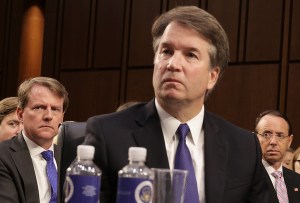
Another reason why Kavanaugh might be thrown overboard, again from the WaPo: Republicans fear reversals in November due to accusation against Supreme Court nominee.
Republicans are bracing for political aftershocks from the sexual assault accusation against Supreme Court nominee Brett M. Kavanaugh, with some expressing fear that the coming investigation will refocus the nation’s attention on an issue that could drive up the Democratic vote in the midterm elections.
The initial hope that the conservative Kavanaugh’s appointment would encourage turnout by grateful GOP voters this fall has been tempered by new fears that more voters, especially independent women, might head to the polls with fresh anger about Republican handling of sexual impropriety after a new round of public hearings.
Anita Hill testifying in 1991
“It’s not just about Kavanaugh but more about the midterms,” Rick Hohlt, a Republican lobbyist and veteran strategist, said of the party’s concerns. “With more women running for public office than ever before and the majority of them being Democrats, we could have a 1992 situation.”
That’s a reference to the elections in 1992, dubbed the “Year of the Woman” after the number of women elected to the House nearly doubled, to 47, and the number of women elected to the Senate tripled, to six. The election came one year after Justice Clarence Thomas was confirmed to the Supreme Court despite allegations that he had sexually harassed a subordinate, Anita Hill, in the workplace.
Even before the accusation against Kavanaugh surfaced, polls showed women preferred Democrats more than men did and were more likely to disapprove of President Trump, who faced accusations of sexual misconduct by 19 women before his 2016 election. A Washington Post-ABC News poll in late August found 58 percent of female registered voters intended to cast a ballot for a Democrat for Congress, compared with 45 percent of men.

Remember Mitch McConnell never wanted Trump to appoint Kavanaugh. It’s a long time until next Monday’s scheduled hearing. A lot can happen in that time. My guess is the Republicans will cut Kavanaugh loose. Certainly, if another woman comes forward, he will be dead in the water.
Meanwhile, FEMA’s threatened presidential emergency alert system rollout has been postponed because of all the protests. NBC News:
The Federal Emergency Management Agency, which oversees the wireless emergency alert (WEA) system, announced that the test that had been scheduled for Thursday will be pushed back to Oct. 3, citing the “ongoing response efforts to Hurricane Florence.”
Postponed, thank goodness!
The initial announcement was met with concerns from social media users who stated that a direct message from President Donald Trump to the nation could be used for political purposes, similar to how he uses his official Twitter page.
Many also went on to raise the issue of the alert being mandatory, with no way to opt of it. One user even messaged Verizon Wireless, one of the 100 wireless service companies that have agreed to provide the alert to their network, asking how she can avoid receiving it.
Some users even threatened to cancel their cellphone service, while others said they would protest the test by turning their phones off, creating the hashtag #GoDark920 in response to the original test date.
Stephen Cobb, a security researcher at ESET, a technology security company, tweeted via his verified account that the blowback against the test indicated the broader frustration with the president.
“This POTUS is so bad that folks are prepared to forgo the potential benefits of a national alert system – which already exists on radio and TV – because it is hard to believe Trump will not abuse it.”

As long as we’re talking about the sexual predator in the White House, I might as well include this creepy info from The Guardian on Stormy Daniels’s tell-all book:
Trump’s bodyguard invites Daniels to dinner, which turns out to be an invitation to Trump’s penthouse, she writes, in a description of alleged events that Daniels has disclosed previously but which in the book are rendered with new and lurid detail. She describes Trump’s penis as “smaller than average” but “not freakishly small.”
“He knows he has an unusual penis,” Daniels writes. “It has a huge mushroom head. Like a toadstool…
“I lay there, annoyed that I was getting fucked by a guy with Yeti pubes and a dick like the mushroom character in Mario Kart…
“It may have been the least impressive sex I’d ever had, but clearly, he didn’t share that opinion.”
Ugh. Still, I’d love to be a fly on the wall when someone reads this to Trump.
Finally, if you haven’t already done so, you should read Hillary Clinton’s new essay at The Atlantic: American Democracy Is in Crisis.
It’s been nearly two years since Donald Trump won enough Electoral College votes to become president of the United States. On the day after, in my concession speech, I said, “We owe him an open mind and the chance to lead.” I hoped that my fears for our future were overblown.
They were not.
Hillary Clinton photographed by Annie Leibovitz
In the roughly 21 months since he took the oath of office, Trump has sunk far below the already-low bar he set for himself in his ugly campaign. Exhibit A is the unspeakable cruelty that his administration has inflicted on undocumented families arriving at the border, including separating children, some as young as eight months, from their parents. According to The New York Times, the administration continues to detain 12,800 children right now, despite all the outcry and court orders. Then there’s the president’s monstrous neglect of Puerto Rico: After Hurricane Maria ravaged the island, his administration barely responded. Some 3,000 Americans died. Now Trump flatly denies those deaths were caused by the storm. And, of course, despite the recent indictments of several Russian military intelligence officers for hacking the Democratic National Committee in 2016, he continues to dismiss a serious attack on our country by a foreign power as a “hoax.”
Trump and his cronies do so many despicable things that it can be hard to keep track. I think that may be the point—to confound us, so it’s harder to keep our eye on the ball. The ball, of course, is protecting American democracy. As citizens, that’s our most important charge. And right now, our democracy is in crisis.
I don’t use the word crisis lightly. There are no tanks in the streets. The administration’s malevolence may be constrained on some fronts—for now—by its incompetence. But our democratic institutions and traditions are under siege. We need to do everything we can to fight back. There’s not a moment to lose.

Read the rest at the Atlantic link.
Friday Reads: The Overlords are winning
Posted: January 23, 2015 Filed under: morning reads, U.S. Politics | Tags: brine spill, Fair Housing Act, oil spill, Roe v. Wade, Southern Strategy 8 Comments Good Morning!
The combination of low voting patterns and big money in politics is finally coming to an ugly fruition. The plan was all laid out in the Powell memo of 1971. Its leaking to Jack Anderson will probably be remembered as one of the last acts of a press free of uber-corporate ownership and manipulation. It was also the beginning of the framework that ultimately led to the Citizen’s United case 5 years ago establishing a freedom of speech right for corporations best encapsulated by Mitt Romney’s famous gaffe in Iowa of “Corporations are people, my friend”.
Though Powell’s memo was not the sole influence, the Chamber and corporate activists took his advice to heart and began building a powerful array of institutions designed to shift public attitudes and beliefs over the course of years and decades. The memo influenced or inspired the creation of the Heritage Foundation, the Manhattan Institute, the Cato Institute, Citizens for a Sound Economy, Accuracy in Academe, and other powerful organizations. Their long-term focus began paying off handsomely in the 1980s, in coordination with the Reagan Administration’s “hands-off business” philosophy.
Most notable about these institutions was their focus on education, shifting values, and movement-building — a focus we share, though often with sharply contrasting goals.* (See our endnote for more on this.)
So did Powell’s political views influence his judicial decisions? The evidence is mixed. Powell did embrace expansion of corporate privilege and wrote the majority opinion in First National Bank of Boston v. Bellotti, a 1978 decision that effectively invented a First Amendment “right” for corporations to influence ballot questions. On social issues, he was a moderate, whose votes often surprised his backers.
The combination of the Southern Strategy, the business interests behind the Powell Memo, and the insipid and wrongly labelled “Moral Majority” has created an unholy trinity of neoconfederates, billionaire plutocrats, and christianist extremists that now drive the Republican Party. We now have a SCOTUS and majority in Congress set to undo many of the advances of the late 20th century. A lot of this came from the mind of Nixon and his cronies.
… Democrats were expanding rights while the Republicans wanted to narrow them or keep them restrictive.
This realignment did not exactly start with Nixon or end with him. Barry Goldwater had voted against the 1964 Civil Rights Act (although he had supported other civil rights bills), but the GOP in general then was unencumbered by a Southern constituency and its leadership often favored civil rights.
After Nixon, though, there was no turning back. In 1980, Ronald Reagan — ever the innocent — went to Mississippi and the Neshoba County Fair to tastelessly proclaim his belief in “states’ rights.” Nearby, three civil rights worked had been killed just 16 years earlier, protesting one of those bogus rights — the right to segregate the races. Reagan never acknowledged any appeal to racism. Racists took it as a wink anyway.
At one time, a good many African-Americans voted Republican — the party of Lincoln, after all. Jackie Robinson initially supported Nixon , as did Joe Louis. The former heavyweight champion had even supported a Republican in the 1946 congressional campaign against Rep. Helen Gahagan Douglas, a liberal civil rights advocate, whose California district was substantially black. As late as the 1970s, there were African-American enclaves in Maryland that voted Republican.
The damage Nixon did to his own party, not to mention the rights of African-Americans and the cause of racial comity, has lasted long after the stench of Watergate has dispersed. It not only persuaded blacks that the Republican Party was inhospitable to them, but it in effect welcomed racists to the GOP fold. Dixiecrats moved smartly to the right.
Excuse me for extrapolating, but segregationists are not merit scholarship winners. Racism is dumb, and so are racists. The Democratic Party showed racists the door.
The GOP welcomed them and, of course, their fellow travelers — creationists, gun nuts, anti-abortion zealots, immigrant haters of all sorts and homophobes. Increasingly, the Republican Party has come to be defined by what it opposes and not what it proposes. Its abiding enemy is modernity.
The first death knell of democracy was probably the undoing of the Fairness Doctrine followed closely by the demonization of labor via the busting of the Air  Traffic Controller’s Union. There are a lot of reasons why the FCC should try to bring it back. The primary one I can think of is the disservice the Fox Propaganda network does to the country in terms of Science and truth. There was some paranoia in the right wing last year that the FCC was thinking about a Fairness Doctrine 2.0.
Under the controversial doctrine, which the FCC abandoned in 1987 and formally took off the books in 2011, the agency required radio and TV stations to air opposing views on controversial issues.
Pai expressed alarm that the FCC could soon start questioning why Fox spends so much time covering the attacks in Benghazi, or why NBC has focused on the controversy over lane closures in New Jersey.
House Republicans made a similar accusation in December, claiming the FCC was working on a “Fairness Doctrine 2.0.”
“Given the widespread calls for the commission to respect the First Amendment and stay out of the editorial decisions of reporters and broadcasters, we were shocked to see that the FCC is putting itself back in the business of attempting to control the political speech of journalists,” Republican members of the House Energy and Commerce Committee wrote in a letter to the FCC.
“It is wrong, it is unconstitutional, and we urge you to put a stop to this most recent attempt to engage the FCC as the ‘news police.’
The controversy stems from a study the agency plans to conduct on “critical information needs.” The FCC is required by law to study ways to eliminate barriers to entry for small media businesses.
Among other things, the agency plans to ask TV journalists about their “news philosophy” and “the process by which stories are selected.” The study will gather data on “perceived station bias” and “perceived responsiveness to underserved populations.” The FCC also wants to examine how local TV stations cover “critical information” such as “economic opportunities” and the “environment”.
 There have been many more instances of cases sent to the Supreme Court and end runs by states around civil rights and liberties like the christianists’ obsession with ending a woman’s right to an abortion without exception in the first two trimesters. We’re beginning to see some of the final steps in the plan this year. We’ve watched the court gut the Voting Rights Act. Are they now set to gut the major provisions of the Fair Housing Act?
A sharply divided US Supreme Court on Wednesday took up a challenge to the Fair Housing Act (FHA) in an action that liberal critics say could gut the major civil rights provision.
At issue in a case from Dallas, Texas, is whether the housing law authorizes lawsuits over racially neutral measures that nonetheless disproportionately impact minority residents.
Liberals support the so-called disparate impact theory of civil rights enforcement, while conservatives warn that such an approach could lead to racial quotas in housing and other areas.
The case has attracted significant attention, with friend-of-the-court briefs filed by various civil rights groups, 17 states, and 20 cities and counties. On the other side, briefs have been filed by a number of conservative groups and business associations, including insurance companies, banks, finance companies, and home builders.
The FHA prohibits anyone from refusing to sell, rent, or otherwise make unavailable a house or apartment to a person because of their race, religion, or national origin. There is no dispute about this aspect of the law.
After the FHA was enacted in 1968, federal courts and agencies began embracing a broader interpretation of the law’s scope, concluding that, in addition to barring intentional discrimination, the statute also authorizes lawsuits when housing decisions disproportionately harm minority groups.
The case before the high court involves a lawsuit challenging decisions by the Texas Department of Housing and Community Affairs in awarding tax credits for low-income housing in Dallas. The Housing Department sought to provide new affordable housing in areas where existing housing was blighted or nonexistent. It sought to do so under race-neutral criteria.
Despite that goal, not everyone was satisfied with the agency’s performance. A Dallas-based group seeking to foster racial integration, the Inclusive Communities Project, sued the Housing Department because it said the agency had failed to provide adequate opportunities for low-income housing in Dallas’ more affluent suburbs.
Also percolating its way through Congress is a ban on all abortions after 20 weeks based on the nonscientific nonsense that the nervous system of a fetus is developed enough at that point to experience pain. It is not. It’s the usual, sneaky, lying way that religionists use to confuse the easily confused. A controversial provision caused the bill to be tabled. Republican Congresswomen were upset by a redefinition of rape tucked away in the bill that sought to ensure that only narrowly approved definitions of “rape” would be treated differently.
It’s one thing to campaign on stopping abortion—it has been a largely successful GOP plank since Roe v. Wade, and one that helped create a juggernaut connection between evangelical Christians and the Republican Party. (Yes, there have been occasional hiccups.) But it’s a different and more complicated matter to actually institute sweeping restrictions successfully.
Republicans have sought for years to ban abortions after 20 weeks. (Molly Redden has a definitive history.) The House GOP has been trying directly for the last few years, but each attempt has come to nought. Besides, even a successful House bill would have run into the Democratic Senate. But with a newly enormous majority in the House and a newly minted majority in the Senate, Republicans finally had a chance to get a bill to the president. While Obama would surely reject it, it would be a powerful political gesture and please the party’s pro-life allies. Even better, they had the opportunity to schedule the vote to coincide with the March for Life in Washington on Thursday.
They almost made it, but then the GOP coalition fell apart—not on wavering opposition to abortion overall, but on the technicalities. Like many such proposals, the bill would have allowed for exceptions in a few limited cases, such as rape. This bill made rape an exception, but only if a woman reported it to law enforcement. As Ed O’Keefe reports, that set off alarms for a bloc of female Republican lawmakers. They worried that the rape-reporting restriction was too strict, and that the bill would alienate young voters and women from the party. And so Wednesday evening, GOP leaders abruptly yanked the bill. Instead, the House passed a less restrictive bill Thursday, permanently banning federal money from going to pay for abortions. A ban already exists, but it has to be renewed every year.
The vise in which the party finds itself is easy to understand but hard to loosen. On the one hand, the party’s religious base has worked hard for Republicans and expects to see results, and most elected officeholders are personally pro-life. (Pulling the bill when thousands of the most fervent pro-lifers are in Washington must be an especially bitter pill for leaders.) But everyone knows the GOP faces a demographic time bomb, since its voters are older and whiter and more pro-life than the general population, so it’s risky to do anything that might make it harder to win them over.
North Carolina’s Renee Ellmers, one of the prominent dissenters in this case and now a target for grassroots conservative fury, is no swing-district moderate. She won reelection in November by defeating American Idol also-ran Clay Aiken by a whopping 18 points. Ellmers removed her name as a sponsor, then said she would vote for the bill—but still requested that no vote be held until concerns could be addressed.
It’s a surprising and little-known fact that opinions about abortion have barely budged in the American public in the 42 years since Roe. As Karlyn Bowman and Jennifer Marsico wrote for The Atlantic, despite years of heated debate, a slight majority of Americans still consistently back legal abortion, even as they personally oppose it. The GOP has found great success at enacting restrictions in states it dominates.
Indeed, it seems that Republican men want certain exemptions to the act of “rape”. It’s amazing to see that Republican women rebelled at the idea of “legitimate rape”.
In sum, some Republican women basically shamed the House into dropping the vote for the bill, mostly because they’re worried it’s going to kick off another “legitimate rape” debacle as male Republicans go on cable TV to brag about the bill and are asked to explain why they only allow for rape exceptions if the victims have reported to the police.
What’s really amazing about this story is that Rep. Renee Ellmers and other female Republicans were pretty much guaranteed to support the bill if the male Republicans allowed for what is really a minor tweak in the language, allowing the rape exception to cover all rape victims, not just the minority that file police reports. After all, this bill is just a symbolic gesture, a wet kiss to the Bible-thumpers amassing on the Hill today for the annual rite of lady-hating sex phobia known as the March for Life. Obama was going to veto it anyway. They had nothing to lose by expanding the definition of “rape” to mean any time a man forces sex on a woman. In fact, they should have welcomed the change, because the original language would have meant reporters asking male Republicans why they require women to file police reports to be believed, which in turn means someone was bound to start talking about “legitimate rape”. Ellmers is hardly some kind of political genius. It doesn’t take a rocket scientist to see where this was headed.
So I’m forced to conclude the reason that so many male Republicans were unwilling to concede this teeny weeny issue is that it was really important to them to pass a bill that formally suggests that women frequently lie about being raped and should be assumed to be lying until a man, in this case a police officer, blesses her account of what happened.
It would be easy to see all of this as the last vestiges of old, white male privilege. Afterall, the news is full of things like this: “A Shocking Number of Americans Under 30 Have No Religion — This Country Is Going to Change.” Again, I keep hoping that we’ll be able to dance on the graves of the Koch Brothers, Pat Robertson, Antonin Scalia, Phyliss Schafly and the like and that it will all go away. Still, it took like 40 years for them to undo so many things. It seems like it will take longer than that to put it all back together again and actually make progress.
And as the Keystone Pipeline Boondoggle snakes its way through this very corrupt Congress, we get news of two pipeline disasters. The first one is in Montana.

A second large oil spill into Montana’s Yellowstone River in less than four years is reviving questions about oversight of the nation’s aging pipeline network.
Investigators and company officials on Wednesday were trying to determine the cause of the 40,000-gallon spill that contaminated downstream water supplies in the city of Glendive.
Sen. Jon Tester said Saturday’s spill from the decades-old Poplar Pipeline was avoidable, but “we just didn’t have the folks on the ground” to prevent it.
The Montana Democrat told The Associated Press more frequent inspections by regulators are needed, and older pipelines should face stricter safety standards.
“We need to take a look at some of these pipelines that have been in the ground for half a century and say, ‘Are they still doing a good job?'” Tester said.
The latest spill comes as Republicans and some Democrats, including Tester, want the Obama administration to approve TransCanada’s Keystone XL pipeline from Canada to the Gulf.
Keystone would cross the Yellowstone roughly 20 miles upstream of the Poplar Pipeline spill.
The second is in North Dakota where three million gallons of fracking brine spilled.
Almost 3 million gallons of saltwater drilling waste spilled from a North Dakota pipeline earlier this month, a spill that’s now being called the state’s largest since the North Dakota oil boom began.
The brine, which leaked from a ruptured pipeline about 15 miles from the city of Williston, has affected two creeks, but it doesn’t currently pose a threat to drinking water or public health. The pipeline’s operator — Summit Midstream Partners — discovered the spill on Jan. 6, but officials didn’t find out about the true size of the spill until this week.
The pipeline company has been trying to clean up the spill by vacuuming water from the creek, but in doing so, they’re also capturing a lot of fresh water.
“The problem is that … the creekbed is kinda being replenished with water so we extract, it fills; we extract, it fills,” John Morgan, a spokesman for Summit Midstream told the Grand Forks-Herald.
North Dakota Department of Health Environmental Health Section Chief Dave Glatt said he hasn’t seen any impacts to wildlife yet, but officials won’t likely know the full impact until all the ice melts. Officials have discovered chloride concentrations in Blacktail Creek as high as 92,000 milligrams per liter — far higher than normal concentrations of about 10 to 20 milligrams per liter.
“That has the ability to kill aquatic life and so we’ll want to see if the aquatic life was able to get out of the way, and if they weren’t, how badly they were impacted,” Glatt said.
Greed, religious extremism, and bigotry! Say hello to SCOTUS and the new Congress!
I find all of this very, very depressing. What’s on your reading and blogging list today?

 peej
peej Carissa
 bostonboomer
 dakinikat
 ecocatwoman
 mablue2
 Mama Lopez
 peggysue22
 quixote
 skydancingguestblogger
 Mona (aka Wonk the Vote)



 Sky Dancing
Recent Comments