
Trump’s main rivals were able to meet minimum thresholds to collect delegates in many of the Super Tuesday contests. But Trump regained his momentum in the March 8 contests, winning three – Michigan, Mississippi and Hawaii – while Cruz prevailed in Idaho.
Yet there is a key Republican convention rule, known as Rule 40, which could hand Trump the nomination on a silver platter because it limits the number of nominees while prohibiting certain attempts to steal the nomination away from a front runner.
The purpose of this rule was to help ensure the coronation of a clear front runner and to give a presumptive nominee a celebratory sendoff into the general election. Prior to the 2012 convention, this rule required a candidate to have won a plurality of delegates in at least five states to have his or her name put into nomination at the convention.
However, once Mitt Romney secured enough delegates to win the 2012 nomination, his supporters (especially key adviser-operative Ben Ginsburg) got this rule revised to block any person from being nominated at the convention unless he or she had won a majority of delegates in at least eight states. (Part of Romney’s reasoning was to freeze out a major floor demonstration of support for libertarian Rep. Ron Paul of Texas and thus to present to the nation watching on TV a united party rallying behind the former Massachusetts governor.)
In addition to prohibiting the recording of any delegates won by candidates who failed to meet the eight-state threshold, Rule 40 barred delegates from promoting a groundswell on the convention floor for any person who did not participate in the state contests. Thus, the rule prevents a modern-day replay of the “We Want Willkie” selection of Wendell Willkie at the 1940 Republican convention. (Ironically, that would now rule out a stealth establishment strategy to mount a “Romney, Romney” uprising at the convention in Cleveland.)
It remains to be seen if and when Trump and his rivals can secure majorities of the delegates in eight states. Trump has met that threshold in seven of the 15 states in which he has won the most votes, meaning he is just one state short of the threshold.
Cruz has won the most votes in seven states and secured a majority of delegates in four states: Idaho, Kansas, Maine and Texas. In other words, the Texas senator is halfway there.
Monday Reads: Attack of the Killer Bunnies
Posted: March 21, 2016 Filed under: Afternoon Reads | Tags: Donald Trump, Killer Bunnies, Republican establishment 24 Comments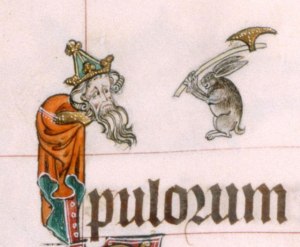 Good Morning!
Things can frequently come in confusing packages. Take my choice of Killer Bunnies today for your visual enjoyment. You just wouldn’t think those cute little furry things could be the source of any one’s nightmare! Yet here there they are! It’s much easier to envision a critter gone bad when it looks positively evil.
I’m with Frank Rich who thinks it’s nuts when all the bunnies in the Republican Party keep saying that Donald Trump is not one of them. They all seem genuinely confused when it’s really quite easy. Donald Trump is their FrankenBunny.
The Republican Elites. The Establishment. The Party Elders. The Donor Class. The Mainstream. The Moderates. Whatever you choose to call them, they, at least, could be counted on to toss the party-crashing bully out.
To say it didn’t turn out that way would be one of the great understatements of American political history. Even now, many Republican elites, hedging their bets and putting any principles in escrow, have yet to meaningfully condemn Trump. McCain says he would support him if he gets his party’s nomination. The Establishment campaign guru who figured the Trump problem would solve itself moved on to anti-Trump advocacy and is now seeking to unify the party behind Trump, waving the same white flag of surrender as Chris Christie. Every major party leader — Paul Ryan, Mitch McConnell, Reince Priebus, Kevin McCarthy — has followed McCain’s example and vowed to line up behind whoever leads the ticket, Trump included. Even after the recurrent violence at Trump rallies boiled over into chaos in Chicago, none of his surviving presidential rivals would disown their own pledges to support him in November. Trump is not Hitler, but those who think he is, from Glenn Beck to Louis C.K., should note that his Vichy regime is already in place in Washington, D.C.
Since last summer, Trump, sometimes in unwitting tandem with Bernie Sanders, has embarrassed almost the entire American political ecosystem — pollsters, pundits, veteran political operatives and the talking heads who parrot their wisdom, focus-group entrepreneurs, super-pac strategists, number-crunching poll analysts at FiveThirtyEight and its imitators. But of all the emperors whom Trump has revealed to have few or no clothes, none have been more conspicuous or consequential than the GOP elites. He has smashed the illusion, one I harbored as much as anyone, that there’s still some center-right GOP Establishment that could restore old-school Republican order if the crazies took over the asylum.
The reverse has happened instead. The Establishment’s feckless effort to derail Trump has, if anything, sparked a pro-Trump backlash among the GOP’s base and, even more perversely, had the unintended consequence of boosting the far-right Ted Cruz, another authoritarian bomb-thrower who is hated by the Establishment as much as, if not more than, Trump is. (Not even Trump has called McConnell “a liar,” which Cruz did on the Senate floor.) The elites now find themselves trapped in a lose-lose cul-de-sac. Should they defeat Trump on a second or third ballot at a contested convention and install a regent more to their liking such as Ryan or John Kasich — or even try to do so — they will sow chaos, not reestablish order. In the Cleveland ’16 replay of Chicago ’68, enraged Trump and Cruz delegates, stoked by Rush Limbaugh, Laura Ingraham, Matt Drudge, et al., will go mano a mano with the party hierarchy inside the hall to the delectation of television viewers while Black Lives Matter demonstrators storm the gates outside.
Republican Donors are acting in backrooms all over the country. It’s probably coming a lot too late, but what’s left to really stop Trump? Utah?
If Donald Trump becomes the Republican Party’s nominee, Utahns would vote for a Democrat for president in November for the first time in more than 50 years, according to a new Deseret News/KSL poll.
“I believe Donald Trump could lose Utah. If you lose Utah as a Republican, there is no hope,” said former Utah Gov. Mike Leavitt, a top campaign adviser to the GOP’s 2012 nominee, Mitt Romney.
The poll found that may well be true. Utah voters said they would reject Trump, the GOP frontrunner, whether former Secretary of State Hillary Clinton or Vermont Sen. Bernie Sanders is the Democratic candidate on the general election ballot.
Yes, Tuesday night is the night Donald Trump will likely get “whipped in Utah”. Does it really matter? And, Cruz is the overwhelming favorite there. Is that the like the utlimate Hobson’s choice or what?
The good news for Donald Trump’s foes: Three lions of Utah Republican politics agree the insurgent billionaire is the wrong choice for 2016.
The bad news: They can’t agree on the right choice to stop him.
Mitt Romney, beloved by Utah’s heavily Mormon and conservative electorate, sought to steer his party toward Ted Cruz on Friday, pledging to vote for Cruz at Tuesday’s caucuses as part of a strategic voting strategy to deny Trump delegates.
But instead of falling in line behind Romney, one of his closest allies, former Utah Gov. Mike Leavitt, threw his voice behind John Kasich instead. And Gary Herbert, Utah’s current governor, says his heart’s also with Kasich, but he can’t bring himself to offer an official endorsement when Utah’s hard-right voters more clearly line up with Cruz. So Herbert’s sitting this one out entirely.
Adding further confusion to the tangled messaging: a fourth favorite Utah son, former Utah Gov. Jon Huntsman, has ruled out backing Kasich — despite what he described as lobbying by Kasich’s allies for his support. Though he’s offered no endorsement either, he’s been less hostile to Trump than his fellow Utah leaders, praising his call to focus more American dollars on domestic infrastructure and signaling support for Trump if he’s the party’s nominee.
Interviews with the state’s last three governors reveal a Utah-based discord that doubles a microcosm of the dispute wracking Republican insiders around the country. Huge swaths of Republican Party loyalists are working feverishly to deny Trump the GOP nomination — afraid he could redefine the party’s brand and doom it to electoral oblivion for a generation, if not destroy it altogether. Yet their attempts to bring down Trump, while united in principal, have been scattershot and at times at cross-purposes in practice.
You can look up all the little Red Blogs that are apoplectic about this. Just Google it. I’m still wondering what the Trump v. Clinton general election is going to be all about. I  keep wondering what those hapless media and pundits who did the debates and townhalls are going to do with both of these folks on the same damn stage. It should be pretty popcorn worthy. Things certainly bounce off Trump much differently than Hillary. The media’s rampant sexism is undoubtedly a contributing factor.
When is a gaffe not a gaffe? When Donald Trump says it.
Over a period of 72 hours earlier in the month, the Republican front-runner faced a campaign crisis after unrest at his events forced him to cancel a rally in Chicago. He responded, not by apologizing but by justifying his supporters’ violent reactions to protesters at his events and offering to pay legal fees.
Meanwhile, Hillary Clinton spent much of the same period cleaning up misstatements about former first lady Nancy Reagan’s role in addressing the AIDS epidemic, whether her policies would kill coal-mining jobs and her husband’s 1993 health care plan.
The three-day window offered a glimpse into an extraordinary campaign cycle, in which strategists on both sides are wondering whether Trump’s penchant for provocation has shifted the gaffe gauge in American politics.
His bombast already has shaken up the Republican primary contest. Now, as the race moves toward the general election, new questions have arisen about a double standard in political rhetoric —— one for Trump and another for everyone else.
“Trump’s ‘gaffes’ haven’t hurt him because a certain segment of GOP primary voters actually support the things he is saying and the way he is saying them,” said Dan Pfeiffer, a former Obama adviser.
Mike DuHaime, a Republican strategist and former adviser to New Jersey Gov. Chris Christie’s presidential campaign, says that the image Trump projects as a political outsider has superseded the controversy that surrounds him. Christie has endorsed Trump.
Whether by mistake or intention, there’s little question that Trump’s eruptions are key to his strategy.

I haven’t had a chance to check out the AIPAC meetings today but it’s usually an interesting indicator of foreign policy chops. So, Hillary explained a lot of stuff and is seen as pro-Israel and hawkish. Bernie just skipped the entire thing because foreign policy has never been his thing but his staff sent them a nice glossy brochure. The Donald, well, he’s getting the full on treatment,
But it’s not Trump’s comments or his opaque policy positions on Israel and the Middle East that bother many of the Jewish leaders who plan on protesting him Monday. It’s the general demagogic tone and tenor of a campaign and candidate who, they believe, is dividing the country.
“When he belittles his opponents, refers to ethnic groups as a monolithic group, the way he speaks about immigrants with disdain, the way he encourages violence, those are things that have been turned against Jews and used against Jews in the not-so-distant past. So there is a real sensitivity to that in our community,” Raskin said. “Those are issues we feel a responsibility to respond to as people who are teachers of religion.”
“What Donald Trump has engaged in is something significantly different than any other candidate in political history. For obvious reasons, the challenge to those who are somehow ‘the other,’ and the use of inflammatory language, the rhetoric of hate and division, we think is unbecoming not only of a presidential candidate but anybody in American political discourse,” said Rabbi Irwin Zeplowitz of Port Washington, New York, whose newly formed group, “Come Together Against Hate,” plans to sit through Trump’s speech in silent protest.
Michael Koplow, the policy director for the Israel Policy Forum based in Washington, wrote last week about the importance of sending a message to Trump.
“AIPAC cannot be seen as legitimizing Trump, even if it provides him with a pulpit,” he wrote on the IPF’s ‘Matzav’ blog. “If this means allowing the crowd to boo, or multiple anonymous quotes to journalists from AIPAC grandees about how odious they find Trump, or some other way of signaling that Trump is outside the boundaries of what is acceptable in the American political arena, it must be done. … Trump must be rejected not on the basis of his approach to Israel; he must be rejected on the basis of everything else. What he does or does not think about Israel is ancillary to the conversation, because American Jews and the state of Israel do not need a friend who looks like this.”
 Hillary went after Trump at AIPAC showing she’s shifted to the General Election as she should. As you know, I’m not an all out supporter of what Israel’s been up to recently under Bibi. So, i’ll put this up with that caveat.
Hillary Clinton used a speech today on Israel and Palestine to slam her potential opponent in the general election, Donald Trump, accusing him of being unqualified to take on the challenges in the Middle East.
“We need steady hands. Not a president who says he’s neutral on Monday, pro-Israel on Tuesday and who knows what on Wednesday because everything’s negotiable,” the Democratic presidential front-runner said during remarks at the American Israel Public Affairs Committee gathering in Washington, D.C., referring to Trump’s recent comment that he is “neutral” on Israel and Palestine.
“America can’t ever be neutral when it comes to Israel’s security or survival. We can’t be neutral when rockets rain down on residential neighborhoods. When civilians are stabbed in the street, when suicide bombers target the innocent,” she continued.
“Some things aren’t negotiable,” she added, “And anyone who doesn’t understand that has no business being our president.”
Hillary and her advisors are being quite open about their strategy on facing Trump in the General.
Neither the Clinton campaign nor several independent super PACs working on her behalf plan to respond with the same brass-knuckles style that Trump has taken with his Republican opponents, aides and outside supporters said. But in their view, Trump isn’t Teflon: Republicans waited too long to go after him, and they went about it the wrong way.
“What the Republicans did was too little, too late,” said David Brock, who runs two pro-Clinton super PACs now engaged in researching and responding to Trump. “It was petty insults. It was not strategic.”
Justin Barasky, spokesman for the large pro-Clinton super PAC Priorities USA, said Republican candidates committed “malpractice” by failing to raise liabilities from Trump’s past or aggressively challenge him on offensive or incorrect statements.
Implicit in the effort is real worry about Trump’s outsider appeal in a year dominated by working-class anger and economic anxiety. The prospect that Trump could compete for some of the blue-collar voters who have flocked to Sanders, for instance — or to reorder the map of competitive states to include trade-affected Michigan or Pennsylvania — has prompted Clinton’s allies to leave nothing to chance.
Yet, they also believe that, although Trump has motivated a loyal plurality of supporters in primary contests, he has limited ability to expand that support once the Republican field clears. Because of the litany of controversial pronouncements he has made, they expect a Trump nomination to make it easier to rally women, Latino and African American voters to turn out for Clinton. In fact, her aides are planning for a historic gender gap between Clinton and Trump.
Given Trump’s willingness to attack his opponents — and his pivot to going after Clinton in recent days — one clear presumption has emerged about the fall contest: It will be ugly.
That’s one reason the former secretary of state plans to counter Trump with high-road substance, policy and issues, according to one senior campaign aide. The idea is to showcase what Clinton’s backers see as her readiness for the job without lowering her to what they describe as Trump’s gutter.
Of course, we have yet to get through what Republicans hope will be a brokered convention where they will be looking for some kind of white knight. There is a key convention rule that can be changed and would need to be changed at this point.
That could be one of the reasons the Republican Killer Bunnies are holding their nose and  giving Ted Cruz a second look. We all know that he’d be bad for all kinds of social justice issues, but he could wreck the economy too. This is from the Street.
The IRS is broken, and the current tax system is convoluted, according to Cruz. He has said he wants doing taxes to “become so simple that they could be filled out on a postcard.”
A simplified tax code is something that Republicans of all stripes have been advocating for years, but Cruz takes this to the extreme.
In 2014 Cruz wrote an op-ed in USA Today calling to abolish the IRS and impose a national flat tax that, as opposed to our current system of progressive taxation, would tax all income levels at the same rate.
Policy wonks argue over the potential economic fallout, but flat tax supporterssuggest that the increased spending resulting from abolishing a complicated tax code with its attendant incentives would give government revenues, in the case of a 17% flat tax, a 1.8 percentage-point shot in the arm.
In a plan like the one Cruz suggests, the poor and middle class would pay more in taxes, but the rich would pay less and have more money to invest back into the economy. A flat tax system would also remove incentives toward consumption by eliminating the various deductions that offset costs, and instead encourage savings. Advocates also argue that the possibility of reaching a higher tax bracket would no longer disincentivize people from earning more and crossing a tax bracket threshold, thus contributing to long-term economic growth.
According to a seminal study by the National Center for Policy Analysis, the flat tax would boost the production core of the economy in every area by getting rid of corporate tax avoidance schemes, except for subsidized agriculture since tax subsidies would be lost there. In the case of a 17% flat tax, there’s also the suggestion that the housing sector would see a 1.5% uptick.
Flat tax opponents, however, argue that such a policy would increase the national deficit because of lost tax revenue in the higher brackets and also would cause outsized economic burdens on the poor while favoring the rich who can shoulder the same tax rates more easily.
Here’s the same analysis with Hillary if you’d like to read it. There is similar analysis for the other candidates. You can compare Bernie and Hillary’s Wall Street policy as viewed  by Wall Street insiders. It’s kind’ve interesting.
My personal thoughts are that Trump will continue to sound more reasonable other than when he’s out the stump with the likes of Arizona’s Sheriff Joe. He’s beginning to get some surrogates–like Palin and Christie–who have no problem sounding outrageous and mean. We’ll just have to see. He’s already called Hillary tired and low energy but it seems like a vanilla threat since every one appears to be smeared with that one.
So, tonight is a townhall with all five remaining candidates on CNN. We will be live blogging it later. Also, tomorrow is the next set of elections. We’ll live blog that too! So stay tuned for more of “Attack of the Killer Rabbits”.
What’s on you reading and blogging list today?
Monday Reads: What Hath Newt Wrought?
Posted: January 23, 2012 Filed under: 2012 presidential campaign, just because, morning reads, Republican presidential politics, U.S. Economy, U.S. Politics | Tags: Barack Obama, Catholic cults, Florida primary, Legionaries of Christ, Marciel Maciel, Mitt Romney, Newt Gingrich, Regnum Christi, Republican debates, Republican establishment, Rick Santorum, South Carolina primary 46 Comments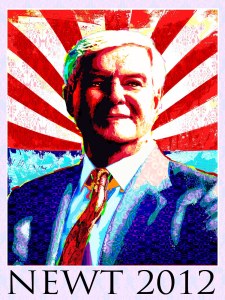
Good Morning!!
How would you like to have to look at that poster until November? Well, quite a few of the pundits are now saying that it could happen. It’s still unlikely as of today, but it’s pretty clear the Republican base simply doesn’t like Mitt Romney, and the only other choices are a crazy old man, a guy who wants to ban birth control and divorce, and Newt Gingrich.
It’s not looking so good for Romney, unless he can start to connect better with Republican voters. He’s still the overall front runner, but if he can’t win big in Florida that could change. Unfortunately for Romney, there’s another debate tonight, and 88% of voters in SC said the debates were very influential in their voting decisions.
I’m fascinated by what is happening to the Republicans, and I spent quite a bit of time yesterday reading opinions on what Newt’s victory in South Carolina means and what might happen next. I thought this morning I’d share some of what I read with you.
Howard Fineman says the Republican race for the nomination will now last “forever, or at least until May.”
The GOP calendar this year is more spread out than it was four years ago, which means that the contest was going to last until at least late April even if Romney had buried Newt Gingrich and Ron Paul long ago. But now that South Carolina has given a boost to Gingrich — and a small but important cache of delegates — it’s clear how long the campaign will last….
Four years ago, nearly 60 percent of all delegates had been chosen by the end of February. Republican officials wanted to correct for that this time around, but they may have overdone it. This year a mere 15 percent of all delegates will have been chosen by the end of February — and even if there were a prohibitive frontrunner (which there is not), no one could mathematically wrap up the nomination before April 24.
Fineman explains that the states have different rules for apportioning delegates. South Carolina is winner take all in each Congressional district. New Hampshire is proportional, so right now Gingrich probably has more delegates than Romney. He suggests there could even be a floor fight at the Convention. And former RNC chairman Michael Steele agrees, saying there’s now a 50-50 chance of that happening.
At Real Clear Politics, Sean Trende writes:
There is no good news buried in here for Mitt Romney. None. As of this writing, Mitt Romney is leading in three counties in South Carolina: Charleston, Beaufort (Hilton Head) and Richland (Columbia). He lost fast-growing, coastal Horry County, home of Myrtle Beach, by 15 points. He lost Greenville and Spartanburg, in the upcountry, by similar margins. He lost Edgefield County by 40 points….
According to the exit polls, Romney lost among every major category of voter. The demographic groups he managed to win include those with postgraduate degrees (18 percent of the electorate), people earning $200,000 or more (5 percent), moderates (23 percent), non-evangelicals (35 percent), and pro-choicers (34 percent). None of the leads over Gingrich in these groups were particularly large.
He says Romney is no longer the inevitable nominee.
Simply put, there are very few states where he can perform among the major demographic groups the way he performed in South Carolina and still expect to win. And remember, this is still in many ways the electorate that selected Christine O’Donnell, Carl Paladino and Linda McMahon as its standard-bearers — in very blue states with relatively moderate GOP electorates, no less.
This vote was an utter repudiation of Romney, and it absolutely will be repeated in state after state if something doesn’t change the basic dynamic of the race. It is true that Gingrich doesn’t have funds or organization, but he gets a ton of free media from the debates, and he has an electorate that simply wants someone other than Romney.
Trende says there about a 35% chance that Romney could lose the nomination now. It turns out that Romney did get some delegates from SC–a total of 2 out of the total of 25. That’s pretty pathetic.

 peej
peej Carissa
 bostonboomer
 dakinikat
 ecocatwoman
 mablue2
 Mama Lopez
 peggysue22
 quixote
 skydancingguestblogger
 Mona (aka Wonk the Vote)



 Sky Dancing
Recent Comments