Yesterday, Time Magazine published an interview with Donald Trump. Why did he choose Time to reveal his plans for rescinding the Constitution if he is elected in November? I’d guess it’s because he wanted another Time cover to add to his collection. He’s a demented old man who doesn’t realize that Time long ago became fairly irrelevant. But they certainly got the attention of the the political world yesterday. Trump spelled out his plans for 2025 and beyond and they are horrifying.
I agree with this tweet that Aaron Rupar posted after reading the article:
I increasingly believe this election will be a referendum on whether anything matters anymore. There’s no rational case for Trump, but there’s a loud contingent on the left that just wants to burn it down. Combine that with low information voters and Republicans circling the wagons around their guy, and you have the outlines of a calamity. Hopefully people wake up.
Here’s the Time interview, followed by commentary from other publications. I’ve cut out the author’s cutesy commentary and just included Trump’s plans.
Six months from the 2024 presidential election, Trump is better positioned to win the White House than at any point in either of his previous campaigns. He leads Joe Biden by slim margins in most polls, including in several of the seven swing states likely to determine the outcome. But I had not come to ask about the election, the disgrace that followed the last one, or how he has become the first former—and perhaps future—American President to face a criminal trial. I wanted to know what Trump would do if he wins a second term, to hear his vision for the nation, in his own words.
What emerged in two interviews with Trump, and conversations with more than a dozen of his closest advisers and confidants, were the outlines of an imperial presidency that would reshape America and its role in the world. To carry out a deportation operation designed to remove more than 11 million people from the country, Trump told me, he would be willing to build migrant detention camps and deploy the U.S. military, both at the border and inland. He would let red states monitor women’s pregnancies and prosecute those who violate abortion bans. He would, at his personal discretion, withhold funds appropriated by Congress, according to top advisers. He would be willing to fire a U.S. Attorney who doesn’t carry out his order to prosecute someone, breaking with a tradition of independent law enforcement that dates from America’s founding. He is weighing pardons for every one of his supporters accused of attacking the U.S. Capitol on Jan. 6, 2021, more than 800 of whom have pleaded guilty or been convicted by a jury. He might not come to the aid of an attacked ally in Europe or Asia if he felt that country wasn’t paying enough for its own defense. He would gut the U.S. civil service, deploy the National Guard to American cities as he sees fit, close the White House pandemic-preparedness office, and staff his Administration with acolytes who back his false assertion that the 2020 election was stolen.
Trump remains the same guy, with the same goals and grievances. But in person, if anything, he appears more assertive and confident. “When I first got to Washington, I knew very few people,” he says. “I had to rely on people.” Now he is in charge. The arranged marriage with the timorous Republican Party stalwarts is over; the old guard is vanquished, and the people who remain are his people. Trump would enter a second term backed by a slew of policy shops staffed by loyalists who have drawn up detailed plans in service of his agenda, which would concentrate the powers of the state in the hands of a man whose appetite for power appears all but insatiable. “I don’t think it’s a big mystery what his agenda would be,” says his close adviser Kellyanne Conway. “But I think people will be surprised at the alacrity with which he will take action.” [….]
In a second term, Trump’s influence on American democracy would extend far beyond pardoning powers. Allies are laying the groundwork to restructure the presidency in line with a doctrine called the unitary executive theory, which holds that many of the constraints imposed on the White House by legislators and the courts should be swept away in favor of a more powerful Commander in Chief.
TV Man, by Michael Vincent Manalo
Nowhere would that power be more momentous than at the Department of Justice. Since the nation’s earliest days, Presidents have generally kept a respectful distance from Senate-confirmed law-enforcement officials to avoid exploiting for personal ends their enormous ability to curtail Americans’ freedoms. But Trump, burned in his first term by multiple investigations directed by his own appointees, is ever more vocal about imposing his will directly on the department and its far-flung investigators and prosecutors.
In our Mar-a-Lago interview, Trump says he might fire U.S. Attorneys who refuse his orders to prosecute someone: “It would depend on the situation.” He’s told supporters he would seek retribution against his enemies in a second term. Would that include Fani Willis, the Atlanta-area district attorney who charged him with election interference, or Alvin Bragg, the Manhattan DA in the Stormy Daniels case, who Trump has previously said should be prosecuted? Trump demurs but offers no promises. “No, I don’t want to do that,” he says, before adding, “We’re gonna look at a lot of things. What they’ve done is a terrible thing.”
Trump has also vowed to appoint a “real special prosecutor” to go after Biden. “I wouldn’t want to hurt Biden,” he tells me. “I have too much respect for the office.” Seconds later, though, he suggests Biden’s fate may be tied to an upcoming Supreme Court ruling on whether Presidents can face criminal prosecution for acts committed in office. “If they said that a President doesn’t get immunity,” says Trump, “then Biden, I am sure, will be prosecuted for all of his crimes.” (Biden has not been charged with any, and a House Republican effort to impeach him has failed to unearth evidence of any crimes or misdemeanors, high or low.)
On his goal of mass deportation of immigrants:
Trump’s radical designs for presidential power would be felt throughout the country. A main focus is the southern border. Trump says he plans to sign orders to reinstall many of the same policies from his first term, such as the Remain in Mexico program, which requires that non-Mexican asylum seekers be sent south of the border until their court dates, and Title 42, which allows border officials to expel migrants without letting them apply for asylum. Advisers say he plans to cite record border crossings and fentanyl- and child-trafficking as justification for reimposing the emergency measures. He would direct federal funding to resume construction of the border wall, likely by allocating money from the military budget without congressional approval. The capstone of this program, advisers say, would be a massive deportation operation that would target millions of people. Trump made similar pledges in his first term, but says he plans to be more aggressive in a second. “People need to be deported,” says Tom Homan, a top Trump adviser and former acting head of Immigration and Customs Enforcement. “No one should be off the table.”
For an operation of that scale, Trump says he would rely mostly on the National Guard to round up and remove undocumented migrants throughout the country. “If they weren’t able to, then I’d use [other parts of] the military,” he says. When I ask if that means he would override the Posse Comitatus Act—an 1878 law that prohibits the use of military force on civilians—Trump seems unmoved by the weight of the statute. “Well, these aren’t civilians,” he says. “These are people that aren’t legally in our country.” He would also seek help from local police and says he would deny funding for jurisdictions that decline to adopt his policies. “There’s a possibility that some won’t want to participate,” Trump says, “and they won’t partake in the riches.”
Helen Lundeberg, Biological Fantasy, 1946
On Abortion:
As President, Trump nominated three Supreme Court Justices who voted to overturn Roe v. Wade, and he claims credit for his role in ending a constitutional right to an abortion. At the same time, he has sought to defuse a potent campaign issue for the Democrats by saying he wouldn’t sign a federal ban. In our interview at Mar-a-Lago, he declines to commit to vetoing any additional federal restrictions if they came to his desk. More than 20 states now have full or partial abortion bans, and Trump says those policies should be left to the states to do what they want, including monitoring women’s pregnancies. “I think they might do that,” he says. When I ask whether he would be comfortable with states prosecuting women for having abortions beyond the point the laws permit, he says, “It’s irrelevant whether I’m comfortable or not. It’s totally irrelevant, because the states are going to make those decisions.” President Biden has said he would fight state anti-abortion measures in court and with regulation.
Trump’s allies don’t plan to be passive on abortion if he returns to power. The Heritage Foundation has called for enforcement of a 19th century statute that would outlaw the mailing of abortion pills. The Republican Study Committee (RSC), which includes more than 80% of the House GOP conference, included in its 2025 budget proposal the Life at Conception Act, which says the right to life extends to “the moment of fertilization.” I ask Trump if he would veto that bill if it came to his desk. “I don’t have to do anything about vetoes,” Trump says, “because we now have it back in the states.”
Donald Trump hasn’t quite let go of the possibility of utilizing mob violence if he loses the next election.
In a sprawling interview for Time magazine, Trump hinted that leveraging political violence to achieve his end goals was still on the table.
“If we don’t win, you know, it depends,” he told Time. “It always depends on the fairness of the election.”
And from Trump’s perspective, that’s winning rhetoric. According to him, his incendiary comments supporting a mob mentality, his early warnings of forthcoming abuses of power, and his threats to be a dictator on “day one” are only inching him closer to the White House. “I think a lot of people like it,” Trump told Time….
Meanwhile, the trial that will determine Trump’s level of involvement on the day that his followers actually attempted to overthrow Congress’s certification of the 2020 vote has been indefinitely waylaid by the former president’s claim of presidential immunity. The Supreme Court heard arguments for that case last week. It is currently unclear how the justices will decide the case, though they are expected to issue an opinion sometime between the end of June and early July.
If you ask Donald Trump, the election could determine the fate of the United States itself.
“If we don’t win on November 5, I think our country is going to cease to exist. It could be the last election we ever have. I actually mean that,” the former president said at a campaign rally in Grand Rapids, Michigan, on Tuesday.
JeeYoung Lee, Panic Room, 2010
In fact, looking at Trump’s plans for a potential second term, it’s more likely that the opposite is true. He has claimed that he wants to be a dictator, but only on “day one,” and plans to install his legal allies at all levels of government. And his Cabinet? It’s sure to be full of ideologues, immigration hard-liners, and outright fascists. Even conservative judges claim he’ll shred the legal system.
But Trump’s remarks could also be a veiled threat that he should win, or else. The far right, from Trump down to militias, hate groups, and grassroots MAGA supporters, could react violently if the election doesn’t go in their favor.
As Brynn Tannehill wrote for The New Republic in March, “The election cycle either ends in chaos and violence, balkanization, or a descent into a modern theocratic fascist dystopia.” It might not be a stretch to suggest that Trump could plan another January 6–type event if he loses. After all, only months prior to the Capitol insurrection, he urged the Proud Boys to “stand back and stand by” on a debate stage.
On April 12, former President Donald Trump sat for an interview with Time. That interview, which ran with some follow-up questions from this past Saturday, was published on Tuesday, and it included a number of alarming tidbits from Trump, many of which reaffirmed his earlier extreme positions or took them further.
But perhaps the most shocking response dealt with a hypothetical posed by the reporter, Eric Cortellessa. Relatively early in the conversation, Cortellessa pushed Trump to take a stance on a federal abortion ban. Trump refused, insisting that his views on abortion did not matter—that he was leaving it up to the states to decide, and that was that. Even as Cortellessa insisted that it was “important to voters” to know where he stands, Trump didn’t budge, even when asked how he felt about women being punished for having abortions. Cortellessa then raised the prospect of a surveillance state keeping tabs on women and their reproductive systems:
Cortellessa:Do you think states should monitor women’s pregnancies so they can know if they’ve gotten an abortion after the ban?
Trump:I think they might do that. Again, you’ll have to speak to the individual states. Look, Roe v. Wade was all about bringing it back to the states.
Trump’s refusal to take a stance on such a sinister possibility shows he remains just as concerned about disappointing his white evangelical base as he is about alienating more moderate voters. But he may have underestimated just how radical this nonstance really was, and just how unsettling it may seem to voters.
That ended up being a theme of the more than hourlong interview: Trump dodged so many questions by railing about his victimhood, boasting about his victories, or just straight-out lying, but when he did give a direct response, it showed a man who had learned no lessons from his 2020 loss or his ongoing legal challenges. The Trump of the interview was just as extreme as ever.
Donald Trump has warned that Joe Biden and his family could face multiple criminal prosecutions once he leaves office unless the US supreme court awards Trump immunity in his own legal battles with the criminal justice system.
In a sweeping interview with Time magazine, Trump painted a startling picture of his second term, from how he would wield the justice department to hinting he may let states monitor pregnant women to enforce abortion laws….
Portrait of the Late Mrs. Partridge, by Leonora Carrington
Trump made a direct connection between his threat to appoint a special prosecutor to investigate the Bidens should he win re-election in November with the case currently before the supreme court over his own presidential immunity.
Asked whether he intends to “go after” the Bidens should he gain a second term in the White House, Trump replied: “It depends what happens with the supreme court.”
If the nine justices on the top court – three of whom were appointed by Trump – fail to award him immunity from prosecution, Trump said, “then Biden I am sure will be prosecuted for all of his crimes, because he’s committed many crimes”.
Trump and his Republican backers have long attempted to link Biden to criminal wrongdoing relating to the business affairs of his son Hunter Biden, without unearthing any substantial evidence. Last June, in remarks made at his golf course in Bedminster, New Jersey, Trump threatened to appoint a special prosecutor were he re-elected “to go after the most corrupt president in the history of the United States of America, Joe Biden, and the entire Biden crime family”. [….]
Several of Trump’s comments in the Time interview will ring alarm bells among those concerned with the former president’s increasingly totalitarian bent.
Trump’s remarks raise the specter that, were he granted a second presidential term, he would weaponize the justice department to seek revenge against the Democratic rival who defeated him in 2020.
Despite the violence that erupted on 6 January 2021 at the US Capitol after he refused to accept defeat in the 2020 election, which is the subject of one of two federal prosecutions he is fighting, Trump also declined to promise a peaceful transfer of power should he lose again in November.
Asked by Cortellessa whether there would be political violence should Trump fail to win, he replied: “If we don’t win, you know, it depends. It always depends on the fairness of an election.”
Pouring yet more gasoline on to the fire, Trump not only repeated his falsehood that the 2020 election had been stolen from him, but said he would be unlikely to appoint anyone to a second Trump administration who believed Biden had legitimately prevailed four years ago. “I wouldn’t feel good about it, because I think anybody that doesn’t see that that election was stolen – you look at the proof,” he said.
The cover story of Time magazine is presented as definitive.
“If he wins,” it states over a picture of former president Donald Trump sitting on a stool. The story from reporter Eric Cortellessa bears the headline, “How far Trump would go,” and interweaves quotes from a lengthy interview Trump granted Cortellessa with the reporter’s assessments of what it tells us about a potential second Trump term.
Max Ernst, The Barbarians
But as is often the case, a lot of what Trump is reported as planning to do is constructed from murky, noncommittal answers Trump offered to specific questions. The interview is very revealing about Trump’s approach to the position in that it strongly suggests he hasn’t thought much about important issues, and makes clear how relentlessly he relies on rhetoric to derail questions.
The interview is not revealing about what Trump is firmly committed to doing. But that’s revealing in its own way: It makes it obvious that a second term, like the first, would see policy and executive actions driven by whomever is around Trump. And Trump is clearly committed to having around him only people who share his political worldview.
Before we list the firm policy commitments Trump offered to Cortellessa, which won’t take long, it’s useful to point out all the revealing comments Trump made simply by being given the space to talk.
For example, when asked whether he would use the military to help deport immigrants despite prohibitions against deploying the military against civilians, Trump told Cortellessa that “these aren’t civilians.” He claimed they were, instead, part of an “invasion,” rhetoric he’s used before. This is false — but revealing about Trump’s potential willingness to use force as part of a deportation effort.
I don’t know about this. I thought Trump made his plans pretty clear–especially because we can base our interpretations on what he has already done. But you can read more at the WaPo link.
The Biden campaign is mounting a concerted push to attack former President Donald J. Trump over statements he made to Time magazine in a wide-ranging interview published Tuesday morning, particularly on abortion.
In the interview, Mr. Trump refused to commit to vetoing a national abortion ban and said he would allow states to monitor women’s pregnancies and prosecute those who violated abortion restrictions.
“This is reprehensible,” President Biden wrote on X. “Donald Trump doesn’t trust women. I do.”
Julie Chavez Rodriguez, Mr. Biden’s campaign manager, said in a statement that Mr. Trump would “sign a national abortion ban, allow women who have an abortion to be prosecuted and punished, allow the government to invade women’s privacy to monitor their pregnancies and put I.V.F. and contraception in jeopardy nationwide.”
Abortion has become a winning issue for Democrats, and Mr. Biden has argued that Mr. Trump and Republicans will continue to erode abortion rights. He and Vice President Kamala Harris have campaigned heavily on the issue in battleground states, and Democrats hope that state ballot initiatives to protect abortion rights will help their candidates for president, Congress and state offices. Their messaging has sought to pin state abortion bans directly on Mr. Trump, whose appointees to the Supreme Court helped overturn Roe v. Wade….
The former president also told Time that he would deploy the U.S. military to detain and deport migrants, and did not dismiss the possibility of political violence should he lose the election.
Democrats highlighted some of those statements as well.
“Donald Trump’s repeated threats of political violence are as horrifying and dangerous as they are un-American,” said Alex Floyd, a spokesman for the Democratic National Committee. “Trump is hellbent on threatening our democracy, win or lose.”
Hillary Clinton urged her followers on X to read about Mr. Trump’s plans for a second term and “take them seriously.”
That’s all I have today. I truly believe that our democracy is hanging in the balance. Whatever you think of Joe Biden, he has generally been a good president. Trump was a disaster last time, and if he wins again, it will be be far worse–beyond anything we can imagine.
Did you like this post? Please share it with your friends:
The Supreme Court hears arguments on Trump’s immunity claim, John Buss, @repeat1968.
Good Day, Sky Dancers!
I got the cutest picture of the granddaughters today. The girls were smiling and looking at each other with adoration. Both were pretty in pink. All I can think of is what kind of country they may inherit.
I watched and listened to trials and hearings that were so surreal that I was pretty sure we’d entered the Evil Spock Timeline. I remember when the Supreme Court protected everyone’s rights. Now, rights are confined to those who brought the men there and paid for their holidays. It was like watching a Skeleton Dance. Not one TV Lawyer could find anything constitutional about the show they put on yesterday. We all laughed at him when he said,‘ I Could … Shoot Somebody, And I Wouldn’t Lose Any Voters’ Evidently, he can do worse than that, and the Supreme Court would make up something to cover his farty, diapered ass.
For three long years, Supreme Court watchers mollified themselves (and others) with vague promises that when the rubber hit the road, even the ultraconservative Federalist Society justices of the Roberts court would put democracy before party whenever they were finally confronted with the legal effort to hold Donald Trump accountable for Jan. 6. There were promising signs: They had, after all, refused to wade into the Trumpian efforts to set aside the election results in 2020. They had, after all, hewed to a kind of sanity in batting away Trumpist claims about presidential records (with the lone exception of Clarence Thomas, too long marinated in the Ginni-scented Kool-Aid to be capable of surprising us, but he was just one vote). We promised ourselves that there would be cool heads and grand bargains and that even though the court might sometimes help Trump in small ways, it would privilege the country in the end. We kept thinking that at least for Justices Brett Kavanaugh and Neil Gorsuch and Chief Justice John Roberts, the voice of reasoned never-Trumpers might still penetrate the Fox News fog. We told ourselves that at least six justices, and maybe even seven, of the most MAGA-friendly court in history would still want to ensure that this November’s elections would not be the last in history. Political hacks they may be, but they were not lawless ones.
For three long years, Supreme Court watchers mollified themselves (and others) with vague promises that when the rubber hit the road, even the ultraconservative Federalist Society justices of the Roberts court would put democracy before party whenever they were finally confronted with the legal effort to hold Donald Trump accountable for Jan. 6. There were promising signs: They had, after all, refused to wade into the Trumpian efforts to set aside the election results in 2020. They had, after all, hewed to a kind of sanity in batting away Trumpist claims about presidential records (with the lone exception of Clarence Thomas, too long marinated in the Ginni-scented Kool-Aid to be capable of surprising us, but he was just one vote). We promised ourselves that there would be cool heads and grand bargains and that even though the court might sometimes help Trump in small ways, it would privilege the country in the end. We kept thinking that at least for Justices Brett Kavanaugh and Neil Gorsuch and Chief Justice John Roberts, the voice of reasoned never-Trumpers might still penetrate the Fox News fog. We told ourselves that at least six justices, and maybe even seven, of the most MAGA-friendly court in history would still want to ensure that this November’s elections would not be the last in history. Political hacks they may be, but they were not lawless ones.
On Thursday, during oral arguments in Trump v. United States, the Republican-appointed justices shattered those illusions. This was the case we had been waiting for, and all was made clear—brutally so. These justices donned the attitude of cynical partisans, repeatedly lending legitimacy to the former president’s outrageous claims of immunity from criminal prosecution. To at least five of the conservatives, the real threat to democracy wasn’t Trump’s attempt to overturn the election—but the Justice Department’s efforts to prosecute him for the act. These justices fear that it is Trump’s prosecution for election subversion that will “destabilize” democracy, requiring them to read a brand-new principle of presidential immunity into a Constitution that guarantees nothing of the sort. They evinced virtually no concern for our ability to continue holding free and fair elections that culminate in a peaceful transfer of power. They instead offered endless solicitude for the former president who fought that transfer of power.
However the court disposes of Trump v. U.S., the result will almost certainly be precisely what the former president craves: more delays, more hearings, more appeals—more of everything but justice. This was not a legitimate claim from the start, but a wild attempt by Trump’s attorneys to use his former role as chief executive of the United States to shield himself from the consequences of trying to turn the presidency into a dictatorship. After so much speculation that these reasonable, rational jurists would surely dispose of this ridiculous case quickly and easily, Thursday delivered a morass of bad-faith hand-wringing on the right about the apparently unbearable possibility that a president might no longer be allowed to wield his powers of office in pursuit of illegal ends. Just as bad, we heard a constant minimization of Jan. 6, for the second week in a row, as if the insurrection were ancient history, and history that has since been dramatically overblown, presumably for Democrats’ partisan aims.
All this with the husband of an insurrectionist sitting on the bench. I heard Nicole Wallace give the best explanation of anything I’ve heard on why these men act out their grievances in court decisions last night. Two of the guys that sit on the bench are sex pests and were publicly shown to be so. Alito is just perpetually mad at everything but mostly at being branded a bigot because he has issues with women and gay people. His hateful take on religion basically focuses on controlling the objects of his hatred. Protecting his religious practice means he should get away with whatever. Nicole Wallace argued that they love Trump because they are all angry and aggrieved. They identify with Trump because they feel they’re in a similar situation. Civil rights are all about not letting white boys be white boys. They all want absolute immunity. We have to rely on Amy and John to be reasonable. Amy’s line of questions actually gave me a bit of hope.
It’s a weird timeline for me to quote Bill Kristol and Andrew Egger. This is from the Bulwark. “ Trump Melts Institutions, SCOTUS Edition. The Supreme Court’s no-win situation and the healthy liberalism we need.”
… reading the tea leaves of oral arguments is always an exercise in guesswork. Hopefully SCOTUS won’t be long in unveiling their opinion on the matter.
But one other thing is worth saying: It’s completely understandable that so many people’s first instinct was to roll their eyes at the Court’s apparent interest in using this case to trace out the complex contours of any newly explicit presidential right to official-act immunity—given the remarkable hubris of Trump’s bringing those arguments in the first place.
After all, here’s a guy who, during his second impeachment, explicitly arguedthat prosecuting an ex-president was the role of the criminal courts: “a president who left office is not in any way above the law,” his lawyers argued, “as the Constitution states he or she is like any other citizen and can be tried in a court of law.”
Now Trump articulates just the opposite position: No act that is “official” in form—which, his lawyers have had to admit during arguments, would include such acts as ordering the military to carry out a coup—can be criminally prosecuted after he leaves office unless he was first convicted in an impeachment trial for that conduct. How any president enjoying such expansive power could ever be impeached by a Congress he could apparently order murdered without consequence remains unclear.
It’s a ridiculous exercise, a transparent stalling tactic. For Team Trump, just getting the argument in front of SCOTUS was a victory in and of itself, further diminishing the odds of a jury getting to rule on Trump’s stolen-election charges before the November election. “Literally popping champagne right now,” one lawyer close to Trump told Rolling Stonewhen the court announced it would consider the immunity claim in February. This week, RS quoted another Trump source that it hardly matters what the court does now: “We already pulled off the heist.”
At the same time, no matter how transparent Trump’s run-out-the-clock motivations in bringing the petition to the Court, it’s true that the claims of presidential immunity at hand have never been litigated. The justices are highly unlikely to endorse Trump’s theory that every presidential act that is official “in form” is exempt from prosecution—but are some presidential acts immune? What is the line between a president acting in his capacity as president and acting in his capacity as a candidate or private citizen? And could it be true—as Trump’s lawyers have argued—that opening up too broad a swath of presidential actions to post-presidency prosecution could hamper a president’s ability to run the country effectively?
Evidently, Kavanaugh’s love of beer causes him to be delusional and totally out of it.
Kavanaugh: President Ford's pardon of Nixon, very controversial in the moment…. Now looked upon as one of the better decisions in presidential history I think by most people. pic.twitter.com/YaB0Px4v25
The notion that Donald Trump’s supporters believe that he should be able to overthrow the government and get away with it sounds like hyperbole, an absurd and uncharitable caricature of conservative thought. Except that is exactly what Trump’s attorney D. John Sauer argued before the Supreme Court yesterday, taking the position that former presidents have “absolute immunity” for so-called official acts they take in office.
“How about if a president orders the military to stage a coup?” Justice Elena Kagan asked Sauer. “I think it would depend on the circumstances whether it was an official act,” Sauer said after a brief exchange. “If it were an official act … he would have to be impeached and convicted.”
The Democratic appointees on the bench sought to illustrate the inherent absurdity of this argument with other scenarios as well—Kagan got Sauer to admit that the president could share nuclear secrets, while Justice Sonia Sotomayor presented a scenario in which a president orders the military to assassinate a political rival. Sauer said that might qualify as an official act too. It was the only way to maintain the logic of his argument, which is that Trump is above the law
This Mike Luchovich cartoon is brutal and true. I am shifting to the other SCOTUS shit show this week. CNN has “Takeaways from the Supreme Court’s oral arguments over emergency abortions.” Again, thank goodness my youngest daughter is in Denver. Who knows what her outcome may have been? Dr. Daughter is getting more colleagues in Washington State because of Idaho. Pregnant women are gestational containers there. This analysis was provided by Tierney Sneed and John Fritze.
The dispute, stemming from the Justice Department’s marquee response to the high court’s reversal of Roe v. Wade in 2022, turns on whether federal mandates for hospital emergency room care override abortion bans that do not exempt situations where a woman’s health is in danger but her life is not yet threatened.
To prevail, the Biden administration will need the votes of two members of the court’s conservative bloc, and with Justice Brett Kavanaugh signaling sympathies toward Idaho, the case will likely come down to the votes of Chief Justice John Roberts and Amy Coney Barrett. The two justices had tough questions for both sides of the case.
The court’s far-right wing, perhaps in an attempt to keep those two justices on their side, framed the case as a federal overreach into state power. The court’s liberals, meanwhile, focused on the grisly details of medical emergencies faced by pregnant woman that were not covered by the limited life-of-the-woman exemption in Idaho’s ban.
Follow the link to the list of take-aways. While that craziness was going on in the District, we continued to be treated to the life and times of Tabloid targets and publishers. Every time I tune into anything dealing with Trump, I feel like someone slipped me the brown acid.
How can one malevolent man be so universally dangerous and disruptive? Especially one so incredibly stupid! Can we have a debate on who is more genuinely evil? A to or Trump? Thomas is a stooge. Kavanaugh is a wingman. Gorsuch certainly is in the running for evil, but not the way Alito does it. Robarts is out of his league and likely to go down in shame as history judges him the least effective Chief Justice ever
So, back to Pecker and the man who has to pay for sex coming and going. There’s been a whole of objecting accompanied by “sustained.”
recross: Trump cares about his family and so was worried about these types of stories, right? objection sustained End of Pecker testimony
JUST NOW: During his cross of Pecker, Trump's defense attorney, Emil Bove, has been repeatedly referring to Trump as "President Trump" when referencing periods of time when Trump was not in office.
The DA's office keeps objecting and Judge Merchan keeps sustaining those…
— Norm Eisen (#TryingTrump out now!) (@NormEisen) April 26, 2024
More will be coming once the print journalists get their stories in. I wish I could be Pollyanna and play the glad game, but I can only come up with the bad news. We get to see this continually, which is also the thing I’m glad about. I m feel like a total masochist every time I turn the TV on or read a magazine article, but just think how awful it would be if we didn’t know about this. I’m not sure what will become of Donald, but I’m certain that we still have time to make certain he doesn’t get back into the White House. We have time to stop the MAGAdons that want to clone that agenda into every state and the U.S. Congress. We’ll see and read nothing else but propaganda if we don’t stop them now.
What’s on your reading and blogging list today?
Guess who John Prine wrote this about?
Did you like this post? Please share it with your friends:
“Republicans, any minute now… ” John Buss @repeat1968
Good Day, Sky Dancers!
I’ve been blogging long enough to remember Fridays as a quiet news day. We’re facing President’s Day on Monday. We can’t talk about Presidents these days without the overwhelming need for lawyers. This is crazy. I feel like I’m watching a TV Lawyer Drama. My mother loved them, so I remember everyone from Perry Mason to the Law and Order series. Real-life court drama is far whackier than I ever thought. Just think, I was called for jury duty this month. I can think of a few states that are probably running out of jurors by now.
I’m watching the Fulton County District Attorney’s father testifying why Black Americans keep cash on hand. He’s retelling a story about the time he had a Fellowship at Harvard, and a restaurant nearby would not take any of his credit cards. The store even displayed an AmEx sign, but they would not take his. This happened when Fanni was 3. This is another story from Black America that Wipipo must see.
I’m not sure you watched her yesterday, but she left her accusers looking pretty bad. This is from Talking Points Memo. “Fani Willis Endures Disrespect, Racist Tropes, And Public Humiliation.” It’s written by David Kurtz.
The smoldering confrontation in an Atlanta courtroom between District Attorney Fani Willis and the coterie of Trump co-defendants had so many layers of gender, race, and power dynamics that it felt like a theatrical production in which the playwright got a little too exuberant and ended up with an over-the-top script.
Any playwright would die for Willis’ meme-a-minute dialogue, throwing off lines so memorable and original that it was hard to keep up:
“A man is not a plan.”
“I’m not going to emasculate a black man.” (Oh, but she did.)
“I’m not a hand holder.”
The hearing was ostensibly about whether her romantic relationship with the special prosecutor she hired to manage the RICO election interference case was disqualifying. But that was a thin veil over the roiling cauldron of disrespect, racist tropes, and public humiliation that the defendants were indulging in.
Willis came in red hot, literally running from her office to the courtroom when it was her time to testify. She took over the room. She raised and waived objections from the witness chair. She refused to be led down primrose paths by defense counsel. She talked over everyone: defense counsel, the judge, and her own team. I couldn’t help but think that Trump himself would secretly admire her command and bravura.
But it wasn’t the performative high dudgeon that Bill Clinton patented and every politican since has doubled down with. It was the seething, barely controlled anger of a Black woman put in a position none of her white male counterparts have had to endure, at the hands of a criminal defendant no less. White prosecutors have used the power of the law to torment Black people for centuries, but a Black woman becomes prosecutor and finds herself tormented by white criminal defendants.
Most of the news coverage elided the racial and gender power dynamics at play. But Black people recognize this modern day spectacle of demeaning and dehumanizing treatment: Willis’ personal life scrutinized, her sex life exposed to public ridicule, her ways of handling money and relationships treated not as a difference of culture or social class but as unethical and disqualifying. And racists recognize it, too! Fox News was beside itself with the spectacle. To take one example, actually just one word: “pedigree.”
I think that when young women see this, they will have their Anita Hill Moment. We still have a long way to go before women, and black women, in particular, are not singled out for things that white men basically do all the time. It’s only a problem when anyone else does it.
All of this is part and parcel of the Legal Clowns around Trump and his criminal and insurrectionist cronies. We all have to watch people get sullied so that Donald Trump looks like he’s not alone with his inappropriate, criminal, and traitorous behaviors. As I said, yesterday was a display of Law and Republican Disorder. Hunter Biden should consider a large number of civil suits over this one. The headline and story are from the AP. “FBI informant charged with lying about Joe and Hunter Biden’s ties to Ukrainian energy company. This guy was the center of attention for right-wing media for weeks and months. Sean Hannity considered his testimony to be the smoking that would lead to the impeachment of Joe. Well, their guy’s a bigger liar than Trump, and he’s in trouble.
An FBI informant has been charged with fabricating a multimillion-dollar bribery scheme involving President Joe Biden, his son Hunter and a Ukrainian energy company, a claim that is central to the Republican impeachment inquiry in Congress.
Alexander Smirnov falsely reported to the FBI in June 2020 that executives associated with the Ukrainian energy company Burisma paid Hunter and Joe Biden $5 million each in 2015 or 2016, prosecutors said in an indictment. Smirnov told his handler that an executive claimed to have hired Hunter Biden to “protect us, through his dad, from all kinds of problems,” according to court documents.
Prosecutors say Smirnov in fact had only routine business dealings with the company in 2017 and made the bribery allegations after he “expressed bias” against Joe Biden while he was a presidential candidate.
Smirnov, 43, appeared in court in Las Vegas briefly Thursday after being charged with making a false statement and creating a false and fictitious record. He did not enter a plea. The judge ordered the courtroom cleared after federal public defender Margaret Wightman Lambrose requested a closed hearing for arguments about sealing court documents. She declined to comment on the case.
This headline from NBC explains the Trump Legal Team’s decision to not take his residential immunity charges to the Supreme Court last night. I guess he can delay things more, but here’s the analysis by Lawrence Hurley. “Trump opts against Supreme Court appeal on civil immunity claim over Jan. 6 lawsuits. The decision not to seek high court review means cases brought against Trump over Jan. 6 can move forward in district court, although he can still mount an immunity defense.” In other words, we still get to hear his whiny, irritating voice say they took A-WAY my prezidental immunity.
Lawsuits seeking to hold Donald Trump personally accountable for his role in the Jan. 6 attack on the Capitol can move forward after the former president chose not to take his broad immunity claim to the Supreme Court.
Trump had a Thursday deadline to file a petition at the Supreme Court contesting an appeals court decision from December that rejected his immunity arguments, but he did not do so.
The appeals court made it clear that Trump could still claim immunity later in the proceedings in three cases brought by Capitol Police officers and members of Congress.
“President Trump will continue to fight for presidential immunity all across the spectrum,” said Steven Cheung, a Trump spokesman.
The civil lawsuits against Trump are separate from the criminal case against him that also arose from Jan. 6. On Monday, Trump asked the justices to put that case on hold on immunity grounds.
Trump’s lawyers argued that any actions he took on Jan. 6 fall under the scope of his responsibilities as president, thereby granting him immunity from civil liability. The U.S. Circuit Court of Appeals for the District of Columbia rejected that argument, ruling that Trump was acting in his role as a political candidate running for office, not as president.
A judge is expected to rule on whether Donald Trump should pay a $370m fine in his New York fraud trial and face a lifetime ban from the New York real estate industry.
The New York attorney general’s office sued Trump for inflating the value of his assets on government financial statements. Trump’s adult sons, Donald Trump Jr and Eric Trump, and two former Trump Organization executives, Allen Weisselberg and Jeff McConney, are also defendants in the case.
The New York AG’s office initially asked for $250m in disgorgement, or the amount of money that was wrongfully profited after Trump fudged his net worth. In their written closing arguments in January, prosecutors ended up bumping up their disgorgement figure to $370m.
Prosecutors are also asking the judge, Arthur Engoron, to ban Trump from the New York real estate industry. It’s a similar punishment to that which a New York federal court meted out to “pharma bro” Martin Shkreli after he was found guilty of price-gouging a life-saving drug. Prosecutors in the Trump case cited the Shkreli ruling as an example of what they see as a fitting punishment for Trump.
The fine and a ban would be on top of the punishment Engoron instructed in his September pre-trial ruling, when he ordered the cancellation of Trump’s business licenses. Trump, who has denied any wrongdoing, has appealed that ruling and will undoubtedly appeal a second guilty verdict.
Lara Trump won’t back down as she debuts her latest hit! John Buss @repeat1968
Tick Tock, Mother Fucker! There are some other related Trump drama/trauma. Headlines include Lara Trump as RNC chair.
Alexei Navalny, who crusaded against official corruption and staged massive anti-Kremlin protests as President Vladimir Putin’s fiercest foe, died Friday in the Arctic penal colony where he was serving a 19-year sentence, Russia’s prison agency said. He was 47.
The stunning news — less than a month before an election that will give Putin another six years in power — brought renewed criticism and outrage directed at the Kremlin leader who has cracked down on all opposition at home.
Putin may have killed him, but Navalny’s memory will live on in the hearts and minds of many.
What’s on your reading and blogging list today?
Did you like this post? Please share it with your friends:
“The only thing great about a trump rally is the end. I always laugh and laugh.” John Buss @repeat1968
Good Day, Sky Dancers!
The entire eastern half of the United States seems inundated with some kind of precipitation. New Orleans has pretty much shut down while awaiting an afternoon and evening of heavy rains and likely tornadoes. I’m sitting in the very dark, quiet before the storm. It’s a bit of a metaphor for what’s going to be a tumultuous year. I started with this quote today because mediocre white men are still ruining the country. Louisiana inaugurated one as its Governor yesterday, who’s a pallbearer for the Christian White Supremacists we already have terrorizing the country. LSU–supposedly our flagship university–is already cleansing itself of professors who are experts in climate change and white-washed its student recruitment outreach through its renamed Office of Diversity and Inclusion and its Mission.
Jeff Landry with the Sword of Mediocre White Men. The sword was his prop for his inaugural speech.
Former AGA Landry, now Governor, was elected by only 10% of the Louisiana electorate. A low voter turnout handed him the office. He gave his inaugural address from behind a sword. It’s going to get ugly here. There were literally a handful of people at the ceremony. Speaker of the House Ayatollah Mike Johnson was there. So was Sleazy Steve. All the short little bully guys were there. This is from the AP.
Louisiana Gov.-elect Jeff Landry, a Republican endorsed by former President Donald Trump and known for his conservative positions on issues like abortion, was inaugurated Sunday evening — marking a political shift of leadership in a state that has had a Democratic governor for the last eight years.
During his 30-minute speech, Landry called for unity and expressed his love for the Bayou State while also laying out some of his priorities, including an aggressive response to addressing “uncivilized and outrageous” violent crime and safeguarding schools from “the toxicity of unsuitable subject matter.”
Walt Handelsman, political cartoonist for The Advocate and Times Picayune, has some really great takes on the radicalism of Landry
We know him. He hates New Orleans and will likely throw the state’s power into eliminating the independence that our charter provides. He does not want unity. He wants compliance and complacency. The First Amendment means nothing to him. You already see LSU scramble to be compliant.
Landry has vowed to call a special legislative session in his first few months in office to address the issue. He has pushed a tough-on-crime rhetoric, calling for more “transparency” in the justice system and continuing to support capital punishment. Thank goddesses that my LSU alumni daughters have left the state.
“I pledge to do all I possibly can to make our state safer and to bring an end to the misguided and deadly tolerance for crime and criminals that plague us,” Landry said Sunday.
Landry, who has served as the state’s attorney general for eight years, won the gubernatorial election in October, beating a crowded field of candidates and avoiding a runoff. The win was a major victory for the GOP, reclaiming the governor’s mansion. Edwards was unable to seek reelection due to term limits.
“Our people seek government that reflects their values,” Landry said Sunday. “They demand that our children be afforded an education that reflects those wholesome principles, and not an indoctrination behind their mother’s back.”
Ever notice how these guys just ooze white male privilege while screaming they are the most persecuted people on the planet? WBUR interviewed author Ijeoma Oluo in 2020 to explain the Mediocre White Man Syndrome. She also explains how dangerous it is.
White male mediocrity protects the belief that white men are perceived as stronger and more successful than women and people of color regardless of skill or achievements, she says.
“It’s a system that protects mediocrity, that sets [mediocrity] as the goal,” she says. “And the idea that anything would ask for more of our systems — let alone the people within these systems — becomes a threat to the status quo and to our systems of power.”
This ideology serves as one of capitalism’s primary protections by convincing people to participate in the system, she says.
White men believe that greatness and prosperity are coming despite the realities of their financial situation or career, she says. But when the paycheck doesn’t come, white men often blame women and people of color for taking it away.
Every person deserves to feel safe and thrive, she says, but society’s leaders need to show they can make that happen.
“Who leads us and [who] we reward for their contributions should actually be making meaningful contributions that improve the lives of people in our society,” she says, “should be leaders that can effectively lead and bring prosperity to everyone, regardless of race and gender or skill or talent.”
In the book, Oluo highlights key moments to show how this system works from the way women were kicked out of the workforce after the Great Depression, to how women of color in politics are challenged for holding different views on equity than their white male colleagues.
While she says she could write 100 books on this topic, Oluo started by asking “fundamental questions about white male identity in America as a political and social construct” throughout history. She collected hundreds of stories and looked for common threads.
So, I buried the lede. Yes! I did. That quote up top is from the former guy for whom even mediocre is a struggle. This is from USA Today. “‘I was entitled’: Donald Trump previews his Tuesday courtroom appeal on presidential immunity. Trump is juggling court hearings in criminal and civil cases while also campaigning for the White House.”
Donald Trump is opening 2024 in what is likely to be a familiar place for him this election year: the courtroom.The former president and 2024 GOP frontrunner previewed on social media Monday his reasons why he should be shielded from charges of election interference. The crux of his argument, which his lawyers will make in a D.C. appeals court hearing Tuesday: he was president when the events occurred, so he is immune.
“Of course I was entitled, as President of the United States and Commander in Chief, to Immunity,” Trump said in a post Monday on Truth Social.
The case just one of the matter’s on Trump’s courtroom docket for the week. On Thursday, lawyers will make their closing arguments in the New York real estate fraud case in which $370 million in damages are at stake.
Don’t expect Trump himself to take the stand in either case this week. That’s for the lawyers, with lots of questions from the judges. But Trump may weigh in outside the courtroom, and most certainly will make his case on social media.
This argument is basically the mantra of the mediocre white man. This is from CNN. “Trump wants Georgia election subversion case dismissed, arguing he has presidential immunity.” If anyone would’ve thought this was a rational, legal argument, it would’ve been Richard Nixon. He just up and quit in the face of charges. Trump seems to be confused between the DOJ policy of avoiding election cycles and the U.S. Constitution. He seems to think he has a “Get out of Jail Free” card. It does appear that way with all of the things he’s done the normal person out awaiting trial would not.
Former President Donald Trump is seeking to have the sweeping criminal conspiracy case against him in Georgia thrown out by arguing he is protected from prosecution under presidential immunity.
Trump’s immunity claims in the Georgia case, filed on Monday as part of a motion to dismiss state-level criminal charges against the former president, are similar to those argued by his defense team in the federal election subversion case.
“The indictment in this case charges President Trump for acts that lie at the heart of his official responsibilities as President. The indictment is barred by presidential immunity and should be dismissed with prejudice,” the motion filed by Trump’s lawyer in the Georgia case reads.
Monday’s filing in the Georgia case reiterates what the former president’s lawyers have repeatedly asserted – that Trump was working in his official capacity as president when he allegedly undermined the 2020 election results and therefore has immunity.
Entitlement just oozes from these guys. This is from the Washington Post. “Business Insider story on Harvard antagonist’s wife draws owner’s scrutiny. The news site’s German owner, Axel Springer, plans to review a story about alleged plagiarism by former MIT professor Neri Oxman, whose billionaire husband, Bill Ackman, sought to oust Harvard’s president for similar academic transgressions. Its editor defends the story.” The hypocrisy is evident when the spotlight is turned on them.
Business Insider and its German parent company appear to be at odds over its reporting on plagiarism allegations against the wife of a high-profile hedge fund manager.
The financial news site published two stories last week alleging that Neri Oxman, a prominent former Massachusetts Institute of Technology professor, had plagiarized repeatedly in her academic work, including lifting from Wikipedia more than a dozen times in her dissertation.
Those stories came after her husband, billionaire investor Bill Ackman, spent weeks pressuring his alma mater, Harvard University, to oust its president — initially over his contention that she had mishandled incidents of antisemitism on campus but later over reports that she had committed plagiarism earlier in her career. At one point, Ackman wrote that a Harvard student who committed “much less” plagiarism than Claudine Gay would be forced out of the university. Gay resigned from the presidency last week.
But when Business Insider raised plagiarism concerns about his wife’s work, Ackman excoriated the publication, accusing it of unethical journalism, promising to review its writers’ work and predicting that it would “go bankrupt and be liquidated.” In one social media post, he implied that Business Insider’s investigations editor (whom he called “a known anti-Zionist”) may have been “willing to lead this attack” because Oxman is Israeli.
Neither Ackman nor Oxman, whose companies didn’t respond to requests for comment, have pointed to any factual errors in the articles.
Donald Trump’s lawyer Alina Habba has said that Supreme Court Justice Brett Kavanaugh would be among the judges to throw out the decision disqualifying the former president from the ballot in Colorado as Trump “went through hell” to get him to the bench.Speaking to Fox News‘ Sean Hannity, Habba singled out Kavanaugh as one of those on the SCOTUS bench who will “step up” for Trump after the Colorado Supreme Court made a historic ruling in December to ban Trump from running for president in the state over violating the Constitution’s insurrection clause around the January 6 attack.
Trump has appealed the decision to the Supreme Court and has denied that his actions related to the Capitol riots violated Section 3 of the 14th Amendment. The section, brought in after the Civil War, states that a person who “engaged in insurrection or rebellion” after taking an oath of office to support the Constitution cannot run for office again.
The conservative majority Supreme Court bench, which includes three justices nominated to the bench by Trump—Kavanaugh, Amy Coney Barrett, and Neil Gorsuch—is expected to take on the case, and rule on whether to allow or throw out the Colorado decision.
Habba predicted that the Supreme Court would make a “slam dunk” ruling in Trump’s favor while suggesting Kavanaugh is one of the nine justices who will want to overturn the decision to ban Trump from running for office in Colorado.
“People like Kavanaugh, who the president fought for, who the president went through hell to get into place, he’ll step up,” Habba said.
“Those people will step up, not because they’re pro-Trump, but because they’re pro-law, because they’re pro-fairness and the law on this is very clear.”
Here are legal sources with annotations on Article 2, Section 3 of the U.S Constitution on the idea of Presidential Immunity from Judicial Direction. This has been a topic considered the Court for some time. Some of the Presidents who have taken the concept to court include Richard Nixon, Bill Clinton and Andrew Johnson. These are annotations from Justia. on the Johnson case and the Nixon case. It’s elucidation in the court on Article Two, Section 3 of the U.S. Constitution about Presidential responsibilities which includes the State of the Union Address from Court Cases.
In Mississippi v. Johnson,807 in 1867, the Court placed the President beyond the reach of judicial direction, either affirmative or restraining, in the exercise of his powers, whether constitutional or statutory, political or otherwise, save perhaps for what must be a small class of powers that are purely ministerial.808 An application for an injunction to forbid President Johnson to enforce the Reconstruction Acts, on the ground of their unconstitutionality, was answered by Attorney General Stanberg, who argued, inter alia, the absolute immunity of the President from judicial process.809 The Court refused to permit the filing, using language construable as meaning that the President was not reachable by judicial process but which more fully paraded the horrible consequences were the Court to act. First noting the limited meaning of the term “ministerial,” the Court observed that “[v]ery different is the duty of the President in the exercise of the power to see that the laws are faithfully executed, and among these laws the acts named in the bill. . . . The duty thus imposed on the President is in no just sense ministerial. It is purely executive and political.”
“An attempt on the part of the judicial department of the government to enforce the performance of such duties by the President might be justly characterized, in the language of Chief Justice Marshall, as ‘an absurd and excessive extravagance.’”
“It is true that in the instance before us the interposition of the court is not sought to enforce action by the Executive under constitutional legislation, but to restrain such action under legislation alleged to be unconstitutional. But we are unable to perceive that this circumstance takes the case out of the general principles which forbid judicial interference with the exercise of Executive discretion.” . . .
“The Congress is the legislative department of the government; the President is the executive department. Neither can be restrained in its action by the judicial department; though the acts of both, when performed, are, in proper cases, subject to its cognizance.”
“The impropriety of such interference will be clearly seen upon consideration of its possible consequences.”
“Suppose the bill filed and the injunction prayed for allowed. If the President refuse obedience, it is needless to observe that the court is without power to enforce its process. If, on the other hand, the President complies with the order of the court and refuses to execute the acts of Congress, is it not clear that a collision may occur between the executive and legislative departments of the government? May not the House of Representatives impeach the President for such refusal? And in that case could this court interfere, in behalf of the President, thus endangered by compliance with its mandate, and restrain by injunction the Senate of the United States from sitting as a court of impeachment? Would the strange spectacle be offered to the public world of an attempt by this court to arrest proceedings in that court?”810
Rare has been the opportunity for the Court to elucidate its opinion in Mississippi v. Johnson, and, in the Watergate tapes case,811 it held the President amenable to subpoena to produce evidence for use in a criminal case without dealing, except obliquely, with its prior opinion. The President’s counsel had argued the President was immune to judicial process, claiming “that the independence of the Executive Branch within its own sphere . . . insulates a President from a judicial subpoena in an ongoing criminal prosecution, and thereby protects confidential Presidential communications.”812 However, the Court held, “neither the doctrine of separation of powers, nor the need for confidentiality of high-level communications, without more, can sustain an absolute, unqualified Presidential privilege of immunity from judicial process under all circumstances.”813 The primary constitutional duty of the courts “to do justice in criminal prosecutions” was a critical counterbalance to the claim of presidential immunity, and to accept the President’s argument would disturb the separation-of-powers function of achieving “a workable government” as well as “gravely impair the role of the courts under Art. III.”814
Present throughout the Watergate crisis, and unresolved by it, was the question of the amenability of the President to criminal prosecution prior to conviction upon impeachment.815 It was argued that the Impeachment Clause necessarily required indictment and trial in a criminal proceeding to follow a successful impeachment and that a President in any event was uniquely immune from indictment, and these arguments were advanced as one ground to deny enforcement of the subpoenas running to the President.816 Assertion of the same argument by Vice President Agnew was controverted by the government, through the Solicitor General, but, as to the President, it was argued that for a number of constitutional and practical reasons he was not subject to ordinary criminal process.817
Oops, I’m down a history rabbit hole now. I guess it’s time to close. I love the song “Call me Rose” by Bruce Cockburn because of it’s implied karmic rebirth of Richard Nixon as a single woman on welfare with a child.
Anyway, this week should be another show stopper. Take care! I see the rain has started here. I wonder if BB is still getting that snowstorm. Bet thing to ponder is when exactly is this Former Guy shitstorm ending?
What’s on your reading and blogging list today?
Did you like this post? Please share it with your friends:
I’m going to try to be upbeat today, although I will still have to include Trump-related stories. I can’t handle the war news today, though.
I’ll begin with a post by Simon Rosenberg, who is a very optimistic political commentator. He was one of the few poll-watchers who predicted the Democratic sweep in the 2022 midterms.
According to Wikipedia, Rosenberg is “founder of New Democrat Network and the New Policy Institute, a liberal think tank and advocacy group based in Washington, D.C.” He publishes at his website, Hopium Chronicles. You may have seen him on MSNBC last night.
Consumer sentiment has risen sharply in recent weeks, and measures of life, job and income satisfaction are remarkably high. There is no doubt that recent years have been hard — Covid, an insurrection at the Capitol, the Russian invasion of Ukraine, repeated OPEC price hikes, global and domestic inflation — but it is increasingly clear that America is getting to the other side of this challenging period, and are in a far better place than when President Biden took office.
And the Democratic party is historically strong.
Second, the strength of the president’s record is only matched by the strength of his party. I don’t think it is widely understood how strong the Democratic Party is right now. The party has won more votes in seven of the past eight presidential elections, something no party has done in modern American history. Over the last four presidential elections, Democrats have averaged 51% of the popular vote, their best showing over four national elections since the 1930s.
In both 2022 and 2023, Democrats prevented the historical down ballot struggle of the party in power and had two remarkably successful elections. In the 2022 midterms, Democrats’ statewide margins were greater than the 2020 presidential margins in Arizona, Colorado, Georgia, Michigan, Minnesota, New Hampshire and Pennsylvania — all recent battleground states. That showing led the party to pick up a Senate seat, four state legislative chambers and two governorships, and helped keep the House of Representatives close, making it far more likely Republicans lose it in 2024.
What was visible of fog-bound Boston from the air yesterday, 12-26-2023
While in 2022, Republicans could point to gains in New York and California to offset their losses in the battleground states, there were no places in 2023 where they outperformed expectations. A blue wave washed across the U.S. in 2023, and this ongoing strong performance of the Democratic Party in election after election, in all parts of the country, should fill Biden’s supporters with confidence.
Finally, while Democrats keep winning, conventional wisdom continues to overly discount Trump’s historic baggage and MAGA’s repeated electoral failures. Despite these repeated failures, Republicans are on the cusp of nominating Trump again, who this time is an even more degraded and dangerous version of MAGA than he was in 2020.
I hope you’ll read the rest at the MSNBC link. It’s well worth your time.
The Democratic-aligned House Majority PAC is putting down $5.2 million in initial reservations for TV and digital ads to try to win the House special election to replace the expelled Rep. George Santos, R-N.Y., the group told NBC News.
The group said it will spend $3.7 million on TV and $1.5 million on digital platforms, along with $700,000 on mail ads, in the weeks ahead of the Feb. 13 contest in New York’s 3rd Congressional District. The election pits Democrat Tom Suozzi, a former congressman eying a comeback, against Republican nominee Mazi Melesa Pilip, a Nassau County legislator.
The competitive district, which includes parts of Long Island and Queens, voted for President Joe Biden in 2020 before it elected Santos in 2022. But his subsequently unearthed biographical fabrications and sweeping federal indictment prompted the House to expel him on Dec. 1. It is the type of district that will be heavily contested next November, and it could determine which party wins the chamber, which Republicans now narrowly control.
The contest “represents the first step to Democrats taking back the House in 2024,” House Majority PAC President Mike Smith said in response to written questions. “A resurgence in New York represents House Democrats’ best path to the majority.”
The Make Way for Ducklings statues in Christmas attire.
Lauren Boebert is facing a brutal and very expensive reelection fight in 2024.
Adam Frisch, the main Democratic challenger to the lightning-rod Republican congresswoman from Colorado’s 3rd District, has been raking in jaw-dropping amounts of campaign cash.
According to the Federal Election Commission, Frisch’s campaign has raised over $7.7 million so far, making him one of the top fundraisers in the 2024 House races. As spotted by the Time reporter Mini Racker, that’s enough to put him behind Republican Rep. Kevin McCarthy and the Democratic leader Hakeem Jeffries in total funds raised.
Frisch came close to unseating Boebert in 2022, falling short by just 546 votes in what was considered a safe Republican district. That electoral performance was before the litany of controversies that have made Boebert a tabloid favorite, including a scandal this summer when she was booted from a Denver theater after vaping and groping her date during a performance of “Beetlejuice.”
Boebert has raised $2.4 million for her campaign this cycle. The money gap becomes even starker when you compare totals for just the third quarter, July 1 to September 30, the latest reporting period available from the FEC: Frisch pulled in $3.4 million, while Boebert managed just $854,000.
There’s a chance Frisch’s fundraising may not even be used against Boebert. She’s facing a substantial primary challenge from the Republican attorney Jeff Hurd, who raised over $412,000 in the third quarter, though his campaign launched only in August.
One of the Republicans in Michigan who acted as a fake elector for Donald J. Trump expressed deep regret about his participation, according to a recording of his interview with the state attorney general’s office that was obtained by The New York Times.
The elector, James Renner, is thus far the only Trump elector who has reached an agreement with the office of Michigan Attorney General Dana Nessel, which brought criminal charges in July against all 16 of the state’s fake Trump electors. In October, Ms. Nessel’s office dropped all charges against Mr. Renner after he agreed to cooperate.
Newbury Street (a downtown shopping district) on Christmas
Mr. Renner, 77, was a late substitution to the roster of electors in December 2020 after two others dropped out. He told the attorney general’s office that he later realized, after reviewing testimony from the House investigation of the Jan. 6, 2021, attack on the Capitol, that he and other electors had acted improperly.
“I can’t overemphasize how once I read the information in the J6 transcripts how upset I was that the legitimate process had not been followed,” he said in the interview. “I felt that I had been walked into a situation that I shouldn’t have ever been involved in.”
Charges have now been brought against fake electors in three states — Georgia, Michigan and Nevada — and investigations are underway in other states, including Arizona and New Mexico. In Georgia, prosecutors in Fulton County, which includes Atlanta, have looked far beyond the electors themselves and charged Mr. Trump, the former president, and many of his key allies over their efforts to keep him in power despite his loss in 2020. Mr. Trump also faces charges over election interference from Jack Smith, the special counsel appointed by U.S. Attorney General Merrick Garland.
In Michigan, Ms. Nessel, a Democrat, has only charged the electors, but has said her investigation is still open. During their interview of Mr. Renner, her investigators asked about a number of other people involved, including Shawn Flynn, a lawyer who worked with the Trump campaign on the ground in Michigan, and Rudolph W. Giuliani, Mr. Trump’s former personal lawyer. (Mr. Giuliani is among those charged in Georgia; both he and Mr. Trump have pleaded not guilty.)
In criminal and civil cases across the country this month, judges have issued critical opinions chipping away at Trump’s attempt to shield himself. Their rulings are leaving him exposed to potential prison time and massive financial penalties, potentially ruining his 2024 re-election campaign and destroying the billionaire’s famed wealth.
And the most definitive answer could be just weeks away.
The question is seemingly simple: Can an American president commit crimes while in office without ever facing criminal charges?
“It’s kind of ridiculous,” said Paul Saputo, a Texas defense lawyer. “We’re not even going to have a 5-4 decision. I don’t think it’s going to be a close call. They realize that in order for them to really keep the country together, it’s got to be pretty unanimous.”
The growing consensus by legal scholars is that the Supreme Court will lean conservative—in the traditional American sense, not a political one—starkly setting limits on executive power that will leave Trump in the cold. And that’s despite the liberal public’s concerns that Trump will benefit from the current roster at the nation’s highest court, where a third of the nine justices were appointed by the man himself.
Recent general-election polling has generally shown Donald Trump maintaining a slight lead over President Biden. Yet many of those polls also reveal an Achilles’ heel for Mr. Trump that has the potential to change the shape of the race.
It relates to Mr. Trump’s legal troubles: If he is criminally convicted by a jury of his peers, voters say they are likely to punish him for it.
A trial on criminal charges is not guaranteed, and if there is a trial, neither is a conviction. But if Mr. Trump is tried and convicted, a mountain of public opinion data suggests voters would turn away from the former president.
Still likely to be completed before Election Day remains the special counsel Jack Smith’s federal prosecution of Mr. Trump for allegedly scheming to overturn the 2020 election. That trial had been set to start on March 4, 2024, but that date has been put on hold, pending appellate review of the trial court’s rejection of Mr. Trump‘s presidential immunity. On Friday the Supreme Court declined Mr. Smith’s request for immediate review of the question, but the appeal is still headed to the high court on a rocket docket. That is because the U.S. Court of Appeals for the District of Columbia will hear oral argument on Jan. 9 and will probably issue a decision within days of that, setting up a prompt return to the Supreme Court. Moreover, with three other criminal cases also set for trial in 2024, it is entirely possible that Mr. Trump will have at least one criminal conviction before November 2024.
“Jingle Bells Composed Here”
The authors look at the polls:
The negative impact of conviction has emerged in polling as a consistent through line over the past six months nationally and in key states. We are not aware of a poll that offers evidence to the contrary. The swing in this data away from Mr. Trump varies — but in a close election, as 2024 promises to be, any movement can be decisive.
To be clear, we should always be cautious of polls this early in the race posing hypothetical questions, about conviction or anything else. Voters can know only what they think they will think about something that has yet to happen.
Yet we have seen the effect in several national surveys, like a recent Wall Street Journal poll. In a hypothetical matchup between Mr. Trump and Mr. Biden, Mr. Trump leads by four percentage points. But if Mr. Trump is convicted, there is a five-point swing, putting Mr. Biden ahead, 47 percent to 46 percent.
In another new poll by Yahoo News and YouGov, the swing is seven points. In a December New York Times/Siena College poll, almost a third of Republican primary voters believe that Mr. Trump shouldn’t be the party’s nominee if he is convicted even after winning the primary.
The damage to Mr. Trump is even more pronounced when we look at an important subgroup: swing-state voters. In recent CNN polls from Michigan and Georgia, Mr. Trump holds solid leads. The polls don’t report head-to-head numbers if Mr. Trump is convicted, but if he is, 46 percent of voters in Michigan and 47 percent in Georgia agree that he should be disqualified from the presidency.
Those are often places where a greater number of conflicted — and therefore persuadable — voters reside. An October Times/Siena poll shows that voters in the battleground states of Arizona, Georgia, Michigan, Nevada and Pennsylvania favored Mr. Trump, with Mr. Biden narrowly winning Wisconsin. But if Mr. Trump is convicted and sentenced, Mr. Biden would win each of these states, according to the poll. In fact, the poll found the race in these six states would seismically shift in the aggregate: a 14-point swing, with Mr. Biden winning by 10 rather than losing by four percentage points.
There’s more interesting number crunching at the NYT link.
An Indiana man who crashed his truck and had been trapped inside it for nearly a week was found alive on Tuesday by two fishermen who happened to spot the wrecked vehicle.
The fishermen – Nivardo Delatorre and his father-in-law Mario Garcia – noticed the crashed truck under an overpass on Interstate 94 as they were walking along Salt Creek in Portage, Indiana, looking for fishing holes. They initially believed they had seen a dead person inside the vehicle until one of them touched the body and the man turned his head and spoke to them.
Christmas in Boston
“I went to touch it, and he turned around,” Garcia said at a press conference. “And it almost killed me there because it was kind of shocking.”
“He was alive, and he was very happy to see us — I’ve never seen a relief like that,” he added. “He says that he tried yelling and screaming, but nobody would hear him. It just was quiet, just the sound of the water.”
The two good Samaritans called 911 and first responders rushed to the scene at about 3:45 p.m. Tuesday. The driver told the fisherman he had been stranded and paralyzed in place since Dec. 20.
The driver, identified as 27-year-old Matthew Reum, was heading westbound on Interstate 94 when his truck left the roadway for unknown reasons, Indiana State Police said in a news release.
The vehicle was driven into a ditch before making it into a creek and stopping under the bridge. Reum was pinned inside the vehicle and was unable to reach his cellphone to call for help.
The Portage Fire Department and Burns Harbor Fire Department were able to cut Reum from the vehicle using heavy machinery. He was then flown to a hospital in critical condition for treatment of severe, life-threatening injuries.
I hope he recovers.
That’s all I have for you today. What stories are you following?
Did you like this post? Please share it with your friends:
The Sky Dancing banner headline uses a snippet from a work by artist Tashi Mannox called 'Rainbow Study'. The work is described as a" study of typical Tibetan rainbow clouds, that feature in Thanka painting, temple decoration and silk brocades". dakinikat was immediately drawn to the image when trying to find stylized Tibetan Clouds to represent Sky Dancing. It is probably because Tashi's practice is similar to her own. His updated take on the clouds that fill the collection of traditional thankas is quite special.
You can find his work at his website by clicking on his logo below. He is also a calligraphy artist that uses important vajrayana syllables. We encourage you to visit his on line studio.







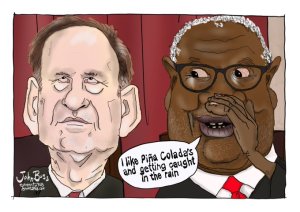
 All this with the husband of an insurrectionist sitting on the bench. I heard Nicole Wallace give the best explanation of anything I’ve heard on why these men act out their grievances in court decisions last night. Two of the guys that sit on the bench are sex pests and were publicly shown to be so. Alito is just perpetually mad at everything but mostly at
 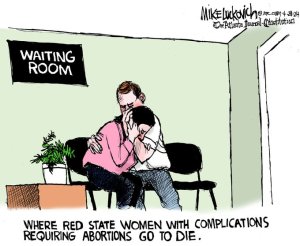 This Mike Luchovich cartoon is brutal and true. I am shifting to the other SCOTUS shit show this week.
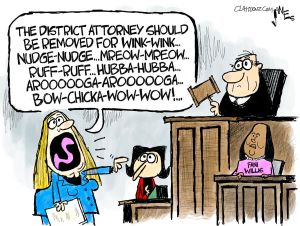
 We’re expecting today’s ruling on the civil Fraud case in New York State’s District Court.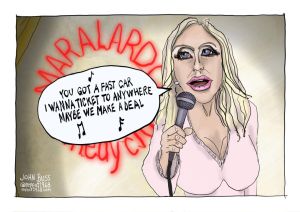
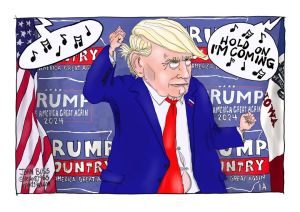

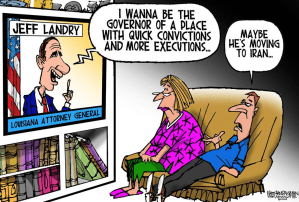
 Ever notice how these guys just ooze white male privilege while screaming they are the most persecuted people on the planet? WBUR interviewed author Ijeoma Oluo in 2020 to explain
  So, I buried the lede. Yes! I did. That quote up top is from the former guy for whom even mediocre is a struggle. This is from
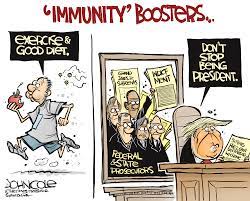 This argument is basically the mantra of the mediocre white man.
 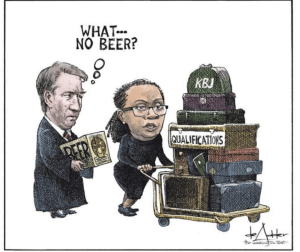 Entitlement just oozes from these guys. This is from the
  Remember this? It’s like the patented hand shake of thee Mediocre White Man Club.
 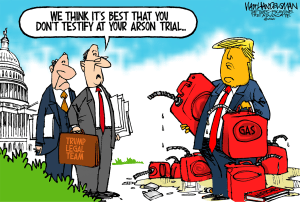 Here are







 peej
peej Carissa
 bostonboomer
 dakinikat
 ecocatwoman
 mablue2
 Mama Lopez
 peggysue22
 quixote
 skydancingguestblogger
 Mona (aka Wonk the Vote)



 Sky Dancing
Recent Comments