
Friday Reads
Posted: March 23, 2012 Filed under: morning reads | Tags: granny starving, Jame's O'Keefe, Nadia Naffee, Paul Ryan, Rape Barn, Republican Budget, Secretary of State Hillary Clinton, Susan G. Komen 12 Comments Good Morning!!
The karma continues to unfold at the Komen foundation. Their original decision to defund planned parenthood under pressure from right wing extremists has left the foundation short on staff and worried about funds.
The chief executives of the Greater New York and Oregon affiliates, among the most outspoken in their criticism of Komen’s unsuccessful attempt to defund Planned Parenthood, are leaving. Three officials at the Dallas headquarters have left or announced their resignations, a spokeswoman said.
Meanwhile, questions are being raised about the breast cancer charity’s ability to raise money after the public relations fiasco. The New York affiliate postponed two events, including its annual awards gala, “because we were not certain about our ability to fundraise in the near term,” spokesman Vern Calhoun said Wednesday.
Komen is asking staff members at headquarters to review budgets for the fiscal year beginning April 1 because of anticipated drops in revenue, according to a source familiar with the process who spoke on the condition of anonymity for fear of retaliation. Budgeting for the coming year was basically completed before the Planned Parenthood controversy erupted.
Komen spokeswoman Leslie Aun declined to comment on the internal budget process. But she added: “It goes without saying that you can’t budget for things you don’t know are going to happen.”
Truth Dig’s Bill Boyarksy calls the Paul Ryan Budget Reverse Robin Hood on steroids. The article focuses on the extreme changes to Medicare suggested by Ryan and given the thumbs up by Romney.
The plan was conceived by House Budget Committee Chairman Paul Ryan, R-Wis., and is backed by Romney, who is favored to win the Republican presidential nomination after his victory Tuesday in the Illinois primary. If he defeats President Obama and the Republicans win the Senate along with holding the House, consider it a blueprint for 2013.
The Ryan-Romney plan would cut taxes to the affluent and corporations, increase arms spending and cut expenditures for almost everything else, including environmental programs, child care, the Children’s Health Insurance Program, aid to college students and funding for transportation, which includes air traffic control. Medicare would be cut, the health care reform law repealed. If you think the health reform law is too kind to insurance companies, you’ll be amazed at the way Ryan-Romney lets big insurance really run things.
“In essence, this budget is Robin Hood in reverse—on steroids,” said Robert Greenstein, president of the Center on Budget and Policy Priorities. “It would likely produce the largest redistribution of income from the bottom to the top in modern U.S. history and likely increase poverty and inequality more than any other budget in recent times and possibly in the nation’s history.
“Chairman Ryan says these changes in domestic programs are necessary due to the nation’s severe fiscal straits. The nation’s fiscal straits, however, surely do not justify massive new tax cuts for its wealthiest people alongside budget cuts that would cast tens of millions of less fortunate Americans into the ranks of the uninsured, take food from poor children, make it harder for low-income students to get a college degree and squeeze funding for research, education and infrastructure. Under Chairman Ryan’s budget, our nation would be a very different one—less fair and less generous, with an even wider gap between the very well-off and everyone else … and our society would be a coarser one.”
State austerity budgets have created a need for PTA fundraising. What’s that old saying about the navy should do the bake sales for battleships instead?
While the National Parent Teacher Association doesn’t keep track of how much money its 5 million members raise, interviews with dozens of schools and state PTAs confirm that as states have slashed school funding, parent contributions to public schools have soared. It’s no longer unusual for families at well-heeled schools to raise hundreds of thousands of dollars a year – even a million – for copy machines, paper, finger paints and other school supplies along with gym, art and music programs.
PTA funds also are used for much-needed building maintenance, classroom aides and essential staff like school nurses, but critics fear that these voluntary funds inadvertently let states off the hook and widen the gap between rich schools and poor, which can’t raise that kind of cash.
“It’s one thing to raise $300 for a teacher to buy school supplies, but it’s another thing to say $1 million,” says Arnold Fege, director of public engagement and advocacy at the Public Education Network in Washington, a network of community-based school reform organizations.
“This really moves us in the wrong direction,” he adds. “When we should be looking at adequacy, we’re assuring a system where there are winners and losers.”
Indeed, 37 states now provide less funding to elementary and high schools than they did last year, and 30 states spend less than they did four years ago, according to the Center on Budget and Policy Priorities, a non-partisan research and policy institute in Washington.
But in an age of helicopter dads and tiger moms, parents are eager to maintain class sizes and popular enrichment programs. Parent associations feel the pressure to raise money to fill the gap.
Nasty right wing hit film man James O’Keefe is in more trouble. One of his former colleagues is blogging and telling all. I have to wonder if this will impact his parole since one of the charges is that he maintains a “rape barn”.
It’s a right-wing rabble-rouser showdown! Jazz-handed pimp impersonator James O’Keefe is at “#WAR” with a former Project Veritas colleague who is now blogging an O’Keefe tell-all involving stolen panties, drugged beers, a “rape barn,” “taped intimate moments,” a $20K pay-off, and barbs about “black welfare queens.” James O’Keefe has graduated from creepy seductions to a full-blown sex scandal.
Harvard grad student Nadia Naffe recently filed a criminal harassment complaint against James. Citing insufficient evidence, a judge dismissed the case. Now Nadia is on a scorched earth cyber rampage. “If he wants a fight, bring it on. This is #WAR,” she tweeted last night, after retweeting outraged utterances from an unofficial Rubio4President account about James’ “rape barn.” On her personal blog, she is currently on part two of a sprawling anti-O’Keefe opus.
Nadia says she worked with James on his painful “To Catch a Journalist” series, during which he made racially charged romantic overtures. Weeks later, she agreed to stay in a “renovated barn” on his parents’ property while working on another project. She then republishes a 1500-word email she apparently sent to James and the Project Veritas board after the rape barn weekend:
You can read Nadia Naffe’s blog here.
The Economist focuses on Hillary Clinton’s record as Secretary and State and has some ideas on her future plans.
On that first of more than half a dozen Asian trips, Jeffrey Bader, the White House’s director for East Asia until leaving last year, was struck by the shrieks of approval Mrs Clinton elicited along her motorcade route or in hotel lobbies. At a university in South Korea, he says, thousands of star-struck girls greeted her as “the ultimate woman’s role model”.
Certainly no previous secretary has enjoyed Mrs Clinton’s advantages in the second part of her job, as America’s ambassador. Already a celebrity, she knew many of the world’s leaders before starting out. It may help, too, that she is not a lawyer, general or professor, like previous secretaries of state, but a politician who has seen at first hand the high politics of the White House and the low politics of the Senate and the campaign trail. At a time when people everywhere are demanding a say in how they are governed, she thinks it is an advantage to be able to say to nervous leaders in fledgling democracies: “Mr President, I’ve won elections and I’ve lost elections; I do know how you feel.”
Not only has Clinton travelled to 95 countries. She’s reformed the State Department.
Borrowing an idea from the Pentagon, she launched its first quadrennial strategy review. The aim, she said in an article for Foreign Affairs, was to develop “a more holistic approach to civilian power”.
America’s ambassadors were instructed that diplomacy was no longer a matter of talking only to other governments: they were to see themselves as CEOs of multi-agency missions, reaching out to the whole of society. In the 21st century, she said, “a diplomat is as likely to meet with a tribal elder in a rural village as a counterpart in a foreign ministry, and is as likely to wear cargo pants as a pinstriped suit.” In umpteen meetings with “civil society” around the world, she has led by example.
Also new is an emphasis on “economic statecraft”, an attempt to co-ordinate everything from pushing China on its exchange rate, to promoting free trade, to defending intellectual property, to luring inward investment and helping American firms find markets and opportunities overseas. She has appointed the department’s first chief economist. These, however, are areas where the Treasury, Commerce Department and White House are already active—and likely to stay dominant.
Running the department has also given Mrs Clinton an instrument to promote the welfare of women, a cause she made her own as first lady in 1995 when a speech on women’s rights at a conference in Beijing made a global splash. She has installed Melanne Verveer, her former White House chief of staff, as ambassador for women, reporting directly to her, and another longtime aide, Kris Balderston, “special representative for global partnerships”. One of his projects has been to create a coalition of governments, corporations and non-profits to develop cheap, hygienic cooking stoves for the millions of women around the world who have to forage for fuel to feed their families.
It’s a nice long article with a list of some of her bigger accomplishments. Make some time to read it !
So, what else is on your reading and blogging list today?
The Tide Could Be Turning on SOPA/PIPA
Posted: January 14, 2012 Filed under: cyber security, First Amendment, SOPA, Team Obama, the blogosphere, U.S. Politics | Tags: anonymous, Ars Technika, Darrell Isa, DNS blocking, Eric Cantor, Lamar Smith, online piracy, Orrin Hatch, Pat Leahy, Paul Ryan, PIPA, Power to the people, reddit, SOPA, Timothy B. Lee, White House 8 Comments
This morning I got a “breaking news” e-mail from Politico reporting that the White House had come out with a (somewhat wishy-washy) statement on the Stop Online Piracy Act (SOPA). Here’s the text of the e-mail:
Obama administration officials said in a blog post today that they would “not support legislation that reduces freedom of expression, increases cybersecurity risk, or undermines the dynamic, innovative global Internet.” The White House did not take a definite position on SOPA and the PROTECT IP Act, but said “the DNS filtering provisions in some proposed legislation suggests that they pose a real risk to cybersecurity and yet leave contraband goods and services accessible online.” The officials said, however, that legislation is needed to combat online piracy.
A number of sources are reporting this now as Obama “coming out against SOPA and PIPA. For example, at Slate, Matthew Yglesias writes:
SOPA/Protect IP fights are turning into an example of how the political system sometimes does work correctly after all. The con forces on these bills initially looked numerically overwhelmed in congress and hugely outspent. But opponents really mobilized vocally, got people and institutions who don’t normally focus on politics to write about this, and perhaps most important of all demonstrated that more people genuinely cared about this issue than most members of congress initially realized. Now the momentum has slowed incredibly and the White House technology policy team has come out against these bills.
Still, even Yglesias admits the WH statement is qualified.
To look a gift horse in the mouth for a second, however, I note that the White House statement does contain a “reasonable” to-be-sure line stating that “online piracy is a real problem that harms the American economy, and threatens jobs for significant numbers of middle class workers and hurts some of our nation’s most creative and innovative companies and entrepreneurs.”
Politico calls it “walking a thin line.”
In a blog post penned by three administration officials, the White House said it opposes any bill that would make it easier for government to censor the Web or make the Internet less secure, but it stopped short of saying whether that includes two bills that have sent the tech industry into a panic.
If that sounds like a careful effort to walk a thin line, it is: Some of the president’s biggest supporters in Hollywood and Silicon Valley and beyond are sharply divided over the bills, and the White House needs a way to keep both sides happy.
The Stop Online Piracy Act in the House and Protect IP Act in the Senate are an attempt by business interests led by Hollywood to crack down on people pirating movies and music and stop the sale of knockoff goods.
But Web companies and Internet freedom activists have cried foul, saying the bills would put restrictions on the Web in a way that could destroy the fundamental openness of the Internet and prevent the next generation of Facebooks or eBays from getting off the ground.
At Ars Technika, Timothy B. Lee reports that Congress is feeling the heat. They provide a number of examples of powerful legislators who are now having second thoughts–including Pat Leahy (one of the prime movers of the bills), Paul Ryan, Orrin Hatch, and Lamar Smith, who
announced that he would be pulling the DNS-blocking provisions from his own bill. “After consultation with industry groups across the country, I feel we should remove Domain Name System blocking from the Stop Online Piracy Act so that the Committee can further examine the issues surrounding this provision,” Smith said in a Friday statement.
DNS blocking would basically impose the kind of censorship used by China to block internet users from foreign websites that provide information the government doesn’t want people to be able to read. It would really kill what’s left of the First Amendment.
In addition, Lee notes in an update that Eric Cantor has said there will be no vote on SOPA until there is a “consensus.”
On the WH announcement, Lee writes:
The statement was made in response to a petition on the White House’s “we the people” site asking the president to veto SOPA if it reached his desk. The officials—IP enforcement coordinator Victoria Espinel, CTO Aneesh Chopra, and cybersecurity coordinator Howard Schmidt—did not commit the president to vetoing SOPA. However, they laid out criteria for an anti-piracy bill that seems to clearly rule out SOPA and the Senate’s Protect IP Act in their current form.
Also reported in the Ars Technika story,
Rep. Darrell Issa (R-CA), a SOPA opponent, announced Saturday that he is postponing hearings on SOPA’s DNS provisions that had been slated for Wednesday, January 18 before his House Oversight and Government Reform Committee.
“While I remain concerned about Senate action on the Protect IP Act, I am confident that flawed legislation will not be taken up by this House,” Issa said. “Majority Leader Cantor has assured me that we will continue to work to address outstanding concerns and work to build consensus prior to any anti-piracy legislation coming before the House for a vote.”
All this seems to bode well for the anti-SOPA/PIPA fight, along with the escalation in pushback by opponents that I posted in a comment yesterday that Anonymous has revealed the personal information of some powerful men in the media and Hollywood who are pushing for the bill.
Power to the People!
It’s Saturday!
Posted: October 22, 2011 Filed under: #Occupy and We are the 99 percent!, Barack Obama, Congress, Democratic Politics, morning reads, Republican politics, Social Security, U.S. Economy, U.S. Politics, unemployment | Tags: Bain Capital, Barack Obama, Black Swan, DNC, Eric Cantor, Human Rights, interest on student loans, Mitt Romney, Muammar Gaddafi, Paul Ryan, Paul Volker, Pell Grants, Regulations, student loans, Volker rule, Wall Street donors, war crimes, Wharton School, World Bank 33 Comments
Happy Saturday Sky Dancers!! It’s a beautiful fall day here in Indiana, but I’m looking forward to getting back to Boston. I’ll be taking off in a couple of days and I hope to be home by Tuesday or Wednesday. My mom is going along for the ride so she can hang out with her youngest grandsons for awhile. It will be fun, because she’ll be there over Halloween. But enough about my boring life–let’s get to the news.
This story is a couple of days old, but still worth reading. Via BDBlue at Corrente, Which GOP candidate do you think has raised the most money from Wall Street?
Despite frosty relations with the titans of Wall Street, President Obama has still managed to raise far more money this year from the financial and banking sector than Mitt Romney or any other Republican presidential candidate, according to new fundraising data.
Obama’s key advantage over the GOP field is the ability to collect bigger checks because he raises money for both his own campaign committee and for the Democratic National Committee, which will aid in his reelection effort.
As a result, Obama has brought in more money from employees of banks, hedge funds and other financial service companies than all of the GOP candidates combined, according to a Washington Post analysis of contribution data. The numbers show that Obama retains a persistent reservoir of support among Democratic financiers who have backed him since he was an underdog presidential candidate four years ago.
And get this–Obama has raised nearly twice as much as Romney from the Mittster’s old firm, Bain Capital! So don’t believe all those stories in the media about the Wall Street titans switching to Mitt.
Here’s another “breaking news” story from Forbes: US Businesses Not Being Strangled By Regulation And Taxation, World Bank Says. Gee, no kidding? But the Republicans say that’s the main cause of our economic problems, don’t they?
The World Bank uses indicators such as time spent to set up a business to getting credit, among other things, in benchmarking the 183 countries it ranks in “Doing Business”. The report measures and tracks changes in the regulations applied to domestic companies in 11 areas in their life cycle–such as investors rights, taxation, cross border transactions, legality and enforcement of contracts and bankruptcy law. A fundamental premise of doing business is that economic activity requires good rules that are transparent and accessible to all, not just big business. Such regulations should be efficient, the World Bank states, striking a balance between safeguarding some important aspects of the business environment and avoiding distortions that impose unreasonable costs on businesses. “Where business regulation is burdensome and competition limited, success depends more on whom you know than on what you can do. But where regulations are relatively easy to comply with and accessible to all who need to use them, anyone with talent and a good idea should be able to start and grow a business (legally),” the World Bank said.
Where does the supposed regulation and taxation crippled U.S. stand in the rankings? It is number four, trailing behind New Zealand (3), Hong Kong (2) and Singapore (1).
What it looks like from the research desks at one of the most powerful and elite multilateral institutions on the planet is a U.S. that does not have the government in its way, but a U.S. whose government is more out of the way than it is in every other major economy on earth, including mainland China.
Wow, I wonder if Congressman Paul Ryan reads Forbes? Naaaah… probably too far left for him. And speaking of Ryan, he appeared at a town hall meeting in Muskego, WI yesterday and made a complete ass of himself as usual. From Think Progress:

During a town hall today, House Budget Committee Chairman Paul Ryan (R-WI) was asked by Matthew Lowe, a student, why the GOP wants to cut Pell Grants. Ryan responded by saying that the program is “unsustainable,” before telling Lowe that he should be working three jobs and taking out student loans to pay for college, instead of using Pell Grants:
LOWE: I come from a very middle-class family and under President Obama, I get $5,500 per year to pay for school, which doesn’t come close to covering all of the funding, but it helps ease the burden. Under your plan, you cut it by 15 percent. I was just curious why you would cut a grant that goes directly to the middle- and lower-class people that need it the most.
RYAN: ‘Cause Pell Grants have become unsustainable. It’s all borrowed money…Look, I worked three jobs to pay off my student loans after college. I didn’t get grants, I got loans, and we need to have a system of viable student loans to be able to do this.
That’s funny. I read that Ryan used his father’s Social Security survivor benefits to put himself through college. I’d like to see some documentation on those three jobs he claims he worked while attending classes, writing papers, and studying for exams. Besides, I’ll bet the unemployment rate for college-age kids wasn’t at depression levels back then.
And speaking of paying for college, here’s an interesting piece at Truthout by Ellen Brown: Can the Fed Prevent the Next Crisis by Eliminating Interest on Student Loan Debt?
Among the demands of the Wall Street protesters is student debt forgiveness – a debt “jubilee.” Occupy Philly has a “Student Loan Jubilee Working Group,” and other groups are studying the issue. Commentators say debt forgiveness is impossible. Who would foot the bill? But there is one deep pocket that could pull it off – the Federal Reserve. In its first quantitative easing program (QE1), the Fed removed $1.3 trillion in toxic assets from the books of Wall Street banks. For QE4, it could remove $1 trillion in toxic debt from the backs of millions of students.
The economy would only be the better for it, as was shown by the GI Bill, which provided virtually free higher education for returning veterans, along with low-interest loans for housing and business. The GI Bill had a sevenfold return. It was one of the best investments Congress ever made.
There are arguments against a complete student debt write-off, including that it would reward private universities that are already charging too much and it would unfairly exclude other forms of debt from relief. But the point here is that it could be done and it (or some similar form of consumer “jubilee”) would represent a significant stimulus to the economy.
According to Brown, student loan debt is “the next Black Swan.”
Here’s another stupid Republican story for you. Eric Cantor was scheduled to give a speech yesterday at the elite Wharton School of Business at the University of Pennsylvania. Cantor was to speak on what Republicans plan to do about income inequality. The school was so excited that they opened the talk to the public. In addition, there was to be a protest by several groups, including Occupy Philly.
Guess what Cantor did? He wimped out and cancelled. ROFLOL! From the LA Times:
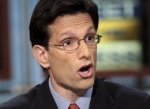
Cantor was scheduled to speak on income inequity at a lecture hosted by the Wharton business school. The Virginia Republican’s office said he called off the speech after learning that protesters planned to rally outside and attendance would not be limited to students and others affiliated with the school.
Ron Ozio, director of media relations at University of Pennsylvania, said the business school “deeply regrets” that the event was canceled.
“The university community was looking forward to hearing Majority Leader Cantor’s comments on important public issues, and we hope there will be another opportunity for him to speak on campus,” Ozio said in a statement. “The Wharton speaker series is typically open to the general public, and that is how the event with Majority Leader Cantor was billed. We very much regret if there was any misunderstanding with the Majority Leader’s office on the staging of his presentation.”
This is pretty disgusting: Libyans line up to see Gaddafi’s body on display; groups call for probe into death
International human rights groups called Friday for an investigation into the death of former Libyan leader Moammar Gaddafi as gory new videos showed him being spat at and punched by revolutionaries and as skepticism mounted about official claims that he was shot in crossfire after being captured.
The new cellphone videos cast a shadow over the revolutionaries even as they were celebrating the end of their eight-month struggle to wrest control of the country. NATO had backed the rebels in the name of shielding pro-democracy civilians from Gaddafi’s brutality.
“The government version certainly does not fit with the reality we have seen on the ground,” said Peter Bouckaert of Human Rights Watch, who has been investigating the capture of Gaddafi in his home town of Sirte. Amnesty International warned that the killing could be a war crime.
Why do I suspect the U.S. Government gave the go-ahead for Gaddafi to be executed, just like Osama bin Laden? You might want to read Joseph Cannon’s take on this one.
Finally, late last night the Volker Rule was number 1 in Google’s top stories. From the NYT:
When Paul Volcker called for new rules in 2009 to curb risk-taking by banks, and thus avoid making taxpayers liable in the future for the kind of reckless speculation that caused the financial crisis and resulting bailout, he outlined his proposal in a three-page letter to the president.
Last year, when the Dodd-Frank Wall Street Reform and Consumer Protection Act went to Congress, the Volcker Rule that it contained took up 10 pages.
Last week, when the proposed regulations for the Volcker Rule finally emerged for public comment, the text had swelled to 298 pages and was accompanied by more than 1,300 questions about 400 topics.
Wall Street firms have spent countless millions of dollars trying to water down the original Volcker proposal and have succeeded in inserting numerous exemptions. Now they’re claiming it’s too complex to understand and too costly to adopt.
Gee, what a surprise. I wonder how many of those millions were taxpayer dollars?
So…what are you reading and blogging about today?
Thursday Reads
Posted: July 21, 2011 Filed under: Barack Obama, Democratic Politics, Federal Budget and Budget deficit, morning reads, Republican politics, Republican presidential politics, Social Security, the internet, U.S. Economy, U.S. Politics, unemployment, voodoo economics, We are so F'd | Tags: austerity, Barack Obama, Chris Christie, collective bargaining, employers, Eric Cantor, Federal debt ceiling, frustration index, Gang of Six, John Kasich, Judd Gregg, Michele Bachman, Migraines, Paul Ryan, polls, Republicans, social media, taxes, Vernal Fall, Yosemite 41 Comments
Good Morning!! I’m going to start out with some interesting poll results that came out yesterday.
According to the latest Washington Post-ABC News poll, a lot of ordinary Republicans are unhappy with their GOP representatives in Washington, DC. From the WaPo:
While Republicans in Congress have remained united in their opposition to any tax increases, the poll finds GOP majorities favoring some of the specific changes advocated by the president, including higher income tax rates for the wealthiest Americans.
There is also broad dissatisfaction with Obama’s unwillingness to reach across the aisle: Nearly six in 10 of those polled say the president has not been open enough to compromise. Among independents, 79 percent say Republicans aren’t willing enough to make a deal, while 62 percent say the same of Obama.
Republicans may also be losing the war of perception about who stands with whom in the debates over the deficit and the economy. A majority view the president as more committed to protecting the interests of the middle class and small businesses, while large majorities see Republicans as defending the economic interests of big corporations and Wall Street financial institutions.
ABC’s The Note reports that based on the same poll,
Against a backdrop of broad concern about the impact of default, 80 percent of Americans in a new ABC News/Washington Post poll say they’re dissatisfied or even angry with the way the federal government is working, up 11 points in a single month. It last was this high in 1992, during the economic downturn that cost the first President Bush a second term.
The times today are nearly as tough: The ABC News Frustration Index has risen to 72 on its scale of 0 to 100, its highest since just before the 2010 midterm elections and well into the political danger zone. The index combines dissatisfaction with the government, anti-incumbent sentiment and ratings of the president and the economy alike.
But unlike 1992 – or 2010 – the opposition party’s taking even more heat than the president. While President Obama for the first time has fallen under 40 percent approval for handling the economy, the Republicans in Congress do even worse, 28 percent approval. On handling the deficit, it’s a weak 38 percent approval for Obama, but a weaker 27 percent for the GOP. And on handling taxes, Obama has 45 percent approval, the GOP, 31 percent.
It’s good to know that some Americans are getting angry. I wish they’d get out the pitchforks and make some noise about it in the streets.
A couple of GOP governors are dropping in the polls too. Media star Chris Christie is turning off his NJ constituents.
Gov. Chris Christie’s popularity has declined significantly over the first half of 2011 and he would have a very difficult time winning reelection if voters in New Jersey went to the polls today, according to a survey by Public Policy Polling.
While Republican activists outside New Jersey want Christie to seek the party’s 2012 presidential nomination, only 43 percent of Garden State voters approve of the job the governor is doing to 53 percent who disapprove.
The figures represent a 13 point decline from when Public Policy Polling last surveyed voters in January, when Christie’s standing was 48 percent approval and 45 percent disapproval.
Christie’s numbers are steady with Republicans but independents have really turned on him, going from approving by a 55 percent to 39 percent margin to disapproving by a 54 percent to 40 percent margin. And his crossover popularity with Democrats is on the decline as well. Where 23 percent approved of him in January, now only 16 percent do.
Christie has been making huge cuts in government services. I guess austerity isn’t as popular with the grass roots as it is with the power elites.
Gov. John Kasich of Ohio is even more unpopular than Christie.
The latest poll released Wednesday by Connecticut’s Quinnipiac University showed that only 35 percent of registered voters approve of the job the Republican governor has done in his first six months. Exactly half say they disapprove, up 1 percentage point since May, with the remainder undecided.
“Even after the state budget has been approved as he promised without raising taxes, and even though the Quinnipiac University poll finds that 63 percent say they favor such an approach, Gov. Kasich’s name remains mud in the eyes of the Ohio electorate,” said Peter A. Brown, assistant director of the Quinnipiac University Polling Institute.
The same poll shows that even some of those who approve of the governor’s performance are prepared to reject his signature law restricting the collective bargaining power of government employees at the ballot on Nov. 8. Fifty-six percent of voters say it should be repealed, up 2 percentage points since May.
Republicans always overreach, don’t they? It looks like the 2010 win may have been just a flash in the pan.
Michele Bachmann is surging in the polls against Mitt Romney.
The Minnesota congresswoman returned to Iowa early Wednesday morning as polls show her gaining ground nationally as a top alternative to former Massachusetts Gov. Mitt Romney, the early front-runner for the GOP nomination. Since formally entering the race last month, she has eclipsed other Republicans in the field, including fellow Minnesotan Tim Pawlenty, who has been actively campaigning all year.
The latest Wall Street Journal/NBC News poll offered a statistical glimpse at their diverging fortunes. In the poll, 16% of the registered Republicans picked Ms. Bachmann as their top choice, putting her second behind Mr. Romney, who remains the first choice of 30% of the Republicans polled. In the same survey, 2% of registered Republicans chose the former Minnesota governor as their top pick, down from 6% in April.
Meanwhile, Bachmann is still being hassled about her migraine headaches. Karl Rove is calling for her to release her medical records. Boy those Republican power brokers are really scared of Bachmann, aren’t they?
A doctor who has examined Bachmann says the headaches aren’t a big deal.
A letter dated Wednesday from a congressional doctor whose office has examined Republican Michele Bachmann described the presidential candidate’s migraines as occurring “infrequently” and controlled by prescription medication.
Bachmann’s campaign distributed the letter from Dr. Brian Monahan, the attending physician in Congress. Bachmann has been evaluated by that office during her three terms in Washington.
Former NH Senator Judd Gregg thinks the Republicans in the House will push the debt limit battle to the brink. In fact, he thinks it will take Social Security checks not going out to get them to agree to raising the debt ceiling.
“My gut tells me that we’ll need a weekend of drama — maybe a weekend of the government not paying its bills — politicians need drama to make something happen. As soon as social security checks don’t go out, the politics will change. I suspect it’ll take artificial drama to get closure past the House.”
“Boehner understands that a shutdown is bad for his caucus and that there’s something viable short of a shutdown but right now… it’s a 50-50 chance that we go into a few days of disruption.”
Gregg said lawmakers don’t really care about the nation’s credit rating:
“Policy-makers only worry about a ratings downgrade at the margins. They don’t really care. The ratings agencies put themselves in a corner that’s foolish. I’ve always found them to be incredibly naive about the political process. To be so definitive is foolish.”
“For the ratings agencies to make this drop-dead date, it’s stupid and naive because we’ll straighten it out, but our process doesn’t allow it to do it overnight.”
Gregg says all this will means the Republicans get most of the blame for the mess. They didn’t learn anything from what happened to Gingrich, did they?
Gregg is probably right about the gang of six plan, since that is basically what the Republicans already rejected. And Brian Beutler reports that they are rejecting it again.
As time goes on, and conservative interest groups and members of Congress rip into it, support among Republicans for the Gang of Six plan to reduce deficits will begin to wane. In fact, that’s already happening.
In a publicly released memo meant to undermine support for the Gang of Six plan in its current form, House Budget Committee chairman Paul Ryan (R-WI) laments, “it increases revenues while failing to seriously address exploding federal spending on health care, which is the primary driver of our debt. There are also serious concerns that the proposal’s substance on spending falls far short of what is needed to achieve the savings it claims.”
And check this out from Politico:
A few wealthy donors have called Cantor to tell him they wouldn’t mind if their taxes are raised. During two closed meetings this week — one with vote-counting lawmakers, and another with the entire conference — Cantor told colleagues that some well-heeled givers have told them they’re willing to pay more taxes. Cantor, according to an aide, has responded that House Republicans aren’t standing up for the wealthy, but rather for the middle class, who want to see their taxes stay low.
Yeah sure, Eric. You’re standing up for the middle class. ROFLOL!
With unemployment so high, all we need is more impediments to getting hired. According to the NYT, even obscure blog comments could come into play as companies evaluate job candidates.
A year-old start-up, Social Intelligence, scrapes the Internet for everything prospective employees may have said or done online in the past seven years.
Then it assembles a dossier with examples of professional honors and charitable work, along with negative information that meets specific criteria: online evidence of racist remarks; references to drugs; sexually explicit photos, text messages or videos; flagrant displays of weapons or bombs and clearly identifiable violent activity.
[….]
Less than a third of the data surfaced by Mr. Drucker’s firm comes from such major social platforms as Facebook, Twitter and MySpace. He said much of the negative information about job candidates comes from deep Web searches that find comments on blogs and posts on smaller social sites, like Tumblr, the blogging site, as well as Yahoo user groups, e-commerce sites, bulletin boards and even Craigslist.
….it is photos and videos that seem to get most people in trouble. “Sexually explicit photos and videos are beyond comprehension,” Mr. Drucker said. “We also see flagrant displays of weapons. And we see a lot of illegal activity. Lots and lots of pictures of drug use.”
I’ll end with this nightmarish story from the LA Times: Witness tells of horror as 3 swept over Vernal Fall in Yosemite
Bibee, a 28-year-old carpenter who grew up in Angels Camp, northwest of the park, had brought Amanda Lee, a visitor from Missouri, to the top of Vernal Fall on Tuesday — her first visit to Yosemite, but the latest of many for him.
They were standing behind a metal barricade, peering at the cascade….Bibee saw a man cross over the barricade. He was leaning over the 317-foot waterfall, holding a young girl, who was screaming in terror. People begged them to get back. “I’m yelling at him, ‘You SOB, get over here!'” Bibee said. Eventually, the two returned to safety.
But then Bibee noticed that three other people had also crossed over, and were “taking pictures and being stupid.”
The three people, members of a church group, fell into the water and went over the falls. All are presumed dead. Why would people go past a barricade and warning signs to stand on the edge of a raging waterfall? But it’s not the first time. The article says twelve people have gone over the falls previously–all were killed.
That’s it for me. What are you reading and blogging about today?
Some juicy gossip about Rep. Paul Ryan and his drinking buddies
Posted: July 10, 2011 Filed under: Corporate Crime, Economy, Psychopaths in charge, Republican politics, the villagers, U.S. Economy, U.S. Politics | Tags: AQR Capital, Barack Obama, Bistro Bis, Brad De Long, Clifford Asness, Elizabeth Fama, Eugene Fama, freshwater economists, Goldman Sachs, hedge fund managers, Jayer-Gilles 2004 Echezeaux Grand Cru, John Cochrane, Paul Krugman, Paul Ryan, Susan Feinberg, Talking Points Memo, University of Chicago, wine 12 Comments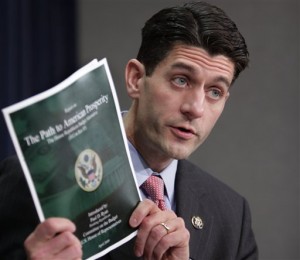
Paul Ryan hawking his plan to throw grandma from the train
You may have seen this gossipy story about Rep. Paul Ryan at Talking Points Memo on Friday. I’ve been meaning to post something about it but just haven’t found the time. Now TPM has a very interesting update. Here’s the background:
Rep. Paul Ryan (R-WI), a leading advocate of shrinking entitlement spending and the architect of the plan to privatize Medicare, spent Wednesday evening sipping $350 wine with two like-minded conservative economists at the swanky Capitol Hill eatery Bistro Bis.
[….]
Susan Feinberg, an associate business professor at Rutgers, was at Bistro Bis celebrating her birthday with her husband that night. When she saw the label on the bottle of Jayer-Gilles 2004 Echezeaux Grand Cru Ryan’s table had ordered, she quickly looked it up on the wine list and saw that it sold for an eye-popping $350, the most expensive wine in the house along with one other with the same pricetag.
Feinberg, an economist by training, was even more appalled when the table ordered a second bottle. She quickly did the math and figured out that the $700 in wine the trio consumed over the course of 90 minutes amounted to more than the entire weekly income of a couple making minimum wage.
Feinberg took some photos with her cell phone, approached the table and asked whether the two men with Ryan were lobbyists. One of the men responded by saying, “F&ck her.” Ryan claimed the two men were economists but refused to provide their names. Ryan then paid for one of the bottles of wine, but when asked about the appropriateness of spending so much when he was going all Dickensian on old people, Ryan avoided answering.
Today, TPM learned the identity of the two men who wined and dined Ryan on Friday night.
TPM has confirmed that the two other men with Ryan were Cliff Asness and John Cochrane. Both men have doctorate degrees in economics and are well-known in the conservative media world as die-hard proponents of the free market’s ability to right itself without government bailouts when the crisis hit in late 2008.
Asness, who ordered the wine and who, according to Feinberg was the one who said “Fuck her,” is better known as a high-profile hedge fund manager. Asness founded and runs AQR Capital, which manages an estimated $26 billion in a variety of traditional products and hedge funds, and his life story has been the subject of numerous books and articles about the rise and fall of Wall Street. He’s also grabbed headlines for being one of the most voluble opponents of President Obama’s economic policies.
[….]
Cochrane, the other, more tempered dinner companion, is the AQR Capital Management Distinguished Service Professor of Finance at the University of Chicago, an apparent tip of the hat to the contributions Asness’ AQR Capital Management has made to the Booth School of Business there.
Before launching AQR Capital in 1997, Asness worked for Goldman Sachs, the most profitable securities firm in Wall Street history, as the director of quantitative research for its Asset Management Division.
Via TPM, in 2009, Asness wrote an open letter to Barack Obama in which he (Asness) complained bitterly about some mildly critical remarks the President had made about hedge fund managers who refused to help out by buying Chrysler bonds. From New York Magazine:
Clifford Asness, the filthy-stinking-rich quant behind AQR Capital Management, [is] publicly engaging with a formidable opponent: The president of the United States. Asness, who supported Obama during the election, was appalled by Obama’s treatment of his colleagues during the Chrysler situation, and although he was not personally involved, he felt he had to make a stand.
Here is a portion of the letter:
Here’s a shock. When hedge funds, pension funds, mutual funds, and individuals, including very sweet grandmothers, lend their money they expect to get it back. However, they know, or should know, they take the risk of not being paid back. But if such a bad event happens it usually does not result in a complete loss. A firm in bankruptcy still has assets. It’s not always a pretty process. Bankruptcy court is about figuring out how to most fairly divvy up the remaining assets based on who is owed what and whose contracts come first. The process already has built-in partial protections for employees and pensions, and can set lenders’ contracts aside in order to help the company survive, all of which are the rules of the game lenders know before they lend. But, without this recovery process nobody would lend to risky borrowers. Essentially, lenders accept less than shareholders (means bonds return less than stocks) in good times only because they get more than shareholders in bad times.
The above is how it works in America, or how it’s supposed to work. The President and his team sought to avoid having Chrysler go through this process, proposing their own plan for re-organizing the company and partially paying off Chrysler’s creditors. Some bond holders thought this plan unfair. Specifically, they thought it unfairly favored the United Auto Workers, and unfairly paid bondholders less than they would get in bankruptcy court. So, they said no to the plan and decided, as is their right, to take their chances in the bankruptcy process. But, as his quotes above show, the President thought they were being unpatriotic or worse.
Well, Duh! But if “filthy, stinking rich” guys like Asness were patriotic, we probably wouldn’t have had a financial meltdown in the first place, now would we?
The other guy with Ryan on Friday, Professor John Cochrane of the University of Chicago, is a freshwater economist and follower of Eugene Fama AKA “the father of modern finance,” and Robert R. McCormick Distinguished Service Professor of Finance a the University of Chicago. Cochrane is also married to Fama’s daughter Elizabeth.
In early 2009, Cochane and Nobel Prize-winning economist Paul Krugman engaged in a legendary on-line debate that also involved Brad De Long and Eugene Fama. The whole thing was too wonky for me, but I gather it had something to do with Fama and Cochrane critiquing the use of fiscal stimulus and Krugman saying that the two freshwater economists wanted to return to the “Dark Ages of macroeconomics.” Here’s Krugman’s introductory paragraph:
Brad DeLong is upset about the stuff coming out of Chicago these days — and understandably so. First Eugene Fama, now John Cochrane, have made the claim that debt-financed government spending necessarily crowds out an equal amount of private spending, even if the economy is depressed — and they claim this not as an empirical result, not as the prediction of some model, but as the ineluctable implication of an accounting identity.
Maybe Daknikat can explain what the “cage match” was all about.
I think Paul Ryan is going to need to be a little more careful in the future if he is going to continue promoting the end of Medicare as we know it.

 peej
peej Carissa
 bostonboomer
 dakinikat
 ecocatwoman
 mablue2
 Mama Lopez
 peggysue22
 quixote
 skydancingguestblogger
 Mona (aka Wonk the Vote)



 Sky Dancing
Recent Comments