
Monday Morning Reads
Posted: October 10, 2011 Filed under: Global Financial Crisis, Marriage Equality, morning reads, Surreality, U.S. Military, U.S. Politics, unemployment, Women's Rights | Tags: Anita Hill, Crackerbox Palace, DOMA, George Harrison, Indigenous People's Day, National Coming Out Day, Native American Day, Occupy, Paul Krugman, plutocracy, Subprime mortgage crisis and the CRA, Taxes and poor people, technology, the Great Depression 25 Comments Good Morning!
and Happy Native Americans’ Day!
The second Monday of October annually marks Columbus Day in many parts the United States but not all states or region follow this observance. Instead, they celebrate other events on the day. For example, South Dakota’s official holiday on this date is Native Americans’ Day (also known as Native American Day), while people in Berkeley, California, celebrate Indigenous People’s Day.
 I think it’s a great idea to switch the current federal holiday out to a celebration of indigenous cultures or maybe find a better thing to celebrate!
BTW, National Coming Out Day is Tomorrow. That’s something to remember as you read that Speaker Boehner is threatening to withold funds from the Justice Department if that don’t vigorously enforce DOMA. There he goes again!!! The Republican Jobs Agenda is just always topmost on the priority list.
“We’re going to take the money away from the Justice Department, who’s supposed to enforce it, and we’ll use it to enforce the law,” Boehner told the conservative Value Voters Summit.
Boehner is engaged in an ongoing dispute with Attorney General Eric Holder over his refusal to defend in court the Defense of Marriage Act. President Obama has taken the stance that the law is unconstitutional. While the Justice Department usually defends laws passed by Congress against legal challenges, the Obama administration has stopped defending DOMA while Democrats work to repeal the law.
In March, Boehner announced that if Obama wouldn’t defend DOMA, he would, hiring a private law firm to defend it on behalf of the House.
“As the Speaker of the House, I have a constitutional responsibility. I’ve raised my hand to uphold and defend the Constitution of the United States and the laws of our country,” Boehner said Friday.
You know, he’s all about saving those taxpayer dollars too. True Story.
Here’s a movement I want to join if this California Republican Nutter would only give me the location where they’re taking on volunteers. And yes, it’s a REAL tweet.
@RepJackKimble After Value Voters I am more convinced than ever about the radical atheist agenda to secularize Columbus Day
Okay, I’d like to use the next bit of space to clear up a few right wing memes with actual research. I know, you’re shocked, it’s so unlike me to do so. First, while Fannie and Freddie exacerbated the meltdown and behaved as irresponsibly as any Wall Streeter, there is absolutely no connection between the meltdown and the Community Reinvestment Act. I have never been able to figure out how folks jumped the shark to make this connection, but it happened. I’ll give you the bottom line from the abstract but if you want to chase after the econometrics, feel free to follow the link.
In this paper we examine more directly whether these programs were associated with worse outcomes in the mortgage market, including delinquency rates and measures of loan quality.
We rely on two empirical approaches. In the first approach, which focuses on the CRA, we conjecture that historical legacies create significant variations in the lenders that serve otherwise comparable neighborhoods. Because not all lenders are subject to the CRA, this creates a quasi-natural experiment of the CRA’s effect. We test this conjecture by examining whether neighborhoods that have been disproportionally served by CRA-covered institutions historically experienced worse outcomes. The second approach takes advantage of the fact that both the CRA and GSE goals rely on clearly defined geographic areas to determine which loans are favored by the regulations. Using a regression discontinuity approach, our tests compare the marginal areas just above and below the thresholds that define eligibility, where any effect of the CRA or GSE goals should be clearest.
We find little evidence that either the CRA or the GSE goals played a significant role in the subprime crisis. Our lender tests indicate that areas disproportionately served by lenders covered by the CRA experienced lower delinquency rates and less risky lending. Similarly, the threshold tests show no evidence that either program had a significantly negative effect on outcomes.
Okay, one more meme to shoot down. You know how all those Republican presidential wannabes are trotting around saying about half of Americans don’t pay taxes and the rich are still burdened? I’ve shot down some of that argument before, but here’s some further details. I’m quoting from the executive summary and not the study itself. Again, you can go into the methodology if you want here.
A recent finding by Congress’ Joint Committee on Taxation that 51 percent of households owed no federal income tax in 2009 [1] is being used to advance the argument that low- and moderate-income families do not pay sufficient taxes. Apart from the fact that most of those who make this argument also call for maintaining or increasing all of the tax cuts of recent years for people at the top of the income scale, the 51 percent figure, its significance, and its policy implications are widely misunderstood.
- The 51 percent figure is an anomaly that reflects the unique circumstances of 2009, when the recession greatly swelled the number of Americans with low incomes and when temporary tax cuts created by the 2009 Recovery Act — including the “Making Work Pay” tax credit and an exclusion from tax of the first $2,400 in unemployment benefits — were in effect. Together, these developments removed millions of Americans from the federal income tax rolls. Both of these temporary tax measures have since expired.
In a more typical year, 35 percent to 40 percent of households owe no federal income tax. In 2007, the figure was 37.9 percent. [2]- The 51 percent figure covers only the federal income tax and ignores the substantial amounts of other federal taxes — especially the payroll tax — that many of these households pay . As a result, it greatly overstates the share of households that do not pay any federal taxes. Data from the Urban Institute-Brookings Tax Policy Center show only about 14 percent of households paid neither federal income tax nor payroll tax in 2009, despite the high unemployment and temporary tax cuts that marked that year.[3]
- This percentage would be even lower if federal excise taxes on gasoline and other items were taken into account.
- Most of the people who pay neither federal income tax nor payroll taxes are low-income people who are elderly, unable to work due to a serious disability, or students, most of whom subsequently become taxpayers. (In a year like 2009, this group also includes a significant number of people who have been unemployed the entire year and cannot find work.)
- Moreover, low-income households as a whole do, in fact, pay federal taxes. Congressional Budget Office data show that the poorest fifth of households as a group paid an average of 4 percent of their incomes in federal taxes in 2007 (the latest year for which these data are available), not an insignificant amount given how modest these households’ incomes are — the poorest fifth of households had average income of $18,400 in 2007. [4] The next-to-the bottom fifth — those with incomes between $20,500 and $34,300 in 2007 — paid an average of 10 percent of their incomes in federal taxes.
- Even these figures understate low-income households’ total tax burden, because these households also pay substantial state and local taxes. Data from the Institute on Taxation and Economic Policy show that the poorest fifth of households paid a stunning 12.3 percent of their incomes in state and local taxes in 2010.[5]
- When all federal, state, and local taxes are taken into account,the bottom fifth of households paid 16.3 percent of their incomes in taxes, on average, in 2010. The second-poorest fifth paid 20.7 percent. [6]
I know it’s statistics heavy, but some times that’s the best way to see what is actually going on. Right wing memes seem to thrive on taking things completely out of context and this one about tax dodging poor people is a doozy. See exactly how many taxes that get paid that weren’t counted in that famous figure which is an anomaly as it is.
Here’s an interesting article at NYT by David Leonhardt on how today’s economy makes the Great Depression look like the halcyon days.
Still, the reasons for concern today are serious. Even before the financial crisis began, the American economy was not healthy. Job growth was so weak during the economic expansion from 2001 to 2007 that employment failed to keep pace with the growing population, and the share of working adults declined. For the average person with a job, income growth barely exceeded inflation.
The closest thing to a unified explanation for these problems is a mirror image of what made the 1930s so important. Then, the United States was vastly increasing its productive capacity, as Mr. Field argued in his recent book, “A Great Leap Forward.” Partly because the Depression was eliminating inefficiencies but mostly because of the emergence of new technologies, the economy was adding muscle and shedding fat. Those changes, combined with the vast industrialization for World War II, made possible the postwar boom.
In recent years, on the other hand, the economy has not done an especially good job of building its productive capacity. Yes, innovations like the iPad and Twitter have altered daily life. And, yes, companies have figured out how to produce just as many goods and services with fewer workers. But the country has not developed any major new industries that employ large and growing numbers of workers.
There is no contemporary version of the 1870s railroads, the 1920s auto industry or even the 1990s Internet sector. Total economic output over the last decade, as measured by the gross domestic product, has grown more slowly than in any 10-year period during the 1950s, ’60s, ’70s, ’80s or ’90s.
Perhaps the most important reason, beyond the financial crisis, is the overall skill level of the work force. The United States is the only rich country in the world that has not substantially increased the share of young adults with the equivalent of a bachelor’s degree over the past three decades. Some less technical measures of human capital, like the percentage of children living with two parents, have deteriorated. The country has also chosen not to welcome many scientists and entrepreneurs who would like to move here.
I’m still of the opinion that we should hand out citizenship to any of our highly skill foreign students and do everything we can to keep them here. I have a feeling I’m in the minority on that opinion, however.
If you want to do some time tripping to a really upsetting period of history for women, here’s The Nation on The Legacy of Anita Hill. We’re now stuck with this total jerk on SCOTUS because of people like Joe Biden. I’ll never forget one of those senators that let Clarence Thomas get away with it. They hid the women that could verify her stories and put her squarely in the worst position possible. She handled it with dignity and we all lost.
Anita Hill remains an icon to whom subsequent generations are rightfully indebted. At the same time, she has not remained trapped by her own symbolism or frozen in time. It is sometimes forgotten that she is a respected scholar of contract jurisprudence, commercial law and education policy. She is a prolific author, publishing numerous law review articles, essays, editorials and books. Today, Hill is a professor of social policy, law and women’s studies at Brandeis University. Much of her most recent research has been on the housing market, and her most recent book, published this month, is Reimagining Equality: Stories of Gender, Race, and Finding Home.
It is ironic that the full substance of Hill’s remarkable intellectual presence remains so overshadowed by those fleeting, if powerful, moments of her Senate testimony. If the larger accomplishments of her life aren’t quite as iconic as that confrontation with Clarence Thomas, they nonetheless merit attention by feminists and scholars alike. To begin with, Hill is a remarkably elegant and accessible writer. For those who wish to apprehend the gravitas of her intelligence and dignity, Reimagining Equality would be a good place to start.
Krugman gets the Occupy protestors and has some delightful comments up on the Panic of the Plutocrats. He eloquently lays out the hype coming from the Cantors and the Bloombergs as well as CNBC and Fox that paints every one upset with their behavior as Leninist. The descriptions are a hoot but here’s the meat.
The way to understand all of this is to realize that it’s part of a broader syndrome, in which wealthy Americans who benefit hugely from a system rigged in their favor react with hysteria to anyone who points out just how rigged the system is.
Last year, you may recall, a number of financial-industry barons went wild over very mild criticism from President Obama. They denounced Mr. Obama as being almost a socialist for endorsing the so-called Volcker rule, which would simply prohibit banks backed by federal guarantees from engaging in risky speculation. And as for their reaction to proposals to close a loophole that lets some of them pay remarkably low taxes — well, Stephen Schwarzman, chairman of the Blackstone Group, compared it to Hitler’s invasion of Poland.
And then there’s the campaign of character assassination against Elizabeth Warren, the financial reformer now running for the Senate in Massachusetts. Not long ago a YouTube video of Ms. Warren making an eloquent, down-to-earth case for taxes on the rich went viral. Nothing about what she said was radical — it was no more than a modern riff on Oliver Wendell Holmes’s famous dictum that “Taxes are what we pay for civilized society.”
I have one more offering that is just for pure delight. It’s a short bit from the daughter of George Harrison’s Business Manager on what it was like to run the halls of crackerbox palace as a child.
Harrison’s wife, Olivia, always took good care of us and, like her husband, had a gentle, calming disposition. I loved going up the great gothic staircase in the living room to the recording studio on the first floor. I was fascinated by the recording console and the selection of instruments. Sometimes, Harrison would play new music for us and ask for our feedback.
Adjacent to the recording studio was a room with gold records and awards and an Oscar statuette. I remember the exhilarating sensation I got picking up the Oscar earned for “Let It Be” and feeling it weigh down my hand.
When it got late, and Dad was still in meetings, we would go to bed in one of the guest rooms down the hall from the studio with sounds of Harrison’s sitar lulling us to sleep.
You can see I’m full throttle academic today. What’s on your reading and blogging list today?
Tuesday Reads: Romney vs. Perry, 9/11 Revelations, and Hormonal Effects of Fatherhood
Posted: September 13, 2011 Filed under: morning reads, U.S. Economy, U.S. Politics | Tags: 9/11 investigations, Bob Graham, evolutionary biology, fatherhood and testosterone levels, Mitt Romney, Paul Krugman, Republican Tea Party Debate, Rick Perry 16 Comments
Good Morning!! Let’s see if there’s any news out there. I didn’t see much of the Tea Party debate, because I was watching the New England Patriots crush the Miami Dolphins. That was soooo much better than watching Wolf Blitzer and the crazy people. Thanks so much to those of your who watched and documented the insanity so I didn’t have to.
According to Alexander Burns at Politico, Mitt Romney turned into an attack dog and lit into Rick Perry.
Mitt Romney went on the attack against Rick Perry at the first possible opportunity Monday night, challenging the Texas governor on whether he “continues to believe that Social Security should not be a federal program … or does he retreat from that view.”
[….]
Romney jumped in with a hit against Perry’s book, “Fed Up!” – the tome that Perry used to describe Social Security as a program that violated constitutional principles.
“Gov. Perry pointed out that in his view, Social Security is not constitutional,” Romney said.
And so on, with Perry giving weak responses. It’ll be interesting to see Romney challenge Obama on Social Security during the general election. Talk about role reversal!
Unfortunately, the latest CNN poll shows Perry still leading the rest of the Republicans in terms of electability.
Hours before the start of the first-ever CNN/Tea Party Republican debate, a new national survey indicates that Texas Gov. Rick Perry is maintaining his lead in the race for the GOP presidential nomination.
And according to a CNN/ORC International Poll, what appears to be Perry’s greatest strength – the perception among Republicans that he is the candidate with the best chance to beat President Barack Obama in 2012 – seems to be exactly what the GOP rank and file are looking for.
Paul Krugman wrote an addendum to his recent “controversial” blog post about the September 11 anniversary.
The fact is that the two years or so after 9/11 were a terrible time in America – a time of political exploitation and intimidation, culminating in the deliberate misleading of the nation into the invasion of Iraq. It’s probably worth pointing out that I’m not saying anything now that I wasn’t saying in real time back then, when Bush had a sky-high approval rating and any criticism was denounced as treason. And there’s nothing I’ve done in my life of which I’m more proud.
[….]
Now, I should have said that the American people behaved remarkably well in the weeks and months after 9/11: There was very little panic, and much more tolerance than one might have feared. Muslims weren’t lynched, and neither were dissenters, and that was something of which we can all be proud.
But the memory of how the atrocity was abused is and remains a painful one. And it’s a story that I, at least, can neither forget nor forgive.
Good for him for sticking to his guns.
Former Senator Bob Graham today called for another 9/11 investigation, because of a new report that the FBI knew of connections between the hijackers and Saudis living in Florida and never revealed those finding to Congress of the 9/11 Commission.
Ten years after the deadliest attack of terrorism on U.S. soil, new information has emerged that shows the FBI found troubling ties between the hijackers and residents in the upscale community in southwest Florida, but the investigation wasn’t reported to Congress or mentioned in the 9/11 Commission Report.
Former U.S. Sen. Bob Graham, the Florida Democrat who cochaired the bipartisan congressional Joint Inquiry into the attacks, said he should have been told about the findings, saying it “opens the door to a new chapter of investigation as to the depth of the Saudi role in 9/11. … No information relative to the named people in Sarasota was disclosed.”
The U.S. Justice Department, the lead agency that investigated the attacks, refused to comment, saying it will discuss only information already released.
The results of a new study suggest that when men become fathers, their testosterone levels go down. The researchers looked at testosterone levels in a large sample of men before they married and had children and again a few years after their children were born. According to TheManlyZone.com, lower levels of testosterone could be nature’s way of making men less interested in other partners and more interested in caring for their families.
Experts say the research has implications for understanding the biology of fatherhood, hormone roles in men and even health issues like prostate cancer.
“The real take-home message,” said Peter Ellison, a professor of human evolutionary biology at Harvard who was not involved in the study, is that “male parental care is important. It’s important enough that it’s actually shaped the physiology of men.”
“Unfortunately,” Dr. Ellison added, “I think American males have been brainwashed” to believe lower testosterone means that “maybe you’re a wimp, that it’s because you’re not really a man.
“My hope would be that this kind of research has an impact on the American male. It would make them realize that we’re meant to be active fathers and participate in the care of our offspring.”
That’s all I’ve got for today. What are you reading and blogging about?
Thursday Reads: A Poverty Tour, Confidence Fairies, A-Rod, D.B. Cooper, and Wingnut Censors
Posted: August 4, 2011 Filed under: 2012 presidential campaign, Barack Obama, Crime, Democratic Politics, poverty, religion, Republican politics, Surreality, Team Obama, U.S. Economy, U.S. Politics, voodoo economics | Tags: Alex Rodriguez, Barack Obama, bible, censorship, confidence fairy, Cornel West, D.B. Cooper, FBI, Jay Carney, Keith Olbermann, Newt Gingrich, Paul Krugman, Poverty Tour, ratings agencies, Slaughterhouse Five, Tavis Smiley, Tim Geithner, Twenty Boy Summer, U.S. Economy 27 Comments
Good Morning!! Let me get a sip of my breakfast tea, and then I’ll share what I found in the news today.
After doing his level best to wreck the U.S. economy, President Obama headed to Chicago to celebrate his birthday and rake in some campaign donations.
Taking a brief hometown respite Wednesday night, President Barack Obama used a 50th birthday bash in Uptown to raise re-election money from a friendly crowd as he sought to recharge a presidency showing signs of scars from Washington’s partisan battles.
The president told supporters at the Aragon Entertainment Center that the nation doesn’t have time to “play these partisan games.”
“I hope we can avoid another self-inflicted wound like we saw over the last couple weeks,” Obama said of the recent debt-ceiling gridlock.
Although Obama doesn’t turn 50 until Thursday, his visit symbolized presidentially and politically a need to turn the corner following weeks of bruising debate over raising the nation’s debt ceiling and cutting the country’s deficit.
Awww, poor guy. Screwing the poor, the elderly, baby boomers, and the working- and middle-classes must be really exhausting.
Meanwhile, Tavis Smiley and Cornel West are heading up a “poverty tour”
to highlight what they see as deficiencies in the Obama’s administration and to force the president and Congress to pay more attention to poor people who have been hit hardest by the recession.
Smiley called the legislation, signed by the president, “a declaration of war on the poor.”
“I don’t understand how the president could agree to a deal that does not extend unemployment benefits, does not close a single corporate loophole and doesn’t raise the taxes on the rich,” said Smiley. “The poor are being rendered more and more invisible in this country. Nobody, not the president, not the Republicans in Congress, is speaking to the truth of the suffering of everyday people.”
Paul Krugman was on Keith Olbermann’s show last night. I keep forgetting to watch that! Krugman discussed a number of things related to the debt ceiling bill, including Newt Gingrich’s remark that the Obama’s is “the Krugman Presidency.” It is to laugh!
Vodpod videos no longer available.Today, Obama’s press secretary Jay Carney said there won’t be a double-dip recession and the economy is going to grow.
He blamed the earthquake and tsunami in Japan, higher energy prices, default worries in Europe and recently resolved uncertainty over raising America’s borrowing limit. Carney said, “We believe the economy will continue to grow.”
Al-righty then! I guess we have nothing to worry about.
At his blog, Krugman responded that “hope is not a plan.”
Of course there’s a threat. Larry Summers puts the odds at one in three; I might be slightly more optimistic, but the risk is very real. Who, exactly, is at the White House who knows better?
And think about the politics here. For two years the White House has been determinedly cheerful, always declaring that the recovery was on track, that its policies were working fine. And all it did was squander its credibility. Maybe admitting the truth, saying that in fact we hadn’t done nearly enough, would not have helped get useful legislation through Congress. But at least it would have conveyed the message that the WH was living in the same reality as ordinary workers.
Now they’re doing it again. To what purpose? Do they think the markets will be reassured? Do they think consumers will be reassured? At this point, after the “summer of recovery” came and went a whole year ago?
Apparently, that is what they think. Via Digby, Tim Geithner, who seems to be the person Obama listens to most on economic issues, strongly believes in the “confidence fairy.” He must also be the source of Jay Carney’s belief that we won’t have another recession, because that’s what Geithner told George Stepanopoulos a couple of days ago.
GEORGE STEPHANOPOULOS: But don’t you think that any deficit reduction now will — will hurt the attempts of the economy to recover?
TIM GEITHNER: You know, I think the — basic reality we live with and, you know, part of governing is recognize we live with — we don’t have unlimited resources, and we inherited and are left with unsustainable deficits long term. And the president understands that for the sake of the economy long-term it’s very important we demonstrate to the American people, to people around the world that we can get our arms around this and start go back to living’ within our means.
Now, we want to do that very carefully so we create room for the economy to grow and we have the resources necessary to invest in things that are going to be very important to the future like education, like infrastructure, like incentives for private investment. And to do that, it is absolutely essential to lock in these long term savings. Now — the president was very strong on this and made sure that we were not going to accept spending cuts that would damage the prospects for near term recovery. Now, with this behind us, and we get this —
GEORGE STEPHANOPOULOS: So this won’t cost us jobs?
TIM GEITHNER: No, it will not. Now … if we put this behind us then we can turn back to the important challenge of trying to find ways to make sure that we do everything we can to get more people back to work, strengthen our growth. And we’ll have more ability to do that now with people more confident and we can start to get our arms around the long-term problems.
WTF?! Is this guy for real? As Krugman said, “hope is not a plan,” but they don’t seem to have anything else.
At The Nation, George Zornick asks a very good question: Is it time to downgrade the ratings agencies?
…by almost all accounts inside the beltway, a downgrade in the federal government’s credit rating would be catastrophic. But a closer look at who issues these ratings, how they do it, and the real-world impact of these ratings tells a different story.
The first clue that these ratings might not be highly calibrated, serious indicators of creditworthiness can be found in the 2008 economic collapse. The financial products created by Wall Street that were full of toxic mortgage securities were all blessed with gold-star ratings as safe investments from the country’s three main credit ratings agencies, Moody’s, Fitch and Standard and Poor’s.
These products were so awful as to destroy Lehman Brothers, threaten many other trading firms, and plunge the economy into recession, but the ratings agencies consistently told investors they were safe. As William Greider has noted here, this essentially made the rating agencies “unindicted co-conspirators” in the collapse.
Were these agencies just bad at their jobs? Maybe, but Greider offers another more sinister theory: since the banks pay the rating agencies to examine their financial products, a harmful rating would persuade the banks to just shop elsewhere for a more favorable outcome. “This is an outrageous conflict of interest at the very heart of the financial system,” Greider writes.
Overpaid New York Yankee Alex Rodriguez is in trouble again, this time for illegal gambling. Baseball officials opened an investigation after
Star Magazine reported that Rodriguez “played in an underground, illegal poker game where cocaine was openly used, and even organized his own high-stakes game, which ended with thugs threatening players.”
Under the rules that govern baseball players, Rodriguez will have to truthfully answer baseball’s questions. If he acknowledges that he played in underground games or if officials uncover evidence that he did so, he could face a suspension.
The report Wednesday came a month after Major League Baseball opened its own investigation into Rodriguez’s ties to gambling. The investigation was prompted by a Star Magazine report in June that said Rodriguez had participated in a high-stakes illegal poker game with the actors Tobey Maguire, Leonardo DiCaprio, Ben Affleck and Matt Damon.
Hmmm…he was playing with Red Sox fans Affleck and Damon. I wonder who talked to Star Mag? I also learned on Google that A-Rod is dating actress Cameron Diaz. Boy is she making a big mistake.
Here’s an update on the D.B Cooper story I wrote about in the Tuesday Reads: My uncle was D.B. Cooper, Oklahoma woman claims It sounds crazy, but apparently the FBI believe this woman’s story.
To Marla Cooper of Oklahoma, her uncle was D.B. Cooper — except she knew him as Uncle L.D. She believes he died in 1999.
“I saw my uncle plotting a scheme,” Cooper told CNN’s Brooke Baldwin of what she said she remembers witnessing as an eight-year-old girl four decades ago.
Cooper said she was with two uncles at her grandma’s house around Thanksgiving time.
“I was with them while they were plotting it. I didn’t really know what was going on,” Cooper said. “Afterwards on Thanksgiving Day, I saw them return and I heard them discussing what they had done with my father. I have very vivid memories of it.”
Her claim might be cause for healthy speculation, especially 40 years after the fact, but two sources close to the investigation have told CNN that Marla Cooper’s tip led to the FBI reviving the case and for the past year the agency has been actively working the lead.
She says her uncle returned home badly injured and was treated at a VA hospital. Then he disappeared and she never saw him again. Her family made her swear she would never talk about what had happened.
Finally, from Think Progress, here’s an update from the annals of wingnut craziness: MO High School Bans ‘SlaughterHouse Five’ From Curriculum, Library Because Its Principles Are Contrary To The Bible
On Monday at the Republic, MO school board meeting, four Republic School Board members reviewed a year-old complaint that three books are inappropriate reading material for high school children. In a 4-0 vote, the members decided to ax two of the three books from the high school curriculum and the library shelves: Twenty Boy Summer by Sarah Ockler and Slaughterhouse-Five by Kurt Vonnegut. Speak by Laurie Halse Anderson was spared. The resident who filed the original complaint targeted these three books because “they teach principles contrary to the Bible”
Wesley Scroggins, a Republic resident, challenged the use of the books and lesson plans in Republic schools, arguing they teach principles contrary to the Bible.
“I congratulate them for doing what’s right and removing the two books,” said Scroggins, who didn’t attend the board meeting. “It’s unfortunate they chose to keep the other book.”
Horrors! Contrary to the Bible? We can’t have that! You know, sometimes I’m very grateful to live in a relatively civilized place like Boston. This is one of those times.
On that note, I’m going to get another cup of tea and then check out what you all are reading and blogging about. Please post your links in the comments.
Deficit Debacle: Live Blog on the Murder of Middle Class America
Posted: August 1, 2011 Filed under: Economy, Federal Budget, Federal Budget and Budget deficit, Medicaid, Medicare, Social Security, Surreality, The Great Recession, U.S. Economy, U.S. Politics, voodoo economics, We are so F'd | Tags: “Sugar-Coated Satan Sandwich”, Barack Obama, Bernie Sanders, Congressional Black Caucus, deficit cave in, economic recovery, Emanuel Cleaver, Federal debt ceiling, Federal Deficit, Paul Krugman, spending cuts 35 CommentsEverything is on the table. Except taxes. WTF?
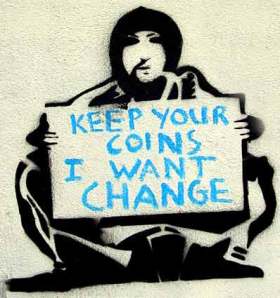 I’m watching Bernie Sanders trying defend our precious safety nets right now. The debate over this horrible capitulation to right wing extremists is carried on CSPAN . Sanders is reminding the president that all the polls call for shared sacrifice. He’s saying the proposal is bad and unfair. He’s just announced on the floor he will not vote for the package. What were getting is sacrificed on the alter of greed. At least some one recognizes this.
They’re taking a senate quorum call right now.
Here’s some headlines for you to think about.
From former Biden economic adviser Jared Bernstein: Lousy Negotiation skills are not the problem.
What did we just go through and what does it mean for our national politics, our fiscal and economic policy?
–First, a small but influential group of extreme conservatives are so intent on shrinking the federal government that they would credibly threaten national default;
–Second, Democrats, including the president, do not have a strategy to counteract such extremism, so they accepted a plan far less balanced than they would have liked—the final deal could well turn out to be $3 trillion in spending cuts over ten years, with no revenue increases to offset the cuts.
–Third, and perhaps most importantly, like every debate about the size of government, it’s impossible for normal people, if not the “experts,” to figure out what anyone is really talking about and therefore to judge the deal.
What does it mean to cut $3 trillion in government spending? How will it affect retirement security? Education? Jobs in the short run and investment over the long run? Does it put us on a sustainable fiscal path.
We’re about to agree to cut $1 trillion from something called discretionary spending. That probably sounds great to some folks and bad to others. But what does it mean?
The President bragged on this very point last night, telling America that discretionary spending as a share of the economy will come down to its lowest level since Eisenhower. As if we’ve all been walking around thinking, “if only we could get this budget category down to Ike levels, everything would fall into place.”
In fact, these cuts will hurt our ability to pursue what I view as most positive aspects of the President’s economic agenda—investment in infrastructure, clean energy, research, education. They will pinch programs that are already budget constrained…programs that help low income people with child care, housing, and community services. (One piece to watch for here—defense spending is also in this category, and is supposed to account for about one-third of the cuts…that helps, of course, take pressure of these other parts.)
Then, in part two of the deal, we unleash the gang-of-twelve who are assigned to come up with $1.5 trillion more in deficit savings.
They’ll be hitting the entitlements—Social Security, Mcare, Mcaid—and more defense, but if they deadlock—a non-trivial probability—automatic cuts ensue.
My thought is that the political game has become all important in this negotiation and no one is really thinking about the outcome. The Teabots are insane so they can be discounted, but all of this fall-in by senators and representatives that know what’s going on has got to be the most painful thing I’ve ever watched. Can’t some of them use their brains and consciences for a change instead of checking their labels and owner dog tags?
Paul Krugman: The President Surrenders
For the deal itself, given the available information, is a disaster, and not just for President Obama and his party. It will damage an already depressed economy; it will probably make America’s long-run deficit problem worse, not better; and most important, by demonstrating that raw extortion works and carries no political cost, it will take America a long way down the road to banana-republic status.
Start with the economics. We currently have a deeply depressed economy. We will almost certainly continue to have a depressed economy all through next year. And we will probably have a depressed economy through 2013 as well, if not beyond.
The worst thing you can do in these circumstances is slash government spending, since that will depress the economy even further. Pay no attention to those who invoke the confidence fairy, claiming that tough action on the budget will reassure businesses and consumers, leading them to spend more. It doesn’t work that way, a fact confirmed by many studies of the historical record.
Indeed, slashing spending while the economy is depressed won’t even help the budget situation much, and might well make it worse. On one side, interest rates on federal borrowing are currently very low, so spending cuts now will do little to reduce future interest costs. On the other side, making the economy weaker now will also hurt its long-run prospects, which will in turn reduce future revenue. So those demanding spending cuts now are like medieval doctors who treated the sick by bleeding them, and thereby made them even sicker.
And then there are the reported terms of the deal, which amount to an abject surrender on the part of the president. First, there will be big spending cuts, with no increase in revenue. Then a panel will make recommendations for further deficit reduction — and if these recommendations aren’t accepted, there will be more spending cuts.
They are killing any hope we have of a decent recovery. We don’t have one now. The US Manufacturing Index just fell to a two year low. This is one of the first leading indicators to show a looming recession. One of the most telling signs this morning about this is that the stock market is going down and now there is a flight to safety. Oddly enough, the flight to safety is to US Treasury bonds.
“We’ve turned from budget crisis to economic crisis,” said Paul Horrmann, a broker in New York at Tradition Asiel Securities Inc., an interdealer broker. “We’ve gone from worrying about a budget and default to the economy long term. Higher prices are bringing in buyers, not sellers.”
Still, what about the JOB crisis?
Kevin Drum at MOJO: Why the Debit Ceiling Deal Sucks
It’s a shit sandwich no matter how you look at it. And it’s a shit sandwich in at least two very specific ways: (1) It means we’ll continue to live in a fantasyland that says we don’t need any tax increases even though our population is aging and we’re plainly going to need higher revenues to support this demographic reality; and (2) we’ll continue to live in a fantasyland that says our problems are primarily caused by discretionary spending. This is, of course, exactly the opposite of reality, which means we’re going to screw the poor and do nothing serious about the long-term deficit. Nice work, adults.
Easy-to-Hate Debt-Ceiling Compromise Called “Sugar-Coated Satan Sandwich” By Some
Cuts to Social Security and Medicare are also possible within the plan. Representative Emanuel Cleaver (D-MO), the chairman of the Congressional Black Caucus, called the deal a “sugar-coated Satan sandwich,” which itself deserves $1.2 trillion.
We’re seriously f’d on this one folks.
Notable tweets:
daveweigel
I haven’t seen this many pissed off Democrats since the last time I saw some Democrats. #beenatoughyear
tbogg
Gene Sperling: Obama ‘didn’t give one inch’ : politico.com/news/stories/0… So Obama’s people say he owns this shit sandwich. Jesus. #Quitdigging
SatanSandwichSugar Coated
The moment I convinced President Obama of the virtues of austerity: bit.ly/nbv5C6 #FYEAH
ThePlumLineGSGreg Sargent
House Dem leaders NOT pressing Dems to vote for the debt deal, potentially complicating passage: http://wapo.st/o3wyDP
nytimes The New York Times
How the Debt Plan Would Work
Read this CBO letter to Congressional Leaders. They’re putting discretionary funding caps on Social Security, Medicare, SCHIP, Medicaid, et. Iraq and Afghanistan are exempt from spending caps. This is AWFUL!!! Worse than I thought … Please read this analysis from the CBO to congress!!!
House DEBATE and vote on package: running here at CSPAN. They are voting on the debate rules right now at 3:30 pm cst. Progressive Caucus leaders talking right now saying they will not support the deal because it’s incredibly wrong and worse than the Reid Compromise. Lynn Woolsey and Barbara Lee announcing they will vote no.
Please report on who you know is voting for or against below so we can keep track of who needs to face a real democrat in a primary,
Krugman Debunks Republican Fairy Tales
Posted: July 30, 2011 Filed under: Economy | Tags: Bush tax cuts, Paul Krugman, Ronald Reagan Fairy Tales 11 Comments As we inch closer to purposeful default on our debt and spending policies destined to send us into recession, Nobel Prize winning Economist Paul Krugman comes out blasting with some nifty graphs. Stylized facts are an economist’s best friend. We continue to see this unending push of thoroughly trounced bad hypotheses spew out of Republicans and even the President. The vast degree of economic illiteracy in this country astounds me.
First, I’ll repeat one set of facts I mentioned in my post yesterday. Ronald Reagan was responsible for the largest tax increases in history and Barrack Obama was responsible for the largest tax cuts through his stimulus plan. This doesn’t even include his extension of the Dubya tax cuts. Discussion during TEFRA of 1982 resembles the discussion going on today. However, Reagan did tax increases. This particular ridiculousness is enough to make a data junkie scream. If you look at deficit numbers, former President Jimmy Carter was moving towards a budget balanced by the end of his term in office. Reagan blew government spending out of the water. However, Dubya remains the biggest spender of all since World War 2. If you want to blame the spending on any one, blame it on Reagan and George W, Bush. More on that in a bit.
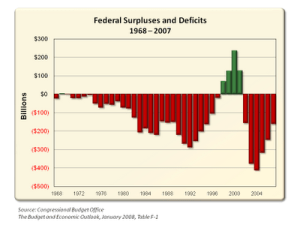
Paul Krugman covers another Reagan Bedtime Story. He also points out that even conservative economists have started spewing the notion that Reagan was responsible for an era of “unprecedented growth”. This is also not true.
This shows what everyone was supposed to know: we had an awesome performance in the generation following the war (despite very high tax rates on the rich and a very strong union movement); we had a long period of poor productivity performance that spanned the Ford, Carter, Reagan, and Bush I administrations; we then had a revival during the Clinton administration, but even so not up to postwar standards. By the way, I don’t give Clinton credit for that revival; it was about learning to use technology. But in any case, there is no hint of a Reagan miracle in the data.
Now, back to stylized facts on federal spending. This is also from Krugman. There is this huge meme out there right now that some how, President Obama has gone on some kind of spending spree. This couldn’t be further from the truth. It appears that Rush Limbaugh is not only a big fat liar, but he is also incapable of doing the math on simple fractions. He is joined by nearly every Republican in the House today.
The fact is that federal spending rose from 19.6% of GDP in fiscal 2007 to 23.8% of GDP in fiscal 2010. So isn’t that a huge spending spree? Well, no.
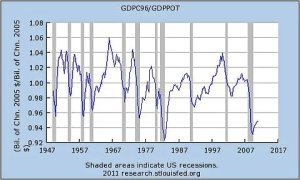
First of all, the size of a ratio depends on the denominator as well as the numerator. GDP has fallen sharply relative to the economy’s potential; here’s the ratio of real GDP to the CBO’s estimate of potential GDP:
A 6 percent fall in GDP relative to trend, all by itself, would have raised the ratio of spending to GDP from 19.6 to 20.8, or about 30 percent of the actual rise.
That still leaves a rise in spending; but most of that is safety-net programs, which spend more in hard times because more people are in distress.
Beginning in 2005, the CBPP showed how George W. Bush’s excessive tax cuts played the largest part in federal deficits. Simply allowing these to expire last December would have gone farther in pushing a balanced budget than nearly anything done to date. In May of this year, they continued their analysis of how the Bush Policies were the ones driving the budget deficit.
Some lawmakers, pundits, and others continue to say that President George W. Bush’s policies did not drive the projected federal deficits of the coming decade — that, instead, it was the policies of President Obama and Congress in 2009 and 2010. But, the fact remains: the economic downturn, President Bush’s tax cuts and the wars in Afghanistan and Iraq explain virtually the entire deficit over the next ten years (see Figure 1).
The deficit for fiscal year 2009 — which began more than three months before President Obama’s inauguration — was $1.4 trillion and, at 10 percent of Gross Domestic Product (GDP), the largest deficit relative to the economy since the end of World War II. At $1.3 trillion and nearly 9 percent of GDP, the deficit in 2010 was only slightly lower. If current policies remain in place, deficits will likely resemble those figures in 2011 and hover near $1 trillion a year for the next decade.
The events and policies that pushed deficits to these high levels in the
near term were, for the most part, not of President Obama’s making. If not for the Bush tax cuts, the deficit-financed wars in Iraq and Afghanistan, and the effects of the worst recession since the Great Depression (including the cost of policymakers’ actions to combat it), we would not be facing these huge deficits in the near term. By themselves, in fact, the Bush tax cuts and the wars in Iraq and Afghanistan will account for almost half of the $20 trillion in debt that, under current policies, the nation will owe by 2019. The stimulus law and financial rescues will account for less than 10 percent of the debt at that time.
Other drives of the current deficit are extremely short-lived. These would be all the financial rescue spending delivered to financial institutions and the recession which brings in loss of revenues and increased expenditures. The other big expenditures are the two unfunded wars that having been running for over 10 years. These are the first wars that we have ever run that were not funded by tax increases.
However, these Republican Fairy Tales do not let the current President off the hook. He seems as hell bent as the Republicans in many ways to repeat their sins. He also seems woefully short on economic knowledge and incapable of listening to his economics advisers–now frustrated and gone–on what to do with the economy. The simplest way to shut down the deficit would be to eliminate preferential treatment of capital gains income and let the Bush tax cuts expire. I’d prefer they expire for folks over $200,000 a year, but letting them expire altogether is better than setting the stage for all these falsehoods spewing from Limbaugh and the like. Obama should’ve let the tax cuts expire when he had the chance. However, his ability to negotiate a position that proposes a Democratic alternative policy has never been present. People can’t figure out if he is just has the world’s worst negotiating skills or he wants what the Republicans want. My belief is that the outcome could matter less to him as long as he gets some ego strokes from it.
We have gotten to the point that complete insanity and adherence to fairy tales is putting our economy in serious jeopardy. We simply cannot afford to listen to the voices of ignorance any more. I cannot even believe we’re being held hostage now to a balanced budget amendment. That is one of the most flagrantly wrong policies any one could ever think about. I’m going to take that on this week since I can’t believe that zombie canard is back haunting the halls of Congress again.
We seriously need experienced economic stewardship of the economy right now. We have a tremendous jobs deficit that will only get worse if any of these seriously flawed budget initiatives pass. We couldn’t have gotten a worse group of leaders at a more crucial point in time. Their mistakes will hurt this country for a very long time.

 peej
peej Carissa
 bostonboomer
 dakinikat
 ecocatwoman
 mablue2
 Mama Lopez
 peggysue22
 quixote
 skydancingguestblogger
 Mona (aka Wonk the Vote)



 Sky Dancing
Recent Comments