“The Orangeutan is full-bore flinging poo to distract from the Epstein Trump Files.” John Buss, @repeat1968
Good Day, Sky Dancers
My outrage today at the latest, least presidential Truth Social Post that I may have ever seen knows no bounds. And yet, the boundless insanity of the “Press Secretary” tells me it’s fake. Don’t you just hate it when some Clairol MAGA Blonde bimbo tries to tell you how you feel? Here’s the headline at the New York Times. I’d share the Washington Post headline, too, but Jeff Bezos is busy ripping all the vital organs of that once great newspaper. “Trump Posts Video Portraying Obamas as Apes. The White House press secretary dismissed criticism of the clip’s racist content, shared by the president’s Truth Social account, as “fake outrage.” What an international disgrace of a country we’ve become!
Erica L. Green and Isabella Kwai share the lede.
President Trump posted a blatantly racist video clip portraying former President Barack Obama and the former first lady Michelle Obama as apes, the latest in a long pattern by Mr. Trump of promoting offensive stereotypes about Black Americans and others.
The brief clip, set to “The Lion Sleeps Tonight,” was spliced near the end of a 62-second video that promoted conspiracy theories about anomalies in the 2020 presidential election.
The depiction of Mr. and Mrs. Obama as apes perpetuates a racist trope, used historically by slave traders and segregationists to dehumanize Black people and justify lynchings and other atrocities. A spokeswoman for Mr. Obama declined to comment.
Mr. Trump has a history of making degrading remarks about people of color, women and immigrants. And in his second administration, official posts from the White House, Labor Department and Homeland Security Department have posted images and slogans that echo white supremacist messaging.
In response to questions about the clip, which Mr. Trump posted Thursday during a late-night spree on social media, Karoline Leavitt, the White House press secretary, said criticism of the video was “fake outrage.”
“This is from an internet meme video depicting President Trump as the King of the Jungle and Democrats as characters from the Lion King,” she said. “Please stop the fake outrage and report on something today that actually matters to the American public.”
Senator Tim Scott of South Carolina — the Senate’s only Black Republican — wrote on X that he hoped the post was fake “because it’s the most racist thing I’ve seen out of this White House. The President should remove it.”
The latest clip appeared to have been taken from a video that was shared in October by a user on X with the caption “President Trump: King of the Jungle,” and an emoji of a lion.
In that video, several high-profile Democrats — including former U.S. secretary of state Hillary Clinton, Representative Alexandria Ocasio-Cortez of New York, Mayor Zohran Mamdani of New York, former President Joseph R. Biden Jr. and former vice president Kamala Harris — were shown as various animals, while Mr. Trump was depicted as a lion. The Obamas, in the clip, were shown as apes. The video ended with the animals bowing down to Mr. Trump.
NBC News‘ Rebecca Shabad has further information on the disgusting post. “Trump shares racist video depicting the Obamas as monkeys. The White House defended Trump’s post, saying it was “from an internet meme video depicting President Trump as the King of the Jungle.”
The roughly minute-long video otherwise focused on false election fraud claims about the 2020 presidential election, but at the very end it suddenly flashed to a clip of the Obamas’ faces superimposed on the heads of cartoon apes as the song “The Lion Sleeps Tonight” by The Tokens played in the background.
The imagery, which evokes long-standing racist tropes against Black people, comes during Black History Month, which honors the accomplishments and contributions of Black Americans. Barack Obama made U.S. history as the first Black president.
White House press secretary Karoline Leavitt responded to NBC News’ request for comment Friday morning with a statement: “This is from an internet meme video depicting President Trump as the King of the Jungle and Democrats as characters from the Lion King. Please stop the fake outrage and report on something today that actually matters to the American public.”
The video the White House referred to appeared to have been posted initially by an X user in October and shows the Obamas as apes in the beginning and other Democrats’ faces as the heads of other African animals as the song continues to play. Former Secretary of State Hillary Clinton is depicted as a warthog and Illinois Gov. J.B. Pritzker as an elephant, for example, while Trump is presented as a lion.
Representatives for the Obamas didn’t immediately respond to NBC News’ request for comment.
Trump’s repost drew strong criticism on social media, including from Sen. Tim Scott, R-S.C., who sharply denounced the president on X. “Praying it was fake because it’s the most racist thing I’ve seen out of this White House. The President should remove it,” he said.
The President continues to do despicable things to immigrant families and to communities that stand up to his reckless and unconstitutional policies. This is from MPR News, located in the Twin Cities area. Regina Medina reports the story. “DHS has requested expedited deportation proceedings against family of Liam Conejo Ramos.”
The federal government has filed a motion seeking to end asylum claims for the family of Liam Conejo Ramos, according to the lawyer representing the family. The 5-year-old returned home this week after he was detained with his father on Jan. 20 and sent to a detention center in Texas.
The Department of Homeland Security filed a motion Wednesday to expedite deportation proceedings in the family’s case, said immigration attorney Danielle Molliver with Nwokocha & Operana Law Offices.
A hearing is scheduled for Friday, although Molliver is requesting more time to respond. She said she thought the motion was “retaliatory.”
“It’s really frustrating as an attorney, because they keep throwing new obstacles in our way. There’s absolutely no reason that this should be expedited. It’s not very common,” Molliver said.
Molliver said the federal government may not deport them to Ecuador, their home country. Instead, the family could apply for asylum in a third country.
Liam’s father, Adrian Conejo Arias, said they don’t know what will happen to them.
“The government is moving many pieces, it’s doing everything possible to do us harm, so that they’ll probably deport us. We live with that fear too,” Conejo Arias said. The interview was conducted in Spanish and translated by MPR News.
DHS did not immediately respond to a request for comment.
I truly believe that the more he goes after this family, the more his polls will fall, and he will pull Republicans down further as the Midterm elections near. What is also clear is that the Washington Post will not be up to doing any kind of real reporting on any of this. Ruth Marcus of The New Yorker has this analysis. “How Jeff Bezos Brought Down the Washington Post. The Amazon founder bought the paper to save it. Instead, with a mass layoff, he’s forced it into severe decline.”
On September 4, 2013, the Amazon founder Jeff Bezos held his first meeting with the staff of the Washington Post, the newspaper he had agreed to purchase a month earlier from the Graham family, for two hundred and fifty million dollars. It had been a long and unsettling stretch for the paper’s staff. We—I was a deputy editor of the editorial page at the time—had suffered through years of retrenchment. We trusted that Don Graham would place us in capable hands, but we did not know this new owner, and he did not know or love our business in the way that the Graham family had. Bezos’s words at that meeting, about “a new golden era for the Washington Post,” were reassuring. Bob Woodward asked why he had purchased the paper, and Bezos was clear about the commitment he was prepared to make. “I finally concluded that I could provide runway—financial runway—because I don’t think you can keep shrinking the business,” he said. “You can be profitable and shrinking. And that’s a survival strategy, but it ultimately leads to irrelevance, at best. And, at worst, it leads to extinction.”
To look back on that moment is to wonder: How could it have come to this? The paper had some profitable years under Bezos, sparked by the 2016 election and the first Trump term. But it began losing enormous sums: seventy-seven million dollars in 2023, another hundred million in 2024. The owner who once offered runway was unwilling to tolerate losses of that magnitude. And so, after years of Bezos-fuelled growth, the Post endured two punishing rounds of voluntary buyouts, in 2023 and 2025, that reduced its newsroom from more than a thousand staffers to under eight hundred, and cost the Post some of its best writers and editors. Then, early Wednesday morning, newsroom employees received an e-mail announcing “some significant actions.” They were instructed to stay home and attend a “Zoom webinar at 8:30 a.m.” Everyone knew what was coming—mass layoffs.
The scale of the demolition, though, was staggering—reportedly more than three hundred newsroom staffers. The announcement was left to the executive editor, Matt Murray, and human-relations chief Wayne Connell; the newspaper’s publisher, Will Lewis, was nowhere to be seen as the grim news was unveiled. In what Murray termed a “broad strategic reset,” the Post’s storied sports department was shuttered “in its current form”; several reporters will now cover sports as a “cultural and societal phenomenon.” The metro staff, already cut to about forty staffers during the past five years, has been shrunk to about twelve; the foreign desks will be reduced to approximately twelve locations from more than twenty; Peter Finn, the international editor, told me that he asked to be laid off. The books section and the flagship podcast, “Post Reports,” will end. Shortly after the meeting, staffers received individualized e-mails letting them know whether they would stay or go. Murray said the retrenched Post would “concentrate on areas that demonstrate authority, distinctiveness, and impact,” focussing on areas such as politics and national security. This strategy, a kind of Politico-lite, would be more convincing if so many of the most talented players were not already gone.
Graham, who has previously been resolutely silent about changes at the paper, posted a message on Facebook that pulsed with anguish. “It’s a bad day,” he wrote, adding, “I am sad that so many excellent reporters and editors—and old friends—are losing their jobs. My first concern is for them; I will do anything I can to help.” As for himself, Graham, who once edited the sports section, said, “I will have to learn a new way to read the paper, since I have started with the sports page since the late 1940’s.”
Tech Bros and MAGA have ruined our democracy. Paul Krugman, however, argues that “American Decency Still Lives. When pushed far enough, Americans will do the right thing.” This is posted on his SubStack. I have found this to be true here in New Orleans. Even more so, I watch the city where I lived before moving here show the earnest Lutheran social justice so famously known as Minnesota nice. It has a yin and a yang, believe me.
If you want to accomplish anything in politics, you have to have realistic expectations about voters. Ordinary people aren’t deeply informed about policy or politics. They have jobs to do, children to raise, lives to live. A large proportion of voters don’t have strong ideological preferences — not because they’re “moderates,” but because they don’t think ideologically at all. Instead, they think pragmatically – they think about things like the price of eggs and the cost of health insurance. And because the average voter isn’t a policy or data wonk, they are often misled – for example, by claims that crime is rising even when it’s actually falling.
Granted, some voting behavior is motivated by ugly biases. Racism and sexism, homophobia and transphobia, are still important factors in politics. But there’s a difference between political realism and nihilistic cynicism.
Many of my readers are probably aware of the famous confessional by the German pastor Martin Niemöller:
First they came for the Communists
And I did not speak out
Because I was not a Communist
Then they came for the Socialists
And I did not speak out
Because I was not a Socialist
Then they came for the trade unionists
And I did not speak out
Because I was not a trade unionist
Then they came for the Jews
And I did not speak out
Because I was not a Jew
Then they came for me
And there was no one left
To speak out for me
I don’t know if Stephen Miller has ever seen these words. But if he has, he has taken them not as a warning but as operating instructions. MAGA’s ethnic cleansing plans — because that’s what they are — were clearly based on the cynical assumption that native-born white Americans wouldn’t rise to the defense of civil liberties and rule of law if state violence was directed at people who don’t look like them.
And for much of Trump’s first year in office many Democrats were reluctant to challenge his immigration policies, because their defeat in 2024 was widely seen as in part a response to surging immigration during the Biden years. Until recently, Democrats tried to keep the national conversation focused on affordability and Trump’s obvious failure to deliver on his promises to bring grocery prices way down.
While the Democratic strategy was an understandable response to a shattering electoral defeat, it rested on a cynical and nihilistic view of American voters: that they couldn’t be trusted to vote against a party that reveled in inflicting cruelty and injustice as long as the price of gasoline fell.
But recent events refute this nihilistic cynicism. Yes, Americans still name the economy as the most important political issue. But moral outrage over the Trump administration’s brutality (and its corruption, but that’s a subject for another post) has exploded as a political force over the past two months.
There was substantial resistance to ICE’s attempts to intimidate Los Angeles and Chicago. But the response since the invasion of Minneapolis (and now all of Minnesota) began in December has been on another level, a mass nonviolent uprising reminiscent of the civil rights movement in the 1960s and the color revolutions in the former Soviet empire.
MPR News reports that nearly 30,000 Minnesotans have been trained as constitutional observers, with another 6,000 volunteers registered to deliver food, give at-risk families rides, and so on. This is time-consuming, exhausting, dangerousactivism. Yet ordinary Americans in large numbers are willing to do it.
Cell phone cameras and whistles can’t completely stop ICE’s brutality and lawlessness. For some reason I’m especially troubled by tales of the many cars found abandoned in the middle of the street, their windows smashed and their occupants obviously abducted. But the resistance is throwing sand in the gears and producing acute frustration among the masked thugs, who have repeatedly been filmed drawing guns on citizens doing nothing but observing them.
And the public is not on the side of the thugs.
Profanity-laden anti-MAGA chant erupts at major pro-wrestling event
Plus, once again, a major nation is turning to China for its trade initiatives because our #FARTUS is too stupid and stuck-up to recognize that his economic policies are dooming a lot of our industries and jobs. This is from the AP. I cannot believe we keep repeating obvious mistakes from the past because no one in Congress will do their fucking job! “Facing high Trump tariffs, Africa’s leading economy says it’s close to a new trade deal with China.” Just think, a few years ago, we were on target to keep them in second place.
China and South Africa signed a framework agreement for a new trade deal on Friday as Africa’s leading economy looks to other options following the high import tariffs imposed on it by the U.S. and its diplomatic fallout with the Trump administration.
South Africa’s Ministry of Trade and Industry said the agreement would start negotiations over a deal that would give some South African goods, such as fruit, duty-free access to the Chinese market. The ministry said it expected the trade deal to be finalized by the end of March.
In return, the trade ministry said China will get enhanced investment opportunities in South Africa, where its car sales have seen rapid growth.
The U.S. slapped 30% duties on some South African goods under U.S. President Donald Trump’s reciprocal tariffs policy — one of the higher rates applied across the world. South Africa has said it is still negotiating with the U.S. for a better deal.
The China-South Africa deal follows others looking for alternatives to U.S. partnership in the face of Trump’s aggressive trade policies.
The announcement on the negotiations between China and South Africa came days after Trump issued a short-term renewal of a longstanding free-trade agreement between the U.S. and African nations. The U.S. extended the African Growth and Opportunity Act, which South Africa is a major beneficiary of, just until the end of the year and indicated it would be modified to fit the administration’s America First policy.
China is already South Africa’s largest trade partner for both imports and exports, while Chinese economic influence across the African continent continues to grow and it dominates in the extraction of Africa’s critical minerals that are key components for new high-tech products.
“South Africa looks forward to working with China in a friendly, pragmatic and flexible manner,” the trade ministry said.
The Stupid. It hurts.
What’s on your reading and blogging list today?
Did you like this post? Please share it with your friends:
I haven’t been feeling well for the past several days, and I’ve only been following the news superficially. There is so much going on, but I’ll do my best. Here’s the latest.
Trump is scheduled to give a speech from the White House tonight at 9PM.
President Donald Trump intends to preview his agenda for next year and beyond in a live speech from the White House on Wednesday night. His remarks are coming at a crucial time as he tries to rebuild his steadily eroding popularity.
The White House offered few details about what the Republican president intends to emphasize in the 9 p.m. EST speech. Public polling shows most U.S. adults are frustrated with his handling of the economy as inflation picked up after his tariffs raised prices and hiring slowed.
In 2026, Trump and his party face a referendum on their leadership as the nation heads into the midterm elections that will decide control of the House and the Senate.
Trump has said that he thinks more Americans would back him if they simply heard him describe his track record. Administration officials say investment commitments for new factories will reverse the recent decline in manufacturing jobs and that consumer activity will improve dramatically as people receive increased tax refunds next year.
“It has been a great year for our Country, and THE BEST IS YET TO COME!” Trump said in a Tuesday social media post announcing the speech.
Sorry, Grandpa. Your economy sucks because of your idiotic tariffs, your cruel mass deportations, and your general incompetence.
Tariffs are unpopular, prices remain stubbornly high and Americans are souring on President Trump’s handling of the economy.
So Mr. Trump has reprised a familiar political strategy: promise people cash.
The president has repeatedly floated the idea of sending one-time $2,000 rebate checks to many families.Credit…Eric Lee for The New York Times
The White House is trying to tamp down Americans’ economic anxieties by dangling the prospect of checks and other paydays next year, hoping that the money might assuage voters who blame the president for their rising cost of living.
Mr. Trump, who is set to address the nation on Wednesday night, has repeatedly teased the idea of sending one-time $2,000 rebate checks to many families, funded using money collected from his sweeping global tariffs. But he has not devised a detailed plan for providing the rebates, an expensive policy that Republicans in Congress must approve and one that they have not yet considered.
The president has also begun hyping up the tax refunds that Americans are slated to receive in 2026. For many people, these cash payments are expected to be larger than they were last year, after Republicans adopted a sprawling set of tax cuts in July.
Both Mr. Trump and members of his administration have periodically drawn an equivalence between the supposed tariff rebates and the enacted tax law. They have claimed the money could bolster the economy and alleviate some of the financial strains on families, even at a time when Mr. Trump maintains that much of the talk about affordability is a “hoax.”
“Next year is projected to be the largest tax refund season ever, and we’re going to be giving back refunds out of the tariffs, because we’ve taken in literally trillions of dollars,” Mr. Trump said at a cabinet meeting last week. “And we’re going to be giving a nice dividend to the people, in addition to reducing debt.”
But economists take a dimmer view. Even if Americans were to delight in a series of new government-issued checks, the payments would hardly address the reasons that prices remain so high — including a shortage in housing that has driven up rents and mortgages and the global tariffs that have made imports more expensive. And the money that may soon be sloshing around the economy could end up worsening inflation, undermining Mr. Trump’s own economic goals.
Alex Durante, a senior economist at the Tax Foundation, said that simply “pumping money” into the economy — without any other underlying changes — threatened to “just generate a cycle where you continue to get higher prices.”
When Politico recently asked Donald Trump to grade the current U.S. economy, he replied “A-plus-plus-plus-plus-plus.” He made this boast at a time when actual economic data were still scarce, a consequence of the government shutdown that stopped or delayed key information about the state of the job market.
Yesterday the report on employment during the month of November finally arrived. And the message of the report on the state of the US economy was clear: A+++++ my A++. While it’s too soon to declare that we’re in a recession, the data are at least pre-recessionary: that is, the numbers are weak enough that we should be seriously worried that a recession is coming. And that’s a state of affairs completely at odds with Trump’s rose-colored — spray-tanned? — picture.
I’ll talk about the reasons the gap between Trump’s big boasts and the glum reality matters in a minute. First, however, let’s talk about what we learned from yesterday’s report.
Most importantly, the data show a weak labor market. Employment isn’t falling off a cliff, but job growth has been weak and hasn’t kept pace with the number of people seeking work. The headline unemployment rate in November was 4.6 percent, up from an average of 4 percent in 2024. That number is close to triggering the Sahm Rule, an economic rule of thumb devised by Claudia Sahm, a former economist at the Board of Governors of the Federal Reserve, that has historically been highly successful at identifying the early stages of a recession.
We can’t do a strict application of the Sahm Rule yet because Sahm’s method is based on the average unemployment rate over the past three months. Unfortunately, the shutdown prevented the Bureau of Labor Statistics from collecting key data in October. But if we do an interpolation of October’s unemployment rate by averaging over September’s rate of 4.4% and November’s rate of 4.6%, we can estimate that October’s unemployment rate was 4.5%. And those 3 months of unemployment numbers bring us within a whisker of the unemployment rise that, according to the Sahm Rule, signals that a recession is on the horizon.
The state of the economy looks even worse if we take a wider view of the labor market. The BLS calculates 6 different measures of unemployment. The most commonly cited number is U-3 — the number of workers who are actively seeking jobs but haven’t found them. But the broadest measure is U-6, which includes underemployed workers stuck in part-time employment and discouraged workers who have temporarily given up job search. And U-6 has risen sharply since January, when Trump took office:
Source: BLS
Further evidence consistent with a poor and deteriorating job market is data showing that the number of job-seekers who are long-term unemployed – that is, have been unemployed for 27 weeks or more – has risen by almost a third (from 1.45 million to 1.91 million) since 2024. This means that the unemployed are finding it harder to find jobs.
Read more details at the Substack link.
Most Americans aren’t stupid. They can see how much prices have gone up on necessities like food and electricity. Trump is losing popularity even with his MAGA base.
Marjorie Taylor Greene: "I think the midterms are gonna be very hard for Republicans. I'm one of the people that's willing to admit the truth and say I don't see Republicans winning the midterms right now, so that doesn't bode well for Mike Johnson."
Rep. Marjorie Taylor Greene (R-Georgia) on Tuesday said President Donald Trump has “real problems” within the Republican Party, adding in an interview with CNN that the president is out of touch with voters on key issues such as affordability.
Greene told Kaitlan Collins on “The Source” that the “dam is breaking” in terms of Trump’s hold onsupport within the party and that she expects Republicans to struggle in next year’s midterm elections.
“I think the midterms are going to be very hard for Republicans,” Greene said. “I’m one of the people that’s willing to admit the truth and say I don’t see Republicans winning the midterms right now.” [….]
Greene had carved out a high-profile role as one of Trump’s most vocal allies, first in the “Make America Great Again” movement and then with her support for the “America First” agenda. But after weeks of speaking out against the president on several issues, Greene and Trump had an acrimonious public split last month after she joined with Democrats on a discharge position to compel a House vote calling on the Justice Department to release files related to convicted sex offender Jeffrey Epstein….
Speaking to The Washington Post this week, Greene described herself as a “bellwether” who is closely attuned to Trump’s base. “I say it, and then within four to six months, everybody’s saying the same thing,” she said….
“He’s got real problems with Republicans within the House and the Senate that will be breaking with him on more things to come,” she added.
Greene also said Trump’s supporters “didn’t appreciate” the president’s reaction to the death of Rob Reiner, who was found stabbed to death alongside his wife, photographer Michele Singer Reiner, in their Los Angeles home Sunday. The couple’s son Nick Reiner faces two counts of first-degree murder, among other charges, in their deaths.
Marjorie Taylor Greene: "What I'd like to see from the president is empathy for Americans. Donald Trump is a billionaire and he's the president. When he looks into a camera and says 'affordability is a hoax,' he's talking to Americans that are suffering and have been for many years now."
Four House Republicans joined Democrats Wednesday to force a House vote on a straight three-year extension of the enhanced Obamacare tax credits that will expire Dec. 31, delivering a sharp rebuke to Speaker Mike Johnson and other GOP leaders.
Reps. Brian Fitzpatrick of Pennsylvania, Mike Lawler of New York, Rob Bresnahan of Pennsylvania and Ryan Mackenzie of Pennsylvania signed the discharge petition filed by House Minority Leader Hakeem Jeffries — hours after House GOP leaders rejected attempts by Fitzpatrick and other Republican moderates to seek a floor vote on extending the subsidies used by more than 20 million Americans.
Fitzpatrick said in a late-night House Rules Committee meeting Tuesday that “the only thing worse than a clean extension … would be expiration, and I would make that decision.” Lawler added that “the only feasible path forward is a discharge petition” if GOP leader reject a floor vote.
Under House rules, a completed discharge petition is subject to a waiting period, meaning no vote could happen until next month — though Johnson could choose to move sooner.
“We have worked for months to craft a two-party solution to address these expiring healthcare credits,” Fitzpatrick said in a statement Wednesday. “Our only request was a Floor vote on this compromise, so that the American People’s voice could be heard on this issue. That request was rejected. … Unfortunately, it is House leadership themselves that have forced this outcome.”
Jeffries told reporters Wednesday his discharge petition is “the most straightforward path to ensuring that tens of millions of Americans don’t have their health care ripped away from them because of the expiration of the Affordable Care Act tax credits.”
"It's idiotic, it's political malpractice," Rep. Mike Lawler (R-N.Y.) told reporters Tuesday of Johnson refusing to give them an ACA extension vote.Lawler, and other moderate Republicans didn't rule out joining Democrats to force a vote on a three-year extension of the subsidies, Axios reported.
Donald Trump is worried that Republicans aren’t as afraid of him as they used to be. Despite his self-billing as a dealmaker, the president has only ever had one tool to control his party: fear. GOP politicians have been afraid of career damage and literal physical harm if they crossed him. Trump is not above reminding elected officials that he has unhinged followers who are known to be violent. But as his approval ratings fall and the 2026 midterm elections inch closer, it seems Republicans are slightly less worried about the president’s wrath.
The first indicator was the House vote on Nov. 18 to release the Epstein files against Trump’s expressed wishes. But the biggest sign that the president’s grip on power is weakening came last week, when a majority of Republicans in the Indiana statehouse struck down a gerrymandering bill Trump had demanded.
As I argued in the latest Standing Room Only newsletter, this context helps explain why Trump responded to the death of beloved director Rob Reiner and his wife Michele with an ugliness that’s shocking — even for this president. Although the Los Angeles Police Department had arrested the couple’s son for the apparent homicide, Trump insinuated on Truth Social that it was one of his own followers who killed the Reiners out of revenge for their anti-Trump activism. He doubled down when asked about it by reporters in the Oval Office on Monday. The message was hard to miss: If you oppose Trump, he wishes you dead.
These are promising signs, but it’s not worth holding your breath waiting for GOP politicians to openly turn on a president who demands absolute loyalty. Instead of public rebellion, most Republicans seem to be engaged in a form of quiet quitting. They won’t go out of their way to resist Trump, but they are losing enthusiasm for defending him. They’re struggling to hide their frustration or their scheming for a post-Trump world. Overall, the posture is one of lying low, waiting for the old man to be gone so they can begin the project of rebuilding the GOP and their own careers in a post-Trump era.
Read the rest at Salon.
Trump is also becoming noticeably less involved in actually running the government (gift link): The White House Is a Lost Cause.
There is a presidency at work in Washington, but it is not clear that there is a president at work in the Oval Office.
Ask Donald Trump about the goings on of his administration, and there is a good chance he’ll defer to a deputy rather than answer the question. “I don’t know her,” he said when asked about his nominee for surgeon general, Casey Means, earlier this year. “I listened to the recommendation of Bobby,” he said, pointing to Robert F. Kennedy Jr., the secretary of health and human services.
Ask Trump for insight into why his administration made a choice or to explain a particular decision, and he’ll be at a loss for words. Ask him to comment on a scandal? He’ll plead ignorance. “I know nothing about it,” Trump said last week, when asked about the latest tranche of photographs released from the estate of Jeffrey Epstein.
None of this on its own means the president isn’t working or paying attention to the duties of his office. But consider the rest of the evidence. He is by most accounts isolated from the outside world. He does not travel the country and rarely meets with ordinary Americans outside the White House. He is shuttled from one Trump resort to another to play golf and hold court with donors, supporters and hangers-on.
Ronald Reagan took regular meetings with congressional leaders to discuss his legislative agenda; George H.W. Bush spearheaded negotiations with the nation’s allies and led the United States to war in Iraq; and George W. Bush was, for better or worse, “the decider” who performed leadership for the cameras as much as he tried to exercise it from the Oval Office. Trump is a ubiquitous cultural presence, but there is no outward sign that he is an active participant in running the national government. He was mostly absent during discussions of his signature legislation — the One Big, Beautiful Bill Act — and practically AWOL during the monthlong government shutdown.
It is difficult for any president to get a clear read on the state of the nation; it takes work and discipline to clear the distance between the office and the people. But Trump, in his second term, does not seem to care about the disconnect. Abraham Lincoln once remarked that it would “never do for a president to have guards with drawn sabers at his door, as if he fancied he were, or were trying to be, or were assuming to be, an emperor.” A president has to be engaged — attentive to both the government and the public he was elected to serve.
Trump is neither. He is uninterested in anyone except his most devoted fans, and would rather collect gifts from foreign businessmen than take the reins of his administration. “The president doesn’t know and never will,” Susie Wiles, the White House chief of staff, said in an interview with Vanity Fair, commenting on the work of Elon Musk in the first months of the year. “He doesn’t know the details of these smallish agencies.”
A bit more:
Russell Vought
Instead, the work of the White House has been delegated to a handful of high-level advisers. Russell Vought, the director of the Office of Management and Budget, is the de facto shadow president for domestic affairs. As one senior government official told ProPublica, “It feels like we work for Russ Vought. He has centralized decision-making power to an extent that he is the commander in chief.” It was Vought who orchestrated the administration’s assault on the federal bureaucracy, including the wholesale destruction of U.S.A.I.D. It was Vought who either froze or canceled hundreds of billions of dollars in funding for anti-poverty programs, H.I.V. reduction initiatives and research into science, medicine and technology. And it is Vought who has been pushing the boundaries of executive power as he attempts to turn the federal government into little more than an extension of the personal will of the president — as channeled through himself, of course.
If Vought is the nation’s shadow president for domestic policy, then Stephen Miller is its shadow president for internal security. Miller, Trump’s top domestic policy adviser, is using the president’s authority to try to transform the ethnic mix of the country — to make America white again, or at least whiter than it is now. He is the primary force behind the expansion of Immigration and Customs Enforcement and Customs and Border Protection into a roving deportation force. He has pushed both agencies to step up their enforcement operations, targeting schools, restaurants, farms and other work sites and detaining anyone agents can get their hands on, regardless of citizenship or legal status. It is Miller who is behind the militarization of ICE, the use of the National Guard to occupy Democrat-led cities and assist deportation efforts, and the plan to blanket the United States with a network of detention camps for unauthorized immigrants and anyone else caught in his dragnet.
In other words, the Nazis are running White House policy. Use the gift link to read more.
The latest White House mess is the Vanity Fair profile of Chief of Staff Susie Wiles.
Susie Wiles generally helps quietly shape headlines. She is rarely the focus of them.
That changed in dramatic fashion Tuesday after Vanity Fair published a deeply reported profile of the 68-year-old White House chief of staff, whose decades-long career in politics has been defined by a measured, steady-the-ship tone, never one that could be construed as undermining her boss.
In the two-part Vanity Fair piece — which included 11 interviews over nearly a year, with the White House’s cooperation — Wiles comes off as far more candid than her public persona. She not only speaks openly about both President Donald Trump and those who make up the core of his administration, but appears to acknowledge that at times she has been at odds with some of the policies that have been central to Trump’s second term. While not unusual for a chief of staff to disagree with the president they serve, those concerns generally remain part of private conversations.
Susie Wiles
Wiles revealed there had been “huge disagreements” over implementing tariffs, acknowledged that the administration must “look harder” at its process for mass deportation and said she had to “get on board” with Trump’s decision to give blanket pardons to Jan. 6 defendants. She said she initially believed only those who did not commit violent acts should be pardoned.
The profile prompted an all-hands-on-deck pushback from the White House and Trump’s political orbit. The central talking point became that the profile lacked context, and supporters blasted the outlet for being unfair rather than offering any direct refutation of the authenticity of quotes or what was reported.
Wiles herself also offered rare public condemnation.
“Significant context was disregarded and much of what I, and others, said about the team and the President was left out of the story,” she posted on social media. “I assume, after reading it, that this was done to paint an overwhelmingly chaotic and negative narrative about the President and our team.”
In an interview with the New York Post, Trump defended his top staffer.
“I think from what I hear, the facts were wrong, and it was a very misguided interviewer, purposely misguided,”he said.
Trump added “she’s fantastic” when asked if he continues to have full confidence in Wiles.
I’m still in my “avoiding the news” phase. Of course, I can’t help hearing about big events–I’m just not spending huge swaths of time reading Substacks and social media posts. Unread emails pile up as I fritter away my time indulging my guilty TV pleasures–animal shows and true crime dramas. So this morning I’ve been looking around to see what’s been happening while I was checked out. Here are the stories that grabbed my attention.
Hopeful Signs?
Democrats are continuing to do well in off-year elections. Yesterday, there were big wins in Florida and Georgia.
MIAMI — Democrats can now add a major city in Donald Trump’s home state — and one set to host his future presidential library — to its list of off-cycle election wins.
In a Tuesday runoff, Miamians elected Eileen Higgins as mayor, the first woman in the city’s history to hold the job and the first Democrat in 28 years. Higgins, a former county commissioner, defeated Republican Emilio González, an ex-city manager who had the endorsement of Trump and Gov. Ron DeSantis, with 60 percent of the vote.
Eileen Higgins
“Miami chose a new direction,” Higgins said during her victory speech at the Miami Woman’s Club. “You chose competence over chaos, results over excuses and a city government that finally works for you.”
Though the race and the job of mayor are nominally nonpartisan, the election generated sizable interest from national Democrats and Republicans. Higgins’ win adds to the slew of victories and close calls Democrats have seen this year, including last week’s strong performance in a House special election in Tennessee.
The election could boost messaging for Florida Democrats, who’ve faced setbacks in recent election cycles and have a 1.4 million registered voter disadvantage in this former swing state.
“Tonight’s victory shows that the pendulum is swinging in our favor and that when we commit to relentless, year-round organizing and invest in a long-term strategic field program, we can, in fact, win,” FDP Chair Nikki Fried said in a statement Tuesday night.
Democrats continued their run of successes in special elections by flipping a state House seat in Georgia Tuesday, according to a projection from the CNN Decision Desk.
The Democratic victory, in a district that voted for President Donald Trump by about 12 percentage points last year, comes ahead of next year’s critical midterms, when Georgians will vote in closely watched races for Senate and governor.
Eric Gisler
Eric Gisler, a Democrat who owns a local olive oil store, will defeat Republican Mack “Dutch” Guest in the 121st House District, in the northeastern part of the state, near the college town of Athens.
Between regularly scheduled elections in Virginia and New Jersey and special elections held on newly redrawn maps in Mississippi, Democrats flipped about 20 state legislative seats on Election Day last month. Those victories came after Democrats flipped two seats in Iowa and one in Pennsylvania during special elections earlier in the year.
Republicans still control a significant majority in the Georgia House, but Tuesday’s results come just a month after Democrats won two statewide elections to flip two seats on the state’s Public Service Commission….
The Democratic Party of Georgia congratulated Gisler in a statement Tuesday evening, “This isn’t just a win for Georgia Democrats – it’s a win for every family in Oconee and Clarke Counties who has been struggling to get ahead under 22 years of failed Republican leadership.”
Trump’s “Affordability” Speech in Mount Pocono, Pennsylvania
He mocked the word “affordability,” touted how high the stock market had risen and said Americans didn’t need so many pencils. He launched into a number of digressions to disparage the country of Somalia, the concept of climate change and the news media in the back of the room.
Trump spoke from a 1,200-capacity ballroom at the Mount Airy Resort and Casino in the Pocono Mountains for what White House officials have suggested would be a kickoff to promote Trump’s economic policies — and an attempt to wrangle an issue that has become a political liability ahead of the 2026 midterm elections.
Instead, the 90-minute speech was a greatest hits of his campaign trail appearances — complimenting the power of his chief of staff, Susie Wiles, and “the lips that don’t stop” of White House press secretary Karoline Leavitt — with occasional nods to the current economic anxieties. He promoted his trade policies, without speaking to the impact they’ve had on consumer prices, and he promised lower energy costs.
“We inherited the highest prices ever, and we’re bringing them down,” he said several times.
“We’re getting inflation — we’re crushing it, and you’re getting much higher wages,” he said. “I mean, the only thing that is really going up big, it’s called the stock market and your 401(k).”
While suggesting prices were no longer going up, Trump also ridiculed Democrats for suggesting that voters cared about affordability, an issue that was a focus of their successful campaigns last month in New Jersey, Virginia and New York City.
“They said, ‘Oh, he doesn’t realize prices are higher.’ Prices are coming down very substantially,” Trump said. “But they have a new word. You know, they always have a hoax. The new word is affordability. So they look at the camera and they say, ‘This election is all about affordability.’”
Trump talks affordability in PA.
The election may very well be about people’s ability to afford basics–food, clothing, and housing. Trump has never had to worry about those things, so he mocks people who do.
Later, he attempted to clarify.
“I can’t say affordability is a hoax because I agree the prices were too high. So I can’t go to call it a hoax because they’ll misconstrue that,” he said. “But they use the word affordability.And that’s the only word they say. Affordability. And that’s their only word. They say, ‘Affordability.’ And everyone says, ‘Oh, that must mean Trump has high prices.’ No. Our prices are coming down tremendously from the highest prices in the history of our country.”
“You know, you can give up certain products. You can give up pencils,” he said, suggesting that he was focused on promoting American-made steel while China was focused on providing multiple pencils to its citizens.
“You always need steel. You don’t need 37 dolls for your daughter,” he said. “Two or three is nice, but you don’t need 37 dolls. So, we’re doing things right. We’re running this country right well.”
“Affordability” is another word like “groceries” to Trump–words for things outside his own experience. He doesn’t have to worry about getting enough to eat or staying warm in his home–so other people shouldn’t care about those things either. Just deal with it while he has fun with his tariffs.
Last night Donald Trump gave an important speech on the economy in Pennsylvania — supposedly in a working-class area, although the actual venue was a luxury casino resort. The event was initially touted as the start of an “affordability tour,” the first of a series of speeches intended to reverse Trump’s cratering approval on his handling of inflation and the economy. A number of news analyses suggested that he would use the occasion to blame Democrats for the economy’s troubles.
King Trump doesn’t care about your affordability concerns.
That was never going to happen. Trump did, of course, take many swipes at Joe Biden, as well as attacking immigrants, women and windmills. But to blame Democrats for the economy’s problems he would have to admit that the Trump economy has problems. And the speech was important because it revealed that he won’t make any such admission, and will continue to gaslight the public.
On Monday Politico interviewed Trump, asking him, among other things, what grade he would give the current economy. His answer: “A-plus-plus-plus-plus-plus.”
In fact, until very recently Trump wouldn’t even accept the reality that ordinary Americans don’t share his triumphalism. When Fox News’s Laura Ingraham asked him a month ago why people are anxious about the economy, Trump replied
“I don’t know they are saying that. The polls are fake. We have the greatest economy we’ve ever had.”
Scott Bessent, billionaire
Since then Trump and his minions seem to have come around to admitting that Americans are, in fact, unhappy with the state of the economy. But if the economy is A+++++, why don’t people see it? The problem can’t possibly lie with him — so it must lie with you. “The American people don’t know how good they have it.”
I put that line in quotes because it isn’t a caricature or a paraphrase. It is, in fact, literally what Scott Bessent, the Treasury secretary, said the other day:
“We’ve made a lot of gains, but remember, we’ve got this embedded inflation from the Biden years, where mainstream media, whether it’s Greg Ip at the Wall Street Journal, toxic Paul Krugman at New York Times or former Vice Chair, Alan Blinder, all said it was a vibecession. The American people don’t know how good they have it.”
Krugman’s response:
I may not be a political strategist, but I don’t think “You’re all a bunch of ingrates” is a winning message. It was, however, really the only message Trump could deliver, given his utter lack of empathy or humility.
At this point I could bombard you with a lot of data showing that the economy is not, in fact, A+++++. But it isn’t a disaster area, at least not yet. So why are Americans feeling so down? The main culprit is Trump himself.
First, during the 2024 campaign Trump repeatedly promised to bring consumer prices way down beginning on “day one.” We’re now 11 months in, prices are still rising, and voters who believed him feel, with reason, that they were lied to. Last night Trump insisted that prices are, in fact, coming way down. Again, “Who you gonna believe, me or your lying eyes?” is a self-destructive political strategy.
Second, Trump would be in much better political shape right now if he had basically continued Biden’s policies, with only a few cosmetic changes. When he took office inflation was on a declining trajectory. Consumer sentiment was relatively favorable at the start of 2025. Americans were still angry about high prices, but the inflation surge of 2021-3 had happened on Biden’s watch and was receding into the past. My guess is that many voters would have accepted Trump’s claims that high prices were Democrats’ fault and given him the benefit of the doubt about the economy’s future if he had simply done nothing drastic and left policies mostly as they were.
Instead, he brought chaos: Massive and massively unpopular tariffs, DOGE disruptions, masked ICE agents grabbing people off the street, saber-rattling and war crimes in the Caribbean. Many swing voters, I believe, supported Trump out of nostalgia for the relative calm that prevailed before Covid struck. They didn’t think they were voting for nonstop political PTSD.
And there’s more to come. Health insurance costs are about to spike, because Republicans refuse to extend Biden-era subsidies. Inflation may pick up in the next few months as retailers, who have so far absorbed much of the cost of Trump’s tariffs, begin passing them on to consumers.
In a speech that the White House billed as an address on the economy, amid a backlash driven in part by Mr. Trump’s sweeping tariffs, Mr. Trump veered between assurances that life was better than ever under his administration and blaming immigrants for the country’s economic woes.
Mr. Trump revived what had been an effective campaign message, promising that sending immigrants home would mean “more jobs, better wages and higher income for American citizens,” though the early stages of his mass deportation campaign have so far coincided with widespread economic anxiety.
“I didn’t say ‘shithole,’ you did!” Mr. Trump replied with a grin. He then recounted his use of the term at a White House meeting in 2018 to describe countries that he was balking at accepting immigrants from. Mr. Trump had then denied saying that after it was publicly reported. Nearly six years later, he appeared proud of the remark.
Quiet, Piggy!
Throughout the speech, Mr. Trump doubled down on a barrage of incendiary attacks that he has unleashed against immigrants since the shooting of two National Guard members near the White House last month. The day after the shooting, Mr. Trump floated the possibility of stripping naturalized American citizens of their citizenship (which is only done in rare cases) and vowed to deport all immigrants that he saw as “non-compatible with Western civilization.”
During his xenophobic tirade, Mr. Trump made little distinction between unauthorized migrants and those who followed all the correct procedures to enter the country and eventually become American citizens. He described Somali immigrants as lazy, murderous and “garbage,” and said the home countries of many immigrants were “filthy, dirty, disgusting.”
Americans are struggling with affordability pressures that are squeezing everything from their everyday necessities to their biggest-ticket expenses
Nearly half of Americans said they find groceries, utility bills, health care, housing and transportation difficult to afford, according to The POLITICO Poll conducted last month by Public First. The results paint a grim portrait of spending constraints: More than a quarter, 27 percent, said they have skipped a medical check-up because of costs within the last two years, and 23 percent said they have skipped a prescription dose for the same reason.
The strain is also reshaping how Americans spend their free time. More than a third — 37 percent — said they could not afford to attend a professional sports event with their family or friends, and almost half — 46 percent — said they could not pay for a vacation that involves air travel.
While President Donald Trump gave himself an “A-plus-plus-plus-plus-plus” grade on the economy during an exclusive interview with POLITICO’s Dasha Burns, the poll results underscore that voters’ financial anxieties have become deeply intertwined with their politics, shaping how they evaluate the White House’s response to rising costs.
Trump insists that “prices are all coming down,” as he told Burns, but the results pose a challenge for Trump and the Republican Party ahead of the 2026 midterms, with even some of the president’s own voters showing signs that their patience with high costs is wearing thin.
POLITICO reporters covering a variety of beats have spent the past few weeks poring over the poll results. We asked some of them to unpack the data for us and tell us what stood out most.
The Pentagon was in a bind. The military had plucked two survivors from the Caribbean Sea in mid-October after striking a boat that U.S. officials said was carrying drugs, and it needed to figure out what to do with them.
On a call with counterparts at the State Department, Pentagon lawyers floated an idea. They asked whether the two survivors could be put into a notorious prison in El Salvador to which the Trump administration had sent hundreds of Venezuelan deportees, three officials said.
The State Department lawyers were stunned, one official said, and rejected the idea. The survivors ended up being repatriated to their home countries of Colombia and Ecuador.
A little under two weeks later, on Oct. 29, Pentagon officials convened another session about boat strike survivors, a video conference involving dozens of American diplomats from across the Western Hemisphere. The message was that any rescued survivors should be sent back to their home countries or to a third country, said three other officials, who, like others interviewed for this article, spoke on the condition of anonymity to discuss internal deliberations.
Behind that policy was a quieter goal: to ensure survivors did not end up in the U.S. judicial system, where court cases could force the administration to show evidence justifying President Trump’s military campaign in the region.
The previously unreported calls demonstrate the haphazard and sometimes tense nature of the process within the Trump administration to weigh what to do with the survivors of U.S. attacks on boats that the military asserts — without presenting evidence — are drug-smuggling vessels posing an immediate threat to Americans.
Pentagon officials largely kept State Department counterparts in the dark about strike operations, then scrambled to try to enlist diplomats to help deal with survivors, whom military officials referred to by specific terms that included “distressed mariners.” That phrase is usually used in a peacetime and civilian context.
The talks took place after the first attack on Sept. 2, when the U.S. military killed two survivors with a second strike. Pentagon officials have not fully explained the process for handling survivors to other agencies or Congress, even as the campaign has continued, killing at least 87 people in 22 attacks.
As the US military has undertaken a campaign of attacks against alleged drug boats in the Caribbean Sea and eastern Pacific Ocean, at least five people have survived initial strikes ending up in the water after explosions killed fellow crew members and disabled their ships.
But what happened next to the survivors varied greatly – two were detained by the US Navy only to be returned to their home countries, one was left to float in the ocean and is presumed dead, and two more have been at the center of intense scrutiny in recent weeks following reporting that the US military conducted a second strike killing them as they clung to their flipped and damaged boat on September 2.
The contrast in treatment has happened while policy on how the military will handle survivors remains steady, according to defense officials….
Democratic lawmakers have demanded answers about the follow-up strike with some suggesting that the US military may have violated international law by killing the survivors.
Last week, Adm. Frank “Mitch” Bradley met with lawmakers on Capitol Hill in closed-door meetings to explain the attack. Bradley was the commander of Joint Special Operations Command at the time of the strike and oversaw the attack; Secretary of Defense Pete Hegseth and the White House have said Bradley was ultimately the official who directed the follow-on strikes, and that they support his decision.
Bradley told lawmakers he ordered a second strike to destroy the remains of the vessel, killing the two survivors, on the grounds that it appeared that part of the vessel remained afloat because it still held cocaine, CNN has reported. The survivors could hypothetically have floated to safety, been rescued, and carried on with trafficking the drugs, the logic went.
People briefed on the follow-up strike said they were concerned that it could violate the law of armed conflict, which prohibits the execution of an enemy combatant who is “hors de combat,” or taken out of the fight due to injury or surrender.
“Pfft… don’t tell me chemtrails aren’t real.” John Buss, @repeat1968
Good Day, Sky Dancers!
All you have to do is to take a look at Orange Caligula’s response to the 7 million plus Americans letting them know how much he sucks to figure out how deeply we owned his thoughts on Saturday. He had no fake military birthday parade to distract him for this one. The headlines in the legacy media were so overtly blasé that you got a true sense of how deeply they’ve sucked the last decade. The problem is we might be living rentfree in his mind, but he’s still held up in the White House turning it into a mid-century modern whore house.
So, let’s go find the consensus among the public intellectuals who don’t worry about the threats of law suits and shutdowns to their bottom lines. Paul Waldman provides this analysis over at Public Notice. “No Kings was a huge success. Just look at Trump’s response. Turnout was enormous. There was no violence. And the wannabe king is triggered.”
There were some immediate attempts to simply dismiss the No Kings protests; White House spokespeople asked by journalists about the event responded “Who cares?” But President Trump cares very, very much.
The Republican Party has increasingly come to define itself by what and whom it hates. If some new issue bursts into public awareness, they won’t know what they think until they find out what position Democrats were taking so they can take the opposite one. They’re anti-anti-racism, and anti-anti-climate change, and all it takes to get them to denounce something is to tell them liberals like it. They’ll even get worked up about a corporate logo if a bunch of bots tell them it’s woke, apparently because the Founding Fathers would never have stood for sans serif fonts.
So calling this event (and the larger movement it seeks to create) “No Kings” turns out to have been a stroke of genius, because Trump’s response was to essentially say Yeah, I’m the king — and because I’m the king, I can poop on people!
After so many years one would think he had lost the ability to shock, but no — generative AI slop tools give Trump a whole new way to act like a petulant toddler:
Trump posts AI video showing him literally dumping shit on America
Yes, the president of the United States posted a video showing him wearing a crown and pooping on crowds of Americans. Whether you think this is evidence of rapidly advancing dementia or just a new expression of the same vulgar and juvenile impulses Trump has always had, there is no universe in which posting a video like that one is politically beneficial for him.
“The rule of kings is bad and just what America was created to reject” is a pretty fundamental American idea. But in the world of today’s Republican Party, if Donald Trump says kings are good and it’s good that he’s a king, everyone else in the party is required to agree.
Economist and former NYT’s columnist Dr. Paul Krugman had similar thoughts. He freely writes them now on his SubStack. “Civil Resistance Confronts the Autocracy. While MAGA’s spin was both insane and revealing, the No Kings Day 2 Marches were a major step towards taking our country back.”
Last Saturday’s No Kings Day 2 was awesome to behold. The very best of America shone through. From coast to coast, in big cities and small, in red states as well as blue states, Americans peacefully marched to uphold our humanity as a country and to show our solidarity against autocracy and lawlessness.
And also awesome were the right-wing attacks on Kings Day 2 participants in the days before the rallies. They were so extreme and so unhinged, so utterly disconnected from reality, that they defeated their ostensible purpose of intimidating the marchers into silence. While the rest of us saw families, old people, young people, folks in funny costumes, many of them waving the Stars and Stripes, MAGA saw criminals and America-haters.
But I have a theory about the deeper purpose of the MAGA attacks on No Kings Day 2. America, I’d argue, is currently operating in a strange condition — what I would call a “bubble autocracy.” Donald Trump has not yet consolidated anything like absolute political power. But parts of our society — the Republican Party and a number of supposedly independent institutions like, say, CBS — are in effect living inside a bubble in which they operate as if he has. Within that bubble, a cult of personality around Trump has been built, a cult of personality worthy of Kim Jong Un. And to show their fealty to Dear Leader, Republicans must engage in bizarre rhetoric.
Before I explain my theory of how the right lost its mind, some personal observations.
I attended Saturday’s No Kings Day march in Manhattan, for several reasons. As a citizen, I felt it was my duty. As a journalist, I wanted to see with my own eyes the mood, and whether there was violence either by or, far more likely, against the protestors. And I was, to be honest, feeling some anxiety about crowd size: a disappointing turnout would have been a significant blow to our chances of saving American democracy. No surprise that Trump attempted to discourage participation by declaring in advance that “I hear that very few people are going to be there,” while his lackeys spouted insane conspiracy theories.
I needn’t have worried. The march I joined was immense. G. Elliott Morris and the independent science newsroom Xylon estimate that 320,000 people protested in New York, and their median estimate is that more than 5 million protested nationwide. As Morris says, Saturday’s events were very likely “the biggest single-day protest since 1970.” Furthermore, the event was completely nonviolent: The New York Police Department reported zero arrests.
As for me, I’ll stop wearing my No Kings T-shirt when some one pries it from my cold back or when Heather Cox Richardson tells me I can retire it. This is from her Sunday Substack, Letters from an American.”
A video of Trump in a bomber attacking American cities carries an implied threat that the disdain of throwing excrement doesn’t erase. This morning, Trump reinforced that threat when he reminded Fox News Channel host Maria Bartiromo: “Don’t forget I can use the Insurrection Act. Fifty percent of the presidents almost have used that. And that’s unquestioned power. I choose not to, I’d rather do this, but I’m met constantly by fake politicians, politicians that think that, that you know they it’s not like a part of the radical left movement to have safety. These cities have to be safe.”
That “safety” apparently involves detaining U.S. citizens without due process. On Thursday, Nicole Foy of ProPublica reported that more than 170 U.S. citizens have been detained by immigration agents. She reports they “have been dragged, tackled, beaten, tased and shot by immigration agents. They’ve had their necks kneeled on. They’ve been held outside in the rain while in their underwear. At least three citizens were pregnant when agents detained them. One of those women had already had the door of her home blown off while Department of Homeland Security Secretary Kristi Noem watched.”
On Friday, the Trump administration pushed its attempt to use the military in Democratic-led cities, asking the Supreme Court to let it deploy troops in Chicago immediately. Chris Geidner of Law Dork notes that four judges, two appointed by Democrats and two appointed by Republicans, have rejected the administration’s arguments for why they must send in troops. Now the Department of Justice has appealed to the Supreme Court, asking for a decision on the so-called shadow docket, which would provide a fast response, but one without any hearings or explanation.
The administration’s appeal to the Supreme Court warned that there was “pressing risk of violence” in Chicago—a premise the judges rejected—and said preventing Trump from going into the city “improperly impinges on the President’s authority.”
How much difference will the No Kings Day protests, even as big as they were, make in the face of the administration’s attempt to get rid of our democratic political system and replace it with authoritarianism? What good is an inflatable frog against federal agents?
Scholar of social movements Lisa Corrigan noted that large, fun marches full of art and music expand connections and make people more willing to take risks against growing state power. They build larger communities by creating new images that bring together recognizable images from the past in new ways, helping more people see themselves in such an opposition. The community and good feelings those gatherings develop help carry opposition through hard moments. Corrigan notes, too, that yesterday “every single rally (including in the small towns) was bigger than the surrounding police force available. That kind of image event is VERY IMPORTANT if you’re…demonstrating social coherence AGAINST a fascist government and its makeshift gestapo.”
It’s funny how that AI-generated Trump video had nothing intelligent but everything artificial in it. Notice that he gets to reach altitude with nothing covering his face,nose, and barely his mouth. He managed to look like a toddly with a sippy cup urinal. Alan Elrod–writing for Liberal Currents–has this to say about the increasingly isolated Republican Party. He presents an analsyis of what we’ve learned about those gross Young Republican chat logs. We always knew the incels would be the last to leave and failures with the lead. “Sex Is Gay, Rape Is Epic, No Fatties: Young Right-Wing Men Are Obsessed With Male Power and Male Bodies. The group chat leak reveals what over a decade of incel messaging and Bronze Age Pervert have done to Young Republicans.”
It’s tempting to shrug off the language in the Young Republicans’ group chat as the pathetic humor of pasty losers. But the danger is real. As Bates stresses, we have seen incel ideology drive heinous acts of public violence, most notably in the cases of Elliot Rodger in Isla Vista and the Toronto van attack committed by Alek Minassian. As Cynthia Miller-Idriss, an expert on right-wing extremism and terroristic violence, argues in her new bookMan Up: The New Misogyny & The Rise of Violent Extremism:
Such violence is also fueled by the constant dehumanization of women online, along with the casual celebration of violence and harassment directed toward them. One of the neo-Nazi men arrested for plotting an antisemitic attack in New York City in 2022 had previously shared online that he had violently attacked a transgender person and described himself as “most proud of being ‘good at raping women,’ ” according to an assistant district attorney on the case.
In other cases, women are not just targeted with rage as a means of punishment; they are attacked violently as a strategy of elimination. The six Asian women and two others gunned down in a rampage at three Atlanta massage parlors in the spring of 2021 were killed because the 21-year-old gunman believed he deserved to live in a world without the sexual temptation he believed they created for him. It’s hard to think of a clearer example of how mass violence can be generated from a sense of entitlement and male supremacist reasoning. Violent attacks against women in cases like these—as well as in domestic and intimate partner violence and misogynist incel attacks—are not only or even primarily about sex. Rather, they are rooted in what Kate Manne describes as “some men’s toxic sense of entitlement to have people look up to them steadfastly, with a loving gaze, admiringly-and to target and even destroy those who fail, or refuse, to do so.”Supremacy is an all-consuming logic on the MAGA right today. Christian supremacy, white supremacy, male supremacy, almost every corner of MAGA is marked by one or some combination of supremacist logic and a desire to subjugate some other group. This fixation on domination is precisely why I argued back in March that Andrew Tate has natural appeal to many younger Republicans and that rape as an ordering principle defines MAGA politics.
The federal agency responsible for overseeing and modernizing the US nuclear stockpile will furlough the vast majority of its staff Monday as the government shutdown drags on, according to the Department of Energy.
About 1,400 employees at the National Nuclear Security Administration, or NNSA, will receive furlough notices Monday, while fewer than 400 employees will remain on the job to safeguard the stockpile, Energy Department spokesperson Ben Dietderich told CNN.
Energy Secretary Chris Wright will speak about the shutdown’s impact on the US’ nuclear deterrent efforts Monday while visiting the Nevada National Security Site.
The NNSA Office of Secure Transportation, which oversees the transportation of nuclear weapons around the country, will be funded through October 27.
And remember all that talk of Peace before some one else got the Nobel Prize? This is from the Washington Post. “In tense meeting, Trump told Zelensky to concede land, meet Putin’s demands. Following the trip to Washington, Zelensky has set up a series of calls and meetings with his main European backers.”
Ukrainian President Volodymyr Zelensky is rallying the support of his European partners after a bruising meeting with President Donald Trump, in which he was told to make concessions to end the war or risk facing destruction at the hands of Russia.
In a tense meeting at the White House on Friday, Trump tossed aside maps of the front line and urged Kyiv to concede its entire Donbas region to Russia to clinch a deal, according to people familiar with the exchange who spoke on the condition of anonymity to share sensitive diplomacy.
“He said [Russian President Vladimir] Putin will destroy you if you don’t agree now,” one of the people said. “Zelensky had his maps and everything, and he was explaining it to him but [Trump] wanted nothing to do with it.”
Trump listened but was not responsive to the Ukrainian message, the person said. “It was pretty much like ‘No, look guys, you can’t possibly win back any territory. … There is nothing we can do to save you. You should try to give diplomacy another chance.’”
So much success! So much winning! How can we even wrap our minds around it? And what about this story on Justice Bondi-style? This is from CBS’ Scott Pelley. The interview came from Sixty Minutes last night.
Erez Reuveni, a fired Department of Justice lawyer who’s now blowing the whistle, says he witnessed a disregard of due process and for the rule of law at the DOJ.
Reuveni previously won commendations for his work and was so effective defending President Trump’s first-term immigration policy that he was promoted quickly in Mr. Trump’s second term. But he says he was put on leave and then fired after refusing to sign a brief in the mistaken deportation case of Kilmar Abrego Garcia. Reuveni’s whistleblower disclosure helped highlight a growing concern in many courts across the country that the Justice Department is allegedly abusing the limits of the law.
“I took an oath to uphold and defend the Constitution. And my view of that oath is that I need to speak up and draw attention to what has happened to the department, what is happening to the rule of law,” Reuveni said. “I would not be faithfully abiding by my oath if I stayed silent right now.”
…
When more facts were known about the weekend flights, it turned out a Salvadoran man, Kilmar Abrego Garcia, had been deported by mistake.
While people deported in error are normally returned, Reuveni said that in a phone call from a superior, he was ordered to argue that Abrego Garcia was an MS-13 member and a terrorist to prevent his return.
“I respond up the chain of command, no way. That is not correct. That is not factually correct. It is not legally correct. That is, that is a lie. And I cannot sign my name to that brief,” Reuveni said.
Reuveni said what was important was not whether or not Abrego Garcia was a member of MS-13 or a terrorist, but whether or not he received due process.
“What’s to stop them if they decide they don’t like you anymore, to say you’re a criminal, you’re a member of MS-13, you’re a terrorist,” Reuveni said. “What’s to stop them from sending in some DOJ attorney at the direction of DOJ leadership to delay, to filibuster, and if necessary, to lie? And now that’s you gone and your liberties changed.”
Reuveni was fired after refusing to sign a brief that called Abrego Garcia a terrorist. In June, he filed a whistleblower complaint with the help of attorneys from the Government Accountability Project.
While, the news still doesn’t feel like we’re living in America, the streets are begining to fill with enough Americans dedicated to truth, justice, and our evolving society, I have hope.
What’s on your reading and blogging list today?
Did you like this post? Please share it with your friends:
“Putin addresses the residents of his newly acquired territory.” John Buss, @repeat1968, @johnbuss.bsky.social
Good Day, Sky Dancers!
I am having an ongoing debate with myself about the current administration. Is it the stupidity, the arrogance, or the meanness that most damaged our Constitutional democracy? Or is it the greed? I’m tagging all my posts here with the words Polycrisis, Kakistocracy, and Oligarchy or Broligarchy. It’s getting to be a tough search to find a few journalists who will actually tell it like it is.
This article in The Guardian early this month by Jonathan Freeland describes the current president thusly. “Donald Trump is turning America into a mafia state. The pattern is inescapable – with just one caveat: organised crime bosses occasionally display more honour.” I’ll just add a local New Orleans colloquialism. True Dat.
Behold Donald Corleone, the US president who behaves like a mafia boss – but without the principles. Of course, one hesitates to make the comparison, not least because Donald Trump would like it. And because the Godfather is an archetype of strength and macho glamour while Trump is weak, constantly handing gifts to America’s enemies and getting nothing in return. But when the world is changing so fast – when a nation that has been a friend for more than a century turns into a foe in a matter of weeks – it helps to have a guide. My colleague Luke Harding clarified the nature of Vladimir Putin’s Russia when he branded it the Mafia State. Now we need to attach the same label to the US under Putin’s most devoted admirer.
Consider the way Trump’s White House conducts itself, issuing threats and menaces that sound better in the original Sicilian. This week the president said that a deal ending Russia’s war on Ukraine “could be made very fast” but “if somebody doesn’t want to make a deal, I think that person won’t be around very long”. You didn’t need a translator to know that the somebody he had in mind was Volodymyr Zelenskyy.
On Thursday, Trump was confident that the Ukrainians would soon do his bidding “because I don’t think they have a choice”. Almost as if he had made them an offer they couldn’t refuse. Which of course he had. By ending the supply of military aid and the sharing of US intelligence, as he did this week, he had effectively put a Russian revolver to Ukraine’s temple,its imprint scarcely reduced by Trump’s declaration today that he is “strongly considering” banking sanctions and tariffs against Moscow, a move that looked a lot like a man pretending to be equally tough on the two sides, but which should fool nobody.He expects Zelenskyy to sign away a huge chunk of Ukraine’s minerals, the way Corleone’s rivals surrendered their livelihoods to save their lives.
This is how the US now operates in the world. Dispensing with the formalities during his annual address to Congress on Tuesday, Trump repeated his threat to grab Greenland: “One way or the other, we’re going to get it.” That recalled his earlier warning to Copenhagen to give him what he wants or face the consequences: “maybe things have to happen with respect to Denmark having to do with tariffs”. Nice place you got there; would be a shame if something happened to it.
It’s the same shakedown he’s performing on the US’s northern neighbour. Canada’s outgoing prime minister Justin Trudeau spelled it out this week, accusing Trump of trying to engineer “a total collapse of the Canadian economy because that will make it easier to annex us”, adding that: “We will never be the 51st state.” It’s a technique familiar in the darker corners of the New Jersey construction industry: a series of unfortunate fires that only stops when a recalcitrant competitor submits.
Both the substance and the style are pure mafia. Note the obsession with respect, demonstrated in last week’s Oval Office confrontation with Zelenskyy. Between them, JD Vance and Trump accused the Ukrainian leader three times of showing disrespect,sounding less like world leaders than touchy Tommy DeVito, the Joe Pesci character in Goodfellas.
Note too the humiliation of subordinates. In his address to Congress, the president introduced secretary of state Marco Rubio as the man charged with taking back the Panama canal. “Good luck, Marco,” said Trump, with a chuckle. “Now we know who to blame if anything goes wrong.” Cue anxious laughter from the rest of the underlings, briefly relieved that it wasn’t them.
It’s hard for aides and opponents alike to keep up because power is exercised arbitrarily and inconsistently. Tariffs are imposed, then suspended. Indeed, one reason why import taxes so appeal to Trump is that they can be enforced instantly and by presidential edict. That extends to the exemptions Trump can offer to favoured US industries. As MSNBC’s Chris Hayes observed: “This is very obviously going to be a protection racket, where Trump can at the stroke of a pen destroy or save your business depending on how compliant you are.”
This characterization of Trump is so spot on that you really should go read the rest. I’m using this description of FARTUS as a background to the absolutely appalling crap that’s going on today. It’s hard to mentally deal with how quickly he’s disassembled so many long-standing U.S. Institutions in such a short time. This is especially true because it appears that the massive amount of incompetence and ignorance that his appointments display just escalates the damage. Look at this headline in The Atlantic. It’s reported by Jeffrey Goldberg. “The Trump Administration Accidentally Texted Me Its War Plans. U.S. national-security leaders included me in a group chat about upcoming military strikes in Yemen. I didn’t think it could be real. Then the bombs started falling.” WTAF?
The world found out shortly before 2 p.m. eastern time on March 15 that the United States was bombing Houthi targets across Yemen.
I, however, knew two hours before the first bombs exploded that the attack might be coming. The reason I knew this is that Pete Hegseth, the secretary of defense, had texted me the war plan at 11:44 a.m. The plan included precise information about weapons packages, targets, and timing.
This is going to require some explaining.
The story technically begins shortly after the Hamas invasion of southern Israel, in October 2023. The Houthis—an Iran-backed terrorist organization whose motto is “God is great, death to America, death to Israel, curse on the Jews, victory to Islam”—soon launched attacks on Israel and on international shipping, creating havoc for global trade. Throughout 2024, the Biden administration was ineffective in countering these Houthi attacks; the incoming Trump administration promised a tougher response.
This is where Pete Hegseth and I come in.
On Tuesday, March 11, I received a connection request on Signal from a user identified as Michael Waltz. Signal is an open-source encrypted messaging service popular with journalists and others who seek more privacy than other text-messaging services are capable of delivering. I assumed that the Michael Waltz in question was President Donald Trump’s national security adviser. I did not assume, however, that the request was from the actual Michael Waltz. I have met him in the past, and though I didn’t find it particularly strange that he might be reaching out to me, I did think it somewhat unusual, given the Trump administration’s contentious relationship with journalists—and Trump’s periodic fixation on me specifically. It immediately crossed my mind that someone could be masquerading as Waltz in order to somehow entrap me. It is not at all uncommon these days for nefarious actors to try to induce journalists to share information that could be used against them.
I accepted the connection request, hoping that this was the actual national security adviser, and that he wanted to chat about Ukraine, or Iran, or some other important matter.
Two days later—Thursday—at 4:28 p.m., I received a notice that I was to be included in a Signal chat group. It was called the “Houthi PC small group.”
A message to the group, from “Michael Waltz,” read as follows: “Team – establishing a principles [sic] group for coordination on Houthis, particularly for over the next 72 hours. My deputy Alex Wong is pulling together a tiger team at deputies/agency Chief of Staff level following up from the meeting in the Sit Room this morning for action items and will be sending that out later this evening.”
The message continued, “Pls provide the best staff POC from your team for us to coordinate with over the next couple days and over the weekend. Thx.”
The term principals committee generally refers to a group of the senior-most national-security officials, including the secretaries of defense, state, and the treasury, as well as the director of the CIA. It should go without saying—but I’ll say it anyway—that I have never been invited to a White House principals-committee meeting, and that, in my many years of reporting on national-security matters, I had never heard of one being convened over a commercial messaging app.
Definitely go read this one. I’ve been missing reading John le Carré. I’m assuming anyone with a background in spying would have saucer eyes by this time. Trump’s love of playing checkers with the countries of the world is dangerous and immoral. He plays with everyone’s life like a mad king. This is from Oliver Darcy at Status. It’s a remarkable indictment of how the press enables his heinous policies and statements. “Gulf of Fear. When news anchors tiptoe around the name Gulf of Mexico, it’s not just semantics—it’s a glimpse at how the press starts to flinch under political pressure.”
In China, Taiwan doesn’t exist—at least not as a country. On official maps, it’s a province. The government enforces strict language about Taiwan’s status, shaping how its people—and the rest of the world—talk about it. The goal, of course, is far more significant than the name on a map. It’s not about semantics. It’s about wielding influence and asserting dominance. Controlling the language people use, particularly in relation to global geography, is a powerful capability to possess.
In the United States, that kind of top-down dictation might feel like a distant threat, the kind of thing that happens in authoritarian regimes or dystopian novels like “1984,” not in a country built on free speech safeguarded by the First Amendment. Americans tend to believe our press is too independent and and too proud to ever bow to government pressure. We assume that if a president ever tried to dictate language, the Fourth Estate would resist. We assume that we’re immune from such pressures.
But an important segment of the press—the television news media—over the past week quietly demonstrated that it is far less adversarial and far more compliant than the breathless promos these networks air hyping themselves as fearless truth-tellers. When the eyes of the world fixated on the stranded NASA astronauts being rescued and touching down back on Earth, every channel danced around what precisely to call the body of water they splashed into. A review of transcripts, courtesy of SnapStream, revealed an alarming reality: not one of the outlets could muster up the courage to simply refer to it as the Gulf of Mexico, the water feature’s name since the 16th century.
Instead, television news organizations tied themselves in knots, performing linguistic gymnastics to stay out of Donald Trump’s crosshairs, while also tiptoeing around audiences who would have surely been incensed to see them bend the knee and call it the “Gulf of America.” On ABC News, “World News Tonight” anchor David Muir referred to “spectacular images from off the coast of Florida.” On the “NBC Nightly news,” anchor Lester Holt spoke about the astronauts “splashing down off the Florida Gulf coast.” On the “CBS Evening News,” it was referred to simply as “the Gulf.” And on CNN, anchor Jake Tapper tried to seemingly have it both ways, noting the U.S. government refers to it as the “Gulf of America,” but the rest of the world calls it the Gulf of Mexico.
In fact, I could only one find instance on a television newscast where a journalist referred to the body of water as the Gulf of Mexico. During an appearance on MSNBC, NBC News correspondent Tom Costello used the term, but then quickly corrected himself, almost as if he had realized he was forbidden from doing so. “Six hours from right now, there will be a splashdown in the Gulf of Mexico,” he said, before backtracking. “Sorry, however you want to call the Gulf. It will be splashing down in the Gulf.”
Suffice to say, none of this was an accident.
We first saw the capitulation of the tech bros and their social media platforms, including Jeff Bezos, who has ruined The Washington Post. This week, the situation there is getting worse. The first thing any autocrat wants to do is to come for any vestige of a free media. This is from MEDIAITE as reported by David Gilmour. “Trump Claims Jeff Bezos Trashed the ‘Crazy People’ in His Own Newsroom: ‘They’re Out of Control’.
President Donald Trump claimed that billionaire Washington Post owner Jeff Bezos privately expressed regret over the newspaper’s editorial direction and trashed his own “out of control” newsroom for writing “bad articles” about him.
The comments came during a sit-down with OutKick’s Clay Travisaboard Air Force One on Saturday after Travis suggested “it seems” that Bezos may be attempting to make The Washington Post “more fair” in coverage towards Trump.
Trump agreed and didn’t hesitate to praise Bezos, telling Travis “I think it’s great.”
Travis later asked whether Trump had discussed how the newspaper had come after him “like crazy” in the past, AND the president replied: “At length, I talked to him about it. [Bezos is] a good guy. I didn’t really know him in the first term. I mean, it’s such a difference between now and the first time.”
Pressed on what Bezos had said he had planned for The Post’s coverage, Trump said: “Just that. He’s really trying to be more fair.”
Trump continued: “They actually did a couple of bad articles on him. He said, ‘This is crazy, I lose my fortune running this thing and they, you know, they’re out of control.’ These people are crazy. They’re crazy people. They’re out of control.”
“And he’s a actually a very good guy,” the president added. “If you look at the inauguration, look at the people that were on that stage, here was a who’s who of a world that was totally against me the first time. It’s a much different presidency. I have much more support.”
And now, we have the capitulation of top law firms. How many more legs of democracy will we lose? The Bulwark draws the line today. “Stop Making Excuses for Not Fighting Trump. The capitulations and acquiescence we’ve seen so far will only make opposition more difficult down the road.” This is written by William Kristol under the lede “No Excuse.”
Among those who might be expected to stand up against Donald Trump’s authoritarianism, the hills are alive with the sound of excuses.
You’re an elected official. The Trump administration has rounded up individuals and sent them, without any due process and with much carelessness about who’s been seized, to a mega-prison in El Salvador. The administration is boasting about what it’s done and heralding it a prelude to further actions in the same vein.
You’re thinking of condemning these truly grotesque violations of constitutional rights and human decency. Maybe I should say this isn’t right?
Whoa, Nellie! Not so fast, your political advisers hasten to instruct you. The polls on this issue aren’t great. This really isn’t the hill to die on.
You take their advice. But you tell yourself, and you assure others, that of course you will fight one day—on some other hill, on some faraway hill, some time far in the future.
But to fight now? Bad idea.That would simply play into Trump’s hands. After all, Trump and his allies are good at fighting. If you try to do something, there’s a risk they’ll turn it against you. Whereas if you say nothing, nothing can be used against you.
You might worry for a second that silence and acquiescence just plays into Trump’s hands. But you’re not a sophisticated Democratic operative. So you take their advice.
And anyway, there’s a better plan. That plan is that, eventually, Trump will become less popular. Then, the public will rise up. And then you can speak up. It all works out.
It also works out if you’re in the private sector. In fact, if you’re the head of a huge law firm, capitulation isn’t just a regrettable necessity, it’s your duty. You’re acting in the best interests of your clients. It would be wrong and irresponsible to act otherwise.
What’s more, No one in the wider world can appreciate how stressful it is to confront an executive order like this until one is directed at you.
The people in the “wider world”—those serving in the military or waiting tables or cleaning offices at Paul Weiss—they just can’t appreciate the stress that comes from occupying that corner office at 51st and 6th.
Ugh.
All of these excuses—and there are many more!—are distasteful. But what’s worse is that they make it easier and more likely that others will capitulate. They make it seem that you’re kind of a chump if you actually fight Trump’s authoritarian takeover. The excuses offered for capitulation increase the damage done by capitulation.
As usual, Shakespeare saw all. Here’s Pembroke in Act IV, Scene 2 of King John:
And oftentimes excusing of a fault Doth make the fault the worse by th’ excuse, As patches set upon a little breach Discredit more in hiding of the fault Than did the fault before it was so patched.
The excuses offered by our elites for not standing up to authoritarianism have the effect of helping the authoritarians gain further ground.
Zach Beauchamp writes at VOX, “There’s a pattern in Trump’s power grabs. The White House strategy demands we defend alleged criminals and those with unpopular views.”
After rising to power, Nazis pitched power grabs as efforts to address the alleged threat posed by menaces like “Judeo-Bolshevism,” harnessing the powers of bigotry and political polarization to get ordinary Germans on board with the demolition of their democracy.
What’s happening in America right now has chilling echoes of this old tactic. When engaging in unlawful or boundary-pushing behavior, the Trump administration has typically gone after targets who are either highly polarizing or unpopular. The idea is to politicize basic civil liberties questions — to turn a defense of the rule of law into either a defense of widely hated groups or else an ordinary matter of partisan politics.
The administration’s first known deportation of a green card holder targeted a pro-Palestinian college activist at Columbia University, the site of some of the most radical anti-Israel activity. For this reason, Columbia was also the first university it targeted for a funding cutoff. Trump has also targeted an even more unpopular cohort: The first group of American residents sent to do hard labor in a Salvadoran prison was a group of people his administration claimed without providing evidence were Tren de Aragua gang members.
Trump is counting on the twin powers of demonization and polarization to justify their various efforts to expand executive authority and assail civil liberties. They want to make the conversation less about the principle — whether what Trump is doing is legal or a threat to free speech — and more a referendum on whether the targeted group is good or bad.
There is every indication this pattern will continue. And if we as a society fail to understand how the Trump strategy works, or where it leads, the damage to democracy could be catastrophic.
This, too, is a long read that deserves a look. A lot of this goes back to White House aid Stephan Miller. This guy needs to have an entire press detail following him. I’m going to end with a few articles on economics. The first comes from Paul Krugman and will clarify what’s happening with Social Security. “Social Security: A Time for Outrage. Trump’s policies attack his own base — but who will tell them?” I often find myself in conversations with friends, and we all wonder if Trump Supporters will ever show a glimmer of intelligence.
Donald Trump is often described as a “populist.” Yet his administration is stuffed with wealthy men who are clueless about how the other 99.99 percent lives, while his policies involve undermining the working class while enabling wealthy tax cheats.
What is true is that many working-class voters supported Trump last year because they believed that he was on their side. And that disconnect between perceptions and reality ought to be at the heart of any discussion of what Democrats should do now.
Right now the central front in the assault on the working class is Social Security, which Elon Musk, unable to admit error, keeps insisting is riddled with fraud. The DOGE-bullied Social Security Administration has already announced that those applying for benefits or trying to change where their benefits are deposited will need to verify their identity either online or in person — a huge, sometimes impossible burden on the elderly, often disabled Americans who need those benefits most. And with staff cuts and massive DOGE disruption, it seems increasingly likely that some benefits just won’t arrive as scheduled.
Oh, and Leland Dudek, the acting Social Security administrator, threatened to shut the whole thing down unless DOGE was given access to personal data.
Not to worry, says Howard Lutnick, Trump’s Commerce secretary. Only “fraudsters” would complain about missing a Social Security check:
Let’s say social security didn’t send out their checks this month. My mother who’s 94, she wouldn’t call and complain. She’d think something got messed up, and she’ll get it next month. A fraudster always makes the loudest noise, screaming, yelling and complaining.
There’s so much wrong with that statement that it’s hard to know where to start. But it’s clear that Lutnick — like many affluent people — has no idea how important Social Security is to the finances of most older Americans. According to a Social Security Administration study, half of Americans over 65 get a majority of their income from Social Security; a quarter depend almost entirely on Social Security, which supplies more than 90 percent of their income. I doubt that these people would shrug off a missed check.
Reliance on Social Security isn’t evenly distributed across the population; it’s strongly correlated with socioeconomic status. In particular, it very much depends on education, with less-educated Americans much more reliant on the program than those with more education:
That Lutnick quote cannot be repeated enough. The last read I’m sharing today comes from The Economist. “Musk Inc is under serious threat. The world’s richest man has lost focus. His competitors are taking advantage.” Well, isn’t that special?
UNTIL RECENTLY Elon Musk had little need to look over his shoulder. He once described competition for Tesla, his electric-vehicle (EV) company, as “the enormous flood of gasoline cars pouring out of the world’s factories every day”, rather than the “small trickle” of other EV-makers. SpaceX, his rocket firm, had so undercut and outwitted the bloated aerospace incumbents that it had developed an almost invincible aura.
Yet if Mr Musk can tear himself away from the intoxication of shredding the American government, he may notice something. It is not just that the political firestorms he has whipped up this year are singeing his companies’ brands. It is that the two businesses that underpin his corporate empire—accounting for around 90% of its value and probably all its profit—are facing increasingly stiff competition. The world’s richest man has lost focus—and now has a target on his back.
Start with SpaceX. Last year it conducted five out of every six of the world’s spacecraft launches. Through its Starlink division, it owns 60% of satellites in space. In December it sold shares at a valuation of $350bn, two-thirds higher than its previous level. Starlink, its main profit engine, is on track to generate more than $11bn of revenue this year and $2bn of free cash flow, says Chris Quilty of Quilty Space, a consultancy.
Now, however, Mr Musk’s bomb-throwing interventions are alarming SpaceX customers, and at a time when rivals are growing more capable. His on-again, off-again threats to end Starlink’s support for Ukraine have raised the difficult question of trust. European politicians are pondering how reliable Mr Musk will be as a long-term provider of strategic satellite communications. The search for alternatives has helped spur a more than tripling of the share price of Eutelsat, the French owner of OneWeb, which provides satellite services to broadband companies.
No European supplier could come close to matching the 7,000 satellites Starlink has in low orbit. (Eutelsat has a mere 600.) Nor could any compete on price. As Simon Potter of BryceTech, another space consultancy, puts it, for now the concerns are “more noise than action”. Yet Starlink may soon face meaningful competition from Amazon’s Project Kuiper, which aims to put over 3,000 satellites into low orbit, creating a space-based broadband network. If it achieves that, some customers outside America may decide they have more confidence in an Amazon product than in one belonging to the mercurial Mr Musk.
Jeff Bezos, Amazon’s founder, is also stepping up the pace in the launch business with Blue Origin. His rocket firm is separate from Project Kuiper, but has contracts to fly many of its satellites. In January Mr Bezos’s New Glenn rocket reached orbit on its first try. If Blue Origin manages to make repeated successful journeys with reusable rockets, it could become a meaningful competitor to SpaceX. So could Rocket Lab, SpaceX’s closest rival by number of launches, which is due to debut Neutron, a new rocket, this year.
Here comes the Rooster.
It’s like we’re in a very bad dystopian novel and can’t escape. Anyway, I’m not shutting up any time soon.
What’s on your Reading and Blogging list today?
Here’s a picture of this big boy who keeps crossing the road in front of my house. The rain just stopped, and the sun cleared up, so he’s been yelling at the sun for about an hour now. I feel like he’s some kind of omen.
Here’s an Alice in Chains song about the Vietnam War. That ought to cheer you up.
Did you like this post? Please share it with your friends:
The Sky Dancing banner headline uses a snippet from a work by artist Tashi Mannox called 'Rainbow Study'. The work is described as a" study of typical Tibetan rainbow clouds, that feature in Thanka painting, temple decoration and silk brocades". dakinikat was immediately drawn to the image when trying to find stylized Tibetan Clouds to represent Sky Dancing. It is probably because Tashi's practice is similar to her own. His updated take on the clouds that fill the collection of traditional thankas is quite special.
You can find his work at his website by clicking on his logo below. He is also a calligraphy artist that uses important vajrayana syllables. We encourage you to visit his on line studio.


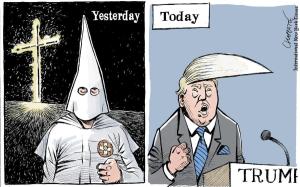
 The President continues to do despicable things to immigrant families and to communities that stand up to his reckless and unconstitutional policies. This is from
  I truly believe that the more he goes after this family, the more his polls will fall, and he will pull Republicans down further as the Midterm elections near. What is also clear is that the Washington Post will not be up to doing any kind of real reporting on any of this. Ruth Marcus of
  Tech Bros and MAGA have ruined our democracy.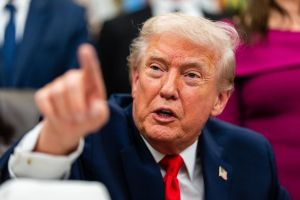

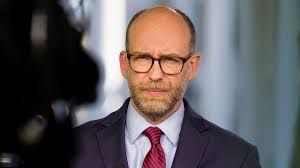
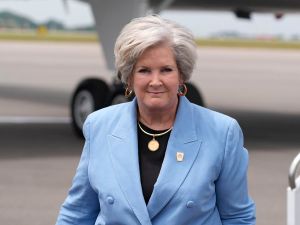


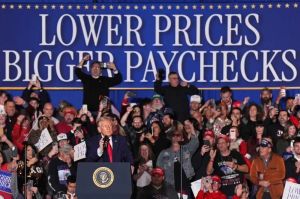

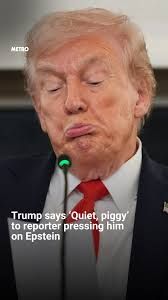


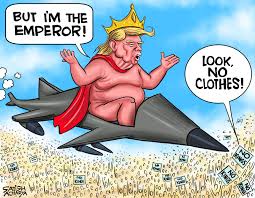 Economist and former NYT’s columnist Dr. Paul Krugman had similar thoughts. He freely writes them now on his
 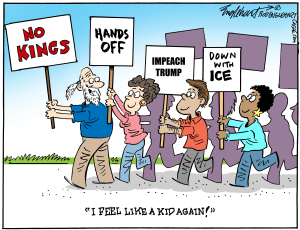 As for me, I’ll stop wearing my No Kings T-shirt when some one pries it from my cold back or when Heather Cox Richardson tells me I can retire it. This is from her Sunday
 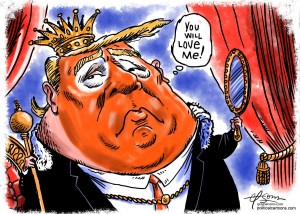 It’s funny how that AI-generated Trump video had nothing intelligent but everything artificial in it. Notice that he gets to reach altitude with nothing covering his face,nose, and barely his mouth. He managed to look like a toddly with a sippy cup urinal. Alan Elrod–writing for
 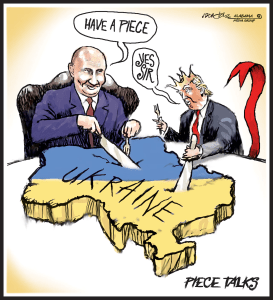 Here’s something scary from CNN to think on with Halloween on the Horizon.
  So much success! So much winning! How can we even wrap our minds around it? And what about this story on Justice Bondi-style? This is from CBS’ Scott Pelley. The interview came from
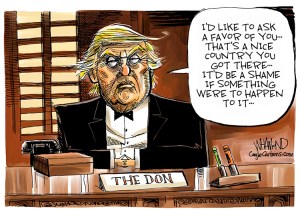 This characterization of Trump is so spot on that you really should go read the rest. I’m using this description of FARTUS as a background to the absolutely appalling crap that’s going on today. It’s hard to mentally deal with how quickly he’s disassembled so many long-standing U.S. Institutions in such a short time. This is especially true because it appears that the massive amount of incompetence and ignorance that his appointments display just escalates the damage. Look at this headline in
  Definitely go read this one. I’ve been missing reading John le Carré. I’m assuming anyone with a background in spying would have saucer eyes by this time. Trump’s love of playing checkers with the countries of the world is dangerous and immoral.
  We first saw the capitulation of the tech bros and their social media platforms, including Jeff Bezos, who has ruined The Washington Post. This week, the situation there is getting worse. The first thing any autocrat wants to do is to come for any vestige of a free media. This is from
 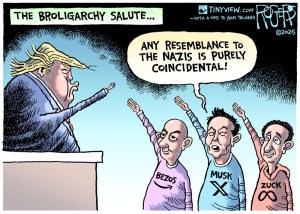 And now, we have the capitulation of top law firms. How many more legs of democracy will we lose?
 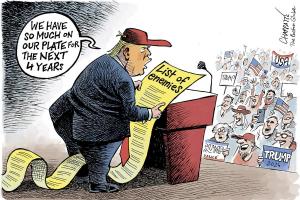 Zach Beauchamp
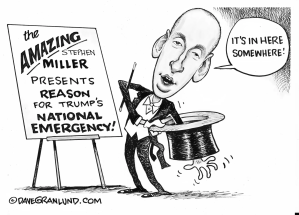 This, too, is a long read that deserves a look. A lot of this goes back to White House aid Stephan Miller. This guy needs to have an entire press detail following him. I’m going to end with a few articles on economics. The first comes from Paul Krugman and will clarify what’s happening with
  That Lutnick quote cannot be repeated enough. The last read I’m sharing today comes from

 peej
peej Carissa
 bostonboomer
 dakinikat
 ecocatwoman
 mablue2
 Mama Lopez
 peggysue22
 quixote
 skydancingguestblogger
 Mona (aka Wonk the Vote)



 Sky Dancing

Recent Comments