
Breaking News: Mubarak likely to step Down
Posted: February 10, 2011 Filed under: Breaking News, Egypt, Foreign Affairs | Tags: Mubarak stepping down, Omar Suleiman 94 CommentsThere are reports coming from all news sources that Mubarak is “likely to cede power” sometime tonight.
President Hosni Mubarak will meet the demands of protesters, military and ruling party officials, the Associated Press reported Thursday, in the strongest indication yet that Egypt’s longtime president may be about to give up power.
The military’s supreme council was meeting Thursday, without Mubarak, its commander in chief, and announced on state TV its “support of the legitimate demands of the people,” AP said.
CIA director Leon Panetta, testifying on Capitol Hill Thursday, told the House Intelligence Committee”there is a strong likelihood that Mubarak will step down this evening.”
Most reports indicate that he will turn power over to new VP Omar Suleiman and the Egyptian military.
There is a strong likelihood that embattled Egyptian President Hosni Mubarak will step down Thursday night, CIA Director Leon Panetta told the U.S. Congress.
Mubarak has agreed to yield power to his vice president, a senior U.S. official told CNN, citing contacts within the Egyptian government.
This official, speaking on condition of anonymity because of the sensitivity of the information, said that given the mixed signals sent throughout the crisis that “we need to see it happen.”
But the source said the information came from reliable and ranking officials in the Mubarak regime. Asked when the transfer of power might take place, the official said: “We are told soon is the plan.”
The secretary-general of Egypt’s ruling party confirmed Thursday that a transition was underway and he expected Mubarak to address the nation soon.
This happened as a general strike by all levels of Egyptians began. There’s some indication that protests may not end
Thursday’s sudden developments came as thousands of Egyptians again took to the streets of Cairo and other Egyptian towns and cities, calling for President Mubarak to step down.
Doctors, bus drivers, lawyers and textile workers were on strike in Cairo on Thursday, with unions reporting walkouts and protests across the country.
The BBC’s Jon Leyne, in Cairo’s Tahrir (Liberation) Square, the focal point of the anti-Mubarak protests, reports that the protesters there are starting to celebrate after hearing news of Mr Mubarak’s possible departure.
But Egyptian Information Minister Anas el-Fekky told Reuters news agency: “The president is still in power and he is not stepping down. The president is not stepping down and everything you heard in the media is a rumour.”
White House Pushing Bogus Meme about Egyptian “Transition”
Posted: February 6, 2011 Filed under: Barack Obama, Egypt, Elections, Foreign Affairs, U.S. Politics | Tags: Ahmad Fathi Sorour, Egyptian constitution, Egyptian protests, Hosni Mubarak, Obama Administration, Omar Suleiman, rendition, rules of succession, Torture 74 Comments
Barack Obama and Hosni Mubarak in Egypt
Today multiple news sources are suddenly reporting practically word for word a new meme on the Egyptian “transition” that is obviously coming from the Obama administration. And the message has been coordinated with Egyptian Vice President Omar Suleiman. Mubarak is being gradually edged out, and the U.S. needs to make sure they stay in control of the situation. Obama must make sure to prevent real democracy from taking hold in Egypt.
So the new meme is that Mubarak will be kept around as a powerless figurehead, but first he needs to make some changes in the constitutional rules of succession so that Suleiman can legally be in charge of the “transition” government. Why Suleiman? Supposedly because the guy who is supposed to succeed Mubarak, Ahmad Fathi Sorour, is “much worse” than even Suleiman the torturer. Yet there is never any credible explanation for why Solour is so terrible that it’s better to have a torturer in control of the lead-up to US-controlled “free and fair” elections
From the Village organ: What Mubarak must do before he resigns.
If today Mubarak were no longer available to fulfill his role as president, the interim president would be one of two candidates. If he chooses to leave the country, say for “medical reasons,” the interim president would be Omar Suleiman, the former intelligence chief who was recently made vice president. Egyptians, particularly those of us calling for an end to Mubarak’s three-decade rule, see Suleiman as Mubarak II, especially after the lengthy interview he gave to state television Feb. 3 in which he accused the demonstrators in Tahrir Square of implementing foreign agendas. He did not even bother to veil his threats of retaliation against protesters.
On the other hand, if Mubarak is pushed to resign immediately we would have an even worse interim president: Fathi Surur, who has been speaker of the People’s Assembly since 1990.
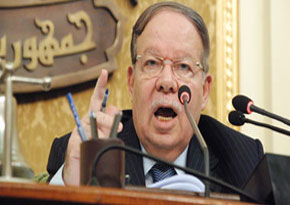
Ahmad Fathi Sorour
And he would be worse because?
Surur has long employed his legal expertise to maintain and add to the arsenal of abusive laws that Mubarak’s regime has used against the Egyptian people. Since neither Suleiman nor Surur would be able to amend the constitution during the interim tenure, the next presidential election would be conducted under the notoriously restrictive election rules Mubarak introduced in 2007. That would effectively guarantee that no credible candidate would be able to run against the interim president.
So before Mubarak resigns he must sign a presidential decree delegating all of his authorities to his vice president until their current terms end in September.
But Suleiman “has long employed his [military and intelligence] expertise” to cooperate with U.S. rendition and torture policies. Why is he better? Why should anyone believe that Suleiman will push for real democracy? Give me a break! The U.S. wants Suleiman in charge because he is their guy.
“A chance to move beyond rhetoric to support the democratic movement sweeping over Egypt”
Posted: January 31, 2011 Filed under: Egypt | Tags: 2011: days of revolt, Obama Administration, Omar Suleiman, Orderly transition 59 CommentsFrom Sunday. LA Times Babylon & Beyond blog:
More than 80 American academics, including Noam Chomsky and several California scholars, posted an open letter online Sunday to President Obama […]

From the Tahrir demonstrations
Here’s the open letter, as posted on the Institute for Public Accuracy site:
Dear President Obama:
As political scientists, historians, and researchers in related fields who have studied the Middle East and U.S. foreign policy, we the undersigned believe you have a chance to move beyond rhetoric to support the democratic movement sweeping over Egypt. As citizens, we expect our president to uphold those values.
For thirty years, our government has spent billions of dollars to help build and sustain the system the Egyptian people are now trying to dismantle. Tens if not hundreds of thousands of demonstrators in Egypt and around the world have spoken. We believe their message is bold and clear: Mubarak should resign from office and allow Egyptians to establish a new government free of his and his family’s influence. It is also clear to us that if you seek, as you said Friday “political, social, and economic reforms that meet the aspirations of the Egyptian people,” your administration should publicly acknowledge those reforms will not be advanced by Mubarak or any of his adjutants.
There is another lesson from this crisis, a lesson not for the Egyptian government but for our own. In order for the United States to stand with the Egyptian people it must approach Egypt through a framework of shared values and hopes, not the prism of geostrategy. On Friday you rightly said that “suppressing ideas never succeeds in making them go away.” For that reason we urge your administration to seize this chance, turn away from the policies that brought us here, and embark on a new course toward peace, democracy and prosperity for the people of the Middle East. And we call on you to undertake a comprehensive review of US foreign policy on the major grievances voiced by the democratic opposition in Egypt and all other societies of the region.
You can view the signatories here. You can also download a pdf. And, to leave feedback, apparently you can to egyptletter.blogspot.com.
Earlier on Sunday, the Carnegie Endowment published the following statement from its Working Group on Egypt, urging for free and fair elections and recommending a suspension of economic and military aid to Egypt until certain conditions that would ensure a free and fair election are met:
Amidst the turmoil in Egypt, it is important for the United States to remain focused on the interests of the Egyptian people as well as the legitimacy and stability of the Egyptian government.
Only free and fair elections provide the prospect for a peaceful transfer of power to a government recognized as legitimate by the Egyptian people. We urge the Obama administration to pursue these fundamental objectives in the coming days and press the Egyptian government to:
- call for free and fair elections for president and for parliament to be held as soon as possible;
- amend the Egyptian Constitution to allow opposition candidates to register to run for the presidency;
- immediately lift the state of emergency, release political prisoners, and allow for freedom of media and assembly;
- allow domestic election monitors to operate throughout the country, without fear of arrest or violence;
- immediately invite international monitors to enter the country and monitor the process leading to elections, reporting on the government’s compliance with these measures to the international community; and
- publicly declare that Hosni Mubarak will agree not to run for re-election.
We further recommend that the Obama administration suspend all economic and military assistance to Egypt until the government accepts and implements these measures.
The Working Group on Egypt is a nonpartisan initiative bringing substantial expertise on Egyptian politics and political reform, and aimed at ensuring that Egypt’s elections are free and fair and open to opposition candidates.
Laura Rozen’s report on the Egypt working group’s statement provides further insight:
A bipartisan group of former U.S. officials and foreign policy scholars is urging the Obama administration to suspend all economic and military aid to Egypt until the government agrees to carry out early elections and to suspend Egypt’s draconian state of emergency, which has been in place for decades.
“We are paying the price for the fact that the administration has been at least of two minds on this stuff, and we should have seen it coming,” said Robert Kagan, co-chair of the bipartisan Egypt working group, regarding what many analysts now say is the inevitable end of Hosni Mubarak’s thirty year reign as Egypt’s president.
Though the Obama administration has tried to look like it’s not picking sides in urging restraint from violence amid five days of Egyptian unrest calling for Mubarak to step down, “the U.S. can’t be seen as neutral when it’s giving a billion and a half dollars” to prop up the Mubarak regime, Kagan said.
And, from Zaid Jilani at Think Progress:
The position of the Obama administration has been unclear. While administration officials have condemned abuses of civil liberties, they’ve also fallen short of endorsing Mubarak’s ouster or ending support for the regime, with Vice President Joe Biden even going as far as to say that Mubarak isn’t a dictator.
The United States gives nearly $2 billion in aid to the Egyptian regime every year, and offers diplomatic and military cooperation that helps bolster Mubarak. As protesters continue to be beaten, tortured, and killed by internal security forces, it’s important to know that these abuses are being subsidized by U.S. taxpayer dollars. Threatening to reduce or eliminate this monetary assistance to the Egyptian regime would be a powerful tool that the United States could use to help advance democracy and promote freedom in the country.
In light of the open letter from Chomsky et al and the statement from the CEIP’s working group on Egypt, I thought it might be helpful to recap what the Obama Administration said yesterday.
Omar Suleiman and the U.S. Rendition and Torture Program
Posted: January 30, 2011 Filed under: Barack Obama, Diplomacy Nightmares, Egypt, Foreign Affairs, U.S. Politics, Wikileaks | Tags: Barack Obama, Bill Clinton, Edward S. Walker, Eqyptian protests, Hillary Clinton, Hosni Mubarak, Jr., Omar Suleiman, rendition, Stephen Grey, Torture 34 Comments
Omar Suleiman
Omar Suleiman was recently appointed Vice President of Egypt by desperate dictator Hosni Mubarak. There has also been talk that Suleiman could become Mubarak’s successor now that Mubarak’s son Gamal is seemingly out of the picture.
It will be interesting to see how the Obama administration responds to this appointment, since the U.S. has had very close relations with Suleiman. Some basic background on Suleiman from Reuters:
* He has been the director of the Egyptian General Intelligence Services (EGIS) since 1993, a role in which he has played a prominent public role in diplomacy, including in Egypt’s relations with Israel and with key aid donor the United States.
* He was born on July 2, 1936 in Qena, in southern Egypt. He later enrolled in Egypt’s premier Military Academy in 1954, after which he received additional military training in the then Soviet Union at Moscow’s Frunze Military Academy.
* He also studied political science at Cairo University and Ain Shams University. In 1992 he headed the General Operations Authority in the Armed Forces and then became the director of the military intelligence unit before taking over EGIS.
* Suleiman took part in the war in Yemen in 1962 and the 1967 and 1973 wars against Israel.
* As Egypt’s intelligence chief, Suleiman was in charge of the country’s most important political security files, and was the mastermind behind the fragmentation of Islamist groups who led the uprising against the state in the 1990s.
Here is another profile from the BBC.
While he has shown little political ambition, General Suleiman has often been mentioned as a possible successor to the 82-year-old Mr Mubarak.
He would continue in the trend of military strongmen who have led Egypt since the 1952 revolution.
And perhaps more ominously, based on what you’re about to read about Suleiman’s activities,
Even if he is not the next president, even in a transitional capacity, some experts believe that Omar Suleiman is likely to be a kingmaker.

 peej
peej Carissa
 bostonboomer
 dakinikat
 ecocatwoman
 mablue2
 Mama Lopez
 peggysue22
 quixote
 skydancingguestblogger
 Mona (aka Wonk the Vote)



 Sky Dancing
Recent Comments