Posted: December 13, 2025 | Author: bostonboomer | Filed under: just because | Tags: Affordable Care Act, cat art, caturday, Donald Trump, Health care, Indiana Senate Republicans, Obamacare, redistricting |
Good Afternoon!!

Cat and Butterfly, Ohara Koson
Trump is still “president,” and he continues to do terrible things; but there are beginning to be a few positive signs that his grip on the GOP is waning as his approval ratings continue to drop. One of those signs is the refusal of Republicans in the state senate to follow his demand for redistricting. As some people here know, I grew up in Indiana. I can’t help feeling a bit of Hoosier pride about this.
Thomas Beaumont and Isabella Volmert: Trump was unable to insult his way to victory in Indiana redistricting battle.
If Indiana Republican senators had any doubt about what to do with President Donald Trump’s redistricting proposal, he helped them make up their minds the night before this week’s vote.
In a social media screed, Trump accused the state’s top senator of being “a bad guy, or a very stupid one.”
“That kind of language doesn’t help,” said Sen. Travis Holdman, a banker and lawyer from near Fort Wayne who voted against the plan.
He was among 21 Republican senators who dealt Trump one of the most significant political defeats of his second term by rejecting redistricting in Indiana. The decision undermined the president’s national campaign to redraw congressional maps to boost his party’s chances in the upcoming midterm elections.
In interviews after Thursday’s vote, several Republican senators said they were leaning against the plan from the start because their constituents didn’t like it. But in a Midwest nice rebuttal to America’s increasingly coarse political discourse, some said they simply didn’t like the president’s tone, like when he called senators “suckers.”
Trump didn’t seem to get the message. Asked about the vote, the president once again took aim at Indiana’s top senator, Rodric Bray.
“He’ll probably lose his next primary, whenever that is,” Trump said. “I hope he does, because he’s done a tremendous disservice.”
Sen. Sue Glick, an attorney from La Grange who also opposed redistricting, brushed off Trump’s threat to unseat lawmakers who defied him.
“I would think he would have better things to do,” she said. “It would be money better spent electing the individuals he wants to represent his agenda in Congress.”
My mother used to say that you catch more flies with honey than with vinegar. Trump never learned that simple lesson.
Jonathan Chait at The Atlantic (gift link): The Indiana Vote Is an Inflection Point.
In rejecting yesterday a redistricting plan backed by President Donald Trump, Indiana’s Republican-controlled senate did not merely deny Republicans two new U.S. House seats in next year’s midterm elections. They also engaged in a mass revolt against the president. The stakes of their defiance reach far beyond the midterms. This vote was possibly the most significant blow yet against the authoritarian ambitions that have defined Trump’s second term.

Tabby Cat. Benson b. Moore
The significance of Indiana’s noncompliance lies not in the specifics of what was refused—attempts to gerrymander electoral maps are hardly unprecedented, even though a mid-decade battle violates norms—but in the act of refusal itself. Trump’s authoritarian project relies on the cultlike hold he has over his party. Republicans have come to understand that the cost of defying Trump is the death of their political career. Trump has proved time and again that he will go to any lengths to destroy his intra-party critics, even if doing so harms the party.
That method was on vivid display in Indiana. Trump expected the state to go along with his plans to redraw its map to help his party in the midterms. When the state’s Republicans held back their support, Trump and his allies went on the attack.
Indiana Republican legislators faced bomb threats and intimidation in their homes (such as “swatting,” phone calls, and the like)—a climate of fear, my colleague Russell Berman reports, unlike anything the state has seen.
Heritage Action delivered a Mafia-like threat, as high-minded scholars apparently do these days: “President Trump has made it clear to Indiana leaders: if the Indiana Senate fails to pass the map, all federal funding will be stripped from the state. Roads will not be paved. Guard bases will close. Major projects will stop. These are the stakes and every NO vote will be to blame.”
This kind of pressure typically bends targets to Trump’s will. What politician is willing to sacrifice their career or their family’s safety for a single act of defiance?
Yet the spines of Indiana Republicans stiffened where so many others snapped. One reason for this may be that the state contains an unusually strong concentration of Trump-skeptical former governors. Mitch Daniels and Mike Pence remain influential in the state, despite having given up national ambitions by failing to submit fully to Trump. Daniels praised the vote as an act of “principled courageous leadership.”
Indiana’s Republicans also demonstrated strength in numbers. Trump employs the psychology of a schoolyard bully who isolates and targets victims one by one. By engineering a 31–19 vote, Indiana’s Republicans worked together to ensure that no single legislator could be blamed for defying Trump.
Use the gift link to read more.
At The Daily Beast, David Rothkopf enumerates the many ways that Trump’s grip on power is waning: President Trump Is Now Triggering His Very Own MAGApocalypse.
It is hard to know whether Donald Trump or the MAGA movement he created is falling apart faster.
The 79-year-old president is deteriorating rapidly before our eyes—cankles puffier, bruises and bandages on his hand more ever present. He’s nodding off at event after event, slurring his words, his behavior increasingly erratic. And he has become painfully sensitive to the fact that his decay is so apparent, going as far as suggesting that media outlets reporting about his health are guilty of treason.
Of course, every effort he makes to prove he’s not one step away from melting into a bubbling orange puddle seems to make it clearer that he’s losing it.

Gertrude Abercrombie, 17 Feb 1909 – 3 Apr 1977
As bad as all that is, however, MAGA may be collapsing even more quickly than its creator. Prominent Republicans are defecting—like Marjorie Taylor Greene—and more are rumored to be threatening to do likewise. More former loyalists are willing to stand up to him—whether Indiana legislators rejecting Trumpian demands that they gerrymander the state or GOP senators leading inquiries into the possibility that war crimes were committed as part of Trump’s “Pirates of the Caribbean” phase.
Others are speaking out against Trump’s opposition to extending vital health subsidies to Americans—including hardliners like Missouri Senator Josh Hawley—or to express their discomfort with new executive orders seeking to block states from enacting AI regulation.
Trump is losing in the courts. His illegal picks to be U.S.
attorneys are being kicked out; his efforts to, well, trump up charges against opponents like
James Comey and Letitia James have been shot down by grand juries that simply will not go along with cases so obviously fabricated and motivated by retribution rather than any respect for the law.
And he is losing at the ballot box. Recent election results suggest that the onetime star to whom so many MAGA upstarts have hitched their wagons to in the past decade is now electoral poison. Across the country, elections last month produced resounding defeats for the GOP, while in the few elections in which Republicans squeaked out victories, their margins shrank considerably compared to 2024 support for Trump.
The economy is floundering. Deficits are exploding. Tariffs are unpopular. Trump’s inhumane and draconian immigration crackdowns are alienating substantial numbers of his erstwhile supporters, while his foreign policy plans have alienated our allies and empowered our enemies. His overt corruption and catering to billionaires at the expense of average Americans is driving real backlash.
Donald Trump has fallen and, given projections of a rough year ahead, it seems increasingly likely that he can’t get up.
There’s more at the link.
In a guest essay at The New York Times (gift link), E.J. Dionne writes: Trump Is Losing the Reasonable Majority.
Believing in democracy does not require faith that majorities are always right. It does mean having confidence that most of your fellow citizens will, over time, approach public questions with a basic reasonableness. Abraham Lincoln, tradition has it, said it more pithily: “You cannot fool all the people all the time.”
A corollary to Lincoln, that you can’t fool all the people who voted for you all the time, explains the sharp decline in President Trump’s approval ratings.

Cat in Bamboo, Hiroshima, by Jimmy Tsutomu Mirikitani
A significant share of the voters who backed Mr. Trump have decided that he has largely ignored the primary issue that pushed them his way, the cost of living. A billionaire regularly mocking concern about affordability only makes matters worse. They see him as distracted by personal obsessions and guilty of overreach, even when they sympathize with his objectives. Many of his former supporters see him breaking promises he made, notably on not messing with their access to health care.
Some abuses are too blatant to be ignored. A recent The Economist/You Gov poll found that 56 percent of Americans said Mr. Trump was using his office for personal gain; only 32 percent didn’t. A similar 56 percent saw Mr. Trump as directing the Justice Department to go after people he saw as his political enemies; just 24 percent didn’t.
The upshot: A great many Americans who helped put Mr. Trump in office have absorbed what’s happened since. They may not be glued to every chaotic twist of this presidency, but they do pay attention and have concluded, reasonably, that this is not what they voted for.
How many? Let’s take Mr. Trump’s 49.8 percent of the 2024 popular vote as a base line and compare it with his approval ratings. A New York Times analysis of public polling this month found his net approval rating had dropped to 42 percent. A A.P./NORC poll and a Gallup poll pegged it at 36 percent. This suggests that 15 to 25 percent of his voters have changed their minds
I think of these shifts as the triumph of reasonableness — and not because I agree with where these fellow citizens have landed (although I do). I’m buoyed by the capacity of citizens to absorb new facts and take in information even when it challenges decisions they previously made. It turns out that swing voters are what their label implies. The evidence of their own lives and from their own eyes matters.
Use the gift link to read the rest.
So, there really are some positive signs.
Republicans also continue to hurt themselves by refusing to help millions of Americans who are about to lose access to health care because of the drastically increased costs Republicans instituted with their Big Ugly Bill.
Ali Swenson at the AP: Higher cost, worse coverage: Affordable Care Act enrollees say expiring subsidies will hit them hard.
For one Wisconsin couple, the loss of government-sponsored health subsidies next year means choosing a lower-quality insurance plan with a higher deductible. For a Michigan family, it means going without insurance altogether.
For a single mom in Nevada, the spiking costs mean fewer Christmas gifts this year. She is stretching her budget already while she waits to see if Congress will act.
Less than three weeks remain until the expiration of COVID-era enhanced tax credits that have helped millions of Americans pay their monthly fees for Affordable Care Act coverage for the past four years.
The Senate on Thursday rejected two proposals to address the problem and an emerging health care package from House Republicans does not include an extension, all but guaranteeing that many Americans will see much higher insurance costs in 2026.

Young Cat Sleeping, by Mabel Wellington Jack
Here are a few of their stories.
Chad Bruns comes from a family of savers. That came in handy when the 58-year-old military veteran had to leave his firefighting career early because of arm and back injuries he incurred on the job.
He and his wife, Kelley, 60, both retirees, cut their own firewood to reduce their electricity costs in their home in Sawyer County, Wisconsin. They rarely eat out and hardly ever buy groceries unless they are on sale.
But to the extent that they have always been frugal, they will be forced to be even more so now, Bruns said. That is because their coverage under the health law enacted under former President Barack Obama is getting more expensive -– and for worse coverage.
This year, the Brunses were paying $2 per month for a top-tier gold-level plan with less than a $4,000 deductible. Their income was low enough to help them qualify for a lot of financial assistance.
But in 2026, that same plan is rising to an unattainable $1,600 per month, forcing them to downgrade to a bronze plan with a $15,000 deductible.
Kelley Bruns said she is concerned that if something happens to their health in the next year, they could go bankrupt. While their monthly fees are low at about $25, their new out-of-pocket maximum at $21,000 amounts to nearly half their joint income.
“We have to pray that we don’t have to have surgery or don’t have to have some medical procedure done that we’re not aware of,” she said. “It would be very devastating.”
Read more health care stories a the link.
Speaker Mike Johnson will allow a vote on an Obamacare extension next week, but it is expected to fail. From Politico:
House GOP leadership will permit a floor vote to extend enhanced Obamacare subsidies — an olive branch to moderate members who have been clamoring for a chance to go on record in support of an extension.
Republican leaders unveiled text of their health care package Friday evening, which they plan to put on the floor next week.
“The process” for considering that package “will allow” a vote on an amendment to prevent the subsidies from lapsing Dec. 31, according to a House Republican leadership aide granted anonymity to share the unannounced plans.
It’s a concession from leaders who have been reluctant to endorse an extension of the subsidies, which divides congressional Republicans. It’s a win for centrists and vulnerable incumbents, who see political peril in not acting on the tax credits and have been promising to push discharge petitions that would circumvent leadership and force votes on their own legislative proposals.
Speaker Mike Johnson and senior Republicans met Friday morning on the topic to chart a path forward.
But Republicans leaders ultimately expect the extension vote to fail, resulting in skyrocketing premiums for millions of Americans when the subsidies expire at the end of the year.
You read that right: Johnson has come up with a Republican “health care plan.” AP: Speaker Johnson unveils health care plan as divided Republicans scramble for alternative.
The Senate failed to get anywhere on the health care issue this week. Now it’s the House’s turn to show what it can do.
Speaker Mike Johnson unveiled a Republican alternative late Friday, a last-minute sprint as his party refuses to extend the enhanced tax subsidies for those who buy policies through the Affordable Care Act, also called Obamacare, which are expiring at the end of the year. Those subsidies help lower the cost of coverage.

Two Cats, Eleanore G. Cohen
Johnson, R-La., huddled behind closed doors in the morning — as he did days earlier this week — working to assemble the package for consideration as the House focuses the final days of its 2025 work on health care.
“House Republicans are tackling the real drivers of health care costs to provide affordable care,” Johnson said in a statement announcing the package. He said it would be voted on next week.
Later Friday, though, House Democratic Leader Hakeem Jeffries said: “House Republicans have introduced toxic legislation that is completely unserious, hurts hardworking America taxpayers and is not designed to secure bipartisan support. If the bill reaches the House floor, I will strongly oppose it.”
So what’s the GOP plan?
The House Republicans offered a 100-plus-page package that focuses on long-sought GOP proposals to enhance access to employer-sponsored health insurance plans and clamp down on so-called pharmacy benefit managers.
Republicans propose expanding access to what’s referred to as association health plans, which would allow more small businesses and self-employed individuals to band together and purchase health coverage.
Proponents say such plans increase the leverage businesses have to negotiate a lower rate. But critics say the plans provide skimpier coverage than what is required under the Affordable Care Act.
The Republicans’ proposal would also require more data from pharmacy benefit managers, or PBMs, as a way to help control drug costs. Critics say PBMs have padded their bottom line and made it more difficult for independent pharmacists to survive.
Additionally, the GOP plan includes mention of cost-sharing reductions for some lower-income people who rely on Obamacare, but those do not take effect until January 2027.
The emerging package from the House Republicans does not include an extension of an enhanced tax credit for millions of Americans who get insurance coverage through the Affordable Care Act. Put in place during the COVID-19 crisis, that enhanced subsidy expires Dec. 31, leaving most families in the program facing more than double their current out-of-pocket premiums, and in some cases, much more.
I think Republicans will find that this issue will destroy them in the midterm elections.
More news stories to check out:
The Washington Post: VA plans to abruptly eliminate tens of thousands of health care jobs.
The New York Times: Hundreds Quarantined in South Carolina as Measles Spreads.
The Hill: US set to lose measles elimination status: The ‘house is on fire.’
The New York Times: Immigration Agents Are Using Air Passenger Data for Deportation Effort.
City Beat: Cincinnati ICE Leader Accused of Strangling Woman Held on $400k Bond.
The Washington Post: Trump takes first step in possible bid to control D.C.’s public golf courses.
Politico: Trump seems to wave the white flag on his US attorneys gambit.
That’s all I have for today. I tried to stick with somewhat positive stories. (FYI, the images in this post comes from the Smithsonian collection of cat art.)
Did you like this post? Please share it with your friends:
Posted: October 25, 2025 | Author: bostonboomer | Filed under: just because | Tags: art-deco bas-relief sculptures, Bonwit Teller department dtone, demolition of White House East Wing, Donald Trump, food stamps, historic magnolia trees, Kennedy Garden, Obamacare, Trump's garish ballroom, White House family theater |
Good Afternoon!!

Leandro M. Velasco (b.1933), Blonde in Red with a White Cat
I’m still focused on Trump’s demolition of the White House East Wing. Lately I’ve been wondering what happened to all the furniture and art work.
Was any of it saved, or was everything destroyed along with the building? Has anyone reported seeing moving vans outside the White House that could have been removing some of the valuable items and putting them in storage? If not, could all these things be stored in the White House itself? I doubt it. Why aren’t journalists asking these questions?
I don’t trust Trump to preserve anything of historical value. I would not be at all surprised if he simply demolished the building and all of its contents. After all, he destroyed the Rose Garden and replaced it with a pavement and tacky tables with attached umbrellas. And Trump has a history of carelessly destroying important art works.
Forbes: Trump’s White House Demolition Isn’t His First Time Leveling A Building — Or Ignoring Preservationists.
With Donald Trump demolishing the White House’s East Wing to make room for a 90,000-square-foot ballroom, the president is returning to the playbook from his Trump Tower days—move fast, build big and leave preservationists fuming.
Key Facts
In October 1979, New York City’s Planning Commission approved a special permit for Trump to build a 56-story mixed-use tower on the site of the Bonwit Teller department store on Fifth Avenue.
Trump later wrote in “The Art of the Deal” that in December 1979, a representative of the Metropolitan Museum of Art asked him to donate two 15-foot-tall Art Deco bas-relief sculptures of semi-nude goddesses and a 15-by-25-foot nickel-plated grill from the condemned building’s facade.
“I said that if the friezes could be saved, I’d be happy to donate them to the museum,” Trump wrote in “The Art of the Deal”; he later confirmed the deal in writing, according to Preservation News, a publication of the National Trust for Historic Preservation of the United States.
In June 1980, however, the “sculptures were smashed by jackhammers” while the grillwork, which was supposed to be shipped to a New Jersey warehouse, went missing, Preservation News reported at the time.
Trump said he had the friezes torn down after being told their weight would require “special scaffolding for safety’s sake,” delaying the project by several weeks.
“I just wasn’t prepared to lose hundreds of thousands of dollars to save a few Art Deco sculptures that I believed were worth considerably less, and perhaps not very much at all,” he wrote.
“We are certainly very disappointed and quite surprised,” Ashton Hawkins, vice president and secretary of the Met’s board of trustees, told the New York Times, which ran an article about the destruction on the front page. “Can you imagine the museum accepting them if they were not of artistic merit?”
Read more details about Trump’s path of destruction:
ArtNet: Donald Trump Has a History of Pulverizing Historic Buildings.
The Daily Beast: Trump’s East Wing Demolition Isn’t His First Shocking Historic Smashup.
There are some things we know for sure Trump has destroyed to make room for his hideous ballroom.
CNN: Bill Clinton once called the White House movie theater the ‘best perk’ of the job. It was destroyed this week.
The White House Family Theater, the movie theater which first came to be in 1942 when a cloakroom was converted into a screening room, was demolished this week as part of the destruction of the East Wing to make room for President Donald Trump’s planned $300 million ballroom.

By Lina Rivo
From sporting events to film screenings, the theater provided entertainment and enjoyment to presidents and their families since the latter part of Franklin D. Roosevelt’s presidency.
According to The White House Historical Association, Roosevelt enjoyed watching World War II-era news reels in the former cloakroom in the East Terrace at 1600 Pennsylvania Avenue, “and took special interest in the battles fought in Europe and Asia.”
The 32nd US president demonstrated an understanding of the importance of pop culture, including movies.
“Entertainment is always a national asset,” Roosevelt said in 1943 as the United States was engaged in WWII. “Invaluable in time of peace, it is indispensable in wartime.” [….]
Later presidents greatly enjoyed showing movies in the theater, and the George W. Bush Library detailed that film screenings would run the gamut from official events with members of the public invited as guests to “private events and intended for the enjoyment of the President, his family, and his close friends and staff.”
“The best perk out in the White House is not Air Force One or Camp David or anything else,” said former President Bill Clinton. “It’s the wonderful movie theatre I get here, because people send me these movies all the time.”
I suppose Trump could have saved the vintage chairs with footrests, lights, and decorations, but I’m sure he didn’t.
ABC News: At least 2 historic magnolia trees, Kennedy Garden appear to have been removed to make way for Trump’s White House ballroom. The two trees date to the 1940s and commemorate two past presidents.
Satellite images show President Donald Trump’s project to build a $300 million grand ballroom has appeared to take down at least six trees on the White House grounds — including two historic magnolia trees commemorating Presidents Warren G. Harding and Franklin D. Roosevelt.
The satellite images released on Thursday provide the fullest picture yet of the extent of the demolition work on the White House’s East Wing and its effect on the surrounding parkland — changes made without consulting the government commission established by federal law to ensure the preservation and integrity of government buildings in D.C., according to former commission officials who spoke to ABC News.
Visible construction work on the new ballroom appears to have begun more than three weeks ago, according to satellite images of the White House complex taken over the last month. An image taken on Sept. 26 shows preparations for the construction, including the removal of multiple trees in President’s Park.
The Jacqueline Kennedy Garden — established by first lady Edith Roosevelt as the Colonial Garden in 1903 adjacent to the East Wing — was also leveled during the demolition, according to satellite images. Earlier this year, Trump also paved over the Rose Garden, which was designed by the same architect who designed the Kennedy Garden.
More details at the link.
ABC News also reports that Trump says no plans to name White House ballroom after himself. Yet, officials are referring to it as “The President Donald J. Trump Ballroom.”
President Donald Trump says he has no plans to name his $300 million White House ballroom after himself.
Speaking to reporters in brief remarks while departing the White House on Friday evening for a trip to Asia, Trump denied an earlier report that he was likely to add his name to the new ballroom.
“I don’t have any plan to call it after myself,” Trump said. “That was fake news. Probably going to call it the presidential ballroom or something like that. We haven’t really thought about a name yet.”
Earlier, senior administration officials told ABC News that some in the administration were already referring to it as “The President Donald J. Trump Ballroom” and that that name was likely to stick….
Before Friday, Trump had not publicly said what he intends to name the ballroom, but he is known for branding his construction projects after himself.
When asked by ABC News Chief White House Correspondent Mary Bruce on Thursday if he had a name for his ballroom yet, Trump smiled and said: “I won’t get into that now.”

Manfred W. Juergens, The Girl with the Cat
Give me a break. Of course he’ll name it after himself. He’ll probably put a huge “Trump” sign on it–like the one on Trump tower. And I expect his name will also be on the Hitler arch he’s planning that will overshadow the Lincoln Memorial.
And then there’s the corrupt financing of the project. NBC News: White House will allow anonymous donors to contribute to Trump’s ballroom project.
President Donald Trump is accepting anonymous donations for the grand ballroom he is currently having built at the White House, an aide told NBC News on Friday.
While the Trump administration has released a list of donors for the project that has become a fixation for the president (which includes NBCUniversal’s parent company, Comcast), the aide said that some may contribute anonymously.
“We will, and have so far, released names of donors and companies who wish to be named publicly. Donors also have the option to remain anonymous and we will honor that if that’s what they choose,” said the aide, who spoke on the condition of anonymity to candidly discuss the undertaking.
The White House would not commit to publicly releasing the amount of money each donor gives to the project, with the aide saying similarly that the administration “will honor the wishes of the donors of what they want publicly shared.”
Trump claims he won’t accept foreign donations, but how would we know? He’s a fucking liar; you can’t believe anything he says.
An even more serious question about the ballroom: why would Trump be doing this if he’s planning leave the White House in 2028? Arwa Mahdawi at The Guardian: Why is Trump demolishing the White House’s East Wing? Because he wants to.
The 123-year-old East Wing of the White House, the home of offices for every first lady for almost half a century, is now a pile of rubble. After Trump said in July that the historic building would not be touched, it was stealthily bulldozed to make way for a $300m ballroom. According to Trump, there was a teeny little change of plans “after really a tremendous amount of study with some of the best architects in the world”.
While the likes of the National Trust for Historic Preservation are upset about the destruction of a “National Historic Landmark, a National Park, and a globally recognized symbol of our nation’s ideals”, some large corporations appear to be looking on the bright side. Trump has said the new 90,000 sq ft ballroom is going to be “paid for 100% by me and some friends of mine”. Now the world’s CEOs have a wonderful opportunity to prove just how friendly to Trump they are….

By Jane Wood
National history aside, this sudden demolition of the first ladies’ headquarters raises a lot of questions. If I lived in a house that I didn’t own – one that I was scheduled to move out of in January 2029 – I probably wouldn’t start an enormous and extremely controversial construction project. Why is Trump doing this?
The short answer is: because he wants to. As I think we all know by now, the president does whatever the hell he feels like regardless of norms, conventions, or silly little laws. And, increasingly, there’s nobody there to stop him. The only checks that Trump cares about are the ones made out to him and the only balances he is interested in are those of his bank accounts.
Trump has given a few rationales for the project that go beyond ‘because I want to.’ He’s argued that the old East Wing was no longer fit for purpose and a much larger space was needed. There are some people out there who agree with him. Gahl Hodges Burt, for example, who was social secretary for three years under President Ronald Reagan, told the New York Times that tearing down the East Wing to make space for the ballroom was unfortunately necessary and overdue.
Beyond practical issues, there’s also ego. Trump’s big boy ballroom will be a big shiny monument to him long after he’s gone.
Still, you’ve got to wonder whether this mega-project means the president is not actually planning on going anywhere anytime soon. Particularly since Trump doesn’t seem to be the sort of person to start a large project he won’t have a chance to personally enjoy. The US Constitution’s 22nd amendment makes it very clear that a president cannot have more than two terms. But that hasn’t stopped Trump from repeatedly teasing the idea that he might serve a third term. In March he told NBC News he was “not joking” about the idea and there were methods for doing so.
Read more at the link.
According to Nancy Walecki at The Atlantic, Trump may be planning to use the rubble and dirt from the East Wing teardown to upgrade a golf course (gift link). My Quest to Find the East Wing Rubble.
I’d heard that the dirt from the East Wing demolition was being deposited three miles away, on a tree-lined island next to the Jefferson Memorial called East Potomac Park. So yesterday I drove around until I saw trucks and men in construction gear. They were congregating at an entrance to the public East Potomac Golf Links, where rounds of golf carried on as usual, except every few minutes, dump trucks entered the green.

By Giovanni Parlatto da Massaquano
The trucks would cut across the course to a cordoned-off site in the middle, where the grass had been torn away and replaced with piles of dirt. It did not look like much, but several employees at the site confirmed: This was not just any dirt. This was White House dirt. The precursor to the East Wing was constructed during Theodore Roosevelt’s administration in 1902 and updated during Franklin D. Roosevelt’s administration in the ’40s. Maybe this was not just White House dirt but Roosevelt-era dirt. I gazed upon the golfers going about their games. Do they know, I wondered, that they are in the presence of such particularly American soil?
I asked one employee what the plan was for all this dirt. “Oh, they’re gonna turn it into another hole,” he said. Other reporters have heard the same. But when I asked a different employee about it, he demurred; his boss drove by and said, “No comment” before my colleague Grace Buono had even asked him a question. Donald Trump has reportedly been considering rebranding East Potomac Golf Links as the Washington National Golf Course and giving it a makeover. He even mocked up a new golden logo for it that’s nearly identical to those of the courses he owns. I suppose the East Wing demolition is an excellent source of soil. (The White House did not respond to my request for comment. It told CBS News that wood and plants from the site could end up being recycled for garden nurseries.)
Use the gift link to read more if you’re interested.
This might be a dumb question, but where will all those hundreds of people going to the ballroom park their fancy cars and limos? Maybe Trump is planning to knock down the entire White House and replace it with a parking lot?
Meanwhile, thanks to the government shutdown, the “big beautiful bill,” and Mike Johnson’s keeping the House from meeting, millions of Americans will soon be facing hunger and lack of health care.
The Guardian: Americans brace for food stamps to run out: ‘The greatest hunger catastrophe since the Great Depression.’
While Republicans have sought to blame Democrats for the potential loss in benefits that people who make little money rely on, those who work in the food-insecurity space say that is misleading because Donald Trump’s One Big Beautiful Bill Act already eliminated almost $187bn in funding for Snap through 2024, according to a congressional budget office estimate.
Should funding run out at the end of the month, “we will have the greatest hunger catastrophe in America since the Great Depression, and I don’t say that as hyperbole”, said Joel Berg, CEO of Hunger Free America.
Snap supports working families with low-paying jobs, low-income people aged 60 years and older and people with disabilities living on a fixed income, according to the Center on Budget and Policy Priorities.
Snap participants generally must be at or below 130% of the federal poverty line. The average participant receives about $187 a month, the center reports.
The Department of Agriculture recently sent a letter to regional Snap directors warning them that funding for Snap will run out at the end of the month and directing them to hold payments “until further notice”.
More than 200 Democratic representatives have urged the USDA to use contingency funds to continue paying for Snap benefits.
“There are clear steps the administration can and must take immediately to ensure that millions of families across the country can put food on their table in November,” a letter from the lawmakers to the USDA states. “SNAP benefits reach those in need this November would be a gross dereliction of your responsibilities to the American people. We appreciate your consideration of these requests.”
But that’s not going to happen.
Politico: Trump administration says it won’t tap emergency funds to pay food aid.
The Trump administration won’t tap emergency funds to pay for federal food benefits, imperiling benefits starting Nov. 1 for nearly 42 million Americans who rely on the nation’s largest anti-hunger program, according to a memo obtained by POLITICO.
USDA said in the memo that it won’t tap a contingency fund or other nutrition programs to cover the cost of the Supplemental Nutrition Assistance Program, which is set to run out of federal funds at the end of the month.

By Gurutze Ramos
The contingency fund for SNAP currently holds roughly $5 billion, which would not cover the full $9 billion the administration would need to fund November benefits. Even if the administration did partially tap those funds, it would take weeks to dole out the money on a pro rata basis — meaning most low-income Americans would miss their November food benefits anyway.
![]() In order to make the deadline, the Trump administration would have needed to start preparing for partial payments weeks ago, which it has not done.
In order to make the deadline, the Trump administration would have needed to start preparing for partial payments weeks ago, which it has not done.
White House and Trump administration officials warned earlier this week they were unlikely to shift funds around to avert SNAP lapsing for 40 million low-income Americans in November — instead blaming Democrats for the pending lapse.
Premiums for the most popular types of plans sold on the federal health insurance marketplace Healthcare.gov will spike on average by 30 percent next year, according to final rates approved by the Centers for Medicare and Medicaid Services and shown in documents reviewed by The Washington Post.
The higher prices — affecting up to 17 million Americans who buy coverage on the federal marketplace — reflect the largest annual premium increases by far in recent years. The higher premiums, along with the likely expiration of pandemic-era subsidies, mean millions of people will see their health insurance payments double or even triple in 2026.
The premium spikes, mirroring the rising cost of private-employer-sponsored plans,arrive during a protracted and bitter congressional battle over health insurance costs that prompteda government shutdown Oct. 1.Democrats have urged an extension of enhanced subsidies for plans sold through the Affordable Care Act to soften the blow of rising insurance costs, while Republicans have said the additional assistance was never meant to be permanent.
The spike in premiums will become visible to more Americans on Monday, when the Trump administration is expected to open Healthcare.gov for window shopping to browse the price of plans ahead of the Nov. 1 start to open enrollment.
But Trump will get his ugly ballroom.
I’ll end there, and add some links in the comment thread. What do you think about the Trump’s destruction of the East Wing? What else is on your mind today?
Did you like this post? Please share it with your friends:
Posted: June 27, 2020 | Author: bostonboomer | Filed under: morning reads, U.S. Politics | Tags: Afghanistan, Bill Barr, Confederate monuments, coronavirus pandemic, Covid-19, Donald Trump, Obamacare, Russia, SCOTUS, Taliban |

Jones, Leslie, 1886-1967 (photographer) Date created 1938, Boston Public Library
Good Morning!!
I could hardly bring myself to read news this morning, but I forced myself to see what stories are out there. My offerings:
The biggest one is about Trump ignoring reports of Russians trying to kill American troops in Afghanistan.
The New York Times: Russia Secretly Offered Afghan Militants Bounties to Kill U.S. Troops, Intelligence Says.
American intelligence officials have concluded that a Russian military intelligence unit secretly offered bounties to Taliban-linked militants for killing coalition forces in Afghanistan — including targeting American troops — amid the peace talks to end the long-running war there, according to officials briefed on the matter.
The United States concluded months ago that the Russian unit, which has been linked to assassination attempts and other covert operations in Europe intended to destabilize the West or take revenge on turncoats, had covertly offered rewards for successful attacks last year.
 Islamist militants, or armed criminal elements closely associated with them, are believed to have collected some bounty money, the officials said. Twenty Americans were killed in combat in Afghanistan in 2019, but it was not clear which killings were under suspicion.
The intelligence finding was briefed to President Trump, and the White House’s National Security Council discussed the problem at an interagency meeting in late March, the officials said. Officials developed a menu of potential options — starting with making a diplomatic complaint to Moscow and a demand that it stop, along with an escalating series of sanctions and other possible responses, but the White House has yet to authorize any step, the officials said.
An operation to incentivize the killing of American and other NATO troops would be a significant and provocative escalation of what American and Afghan officials have said is Russian support for the Taliban, and it would be the first time the Russian spy unit was known to have orchestrated attacks on Western troops.
Any involvement with the Taliban that resulted in the deaths of American troops would also be a huge escalation of Russia’s so-called hybrid war against the United States, a strategy of destabilizing adversaries through a combination of such tactics as cyberattacks, the spread of fake news and covert and deniable military operations.
Read more about this at The Washington Post: Russian operation targeted coalition troops in Afghanistan, intelligence finds.
I wonder if GOP senators are going to do anything about this, or will they think it’s just fine for Trump to keep being pals with Putin no matter what he does?
The New York Times has another big story on how the coronavirus pandemic sneaked up on us: How the World Missed Covid-19’s Silent Spread.
Dr. Camilla Rothe was about to leave for dinner when the government laboratory called with the surprising test result. Positive. It was Jan. 27. She had just discovered Germany’s first case of the new coronavirus.
But the diagnosis made no sense. Her patient, a businessman from a nearby auto parts company, could have been infected by only one person: a colleague visiting from China. And that colleague should not have been contagious.
The visitor had seemed perfectly healthy during her stay in Germany. No coughing or sneezing, no signs of fatigue or fever during two days of long meetings. She told colleagues that she had started feeling ill after the flight back to China. Days later, she tested positive for the coronavirus.

Girl with her kitten, mid-1800s
Scientists at the time believed that only people with symptoms could spread the coronavirus. They assumed it acted like its genetic cousin, SARS.
“People who know much more about coronaviruses than I do were absolutely sure,” recalled Dr. Rothe, an infectious disease specialist at Munich University Hospital.
But if the experts were wrong, if the virus could spread from seemingly healthy carriers or people who had not yet developed symptoms, the ramifications were potentially catastrophic. Public-awareness campaigns, airport screening and stay-home-if-you’re sick policies might not stop it. More aggressive measures might be required — ordering healthy people to wear masks, for instance, or restricting international travel.
Dr. Rothe and her colleagues were among the first to warn the world. But even as evidence accumulated from other scientists, leading health officials expressed unwavering confidence that symptomless spreading was not important.
In the days and weeks to come, politicians, public health officials and rival academics disparaged or ignored the Munich team. Some actively worked to undermine the warnings at a crucial moment, as the disease was spreading unnoticed in French churches, Italian soccer stadiums and Austrian ski bars. A cruise ship, the Diamond Princess, would become a deadly harbinger of symptomless spreading.
Read the rest at the NYT.
More interesting Covid-19 articles:
The New York Times: New Numbers Showing Coronavirus Spread Intrude on a White House in Denial.
Bloomberg Opinion: A Horrifying U.S. Covid Curve Has a Simple Explanation.
Bloomberg Law: Virus Fatality Picture Is Obscured by Ultimate Lagging Indicator.
The Daily Beast: Here’s What It Looks Like When People Don’t Wear Masks.
CNBC: This chart shows the link between restaurant spending and new cases of coronavirus.
CNN Politics: Measures to protect Trump from coronavirus scale up even as he seeks to move on.
AP: Reporter at Trump’s Tulsa rally tests positive for COVID-19.
Meanwhile, as the virus rages through the South and West, Trump is trying to finally kill Obamacare. The Washington Post: Trump administration’s move to end Obamacare amid pandemic reignites political fight.
The Trump administration touched off another politically charged battle over the future of Obamacare with its latest maneuver to dismantle the law amid a pandemic — a move that Democrats immediately weaponized for competitive campaigns this fall and few Republicans defended.
 The 82-page brief filed late Thursday to the Supreme Court in a high-profile case brought by GOP state attorneys general undercuts President Trump’s repeated pledges to ensure coverage for people with preexisting conditions as his administration and the broader Republican Party seek to wipe away that protection.
Trump vowed as recently as last weekend, at a campaign rally in Tulsa, that he would “always protect patients with preexisting conditions, always, always.” But his own administration’s position in court is that the 2010 Affordable Care Act’s individual mandate is unconstitutional, and therefore so is the entire law — even its most popular provisions, such as coverage for those with preexisting conditions….
Republican officials and strategists working on competitive campaigns were privately aghast Friday at the administration’s decision to reignite the issue, particularly as health care is at the forefront of voters’ minds because of the ongoing coronavirus pandemic.
The ties between the pandemic and access to Obamacare were underscored this week with a new report from the Centers for Medicare and Medicaid Services, which found that 487,000 Americans used a special enrollment period for the health care law after losing their own coverage, probably due to job losses.
Trump wants to throw protesters in jail if they try to take down Confederate monuments. Politico: Trump issues executive order warning cities, protesters over destruction of monuments.
President Donald Trump on Friday ordered the Justice Department to prioritize prosecution of protesters who damage federal monuments and limit federal funding for local governments that are perceived to not be adequately protecting those monuments.
The executive order also emphasized strict sentencing, with a maximum of 10 years in prison, for those found guilty of such acts, a key plank of Trump’s law and order strategy the president has repeatedly tweeted and talked about in recent weeks.
 Trump’s order comes as protests across the country against systemic racism and police brutality have resulted in the toppling of monuments to Confederate leaders, slave owners and European colonists.
The order characterizes protesters as actively seeking to undermine the integrity of the United States government — referring to them as “Anarchists and left-wing extremists” — and comes a day after Trump labeled demonstrators as “terrorists” who will face “retribution.”
Judge Amy Berman Jackson said yesterday that Roger Stone won’t get a 2-month delay before heading to jail. The Washington Post: Roger Stone ordered to report to prison July 14, as judge denies request for two-month delay.
A federal judge has ordered Roger Stone to report to prison July 14, granting him a two-week delay because of the coronavirus pandemic, but not the two months that President Trump’s confidant had requested with prosecutors’ assent.
Stone, 67, had been due to surrender June 30 to a federal prison in Jesup, Ga., while he appeals his November conviction on charges of lying and witness tampering in a congressional investigation.
In an order and sealed opinion late Friday, U.S. District Judge Amy Berman Jackson granted a two-week delay. Prosecutors had not opposed Stone’s request for a delay until Sept. 3, saying the Justice Department’s policy during the pandemic has been to grant up to a 60-day extension upon defendants’ request “without respect to age, health, or other COVID-19 risk factors.”
More stories to check out, links only:
The Washington Post: Barr forms task force to counter ‘anti-government extremists’
CNN: In Texas, questions grow about a lesser-known US Attorney ousted by Attorney General Barr.
Vox: “It’s ideologue meets grifter”: How Bill Barr made Trumpism possible.
Above the Law: Bill Barr Has Thoughts On ‘Blacks’
The New York Times: U.S. Must Release Children From Family Detention Centers, Judge Rules.
Los Angeles Times: Working-class white women are turning on Trump.
The New York Times: How Trump and the Black Lives Matter Movement Changed White Voters’ Minds.
Harry Enten at CNN: Candidates who recover from Trump-like deficits are rarely incumbents.
NBC News: Facebook just lost one of the biggest advertisers in the world for the rest of 2020.
Take care of yourselves and have a nice weekend everyone!
Did you like this post? Please share it with your friends:
Posted: September 19, 2017 | Author: bostonboomer | Filed under: morning reads, U.S. Politics | Tags: Affordable Care Act, America First, Dominica, Donald Trump, Facebook, Hurricane Jose, Hurricane Maria, Iran deal, Kim Jong Un, Michael Cohen, North Korea, nuclear war, Obamacare, Paul Manafort, Robert Mueller, Rocket Man, tRumpcare, United Nations |

Sofia Loren playing pool, circa 1950s
Good Morning!!
The news has been overwhelming since Monday morning dawned. I’m feeling overwhelmed and I was going to go with baby animals, but then I found some great historical photos on Twitter.
Trump just finished his insane speech to the UN. I couldn’t stand to listen to him, but I watched with the sound off and closed captions.
The headline from the speech was that Trump threatened to “totally destroy” North Korea and again called Kim Jong Un “Rocket Man.” He also called for complete denuclearization of the Korean peninsula. That obviously will not happen. So should we prepare for nuclear war?
In addition, Trump ranted about “America first” and said every nation should put itself first–except when he was ranting about Syria, Afghanistan, ISIS, and North Korea. He also threatened to withdraw from the Iran nuclear deal. According to the talking heads on MSNBC, there were audible gasps from the audience during at some points in the speech.
Meanwhile, Hurricane Maria has already devastated Dominica and is headed for Puerto Rico. The Washington Post: ‘Extremely dangerous’ Hurricane Maria churns toward Virgin Islands and Puerto Rico; Jose to scrape Northeast coast.
The wicked 2017 hurricane season began delivering more punishing blows Tuesday as Hurricane Maria raked across the Caribbean with “potentially catastrophic” winds of 160 mph. To the north, Hurricane Jose churned on a path to brush the Northeast coast with raging surf and potentially damaging gusts.
Maria strengthened to the highest-level Category 5 on Tuesday after making landfall on the island of Dominica. The storm carries the potential to cause widespread destruction along its path from the central Lesser Antilles through Puerto Rico, including some areas battered earlier this month by the huge Hurricane Irma.

James Dean signing autographs
“Maria is forecast to remain an extremely dangerous Category 4 or 5 hurricane while it approaches the Virgin Islands and Puerto Rico,” the National Hurricane Center said Tuesday.
Jose is capable of producing coastal flooding and pockets of damaging wind from eastern Long Island to coastal Massachusetts, its effects are most likely to resemble those of a strong nor’easter — rather than a devastating hurricane.
It’s already pouring rain here, and I guess that’s going to continue through tomorrow. We haven’t seem much of the sun here lately, but that’s not a big deal. I just hope Maria slows down before she gets to you all down South.
We got big news in the Russia investigation last night. We learned that Paul Manafort was under surveillance under a FISA warrant beginning in 2014 and again before and after the inauguration while Trump was still talking to him on the phone. If you haven’t read the NYT and CNN stories, be sure to check them out. We also learned that the FBI raid on Manafort’s home was a “no-knock” warrant and agents surprised him in his bedroom.
NYT: With a Picked Lock and a Threatened Indictment, Mueller’s Inquiry Sets a Tone.
CNN: Exclusive: US government wiretapped former Trump campaign chairman.
Three reactions to these stories:
Lawfare: The Latest Scoops from CNN and the New York Times: A Quick and Dirty Analysis.
As Jim Comey might put it: Lordy, there appear to be tapes….
The Times’ revelation that Manafort has been informed that he will be indicted involves a pretty spare set of reported facts. In fact, there’s really only one fact: “The special counsel, Robert S. Mueller III, then followed the house search with a warning: His prosecutors told Mr. Manafort they planned to indict him, said two people close to the investigation.” The language here is not legally precise. It could mean that Manafort has been formally informed that he is an investigative “target”—a designation that means that prosecutors intend to ask a grand jury to indict him. It could, instead, suggest something less than that—a kind of verbal aggressiveness designed to put pressure on him to cooperate.

Helen Keller meets Charlie Chaplin 1919
The significance of this is that it means that Special Counsel Robert Mueller’s investigation has reached a critical stage—the point at which he may soon start making allegations in public. Those allegations may involve conduct unrelated to L’Affaire Russe—that is, alleged bad behavior by Manafort and maybe others that does not involve the Trump campaign—but which may nonetheless serve to pressure Manafort to cooperate on matters more central. Or they may involve conduct that involves his behavior with respect to the campaign itself. Note that if Manafort cooperates, we may not see anything public for a long time to come. Delay, that is, may be a sign of success. But in the absence of cooperation, the fireworks may be about to begin.
This is not the first indication in recent weeks that the Mueller investigation is nearing the litigation stage. The fact that Mueller’s staff executed a search warrant against Manafort in July—which was first reported Aug. 9 by the Washington Post—was telling, implying that the special counsel had shown a court probable cause of criminal activity.
That’s just a taste. Head over to Lawfare to read the whole thing. You won’t be sorry.
Natasha Bertrand at Business Insider: Raids, warrants, and wiretaps: The Trump-Russia probe ‘has reached a critical stage.’
Recent revelations about special counsel Robert Mueller’s investigation into Russia’s election interference and potential collusion with President Donald Trump’s campaign team indicate that the case has reached the point where Mueller may soon start announcing criminal charges.

Washing day in NYC, 1934
The Wall Street Journal and CNN reported on Friday that Mueller had obtained a search warrant for records of the “inauthentic” accounts Facebook shut down earlier this month and the targeted ads these accounts purchased during the 2016 election.
Legal experts said the warrant meant Mueller had been able to convince a federal judge that there was good reason to believe a foreign entity had committed a crime by making campaign contributions in the form of ads and the spread of fake news and that evidence of that crime would be found on Facebook.
Three days later, The New York Times reported that Mueller told Trump’s former campaign chairman, Paul Manafort, he was going to be formally charged with a crime following a raid on his Virginia home over the summer.
Mueller has also issued subpoenas to a Manafort spokesman, Jason Maloni, and former attorney, Melissa Laurenza, to testify before a federal grand jury.
Bertrand’s piece is partially a summary of the longer Lawfare article.
The Washington Post: The Daily 202: Mueller tightening the screws on Manafort. This one is useful summary of the stories that broke yesterday.
Mueller is also “turning up the heat on Facebook.” Vanity Fair:
Facebook is facing an unusual degree of scrutiny as Robert Mueller’s team of prosecutors makes the social media a central focus of the Justice Department’s probe into Russian interference in the 2016 election, including how the platform was used to disseminate foreign propaganda and misleading news stories. There are lots of attempts these days to get the attention of many people on various social media accounts, so have even started buying YouTube views to gain popularity. Earlier this month, Facebook told congressional investigators that it sold about $100,000 worth of ads to a pro-Kremlin Russian troll farm that targeted U.S. voters. But while some lawmakers appeared frustrated by Facebook’s overly general answers to their inquiries, Mueller isn’t asking nicely.

The latest revelation could mark a turning point in Mueller’s investigation. In order to obtain a search warrant, the former F.B.I. director would have had to prove that he has evidence suggesting a crime occurred and that it occurred on Facebook. “He would have to sort of lay out evidence showing that this crime had occurred, not just merely say so, but records that he had obtained, testimony that had been given, or interviews that people gave to the F.B.I.,” former federal prosecutor Renato Mariotti told CBS News on Sunday. “It’s a very serious and significant move forward for the Mueller investigation.” Anyone who was part of that effort could be criminally liable, he added. Because Mueller has been looking at relatively specific, narrow crimes, Mariotti said he believes the special counsel’s office is “closing in on charging foreign individuals.” As Chris Smithwrote for Vanity Fair on Friday, some lawmakers believe that investigation could include a closer look at the election data operation run by Jared Kushner and Trump’s digital campaign chief, Brad Parscale, as well as their work with the data-mining firm Cambridge Analytica.
More at the link.
Finally, long-time Trump toady Michael Cohen [was scheduled to appear] before the Senate Intelligence Committee this morning. NBC News:
Cohen, who served as executive vice president and special counsel at the Trump Organization and continues to serve as the president’s personal attorney, is perhaps the closest associate to Trump outside of his immediate family. He will speak with professional staff of the Senate Intelligence Committee Tuesday weeks after the president’s son and son-in-law spoke with it and other congressional panels looking into Russia’s meddling in U.S. elections.

Miles Davis defining cool in 1947.
According to congressional sources, the committee intends to pursue several lines of questioning with Cohen, with the goal of putting him on the record on key topics that have drawn scrutiny during the investigation, including potential direct contacts between Trump associates and people with close ties to the Kremlin.
Cohen had been mentioned by name in a dossier on Trump prepared by former British spy Christopher Steele, alleging he attended a secret meeting in Prague in August 2016 to discuss Russia’s hacking of Democratic targets. Cohen has adamantly denied such a meeting, and his own attorney called the allegations “wholly unsubstantiated” and even “libelous” in a letter to leaders of the House Intelligence Committee in August.
Committee staff will also likely ask Cohen about emails he received in 2015 from Felix Sater, a former Trump associate with a criminal past, about a potential deal to open a Trump Tower in the Russian capital. Some of the emails were published by the New York Times in August.
UPDATE: Cohen’s appearance was cancelled because he violated an agreement not to speak to the media. He will now be subpoenaed.
As you know, the Republicans are making a last ditch effort to take health care away from Americans. Margaret Sanger-Katz at the NYT The Upshot: One Reason to Take the Latest Obamacare Repeal Seriously, and Three Reasons It Could Fail.
How seriously should Americans take the Republicans’ last-ditch effort to repeal and replace the Affordable Care Act?
The party has until the end of the month to repeal the health law without needing 60 Senate votes. That’s why the latest proposal, by Senators Bill Cassidy of Louisiana and Lindsey Graham of South Carolina, is getting so much attention.

Pablo Picasso & Brigitte Bardot, 1956
Their bill would eliminate the two big coverage programs created by Obamacare, and instead give blocks of money to state governments, with few limitations on how they can distribute them to provide health coverage to their residents. States would be free to eliminate Obamacare rules requiring that insurance cover a minimum package of benefits, and they could charge sick customers more than healthy customers.
It would also make major changes to Medicaid, reducing federal funding even for populations that were covered before Obamacare. The results would most likely be substantial reductions in the number of Americans with health coverage, and new challenges for Americans with pre-existing health conditions in some states.
There are elements of the bill that are likely to attract support from Republican lawmakers, and from some Republican governors. The policy is in line with many Republican lawmakers’ views that states are better able to manage their health programs than the federal government.
But the bill faces substantial challenges, both political and procedural. Here are three reasons the effort may not succeed — and one very important reason it might.
Read the reasons at the NYT link.
What else is happening? Please post your thoughts and links in the comment thread below.
Did you like this post? Please share it with your friends:
Posted: July 28, 2017 | Author: dakinikat | Filed under: Afternoon Reads | Tags: Affordable Health Care Act, Obamacare, Repeal #FAIL, tRumpcare |

Good Morning Sky Dancers!
I’m not sure how many of you watched the late night drama on the floor of the US Senate last night on the so-called “skinny repeal” but it was the first thing that’s ended well for some time. This was old time Senate Drama and not the kind cooked up by Kremlin Caligula and Scary Moochie. for reality TV viewers.
Senator John McCain–long time cancer survivor and usually full of empty words–stood up and did the right thing. He stood with Murkowski and Collins and voted a resounding “no”. He did so in a way that will undoubtedly make him the target of the Orange of Wrath. As my youngest used to say, it was Amazeballs.
Ed O’Keefe of WAPO provides the narrative.
It was the most dramatic night in the United States Senate in recent history. Just ask the senators who witnessed it.
A seven-year quest to undo the Affordable Care Act collapsed — at least for now — as Sen. John McCain (R-Ariz.) kept his colleagues and the press corps in suspense over a little more than two hours late Thursday into early Friday.
Not since September 2008, when the House of Representatives rejected the Troubled Asset Relief Program — causing the Dow Jones industrial average to plunge nearly 800 points in a single afternoon — had such an unexpected vote caused such a striking twist.
The bold move by the nation’s most famous senator stunned his colleagues and possibly put the Senate on the verge of protracted bipartisan talks that McCain is unlikely to witness as he begins treatment for an aggressive form of brain cancer.
“I’ve stated time and time again that one of the major failures of Obamacare was that it was rammed through Congress by Democrats on a strict party-line basis without a single Republican vote,” he said in a statement explaining his vote. “We should not make the mistakes of the past.”
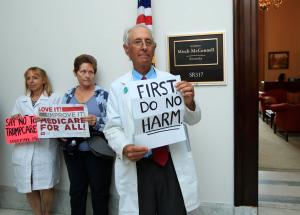
Retired family physician Jay Brock of Fredericksburg, Va., joins other protesters against the Republican health care bill outside the office of Senate Majority Leader Mitch McConnell of Ky., Monday, July 17, 2017, on Capitol Hill in Washington. (AP Photo/Manuel Balce Ceneta)
McCain released this statement to the press.
“From the beginning, I have believed that Obamacare should be repealed and replaced with a solution that increases competition, lowers costs, and improves care for the American people. The so-called ‘skinny repeal’ amendment the Senate voted on today would not accomplish those goals. While the amendment would have repealed some of Obamacare’s most burdensome regulations, it offered no replacement to actually reform our health care system and deliver affordable, quality health care to our citizens. The Speaker’s statement that the House would be ‘willing’ to go to conference does not ease my concern that this shell of a bill could be taken up and passed at any time.
“I’ve stated time and time again that one of the major failures of Obamacare was that it was rammed through Congress by Democrats on a strict-party line basis without a single Republican vote. We should not make the mistakes of the past that has led to Obamacare’s collapse, including in my home state of Arizona where premiums are skyrocketing and health care providers are fleeing the marketplace. We must now return to the correct way of legislating and send the bill back to committee, hold hearings, receive input from both sides of aisle, heed the recommendations of nation’s governors, and produce a bill that finally delivers affordable health care for the American people. We must do the hard work our citizens expect of us and deserve.”
 Paul Krugman tries to make sense of the Republican Cruelty on display during this debacle. The passage of any of these Republican Repeal Bills would have been the definition of winning at any cost. I cannot even believe Louisiana Senator Bill Cassidy–a medical doctor–would throw millions of people into suffering and early death. That’s a cost only an army of demons could love.
More than 40 percent of the Senate bill’s tax cuts would go to people with annual incomes over $1 million — but even these lucky few would see their after-tax income rise only by a barely noticeable 2 percent.
So it’s vast suffering — including, according to the best estimates, around 200,000 preventable deaths — imposed on many of our fellow citizens in order to give a handful of wealthy people what amounts to some extra pocket change. And the public hates the idea: Polling shows overwhelming popular opposition, even though many voters don’t realize just how cruel the bill really is. For example, only a minority of voters are aware of the plan to make savage cuts to Medicaid.
In fact, my guess is that the bill has low approval even among those who would get a significant tax cut. Warren Buffett has denounced the Senate bill as the “Relief for the Rich Act,” and he’s surely not the only billionaire who feels that way.
Which brings me back to my question: Why would anyone want to do this?
I won’t pretend to have a full answer, but I think there are two big drivers — actually, two big lies — behind Republican cruelty on health care and beyond.
First, the evils of the G.O.P. plan are the flip side of the virtues of Obamacare. Because Republicans spent almost the entire Obama administration railing against the imaginary horrors of the Affordable Care Act — death panels! — repealing Obamacare was bound to be their first priority.
Once the prospect of repeal became real, however, Republicans had to face the fact that Obamacare, far from being the failure they portrayed, has done what it was supposed to do: It used higher taxes on the rich to pay for a vast expansion of health coverage. Correspondingly, trying to reverse the A.C.A. means taking away health care from people who desperately need it in order to cut taxes on the rich.
So one way to understand this ugly health plan is that Republicans, through their political opportunism and dishonesty, boxed themselves into a position that makes them seem cruel and immoral — because they are.
 McCain may have put on a show but the closing act was worth it and the wait.
The clerk read the Arizona senator’s surname in the microphone of the tense Senate chamber. The two words were met with silence — McCain had stepped out of the room minutes before.
But moments later, he reappeared. By then, the alphabetical roll call had reached Sen. Gary Peters of Michigan. McCain walked over to the front of the chamber, raising his right arm. He held it up in the air until he had the attention of the clerk.
“No,” he said, with a swift thumbs-down.
It was a “no” that could barely be heard on C-SPAN, and a thumbs-down that viewers would not have been able to easily make out. But the moment was crystal clear for the dozens of reporters watching from the gallery above, who let out a collective gasp and made a stampede exit for the wooden double doors behind them to report the news.
In hindsight, it seems clear: McCain had made up his mind to vote “no” well before he walked into that chamber.
There were hints in his body language, the demeanor of the colleagues who approached him and the way the senator navigated the room. As he huddled with members in a series of hushed conversations while Thursday night turned into Friday morning, there were words that could almost be heard from above and even discerned through lip-reading. The clues were all there.
 But with all of the McCain show, it was Collins, Murkowski, and a lot of Democrats–including Red Staters–that held firm during the entire ordeal. Phillip Bump of WAPO has this right.
In other words, those 50 people helped McCain be the political winner. Here are seven people in particular who he can thank for his victory lap this morning.
Sen. Susan Collins (R-Maine). It’s sort of amazing that Collins hasn’t gotten more attention for her role in opposing the health-care bill this week. She was one of two Republican senators who opposed the motion-to-proceed, the procedural vote that allowed the climactic vote on Friday morning to happen at all. She was one of the three votes against the Republican bill.
She also made headlines for bashing President Trump after a hearing when a live microphone caught her conversation with a colleague. The administration’s handling of the budget was just “incredibly irresponsible,” and she was “worried” about what might happen. She delivered bad headlines for Trump on three different days — yet somehow has escaped his Twitter wrath.
Sen. Lisa Murkowski (R-Alaska). Murkowski did not escape that wrath.
She also didn’t escape a phone call from the secretary of the interior in which projects important to her state were tacitly threatened. (That’s according to her colleague from Alaska, who received a similar call. She told reporters on Thursday that she preferred not to use the word “threat.”)
Murkowski’s opposition was driven, among other things, by a desire to protect funding for Planned Parenthood, a commitment she made publicly in the state earlier this year. When McCain’s “no” became known on the floor of the Senate as voting loomed, Murkowski was swarmed by her colleagues, hoping to cajole her into flipping. As on the motion-to-proceed, which she also opposed, Murkowski didn’t budge.
I admit to running the gamut of emotions from anxiety, fear, and depression over the thought of losing my access to health care again. I’ve been on Louisiana’s Medicaid Expansion now for a year. I’m getting preventative care again. It’s something that I will likely need for three more years until I can get on Medicare given it will be there for me as it has been for all other over 65 Americans.
I hugged the soundly sleeping cat on my chest and startled her when I yelped and sprung up from bed to dance. I have a reprieve from unnecessary suffering. My long-gone cancer still haunts my life.
Protesters on the Hill held their own spontaneous celebration at the news.
A viral video overnight Thursday night showed protesters outside the Capitol break out into massive cheers the moment they learned the Senate GOP’s ObamaCare repeal bill would fail.
The video, shared by Splinter News reporter Emma Roller, captured protesters chanting “yes we did” after news the repeal bill failed.
So, I’m just going to enjoy #FridayFeeling and hope that the usual ugly Friday night Trump news Dumps can be held at bay for awhile.
Just.Breathe.
What’s on your reading and blogging list today?
Did you like this post? Please share it with your friends:


 peej
peej Carissa
 bostonboomer
 dakinikat
 ecocatwoman
 mablue2
 Mama Lopez
 peggysue22
 quixote
 skydancingguestblogger
 Mona (aka Wonk the Vote)



 Sky Dancing
Recent Comments