
Obama’s Political Leanings (pssssttttt … he’s no liberal)
Posted: April 26, 2011 Filed under: 2012 presidential campaign, abortion rights, Barack Obama, Democratic Politics, Domestic Policy, Environment, Environmental Protection, Reproductive Rights, Republican politics, Republican presidential politics, right wing hate grouups, Surreality, Team Obama, The DNC, The Media SUCKS, the villagers, U.S. Economy, U.S. Politics, Voter Ignorance, We are so F'd, WE TOLD THEM SO, Women's Rights | Tags: Ezra Klein, Obama, Right Wing, Rockefeller Republicans 7 Comments
Time to trot out the Unity Pony
I’m having an interesting day reading all the links out there and discussions on several Ezra Klein blog posts. Some one should’ve noticed Obama’s hero-worship of Reagan during the primaries about three years ago. Some one should’ve read his books that were gleeful about past Republican policy initiatives. But no, we were too busy discussing other things to notice how far to the right Barrack Obama really is.
Here’s one of Klein’s posts that’s getting netplay now: The shocking truth about the birthplace of Obama’s policies. Some people just have not been paying attention at all.
President Obama, if you look closely at his positions, is a moderate Republican from the early 1990s. And the Republican Party he’s facing has abandoned many of its best ideas in its effort to oppose him.
If you put aside the emergency measures required by the financial crisis, three major policy ideas have dominated American politics in recent years: a health-care plan that uses an individual mandate and tax subsidies to achieve near-universal coverage; a cap-and-trade plan that attempts to raise the prices of environmental pollutants to better account for their costs; and bringing tax rates up from their Bush-era lows as part of a bid to reduce the deficit. In each case, the position that Obama and the Democrats have staked out is the very position that moderate Republicans staked out in the early ’90s — and often, well into the 2000s.
I’ve been saying for years–literally–that the Obama Health Care Plan was more conservative than Nixon’s and basically was grabbed from Lincoln Chaffe’s Heritage Plan in the 1990s which was later called Dolecare and then later morphed into Romneycare. That’s just Klein’s first example. He also provides evidence on cap and trade which was supported by George H.W. Bush and Newt Gingrich when it was applied to ‘acid rain’ instead of ‘global warming’. He then moves to tax policies. Obama’s obvious proclivities to voodoo economics even showed up in the first stimulus which was top heavy with tax cuts and not big enough on job creation measures. Klein doesn’t even touch the increasing military budgets and interventions, the GLBT and women’s rights issues that get bargained away, FISA, Gitmo, etc., etc., etc. …
Here’s Mark Thoma’s take on the Klein piece and a follow-up by Andrew Samick. Samick considers Obama to be a Rockefeller Republican of all things. I’d say Obama’s even more to the right than that because that’s pretty much the side of the Republican party that raised me. Rockefeller Republicans love Planned Parenthood among other things. Warren Buffet is a great example. Hell, Charlton Heston loved Planned Parenthood. I even heard him speak on population control issues in Omaha, Nebraska in the mid 1970s sponsored by–gasp!–Planned Parenthood. The most interesting part is Thoma’s ending question. Why are we moving so far to the right now?
What’s left unexplained is why movements to the right by both parties — and these aren’t marginal moves — haven’t alienated the middle of the road, swing voters that seem to make a difference in elections. I don’t think I have a good answer for why. In the present case, there is some voter remorse — Obama is far more conservative than many thought — but I don’t think that explains the larger trend.
The original Ezra Klein piece is here: ‘Obama revealed: A moderate Republican’. Believe me, the conversation has gone viral with folks like The National Review (Be forewarned if you go there, it’s a putrid thread.) on line taking the bait. Booman even twists himself into a world class logic pretzel trying to say this is good news because it means Obama’s policies are “mainstream”. Joseph Romm at The Grist discusses the climate policy even further.
In the climate bill debate of the past two years, Obama and the Democrats embraced Republican ideas in an effort to minimize or avoid the partisanship inherent in other approaches that had been explicitly rejected by Republicans, including a tax and a massive ramp up in clean energy funding, as I’ve argued.
But Klein makes an effective case that it simply didn’t matter how reasonable or centrist or business-friendly a strategy environmentalists and progressive politicians pursued (or might have pursued). The Republicans simply were committed to stopping Obama from appearing bipartisan.
The Dems keeps getting suckered by Republicans the way Charlie Brown keeps getting suckered by Lucy. But the difference is that the GOP’s strategy wasn’t even a secret.
Ah, here’s the deal. Romm ties back to Thoma’s question. Why all this goose stepping to the right? Easy. It was the Republican strategy of say not to everything. They had to go further right to say no. Now, we’re in policy measures that are from John Birch Society land. Finally, the Democratic Congress said no more compromises when Planned Parenthood went on the chopping block. They also decided to get what they could get done before Boehner took over the house. We saw a few last minute Democratic Policies get passed but it was only due to the folks in Congress. Obama just went along because, hell, a win is a win, right?
Senate minority leader Mitch McConnell told The New York Times in March 2010, “It was absolutely critical that everybody be together because if the proponents of the bill were able to say it was bipartisan, it tended to convey to the public that this is O.K., they must have figured it out.” Why? As McConnell blurted out right before the 2010 midterm elections, “The single most important thing we want to achieve is for President Obama to be a one-term president.”
Obama kept proposing “conservative” policy at the onset. The Republicans announced they would sabotage it from the get go. This is something we complained about and pointed out here and elseblog for years. Obama’s opening policy moves were always a compromise position for real Democrats. He never was worried about putting policy out there with a real Democratic stamp on it because issues aren’t important to him. This President desperately wanted to pass anything with his name on it that would be called success. I frequently argued he wanted to makes sure there was a Health Plan that went through just to show he could do it when the Clintons couldn’t do it. He threw the Democratic plans over board almost immediately including the wildly popular single payer option. Dumping women’s access to private insurance with access to abortion was his final compromise maneuver to pass the silly thing. He’s thrown policies to the wind that have been basic Democratic Platform staples every chance he’s been in office. The Republicans were never going to act satisfied and were going to keep goosestepping further right. It was their announced strategy. He was more than willing to go right along with them because his proclivities are rightish anyway and he just wants the win.
So, my big question is why didn’t these folks see this coming all along like we did? Then a follow-up, what good does all this discovery now do three years too late?
Of course, if you read the Republican blogs, they’re still screaming Obama’s a socialist and Klein’s a fool. If you hit the partisan Democrats, the pretzel logic maneuvers are as obvious as Booman’s trying to find the sunny side up.
I’ll I can say is we told them so. Follow that up by a we are so f’d.
Saturday: Walk Like a Bahraini Youth Activist
Posted: March 5, 2011 Filed under: morning reads | Tags: 2012, Al Jazeera, bonus class, collective bargaining, demography, GOP, Hillary Clinton, Mideast, Obama, Photography, rightwing canard, student loans, womancession, Women's Rights 24 Comments
Click Image to go to the NYT Lens.
Good morning, news junkies!
I’ve gotten quite hooked on the NYT’s new Lens blog, particularly the regular interview/photo essays compiled by Lens editor James Estrin. A couple months ago, Estrin zoomed the focus in on Eirini Vourloumis and her photographs of Spanish-speaking converts to Islam–you may remember my linking to the interview at the time. This week’s spotlight is on Hazel Thompson and her work documenting the roles of women in Bahrain. There’s also a video of Thompson discussing her experiences at the link. Fascinating stuff.
To the right… from Hazel Thompson’s “Measure of a Woman”… The Youth Activist: Enas Ahmed Al-Farden is the vice president of the Bahrain Youth Forum Society. She is also a radio announcer and a product marketing manager. She lives with her parents and is engaged to be married.
If you have some free time after you’re finished reading this roundup, both the spot on Bahraini women and the earlier one on Latino Muslims are well worth the investment. (I’ll link to them again at the end.) In the meantime, here are the rest of my Saturday picks… grab a cup of whatever gets you up and running in the morning and enjoy.
Economy
- Bryce Covert, via The Nation warns “With State Budgets Withering, Get Ready for the ‘Womancession.‘” A few key (and troubling) points I took away from Covert’s piece, which I’ve paraphrased slightly for the sake of brevity:
- As of November, men’s unemployment is down .04 percent over the previous 12 months, and women’s unemployment over the same period is up .04 percent. Between July 2009 and January 2011, women lost 366,000 jobs while men gained 438,000.
- The public sector has shed 426,000 jobs since August of 2008. 154,000 of those jobs were in education. Women comprise only a little over half of the public workforce but have lost 83.8% of the jobs during the recovery-in-name-only.
- And, just look at who is exempt from Walker’s proposal to strip collective bargaining: public officers, firefighters, and state troopers. It’s the public employee unions made up mostly of women that are facing threat of annihilation.
- Covert has another good piece up at New Deal 2.0 you might want to check out: “Student Debt Can be Deadly.” I’ll try to boil it down for you this morning. The average undergrad student graduates with $4,100 in credit card debt and $19,300 in student loans. Couple that with the phenomena of a) college educated 20-24 year olds having the highest percentage increase in unemployment and b) suicide being the second leading cause of death among college students, and you’ll see what Covert means by deadly.
- Wonk’s two cents: The Taxed Enough Already (TEA) crowd never shuts up about the “debt we’re creating for our children,” but they sure don’t seem to be looking in the right place if that’s what they’re really concerned about.
- At least there was a bit of justice on the student loan front for one individual this week–after six years, the Department of Education has finally forgiven the student debt of Tina Brooks, a disabled former cop. Appalling that it took so long. Propublica’s joint investigation with the Center for Public Integrity and the Chronicle of Higher Education found that…
although borrowers who develop severe and lasting disabilities are legally entitled to get federal student loans forgiven, the process for deciding who is eligible is dysfunctional, opaque and duplicates similar reviews conducted by other federal agencies. Many borrowers have been denied for unclear reasons, and many others have simply given up.
- Really bad theatre or comedy gold? You judge: SEC to curb bonus pay for only about 30 institutions.
- On Thursday, Zaid Jilani from Think Progress posted the graph I’ve been looking for. This is what the workers in Wisconsin, Ohio, and Indiana are protesting:

CLICK GRAPH TO GO TO THINK PROGRESS.
Women’s Rights
- The Center for Reproductive Rights’ Melissa Upreti, via RH Reality Check, reports that “Nepal Advances As U.S. Backslides on Women’s Rights.” What takes the cake is that Nepal’s Supreme Court cites Roe in its groundbreaking affirmation of a woman’s autonomy, access to abortion, and well-being over that of a fetus. I almost want to laugh and tell Nepal’s Supremes that their ruling sounds better than Roe. Our dear Roe has, among other things, successfully kept women’s rights in perpetual limbo for almost 4 decades. As much as I believe in the privacy argument, I’m a much bigger believer in the autonomy and equity arguments.
- Anna Clark, via AlterNet, looks at “What’s Next for Women’s Health (And Rights) in Tunisia and Egypt?” According to Clark, family planning was actually decent under both dictatorships. Will the road to self-governance bring more progress for Arab women or are we looking at another backward slide?
- Here’s a good companion essay to read after Clark’s piece. Margot Badran, via the SSRC’s Immanent Frame, writes of “Egypt’s Revolution and the New Feminism.” From Badran’s pen to the goddess’s ear:
Will the youth now be willing to accept patriarchal authoritarianism sustained by the old family law, a law so out of sync with contemporary social realities—with their own realities? It is very hard to see by what logic they could do so. Freedom, equality, and justice cannot be reserved for some only. For the youth, female and male, who raised this revolution, freedom, equality, and justice are surely non-negotiable, and dignity, the order of the day. This is the essence of the new feminism, call it what you will.
- I missed this one last week. William John Cox’s “Political Upheaval and Women’s Rights,” via Truthout. Excellent long view essay. Cox really lays it all out there. Fundamentalism is a threat to women everywhere, be it in the Mideast or in the US.
[There’s more, so if you need a coffee refill or anything, now would be a good time for an intermission before you click to continue. ]
Morphing the Conversation
Posted: February 7, 2010 Filed under: Global Financial Crisis, Team Obama, The Great Recession | Tags: Bruce Bartlett, David Stockman, Keynes, Meltzer, Obama, Reagan Comments Off on Morphing the ConversationOne of the things that I’ve found profoundly upsetting about the last several decades is how successfully movement  conservatism has confused and morphed policy conversation into a mishmash of labels which in no way describe what used to be general understanding of policy. Movement conservatism has reframed many definitions that were used as the basis for policy discourse. In a reaction to this, movement progressivism has reframed the reframe rather than try to shift the conversation back to what used to be common ground and common definitions. The terms “socialism”, “liberal”, and “Keynesian” are now completely divorced from reality–if I can use that word–and from their traditional meanings. Shared definitions and discussion of one’s assumptions are important for civil debate. Civil debate is necessary for successful policy implementation. Our discourse is so inflamed these day that we no longer even share the process by which we have historically entered into dialogue. Screaming ill-defined frames is now de rigueur.
Movement conservatism–its media outlets and thinktanks– has moved the Overton Window so far off the ruler that even former Reagan officials are coming forward to press the reset button. Movement progressivism has borrowed from their play book and is now doing the same. Several TC readers have brought up some really good examples recently.
My personal hypothesis is that both Democrats and Republicans have the same agenda which is to feed the hand of the industries and interests that can keep them in power. They play on different teams with different sponsors but their basic goals are the same. That would be to return money to people that provide money to them. The rhetoric we see in ads and speeches are positioned to keep us on the hook and tagging along. Ever so often they throw us a few things like a study on getting rid of DADT or a law that looks like it may get rid of job place discrimination. These are mostly symbolic and have very little real effect. The right does the same thing. They throw a few restrictions on abortion rights or pull together funds for an government agency that lets churches proselytize through social services. Nothing changes in the big policy realm except the continuation of laws that concentrate media, economic, and political power into the power brokers of each party’s choice. This is something that many of the ‘tea-partiers’ as well as those drawn to the move-on movement share; a sense that government moves when one set of interests that fund politicians asks it to do so. We get wars when the Oil industry needs its interests protected. We get bail outs when the finance industry needs its interests protected. Meanwhile, the rest of us get fed hype that something is happening in our best interests as they reframe discourse with their best Madison Avenue gestalt.
Yesterday, I tried to approach this problem from the sociopolitical concepts. Today, because of some down thread links folks pointed out, I’m going to switch to the socioeconomic. I tag these things with ‘socio’ on the front, because I do believe that most of this comes from differences in class more than differences in anything else. Today’s populists are spewing the words ‘elite’ when I think what they are really sensing is they are far removed from the bonus class of Wall Street, the political class in Washington, and the cultural class in Hollywood. There is nothing elite about them other than their ability to attract money and power through a velvet schmooze and a public platform.
Punch Drunk on Tax Funded Bailouts
Posted: March 23, 2009 Filed under: Equity Markets, Global Financial Crisis, Main Stream Media, president teleprompter jesus, Team Obama, U.S. Economy, Uncategorized | Tags: bailout, Change When?, Obama, SouthPark, TARP, Timothy Geithner 4 CommentsWhile the Right Wing is off having tea parties and screaming class war, there appears to be some legitimate soul searching going on in left Blogistan about our “punch drunk” POTUS and his continual campaign like appearances. A lot of the discussion is focused on his dogged support of Turbo Tax Timmy and his bailout of the Suckers who created this bad economy for the rest of us. We’ve been overwhelmed with “heckuva-job-Timmy moments and distasteful ‘gallows humor’. When is enough enough?
Meanwhile, those of us that can’t avoid our jobs by taking a permanent vacation in TVLand are watching the economy unwind in spasms of agony and ecstasy. The market, starved for specific plans and information, provided a big thumbs 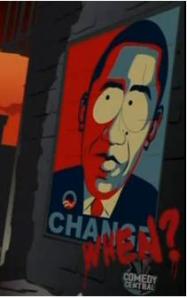 up on a bail out program that at best reheats Dubya’s. If any one was punch drunk, it was the equity markets today. The leaders were the financials, of course, who will continue to provide profits to the market while writing their costs off to the taxpayer. If you were looking for the fresh cold breath of reality, it wasn’t on Wall Street or on Pennsylvania Avenue.
Lucidity, however, is on the rise in other places. I’m finding it in interesting places like the second episode of South Park where the lampoon on the Dark Knight included this little back ground gem; a satire of the famous Obama picutre with a deer-in-the-headlights appearing Obama and the change mantra tagged by a bright red WHEN?
My answer to the when question is probably never.
Most left wing angst appears to be directed at Tim Geithner since the Light Bringer is still too new to the job to blame. We continue to learn how involved both he and his staff at the NY Fed were in the AIG Bonuses. In fact, the Obama administration is trying to scuttle the Excise tax on the bonuses while verbally denouncing executive greed on TV. We’ve also found out that Citibank has managed to insert similar language to protect its executive bonuses. Let’s see how much change we get on that one too.
Not only are right wing shrills like Fox’s Sean Hannity calling for the head of Timmy Geithner but Progressive Diva Arianna Huffington front paged the call on HuffPo today. When Hannity and Huffington carry the same headline, it’s time for more than a few campaign appearances on Leno and 60 minutes. I’m not sure where all this shock and angst is coming from because it’s been rather obvious to some of us for some time that Obama represented rather narrow interests (not ours). How can every Obama supporter be calling the AIG Bailout a travesty while knowing that the architects and enablers of AIG are continuing the task with the Light Bringer’s blessings and attaboys? Well, Obama just mustn’t realize that it’s all Timmy’s fault and we need his head on a limited edition Obama inaugural platter. But, wait, isn’t Obama the one with that great judgement ? C’mon folks reconcile all this in your mental ledger. It really isn’t that hard.
Super Heroes of Macroeconomics
Posted: March 22, 2009 Filed under: Uncategorized | Tags: AIG, bail out, Fraud, Geithner, Obama, Summers, TARP, Wealth Transfers, zombie banks 11 CommentsSomebody must have a lot of time on their hands to write a song called “Hey, Paul Krugman” but still, if the angsty, artsy fartsy creative class that foisted this POTUS on us is finally waking up, then Twitter me when the Revolution comes. I’ve even read the orange cheeto place and seems even a few of them are beginning to see the writing on their blackberries.
So, Paul is still appalled and speaking out against the Zombie Plan. I’d say this is another sfz! warning to the White House. What I can’t repeat enough is that it’s not just Paul. It’s not just me. It’s everyone with any knowledge of macroeconomics and the financial system.
Why am I so vehement about this? Because I’m afraid that this will be the administration’s only shot — that if the first bank plan is an abject failure, it won’t have the political capital for a second. So it’s just horrifying that Obama — and yes, the buck stops there — has decided to base his financial plan on the fantasy that a bit of financial hocus-pocus will turn the clock back to 2006.
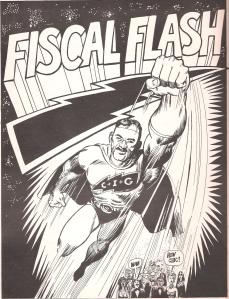 I don’t know if you’ve ever sat in an economics class, but most of you who have will attest that few economics professors are what you would call the dramatic, excitable types. However, I’ve seen more animation out of them recently than I’ve seen in all recent Marvel Comic Books.
From “Reasons Why The Obama Administration will not solve this crisis by the end of 2009” at The Underground Investor:
Consider that President-elect Obama voted FOR the horrible $700 billion bailout plan that accomplished less than zero in fixing the global economy while only transferring wealth from people that were struggling the most to the unethical financial executives that created this problem. These were my exact words in October, 2008, verbatim, about the eventual effect of the bailout plan: “Don’t believe the media spin. This will fix nothing. Even if and when the government overpays Wall Street and US banks by 300%, 500% and 1000% for their toxic assets, this temporarily recapitalizes these financial institutions but only creates A MUCH BIGGER PROBLEM for the future.” If I understood why the bailout plan would most definitely fail, as I blogged here, and the next President of the United States could not, that is a scary thought. On the other hand, if President Obama understood that the bailout plan would likely accomplish nothing but the transference of wealth from hard-working citizens to corrupt financial executives and still voted for the bill, then this action needs no further discourse.
From FT’s Willem Buiter:
Why are the unsecured creditors of banks and quasi-banks like AIG deemed too precious to take a hit or a haircut since Lehman Brothers went down? From the point of view of fairness they ought to have their heads on the block. It was they who funded the excessive leverage and risk-taking of banks and shadow banks. From the point of view of minimizing moral hazard – incentives for future excessive risk taking – it is essential that they pay the price for their past bad lending and investment decisions. We are playing a repeated game. Reputation matters.
Three arguments for saving the unworthy hides of the unsecured creditors are commonly presented:
- Unless the unsecured creditors are made whole, there will be a systemic financial collapse, with dramatic adverse consequences for the real economy.
- If the unsecured creditors are forced to take a hit, no-one will ever lend to banks again or buy their debt.
- The ultimate ‘beneficial owners’ of these securities – notably pensioners drawing their pensions from pension funds heavily invested in unsecured bank debt and owners of insurance policies with insurance companies holding unsecured bank debt – would suffer a large decline in financial wealth and disposable income that would cause them to cut back sharply on consumption. The resulting decline in aggregate demand would deepen and prolong the recession.
I believe all three arguments to be hogwash.

 peej
peej Carissa
 bostonboomer
 dakinikat
 ecocatwoman
 mablue2
 Mama Lopez
 peggysue22
 quixote
 skydancingguestblogger
 Mona (aka Wonk the Vote)



 Sky Dancing
Recent Comments