
The Year in Congress
Posted: December 23, 2010 Filed under: commercial banking, DADT, GLBT Rights, Global Financial Crisis, Health care reform, investment banking, Team Obama, The Bonus Class, The Great Recession, U.S. Economy, U.S. Politics | Tags: Financial Reform, Health care reform, Obama-McConnell Tax Breaks extension, repeal of DADT, START, The Do-a-lot 111th congress 18 CommentsI found this article at the CSM that highlights that we actually had a Do-a-Lot congress this year and it has a nifty self test on political knowledge in 2010 you may want to take. They highlighted six big laws that were passed this year. All of them were definitely steps in the correct direction even though they had flaws that will have to be worked out. I’m not sure I’d consider all of them great successes but when you look back on the list, you’re sure to find something naughty and nice.
Here’s there intro to the list.
The post-election lame-duck session – typically a mopping-up operation to get out of town – also made history, passing key pieces of legislation, often with greater input from Republicans than had earlier been the case. People can argue the merits of what Congress did, but it’s hard to quibble with the scope of the undertaking. Here are six of this Congress’s major accomplishments, in the order in which they were approved.
Here are their list of “six big achievements”.
1. American Recovery & Reinvestment Act
The $819 billion economic stimulus package, signed into law February 2009 less than a month after Barack Obama became president, is the largest stand-alone spending bill in US history. It included tax cuts, as well as new spending for public works, education, clean energy, technology, and health care.
2. Patient Protection and Affordable Care Act
Congress battled for a year to pass health-care reform, which was finally a done deal March 23, 2010. The law mandates that all Americans obtain health insurance coverage, and it sets up entities called health exchanges to provide people with affordable options.
3. Financial regulatory reform
Known officially as the Dodd-Frank Wall Street Reform and Consumer Protection Act, the new law is the most significant regulatory overhaul of the financial system since the Depression ended in the 1930s. Signed into law in July 2010, it aims to end bailouts forced on taxpayers by financial institutions deemed “too big to fail” and to protect consumers. Included in the legislation is a powerful, independent consumer-protection bureau, an early-warning system for financial groups deemed too big to fail, new oversight of credit agencies, and lower fees on debit-card charges. It also directs much of the $600 trillion over-the-counter derivatives trade through clearinghouses and exchanges.
4. Big tax-cut extension, plus new stimulus
Congress averted the largest tax increase in American history by voting in December to extend the Bush-era tax cuts for two years, including for the highest-income households.
5. Repeal of ‘don’t ask, don’t tell’
Fulfilling campaign pledges of the last two Democratic presidents, Obama on Dec. 22 signed a law that repeals a 17-year ban on gay men and women serving openly in the US armed services.
6. New nuclear arms pact with Russia
The new Strategic Arms Reduction Treaty (START) with Russia reduces the US and Russian arsenals of deployed strategic nuclear warheads to 1,550 apiece within seven years. The Senate ratified the treaty Dec. 22 by a vote of 71 to 26.

Juju--my youngest daughter's christmas cat--studies the list
Okay, I’ll put it to you!
Naughty or Nice list?
See, even JuJu the Christmas Cat wants in on the project!!! (I guess my youngest daughter still hasn’t gotten through the doll phase yet.)
Who Will Fight for Us?
Posted: December 13, 2010 Filed under: Breaking News, Democratic Politics, Elections, just because | Tags: cat food commission, Obama-McConnell Tax Breaks extension 30 Comments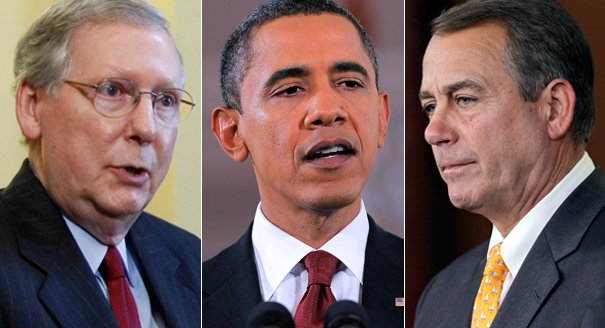
The Deciders
We had a few days of excitement, and for some of us rising hopes that the Democrats–at least in the House–might actually fight back against the Obama-McConnell more money for the rich plan. This morning as I look around the web, I see that the corporate media is assuming that there will be no fight–that this outrageous “compromise” between President Obama and the Republicans is actually a good thing for Democrats.
At the WaPo, the message is the same as at the NYT–the deal is a fait accompli and House Dems aren’t going to put up a fight. In fact, it appears that the tax cut extension for the rich is no longer an issue at all. The only sticking point for House Dems is the estate tax rate.
For Democrats in both chambers, the most onerous provision in the package would exempt estates valued at up to $10 million from a newly imposed estate tax. House Speaker Nancy Pelosi (Calif.) has called the measure a giveaway to the wealthy and “a bridge too far,” given that Obama has abandoned his campaign pledge to allow the Bush tax breaks for wealthy households to expire.
“Most of us agree with almost all of what the president negotiated,” Rep. Chris Van Hollen (D-Md.) told “Fox News Sunday.” “There is one thing that just was the choking point, and that deals with the estate-tax break.”
But, he continued, “I am confident that when we get to January, there will be no tax increases on middle-income Americans. We’re not going to hold this thing up at the end of the day, but we do think that simple question should be put to the test.”
USA Today reports–perhaps sarcastically–that Obama will fight for us next year.
“I will be happy to see the Republicans test whether or not I’m itching for a fight on a whole range of issues,” Obama said last week. “I suspect they will find I am. And I think the American people will be on my side on a whole bunch of these fights.”
[….]
One of those fights will be over the very thing that some Democrats are angry about: The two-year extension of George W. Bush-era tax cuts for the nation’s wealthiest Americans.
“When they expire in two years, I will fight to end them,” Obama said. “Just as I suspect the Republican Party may fight to end the middle-class tax cuts that I’ve championed and that they’ve opposed.”
[….]
…Obama has said that without a deal the Bush tax cuts would expire and everyone would see their taxes rise, and “I want to make sure that the American people aren’t hurt because we’re having a political fight.”
That presumably comes next year.
“I’m looking forward to seeing them on the field of competition over the next two years,” Obama said.
But why should be believe the liar-in-chief? I don’t think even USA Today believes him.
The Hill reports that Steny Hoyer has other plans for next year. He hopes to work on deficit reduction, with the recommendations of Obama’s Catfood Commission “at the center of our national conversation.”
Hoyer said he was “heartened that the president’s bipartisan fiscal commission put forward a provocative, challenging plan on debt — a plan that needs to be at the center of our national conversation.”
He said the plan should be looked at, along with those by the Bipartisan Policy Center, Rep. Jan Schakowsky (D-Ill.) and the Center for American Progress.
As he has in the past, Hoyer stressed the need for entitlement reform, including reform of Social Security possibly by raising the retirement age and raising the cap on income taxes to pay for Social Security.
That sounds really ominous to me.
Now let’s look at some of the few naysayers who still think the President’s plan is wrongheaded.
Paul Krugman is still unhappy with the plan but he’s resigned to its passage by Congress.
The deal will, without question, give the economy a short-term boost. The prevailing view, as far as I can tell — and that includes within the Obama administration — is that this short-term boost is all we need. The deal, we’re told, will jump-start the economy; it will give a fragile recovery time to strengthen.
I say, block those metaphors. America’s economy isn’t a stalled car, nor is it an invalid who will soon return to health if he gets a bit more rest. Our problems are longer-term than either metaphor implies.
And bad metaphors make for bad policy. The idea that the economic engine is going to catch or the patient rise from his sickbed any day now encourages policy makers to settle for sloppy, short-term measures when the economy really needs well-designed, sustained support.
If you believe Krugman, we are headed for long-term economic turmoil with almost no efforts by the government to help people in need or to create jobs.
What the government should be doing in this situation is spending more while the private sector is spending less, supporting employment while those debts are paid down. And this government spending needs to be sustained: we’re not talking about a brief burst of aid; we’re talking about spending that lasts long enough for households to get their debts back under control. The original Obama stimulus wasn’t just too small; it was also much too short-lived, with much of the positive effect already gone.
Elizabeth Warren says we are still in a serious economic crisis. She can’t understand how anyone can believe the economy is recovering when so many American families are still in dire distress.
Wall Street banks reaping profits and paying bonuses while the rest of the country struggles shows “we still have a problem” with economic disparity, said Elizabeth Warren, the Obama administration adviser responsible for setting up the Consumer Financial Protection Bureau.
“This just staggers me; I mean, I just don’t have words to describe what this means,” she said in an interview for Bloomberg Television’s “Conversations With Judy Woodruff” that will be broadcast this weekend. “For me, what an economic recovery is about is about what happens to American families. It’s what happens in the real economy. It’s whether or not families are building up wealth in their homes or whether or not their homes are dragging them over an economic cliff.”
“It isn’t meaningful to talk about profits and a growing economy until American families are stabilized,” she said.
Former Reagan budget director David Stockman says unemployment is far worse than anyone is admitting.
At the rate the US economy is recovering, it will take 28 years to get back to where we were in December 2007 if something doesn’t change, David Stockman, former federal budget director under President Reagan, told CNBC Friday.
“When we look below the surface and the job outlook and the trend that we’ve been in, it’s a lot worse then people think,” Stockman said.
“The jobs that they count every month and people get excited about are really part-time jobs,” he said.
Now that we are in the “new normal,” it’s important to rebucket the data the Labor Department releases on the big picture of the 130 million jobs in the economy, Stockman said.
Take the middle class, Stockman said, which is at the heart of the economy—about 54 million jobs. This is everything you can think of in terms of bread-winner jobs. The annual median wage is $50,000.
“If we are going to have recovery, it has to happen here,” he said, adding, “we lost 7 million jobs in two-year downturn in the ‘Great Recession.”
Even a former supply-side guy like Stockman thinks the key to getting out of this depression (which is what it is) is getting back middle class jobs.
I’m not an economist, so I can’t discuss all this knowledgeably like Dakinikat can. But even I can see that this country is in deep deep trouble. Again, I have to ask: Who will fight for us? And when? What can we do to fight for ourselves?
Dkat here with an update from C-SPAN.
The Senate convenes today where they plan to resume consideration of The Middle Class Tax Relief Act of 2010 (H.R. 4853). Senate Majority Leader Harry Reid (D-NV) has scheduled a procedural vote for 3pm today to move forward on the measure, which includes an extension of unemployment benefits for the next 13 months in exchange for allowing tax cuts for all income levels to continue for another two years.
This vote is scheduled to be broadcast on C-SPAN 2.
UPDATE: Senate in session and voting right now. (Voting to move vote forward 2:00 cst)
President Obama praised the Senate today for taking the important first step toward passing the controversial tax plan he hashed out with Republicans, a compromise bill which has angered many lawmakers inside his own party.
The bill still faces a tough fight in the House and the president “urged the House of Representatives to act quickly to similarly pass the bill.”
“I’m pleased to announce at this hour the U.S. Senate is moving forward on a package of tax cuts that has strong bipartisan support,” he said.
He said the bill “will grow the economy” and “grow jobs.”
The deal passed a procedural vote in the Senate this afternoon, and will come to a final vote later in the week — perhaps as early as Tuesday — before it is taken up by the House.
In a procedural vote, 83 senators voted in support of the legislation, which extends Bush-era tax cuts into the new year. Sixty votes were needed.
There were 15 votes against the bill.
Filibuster!
Posted: December 10, 2010 Filed under: just because, legislation, Live | Tags: Bernie Sanders Filibuster for the Middle Class, Filibuster, Obama-McConnell Tax Breaks extension, Seanator Landrieu, Senator Sanders, Tax Breaks for Billionaires 121 Comments Well, I guess it’s going on long enough we need to open a live blog thread!!!
Senator Bernie Sanders has started a filibuster of the Obama/McConnell behind-closed-doors tax deal.
Sen. Bernie Sanders (I-Vt.) — a self-described democratic socialist — railed against the plan in a lengthy floor speech that he said “you [can] call … a filibuster.”
“You can call what i am doing today whatever you want, you it [sic] call it a filibuster, you can call it a very long speech … ,” read a message posted on Sanders’s Twitter account after he’d taken to the rostrum at 10:24 a.m.
“I’m not here to set any great records or to make a spectacle,” Sanders said at the top of his speech. “I am simply here today to take as long as I can to explain to the American people the fact that we have got to do a lot better than this agreement provides.”
CSPAN-2 is live streaming the Senate.
Right now, my Senator Mary Landrieu is up and appears to be aiding the effort. She even has a nifty graph up about my state of Louisiana.
Sanders has called the plan “virtually a Republican idea”.
Here are the CBO numbers on how much this tax plan will cost. The number is $858 billion dollars.
The Obama-McConnell tax compromise will cost $858 billion over the next 10 years, according to estimates from the Congressional Budget Office.
In other words, the Republican-backed tax plan will cost more than the stimulus bill, which priced out at $787 billion.
For starters, extending all of the Bush tax cuts for two years will cost a total $675.2 billion over 10 years, according to a Dec. 3 Congressional Research Service study. Setting the estate tax at 35%, adding an exemption for estates under $5 million, knocking 2 percentage points off employees’ portion of the Social Security payroll tax, and the cost quickly goes up.
So, how does the U.S. pay the bill?
Twitter Update from CSPAN on the Live Coverage:
Screen grabs from C-SPAN2 HD coverage of Bernie Sanders filibuster http://cs.pn/gveC51 & http://cs.pn/dFZNBq
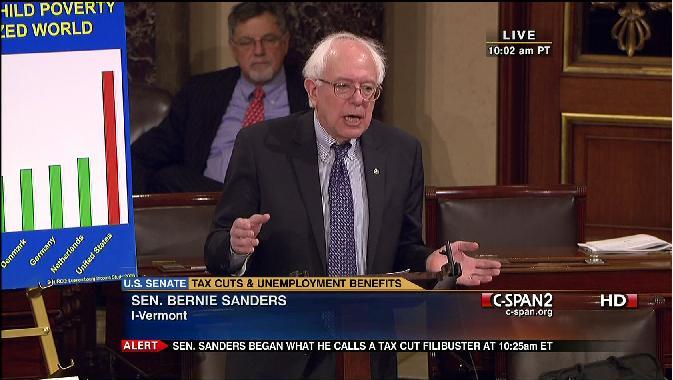
It’s a filibuster as filibusters were originally intended — and, as such, makes a mockery of what the filibuster’s become: a gimmick that allows a minority of senators to quietly impose supermajority requirements on any piece of legislation.
Joined at different times by Sen. Sherrod Brown (D-OH) and Sen. Mary Landrieu (D-LA), Sanders has been decrying the Obama tax cut plan for bailing out the wealthiest people in America. “How can I get by on one house?” Sanders railed, sarcastically. “I need five houses, ten houses. I need three jet planes to take me all over the world! Sorry, American people. We’ve got the money, we’ve got the power.”

 peej
peej Carissa
 bostonboomer
 dakinikat
 ecocatwoman
 mablue2
 Mama Lopez
 peggysue22
 quixote
 skydancingguestblogger
 Mona (aka Wonk the Vote)



 Sky Dancing
Recent Comments