
Haterz gotta Hate
Posted: January 21, 2013 Filed under: right wing hate grouups | Tags: Obama inauguration 38 Comments
One of the most amazing things about the US is its peaceful change after major elections. It’s probably the time we should be most proud. We quietly transfer governance after we elect our officials. It’s amazing to watch all of this even when you’re in the position of having to watch an elected official that you did not support. Today’s inauguration really reflected and celebrated the diversity of today’s USA. It’s weird how some people can’t even relax long enough to realize the country does so many things well. Instead of embracing our exceptionalism, well, haterz gotta hate.
There were a number of sour looks (that’s Boehner’s wife with that look on behind the first couple), sour grapes, and sour comments coming from the sour loser contingent today. There were many inspiring words in the President’s inauguration speech about giving every one the American Dream and the promise of equality. Guess not every one likes that idea.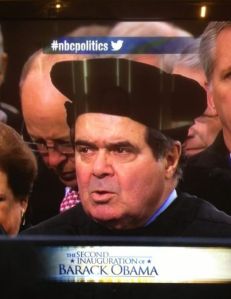
“I’ll probably stay away from twitter today-dont want to hear about this sad day for America + hear sheeple fawning over Obama- sickens me,” tweets AmericanAllegiance.
Free Republic posters feel maybe a little nauseous. One poster writes, “Make sure your TV is on. After all, ALL HAIL OUR KING, OUR GOD KING, KING OBAMA!” Others say they’re saving money by missing out. Another says: “By not turning my TV on today at all, I will probably save a LOT on my electric bill. I figure, at Least $.08. Every little bit helps.” A third thinks they’re the silent majority: “Wonder how the networks will fake the ratings on this fiasco….”
Wonder how Paul Ryan liked his personal take-down in the speech? Ryan even got the Bronx cheer on the way to the ceremony.
President Obama took direct aim in his inaugural address at the Randian rhetoric that animates the politics of Rep. Paul Ryan (R-Wis.) and his conservative followers in the House and around the country, arguing that the United States is “not a nation of takers.”
For Ryan, the country is divided between “takers” and “makers.” He generally puts the number of the former at around a third, with the remainder in the producing category. The dichotomy has been a regular part of his rhetorical repertoire for years, and was elevated during the presidential campaign as Ryan sought the vice presidency.
Ryan argues that social insurance programs that are central to Western welfare states sap the citizenry of ambition. Obama took direct aim at that contention on Monday. “The commitments we make to each other — through Medicare, and Medicaid, and Social Security — these things do not sap our initiative; they strengthen us. They do not make us a nation of takers; they free us to take the risks that make this country great,” he said.
One of the most ludicrous tweets came from Ari Fleischer. Here’s Paul Begala’s response to it.
You’re an expert In Persian respiration? MT“
@AriFleischer: When Reagan sworn in, Iran got scared. Pres Obama sworn in today, Iran yawned.”
Today we celebrated two big US holidays. Never waste an opportunity to distort when you’re one of the disgruntled losers.
“MLK is rolling over in his grave, as the biggest racist in U.S. history gets sworn in on his birthday & using his bible,” tweeted Tom O’Halloran, who has almost 441,000 followers.
“WHT IRONY THT MOST RACIST, DIVISIVE, ANTI-USA &ANTI-CHRISTIAN VALUES PREZ WD B INAUG
URATED (barf)ON MLK DAY-WHOS LIKELY ROLLING N HIS GRAVE!,” tweeted Victoria O’Kane, whose Twitter bio says she’s a “Christian, mother, wife, conservative patriot, author, poet, artist, account executive, humor fan” and has 7,300 followers. The debate over what MLK is doing in his grave rages on Twitter.
Wow.
Oh, and we learned that Eric Cantor is visibly unappreciative of poetry and blessings in Spanish. It’s just too bad we all can’t stop and consider what a wonder we have in a constitutionally-based change of government even when it’s not total change. After all, consider Syria, Libya and Egypt and their fight for liberation from dictators in the age of modern weapons. Peaceful transitions should leave us breathless and feeling blessed.
Monday Reads
Posted: January 21, 2013 Filed under: morning reads | Tags: Barrack Obama, Martin Luther King, Obama inauguration 68 Comments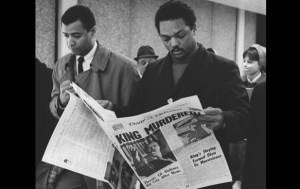 Good Morning!Today is the day we remember Martin Luther King and it’s the day for the formal inauguration ceremony for President Barack Obama.
John Nichols–writing at The Nation–believes that “This President Can—and Must—Claim a Mandate to Govern“.
With his second inauguration, Barack Obama will become the first president since Dwight Eisenhower to renew his tenure after having won more than 51 percent of the vote in two consecutive elections.
More importantly, in a political sense, he will be the first Democrat since Franklin Delano Roosevelt to have won mandates from the majority of the American people in two consecutive elections.
This is the perspective that Americans should bring to the inaugural festivities. We should expect a great deal from Barack Obama. Despite four years of battering by Fox and Limbaugh and the Tea Party and Mitch McConnell, he has been re-elected with a higher percentage of the popular vote than John Kennedy in 1960, Richard Nixon in 1968, Jimmy Carter in 1976, Ronald Reagan in 1980, Bill Clinton in 1992 or 1996 or George Bush in 2000 or 2004.
Obama’s mandate extends beyond himself. His party has increased its Senate majority and Democrats earned 1.4 million more votes in House races than Republicans. Gerrymandering and money kept Republican control of the House, but that opposition party is in such disarray that the president really does have an opening to make something of his mandate.
Obama must seize that opportunity as an essential part of making the case for bold executive orders and a bold legislative agenda that will bring not just the hope but the change he promised in what now seems like a very distant 2008 campaign. The president has in the transition period since the 2012 election displayed a willingness to push harder, to go bigger, and it has yielded significant progress not just on gun-safety issues but in the long struggle against the Republican austerity agenda that makes a diety of deregulating away consumer and environmental protections, tearing the social safety net and cutting taxes for wealthy campaign donors.
To consolidate that progress, and to assure that his second term will be as visionary and activist as his 2012 campaign promised, Obama must, like FDR, use every opportunity to give voice to the agenda- not just in his inaugural address but in his February 12 (Lincoln’s Birthday) State of the Union address.
Many things have become political footballs these days. The bodies, abuse, and rape of women. The idea that taxpayer money should be used to support religious indoctrination or profiting from educating our children. Even Science, so much at the center of a lot things we were proud of in the 20th century,has become political. Are there any dangers in this? Dr. Puneet Opal presents his case at The Atlantic.
Over the past few years, and particularly in the past few months, there seems to be a growing gulf between U.S Republicans and science. Indeed, by some polls only 6 percent of scientists are Republican, and in the recent U.S. Presidential election, 68 science Nobel Prize winners endorsed the Democratic nominee Barack Obama over the Republican candidate Mitt Romney.
As a scientist myself, this provokes the question: What are the reasons for this apparent tilt?
Some of this unease might be because of the feeling that the Republicans might cut federal science spending. The notion is certainly not helped by news-making rhetoric of some Republicans against evolution in favor of creationism; unsubstantiated claims that immunization aimed at preventing future cervical cancer cause mental retardation in young girls; and unscientific views of how the female body can prevent pregnancies under conditions of rape.
These comments might represent heartfelt beliefs of the leaders in question; however, some might simply be statements designed to placate the anti-science sections of their base, as part of the political calculus.
A recent opinion in the leading science journal Nature, written by Daniel Sarewitz, a co-director of the Consortium for Science Policy and Outcomes at Arizona State University, suggests that this polarization of scientists away from the Republicans is bad news. Surprisingly — as he tells it — most of the bad news is the potential impact on scientists. Why? Because scientists, he believes — once perceived by Republicans to be a Democratic interest group — will lose bipartisan support for federal science funding. In other words, they will be threatened with funding cuts. Moreover, when they attempt to give their expert knowledge for policy decisions, conservatives will choose to ignore the evidence, claiming a liberal bias.
The comments of Sarewitz might be considered paranoid thinking on the part of a policy wonk, but he backs up his statement by suggesting a precedent: the social sciences, he feels, have already received this treatment at the hands of conservatives in government by making pointed fingers at their funding. Therefore he says that a sufficient number of scientists must be seen to also support Republicans for the sake of being bipartisan. To be fair to Republicans, no politician has actually targeted science funding in this vindictive manner. But this assessment only goes to show how science is quickly becoming a political football.
I would argue that this sort of thinking might well be bad for scientists, but is simply dangerous for the country. As professionals, scientists should not be put into a subservient place by politicians and ideologues. They should never be felt that their advice might well be attached to carrots or sticks.
Democratic Economists outnumber Republicans by 2.5 to 1. No wonder many Republicans home school their children and use specious textbooks.
The President was sworn in quietly on Sunday on the day mandated by the Constitution.
With only his family beside him, Barack Hussein Obama was sworn into office for a second term on Sunday in advance of Monday’s public pomp, facing a bitterly divided government at home and persistent threats abroad that inhibit his effort to redefine America’s use of power.
It was a brief and intimate moment in the White House, held because of a quirk of the calendar that placed the constitutionally mandated start of the new term on a Sunday.
But the low-key event seemed to capture tempered expectations after four years of economic troubles and near-constant partisan confrontation. And it presaged a formal inauguration on Monday that will be less of a spectacle than the first one, when the nation’s first black president embodied hope and change for many Americans at a time of financial struggle and war.
For Monday’s festivities, with the traditional parade, balls and not least the re-enacted swearing-in outside the Capitol, there will be fewer parties and fewer people swarming the National Mall; organizers expect less than half the 1.8 million people who flocked to the city last time.
Once the parties end, Mr. Obama’s second-term challenges are formidable, not least given his ambitious priorities of addressing the national debt, illegal immigration and gun violence.
The economy, while recovering steadily, remains fragile. The unemployment rate is as high as it was in January 2009, though it is down from the 10 percent peak reached late that year, and there is no consensus with Republicans about additional stimulus measures — or virtually anything else.
And as the terrorist attack in Algeria last week illustrated, Mr. Obama continues to confront threats around the globe, both from state actors like Iran and North Korea and from Qaeda-inspired extremists seeking to exploit power vacuums in the Mideast and across Africa and Asia.
It’s been 50 years since Dr. Martin Luther King delivered his “I’ve Got a Dream” Speech.
The speech he delivered the next day — Aug. 28, 1963 — rocked the nation, as King challenged America to live up to the ideas of justice and equality it professed to cherish.
Fifty years later, the “I Have A Dream” speech is still widely regarded as the most powerful and significant speech of the 20th Century.
As the nation celebrates King’s birthday today, the speech itself is being remembered and celebrated in Detroit — which got the first glimpse of the speech — and across the nation.
King speechwriter Clarence B. Jones, who was one of those advisers on the speech, will be the featured speaker at a program today in Ann Arbor and two programs open to the public in Detroit on Tuesday.
Jones, scholar in residence at the Martin Luther King Jr. Research & Education Institute at Stanford University, helped draft parts of the speech and was on stage with King when he delivered it in Washington.
Jones believes the riveting crescendo of the speech was God-given.
He said he remembers gospel singer Mahalia Jackson, also on stage, telling King, “Tell them about the dream, Martin. Tell them about the dream,” said Jones during a recent telephone conversation. “He pushed the written text aside and started speaking from the heart. It was like he had become possessed, like someone had taken over his body. It was electrifying.”
It wasn’t just what he was saying, but the powerful delivery that stirred the nation’s moral conscience, Jones said.
“The speech tapped into the very core values of who we were supposed to be as a country,” Jones said. “He was speaking prophetically about what America could be if it lived out the principles of the Declaration of Independence. Everybody who heard it, black or white, segregationists or integrationists, everybody knew he was speaking the truth.”
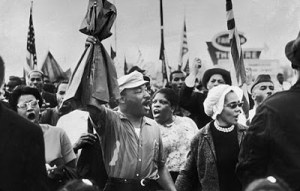
It’s hard to think about what life was like for those black Americans living in the Jim Crow South before the work of people like Dr. King and Miss Rosa Parks. Here’s Dr King Speaking about the Bus Boycott in Selma in 1955. You can find a collection of historical videos on the struggle for racial equality here.
It’s good that we have a day to reflect on all of those things–both good and bad–that make up American History. Have a wonderful holiday!
When Inclusion is Really Exclusion
Posted: December 18, 2008 Filed under: A My Pet Goat Moment, Human Rights, No Obama, president teleprompter jesus, Team Obama | Tags: Gene Robinson prayer, Inauguration, Obama inauguration, Rick Warren prayer 11 Comments When I heard that Rick Warren was invited by PE Obama to say a prayer at the inauguration, my first thought was that Obama’s pandering to the religious right was more than just electioneering. Obama seems intent on including them in his administration. To me, this bodes poorly for science, rational thought, and civil rights. I was hoping he might ask some one like Rev. Gene Robinson, an Episcopalian Bishop to give the prayer because it would demonstrate a true commitment to civil rights. Rev. Robinson is openly gay and his appointment has been an ongoing source of controversy.
I was pleased to read Jeffrey Feldman’s blog today to find there was some one else out there with similar feelings. I always find the Feldman’s analysis of how people looking for positions of power ‘frame’ cultural and political issues fascinating. Feldman believes that Obama is not leading on civil rights issues but ‘tinkering’ and points to previous democratic leaders who took bold stands on civil rights issues. I’m going to highlight his main points, but would suggest you go look at the entire essay.
Obama, Feldman believes, comes up short on the leadership scale.
Marriage equality for gays and lesbians is not just some “social issue” akin to school uniforms, warning labels on music or smoking in restaurants. It is the current epicenter of the civil rights movement in America.
… When Lincoln took office, the abolition of slavery was the epicenter. When Wilson took office, the women’s suffrage movement was the epicenter. When FDR took office, poverty was the epicenter. When Kennedy took office, segregation was the epicenter
Thinking about Obama’s presidency in terms of an ‘epicenter’ of civil rights changes how we think about Rick Warren speaking at the inauguration.
Rick Warren is not just a pastor opposed to gay rights. He is a highly political leader of a mega-church who has compared abortion to the Holocaust and opposed marriage reform in terms equivalent to the bigoted plaintiffs in Loving v. Virginia–the landmark 1967 civil rights case overturning anti-miscegenation marriage laws. In an era where gay rights are the epicenter, Rick Warren is a widely recognized voice arguing against those rights.
Translating Rick Warren into the terms of previous civil rights eras is the key to seeing why his role at Obama’s inauguration is so troubling. By comparison, if this were Lincoln’s inauguration, Rick Warren would have been the equivalent pro-slavery pastor giving the invocation. If this were Wilson’s inauguration, Rick Warren would have been the equivalent of an anti-women’s suffrage pastor saying a prayer. For FDR, he would have been the same as inviting a pastor opposed to rights for the poor. For Kennedy, he would have been the same as inviting a pastor who spoke out repeatedly about the dangers of desegregation.
In each of these cases, for the President-elect to invite the a voice known for arguing against progress–and to do so in the name of political peacemaking, as Barack Obama has done with Rick Warren–would have revealed a tinkerer on civil rights, not a leader.
Feldman raises just one faucet of leadership where Obama fails. Obama’s cabinet appointments are being ‘framed’ as pragmatic. Obama has said he wants to be surrounded by folks that are not idealogues, but folks that will get things done. I guess I have to raise the question of how important is getting a bureaucracy to work when the overall goals are based on functionality and not vision. This is where I think Feldman sees the gay rights as symptomatic of Obama’s lack of leadership skills. As President, Obama should be doing more than just making history based on appearances. If Obama is ‘symbolic’ of civil rights gains, then what does it say to choose Warren, some one who assaults the civil rights of both women and GLBT Americans?
I feel compelled to add my voice to those asking Obama to disinvite Warren. What would it say if Obama, instead, asked Rev Robinson to contribute this prayer instead? Wouldn’t the inclusion of Rev. Gene Robinson make a compelling statement towards the future of civil rights in this country? Wouldn’t this be a strong statement given that the President Elect’s supporters contributed so heavily to the defeat of Prop 8 in California? This would be a sign of leadership and not just a going along with what worked to get Obama elected.

 peej
peej Carissa
 bostonboomer
 dakinikat
 ecocatwoman
 mablue2
 Mama Lopez
 peggysue22
 quixote
 skydancingguestblogger
 Mona (aka Wonk the Vote)



 Sky Dancing
Recent Comments