
Thursday Reads: Snowzilla and Other News
Posted: January 2, 2014 Filed under: Barack Obama, Foreign Affairs, morning reads, U.S. Politics | Tags: Akademic Shokalskiy, clemency, distress signal, Edward Snowden, Glenn Greenwald, Keystone XL pipeline, metadata, Minneapolis fire, National Transportation an Safety Board, North Dakota train derailment, Russian FSB, Snowzilla, Sochi Winger Olympics, surveillance by Russia, winter weather 44 Comments
Boston’s Beacon Hill in Winter
Good Morning!!
This post is late because I had a computer emergency this morning. Fortunately I got it resolved after a struggle, but I was on the verge of panic for a bit. I hate computer problems.
The first big winter storm of 2014 has begun. Here in Greater Boston, we have a couple of inches on the ground. We were supposed to get heavy snow last night, and now they’re saying it will come tonight instead. We’re supposed to get light snow through out the day and we have blizzard warnings in effect for tonight with about a foot of snow expected by tomorrow. We’ll see . . . the weather people haven’t been that accurate so far this winter. But it’s a huge storm that will affect people across the Midwest, the Mid-Atlantic states and New England.
Reuters reports: Powerful storm bears down on U.S. Northeast with Arctic temps.
The double-barreled storm system stretching from the lower Mississippi Valley to the Atlantic coast could dump more than 12 inches of snow in some areas, especially southern New England, by Friday morning, the National Weather Service said.
“Heavy snow, strong winds, frigid temperatures and dangerous wind chills are in forecast for much of the region,” it said in a statement.
The storm is expected to snarl traffic on the I-95 highway corridor between New York and Boston, the weather service said. At the southern edge of the storm, Washington is expected to receive less than one inch of snow.
The powerful storm forced about 1,000 U.S. flights to be canceled and about 250 delayed, with the worst-affected airport Chicago’s O’Hare International, according to FlightAware, a website which tracks air travel.
NPR has a summary of the weather situation, with links: 100 Million People In Path Of 2014’s First Wintry Blast.
In the Arctic, the passengers on that stranded ship have finally been rescued. NBC News:
All 52 passengers who were stranded aboard an ice-locked ship in Antarctica for more than a week were rescued by helicopter early Thursday, officials said.
The Akademic Shokalskiy sent out a distress call on Christmas morning after it became surrounded by sea ice while on a scientific mission more than 1,700 miles south of Australia.
On Thursday, a helicopter from a Chinese ice-breaking ship Xue Long — or Snow Dragon — transported groups from a makeshift helipad which the passengers had stomped out in the ice near the ship.
The Australian Maritime Safety Authority (AMSA) tweeted at 6.20 a.m. ET Thursday that all of the 52 passengers had been airlifted from the Akademik Shokalskiy and were now on board the Aurora Australis ice-breaker.
Photos and video at the link.
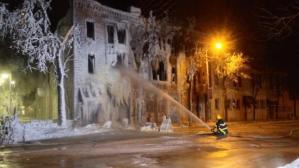
Yesterday an explosion started a fire in a Minneapolis building where many Somalis lived. The building was next door to a mosque. I hope this doesn’t turn out to be arson. From The Columbus Dispatch: 14 hurt in blast, fire in Minneapolis building.
MINNEAPOLIS — A billowing fire engulfed a three-story building with 10 apartments near downtown Minneapolis yesterday, sending more than a dozen people to hospitals with injuries — some critical — ranging from burns to trauma associated with falls.
An explosion was reported about 8:15 a.m., and within minutes, a fire raged through the building, said Robert Ball, a spokesman for Hennepin County Emergency Medical Services. Paramedics, responding amid sub-zero temperatures, found victims on the ground, some with injuries that suggested they might have fallen several stories.
“It’s not clear whether people were pushed out of the building from the explosion, or whether they fell or jumped out of windows to escape,” Ball said.
No fatalities have been reported, but authorities weren’t sure whether any residents still were in the building. Its roof had partially collapsed, making it too dangerous for firefighters to search the premises, said Assistant Minneapolis Fire Chief Cherie Penn.
There were reports of family members saying three people living in the apartment were not in the hospital and cannot be accounted for.
According to an update from CBS Minnesota, Investigators Search For Cause Of Massive Minneapolis Fire, three people are still reported missing.
The Minneapolis Fire Chief said even though many will be wanting to know the cause of this fire immediately, it may take a little bit to figure out what happened.
“You’re going to have to have some patience with us, it’s going to take law enforcement and arson investigators some time. It’s going to be a very difficult investigation. We’re going to determine the cause and origin, so it’s going to take us some time,” said Chief John Fruetel.
We know firefighters inspected the building in 2012 and issued a clean bill with no problems. The focus now is figuring out who the victims are. Fruetel said there is some confusion as to who was in the building or lived there. He said they’ve got some work to do figuring out who lived in the building, who may have had visitors, who were home and who were not home.
Officers are meeting with families to gather information, and several people don’t speak English so they need interpreters.
In addition to apartments, the building contained a store on the ground floor that was used as a “community center.”
Residents of Casselton, North Dakota were allowed to return to their homes, and the investigation into the causes of the derailment of a train carrying crude oil began yesterday. CNN reports that investigators were able to get closer to the wreckage yesterday, but they had already been examining video of the crash.
…[I]nformation taken from recording devices has been revealing, said National Transportation and Safety Board spokesman Robert L. Sumwalt.
A video camera at the head of the oil train recorded the crash as it slammed into a car of a derailed grain train.
“We looked at the last 20 seconds of the forward facing video from the oil train. And basically it shows the collision sequence,” Sumwalt said.
When the oil train arrived, the other train transporting grain and soy bean had already derailed, and one of its cars was lying in the oil train’s path, he said.
The oil train slammed into it and burst into flames.
Much more info at CNN and this NBC News link. This crash should raise serious questions about the Keystone XL project, according to Insurance Journal:
The derailment and fire that led to the evacuation of a North Dakota town has renewed the debate over whether it’s safer to ship oil by rail or pipeline as the U.S. completes a review of the Keystone XL project.
“Any time there is an incident, you have heightened talk and scrutiny on oil transportation,” Brigham McCown, a former director of the Pipeline and Hazardous Materials Safety Administration, said yesterday in an interview. “It will add to the conversation.” [….]
While climate change has been the focus of the fight over TransCanada Corp.’s proposed Keystone XL pipeline from Canada to the U.S. Gulf Coast, a subset in the debate has been the relative safety of pipes versus trains. The U.S. State Department, reviewing the $5.4 billion project because it would cross the U.S. border, is weighing whether the pipeline would be in the national interest.
Keystone would allow about 100,000 barrels a day of crude from the Bakken formation in Montana and North Dakota onto the pipeline through a link in Baker, Montana.
“Bakken oil is going to come under increasing scrutiny,” as a result of the rail explosion, said Robert Schulz, a professor at the University of Calgary’s Haskayne School of Business. “You may see additional thoughts of, ‘Let’s approve Keystone because it’s going to be safer.’”
The North Dakota accident is the fourth major North American derailment in six months by trains transporting crude. Record volumes of oil are moving by rail as production from North Dakota and Texas have pushed U.S. output to the most since 1988 and pipeline capacity has failed to keep up.
There has been quite a bit of Edward Snowden news over the past few days. I’m not a huge fan of the WaPo’s Ruth Marcus, but I couldn’t help agreeing with her column yesterday: Edward Snowden, the insufferable whistleblower.
Time has not deflated Edward Snowden’s messianic sense of self-importance. Nor has living in an actual police state given the National Security Agency (NSA) whistleblower any greater appreciation of the actual freedoms that Americans enjoy.
Insufferable is the first adjective evoked by Snowden’s recent interview with Barton Gellman in The Post, but it has numerous cousins: smug, self-righteous, egotistical, disingenuous, megalomaniacal, overwrought.
The Snowden of Gellman’s interview is seized with infuriating certitude about the righteousness of his cause. Not for Snowden any anxiety about the implications for national security of his theft of government secrets, any regrets about his violations of a duty of secrecy.
“For me, in terms of personal satisfaction, the mission’s already accomplished. I already won,” Snowden proclaimed. “Because, remember, I didn’t want to change society. I wanted to give society a chance to determine if it should change itself.”
And what gave Snowden the right to assume that responsibility? “That whole question — who elected you? — inverts the model. They elected me. The overseers,” he said. “The system failed comprehensively, and each level of oversight, each level of responsibility that should have addressed this, abdicated their responsibility.”
As you can well imagine, the column outraged Snowden’s primary promoter Glenn Greenwald. Marcus is now on his shit-list, and will remain there in perpetuity, because only Glenn is permitted to be that nasty to people who disagree with him. Greenwald is thrilled with The New York Times a the moment, however; because the editorial board called yesterday for President Obama to grant Edward Snowden clemency (as did Greenwald’s former employer The Guardian). I can’t imagine why Obama would do that, since it would set a dangerous precedent for dealing with future thefts of classified information.
Some reactions to two major newspapers calling for Snowden to be allowed to come home and not be prosecuted:
Susan Milligan at US News and World Report: No Clemency for Snowden.
Damien Thompson at The Telegraph: Let Edward ‘Pleased-With-Himself’ Snowden argue his case in an American courtroom.
The Hill: Former Obama official agrees with call for Snowden clemency.
Meanwhile, in Snowden’s adopted country, the FSB has been collecting unprecedented amounts of metadata on Olympic athletes and every foreign and domestic visitor to the Sochi winter games.
As the date for the Olympic Games in Sochi draws closer, Russia’s siloviki are becoming more active in terms of collecting data from Russians and foreigners. Although they can at least partially justify their decision to register every Russian who comes to Sochi during the Olympics with the desire to prevent terrorist attacks, the decree that Prime Minister Dmitry Medvedev signed Nov. 8 has no relationship whatsoever to that goal.
That decree expressly authorizes the government to collect data on telephone calls and Internet contacts made by the Olympic Games’ organizers, athletes and foreign journalists.
Irina Borogan and I have already published an article in The Guardian in October explaining how the authorities had installed an advanced wiretapping and surveillance system in Sochi, but Medvedev’s order adds significant scope to those activities.
The decree provides for the creation of a database for the users of all types of communication, including Internet services at public Wi-Fi locations “in a volume equal to the volume of information contained in the Olympic and Paralympic identity and accreditation cards.” That is, the database will contain not only each subscriber’s full name, but also detailed information guaranteed to establish his identity. What’s more, the database will contain “data on payments for communications services rendered, including connections, traffic and subscriber payments.”
That is called “gathering metadata” in the language of intelligence agencies.
So far no objections to this surveillance have been registered by Edward Snowden, Glenn Greenwald, Julian Assange, or any other member of Wikileaks. I wonder why?
So . . . what stories are you following today? Let us know in the comment thread, and have a great day!
New Year’s Eve Reads
Posted: December 31, 2013 Filed under: Cats, Media, misogyny, Mitt Romney, morning reads, nature, Newt Gingrich, racism, tar sand oil, The Media SUCKS, U.S. Politics | Tags: catnip, dolphins getting high, Edward Snowden, explosions, financial regulation, New Year's Eve 2014, North Dakota train derailment, puffer fish, suicide bombings in Russia, Sunday talk shows love Republicans, Winter Olympics 54 Comments
First Night fireworks, Boston
Good Morning!!
Today is the last day of 2013. Tonight at midnight, we’ll bid adieu to another year. I can’t say I’m sorry to see this one go.
There will be lots of celebratory fireworks in cities around to world tonight; the revelry has already begun in New Zealand. USA Today:
New Zealand rang in the New Year with multicolored fireworks erupting from Auckland’s Sky Tower at midnight Tuesday as thousands of cheering revelers danced in the streets of the South Pacific island nation’s largest city.
Early pyrotechnic shows erupted over Sydney Harbor, dazzling hundreds of thousands viewers ahead of the main event in Australia and Dubai will later try to create the world’s largest fireworks show to ring in 2014.
Unfortunately we’ve also seen some scarier explosions in the past couple of days. Yesterday afternoon there was another accident in North Dakota involving the transport of crude oil. The Minneapolis Star-Tribune reports: Cassleton, N.D. residents flee town after oil train explosion. So far the evacuations are still voluntary and only about 65% of the 2,400 residents of Cassleton have left their homes.
The explosion happened shortly after 2 p.m. Monday after a BNSF grain train derailed and crashed into a crude oil train near Casselton, which is 20 miles west of Fargo, causing tank cars to explode in towering mushroom-cloud flames. No one was injured in the crash….
In the initial hours after the explosion, authorities told residents to stay indoors to avoid the smoke. Later, when residents were urged to evacuate, some drove to Fargo, where a shelter had been set up for them.
BNSF spokeswoman Amy McBeth said the train carrying grain derailed first, then knocked several cars of the oil train off adjoining tracks. BNSF said both trains had more than 100 cars each….
“It was black smoke and then there were probably four explosions in the next hour to hour and a half,” said Eva Fercho, a Casselton resident who saw the fiery aftermath.
The cars were still burning as darkness fell, and authorities said they would be allowed to burn out.
From the Brampton (Canada) Guardian:
The derailment happened amid heightened concerns about the United States’ increased reliance on rail to carry crude oil. Fears of catastrophic derailments were particularly stoked after last summer’s crash in Quebec of a train carrying crude from North Dakota’s Bakken oil patch. Forty-seven people died in the ensuing fire.
The explosions Monday afternoon sent flames and black smoke skyward outside of Casselton, about 40 kilometres west of Fargo. Investigators couldn’t get close to the blaze and official estimates of how many train cars caught fire varied….
Ryan Toop, who lives less than a kilometre away, said he heard explosions and drove as close as about two city blocks to the fire, which erupted on a day when temperatures were below zero.
“I rolled down the window, and you could literally keep your hands warm,” Toop said.
The tracks that the train was on pass through the middle of Casselton, and Cass County Sheriff’s Sgt. Tara Morris said it was “a blessing it didn’t happen within the city.”
No kidding. I’d say that’s a pretty big understatement. Here’s some raw video of the explosion.
In Russia, there are fears that two suicide bombings on Sunday and Monday signal “that a terrorist campaign may have begun that could stretch into the Winter Olympics.” AP via ABC News:
In the wake of Sunday’s bombing at the city’s main railway station and Monday’s blast on a trolleybus, police reinforcements and Interior Ministry troops have been sent into the city, regional police official Andrei Pilipchuk was quoted as telling the Interfax news agency. He said more than 5,200 security forces are deployed in the city of 1 million.
The Health Ministry said three more victims died on Tuesday, raising the toll to 34 — 18 from the station bombing and 16 from the bus. Officials said 65 other people were hospitalized with injuries.
Volgograd authorities have canceled mass events for New Year’s Eve, one of Russia’s most popular holidays, and asked residents not to set off fireworks. In Moscow, festivities were to go ahead but authorities said security would be increased.
There has been no claim of responsibility for either bombing, but they came only months after the leader of an Islamic insurgency in southern Russia threatened new attacks on civilian targets in the country, including on the Winter Games that are to begin Feb. 7 in Sochi.
After their enthusiastic defense of the racism, sexism, pedophilia, and homophobia of Duck Dynasty’s Phil Roberts, you’d think right-wingers would hesitate to attack a mild commentary involving race on MSNBC, but you’d be wrong.
MSNBC Panel Criticized For Segment About Romney’s Black Grandchild (VIDEO). From TPM:
MSNBC host Melissa Harris-Perry and the panelists on her Sunday morning show drew criticism Monday for poking fun at a Romney family photo that included their adopted African-American grandson, Kieran Romney.
Harris-Perry had the panelists attempt to caption a Romney family photo, which included all of Mitt Romney’s grandchildren.
Harris-Perry joked that Kieran Romney would marry Kanye West’s daughter, North West.
“Could you imagine Mitt Romney and Kanye West as in-laws?” she asked.
Panelist and comedian Dean Obeidallah said the photo “really sums up the diversity of the Republican party.” And actress Pia Glenn started singing “one of these things is not like the other.”
Steve Benen took a look back at the Sunday political talk shows to see what proportion of the guests were from the Democratic and Republican parties. We knew this already, but it’s stunning to see it in a graphic.
The Great 2013 Sunday Show Race
The general impression is rooted in fact: the Sunday shows love Republicans. “Meet the Press,” “Face the Nation,” “This Week,” “State of the Union,” and “Fox News Sunday,” hoping to reflect and help shape the conventional wisdom for the political world, collectively favor GOP guests over Democratic guests every year, but who were the big winners in 2013?
The…chart shows every political figure who made 10 or more Sunday show appearances this year, with red columns representing Republicans and blue columns representing Democrats. For 2013, the race wasn’t especially close – House Intelligence Committee Chairman Mike Rogers (R-Mich.) easily came out on top, making 27 appearances this year. That works out to an average of one appearance every 1.9 weeks (or 2.25 Sunday show appearances a month, every month for a year).

Incredible, isn’t it? Newt Gingrich doesn’t even hold any office and, as Benen points out, “hasn’t served in public office since resigning in disgrace 15 years ago” was in third place in front of Dick Durbin, the supposedly powerful Senate Majority Whip.
According to Mike Konczal of The New Republic, 2013 Was a Bad Year for Wall St. Lobbyists.
Last year, nobody thought that banks would face tougher holding requirements for capital, that regulations of the financial derivatives markets would advance, or that the final Volcker would be a pretty good start instead of an incoherent mess. Yet that is what appears to have happened in 2013. So what caused it? And how it might apply to future political goals?
The successes of 2013 were partially driven by the failures of Wall Street in 2012. The multi-billion dollar trading losses from JPMorgan Chase known as the “London Whale” changed the dynamics for financial reform in a way that took a year to realize. JPMorgan had been leading the charge against reform, arguing that the effort was over-harsh and destructive, and that Wall Street had already cleaned up its act on its own. Indeed, the big concern in 2012 was that Wall Street would convince enough moderate Democrats that Dodd-Frank had gone too far in certain respects, and that Congress would stop regulatory action before it was even completed. This fell apart right alongside the multi-billion dollar losses in JPMorgan’s position. Though various bills to remove parts of Dodd-Frank would pass the House by Republican votes, these efforts failed to generate moderate Democratic votes in the Senate after the Whale trade became public.
Read the rest at the link.
Hey did you know that dolphins like to get high? Read about it at The Independent: Dolphins ‘deliberately get high’ on puffer fish nerve toxins by carefully chewing and passing them around.
In extraordinary scenes filmed for a new documentary, young dolphins were seen carefully manipulating a certain kind of puffer fish which, if provoked, releases a nerve toxin.
Though large doses of the toxin can be deadly, in small amounts it is known to produce a narcotic effect, and the dolphins appeared to have worked out how to make the fish release just the right amount.
Carefully chewing on the puffer and passing it between one another, the marine mammals then enter what seems to be a trance-like state.
The behaviour was captured on camera by the makers of Dolphins: Spy in the Pod, a series produced for BBC One by the award-winning wildlife documentary producer John Downer.
Hey, why is that surprising? Lots of animals probably enjoy altered states of consciousness. Have you ever seen a cat on catnip? What about a big cat?
Finally, I highly recommend these two posts on the NSF/Snowden story by NSFWCORP writers now publishing at Pando Daily, Mark Ames and Yasha Levine respectively.
Snowden’s biggest revelation: We don’t know what power is anymore, nor do we care
Rentacops on desktops: Edward Snowden’s dismissal of Surveillance Valley is wrong, and dangerous

 peej
peej Carissa
 bostonboomer
 dakinikat
 ecocatwoman
 mablue2
 Mama Lopez
 peggysue22
 quixote
 skydancingguestblogger
 Mona (aka Wonk the Vote)



 Sky Dancing
Recent Comments