
Thursday Reads: Power to the People!
Posted: November 3, 2011 Filed under: #Occupy and We are the 99 percent!, Foreign Affairs, France, Germany, Greece, Italy, morning reads, Spain, U.S. Economy, U.S. Politics, unemployment | Tags: Angela Merkel, austerity, democracy, Eurodammerung, George Papandreau, Greece, Nicolas Sarkozy, Oakland general strike, Paul Krugman, Robert Reich 40 Comments
Good Morning!! Over the past couple of days, I’ve become really fascinated with the situation in Greece. It’s a pretty fluid situation at the moment. On Tuesday Robert Reich wrote a pretty good primer on what is happening and expressed his view that letting the Greek people decide their own fate is the best idea. Here’s a bit of it:
Greek Prime Minister George Papandreou decided in favor of democracy yesterday when he announced a national referendum on the draconian budget cuts Europe and the IMF are demanding from Greece in return for bailing it out.
(Or, more accurately, the cuts Europe and the IMF are demanding for bailing out big European banks that have lent Greece lots of money and stand to lose big if Greece defaults on those loans – not to mention Wall Street banks that will also suffer because of their intertwined financial connections with European banks.)
If Greek voters accept the bailout terms, unemployment will rise even further in Greece, public services will be cut more than they have already, the Greek economy will contract, and the standard of living of most Greeks will deteriorate further.
If Greek voters reject the terms and the nation defaults, it will face far higher borrowing costs in the future. This may reduce the standard of living of most Greeks, too. But it doesn’t have to. Without the austerity measures the rest of Europe and the IMF are demanding, the Greek economy has a better chance of growing and more Greeks are likely to find jobs.
Shouldn’t Greek citizens make this decision for themselves?
Reich argues that it would have been better in the long run if the American people had been consulted about the bank bailouts here.
If Americans had been consulted about the 2008-2009 Wall Street bailout, I doubt it would have happened the way it did. At the very least, strict conditions would have been placed on the banks in return for the money. The banks would have had to eat the losses of the predatory mortgages they sold, and help homeowners reduce those mortgages. They’d be required to improve the capitalization of small banks in communities across the country. They’d be forced to accept stringent new regulations, including resurrection of Glass-Steagall
But we weren’t consulted. The wishes of the American people were considered irrelevant by the oligarchs who run this country. And the European oligarchs are hoping to prevent the Greek people from claiming a right to make a democratic decision.
Of course if the Greek people do decide to default on their debts, there will be serious consequences–for them and for the rest of Europe. Krugman calls it “Eurodämmerung.” He argues that
…the euro was an inherently flawed idea that can work only given a strong European economy and a significant degree of inflation, plus open-ended credit to sovereigns facing speculative attack. Yet European elites embraced the notion of economics as morality play, imposing across-the-board austerity, tightening money despite low underlying inflation, and have been too concerned with punishing sinners to notice that everything was going to blow apart without an effective lender of last resort.
The question I’m trying to answer right now is how the final act will be played. At this point I’d guess soaring rates on Italian debt leading to a gigantic bank run, both because of solvency fears about Italian banks given a default and because of fear that Italy will end up leaving the euro. This then leads to emergency bank closing, and once that happens, a decision to drop the euro and install the new lira. Next stop, France.
Yikes! But Fortune also says Italy and France are in trouble if Greece defaults. And Spain could go bust too.
What worries is that Spain and Italy are not in the Greek situation but they could be. Greece is bust and Spain and Italy could be driven bust. They both have a lot of debt and each year some of that debt has to be repaid. Now governments almost never do repay debt, they just borrow some more and use the new money to pay off the old. Bit like swirling what you owe around a few credit cards.
Which is just fine: except, if interest rates rise then they have to pay more interest on this new debt that they’re issuing to pay off the old. And if interest rates rise enough then they do go bust, as the interest payments they have to make take too much money out of the budget. Switching money around on zero interest introductory rate cards is very different from doing it when you’re being charged 30%.
Now, the general agreement is that when the interest rates are above 6% then Italy and Spain are in danger of going bust. When they’re over 7% they will do so. But of course, when people see that Italian interest rates are above 6% then they become more wary of lending Italy any more money and so interest rates keep on rising to possibly above 7% and game over.
It’s still not clear what Greece is going do in their referendum. Dakinikat says they need to ask the people if they want to leave the European Union or not. German Chancellor Angela Merkel and French President Nicolas Sarkozy have said that the referendum must ask the Greek people if they want to opt out of the Euro, but not the EU itself. Meanwhile, the offer of a bailout of Greece has been called off until after the vote on the referendum is taken. From Naked Capitalism:
The Eurocrats have decided to try to push Greece into line, threatening expulsion from the Euro (note, not the EU) if Greece does not back down. From a practical matter, if the Greeks were to turn down the bailout package, it would lead to a banking crisis, making a Eurozone exit a not that much more traumatic incremental move with considerable upside. And under the Maastrict treaty, Greece cannot unilaterally exit (although as various commentors have pointed out, Nato is not going to send in tanks if the Greeks were to do so).
But this may be an appeal to the Greek public, or more likely, an effort to break Greek prime minister’s Papandreou’s thin coalition on the eve of a vote of no confidence.
So that’s another possibility–that Papandreau’s government might fall. More on the European reaction from Bloomberg:
Led by Germany and France, Europe’s economic and political anchors, the euro’s guardians yesterday cut off financial aid for Greece until a vote they said would be on Dec. 4 or Dec. 5 determines whether it deserves a fresh batch of loans needed to stave off default.
“The referendum will revolve around nothing less than the question: does Greece want to stay in the euro, yes or no?” German Chancellor Angela Merkel told reporters after crisis talks hours before a Group of 20 summit set to begin today in Cannes, France. French President Nicolas Sarkozy said Prime Minister George Papandreou’s government won’t get a “single cent” of assistance if voters rejects the plan.
The hardball tactics open the door for a nation to leave the currency bloc that at its setup in 1999 capped Europe’s progression from war to prosperity and was declared “irrevocable” by its founding fathers. Polls show most Greeks object to the austerity required for aid, yet more than seven in 10 favor remaining in the euro, a survey last week of 1,009 people published in To Vima newspaper showed.
They’re going to have to decide between two awful choices, and the rest of Europe will have to deal with the results of the vote–if there is a default, failures of banks that hold Greek debt and getting Italian, French, and German taxpayers to pay for more bank bailouts–unless Papandreau’s government falls. Read the whole article at Bloomberg to get a sense of how serious all this is.
In U.S. news, Occupy Oakland called for a general strike today. That situation is still fluid as of this writing, 11PM Eastern on Wednesday night.
OAKLAND – Protesters blocked streets near City Hall, smashed windows at a bank and gathered by the thousands in an attempt to shut down the nation’s fifth-busiest port Wednesday.
The Occupy Oakland protest was the largest in a series of rallies in several cities as the Occupy Wall Street movement that began Sept. 17 tried to grab national attention.
A group of about 300 protesters, many of them men wearing black, some covering their faces with bandanas and some carrying wooden sticks, smashed windows of a Wells Fargo bank branch while chanting “Banks got bailed out. We got sold out.”
Are you getting the feeling this genie can’t be put back in the bottle either? The Occupy demonstrations have shown us that we pretty much live in a police state at this point. There very little respect for the protesters’ constitutional rights by local governments or law enforcement. From Counterpunch, here is a report of what actually happened when police attacked protesters in Oakland on Oct. 25.
In a heavily armed pre-dawn raid, on Tuesday, Oct. 25, with back up from armored vehicles and helicopters, the Oakland Police Department in conjunction, with over 15 other police departments from Northern and Central California, stormed the sleepy Occupy Oakland Encampment.
Asleep inside tents of the makeshift Occupy encampment, were over a hundred men, women and very young children. The heavily armed police force, dressed in black ninja-like outfits, and special forces helmets, with full face-shields down, and armed with and assortment of latest riot gear, fired tear gas canisters and concussion grenades into the camp, as helicopters circled above.
Police then attacked and ransacked the entire encampment. In a short time, the camps library, soup kitchen, and children’s center were left in ruins, and over a hundred of the inhabitants were roughed up, arrested and held on high bail. The activists suffered many injuries, including broken bones.
Please read the whole thing–it’s an eyewitness account of a horrifying paramilitary action by police. As everyone knows, Iraq war veteran Scott Olson was critically injured in the melee.
Late last night as part of the general strike, Oakland protesters succeeded in shutting down the Port of Oakland.
Several thousand Occupy Wall Street demonstrators forced a halt to operations at the United States’ fifth busiest port Wednesday evening, escalating a movement whose tactics had largely been limited to rallies and tent camps since it began in September.
Police estimated that a crowd of about 3,000 had gathered at the Port of Oakland by early evening. Some had marched from the California city’s downtown, while others had been bused to the port.
Port spokesman Isaac Kos-Read said maritime operations had effectively been shut down. Interim Oakland police chief Howard Jordan warned that protesters who went inside the port’s gates would be committing a federal offense.
In New York, Los Angeles and other cities where the movement against economic inequality has spread, demonstrators planned rallies in solidarity with the Oakland protesters, who called for Wednesday’s “general strike” after an Iraq War veteran was injured in clashes with police last week.
Organizers of the march said they want to stop the “flow of capital.” The port sends goods primarily to Asia, including wine as well as rice, fruits and nuts, and handles imported electronics, apparel and manufacturing equipment, mostly from Asia, as well as cars and parts from Toyota, Honda, Nissan and Hyundai.
We knew there would eventually be civil unrest, and now we’re seeing it all over the world and here at home. What next? I’d say 2012 is going to be an eventful year.
With that, I’m going to wrap this up. I know there’s lots of other news, but these two stories–Greece and the general strike in Oakland–seem to me to symbolize what’s happening in the world today. People are sick and tired of being bilked by the super-rich, and ignored by the politicians. It’s so chaotic, yet I feel that the only hope we have is for the people to keep resisting as best they can. For so long, I was afraid nothing would wake American up, but I’m finally getting the feeling that we won’t go down without a fight. Let’s keep the elites nervous!
Sooooo… what are you reading and blogging about today?
Thursday Reads: Allergies, French Attitude Adjustments, Neo-Nazi Homicide Update, and More
Posted: May 26, 2011 Filed under: Barack Obama, Foreign Affairs, Great Britain, morning reads, U.S. Politics, Violence against women, Women's Rights | Tags: allergies, Barack Obama, child abuse, Dominiqe Strauss-Kahn, France, gender differences, George Tron, global warming, Jeff Hall, juveniale crime, michelle obama, Neo-Nazis, Nicolas Sarkozy, pollen, Queen Elizabeth, rape, sexual harrassment, Shakespeare, tornadoes, weather 36 Comments
Pollen
I’ve been saying for awhile now that my spring allergies this year are the worst I can remember. Apparently I haven’t been imagining things. From USA Today:
“Everyone always has a reason to think the current year is the worst year ever for allergies,” said Dr. David Rosenstreich, director of the allergy and immunology division at Montefiore Medical Center in New York City.
But this year those complaints really do have some merit, he added.
“It’s been a very unusual allergy season. I don’t know if it’s because of the very wet winter or that it’s been cold longer, but the pollen counts are much higher. This week, it’s been running about 6,000 grains a day, instead of the usual 1,500,” Rosenstreich said of his local area.
I knew it was really bad this year! The Chicago Tribune got the same story from different allergy experts.
“Allergy season came a bit sooner and faster, and that’s what took everyone by surprise,” said Dr. Sonali Majmudar, an allergist and immunologist based in Hoffman Estates, who said many of her patients report that they’ve never struggled with allergies before this season.
[….]
The choppy, indecisive early spring weather for which Chicago is known, with temperatures jumping between balmy and freezing every few days, might also be to blame, Majmudar said. When it warms up and cools down, pollination starts and stops and immune systems don’t know how to react, she said.
Also contributing: one of the rainiest Aprils on record. While that might be great for yard plants, it’s a big problem for people with allergies, said Dr. Joseph Leija.
That’s exactly how the weather has been here in the Boston area: cold one day, warm the next, then back to cold–and constant rain.
Leija, an allergist at Loyola University Health System’s Gottlieb Memorial Hospital in Melrose Park, also called this the most severe allergy season he has seen in years.
Tree allergy season, which usually begins to wane by early May, is still going strong this year, said Leija, who provides pollen counts for the Midwest to the National Allergy Bureau.
Well at least I know I’m not completely crazy (just partly). According this article in USA Today, allergies are “on the rise” and ragweed is mostly responsible. Want to know if your city is one of the worst for ragweed? Here’s a list of the top 30 cities.
1 Phoenix
2 Las Vegas
3 Kansas City
4 Riverside-San Bernardino
5 Dallas
6 Chicago
7 Sacramento
8 Philadelphia
9 Denver
10 Washington, D.C. (tied)
10 Minneapolis/St. Paul (tied)
12 New York
13 Cincinnati
14 Baltimore
15 Cleveland
16 St. Louis (tied)
16 Detroit (tied)
18. Atlanta
19 Boston
20 Pittsburgh
21 Orlando
22 Los Angeles (tied)
22 San Antonio (tied)
24 Houston
25 Seattle
26 San Diego
27 Tampa
28 Portland
29 San Francisco
30 Miami
Weird. I always thought the southwest was good for allergy sufferers. And I can’t believe Indianapolis isn’t even on the list!
Researchers say the increase in allergies is related to climate change.
Apocalyptic images of global climate change include drought, rising sea levels, suffocating coral reefs and emaciated, drowning polar bears. But a new study points to some of the more immediate and mundane side effects of global warming: runny noses, itchy eyes and persistent coughs.
Researchers say allergies are on the rise, and it’s the result of warmer temperatures and happier allergens, like ragweed and mold.
It figures, doesn’t it? Another recent study found that men are more susceptible to allergies than women, which is the opposite of what many people have always assumed.
It appears that French women are becoming more cognizant of their rights to not be sexually harrassed. Now one of Sarkozy’s ministers has been accused of sexually harrassing and/or attacking two former employees.
French prosecutors have opened an inquiry into sexual harassment accusations leveled against a junior minister by two women, one of whom said the arrest of former IMF chief Dominique Strauss-Kahn on sex crime charges encouraged her to speak up.
The two women filed the complaints this week against George Tron, a minister in charge of the civil service in the center-right government of President Nicolas Sarkozy, according to their lawyer, Gilbert Collard.
Prosecutor Marie-Suzanne Le Queau told Reuters in response to a telephone query that a preliminary inquiry had been opened as a result of the accusations. “The inquiry will cover (suspected) counts of sexual assault and rape,” Le Queau said. All types of penetration can be classified as rape in France.
One of the women
said she was driven to break her silence after former IMF chief Strauss-Kahn was arrested and charged with attempted rape on the basis of the accusations of a New York hotel maid in a case that stunned France and the world.
“When I see that a little chambermaid is capable of taking on Dominique Strauss-Kahn, I tell myself I do not have the right to stay silent,”
I don’t care for the “little chambermaid” reference, but I applaud the general spirit of what this woman had to say.
The Washington Post reports that the French are “questioning attitudes” about the sexual behavior of powerful men
The criminal charges prompted the media to revisit little-reported incidents in which Strauss-Kahn was accused of sexual aggressiveness that appeared to cross the line into harassment. Women have come forward with their own stories of unwanted approaches that they felt powerless to do anything about….
Feminists say that, to succeed in France, women in politics, business and the media have to put up with “heavy flirting” bordering on harassment.
One political TV talk show panel titled “The Return of the Feminists” asked: “Are we all chambermaids?’”
Prominent journalist Helene Jouan said last week that as a young reporter she had to put up with politicians “knocking on my hotel-room door” and sending unwanted text messages. She said the behavior made her uncomfortable, but it was something that was not really talked about.
There is a similar article at Bloomberg.
The arrest in New York of former International Monetary Fund chief Dominique Strauss-Kahn on charges of attempted rape is forcing men to watch what they say and emboldening women to challenge the modern-day version of France’s “droit de cuissage,” a feudal practice giving masters the right to have sex with female servants. It’s prompting introspection in the media over whether its laissez-faire attitude toward private lives of those in power helps them act with impunity.
“Since power is often thought of as an aphrodisiac, there was a sort of acceptance of men’s excesses toward women,” said Rachel Mulot, a member of a feminist group called “La Barbe,” or The Beard, which on May 22 joined protests in Paris against the “dominant male.” The Strauss-Kahn case may serve as a trigger to help victims of sexual assaults to break the “taboo of rape” in France, she said.
I wanted to give you an update on the case of the 10-year-old boy who shot and killed his Neo-Nazi skinhead dad. I told you I thought it was highly likely that the father was abusing his kids. It turns out I was right. The guy was beating his wife too.
A 10-year-old boy charged with murdering his white supremacist father told investigators that he shot the man after growing tired of him hitting him and his stepmother, court documents showed on Wednesday.
In the hours after the shooting, the boy told investigators he thought Jeff Hall, 32, was cheating on his stepmother and that he might have to choose who to live with, according to a police declaration filed in Riverside County.
The blonde-haired boy from Southern California told investigators he went into his parents’ closet, pulled a revolver off a low shelf, went downstairs and aimed the gun at his father’s ear while he was asleep and shot him. He later hid the gun under his bed, according to court documents.
“It was right there on the shelf,” the boy told investigators, according to the police declaration filed Tuesday in support of an arrest warrant for his stepmother Krista McCary on nine felony charges of child endangerment and criminal storage of a gun.
Investigators also reported that the house was a pigsty and not a fit place to be raising five children, including a two-month old baby girl.
The tornado season is continuing in Missouri, Kansas, Oklahoma, and all over the midwest. Why are the tornadoes so bad this year? That’s the question this article in the Christian Science Monitor tries to answer.
Nearly 1,200 tornadoes have swarmed the United States this year, according to preliminary numbers from the National Oceanic and Atmospheric Administration (NOAA). Four of these storms have been rated at the highest tornado strength, an EF-5. The death toll from these tornadoes has likely topped 500, a number not seen since 1953.
But why has this year seen so many and such devastating twisters? Scientists point to several large-scale climate factors, some of which have been at work behind the scenes since winter. And at least some of the mind-boggling tornado numbers, believe it or not, can be chalked up to humans — there are more of us around to see them.
The article offers a number of explanations–too much information to excerpt, so read the whole thing if you’re interested.
I’m going to finish with a couple of Obama-family-related stories First, there’s a sex scandal roiling the private elementary school that Malia Obama attended.
The father of a 5-year-old Sidwell Friends School student has filed a $10 million suit against the school for allegedly allowing its staff psychologist to carry on an affair with his wife.
In court filings, Arthur Newmyer claims he and his daughter suffered “severe emotional distress” when then-school psychologist James Huntington carried on a lengthy affair with his wife, Tara Newmyer. Huntington was treating Newmyer’s daughter at the time, and the suit alleges that the girl was routinely present when he and Tara Newmyer would meet to spend time together.
Arthur Newmyer is accusing Sidwell of being aware of the affair and doing “nothing to stop it.”
Finally, as everyone who hasn’t been living under a rock knows, the Obamas are touring Europe right now. Afrocity posted this photo on Facebook. I think she probably did it to make fun of Michelle Obama, but I really loved it. I just can’t help but like Michelle. I even like her outfits. Go ahead and yell at me for it. I don’t mind. So here’s the photo
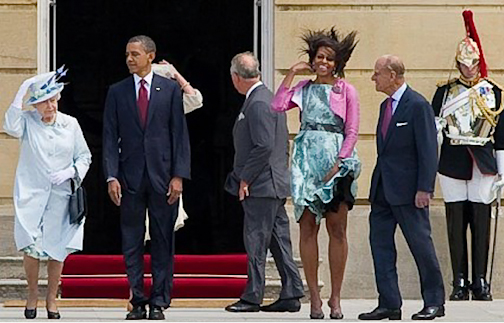
I just love that picture! That woman is a good sport and doesn’t take herself too seriously. I like that. If she were President instead of her husband, I think we’d probably be a lot better off, as you can see below: President Obama talks over “God Save the Queen” and quotes Shakespeare inappropriately. What an embarrassment!
So…. what are you reading and blogging about this morning?
We need a New Brain Trust
Posted: August 13, 2009 Filed under: Global Financial Crisis, president teleprompter jesus, Surreality, Team Obama, The Great Recession, U.S. Economy | Tags: Angela Merkel, Christine Lagarde, Eurozone, French Economy, German economy, Nicolas Sarkozy Comments Off on We need a New Brain TrustWhile the U.S. economy sputters, France and Germany appear to have exited their recessions and returned to modest growth during the spring. There’s been a distinctly different approach to macroeconomic policy taken by Chancellor Angela Merkel and President Nicolas Sarkozy and their respective finance ministers that deserve elucidation.
The French and German economies both grew by 0.3% between April and June, bringing to an end year-long recessions in Europe’s largest economies.
Stronger exports and consumer spending, as well as government stimulus packages, contributed to the growth.
Germany is a manufacturer and exporter. Yes, that’s right. Germany has trade unions, good vacation packages,  excellent schools, universal health care, lots of solar power and tough environmental regulations and they still have a manufacturing economy and they export. Their form of government is basically a type of democratic socialism. All the things we are taught to view with suspicion. Still, Germany manages to manufacture things and export to China the country to whom the U.S. has practically sold their collective soul so we can massively import junk on a rapidly decreasing credit line.
The latest figures showed German exports had grown at their fastest pace for nearly three years at 7%, with particularly strong growth in demand from rapidly-growing economies such as China.
The country’s Federal Statistics Office said that household and government expenditure had also boosted growth.
It added that imports had declined “far more sharply than exports, which had a positive effect on GDP growth”.
“These [GDP] figures should encourage us,” said Germany’s Economy Minister Karl-Theodor zu Guttenberg. “They show that the strongest decline in economic performance likely lies behind us.”
It’s the same story with France. Household consumption and export markets are improving. I don’t know if you’ve ever listened to Finance Minister Christine Lagarde but she’s undoubtedly one of the best in the world. Compare her to our Secretary of Treasury Timothy Geithner and you’ll see who comes up quite short. First, she’s a noted anti trust lawyer as compared to a noted monopoly enabler.
Ms Lagarde said that consumer spending and strong exports had helped to pull France out of recession.
“What we see is that consumption is holding up,” she said.
Official figures showed that household consumption rose by 0.4% in the second quarter.
She said government incentive schemes for trading in old cars, together with falling prices, were helping consumers.
Foreign trade contributed 0.9% to the GDP figure – a “very strong impact”, said Ms Lagarde.
 We are daily fed this propaganda that other countries come up short when compared to the United States and our economic machine. We are told that countries with high union participation, with universal health care, with high standards for the work environment and tough regulations for business and standards for the environment come up short when compared to the U.S. These countries both undertook solid fiscal stimulus. Here is some information on the French package passed in February. The Obama stimulus package passed during February also.
France’s economic stimulus package encompasses a three-pronged plan: €11 billion ($14.5 billion) each to go to direct state investment and to inject capital into private-sector enterprises, plus €4 billion ($5.24 billion) for state-run companies to be applied toward improvements for the national postal service, energy supplies and the rail network. Of that amount, some €1.3 billion ($1.7 billion) is to go into refurbishment of higher educational institutions, prisons, monuments and court.
Here’s some information on the German package also passed in February.
Germany has approved a 50bn euro ($63bn, £44bn) stimulus plan aimed at boosting Europe’s largest economy.
The plan was approved by the upper house of parliament, which represents Germany’s 16 state governments.
It includes infrastructure investments, tax relief, reductions in health care contributions and money for families with children.
The package follows an earlier 23 bn-euro plan that was criticised for being too cautious.

 peej
peej Carissa
 bostonboomer
 dakinikat
 ecocatwoman
 mablue2
 Mama Lopez
 peggysue22
 quixote
 skydancingguestblogger
 Mona (aka Wonk the Vote)



 Sky Dancing
Recent Comments