
Hunter Biden will not appear for a closed-door deposition Wednesday, defying a subpoena from House Republicans who are investigating the Biden family’s finances.
Wednesday Reads
Posted: December 13, 2023 Filed under: Donald Trump, Joe Biden, just because | Tags: abortion, Florida abortion rights petition, Hunter Biden, impeachment inquiry, James Comer, January 6 prosecutions, Jim Jordan, mifepristone, obstruction of justice, Supreme Court 4 CommentsGood Day!!
There is quite a bit of news happening today. The top stories involve the Supreme Court, abortion, Hunter Biden, and the phony “impeachment” of President Biden by a bunch of Republican idiots. Here goes:
The Supreme Court has agreed to hear two troubling cases, one involving access to early abortions, and another that could affect January 6th cases.
The Washington Post: Supreme Court will decide access to key abortion drug mifepristone.
The Supreme Court will decide this term whether to limit access to a key abortion drug, returning the polarizing issue of reproductive rights to the high court for the first time since the conservative majority overturned Roe v. Wade last year.
The Biden administration and the manufacturer of mifepristone have asked the justices to overturn a lower-court ruling that would make it more difficult to obtain the medication, which is part of a two-drug regimen used in more than half of all abortions in the United States. Oral arguments will likely be scheduled for the spring, with a decision by the end of June, further elevating the issue of abortion, which has proven galvanizing for Democrats, during the 2024 campaign season.
The justices will review a decision fromthe conservative U.S. Court of Appeals for the 5th Circuit that said the Food and Drug Administration did not follow proper procedures when it began loosening regulations for obtaining the mifepristone, which was first approved more than 20 years ago. The changes made over the last few years included allowing the drug to be taken later in pregnancy, to be mailed directly to patients and to be prescribed by a medical professional other than a doctor.
Medications to terminate pregnancy, which can be taken at home, have increased in importance over the last 18 months, as more than a dozenstates severely limited or banned abortions following the Supreme Court’s ruling in Dobbs v. Jackson Women’s Health Organization.
Read more at the WaPo link.
NBC News: Supreme Court agrees to hear Jan. 6 case that could affect Trump prosecution.
The Supreme Court on Wednesday agreed to hear an appeal brought by a man charged with offenses relating to the Jan. 6, 2021, assault on the U.S. Capitol in a case that could have a major impact on the criminal prosecution of former President Donald Trump.
The justices will hear a case brought by defendant Joseph Fischer, who is seeking to dismiss a charge accusing him of obstructing an official proceeding, namely the certification by Congress of President Joe Biden’s election victory, which was disrupted by a mob of Trump supporters.
Two other Jan. 6 defendants, Edward Lang and Garret Miller, brought similar appeals, the outcome of which will be dictated by the Supreme Court’s ruling in Fischer’s case.
Fritz Ulrich, a federal public defender representing Fischer, said he was pleased that the court will clarify the scope of the law in question but had no further comment.
Trump has been charged with the same offense as well as others in his federal election interference case. The court’s decision to take up the issue, as well as the timing of its ultimate ruling, could therefore affect his case.
How the case against Trump could be affected:
It will take months for the justices to hear oral arguments and issue a ruling sometime during the court’s current nine-month term, which ends in June.
Trump’s lawyers could use the Supreme Court’s involvement as one opportunity to delay his election interference trial, which is scheduled to start in March.
Trump is the front-runner in the polls for the Republican presidential nomination, and any delay in his criminal trial in Washington would be to his benefit.
If Trump were to win the election in November, he would then be in a position to have the charges dismissed. If the case proceeds as scheduled in March and Trump were to be convicted, he could be sentenced before the election.
Read all the details at NBC News.
One more abortion story:
NBC News: Florida abortion rights activists win over Republicans in ballot measure push.
Jaymie Carter is a registered Republican.
She has been named by two Republican governors — first Rick Scott, then Ron DeSantis — to sit on the Board of Trustees for the State College of Florida, and she says she voted for DeSantis in his 2022 campaign for governor.
But when it comes to the issue of abortion, she’s breaking with her party.
“Women are concerned about what’s happening with our bodies and our right to choose. And there’s a lot of people that you wouldn’t think would be the pro-choice advocates, but they are,” she said. “And the government overreach, it’s huge right now.”
Carter is one of more than 150,000 registered Republican voters who have signed a petition in support of a ballot amendment that would bar the state from restricting abortion “before viability” — which is usually at 24 weeks — or “when necessary to protect the patient’s health.”
That total comes from the Florida Women’s Freedom Coalition, one of several groups working to gather the 891,523 signatures necessary to get the measure on the ballot, working with Floridians Protecting Freedom, the campaign leading the ballot initiative. The group says it has gathered and submitted more than 1.3 million signatures so far. The website of the Florida Division of Elections says it has validated 687,699 signatures as of mid-December.
Florida is one of nine states where groups are pushing to get measures on the ballot that would bar restrictions on abortion rights, following a streak of wins for similar measures in Kansas and Ohio.
And as the Feb. 1 deadline to get the petitions submitted and verified approaches in Florida, some Republican voters are coming out publicly to support and even advocate for it.
Very interesting. I wonder if Ron DeSantis has heard about this yet?
This is the day that House Republicans ordered Hunter Biden to undergo a behind-closed-doors deposition. In a surprise move, Biden held an impressive press conference, in which he reiterated his willingness to answer questions at a public hearing.
Luke Broadwater at The New York Times: Hunter Biden, Defying Deposition Subpoena, Again Offers Public Testimony.
Hunter Biden, the president’s son, appeared on Capitol Hill on Wednesday morning to offer to publicly testify in House Republicans’ impeachment investigation into his father, though he insisted he would not appear for a private deposition they scheduled over his refusals.
The younger Mr. Biden, who has been served a subpoena to testify, spoke to reporters in a hastily called news conference outside the Capitol near the Senate, across the complex from a House office building where Republican lawmakers were waiting to question him behind closed doors.
“I am here,” Mr. Biden said. “Let me state as clearly as I can: My father was not involved in my business.”
“There is no evidence to support the allegations my father was involved in my business because it did not happen,” he added.
The younger Mr. Biden has objected to providing private testimony, saying he fears Republicans will selectively leak his remarks and try to distort what he says. He has repeatedly proposed that he appear at a public hearing instead to answer their questions.
“They have lied over and over,” Mr. Biden said of Republicans.
Republicans have threatened to hold him in contempt of Congress if he does not comply.
Jacqueline Alemany and Matt Viser at The Washington Post: Ahead of House GOP vote on impeachment inquiry, Hunter Biden defies subpoena.
“I’m here to testify at a public hearing today,” Hunter Biden said in a statement outside of the Capitol on Wednesday morning. “Republicans do not want an open process where Americans can see their tactics … or hear what I have to say.” [….]
Hunter Biden
Hunter Biden maintained that he would answer questions only in a public hearing. His legal team has pointed to past comments in which House Oversight Committee Chairman James Comer (R-Ky.) all but dared Hunter Biden to testify — publicly or privately — and the team has said they don’t trust House Republicans not to selectively leak his testimony.
“For six years I’ve been targeted by the unrelenting Trump Machine asking ‘where’s Hunter,’” Hunter Biden said. “Here’s my answer: I am here.”
Comer over the past two weeks has rebuffed Hunter Biden’s offer to publicly testify before the committee, and Republicans on Wednesday vowed to move expeditiously to initiate proceedings to hold him in contempt of Congress for defying their subpoena.
Hunter Biden “does not get to dictate the terms of the subpoena,” Comer told reporters outside of an empty hearing room where Hunter Biden was scheduled to be deposed. Pressed about whether he has found evidence that President Biden had engaged in wrongdoing or criminal conduct, Comer said he had found “some very serious evidence,” before citing two examples of banking records he has repeatedly mischaracterized.

The fake charges against President Biden:
The foundation of the impeachment inquiry, outlined by Judiciary Committee Chairman Jim Jordan (R-Ohio) in a briefing with reporters last week, rests on an unsubstantiated accusation that has become the linchpin of allegations regarding the Biden family’s purported corrupt and criminal conduct.
Republicans allege that Joe Biden as vice president pushed for the firing of Ukraine’s top prosecutor, Viktor Shokin, to quash a probe into the former owner of Burisma, the Ukrainian gas company where Hunter Biden sat on the board. That allegation has been widely refuted by former U.S. officials, as well as Ukrainian anti-corruption activists.
As part of the inquiry, House Republicans also have elevated claims that the Biden administration slowed a Justice Department investigation into Hunter Biden’s financial background, but that testimony has been repeatedly disputed by officials involved in the case.
“There is no fairness or decency in what these Republicans are doing. Their false facts have become the beliefs of too many people,” Hunter Biden said Wednesday.
“They have taken the light of my dad’s love for me and presented it as darkness,” he continued. “They have no shame.
Jonathan Chait at New York Magazine: We Were Told Biden Is Secretly Running the DOJ. Why Is His Son Being Charged?
It has long been an article of faith on the right that Attorney General Merrick Garland is prosecuting Donald Trump because President Biden wants him to. Even the Trump-skeptical corners of the conservative media casually assert, without bothering to supply any evidence for the charge, that Biden is behind the DOJ investigations.
“Biden Justice Department officials and Democratic prosecutors are currently trying to put the other side’s leading contender for the White House in jail … The vapors over Trump saying he’s going to target his enemies,” argues National Review editor-in-chief Rich Lowry, “is rich coming from people who have targeted their enemy by any means necessary for years now.”
“Meantime, a Justice Department special counsel has filed trumped-up charges against Mr. Trump for allegedly defrauding the U.S. … writes Wall Street Journal columnist Allysia Finley, “Abuse executive power. Ignore the law. Run roughshod over individual liberties. Retaliate against political opponents. Mr. Biden and his allies have done exactly what they warn Mr. Trump will do if he returns to the White House.”
You’d think those conservatives might be questioning this assumption, now that Garland’s Justice Department is prosecuting Joe Biden’s son for tax evasion. But no, they’re just pretending it isn’t happening.
There was never any basis for the charge that Garland is working at Biden’s behest. Garland is well-respected by legal types in both parties — that’s why Barack Obama thought he was the only Supreme Court nominee who stood any chance of confirmation by a Republican Senate in 2016 — and received 70 votes for his confirmation.
Unlike Trump, who repeatedly demanded his attorneys general prosecute his enemies and let his criminal buddies go free, and made these demands privately with even more corrupt intent, there is zero public evidence or reporting to suggest Biden has improperly tried to influence Garland’s decisions.
What’s more, the two Justice Department cases against Trump both flow directly from publicly identifiable sources. Trump is being charged in the documents case because the National Archive asked him to return government property, he refused, and then covered up his crimes when the FBI came looking. The January 6 case comes directly out of an investigation by a House committee that turned up damning evidence….
Indeed, the president is angry with his attorney general. “Biden’s relationship with Garland — which was already tense — has become more frigid amid Biden’s frustration at the lengthy criminal investigation and now prosecution of Hunter by the Justice Department,” reports Alex Thompson, “People close to Biden also have fumed at Garland for appointing a special counsel in August.” Thompson also reports, “One person close to the president unflatteringly compared Garland to the former FBI director James Comey, claiming they both have been obsessed with the appearance of having integrity rather than just trying to make the right decision.”
Read the rest at the link.
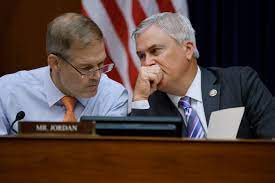
The accusers: Jim Jordan and James Comer
The New York Times: House Set to Approve Biden Impeachment Inquiry as It Hunts for an Offense.
The Republican-led House is on track to approve a formal impeachment inquiry into President Biden on Wednesday, pushing forward with a yearlong G.O.P. investigation that has failed to produce evidence of anything approaching high crimes or misdemeanors.
Republicans say the vote, which is expected in the evening, is needed to give them full authority to carry out their investigations amid anticipated legal challenges from the White House. Democrats have denounced the inquiry as a fishing expedition and a political stunt.
G.O.P. leaders refrained for months from calling a vote to open an impeachment inquiry, given the reservations of mainstream Republicans, many of them from politically competitive districts, about moving forward without proof that Mr. Biden did anything wrong. But the political ground has shifted considerably, and most of them are now willing to do so, emphasizing that they are not yet ready to charge the president.
“Voting in favor of an impeachment inquiry does not equal impeachment,” Representative Tom Emmer of Minnesota, the No. 3 House Republican, said at a news conference on Tuesday. “We will continue to follow the facts wherever they lead, and if they uncover evidence of treason, bribery or other high crimes and misdemeanors, then and only then will the next steps towards impeachment proceedings be considered.”
Read more at the NYT. I guess we’ll learn later today if the Republicans have the votes for their impeachment inquiry without a shred of evidence to support it.
More stories worth checking out today:
AP: Biden takes a tougher stance on Israel’s ‘indiscriminate bombing’ of Gaza.
The New York Times: Top Court Clears Path for Democrats to Redraw House Map in New York.
Reuters: US agency will not reinstate $900 mln subsidy for SpaceX Starlink unit.
The New York Times: In a First, Nations at Climate Summit Agree to Move Away From Fossil Fuels.
Shan Wu at The Daily Beast: Trump, Elon Musk, and Billionaire ‘Populists’ Threaten Democracy and Freedom.
Lazy Caturday Reads: The Supreme Court’s War on Women
Posted: April 22, 2023 Filed under: abortion rights, cat art, caturday, SCOTUS | Tags: abortion pill, Birth Control, Clarence Thomas, Joyce Vance, Judge Matthew Kacsmaryk, mifepristone, Samuel Alito, stalking, Supreme Court 16 Comments
By Hilda Belcher, 1881-1963
Happy Caturday!!
Last night the Supreme Court released their decision in the mifepristone case. They stayed–for now–Texas Judge Matthew Kacsmaryk’s order to ban the abortion pill nationwide. The New York Times reports: Supreme Court Ensures, for Now, Broad Access to Abortion Pill.
The order halted steps that had sought to curb the availability of mifepristone as an appeal moves forward: a ruling from a federal judge in Texas to suspend the drug from the market entirely and another from an appeals court to impose significant barriers on the pill, including blocking access by mail.
The unsigned, one-paragraph order, which came hours before restrictions were set to take effect, marked the second time in a year that the Supreme Court had considered a major effort to sharply curtail access to abortion.
The case could ultimately have profound implications, even for states where abortion is legal, as well as for the F.D.A.’s regulatory authority over other drugs.
If the ruling by the judge in Texas, which revoked the F.D.A.’s approval of the pill after more than two decades, were to stand, it could pave the way for all sorts of challenges to the agency’s approval of other medications and enable medical providers anywhere to contest government policy that might affect a patient.
Judges Alito and Thomas dissented. Only Altio wrote a dissenting opinion. From The Washington Post: Supreme Court preserves access to key abortion drug as appeal proceeds.
In the only noted dissents, Justices Clarence Thomas and Samuel A. Alito Jr. said they would not have granted the Biden administration’s request for a stay of the decision by a panel of the U.S. Court of Appeals for the 5th Circuit.
Thomas did not explain his reasoning. Alito said the administration and the public would not have been harmed by agreeing with the lower court, which wanted to reimpose restrictions loosened by the FDA in recent years.
“It would simply restore the circumstances that existed (and that the Government defended) from 2000 to 2016 under three Presidential administrations,” Alito wrote. He disputed that the court’s intervention at this time would have sent a signal: “Contrary to the impression that may be held by many, that disposition would not express any view on the merits of the question whether the FDA acted lawfully in any of its actions regarding mifepristone.”

By Alice Kent Stoddard
There could have been other dissents; we only know that at least 5 justices voted for the stay. On what happens next:
The 5th Circuit next month will review the merits of the case brought by antiabortion groups against the FDA’s regulation of mifepristone — a review that will be conducted by a separate, and likely different, three-judge panel than the one that made the initial ruling. That merits decision will almost surely be appealed to the Supreme Court no matter the outcome. But until then, the justices’ Friday order says the status quo will remain in place: Mifepristone will be available under existing FDA regulations nationwide.
Joyce Vance wrote a lengthy and detailed discussion of the issues in this case; it’s well worth reading the entire piece at Vance’s Substack page, Civil Discourse: Not Quite Midnight at the Supreme Court. Here is a brief excerpt.
I figured that I’d set my alarm for midnight to see how the Court would rule on the government’s request to stay the Fifth Circuit’s order. That order, you’ll recall, did not side with Texas federal judge Matthew Kacsmaryk’s decision to overrule the FDA’s approval of Mifepristone, a drug proven safe and effective for abortions and miscarriage treatment for over 20 years. But it would have permitted the remainder of the restrictions on Mifepristone that Kacsmaryk ordered to remain in place while the litigation proceeded. That includes requiring the drug be obtained in person and not through the mail, necessitating multiple doctor’s office visits and in-office consumption of the medication, and restricting use to prior to the seventh week of pregnancy—while the litigation proceeded.
When the Supreme Court ruled, they stayed all of it. They preserved the status quo, so Mifepristone will remain available up to 10 weeks, and can be obtained via the mail and used at home while the courts are reviewing the case. But that’s a temporary reprieve.
The stay will last while the case is on appeal to the Fifth Circuit. Presumably the party that loses in that court will appeal to the Supreme Court. They are not required to hear an appeal in a civil case like this. If the Court were to refuse to hear it (“certiorari denied”), then the stay would end and the Fifth Circuit’s order would go into effect. If the Supreme Court agrees to hear the appeal (“cert granted”), the stay will continue until the Court enters final judgment. Because the case involves important issues, it’s very likely the Court will take the case.

Best Friends, by Maxime Dastugue
Vance spends a several paragraphs discussion Altio’s dissent. Not surprisingly, she is quite critical of Alito’s reasoning. Here’s part of it:
Alito rehashed the debate over the use of what has become known as the Court’s “shadow docket”—a docket used for resolving emergency requests. Interestingly, he seemed to take Justice Barrett to task, associating her views with those of progressive justices like Elena Kagan who have objected to the Court’s use of the docket to make decisions without explaining its reasoning (this makes it understandably difficult for lower courts to understand and apply the Court’s logic). Alito notes that Barrett in a 2021 concurrence with a denial of injunctive relief wrote that the Court should not act “on a short fuse without benefit of full briefing and oral argument” in a case that is “first to address the questions presented.” He says that while he agreed with those rulings, if the justices believed that then, they should believe it now. He does not, however, explain why, if he did not believe it back then, it’s okay for him to believe it now. Apparently what’s good for the goose is unnecessary for the gander.
Injunctions present complicated questions, and courts typically, but not always, try to preserve the status quo and protect parties from being harmed or prejudiced while litigation is pending. For instance, in Whole Woman’s Health v. Jackson, one of the cases Justice Alito offered up, Justice Kagan was objecting to the Court’s refusal to keep Texas’s heartbeat law from going into effect while litigation was underway. And that is what the Court ended up doing in this case—preventing any change in the approval status or regulations surrounding Mifepristone’s use while the case is pending. So Justice Alito’s arguments have a tinge of sour grapes, not legal principle.
There’s much more criticism of Alito at the link. Next, Vance addresses the latest news about Judge Kacsmaryk’s bias and dishonesty.
Meanwhile, additional evidence of Judge Kacsmaryk’s anti-abortion bias (there was already plenty) and an improper effort to conceal it has surfaced. In anticipation of his judicial confirmation process in 2019, he requested that his name be removed, pre-publication, from a law journal article he had authored, replacing it with some colleagues from the religious conservative legal group he was working for. The article was critical of legal protections for abortion and transgender people. All federal judicial nominees have to complete a document called a Senate Judicial Questionnaire. The completed application packet is submitted under oath before a nomination can advance. Among other things, it requires nominees to list everything they have published. Kacsmaryk failed to disclose the article and also failed to disclose interviews he gave on Christian talk radio that included his views on abortion and other issues, information the questionnaire calls for.
Again, read more at the Substack link.
Kacsmaryk also has a serious financial conflict of interest. CNN reports: Details about multimillion-dollar stock holding concealed in abortion pill judge’s financial disclosures.
The federal judge who issued a nationwide ruling blocking the approval of a common abortion medication redacted key information on his legally mandated financial disclosures, in what legal experts described as an unusual move that conceals the bulk of his personal fortune.
Woman with Cat, by Theodorus Gerardus Iherminez
In his 2020 and 2021 annual disclosures, Judge Matthew Kacsmaryk wrote that he held between $5 million and $25 million in “common stock” of a company – a significant majority of the judge’s personal wealth. The name of the company he held stock in is redacted, despite the fact that federal law only allows redactions of information that could “endanger” a judge or their family member.
CNN obtained a previous financial disclosure for Kacsmaryk – which is not available online – from 2017, when he was a judicial nominee.
On that unredacted form, Kacsmaryk reported owning about $2.9 million in stock in the Florida-based supermarket company Publix. It’s not clear whether that’s the same holding as the redacted stock, although Publix’s share price had significantly increased by 2020 and 2021 and the company is no longer listed on his more recent disclosures.
Redactions are approved by a judicial committee. The redacted holding accounted for at least 85% of Kacsmaryk’s total reported wealth in 2021, and potentially more.
“The whole point of a disclosure is to explain where you have conflicts,” said Michael Lissner, the executive director of the Free Law Project, a nonprofit that has published judicial disclosures. “If you have stock and you’re not saying what it’s in and it’s this much of your personal wealth, that’s a conflict you have. The public deserves to know.” [….]
The redaction is the latest example of Kacsmaryk not being fully transparent as a judge and judicial nominee, even as he has become one of the most controversial judges in the country.

That’s in addition to his not be fully forthcoming in his Senate confirmation hearing, as Joyce Vance described above.
Two more articles on the Supreme Court from Slate:
Christina Cauterucci at Slate: Birth Control Is Next. If you look closely, attempts to restrict contraception are already in the works.
At first glance, what’s happening right now in Iowa looks like a rosy vision for the future of reproductive rights.
The Republican-controlled state Senate recently passed a bill that would increase access to certain types of contraception by allowing pharmacists to dispense it to patients without a prescription. Their GOP counterparts in the state House have included a similar provision in a larger health care bill. And Republican Gov. Kim Reynolds has indicated that the legislation is one of her top priorities this session.
Girl on Divan with Cat (Eta with the Cat) – Róbert Berény 1919 Hungarian 1887-1953
But look elsewhere in Iowa, and you’ll get a different view. Earlier this month, the state attorney general’s office announced that it would suspend payments for emergency contraception for survivors of sexual assault. The medication had been funded through a program for crime victims, but the Republican attorney general is considering a permanent end to its provision. She is “carefully evaluating whether this is an appropriate use of public funds,” a spokesperson said in a statement.
In other words, counter to a refrain that has taken hold on the left since the overturning of Roe v. Wade, conservatives are not coming for birth control next. They’re coming for birth control now.
Some corners of the right are already in full-blown attack mode. Pulse Life Advocates, one of the Iowa-based anti-abortion groups that is advocating against the over-the-counter contraception bill, states on its website that “contraception kills babies.”
It’s relatively uncommon for an anti-abortion group to state its animus toward birth control so plainly. For years, the major players on the anti-abortion right have claimed to support contraception. They seem to understand that more than 90 percent of Americans are in favor of legal birth control and that most people opposed to abortion likely see contraception as an effective means of reducing demand for it….

Cauterucci writes that it would be foolish to believe Republicans’ reassurances about keeping birth control legal.
Conservatives have tried hard to maintain a veneer of rationality on the issue of contraception. But almost a year into the emboldened post-Dobbs anti-abortion movement, the cracks in that facade are starting to show.
Currently, the right to contraception in the U.S. rests on Griswold v. Connecticut, a landmark 1965 Supreme Court decision that is based, as Roe was, on the right to privacy. In a concurring opinion in Dobbs, Clarence Thomas wrotethat the court “should reconsider” several precedents that concern the right to privacy—including the legality of gay intimacy, the right to gay marriage, and Griswold. And a growing number of Republicans are willing to state that Griswold was wrongly decided, including Republican Sen. Marsha Blackburn and former Arizona Senate candidate Blake Masters.
But the Supreme Court won’t even have to overturn Griswold for conservatives to curtail access to birth control. Across the country, they are executing a game plan that rests on three strategies: Conflate contraception with abortion, claim that birth control is dangerous to women’s health, and let right-wing judges do their thing.
Read more details at Slate.

By Mimi Matthews
This article really shocked me. Mary Anne Franks at Slate: Chief Justice John Roberts’ Mockery of Stalking Victims Points to a Deeper Problem.
Stalking is so closely correlated with lethal violence that experts refer to it as “slow motion homicide”: More than half of all female homicide victims in the U.S. were stalked before they were killed. Despite the terrifying and dangerous consequences, many victims of stalking do not report the abuse to law enforcement for fear they will not be taken seriously.
The reasonableness of that fear was vividly illustrated by the Supreme Court oral arguments in Counterman v. Colorado on Wednesday morning, as members of the highest court of the land joked about messages sent by a stalker to his victim, bemoaned the increasing “hypersensitivity” of society, and brushed aside consideration of the actual harm of stalking to focus on the potential harm of stalking laws.
For nearly two years, Billy Raymond Counterman sent thousands of unsolicited and unwanted Facebook direct messages to C.W., a local musician, ultimately driving her to abandon her career and leave the state. Counterman, who had previously served time in federal prison for making violent threats against his ex-wife and her family, argues that his conduct towards C.W. was free speech protected by the First Amendment. Counterman maintains, supported by amicus briefs from influential civil libertarian organizations such as the ACLU, the EFF, and FIRE, that stalking cannot be criminally prohibited except when the government can prove that the stalker subjectively intended to terrify his victim. The state of Colorado, supported by amicus briefs from First Amendment scholars, stalking experts, and domestic violence victim advocates, argues that it is enough to prove that the stalking would be terrifying to a reasonable person in light of the totality of the circumstances. If the court rules in Counterman’s favor, delusional stalking—no matter how objectively terrifying or threatening—will be transformed into an inviolable constitutional right.
And the ACLU is on the side of the stalkers! The justices got a kick out of the threatening messages sent by the stalker.
During oral argument, Chief Justice John Roberts quoted a handful of the thousands of unsolicited messages Counterman sent to C.W. “Staying in cyber life is going to kill you,’” Roberts read aloud. After a pause, he joked, “I can’t promise I haven’t said that,” prompting laughter from other justices and the audience. Picking out another message, which he described as an “image of liquor bottles” captioned as “a guy’s version of edible arrangements,” Roberts challenged Colorado Attorney General Phil Weiser to “say this in a threatening way,” leading to more laughter from the court. And the laughs didn’t stop there: Counterman’s attorney, John Elwood, shared with the court that his mother would routinely tell him to “drop dead” as a child, but “you know, I was never in fear because of that.”
By Suzy Scarborough
There were more chuckles when Justice Neil Gorsuch returned to Elwood’s anecdote during his questioning of Weiser, but Gorsuch shifted to a more serious tone to express his concern about the reasonable person standard. “We live in a world in which people are sensitive, and maybe increasingly sensitive,” he began. “As a professor, you might have issued a trigger warning from time to time when you had to discuss a bit of history that’s difficult or a case that’s difficult,” Gorsuch continued, a reference to Weiser’s prior experience teaching on a law school faculty. “What do we do in a world in which reasonable people may deem things harmful, hurtful, threatening? And we’re going to hold people liable willy-nilly for that?”
Justice Clarence Thomas echoed the concern, asking whether the reasonable person standard is appropriate given that people are “more hypersensitive about different things now.” [….]
The justices’ message was clear: Stalking is not the problem; sensitivity is. To them, stalking is quite literally a state of mind: If the stalker didn’t mean for his conduct to be frightening, then it isn’t. All the target has to do is understand that; she just needs to lighten up, take a joke, accept the compliment, grasp the lesson. Just because someone has made objectively terrifying statements is no reason to overreact and get law enforcement involved; victims should wait for the stalker to do something really frightening before they jump to conclusions.

That is just plain terrifying! Women’s lives are already in danger in this country; The Supreme Court is making this state of affairs even worse.
More stories to check out, links only:
Heather Cox Richardson on the history of Earth Day, which is today, at Letters from an American.
The New York Times: Airman Shared Sensitive Intelligence More Widely and for Longer Than Previously Known.
The Washington Post: FBI leak investigators home in on members of private Discord server.
The Guardian: A California journalist documents the far-right takeover of her town: ‘We’re a test case.’
Anthony L. Fisher at The Daily Beast: America’s Tragedy Is Its Culture of Fear—Armed With Millions of Guns.
Michelle Goldberg at The New York Times: The Sickening Déjà Vu of Watching Trump Manhandle DeSantis.
The Washington Post: Twitter removes labels from state-controlled media, helping propaganda.
The Washington Post: SpaceX didn’t want to blow up its launchpad. It may have done just that.
Have a great weekend, Sky Dancers!!
Thursday Reads: The Wheels of Justice
Posted: April 13, 2023 Filed under: abortion rights, Blind Justice, Criminal Justice System, Donald Trump | Tags: Aric Toler, Jack Smith, Jack Teixeira, Letitia James, Michael Cohen, mifepristone, Peter Navarro, Special Counsel, Thug Shaker Central 25 Comments
Lady Justice, by Laura Pierre Louis
Good Day, Sky Dancers!!
“The wheels of justice turn slowly, but grind exceedingly fine.” No one knows the source for this quote–one candidates is Sun Tzu and another is Sextus Empricus. But it looks like that is what is happening now in the many legal investigations of Donald Trump. Frankly, I’ve let go of frustration over how slowly the wheels are turning, because I believe there is progress being made. I’m not convinced Trump will ever go to prison, but I think he will finally pay a price for his crimes against our country. Here’s the latest:
The New York Times: Trump to Face Questioning Thursday in N.Y. Attorney General’s Lawsuit.
Donald J. Trump is set to be questioned under oath on Thursday in a civil fraud lawsuit brought by New York Attorney General Letitia James, the latest in a series of legal predicaments entangling the former president, who also faces a separate 34-count criminal indictment unsealed last week.
Ms. James’s civil case, which was filed in September and is expected to go to trial later this year, accuses Mr. Trump, his family business and three of his children of a “staggering” fraud for overvaluing the former president’s assets by billions of dollars. The lawsuit seeks $250 million that it contends they reaped through those deceptions, made in Mr. Trump’s annual financial statements — and asks a judge to essentially run him out of business in the state if he is found liable at trial.
Ms. James’s office plans to question Mr. Trump as part of the discovery phase of the case, in preparation for the trial.
The former president, who spent the night at his Manhattan residence in Trump Tower, arrived at the attorney general’s office shortly before 10 a.m. As a crowd chanted “New York hates you,” Mr. Trump’s motorcade drove into the parking garage underneath the office building at 28 Liberty Street….
This is the second time that lawyers for Ms. James, a Democrat, are questioning Mr. Trump under oath: He also sat for a deposition in the summer of 2022, shortly before the attorney general filed her lawsuit. During that deposition, Mr. Trump lashed out at Ms. James, accusing her of being motivated by politics and then invoking his Fifth Amendment right against self-incrimination hundreds of times over the course of four hours.
Depositions are held in private, so the specifics of his testimony will not be immediately known. But as of Wednesday evening, Mr. Trump was not expected to assert his Fifth Amendment right, people familiar with his thinking said.
Because he was in the White House or on the campaign trail for several years — and no longer running his company — Mr. Trump might try to avoid providing direct answers to Ms. James’s questions, instead giving insubstantial responses. He might say, for example, that he does not recall a particular incident or was not present for it. He could also claim that he delegated the valuation of his assets to employees.
Trump vented his anger and frustration in ugly, deranged posts on his Twitter clone, Truth Social. Examples:
This man belongs in a rubber room!
Special Counsel Jack Smith is moving rapidly in his January 6 and stolen documents investigations. The Washington Post reports that Smith is looking into Trump’s fundraising using lies about election fraud: Special counsel focuses on Trump fundraising off false election claims.
Federal prosecutors probing the Jan. 6, 2021, attack on the U.S. Capitol have in recent weeks sought a wide range of documents related to fundraising after the 2020 election, looking to determine if former president Donald Trump or his advisers scammed donors by using false claims about voter fraud to raise money, eight people familiar with the new inquiries said.
Franco/Flemish School; Justice; The Ashmolean Museum of Art and Archaeology; unknown British artist
Special counsel Jack Smith’s office has sentsubpoenas in recent weeks to Trump advisers and former campaign aides, Republican operatives and other consultants involved in the 2020 presidential campaign, the people said. They have also heard testimony from some of these figures in front of a Washington grand jury, some of the people said.
The eight people with knowledge of the investigation spoke on the condition of anonymity to discuss an ongoing criminal investigation.
The fundraising prong of the investigation is focused on money raised during the period between Nov. 3, 2020, and the end of Trump’s time in office on Jan. 20, 2o21, and prosecutors are said to be interested in whether anyone associated with the fundraising operation violated wire fraud laws, which make it illegal to make false representations over email to swindle people out of money.
The new subpoenas received since the beginning of March, which have not been previously reported, show the breadth of Smith’s investigation, as Trump embarks on a campaign for reelection while assailing the special counsel investigation and facing charges of falsifying business records in New York and a separate criminal investigation in Georgia.
The subpoenas seek more specific types of communications so that prosecutors can compare what Trump allies and advisers were telling one another privately about the voter-fraud claims with what they were saying publicly in appeals that generated more than $200 million in donations from conservatives, according to people with knowledge of the investigation.

Read more at the WaPo.
Trump is hilariously suing Michael Cohen for $500 million for violating a nondisclosure agreement. Raw Story:
Former President Donald Trump is launching a $500 million lawsuit against his former attorney and fixer Michael Cohen, alleging that he violated attorney-client privilege when he issued a tell-all book about the hush payment he helped Trump faciliate to adult film star Stormy Daniels.
But that claim doesn’t make any sense for Trump, said former Manhattan prosecutor Karen Friedman Agnifilo on CNN’s “OutFront” on Wednesday — because it implicitly requires Trump to admit that everything Cohen said, which he is now denying by pleading not guilty to criminal charges against him in New York, is actually true.
“When you look at this, Trump is alleging that Michael Cohen broke attorney-client privilege, he’s talking about all these falsehoods that he put out there,” said anchor Erica Hill. “Is there a legal merit here? I mean, does he have a case?
“It’s an interesting case here because, on the one hand, he’s saying everything is false, right?” said Agnifilo. “So if he was breaching attorney-client privilege, you’re doing that by telling things that were said to you in confidence. But so, is he saying things that Michael Cohen is saying are true because I told him in confidence, and now he’s breached that privilege? Or is he saying that the things are false? Because if they’re false, why didn’t he bring a defamation claim? So it kind of makes no sense.
“It really reads to me like he’s just trying to put his defense in the criminal case out and try and get his statements out there in the court of public opinion.”
She added: “I also think it’s worth noting that there is a little bit of witness intimidation going on here as well. And he’s just using the court system like he seems to want to do, by going after his foes and adversaries.”
Politico: Appeals court rejects Peter Navarro’s bid to retain hundreds of presidential records.
A federal appeals court panel on Wednesday rejected a bid by former Trump White House adviser Peter Navarro to retain hundreds of government records despite a judge’s order to return them promptly to the National Archives.
“There is no public interest in Navarro’s retention of the records, and Congress has recognized that the public has an interest in the Nation’s possession and retention of Presidential records,” the three-judge panel of the D.C. Circuit Court of Appeals concluded in a unanimous two-page order.
The Justice Department sued Navarro last year, seeking to reclaim hundreds of records — contained in Navarro’s personal ProtonMail account — that the government said should have been returned to the National Archives after the Trump administration came to an end in January 2021.
Justica Justice, by Fabiano Millani
Navarro acknowledged that at least 200 to 250 records in his possession belong to the government, but he contended that no mechanism exists to enforce that requirement — and that doing so might violate his Fifth Amendment rights against self-incrimination. Last month, U.S. District Court Judge Colleen Kollar-Kotelly rejected that claim, ordering Navarro to promptly return the records he had identified as belonging to the government.
But Navarro appealed the decision, rejecting the notion that the Justice Department had any legitimate mechanism to force him to return the records. And he urged the court to stay Kollar-Kotelly’s ruling while his appeal was pending. But the appeals court panel — which included Judges Patricia Millett and Robert Wilkins, both appointees of President Barack Obama, and Judge Neomi Rao, an appointee of President Donald Trump — rejected Navarro’s stay request.
Within minutes, Kollar-Kotelly put the squeeze on Navarro, ordering him to turn over the 200 to 250 records “on or before” Friday. She also ordered him to perform additional searches or presidential records that might be in his possession by May 8, with further proceedings scheduled for later in the month.

I’m not sure if these records are related to the January 6 investigation, but Navarro has claimed that giving them up will violate his Fifth Amendment rights.
The flurry of filings is the latest twist in a saga that began when the National Archives discovered that Navarro had relied on a ProtonMail account to do official government business — the result of a congressional investigation into the Trump administration’s handling of the coronavirus crisis.
Navarro is also trying to fend off criminal charges for defying a different congressional investigation — the probe by the Jan. 6 select committee — into his role in strategizing to help Trump overturn the results of the 2020 election. He faces charges for contempt of Congress for defying a subpoena issued by the select committee, a case that has been repeatedly delayed amid battles over executive privilege and immunity for presidential advisers.
In its brief order rejecting Navarro’s stay, the appeals court panel concluded that returning the documents would not violate Navarro’s protection against self-incrimination.
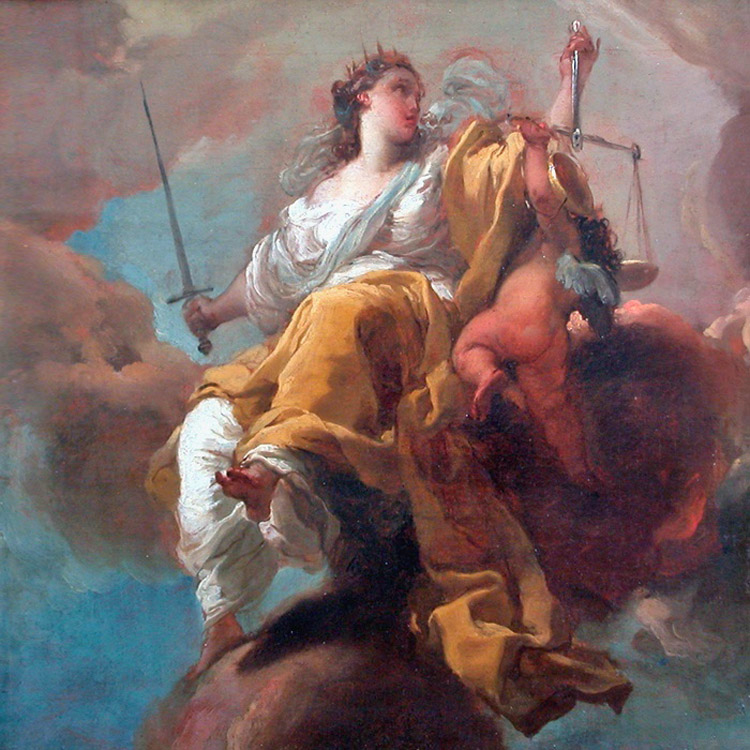
Allegory of Justic, by Gaetano Gandolfi
The wheels of justice are grinding slowly in the Trump investigations, but it looks like they are moving more quickly than the fight for women’s rights their own bodily autonomy. This decision makes no sense to me.
AP: Court preserves access to abortion pill but tightens rules.
AUSTIN, Texas (AP) — A federal appeals court ruled that the abortion pill mifepristone can still be used for now but reduced the period of pregnancy when the drug can be taken and said it could not be dispensed by mail.
The decision late Wednesday temporarily narrowed a ruling by a lower court judge in Texas that had completely blocked the Food and Drug Administration’s approval of the nation’s most commonly used method of abortion. Still, preventing the pill from being sent by mail amounts to another significant curtailing of abortion access — less than a year after the reversal of Roe v. Wade resulted in more than a dozen states effectively banning abortion outright.
The case is likely to go to the U.S. Supreme Court.
“We are going to continue to fight in the courts, we believe the law is on our side, and we will prevail,” White House Press Secretary Karine Jean-Pierre said Thursday, speaking to reporters from Dublin during a visit by President Joe Biden.
Opponents that brought the Texas lawsuit against the drug last year cast the decision by the 5th U.S. Circuit Court of Appeals as a victory.
Abortion rights groups expressed relief that the FDA approval would remain in place for now but criticized the court for reinstating restrictions on the drug. Whole Woman’s Health, an abortion provider that operates six clinics in five states, said in a tweet they were continuing to offer mifepristone in clinics and through virtual services while reviewing the decision that came down shortly before midnight Wednesday.
For goddess sake! Just leave women alone to decide on their medical care in consultation with their doctors!! It’s time to ban Viagra, which is far more dangerous than Mifepristone.
In other news, the case of the leaked classified documents is moving rapidly. The New York Times has now named the leaker: Leader of Online Group Where Secret Documents Leaked Is Air National Guardsman.
The leader of a small online gaming chat group where a trove of classified U.S. intelligence documents leaked over the last few months is a 21-year-old member of the intelligence wing of the Massachusetts Air National Guard, according to interviews and documents reviewed by The New York Times.
The national guardsman, whose name is Jack Teixeira, oversaw a private online group named Thug Shaker Central, where about 20 to 30 people, mostly young men and teenagers, came together over a shared love of guns, racist online memes and video games.
Two U.S. officials confirmed that investigators want to talk to Airman Teixeira about the leak of the government documents to the private online group. One official said Airman Teixeira might have information relevant to the investigation.
Federal investigators have been searching for days for the person who leaked the top secret documents online but have not identified Airman Teixeira or anyone else as a suspect. The F.B.I. declined to comment.
Starting months ago, one of the users uploaded hundreds of pages of intelligence briefings into the small chat group, lecturing its members, who had bonded during the isolation of the pandemic, on the importance of staying abreast of world events.
The New York Times spoke with four members of the Thug Shaker Central chat group, one of whom said he has known the person who leaked for at least three years, had met him in person, and referred to him as the O.G. The friends described him as older than most of the group members, who were in their teens, and the undisputed leader. One of the friends said the O.G. had access to intelligence documents through his job.
While the gaming friends would not identify the group’s leader by name, a trail of digital evidence compiled by The Times leads to Airman Teixeira.
The Times has been able to link Airman Teixeira to other members of the Thug Shaker Central group through his online gaming profile and other records. Details of the interior of Airman Teixeira’s childhood home — posted on social media in family photographs — also match details on the margins of some of the photographs of the leaked secret documents.
The Times also has established, through social media posts and military records, that Airman Teixeira is enlisted in the 102nd Intelligence Wing of the Massachusetts Air National Guard. Posts on the unit’s official Facebook page congratulated Airman Teixeira and colleagues for being promoted to Airman First Class in July 2022.
This is kind of funny, because The Washington Post claimed an exclusive in a story this morning that did not name the leaker: Leaker of U.S. secret documents worked on military base, friend says. But it really wasn’t an exclusive, because Aric Tolder reported the story at bellingcat first.
Now, he has the byline in the NYT story. Hahaha. Hooray for the underdog. He also plans to stay at bellingcat for now.
I imagine there will be more news breaking on this story today. I’ll be watching. Have a great Thursday everyone!!
Tuesday Reads: The GOP War on Abortion Rights
Posted: April 11, 2023 Filed under: abortion rights, just because, SCOTUS | Tags: abortion, Dobbs decision, DOJ, Janet Protasiewicz, Kansas, Matthew Kacsmaryk, mifepristone, Roe v. Wade, Wisconsin 10 CommentsGood Afternoon!!
 I’m going to focus on the abortion battle today. I think it is completely inappropriate for abortion to even be a public issue in the first place, but of course regulating women’s bodies and lives has been a goal for powerful men since ancient times.
I was around before abortion became legal in this country–in fact I was around before birth control was legal for unmarried women. For me it feels like what is happening now is an incredible betrayal. Although women have never been treated in our culture as fully equal with men, the Roe v. Wade decision made it possible for women to make great strides in education and work. Now, nearly fifty years later, the progress toward equality has been halted. Women of child-bearing age are being treated like broodmares once again.
The good news is that the majority of U.S. voters are not on the same page with right wing Republicans and the justices they have managed to put on the federal judiciary and the Supreme Court. We saw this in Kansas when voters rejected a referendum to make abortion illegal in the state. We saw in the mid-term elections when voters clearly saw abortion as one of the top issues. We saw it during the latest midterm elections, when abortion was shown to be a significant issue for voters. We saw it recently in Wisconsin, where voters election Janet Protasiewicz, a pro-choice Democrat, to the State Supreme Court, giving liberals a majority.
Steven Shepard at Politico: Abortion was a 50/50 issue. Now, it’s Republican quicksand.
Conservatives are finding out the hard way that abortion isn’t a 50-50 issue anymore.
Janet Protasiewicz’s 11-point blowout victory this week for a state Supreme Court seat in Wisconsin was just the latest example of voters who support abortion rights outnumbering — and outvoting — their opponents. There was little polling in Tuesday’s race, but in a 2022 midterm exit poll of the state, a combined 63 percent of Wisconsin voters said abortion should be legal in all or most cases, while only 34 percent thought it should be illegal in all or most cases.
Moreover, for the 31 percent of 2022 voters who said abortion was their most important issue — second only to inflation at 34 percent — they overwhelmingly backed Democratic Gov. Tony Evers (83 percent) and Democratic Senate candidate Mandela Barnes (81 percent), who lost narrowly to GOP Sen. Ron Johnson.
Going back to the 1990s, Gallup polling showed Americans divided roughly evenly between those who called themselves “pro-life” and “pro-choice.” Exit polls from the 1990s and 2000s showed voters who said abortion or “moral values” were most important to their vote supported Republican candidates in greater numbers.
But those surveys were conducted when a right to an abortion was law of the land. The Supreme Court’s Dobbs decision last year ending that constitutional right has exposed Americans’ broad opposition to the strict abortion bans adopted or proposed in GOP-controlled states. And it’s revealed that public surveys on the matter probably need more nuanced questions now.
There’s a long history of abortion polling. In the 2000 presidential election, the Los Angeles Times national exit poll found more George W. Bush voters rated abortion as one of their two most important issues than Al Gore voters, and voters were divided 50-50 on whether abortion should remain legal or be made illegal (though with exceptions).
That poll offered three options when measuring voter sentiment on abortion: keep it legal, make it illegal with exceptions or make it illegal with no exceptions.
Now, a four-point question probably best measures where Americans sit on the issue: legal in all cases, legal in most, illegal in all and illegal in most. The 2022 national exit poll used this device, finding that 29 percent of voters believed abortion should be “legal in all cases,” while another 30 percent thought it should be “legal in most cases.” That left 26 percent who thought it should be “illegal in most cases” and only 10 percent who said it should be “illegal in all cases.”
That leaves roughly six-in-10 voters supporting legal abortion in most cases — with the median voter supporting some restrictions — and just over a third who want it to be entirely or mostly illegal.

NY Magazine cover, by Barbara Kruger
The recent decision by reactionary Trump judge Matthew Kacsmaryk in Texas is getting very bad reviews. Kacsmaryk claimed to have the power to tell scientists at the FDA that mifepristone, an abortion pill that has been approved and shown to be safe for more than 20 years, should be banned nationwide. Some recent reactions:
Ruth Marcus at The Washington Post: The worst federal judge in America now has a name.
Congratulations are in order for Judge Matthew Kacsmaryk. The competition is fierce and will remain so, but for now he holds the title: worst federal judge in America.
Not simply for the poor quality of his judicial reasoning, although more, much more, on this in a bit. What really distinguishes Kacsmaryk is the loaded content of his rhetoric — not the language of a sober-minded, impartial jurist but of a zealot, committed more to promoting a cause than applying the law.
Kacsmaryk is the Texas-based judge handpicked by antiabortion advocates — he is the sole jurist who sits in the Amarillo division of the Northern District of Texas — to hear their challenge to the legality of abortion medication.
And so he did, ruling exactly as expected. In an opinion released Friday, Kacsmaryk invalidated the Food and Drug Administration’s 23-year-old approval of the abortion drug mifepristone and, for good measure, found that abortion medications cannot be sent by mail or other delivery service under the terms of an 1873 anti-vice law.
Even in states where abortion remains legal. Even though study after study has shown the drug to be safe and effective — far safer, for instance, than over-the-counter Tylenol. Even though — or perhaps precisely because — more than half of abortions in the United States today are performed with abortion medication.
My fury here is not because I fear that Kacsmaryk’s ruling will stand. I don’t think it will, not even with this Supreme Court. Indeed, another federal district judge — just hours after Kacsmaryk’s Good Friday ruling — issued a competing order, instructing the FDA to maintain the existing rules making mifepristone available. Even Kacsmaryk put his ruling on hold for a week; the Justice Department has already filed a notice of appeal; and the dispute is hurtling its way to the Supreme Court. (Nice work getting yourselves out of the business of deciding abortion cases, your honors.)
No, my beef is with ideologues in robes. That Kacsmaryk fits the description is no surprise. Before being nominated to the federal bench by President Donald Trump in 2017, Kacsmaryk served as deputy general counsel at the conservative First Liberty Institute. He argued against same-sex marriage, civil rights protections for gay and transgender individuals, the contraceptive mandate and, of course, Roe v. Wade.
At his confirmation hearings, Kacsmaryk testified that federal judges are bound “to read the law as it is written and not read into it any policy preference that they might have had before they were judges.”
Well that was a blatant lie. Read the whole article at the WaPo.
Adam Liptak at The New York Times: Abortion Pill Ruling May Face Headwinds at the Supreme Court.
The conservative legal movement has long had two key goals: to limit access to abortion and to restrict the authority of administrative agencies.
The decision last week by a federal judge in Texas invalidating the Food and Drug Administration’s approval 23 years ago of the abortion drug mifepristone checked both of those boxes. The ruling, if it stands, would not only thwart access to the pills, used in more than half of pregnancy terminations, but also undermine the F.D.A.’s authority to approve and regulate other drugs.
At first blush, all of that might seem to make the decision’s chances of surviving review by a Supreme Court dominated by conservative justices quite promising.
But legal scholars said on Monday that the poor quality, breathtaking sweep and unknown collateral consequences of the Texas decision might cause at least some of the Supreme Court’s conservative justices to wait for a case that would allow them to take more measured steps.
“If you’re a justice looking for a case in which to undermine the administrative state, this is not a particularly elegant one,” said Mary Ziegler, a law professor and historian at the University of California, Davis. “Everything about this case makes it an imperfect vehicle, except for the fact that it’s about abortion and the administrative state. This is boundary testing.”
Jonathan H. Adler, a law professor at Case Western Reserve University, said the new case, should it reach the Supreme Court, might meet a reception similar to that of the latest challenge to the Affordable Care Act. In 2021, by a vote of 7 to 2, the court said that the 18 Republican-led states and two individuals who brought the case had not suffered the sort of direct injury that gave them standing to sue.
Despite the conservative majority’s misgivings about the health care law, Professor Adler said, “when push came to shove and they were presented with a fundamentally deficient legal theory, only two justices were willing to give that legal theory the time of day.”
History may repeat itself in the Texas case, he said. “I view some of the administrative law aspects of this case to be similar,” he said, noting that there were significant threshold issues involving the plaintiffs’ standing to sue, whether they had exhausted other avenues for relief and whether they had taken too long to bring an action.
Read more at the NYT link.
Drug companies are not happy with Kacsmaryk’s opinion. The New York Times: Drug Company Leaders Condemn Ruling Invalidating F.D.A.’s Approval of Abortion Pill.
The pharmaceutical industry plunged into a legal showdown over the abortion pill mifepristone on Monday, issuing a scorching condemnation of a ruling by a federal judge that invalidated the Food and Drug Administration’s approval of the drug and calling for the decision to be reversed.
The statement was signed by more than 400 leaders of some of the drug and biotech industry’s most prominent investment firms and companies, none of which make mifepristone, the first pill in the two-drug medication abortion regimen. It shows that the reach of this case stretches far beyond abortion. Unlike Roe v. Wade and other past landmark abortion lawsuits, this one could challenge the foundation of the regulatory system for all medicines in the United States.
“If courts can overturn drug approvals without regard for science or evidence, or for the complexity required to fully vet the safety and efficacy of new drugs, any medicine is at risk for the same outcome as mifepristone,” said the statement.
What the DOJ is doing:
Also on Monday, the Justice Department filed a motion asking the U.S. Court of Appeals for the Fifth Circuit to stay the ruling by Judge Matthew J. Kacsmaryk of the U.S. District Court for the Northern District of Texas until the department’s appeal of the case could be heard. Judge Kacsmaryk, a Trump appointee who has written critically of Roe v. Wade, had issued only a seven-day stay of his ruling to allow the government a chance to appeal.
“If allowed to take effect, the court’s order would thwart F.D.A.’s scientific judgment and severely harm women, particularly those for whom mifepristone is a medical or practical necessity,” said the Justice Department motion, which noted that mifepristone was also used in treating miscarriages.
It added: “This harm would be felt throughout the country, given that mifepristone has lawful uses in every state. The order would undermine health care systems and the reliance interests of businesses and medical providers.”
The appeals court gave the plaintiffs, a coalition of groups and doctors who oppose abortion, until midnight Tuesday to file a response.
There’s much more analysis at the NYT link.
Hannah Getahun at Insider: A Texas judge tried to school the FDA on the abortion pill. Only problem? He used debunked research and a study based on an anonymous blog to do it.
In an unprecedented late Friday night ruling, a Texas federal judge sided with conservative, anti-abortion activists and sought to strip key abortion drug mifepristone of its FDA approval.
The 67-page document, written by right-wing Judge Matthew Kacsmaryk, cited Wikipedia and is full of inaccuracies and falsehoods about the health effects of medical abortion, experts told Insider on Friday.
Kacsmaryk in the ruling cited multiple studies to back up claims that have been widely scrutinized or do not hold up to scientific consensus.
“When you’re issuing a ruling that’s going to impact people nationally, one would hope that that ruling would be evidence-based and that it would look at the body of evidence instead of cherry-picking studies that are really not in line with the scientific consensus on the topic,” M. Antonia Biggs, Ph.D. and social psychologist at ANSIRH previously told Insider.
For example, one study, with ties to anti-abortion nonprofit the Charlotte Lozier Institute, relies on the anonymous experiences of users on one particular website. The study uses 98 blog posts made over the course of 10 years. The authors note that the small sample group is one of the study’s limitations.
In comparison to the study, in 2020, 620,327 legally induced abortions were reported to CDC.
However, despite the limited scope of the study, the conservative Christian judge writes that “eighty-three percent of women report that chemical abortion ‘changed’ them — and seventy-seven percent of those women reported a negative change” — citing the study of 98 anonymous blog posts.
In another example, the judge cites an analysis that suggests a link between negative mental health outcomes and abortion written by abortion researcher Priscilla Coleman whose study has been denounced for years by abortion researchers and whose other work has previously been retracted by leading journals.
Julia Steinberg, an expert on mental health and abortion, told Reuters in 2012 that most women in the study who experienced mental health issues after having an abortion had also experienced them before the abortion. The Guttmacher Institute also debunked the study in a letter.
Clearly, Kacsmaryk is woefully unqualified to be a federal judge.

Ameya Marie Okamoto,The Notorious RBG, 2018
More on Kacsmaryk’s ideological bias from NBC News: Judge’s abortion pill decision embraces extreme language and ideology of anti-abortion movement, experts say.
In interviews, several legal and medical experts said Kacsmaryk’s decision was unprecedented and clearly ideological. His language and reasoning, they said, closely mirrored arguments and concepts put forward by the anti-abortion movement — at the expense of scientific consensus in some instances.
The experts pointed to several key examples of the extreme nature of Kacsmaryk’s 67-page ruling, including his use of politicized terminology and apparent endorsement of the contentious idea of “fetal personhood.” Here are the parts of the ruling experts found most striking….
In his ruling Friday, Kacsmaryk used various terms closely associated with the anti-abortion movement, according to the experts who were interviewed. Notably, Kacsmaryk referred to the two-pill regimen that is the most common way to terminate a pregnancy in the U.S. as “chemical abortion,” rather than “medication abortion.” The plaintiffs in the suit, a group called the Alliance for Hippocratic Medicine, use the same term in their filings and messaging.
“‘Chemical abortion’ is absolutely not a scientific or medical term. It is something that has been utilized and propagated by those who want to ban abortion or restrict abortion,” said Dr. Jenni Villavicencio, an OB-GYN who is the American College of Obstetricians and Gynecologists’ lead for equity transformation.
Villavicencio characterized “chemical abortion” as an “emotive” term meant to inspire fear about the risks of ending a pregnancy.
She also highlighted Kacsmaryk’s references to a fetus as an “unborn human” or an “unborn child.”
Kacsmaryk wrote that mifepristone “blocks the hormone progesterone, halts nutrition, and ultimately starves the unborn human until death.” [….]
Kacsmaryk’s references to an “unborn child” align with other parts of his decision in which he suggests that any potential “side effects” or “significant complications” caused by mifepristone should apply to both the pregnant woman and “to the unborn humans extinguished by mifepristone.”
Such wording, experts said, references the concept of “fetal personhood”: the idea promoted by the anti-abortion movement that a fetus should be recognized as a person with constitutional rights from the moment of conception. Under that theory — which many legal analysts and abortion rights advocates oppose — an abortion would be considered murder.
Finally, This piece from David R. Lurie at Aaron Rupar’s Public Notice outlines the recent history of the federal courts and the consequences of Republicans working to politicize the courts: The federal judiciary’s grave legitimacy crisis. A Texas judge’s absurd abortion pill ruling is the latest sign of how bad it’s gotten.
On Friday, a Trump-appointed judge with a long history of anti-choice activism ordered the FDA to take a medication that is safely used to perform most abortions off the market, based on the thinnest of legal rationales. The same day, Supreme Court Justice Clarence Thomas gaslit the nation by saying he’d seen no need to disclose the hundreds of thousands of dollars’ worth of largess he received from a right-wing billionaire.
These two apparently disparate events are fruit of the same poison tree. They each reflect a fundamental problem with the GOP’s decades’ long effort to remake the nation by packing the federal courts with extremists: A judiciary at odds with, and even contemptuous of, most of the nations’ citizens is not sustainable.
During what can now fairly be titled the federal courts’ “Trump Era,” Americans’ trust in the judicial branch has plummeted. In the wake of the Supreme Court’s overruling Roe, 58 percent of the nation now disapproves of how the Supreme Court is handling its job, and less than half the country has confidence in the institution. This is hardly a surprise; indeed, what’s surprising is how long it has taken most of the nation’s citizens to realize that the packed Supreme Court has become a partisan tool of the Republican Party, and a direct adversary to the nation’s foundational principles of democracy and civil rights.
Even before Trump and Mitch McConnell packed the Supreme Court with a right-wing supermajority, GOP-appointed justices were pursuing a brazenly anti-democratic project, which only became more audacious as each judicial attack was met with little pushback.
Even before Trump and Mitch McConnell packed the Supreme Court with a right-wing supermajority, GOP-appointed justices were pursuing a brazenly anti-democratic project, which only became more audacious as each judicial attack was met with little pushback.
In addition, the court ruled in 2019 that the US Constitution places no limits on the partisan gerrymandering of legislative districts that, in states like Wisconsin, North Carolina, and Tennessee, has so diluted the votes of many citizens as to make a farce of the democratic process. In addition, it appears several justices are interested in a dubious reading of the Constitution that would prevent governors and state courts from addressing such largely GOP-driven gerrymandering, even when it squarely violates the state constitutions state courts and elected officials are charged with enforcing.
The Roberts court also set out to open political campaigns to brazen corruption by gutting campaign finance laws, including in the 2010 Citizens United case, which voided key limits on dark money in political campaigns, as well as a 2021 decision that protected the identities of many dark money donors from even being disclosed. But these deeply partisan decisions proved only to be a preamble for what was to come.
As the two years since Trump’s failed insurrection against democracy have demonstrated, the vast majority of GOP “leaders” either support, or are unwilling to oppose, the Republican Party’s movement toward outright authoritarianism. And that same tendency is evident in the rulings of Trump Era judges.
In last year’s Dobbs decision, the Trump Era Supreme Court supermajority used a case that was initially about a 15-week abortion ban to overrule Roe entirely. As I observed after a draft of the decision was leaked, it was all but inevitable that the GOP, along with the Court, would be met with a public backlash. But that backlash is only leading to a doubling down upon extremism, including among some right-wing jurists.
It should not be surprising, however, that extremists the GOP has installed in the judiciary — chosen for their ideological fervor, not their political savvy — are determined to use their lifetime judicial appointments to impose right-wing economic, political and social policy agendas on the nation, whether the nation wants them or not.
It’s not at all surprising that the right wing courts are so focused on controlling women’s bodies. I’m feeling discouraged and overwhelmed with rage and fear over what is happening, but it does seem as if a majority of Americans are now pro-choice, and they are voting on these issues. So there’s hope. Please share your thoughts on these articles and feel free to discuss any other issue that is important to you.
Take care, Sky Dancers!

 peej
peej Carissa
 bostonboomer
 dakinikat
 ecocatwoman
 mablue2
 Mama Lopez
 peggysue22
 quixote
 skydancingguestblogger
 Mona (aka Wonk the Vote)



 Sky Dancing
Recent Comments