
Tuesday Reads
Posted: August 9, 2011 Filed under: 2012 presidential campaign, Global Financial Crisis, Hillary Clinton, Medicaid, Medicare, morning reads, psychology, religious extremists, Republican presidential politics, Social Security, The Great Recession, the villagers, U.S. Economy, U.S. Politics, voodoo economics, WE TOLD THEM SO | Tags: antisocial personality disorder, Barack Obama, bipolar disorder, creativity, Dean Baker, Depression, economic illiterates, empathy, Farm Subsidies, FDR, hyperthymic personality, JFK, Kenneth Moreno, mania, Michele Bachmann, narcissistic personality disorder, Nassir Ghaemi, psychiatry, rape cops, Rick Perry, trauma, Tufts University, Verizon strike 43 Comments
Good Morning!! I’m switching to strong coffee this morning, because I’ve had the sleepies for the past few days. It’s been really damp and humid here, so maybe that’s the reason. All I know is I keep dozing off, and I don’t like it! Anyway, let’s get to the news before I nod out again.
A few days ago, commenter madaha turned me on to an article about a fascinating new book that just came out last week. The book is called A First Rate Madness. The author is Nassir Ghaemi, a professor of psychiatry at Tufts University. From Salon:
Nassir Ghaemi, an author and professor of psychiatry at Tufts University School of Medicine, argues that many of history’s most famous and admired figures, from Churchill to FDR to Gandhi, showed signs of mental illness — and became better leaders because of it. Ghaemi bases his argument on historical records and some of the latest experimental studies on depression and mania, arguing that mild symptoms can actually enhance qualities like creativity or empathy.
After reading the piece in Salon, I immediately ordered the book and I’ve been dipping into it over the past couple of days.
So far, I’ve read the chapter on FDR, and I’m going to read about JFK next. According to Ghaemi, both of these men had hyperthymic personalities: basically, they were upbeat, enthusiastic, energetic, and creative, because they tended to be somewhat hypomanic (a milder, less disabling form of the mania experienced by those with bipolar disorder). In addition, both FDR and JFK suffered from serious physical illnesses–FDR from polio and JFK from Addison’s disease. These illnesses and other adversities these two men faced enabled them to develop empathy for the suffering of ordinary people–even though they were both from privileged backgrounds. Ghaemi argues that people with slightly abnormal personalities are better leaders–particularly in times of crisis when great creativity, empathy, and resilience are needed. According to Ghaemi:
Many people who experience traumas [like terrorism or war] don’t develop PTSD or other illnesses. So the question is, what keeps those people from getting sick? What creates resilience? The psychological research suggests that personality is a major factor. Resilience seems to be associated with mild manic symptoms, but you can’t develop resilience unless you’ve already experienced trauma. Many of these leaders faced adversity in their childhood and adulthood, and that seemed to make them better able to handle crises. It’s like a vaccine. You get exposed to a little bit of a bacteria then you can handle major infections and I think trauma and resilience and hyperthymic personality seem to follow a similar path.
Ghaemi does not discuss Obama’s personality in the book, but Salon interviewer Thomas Rogers asked the author whether Obama may be too “sane” to be a successful President in our current time of crisis.
Obama’s persona is that of a very sane, rational person who is good at compromise — which is definitely how he sold himself during the debt ceiling crisis. Do you think Obama’s sanity is hurting his abilities as a leader?
I didn’t discuss Obama and other current leaders in the book, because there are documentation and confidentiality issues, and a lot of speculation would have to happen. That said, Obama has said himself that he thinks he’s very normal. This no-drama-Obama persona is meant to reassure people about his normality, but I think that when you look at his memoir there’s a sense of a much more complex and profound person who may have experienced a great deal of anxiety and maybe some depression growing up, being half-white half-African-American. The [sane] parts of his psychology may hinder his leadership in terms of not being creative, and that may not be as useful in a crisis. But to whatever extent he’s not fully completely average, he’ll have some psychological reservoir to draw on to think more creatively and realistically about the current situation.
I wish I could agree that Obama might learn to deal with the nation’s difficulties, but so far he doesn’t seem to learn anything from experience. Most of the leaders that Ghaemi discusses suffered from mood disorders–depression or bipolar disorder. Obama, on the other hand, appears to have a different kind of disorder–either Narcissistic Personality Disorder or Antisocial Personality Disorder, or both.
Dakinikat alerted me to an interview with Ghaemi on NPR. I haven’t listened to it yet, but here’s the link.
Getting back to current news, this coming Saturday, Rick Perry plans to announce that he’s running for the Republican presidential nomination.
Rick Perry intends to use a speech in South Carolina on Saturday to make clear that he’s running for president, POLITICO has learned.
According to two sources familiar with the plan, the Texas governor will remove any doubt about his White House intentions during his appearance at a RedState conference in Charleston.
It’s uncertain whether Saturday will mark a formal declaration, but Perry’s decision to disclose his intentions the same day as the Ames straw poll — and then hours later make his first trip to New Hampshire — will send shock waves through the race and upend whatever results come out of the straw poll.
Immediately following his speech in South Carolina, Perry will make his New Hampshire debut at a house party at the Portsmouth-area home of a state representative, Pamela Tucker, the Union Leader reported Monday. Tucker was among the Granite Staters who went to Texas last week to encourage Perry to run.
What can I say? This is ghastly news. Think Progress is reporting that besides being a fundamentalist religious fanatic, Perry shares a similar problem to that of fellow wingnut Michele Bachmann–he has taken lots of Federal money in farm subsidies–$80,000, to be exact.
Verizon workers have gone out on strike–45,000 of them.
More than 45,000 workers from New England to Virginia went on strike just after midnight today at Verizon Communications. Since bargaining began July 22, Verizon has refused to move from a long list of concession demands. As the contract expired, Verizon, a $100 billion company, still was looking for $1 billion in concessions from 45,000 workers and families. That’s about $20,000 in givebacks for every family, nearly 100 concessionary proposals remained on the table.
This despite Verizon’s 2011 annualized revenues of $108 billion and net profits of $6 billion. At the same time, Verizon Wireless just paid its parent company, Vodaphone, a $10 billion dividend. Meanwhile, Verizon’s five top executives received $258 million over the past four years.
The workers, members of the Communications Workers of America (CWA) and the Electrical Workers (IBEW), say they are striking until Verizon “stops its Wisconsin-style tactics and starts bargaining seriously.”
According to Reuters, both sides are accusing each other of bad acts:
The second day of a strike by Verizon workers turned ugly after union representatives accused managers of injuring three workers while driving past picket lines, and the phone giant complained of a spike in network sabotage cases.
[….]
Verizon complained of network sabotage cases in the same statement where it said some picketing workers were unlawfully blocking Verizon managers’ access to work centers.
A spokeswoman for the Communications Workers of America, representing 35,000 of the strikers, said the union “does not condone illegal action of any kind.” The International Brotherhood of Electrical Workers, representing 10,000 strikers, also said members “are expected to obey the law.”
However, the CWA said some picketing workers were hurt by Verizon managers’ cars and that one worker was knocked unconscious when he was clipped by the mirror of a manager’s car that was speeding past a picket line.
Dean Baker had a great piece at Truthout yesterday: The Economic Illiterates Step Up the Attack on Social Security and Medicare
The nonsense with the S&P downgrade is yet another distraction – after four months of haggling over the debt ceiling idiocy – from the real problem facing the country: a downturn that has left 25 million people unemployed, underemployed or out of the labor force altogether. Tens of millions of people are seeing their career hopes and family lives wrecked by the prospect of long-term unemployment.
The incredible part of this story is that the people who are responsible are all doing just fine, and most of them are still making policy. Furthermore, they are using their own incompetence as a weapon to argue that we have to take even more money from the poor and middle class, this time in the form of Social Security, Medicare and Medicaid benefits.
The basic story is that the economy needs demand. The housing bubble generated more than $1.4 trillion in annual demand through the construction and consumption that it spurred. Now that this demand is gone, there is nothing to replace it. President Obama’s stimulus was replaced by some of the lost demand, but it was nowhere near large enough. We tried to fill a $1.4 trillion hole in annual demand with around $300 billion in annual stimulus in 2009 and 2010. In 2011, most of this boost has been exhausted and the economy is coming to a near standstill.
If we had serious people in Washington, they would be talking about jobs programs, about rebuilding the infrastructure, about work sharing, and any other measure that could get people back to work quickly. However, instead of talking about ways to re-employ people, the fixation in Washington is reducing the deficit.
We’ve heard these arguments again and again (especially from our own Dakinikat), but they bear repeating until the ignorant Villagers get the message.
Remember the “rape cops” in New York–the ones who were found not guilty recently? Well, one of them finally got a tiny bit of justice. A judge sentenced Kenneth Moreno to one year in prison for official misconduct. But then another judge freed him.
Disgraced ex-cop Kenneth Moreno didn’t stay in jail for long.
A couple hours after an angry Manhattan judge flat-out called Moreno a liar Monday and dispatched him to Rikers Island to being a year-long prison sentence, an appeals court judge sprung him.
Moreno, acquitted in May of raping a bombed fashion executive while his partner served as lookout, was released on $125,000 bail by Appeals Court Judge Nelson Roman so he can appeal his conviction on official misconduct charges.
It was a startling turnabout for the 43-year-old Moreno, who Supreme Court Justice Gregory Carro ordered remanded.
I sure hope he ends up serving at least some jail time.
Dakinikat sent me this article on a report (PDF) called How to Liberate American from Wall Street Rule. Here are the report’s basic recommendations:
How to Liberate America from Wall Street Rule spells out details of a six-part policy agenda to rebuild a sensible system of community-based and accountable financial services institutions.
1. Break up the mega-banks and implement tax and regulatory policies that favor community financial institutions, with a preference for those organized as cooperatives or as for-profits owned by nonprofit foundations.
2. Establish state-owned partnership banks in each of the 50 states, patterned after the Bank of North Dakota. These would serve as depositories for state financial assets to use in partnership with community financial institutions to fund local farms and businesses.
3. Restructure the Federal Reserve to function under strict standards of transparency and public scrutiny, with General Accounting Office audits and Congressional oversight.
4. Direct all new money created by the Federal Reserve to a Federal Recovery and Reconstruction Bank rather than the current practice of directing it as a subsidy to Wall Street banks. The FRRB would have a mandate to fund essential green infrastructure projects as designated by Congress.
5. Rewrite international trade and investment rules to support national ownership, economic self-reliance, and economic self-determination.
6. Implement appropriate regulatory and fiscal measures to secure the integrity of financial markets and the money/banking system.
Finally, in case you missed it, I want to call your attention to this article that commenter The Rock linked to last night: Hillary Told You So
At a New York political event last week, Republican and Democratic office-holders were all bemoaning President Obama’s handling of the debt-ceiling crisis when someone said, “Hillary would have been a better president.”
“Every single person nodded, including the Republicans,” reported one observer.
At a luncheon in the members’ dining room at the Metropolitan Museum of Art on Saturday, a 64-year-old African-American from the Bronx was complaining about Obama’s ineffectiveness in dealing with the implacable hostility of congressional Republicans when an 80-year-old lawyer chimed in about the president’s unwillingness to stand up to his opponents. “I want to see blood on the floor,” she said grimly.
A 61-year-old white woman at the table nodded. “He never understood about the ‘vast right-wing conspiracy,’” she said.
Looking as if she were about to cry, an 83-year-old Obama supporter shook her head. “I’m so disappointed in him,” she said. “It’s true: Hillary is tougher.”
Go read the whole thing. That’s all I’ve got for today. What are you reading and blogging about? Please share.
Balanced Budget Amendments are Bad Policy
Posted: August 3, 2011 Filed under: U.S. Economy, U.S. Politics, voodoo economics | Tags: balanced budget amendments, business cycles, Debt, deficits, Federal Deficit, fiscal rules, GDP, John Maynard Keynes, macroeconomics, Michele Bachmann, recessions, social services, taxes, US Congress 9 Comments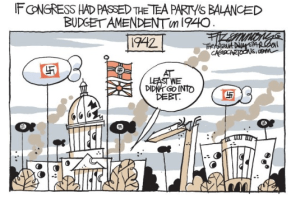 I always have to cover this topic in any introductory macroeconomics class I teach because usually one nutjob or another running for office always brings this up and people fall for it. The arguments are usually based on complete fallacies and misunderstanding of the math of economics, but hey, for some reason balanced budgets sound ‘reasonable’ when they are anything but.
I used to talk theoretically about how balanced budget amendments will kill state economies when the next real recession hits. Well, it hit a few years ago and we’re there. States continue to make their own economies worse day in and day out but there’s still those people that insist that if a family has to balance its budget, then so should the country. That’s even stupid considering most families have mortgages and car payments and probably student loans. Take Michele Bachmann as an example. She’s got all of the above plus farm subsidies and government grants. Even the President is guilty of that false equivalency. No person or family exists in perpetuity. No person or family can print money. No person or family has the power of taxation. Because of these three things, you cannot compare government to a family. Nor can you compare government to a business. Businesses exist to make a profit. Government exists to provide services and goods that the private sector will not provide or provides at an outrageous cost. It exists to administer justice and ensure level playing fields and fair play exists. Everything about a government is unique and is no way comparable to either businesses or households.
Macroeconomists know from years of study that the federal government can influence the economy at large. It does so through its spending and taxing priorities and policies. This is called fiscal policy. We have found several economic laws that guide the relationship between taxes and government spending and the behavior of Gross Domestic Product (GDP) which roughly measures all the legal and reported spending by households, governments, foreigners, and businesses. In our economy, household spending comprises about 68% of all GDP.
Investment or purchases by businesses is the smallest and most erratic component of GDP. Keynes said that it is easily spooked and subject to animistic spirits. Because it’s an unreliable source of growth, Keynes argued that in down turns, government should use its power to spend. Business investment usually only does fine in good economies. Please note, Keynes said deficit spend in recessions. Keynes’ prescription also said that Federal governments should run balanced budgets during times when the economy is fully employed and surpluses during bubble or boom times to relieve inflationary pressure. As usual, conservative politicians completely lie about the nature of Keynes and his highly proven and credible theories on fiscal policy. A lot of what we know about Monetary Policy comes from Milton Friedman, however, that is not the subject today. What I want to emphasize is that both men spent a lot of time analyzing panics and the Great Depression and are very much at the heart of accepted theory. We are seeing a classical lack of aggregate demand today. It is what’s driving the budget deficit. It is what’s driving the joblessness. It is what’s driving the slow recovery. Government must and will by automatic stabilizers be in a deficit position during downturns. It is simple math. More revenues come in during good times than bad. More safety net spending increases during bad times than good. We naturally run towards deficit in bad economies and towards surplus in good.
However, show me an economy that’s booming with high revenues and lower safety net spending and I will show you a group of politicians spending wildly. This tends to create inflation and can lead to bubbles. However, you never hear them complain at that point in time. That’s because it should be relatively easy to balance a budget then, but they do not do so or if they do its by expanding programs that cannot be sustained without borrowing during bad economies.
With that short explanation, let me cite you some folks that tell you why balanced budget amendments are bad policy. This first quote is from Simon Johnson who is the former chief economist for the IMF. He asks us to keep in mind that GDP is a measurement that is fraught with problems. He also mentions the fact that a balanced budget amendment makes the government make recessions worse.
Second and more seriously, imagine that this constitutional amendment were in place and that federal spending were roughly at its limit relative to the size of the economy. Then, what happens should the financial sector blow up again — either through no fault of its own (which, believe it or not, is the current prevailing myth on Wall Street about 2007-9) or because of some toxic combination of malfeasance and malpractice (the current predominant view of 2007-9 among many other people)?
The blame game is irrelevant when G.D.P. drops 10 percent; the issue is how to prevent a Great Depression. But note that with such a decline in G.D.P., a level of nominal spending that was 18 percent of G.D.P. is suddenly 20 percent, and now a constitutional crisis awaits – even before we get to the question of whether tax cuts or other forms of stimulus might be appropriate.
It makes no sense to take aim, as a matter of constitutional process, at two numbers that are both outcomes of deeper economic processes.
And to be frank, sometimes it makes a great deal of sense to apply an economic stimulus to an economy in free fall. One such moment was 1930 (and 1931 and 1932), when no stimulus was applied. Other moments were 2008 and 2009; both President Bush and President Obama initiated stimulus packages. When credit for and confidence in the private sector evaporates, do you really want the government sector to be forced to make quick cuts — or to raise taxes?
James Ledbetter at Reuters argues that even conservatives should oppose a balanced budget amendment (BBA). His reasons are more pragmatic. He argues that it won’t work.
Historically, conservatives have opposed extending government authority in places where it is not effective. You can find all the evidence you need to conclude that balanced budget requirements are useless by simply investigating the oft-repeated claim that 49 states have laws requiring a balanced budget. Leave aside the falsity of the claim and just consider the logic: if so many states are required to balance their budgets, why are so many states in the red?
The answer is that requiring state governments to annually balance their books simply encourages them to find clever ways to disguise debt and deficits. For example: California has both a Constitutional and a statutory requirement that its budgets be balanced. Would any sane person maintain that the state’s books have been anything resembling healthy for at least a decade? This year, after some brutal spending cuts, the governor’s office found that the state still had a short-term deficit of more than $9 billion and $35 billion in long-term debt. The governor’s budget report noted that California’s “massive budget deficits for most of the past decade…have been largely the result of a reliance on one-time solutions, borrowing, accounting maneuvers, and cuts or revenues that were illusory and therefore did not materialize.”
If that sounds familiar, it may be because, as Richard Quest pointed out on CNN Sunday evening, we’ve witnessed numerous Congressional attempts in recent decades to rein in federal deficits—including Gramm-Rudman in 1985 and the Budget Enforcement Act of 1990—all of which fell victim to legislative legerdemain. Why would a federal balanced budget amendment be any different?
Here’s something from The Economist on “Fiscal Rules”. Some fiscal rule–rather than a balanced budget amendment–would better stop congress from spending during booms and full employment cycles rather than balancing its budget via a BBA. This would be a rule that attaches the spending mandates to what’s going on in the economy. But again, I doubt they’d follow it since they’ve ignored a good portion of the Keynesian prescription for years any way.
It is difficult for Congress to tie its own hands. Any law that can pass Congress can later be undone or changed. In the rare cases that Congress puts together a near-perfect piece of legislation, that’s a bad thing. In the vastly more common occurrence that Congress passes highly imperfect legislation in need of significant future tweaks, that’s a very good thing. Support for an amendment to the constitution is a spectacular vote of confidence in the ability of a legislature to design near-perfect legislation, because the only thing rarer than an amendment to the constitution is a subsequent amendment undoing or clarifying a previous amendment.
I see the argument for a well-designed, over-the-business-cycle balanced-budget amendment. But the idea of enshrining this Congress’ pathologies into the constitution is terrifying. Let’s see Congress design some quality fiscal rules using the normal legislative process first, and then we can talk about adding those to the constitution.
Bruce Bartlett has some excellent analysis up for the current go round of balanced budget amendments. Mark Thoma explains how a BBA is a very bad idea. His analysis includes looking at the destabilizing effects that states’ BBAs have had on their economies. There’s a nifty graph that I did not include here if you’d like to go view it.
I’ve argued on many occasions that one of the big lessons we need to learn from this recession is that state-level balanced budget requirements are highly destabilizing. When a recession hits, spending goes up for social services and taxes fall as income, sales, property values, and other sources of revenue for state and local governments decline.
The result is a big hole in state and local government budgets, and that forces either increases in taxes or cuts in spending both of which make things even worse. And though some state and local governments were an exception to this, far and away the choice is to cut spending. We can see this in the state and local government employment statistics:
That’s not what we want to have happening when we are trying to recover from a recession. It would be much better if states had rainy day funds to rely upon, and if the rainy day funds fall short, the federal government could backfill the budget holes to prevent the destabilizing downsizing.
So have we learned the lesson? Nope, at least not if you are a Republican. They’d like to impose the same destabilizing rules on the federal government:
You really would have to search high and low for an economist that actually supports a BBA. The more conservative ones go for the fiscal rule that attaches spending to business cycles but even they believe that it would be unenforceable and easy to avoid. Can you imagine some District Judge trying to look over a complex macroeconomic model and figure out if the government forecast was correct or not?
A group of leading economists, including five Nobel Laureates in economics, today publicly released a letter to President Obama and Congress opposing a constitutional balanced budget amendment. The letter outlines the reasons why writing a balanced budget requirement into the Constitution would be “very unsound policy” that would adversely affect the economy. Adding arbitrary caps on federal expenditures would make the balanced budget amendment even more problematic, the letter says. The Economic Policy Institute and the Center on Budget and Policy Priorities organized the letter.
“A balanced budget amendment would mandate perverse actions in the face of recessions,” the letter notes. By requiring large budget cuts when the economy is weakest, the amendment “would aggravate recessions.”
The signatories of the letter are Nobel Laureates Kenneth Arrow, Peter Diamond, Eric Maskin, Charles Schultze, William Sharpe and Robert Solow; Alan Blinder, former Vice Chair of the Federal Reserve System’s Board of Governors and former member of the Council of Economic Advisors; and Laura Tyson, former Chair of the Council of Economic Advisors and former Director of the National Economic Council.
I’ll let former Reagan economist Bruce Bartlett have the last word here. He looks at the recent debate in Congress on the BBA.
Next week, House Republicans plan to debate a balanced budget amendment to the Constitution. Although polls show overwhelming public support, it is doubtful that many Americans realize that the measure to be debated is not, in fact, a workable blueprint to enforce a balanced budget. In fact, it’s just more political theater designed to delight the Tea Party.
We really need improved economic literacy in this country. I genuinely can’t get over what some of the morons in congress can get away with saying. Economists call them on it but it appears no one every listens.
Clinic Owned by Michele and Marcus Bachmann Offers “Ex-Gay” Therapy
Posted: July 10, 2011 Filed under: 2012 presidential campaign, fundamentalist Christians, psychology, religious extremists, Republican presidential politics, U.S. Politics | Tags: Bachmann & Associates, discredited treatment approach, ex-gay therapy, John M. Becker, Marcus Bachmann, Michele Bachmann, Minnesota, Outpost Missions, reparative therapy, self-hatred, Truth Wins Out, TWO, unethical 7 Comments
For some time, there have been rumors that Bachmann & Associates, a psychological counseling business with two locations in Minnesota offers reparative therapy, often referred to as “ex-gay therapy.” The business is owned owned jointly by GOP presidential candidate Michele and her husband Marcus Bachmann, according to Michele Bachmann’s financial disclosure forms.
The Bachmanns have repeatedly denied that their “clinic” uses this discredited treatment in order to attempt to “cure” clients’ homosexuality. And in fact, the treatment is not listed on the clinic’s website. We now have solid evidence that they are lying.
Two articles were posted on Friday at the Truth Wins Out (TWO) website, one a report of an undercover investigation by John M. Becker and the other by Wayne Besen explaining why the group undertook the investigation and why they have “concluded that That Marcus Bachmann’s Clinic Engages in ‘Ex-Gay’ Therapy.” According to the website, TWO is a “nonprofit organization that fights anti-gay religious extremism.”
There has been an ongoing discussion as to whether the clinic of Marcus Bachmann, the husband of presidential candidate Rep. Michele Bachmann (R-MN), practices “reparative therapy,” the discredited technique that aims to turn gay people into heterosexuals. When asked, Marcus Bachmann said that his clinic did not take part in such therapy. According to a June 15th article in The Daily Beast:
In November 2005, Marcus Bachmann delivered a presentation called “The Truth About the Homosexual Agenda” at the Minnesota Pastors’ Summit. According to a gay activist who attended and spoke to the City Pages, Bachmann’s presentation ended with testimony from three people who claimed they’d been gay and had been “cured” and become straight. “If someone is interested in talking to us about their homosexuality, we are open to talking about that,” he told the newspaper. “But if someone comes in a homosexual and they want to stay a homosexual, I don’t have a problem with that.”
During a week-long Truth Wins Out undercover investigation inside Bachmann & Associates, Truth Wins Out discovered that the clinic actually does practice textbook “reparative therapy.” With two hidden cameras in tow, TWO’s Director of Communications and Development, John Becker, attended five private sessions with Bachmann & Associates counselor Timothy Wiertzema, MA LMFT.
John M. Becker, the young man who went undercover with hidden cameras to investigate whether Bachmann & Associates is offering reparative therapy despite their denials, reported on his experiences in a second article. He scheduled an appointment with a counselor, explaining that he was “struggling with [his] homosexuality.”
Preparing for my first visit was a surreal experience. I couldn’t pay by check since my checks had my name, my husband’s name, and a Vermont address. This meant I would be paying with cash and opening my wallet before each appointment, so I realized I’d have to go through my wallet and remove or hide anything that would invite suspicion. My Human Rights Campaign credit card had to go, lest anyone recognize that organization’s ubiquitous logo. I left our ACLU membership card behind as well. I also hid my out-of-state debit card and library card, and took the photo of Michael and me out of my wallet along with the copy of our marriage certificate that I always keep close. Despite the hot and humid Minnesota weather, I wore long pants to conceal a tattoo on my ankle of a pink triangle, the badge of gay prisoners in Nazi concentration camps and a symbol of the struggle for LGBT equality. At the last minute, in the parking lot, I remembered that Michael’s picture was set as the background image on my phone, so I hurriedly changed it. Finally, I took a deep breath and slipped off my wedding ring, placing it in a plastic bag inside my satchel, right next to one of the hidden cameras. My identity as a proud, openly gay, happily married LGBT rights activist was totally erased. I was ready
Once inside, Becker explained why he was seeking help.
When asked why I came in for counseling, I said that I had been struggling with homosexuality for a long time and tried a lot of things, up to and including suicide, to make it go away – exactly how my 16-year-old self would have responded. I said that I was upset: this struggle has lasted for so long that I started to wonder if I was doing it right and decided to seek outside help. All of my sexual experiences, from age 14 onward, had been with men. What I wanted, though, was to get rid of my homosexuality and eventually marry a woman.
At the second session Becker asked the counselor if he would
ever be able to be completely rid of homosexuality, or merely learn to cope with and manage it? Wiertzema’s response was that it’s situational. Some people have been able to get rid of it completely over a long time period, others over a shorter time period. Still others are able to get it to “subside,” down to a “manageable” level, but it’s still there in the background. He asked me, “Are you okay with knowing that it might take awhile, and that it might not… maybe not happen at all? …Obviously, it’s not okay, in a way, but…” I said that I wanted to give it a go, that it was better to try than to not try.
In subsequent meetings with the therapist, Becker was told that people can overcome their homosexual urges and no longer be attracted to the same sex and that
“We’re all heterosexuals, but we have different challenges.” Attraction to the same sex “is there, and it’s real, but at the core value, in terms of how God created us, we’re all heterosexual.”
All of this despite the fact that
every professional medical and mental health association rejects “ex-gay” therapy…or that the treatment I was seeking was totally unsupported by research. I was never informed about possible alternative treatment options such as gay-affirmative therapy. Nobody ever told me about the potential for harmful side effects like depression and suicidal thoughts. And although I was asked to sign a treatment plan outlining my problem, desired outcome, and treatment strategy, I was never given nor asked to sign any kind of informed consent document that disclosed the above information about “ex-gay” therapy.
Becker asked about churches that would be supportive of his struggle, and was referred to churches that welcome ex-gays, including the Outpost Ministries, which, according to its website,
exists to help the sexually and relationally broken find healing and restoration through relationship with Jesus Christ….Outpost was formed over 30 years ago to meet the needs of men and women making the decision to break away from gay life. We strive to deal with individuals as whole persons, not merely sexual beings. We offer teaching, encouragement and support to individuals, families and the Church. Outpost emphasizes obedience to God’s Word, which begins the healing process. As we grow in our submission to Jesus Christ, we also grow in friendship with Him. It is in relationship with Jesus that we are healed and transformed.
Another article by Maria Blake at The Nation provides support for Becker’s story and the conclusion that Bachmann & Associates offers reparative or “ex-gay” therapy. Blake relates the story of Andrew Ramirez, who came out to his parents during his senior year in high school.
His mother took the news in stride, but his stepfather, a conservative Christian, was outraged. “He said it was wrong, an abomination, that it was something he would not tolerate in his house,” Ramirez recalls. A few weeks later, his parents marched him into the office of Bachmann & Associates, a Christian counseling center in Lake Elmo, Minnesota, which is owned by Michele Bachmann’s husband, Marcus. From the outset, Ramirez says, his therapist—one of roughly twenty employed at the Lake Elmo clinic—made it clear that renouncing his sexual orientation was the only moral choice. “He basically said being gay was not an acceptable lifestyle in God’s eyes,” Ramirez recalls. According to Ramirez, his therapist then set about trying to “cure” him. Among other things, he urged Ramirez to pray and read the Bible, particularly verses that cast homosexuality as an abomination, and referred him to a local church for people who had given up the “gay lifestyle.” He even offered to set Ramirez up with an ex-lesbian mentor.
So there you have it. Michele and Marcus Bachmann are receiving Federal and state taxpayer funds to offer a discredited and unethical therapy without even informing clients of the dangers or that no major medical or psychological organization approves of this approach.
Thursday Reads: DADT Decision, Bachmann Surging, High-Profile Trials, and Mega-Wombats
Posted: July 7, 2011 Filed under: 2012 presidential campaign, Crime, morning reads, Republican presidential politics, Team Obama, The Media SUCKS, U.S. Politics, Violence against women | Tags: 2012 presidential election, Amy Bishop, australia, Billy Bulger, Casey Anthony, crime, DADT, James Wolcott, Jose Baez, Marcia Clark, mega-wombat, Michele Bachmann, Mitt Romney, murder, New Hampshire, Republican presidential wannabes, Texas gang rape, unconstitutional, violence against women, Whitey Bulger 27 Comments
Good Morning!! I think I have some interesting reads for you today, so let’s get right to it.
The biggest story of the day is that the Ninth Circuit Court Of Appeals has ordered the Obama administration to quit stalling and get rid of DADT immediately.
A three-judge panel of the United States Court of Appeals for the Ninth Circuit issued a two-page order against the policy known as “don’t ask, don’t tell” in a case brought by the group Log Cabin Republicans.
In 2010, a federal judge in California, Virginia A. Phillips, ruled that the law was unconstitutional and ordered the government to stop enforcing it. That decision was appealed to the Ninth Circuit, which issued a stay allowing the government to continue enforcing the policy as it made its way through the courts.
Congress repealed the policy last year, but called for a lengthy process of preparation, training and certification, still under way, before ending it….
Judges Alex Kozinski, Kim McLane Wardlaw and Richard A. Paez stated in their order that “circumstances and balance of hardships had changed” since their initial ruling: the Obama administration had informed the court that repeal of the policy was “well under way,” and in a filing in another case on July 1, the Department of Justice took the position that discrimination based on sexual orientation should be subjected to tough scrutiny. The government, the judges wrote, “can no longer satisfy the demanding standard for issuance of a stay.”
And the credit goes to the Log Cabin Republicans, because Democrats are too weak and cowardly to do anything useful anymore.
As I predicted, Michele Bachmann is making gains on Mitt Romney in New Hampshire, according to the latest PPP Poll.
When PPP polled New Hampshire in April Michele Bachmann was stuck at 4%. She’s gained 14 points over the last three months and now finds herself within single digits of Mitt Romney. Romney continues to lead the way in the state with 25% to 18% for Bachmann, 11% for Sarah Palin, 9% for Ron Paul, 7% for Rick Perry and Herman Cain, 6% for Jon Huntsman and Tim Pawlenty, and 4% for Newt Gingrich.
Bachmann’s surge in New Hampshire is being built on the back of the Tea Party. Among voters identifying themselves as members of that movement she’s leading the way at 25% with Palin and Romney tying for second at 16%, and Cain also placing in double digits at 11%. Only 33% of Republican primary voters in the state identify themselves as Tea Partiers though and with the remaining folks Romney’s way ahead with 33% to 13% for Bachmann, and 10% for Huntsman and Paul.
Don’t say I didn’t warn you.
The 14 men (and 5 boys whose names are being withheld because they are juveniles) who gang raped an 11-year-old Texas girl were due in court yesterday.
Four of the accused face charges of continuous sexual abuse of a child, while the majority of the men have been charged with aggravated sexual assault of a child. All defendants are expected to appear in the Liberty, Texas courtroom today for status updates, according to the Associated Press.
Cleveland police began investigating the case in December of last year after cell phone video showing the alleged sex attack started circulating among students at Cleveland schools, according to court documents. The video shows the girl engaged in sexual acts with several men….Most of the men who face charges are free on bond. One of the accused men, Marcus Porchia, 26, has been implicated in another unrelated case for sexual assault.
The trial has been postponed until October because of delays in DNA testing.
“I’m going to pressure the state to pressure the DPS lab to get whatever analysis as quickly as possible,” state District Judge Mark Morefield said.
Morefield reset the 14 men’s cases for Oct. 3. Five juvenile boys also have been charged.
During the hearing, Warren told the judge his office was in tentative negotiations with at least one of the defendants, Jared McPherson. Warren did not say if he was referring to a possible plea agreement and he declined to comment after the hearing. McPherson’s attorney also declined to comment. A gag order is preventing those connected to the case from commenting.
Something tells me this trial won’t get as much publicity as the Casey Anthony trial. I hope I’m wrong, because this is a horrendous crime against a child, and these men need to be put away for a very long time.
Actually the next high profile trial I expect to follow is that of Amy Bishop, the professor who opened fire in a faculty meeting after failing to get tenure. So far the judge is planning to keep the trial open to the public. I hope it will be televised. Once Bishop finishes that trial, she’ll have to go to Massachusetts and face murder charges in the shooting of her brother in 1986.
There’s already a true crime book out about the Bishop case.
The Amy Bishop story inspires fear, confusion, and now 258 pages of true crime drama.
Attorney Mark McDaniel says the lawyers involved in the case will be hurrying to read the book.
McDaniel says, “I promise you the defense lawyers and the prosecutors are reading that, probably reading it today.”
And then there’s the Whitey Bulger trial. Bulger pled not guilty to 19 murders today.
The retired state police colonel who oversaw the unearthing of the remains of several of the people James “Whitey” Bulger is accused of killing from crude mass graves said he felt some personal satisfaction yesterday in seeing his notorious nemesis “a broken man” in chains before a judge.
But retired Col. Thomas J. Foley said that for the families to hear Bulger, 81, plead not guilty to 32 charges, including 19 murders, extortion, machine-gun possession and money laundering, “I’m sure had to be a difficult pill for the families to swallow.”
Assistant U.S. Attorney Brian Kelly said that should the case go to a trial, he expects prosecutors will need at least a month to present evidence and up to 40 witnesses.
J.W. Carney Jr., Bulger’s public defender, would not say whether his client, who faces life imprisonment here and could face the death penalty in murder cases pending in Florida and Oklahoma, is interested in striking a plea deal.
Boston Herald columnist Peter Gelzinis is asking Whitey’s politically powerful brother Billy Bulger to get Whitey to talk.
William M. Bulger, former president of the state Senate and the University of Massachusetts, sits in the front row in a charcoal business suit, a look of implacable rectitude frozen on his pale face.
Around Billy in the courtroom are the wives, brothers, sons and daughters of some of the 19 people Whitey is accused of killing. Billy knows they are there, but never acknowledges them. Strange for a man who began his star-crossed career as a lawyer taking cases in South Boston District Court.
As this circus lumbers forward, it will become increasingly obvious that the only man who can clear a path to something called justice is Billy Bulger, the man some people still think of as “The Good Brother.”
Billy should do what he refused to do 10 years ago before a grand jury and a congressional committee. He should have the courage to confront his brother and urge him to give some small semblance of peace to the families he’s wounded by coming clean. Billy should ask Whitey to take ownership of his sins.
I’ve got a few reactions to the verdict in the Casey Anthony case. James Wolcott says he didn’t follow the case closely, but based on what he did see he wasn’t surprised at the not guilty verdict.
I seemed to be one of the few whose world didn’t flip sideways–I wasn’t that surprised and if anything pleased that the jury made up its own collective mind in defiance of the lynch-mob clamor on the cable channels.
It can’t be said that the know-nothing know-it-alls on Fox News and Nancy Grace’s Sweeney Todd cooking school accepted the jury’s verdict with modesty and maturity. After expressing shock and taking turns to tell us how “stunned” they were, they accused the jury of suffering from Stockholm Syndrome (staring at Casey Anthony’s face somehow melting their reason and resolve), appearing to resent that fact that the defendant might be freed soon (since she might be granted time-served on the lesser charges, having already served years behind bars), and acting peevish that they didn’t get their way, having already convicted Casey Anthony on the airwaves for years now and treating the trial as an audiovisual demonstration of what to them was self-evident.
“Appearing to resent” and “peevish” are too mild, actually–many of the instant commentators on cable were visibly, audibly angry at the AUDACITY these acquittals.
Failed OJ prosecutor Marcia Clark thinks the verdict in the Anthony case is even worse than what happened with OJ.
…it was a circumstantial case. Most cases are. But the circumstances were compelling. Maybe not sufficient to prove premeditated murder—and I never believed the jury would approve the death penalty—but certainly enough to find Casey Anthony guilty of manslaughter at the very least.
Why didn’t they? My guess, since I’m writing this before the inevitable juror cameos, is that the jury didn’t necessarily believe Casey was innocent but weren’t convinced enough of her guilt to bring in a conviction. The thinking goes something like this: Sure, Casey’s behavior after her daughter’s death looks bad—dancing, partying, lying—but that doesn’t mean she killed the baby. Sure, that duct tape was weird, but that could’ve been done after the baby was already dead—no way to know who or when that tape was put on the baby’s face. Sure, the chloroform computer search seems damning, but that may not even have been done by Casey (her mom took the fall for that one).
And so, every bit of evidence presented by the prosecution could’ve been tinged with doubt. At the end of the day, the jury might have found that they just couldn’t convict her based on evidence that was reconcilable with an innocent explanation—even if the weight of logic favored the guilty one.
It’s a thoughtful article, highly recommended. Clark may be right about the jury, because at least one juror is already talking. She says she felt sick to her stomach at having to vote not guilty.
I wonder why she didn’t push for manslaughter then or at least child endangerment?
Jeralyn wrote a couple of good posts on the Anthony case yesterday: The Meaning of a Not Guilty Verdict and So Many Ignorant Reactions to Casey Anthony Acquittal. She had a few choice words for the HLN vampires.
HLN…proceeded to blast the defense team for holding a victory party and sharing a toast of champagne. Excuse me? This team didn’t work as hard as the prosecution? With fewer resources? The defense team saved a life today. That’s as close to G-ds work as it gets for criminal defense lawyers. Why shouldn’t they be proud? They held the state to its burden of proof and the state failed to meet it.
[….]
One viewer said the jury got it wrong because unlike everyone else, they weren’t privy to what was being said on Facebook and Twitter. The host agreed, saying the jury was in a vacuum in the courtroom. Hello? The jury was in the courtroom and heard and saw all the evidence. They were sequestered so they would be free from outside influences and prejudice. The jurors were the ones who received the judge’s instructions on how to apply the law. Did anyone bother to post or read all the instructions on Facebook and Twitter?
[….]
I wish the news media would stop saying no one will ever be held accountable for the little girl’s murder. It hasn’t be proven there was a murder. The defense argued it was an accident. The state took its best shot and came up short.
Congratulations to Jose Baez, Cheney Mason and everyone else on the defense team. They represented their client with pride and dedication, and with enormous sacrifices to their personal lives and law practices. They successfully battered the junk science, and prevailed in the long run — despite the unprofessional conduct of a prosecutor who smirked throughout their closing argument.

Modern day wombat
A fossilized “mega-wombat” has been dug up in Australia.
The fossil of a car sized mega-wombat has been unearthed in northern Australia, scientists said Wednesday — the most complete skeleton of its kind.
Weighing in at a whopping three tonnes, the herbivorous diprotodon was the largest marsupial to ever roam the earth and lived between two million and 50,000 years ago.
A relative of the modern-day wombat, the diprotodon skeleton was dug up in remote Queensland last week — the most northerly specimen ever discovered — and scientists believe it could shed valuable light on the species’ demise.
Mega-Wombat
Along with Australia’s other megafauna, which included towering kangaroos and gigantic crocodiles, diprotodon became extinct around the same time that indigenous tribes first appeared and debate has raged about the role of humans.

Very cool.
That’s all I’ve got for today. What are you reading and blogging about?
Michele and Marcus Bachmann and Cher’s Gaydar
Posted: July 2, 2011 Filed under: 2012 presidential campaign, GLBT Rights, religious extremists, Republican presidential politics, Surreality, U.S. Politics | Tags: 2012 presidential election, discrimination, equal rights, GLBT rights, hypocrisy, Marcus Bachmann, Michele Bachmann, same-sex marriage 24 Comments
GOP Presidential Candidate Michele Bachmann and her potential “first dude” Marcus Bachmann have been campaigning together since her recent announcement that she is running for President. At a rally on June 28, in Myrtle Beach, NC, Michele gave a rousing stump speech and then the happy couple danced together onstage to the strains of “Wabash Cannonball”
——————————————————————
In 2010, Marcus Bachmann explained to a “christian” radio host that homosexuals are “barbarians” who “need to be educated.” Now that the Bachmanns are in the spotlight, their attitudes about homosexuals are beginning to be noted by the corporate media.
——————————————————————-
After Cher saw the above MSNBC segment, she tweeted the following to her followers:
“Just heard Michele Bachmann’s OH SO CHRISTIAN husband talk about ‘Gays’ in the most UNCHRISTIAN way WTF!”
“But Boys please utube this asshole & tell me what u think … Cause My Gay-Dar is GOING OFF!!!”
More of her tweets are posted at the above link.
Here’s another radio interview of Marcus discussing his advice to his daughter about choosing her prom dress and how that process relates to identity.
——————————————————————-
These two are just a bundle of contradictions. Now check this out:
After a long hard day of wingnutting, what does the family of crazy-eyed Minnesota congresswoman Michele do to kick back? Well, of course, they watch Glee! Are the anti-gay Michele Bachmann and her “Christian counselor” husband Marcus hypocrites, stupid or all of these things?
Justin Bieber disappointed U.S. representative and potential presidential candidate Michele Bachmann at last night’s Time 100 by not showing up — she’d brought copies of his book to sign for one of her older sons, who is a special-ed teacher. But she did delight her other, younger children (she’s taken care of 23 foster kids over the years) by meeting another popular teen icon and singer. At the event last night, at Jazz at Lincoln Center, Bachmann and her husband posed with Glee star Darren Criss and e-mailed the pictures to their children. “We looked for Chris Colfer,” she said, but they didn’t find him. “We don’t watch TV, generally speaking. But the kids were thrilled. What kids don’t watch Glee?” Well, maybe the children of potential presidential candidates who think God sent them to stop gay people from having equal rights? Maybe Bachmann doesn’t know that the main message of the popular teen hit is tolerance, respect, and equal treatment — particularly for gay people. She doesn’t watch TV, after all.
My head is spinning!
NOTE: Videos taken from Youtube orginally posted by the Dump Bachman blog, and indispensible source for information on Michele and Marcus Bachmann.

 peej
peej Carissa
 bostonboomer
 dakinikat
 ecocatwoman
 mablue2
 Mama Lopez
 peggysue22
 quixote
 skydancingguestblogger
 Mona (aka Wonk the Vote)



 Sky Dancing
Recent Comments