
Thursday Reads: Bomb Cyclone Edition
Posted: January 4, 2018 Filed under: morning reads, U.S. Politics | Tags: bomb cyclone, bombogenesis, Donald Trump, Fire and Fury, Michael Wolff, winter weather 80 Comments
Sea ice floats in Boston Harbor (Boston Globe)
Good Morning
Jim Cantore is in Rockport on the North Shore and another Weather Channel guy is on the South Shore, in Plymouth, so I guess the storm is going to be bad here in New England. Bombogenesis is still expected to happen off the New England Coast later today. Here’s the explanation of what’s happening from the Boston Globe: Bombogenesis? Bomb cyclone? What exactly these terms mean and how they relate to Thursday’s storm.
The terms were popularized by a 1980 paper by MIT professors Frederick Sanders and John R. Gyakum, who studied “explosive cyclogenesis” (the rapid development of a storm) in the Northern Hemisphere in the 1970s.
According to the NOAA, bombogenesis is a “popular term” to describe the process in which a storm rapidly strengthes. Specifically, it refers to when the storm’s pressure system drops more than 24 millibars in 24 hours.
“This can happen when a cold air mass collides with a warm air mass, such as air over warm ocean waters,” says the agency’s website.
According to Sanders and Gyakum’s paper, bombogenesis is predominantly a cold-season event and occurs over water. The National Weather Service says it is “solely a meteorological term” and does not describe the effects of the storm.
That said, the resulting storm from bombogenesis is called a “bomb” or “bomb cyclone.”
We’re supposed to get at least winds around 60-70 mph and 12 to 18 inches of snow, so it’s basically a just a blizzard with caused by the crazy weather happening out over the ocean.
More from The Washington Post: No need to duck and cover — this is the ‘bomb cyclone,’ explained.
Though it seems as if meteorologists are using hyperbole to draw in more viewers, for a storm to be classified as a “bomb” it actually has to meet a stringent set of criteria. “Explosive bombogenesis” occurs most often in the winter, and it’s almost always referring to a storm that tracks up the East Coast. Nor’easters tend to be bombs.
A cyclone’s strength depends on its air pressure. The lower the pressure, the stronger the storm. Air pressure is the weight of the atmosphere. In a storm, air is rising, so the pressure is lower.
Typical surface-air pressure tends toward 1010 millibars. That’s how we measure how much air is sitting over us. Most of the big storm systems that sweep rain and snow across the United States clock in around 995 or 990. But for a storm to rank a “bomb,” it must rapidly intensify — it has to drop at least 24 millibars in 24 hours.
The storm expected to ride up the East Coast and strike New England looks as if it will be a classic bomb cyclone, with the expectation of a 50-millibar drop in about 24 hours
When a storm strengthens this quickly, it’s a signal of how much air is being drawn into the storm’s circulation. It then spirals inward toward the center, rises and exits through the top. If more air is leaving the storm than is sucked inward, the pressure falls even more and the system will continue to grow.
It’s not rare, but bombogenesis is still a sight to behold from a meteorological perspective. It is most common in nor’easters, the fierce gales that spin up off the East Coast in the late fall and winter. They feed off the temperature contrast between the cold land and adjacent Atlantic waters still holding on to heat left over from the summertime.
More details at the WaPo.
Of course there’s another cyclone happening in Washington, D.C.–a metaphorical one anyway. Yesterday New York Magazine published an excerpt from Michael Wolff’s soon-to-be-released book, Fire and Fury. If you haven’t read it yet, you need to. I know the media has been highlighting bits of it constantly, but reading the whole thing is a whole different experience. The piece is so shocking that I had to read it in sections over the course of the day yesterday.
Today Wolff has released another excerpt in The Hollywood Reporter: “You Can’t Make This S— Up”: My Year Inside Trump’s Insane White House. I haven’t read the whole thing yet, but it begins as a background piece on how Wolff got nearly unrestricted access to Trump and his minions.
I interviewed Donald Trump for The Hollywood Reporter in June 2016, and he seemed to have liked — or not disliked — the piece I wrote. “Great cover!” his press assistant, Hope Hicks, emailed me after it came out (it was a picture of a belligerent Trump in mirrored sunglasses). After the election, I proposed to him that I come to the White House and report an inside story for later publication — journalistically, as a fly on the wall — which he seemed to misconstrue as a request for a job. No, I said. I’d like to just watch and write a book. “A book?” he responded, losing interest. “I hear a lot of people want to write books,” he added, clearly not understanding why anybody would. “Do you know Ed Klein?”— author of several virulently anti-Hillary books. “Great guy. I think he should write a book about me.” But sure, Trump seemed to say, knock yourself out.
Since the new White House was often uncertain about what the president meant or did not mean in any given utterance, his non-disapproval became a kind of passport for me to hang around — checking in each week at the Hay-Adams hotel, making appointments with various senior staffers who put my name in the “system,” and then wandering across the street to the White House and plunking myself down, day after day, on a West Wing couch.
The West Wing is configured in such a way that the anteroom is quite a thoroughfare — everybody passes by. Assistants — young women in the Trump uniform of short skirts, high boots, long and loose hair — as well as, in situation-comedy proximity, all the new stars of the show: Steve Bannon, Kellyanne Conway, Reince Priebus, Sean Spicer, Jared Kushner, Mike Pence, Gary Cohn, Michael Flynn (and after Flynn’s abrupt departure less than a month into the job for his involvement in the Russia affair, his replacement, H.R. McMaster), all neatly accessible.
The nature of the comedy, it was soon clear, was that here was a group of ambitious men and women who had reached the pinnacle of power, a high-ranking White House appointment — with the punchline that Donald Trump was president. Their estimable accomplishment of getting to the West Wing risked at any moment becoming farce.
A bit more:
“You can’t make this shit up,” Sean Spicer, soon to be portrayed as the most hapless man in America, muttered to himself after his tortured press briefing on the first day of the new administration, when he was called to justify the president’s inaugural crowd numbers — and soon enough, he adopted this as a personal mantra. Reince Priebus, the new chief of staff, had, shortly after the announcement of his appointment in November, started to think he would not last until the inauguration. Then, making it to the White House, he hoped he could last a respectable year, but he quickly scaled back his goal to six months. Kellyanne Conway, who would put a finger-gun to her head in private about Trump’s public comments, continued to mount an implacable defense on cable television, until she was pulled off the air by others in the White House who, however much the president enjoyed her, found her militancy idiotic. (Even Ivanka and Jared regarded Conway’s fulsome defenses as cringeworthy.)
Steve Bannon tried to gamely suggest that Trump was mere front man and that he, with plan and purpose and intellect, was, more reasonably, running the show — commanding a whiteboard of policies and initiatives that he claimed to have assembled from Trump’s off-the-cuff ramblings and utterances. His adoption of the Saturday Night Live sobriquet “President Bannon” was less than entirely humorous. Within the first few weeks, even rote conversations with senior staff trying to explain the new White House’s policies and positions would turn into a body-language ballet of eye-rolling and shrugs and pantomime of jaws dropping. Leaking became the political manifestation of the don’t-blame-me eye roll.
The surreal sense of the Trump presidency was being lived as intensely inside the White House as out. Trump was, for the people closest to him, the ultimate enigma. He had been elected president, that through-the-eye-of-the-needle feat, but obviously, he was yet … Trump. Indeed, he seemed as confused as anyone to find himself in the White House, even attempting to barricade himself into his bedroom with his own lock over the protests of the Secret Service.
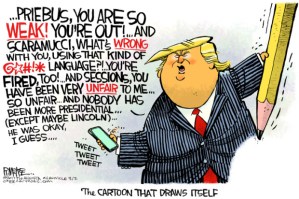
Some pundits have argued that, like Trump, Wolff is a self-promoter. Are we really supposed to believe his reporting? But this morning Axios reported that Wolff has everything on tape.
Rick McKee / Augusta Chronicle
Michael Wolff has tapes to back up quotes in his incendiary book — dozens of hours of them.
— Among the sources he taped, I’m told, are Steve Bannon and former White House deputy chief of staff Katie Walsh.
— So that’s going to make it harder for officials to deny embarrassing or revealing quotes attributed to them in “Fire and Fury: Inside the Trump White House,” out Tuesday.
— In some cases, the officials thought they were talking off the record. But what are they going to do now?
— Although the White House yesterday portrayed Wolff as a poseur, he spent hours at a time in private areas of the West Wing, including the office of Reince Priebus when he was chief of staff.
With all this insanity finally on public display, there is more public discussion of exactly how crazy Trump actually is.
Politico: Washington’s growing obsession: The 25th Amendment.
Lawmakers concerned about President Donald Trump’s mental state summoned Yale University psychiatry professor Dr. Bandy X. Lee to Capitol Hill last month for two days of briefings about his recent behavior.
In private meetings with more than a dozen members of Congress held on Dec. 5 and 6, Lee briefed lawmakers — all Democrats except for one Republican senator, whom Lee declined to identify. Her professional warning to Capitol Hill: “He’s going to unravel, and we are seeing the signs.”
In an interview, she pointed to Trump “going back to conspiracy theories, denying things he has admitted before, his being drawn to violent videos.” Lee also warned, “We feel that the rush of tweeting is an indication of his falling apart under stress. Trump is going to get worse and will become uncontainable with the pressures of the presidency.”
Lee, editor of “The Dangerous Case of Donald Trump,” which includes testimonials from 27 psychiatrists and mental health experts assessing the president’s level of “dangerousness,” said that she was surprised by the interest in her findings during her two days in Washington. “One senator said that it was the meeting he most looked forward to in 11 years,” Lee recalled. “Their level of concern about the president’s dangerousness was surprisingly high.”
Many of us, including Hillary Clinton and Barack Obama, saw the signs during the 2016 campaign and tried to raise alarms. Unfortunately, the media was too busy focusing on Hillary’s emails to notice that Russia was using active measures to infiltrate Trump’s campaign and make him POTUS. They convinced themselves that Trump could never win no matter how much they hammered Hillary. After he won, many of these “journalists” argued that Trump would “pivot” and suddenly begin acting like a normal, sane person.
And now here we are with an insane would-be tyrant in the While House and a Republican Party that refuses to put any kind checks on his power.
In honor of the “bomb cyclone” I give you Toots and the Maytals.

 peej
peej Carissa
 bostonboomer
 dakinikat
 ecocatwoman
 mablue2
 Mama Lopez
 peggysue22
 quixote
 skydancingguestblogger
 Mona (aka Wonk the Vote)



 Sky Dancing
Recent Comments