
Lazy Caturday Reads
Posted: April 15, 2023 Filed under: cat art, caturday, FBI, SCOTUS | Tags: Boston bombing 10th anniversary, Clarence Thomas, Dick Durbin, Espionage Act, ethics, handcycle, Harlan Crow, Jack Teixeira, Michael Tomasky, Red Sox, Senate Judiciary Committee, terrorism, Ukraine mothers 11 Comments
The Favourite Chair, by Leon Charles Huber
Happy Caturday!!
Yesterday I told Dakinikat that I wished I had a feel good story for today’s post. I was asleep when she called last night and left a message about a New York Times article that was discussed on Stephanie Ruhl’s MSNBC show. It was about Ukrainian mothers who traveled thousands of miles to recover their children who had been kidnapped and taken to Russian-controlled territory. Of course it’s a heartbreaking story, but it’s also a heartwarming story of the power of a mother’s love. It also includes powerful photos of the women and their children. I hope you’ll go read it. Here’s just a bit of it.
The Russians Took Their Children. These Mothers Went and Got Them Back, bCarlotta Gall and
For weeks after Russian troops forcibly removed Natalya Zhornyk’s teenage son from his school last fall, she had no idea where he was or what had happened to him.
Then came a phone call.
“Mom, come and get me,” said her son, Artem, 15. He had remembered his mother’s phone number and borrowed the school director’s cellphone.
Ms. Zhornyk made him a promise: “When the fighting calms down, I will come.”
Artem and a dozen schoolmates had been loaded up by Russian troops and transferred to a school farther inside Russian-occupied Ukraine.
While Ms. Zhornyk was relieved to know where he was being held, reaching him would not be easy. They were now on different sides of the front line of a full-blown war, and border crossings from Ukraine into Russian-occupied territory were closed.
But months later, when a neighbor brought back one of her son’s schoolmates, she learned about a charity that was helping mothers bring their children home.
Since it is illegal for men of military age to leave Ukraine now, in March Ms. Zhornyk and a group of women assisted by Save Ukraine completed a nerve-wracking, 3,000-mile journey through Poland, Belarus and Russia to gain entry to Russian-occupied territory in eastern Ukraine and Crimea to retrieve Artem and 15 other children.
Then they had to take another circuitous journey back. “Come on, come on,” urged Ms. Zhornyk, as a cluster of children, laden with bags and suitcases, emerged hesitantly through the barriers at a border crossing from Belarus into Ukraine. She had crossed with her son just hours earlier and pushed forward impatiently to embrace the next group.
“There are no words for all the emotions,” Ms. Zhornyk, 31, said, describing her reunion with Artem. “I was full of emotion, and nervous, nervous.”

Cat on a chair, by Theophile Alexandre Steinlen
There are more details about what happened to the children in the article. Some background:
In the 13 months since the invasion, thousands of Ukrainian children have been displaced, moved or forcibly transferred to camps or institutions in Russia or Russian-controlled territory, in what Ukraine and rights advocates have condemned as war crimes.
The fate of those children has become a desperate tug of war between Ukraine and Russia, and formed the basis of an arrest warrant issued last month by the International Criminal Court accusing President Vladimir V. Putin of Russia and Maria Lvova-Belova, his commissioner for children’s rights, of illegally transferring them.
Once under Russian control, the children are subject to re-education, fostering and adoption by Russian families — practices that have touched a particular nerve even amid the carnage that has killed and displaced so many Ukrainians….
No one knows the full number of Ukrainian children who have been transferred to Russia or Russian-occupied Ukraine. The Ukrainian government has identified more than 19,000 children that it says have been forcibly transferred or deported, but those working on the issue say the real number is closer to 150,000.
Again, there is much more at the NYT link.
I hope you’ll forgive me for highlighting a local Boston story today. This weekend marks the 10th anniversary of the 2013 Boston Marathon bombing. The marathon will take place on Monday. Although only three people were killed in the explosions, there were hundreds of horrific injuries–limbs blown off, terrible burns, traumatic brain injuries.
From Boston.com: Mark the 10-year anniversary of the Marathon bombings in Boston One Boston Day is Saturday, April 15.
It has been 10 years since the Boston Marathon bombings killed three people and injured hundreds more during the 2013 Boston Marathon, and the city is hosting several events in remembrance of the day.
The city of Boston and the Boston Athletic Association (B.A.A.) will host remembrance events on Saturday, April 15 — One Boston Day. The events will honor the victims, survivors, and first responders of the 2013 Boston Marathon.
The city will host an early-morning private gathering and wreath laying at the memorial sites for the families who lost loved ones. Honor guards — including the Boston Fire Department, Boston Police Department, Boston Emergency Medical Services, and Suffolk County Sheriff Department — will be present at the memorial sites throughout the day.
At 8 a.m.,the BAA 5K, featuring 10,000 participants, will begin and end in Boston Common. After the B.A.A. 5K race, the city will open Boylston Street between Dartmouth and Fairfield streets so that members of the public can visit the sites.
At 2:30 p.m., the public is invited to a dedication of a new commemorative Boston Marathon finish line, the ringing of bells, and the unveiling of a One Boston Day marker on Boylston Street along with Gov. Maura Healey, Mayor Michelle Wu, B.A.A. leadership, members of the One Fund community, members of the 2013 Red Sox team, first responders, hospital leaders, and local running groups.
“Every year we come together on One Boston Day to remember the courage, strength, and resilience shown by our city’s people in 2013,” Wu said in a statement. “As we mark 10 years, we will gather together in community on April 15 to remember the lives that were lost, the many injured, and the spirit of humanity displayed that day. As we honor those forever impacted, people in all corners of our City will be giving back in a number of ways, and I encourage everyone to get involved.”
There will also be many local and neighborhood events; and of course, the Red Sox will mark the day at their traditional Marathon Day game and will be wearing their bright yellow home uniforms.
The Red Sox will mark the 10 year milestone by partnering with JetBlue to distribute more than 40,000 blue and yellow Red Sox City Connect hats to students and staff at Boston Public Schools on Friday, April 14. Hall of Famer Pedro Martinez will assist with the distribution. The team will then wear blue and yellow City Connect jerseys during Friday night’s game in Fenway Park agains the Angels.
Painting by Chen Pei Yi
As previously mentioned, the 2013 Red Sox team will join city and state officials and first responders on Saturday, April 15 for the ringing of the bells and the unveiling of the One Boston Day marker. At Saturday’s game, there will be a pre-game ceremony commemorating One Boston Day and the 76th anniversary of Jackie Robinson breaking the color barrier. Fans should be in their seats by 3:30 p.m.
On Sunday, April 16, a reunion of members of the 2013 Red Sox World Series Championship team will take place during pregame ceremonies. Fans should be in their seats by 1 p.m.
On Patriots Day, Monday, April 17, Hall of Famer David Ortiz will serve as the Grand Marshal for the 127th Boston Marathon. Players will wear home jerseys that say “Boston” on the front, as they did for the first time during the Marathon tribute at Fenway Park on April 20, 2013. Fans are asked to be in their seats by 10:45 a.m. for the ceremony. All fans will receive a Boston Strong t-shirt.

The FBI is also marking the anniversary. From FBI News: Marathon Bombing Anniversary. FBI Boston marks 10-year-anniversary by honoring victims, recalling responders’ heroic efforts.
Leading up to the 10-year anniversary of the bombing at the Boston Marathon—and the ensuing manhunt and investigation that was the FBI’s largest terrorism case since 9/11—the special agent in charge of FBI Boston asked his entire office to pause and reflect on the crucible of that massive investigation as they prepared for this year’s 127th running.
Leading up to the 10-year anniversary of the bombing at the Boston Marathon—and the ensuing manhunt and investigation that was the FBI’s largest terrorism case since 9/11—the special agent in charge of FBI Boston asked his entire office to pause and reflect on the crucible of that massive investigation as they prepared for this year’s 127th running.
Three people were killed on April 15, 2013, when two pressure-cooker bombs detonated 11 seconds apart on Boylston Street near the finish line of the iconic 26-mile race. More than 500 people were physically injured, including 17 who suffered amputations. The bombers also took the life of Sean Collier, a Massachusetts Institute of Technology Police officer who was executed while on patrol.
Large images of the victims were arrayed in a conference room last month at the Boston Field Office, along with a whiteboard agents used to sketch out their plans and the wanted posters that helped identify the suspects, brothers Dzhokhar and Tamerlan Tsarnaev. A moment of silence preceded the remembrance ceremony….
…[H]e also wanted to enlighten the office’s large cadre of young agents, analysts, and professionals—many not around 10 years ago—who may not fully appreciate the all-hands-on-deck response required in major cases like this.
“Internally, I wanted to give my personnel a real good idea, with some granularity, about what it means when a critical incident occurs,” he said, “what is expected of all of us to step up, and how we work toward a common goal.”
The article reviews the positive steps that made the investigation a model for the future.
Two survivors stories:
Ten years after the explosions at the Boston Marathon finish line that forced doctors to amputate part of Heather Abbott’s leg, she says the biggest change in her life is her work with the foundation she built to help other amputees. “If someone had told me that I would be doing this ten years ago, I never would have believed them,” Abbott said. “But it’s been an unexpected blessing, I think, for me.”
Cat sleeping on a chair, by George Atsametakis
The creation of the Heather Abbott Foundation is also a blessing for its beneficiaries. The foundation helps amputees pay for prosthetics that insurance won’t cover-which includes almost anything beyond the most basic option. Running blades, swim legs, high heels-these are all vital to helping people live full lives. But insurance companies don’t consider them “medically necessary.” (Prosthetics typically have to be replaced every three to five years.)
Heather delights in sharing the news with beneficiaries that they have been chosen to receive a special prosthesis. “Not only is it incredibly rewarding to hear somebody on the other end of the phone when you tell them that you’re going to give them this prosthetic device,” Abbott said. “But then to hear about the things they’re able to do with it and how it’s changed their life provides me a huge sense of joy.”

People Magazine: Boston Marathon Bombing Survivor Will Race on the 10th Anniversary: ‘I’m Ready to Move On’ (Exclusive).
Marc Fucarile was supporting a friend at the 2013 Boston Marathon when the second bomb went off and instantly amputated his right leg. Now, ten years later, he’ll return to the marathon to thank the city and the people who have supported him.
“You never want to be on the receiving end of generosity because that means something bad happened, but it’s emotional knowing that complete strangers care about you,” Fucarile tells PEOPLE.
Before the 2013 tragedy, Fucarile was an athlete. “I played football, track, and hockey, and it was my first time at a marathon in 35 years,” he says. “The second bomb was right next to me.”
The bomb blew out Fucarile’s ear drums, burned the majority of his lower body, and forced him to undergo years of surgeries. “I did the remainder of 2013 in and out of hospitals with smaller, different surgeries, monitoring scrap metal that lodged in my heart, that took a ride up to the artery and lodged in my right atrium area.”
Fucarile has “skin grafts all over” the lower half of his body and in his hands from “taking off my belt when I was still on fire,” he explains.
Because he sustained a traumatic brain injury, Fucarile says his tolerance for noise and stimulating environments is low, which has affected his relationship with his 15-year-old son….
On the tenth anniversary, he’ll be riding in honor of the community that supported him through the 2013 tragedy. “I’m riding to show my thanks for all the support we received as survivors of such a horrific event,” he says. “The community outpour of support was amazing.”
When he participates in the marathon on Monday, Fucarile says he’ll be representing more than just his own resilience. “I’m riding in the hand cycle to show people, and to show my son, that you can really accomplish anything you put your mind to,” he explains.
A handcyle is a kind of tricycle that is powered by hands rather than your feet.

In politics news, Clarence Thomas has finally been caught breaking an actual law–as opposed to ethics rules, which he has completely ignored–when he sold property to Harlan Crow and failed to report the transaction. He needs to be called to account and forced off the Supreme Court.
Citizens for Ethics.org: CREW files civil and criminal co,mplaint against Clarence Thomas.
The Department of Justice and the Chief Justice of the Supreme Court should investigate Supreme Court Justice Clarence Thomas for failing to disclose hundreds of thousands of dollars in gifts from and property sales to billionaire donor Harlan Crow, according to a complaint sent today by Citizens for Responsibility and Ethics in Washington to the Department of Justice and Chief Justice John Roberts.
According to reporting by ProPublica, Thomas and his wife have accepted luxury travel and vacations for 20 years from “real estate magnate and Republican megadonor” Crow, who befriended Thomas after he joined the Supreme Court, without disclosing them as gifts or travel reimbursements on his financial disclosures filed under the Ethics in Government Act. Thomas also reportedly sold his and other family members’ properties to Crow in 2014 for more than $100,000 without reporting the sales on his financial disclosure reports.
“Justice Thomas’s acceptance of and failure to disclose these repeated, lavish gifts and shocking real estate sales not only undermines public trust in his ability to serve impartially on the Court, it undermines confidence in the Supreme Court as an institution,” CREW President Noah Bookbinder said.
Under the Ethics in Government Act, Thomas is required to disclose travel and other gifts, with the source and a brief description, including the value. The Guide to Judiciary Policy for Financial Disclosure in effect at the time the trips were taken makes it clear that these trips were covered by the reporting requirements. While Thomas claims a hospitality exemption, that exemption would not apply to a private plane or yacht. Under the EIGA and Guide to Judiciary Policy for Financial Transaction, Thomas was required to report the sale of the properties to Crow and could not claim a personal residence exemption on disclosing them, as they were always referred to as rental properties on his disclosures and never lost their investment nature even when the houses on two of the properties were later torn down.
Dahlia Lithwick and Mark Joseph Stern: Quid Pro Crow. Clarence Thomas’ position toward disclosure is actually clarified by his jurisprudence.
When news broke last week, by way of dogged reporting in ProPublica, that Justice Clarence Thomas had accepted decades’ worth of hospitality from billionaire Republican donor Harlan Crow, that this same donor had funded his wife’s legal and political activities and in fact helped pay her salary, and that Thomas had disclosed none of this, our suggestion that the justice had clearly broken the law was dismissed as left-wing “smear.” ProPublica’s new reporting, dropped on Thursday, showed that the same billionaire donor, Harlan Crow, spent $133,363 purchasing several properties co-owned by Thomas, and that these sales were never disclosed. As our colleagues at Slate confirmed this week, Thomas’ mother actually still lives in the property owned by Crow, to which he has made valuable improvements (in addition to buying the house next door and dispensing with previously troublesome neighbors). Unlike the rules around the undisclosed luxury travel reported last week, ProPublica could not find a single ethics expert willing to squint and hop on one foot in a way that would make the failure to report the real estate transaction seem arguably lawful. The court has not responded in any way to the latest revelations. Defenders of Justice Thomas somehow continue to urge that this is a smear campaign by liberals.
Painting by Suzanne Valadon
In a way, the fact that money went from Harlan Crow’s pocket to Thomas’ mom’s house seems less horrifying than last week’s superyachts and half-million-dollar luxury air travel. Who among us wouldn’t want a billionaire to evict the noisy neighbors who were keeping our mothers up late? But it helps to parse out what mattered about both Thomas stories and what is mostly a distraction. That Thomas is a “hypocrite” for claiming to like parking outside Walmarts to commune with real people while secretly indulging his taste for luxe global travel? Doesn’t really matter. Harlan Crow’s penchant for cunningly little embroidered Nazi table linens? Weird, surely, but materially inconsequential….
What mattered last week and what still matters this week is whether the Crow/Thomas dealings can be seen as classic quid pro quo (or perhaps quid pro Crow)corruption. We too often think this can only happen in a scene in which cartoon ducks with big sacks of cash pay politicians to do their bidding, which is never how this actually happens. And the longstanding defense to those claims is that Justice Thomas is too independent a thinker and jurist to be influenced by gifts of bibles and vacations and rent-free housing. But what this new reporting shows—and what actually matters—is that Crow and those like him, who have poured billions of dollars into funding cases before the court, campaigns to seat certain justices on the court, and crusades to keep other justices off the court, turn out to just own the whole building. In tandem with the Leonard Leos and Mark Paolettas who have been rendered in art for all eternity, the Harlan Crows are the actual landlords of the houses where the six conservative justices seemingly get to live rent-free.
f you’re defending Thomas’ unlawful refusal to disclose these transactions by saying he’s too famous/powerful/important/busy/put-upon to disclose these transactions, you are missing the point. Disclosure laws aren’t tawdry “gotcha” traps that form the basis of smear campaigns. Disclosure rules are the only means of transparency in a world of increasingly broken democratic systems. Citizens United and its dismantling of campaign finance reform? Justified on the grounds that disclosure rules suffice to ferret out corruption. We don’t demand that public figures deal honestly with the public because we are mean; we do it because law and democracy rise and fall on knowing who paid who for what.

At The New Republic, Michael Tomasky wrote this piece after the first revelations and before we learned about the real estate transactions: The Democrats Need to Destroy Clarence Thomas’s Reputation.
ProPublica’s report last week is jaw-dropping. In the end it shows this: Thomas used to report his gifts from right-wing billionaire Harlan Crow. Then they became a little controversial. So what did Thomas do? Stop accepting the gifts? That’s what you or I would do, or at least make them far less frequent and ostentatious. But Thomas doesn’t think like you or I do. He thinks: How I can twist the dagger into the liberal establishment’s flesh even further? So rather than stop accepting the gifts, he just decided to stop reporting them. Which ProPublica says is against the law.
Can he be impeached? Not now, with the GOP in control of the House. If that changes, sure, they can try, as Alexandria Ocasio-Cortez and others have suggested. Of course, he would be acquitted in the Senate, where two-thirds are required to convict (indeed, Samuel Chase survived).
But that’s no reason for Democrats not to do it. In fact, as I suspect AOC understands, the way partisanship works today in this country, that’s precisely an excellent reason to do it: Have a long hearing that lays bare every instance of his and his wife’s corrupt activities in a high-profile venue that Americans will watch; make the case to swing-voting Americans that he is dishonoring the court’s name and reputation; drive his approval ratings into the toilet (in a 2022 YouGov poll, Thomas already had the highest “very unfavorable” rating of the nine justices, at 32 percent); and force the Republican senators to vote to keep this clearly undeserving, mediocre, arrogant, unscrupulous hornswoggler on the court.
Make him a political issue (not in time for 2024, alas, but in general). Destroy his reputation. If nothing else, ensure that he goes down in history the way he deserves, as one of the most unqualified Supreme Court justices ever, who has gone on to leave as light an intellectual footprint as someone serving three-plus decades could leave. Make him—and his wife, Ginni, who is also completely without scruples in the way she, as the spouse of a Supreme Court justice, entangles herself in our public life—a metaphor for every insidious thing the far-right wing has done to this country.

Painting by Vanessa Stockard
It’s really up to the Judiciary Committee Chair Dick Durbin to start the process of investigating Thomas, but does Durbin have the guts to do what needs to be done? I don’t think so. He needs to be forced into it by public outrage. I got a newsletter about this from Tomasky in my email today. I can’t find it online, but here’s some of it:
Earlier this week, I wrote in response to ProPublica’s first report that the Democrats need to destroy Thomas’s reputation by holding hearings on his dealings, which of course is something they’ve never done. “Have a long hearing that lays bare every instance of his and his wife’s corrupt activities in a high-profile venue that Americans will watch,” I wrote. “Make the case to swing-voting Americans that he is dishonoring the court’s name and reputation; drive his approval ratings into the toilet (in a 2022 YouGov poll, Thomas already had the highest ‘very unfavorable’ rating of the nine justices, at 32 percent); and force the Republican senators to vote to keep this clearly undeserving, mediocre, arrogant, unscrupulous hornswoggler on the court.”
Now the case for action is even clearer. But action by whom? There’s only one serious contender: the Senate Judiciary Committee. It’s controlled by the Democrats, and they can do whatever they are prepared to do. But what exactly is that?
Last Monday, after the first ProPublica report, committee Chairman Dick Durbin vowed that the committee “will act.” He did not elaborate on that. Later, he urged Chief Justice John Roberts to investigate Thomas. Then I saw on cable news Thursday night (I can’t find anything online Friday morning) that he called on Merrick Garland to do something.
Mr. Chairman: Stop tossing the football around. You have a gavel, and you have subpoena power. Subpoena Clarence Thomas. Next week.
What? Horrors! Subpoena a Supreme Court justice? Can that even be done?
Yes it can, but only if the Democrats have the guts to do it.
The other big story today is about 21-year-old leaker of top secret documents, Jack Teixeira. Here are the latest stories:
Charlie Savage at The New York Times: Teixeira’s case is unusual even in the small world of leak cases.
It is hard to predict how the case against Jack Teixeira, the 21-year-old Air National Guardsman accused of leaking classified documents to friends on a gaming server, will play out — both because the matter is still very preliminary and because the facts are so unusual that there is limited value in comparing it to the general pattern of leak cases.
By Steve Hanks
Based on the charging documents in his case, Airman Teixeira does not appear to have been acting as a foreign agent, differentiating him from classic spying cases. He also does not appear to have been acting as a whistle-blower or otherwise trying to educate the general public by sharing secrets with the news media for publication, making his case different from another sort that has become more common in the 21st century.
He also does not fit a third category of past cases of mishandling classified information: the hoarder. Prosecutors have charged people who are neither spying nor trying to enlighten the public for taking files home and keeping them. But because Airman Teixeira is accused of transmitting large numbers of files to other people who were not authorized to see them, his case is more serious.
These differences show how past cases may be poor guides for how this will play out.
Defendants also have an incentive to make a deal so they can ensure a shorter sentence than the threat they are facing under the Espionage Act, which criminalizes the unauthorized retention and disclosure of national-security secrets. It carries a sentence of up to 10 years per count, and each leaked document could be its own count. Plea deals in leak-related cases have typically resulted in a few years of prison.
But prosecutors may be less willing to offer a relatively attractive prison sentence in a case as serious as Airman Teixeira’s, which involved hundreds of classified documents that revealed sensitive matters, like how extensively the United States has penetrated Russian military communications.

Read more at the NYT and in these articles:
The Washington Post: Leak raises fresh questions about Pentagon’s internal security.
BBC News: Jack Teixeira’s charges in full: ‘Top secret’ access, leak searches and the Espionage Act.
The Wall Street Journal: Airman, Arrested for Leaks, Chatted in Groups Fascinated by Weapons and War.
That’s it for me. I hope you find something here to interest you. Have a great weekend!!
Saturday Reads: President Obama’s Acceptance Speech
Posted: September 8, 2012 Filed under: 2012 presidential campaign, Barbara Ehrenreich, Civil Liberties, Civil Rights, Mitt Romney, morning reads, U.S. Economy, U.S. Military, U.S. Politics | Tags: acceptance speech, Charles P. Pierce, citizenship, democracy, Democratic National Convention 2012, Howard Kurtz, Michael Tomasky, Nielson ratings, Peter Beinart, Politico, self-government, Tom Junod 68 Comments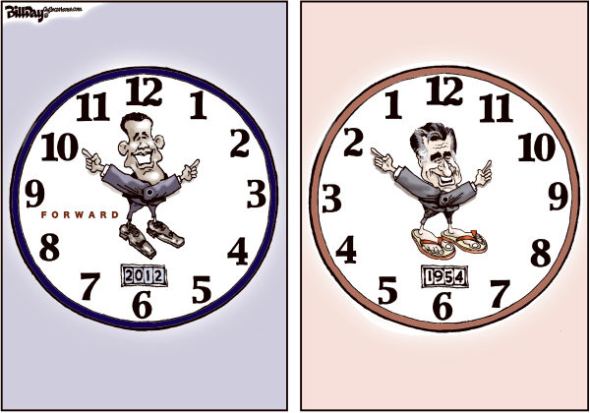
Good Morning!
Generally speaking the pundits didn’t care for President Obama’s acceptance speech on Thursday night. It’s not surprising that the guys at Politico thought it “fell flat.”
A surprisingly long parade of Democrats and media commentators described the speech less as a failure than a fizzle—an oddly missed opportunity to frame his presidency or the nation’s choice in a fresh or inspirational light.
Even those who liked the president’s performance generally went no further than saying that he was effective in doing a job that needed to be done, in a tough-minded if prosaic style.
These shoulder-shrug reactions confront Obama with a question no one expected to be asking when the week in Charlotte began: How did a president for whom stirring speeches were the engine of his rise to power manage to give, at best, only the third-most compelling speech at a convention devoted to his own re-election?
But even more liberal commentators found Obama’s speech wanting. Peter Beinart called it “underwhelming and anticlimactic.”
Obama’s acceptance speech had two apparent goals: The first was to lay out an agenda for the next four years so people feel they have something forward-looking to vote for. The second was to recapture the sense of hope that defined Obama’s 2008 campaign.
On paper, he did both things. But what the speech lacked was a coherent explanation of the nightmare this country has gone through for the last four years. Republicans are laying the Great Recession at Obama’s feet. Obama is saying that Republicans created it and, if elected, will make it worse. To win that argument, Obama needed to explain why the financial crisis happened, and he didn’t. Yes, he mocked the GOP for proposing tax cuts as the answer to every problem, but the financial crisis didn’t happen because of tax cuts. It happened, in large measure, because Republican and some Democratic politicians—blinded by free-market fundamentalism and Wall Street largesse—allowed bankers to create unregulated markets in which they gambled the savings of millions of Americans, knowing that if their bets failed, they wouldn’t be the ones to lose their homes and their life’s savings.
Obama should have told that story, and then gone at Romney for doubling down on the ideology that almost brought America to its knees. Then he should have contrasted that with his own interventions to protect people who the market has failed: whether they be auto workers or people with sick kids.
Michael Tomasky called it Pedestrian and Overconfident
Let’s be blunt. Barack Obama gave a dull and pedestrian speech tonight, with nary an interesting thematic device, policy detail, or even one turn of phrase. The crowd sure didn’t see it my way. The delegates were near delirium; to what extent they were merely still feeding off the amassed energy of the previous two nights I can’t say.
And swing voters watching at home? They probably weren’t as bored as I was, but it seems inconceivable that they’d have been enraptured. This was the rhetorical equivalent, forgive the football metaphor, of running out the clock: Obama clearly thinks he’s ahead and just doesn’t need to make mistakes. But when football teams do that, it often turns out to be the biggest mistake of all, and they lose.
Nevertheless, the final night of the Democratic Convention drew about 35.7 million viewers. The second night of the convention, when Bill Clinton spoke pulled in more views than the Giants-Cowboys game that played opposite the Convention coverage, about 25.1 million people–but nowhere near the number who watched the speeches by Vice President Biden and President Obama. Mitt Romney’s acceptance speech attracted 30.3 million viewers.
Howard Kurtz reported that Obama’s acceptance speech was deliberately “low-key.”
While the pundits are generally calling the president’s Thursday night address mediocre, Obama and his advisers had taken great pains to avoid soaring rhetoric that might have been derided as empty.
Indeed, they extensively tested the president’s speech in dial groups, a type of focus group where voters twist dials to register approval or disapproval of specific passages, and say it tested off the charts. The reaction, they say, was more positive than to Obama’s 2008 acceptance speech in Denver.
In short, the president deliberately dialed it down, stopping well short of the altitudes he is capable of reaching. Perhaps that will prove to be a mistake, but the decision to go with a less rousing approach was carefully considered.
The campaign’s primary goal at the Democratic convention was to provide a concrete sense of what Obama would do in a second term. That was what independent voters wanted, according to the research, and that was the focus in Charlotte.
Personally, I thought the first half of Obama’s speech was underwhelming, but I’ve never been a big fan of his speeches. About half-way through I thought the speech became more interesting. I was impressed that Obama admitted how difficult the job is and that he has questioned himself at times and that he has been “changed” by being President of the United States. I think the best evaluation of the speech that I read yesterday was by Tom Junod at Charles Pierce’s blog: President Obama Falls Back to Earth, Transformed. Junod’s thesis statement: “We should have known that Barack Obama would emerge from this convention conventionalized — that is, as a more conventional politician than he was when he went in. Or that we ever thought he could be.”
He didn’t rise to the occasion on Thursday night; he not only didn’t reinvent the possibilities of political language, he used language that many people had to feel they’d heard before. His speech was disappointing until, with about ten minutes to go, it acknowledged disappointment, and so began its rise. “The times have changed — and so have I,” he said. “I’m no longer just a candidate. I’m the president.” Of course, he was reminding us of his power; the fact of his presidency has become an argument for his presidency. But he was also reminding us that as a candidate who rose to power on the politics of pure potential, he is, as president, a fallen man. “And while I’m proud of what we’ve achieved together, I’m far more mindful of my own failiings, knowing exactly what Lincoln meant when he said, ‘I have been driven to my knees many times by the overwhelming conviction that I had no place else to go.'”
This was where the speech turned, and became, in its statement of humility, a statement of rousing power. “I ask you for your vote,” he said, and his commonplace words had a beseeching quality that put them outside the realm of political performance. He had failed to transform his office, and failed to transform our politics, but he sounded fully aware that he had been himself transformed.
He had started out as the Cassius Clay of our politics, brash and blinding, with an abilty to do things in the ring that no one else had ever thought of — with an ability to be untouchable. Now he stood inside the ring of stars on the blue carpeted stage of the Democratic National Convention as the Muhammad Ali whose greatness was proven after he returned to boxing bigger, slower, harder-hitting but also easier to hit. Oh, Ali got touched, all right, and since he lost his skill at avoiding punches he had to find the skill of taking them. He became a prodigy not of otherworldly gifts but rather of sheer will, and so it was with Obama in his speech on Thursday night. At an event that paid endless tributes to our wounded warriors, he rebranded himself as something of a wounded warrior himself; and at the very moment when those who remembered 2008 hoped he might say something that no one had ever heard before and maybe even reinvent, one more time, the possibilities of a word as hackneyed as hope itself, he instead completed his hard-won journey to convention.
Of course I never thought Obama was anything but an ordinary, conventional politician. As everyone here knows, I never bought the “hope and change” schtick. I never saw Obama as a great liberal savior. I was impressed with his acceptance speech, because he showed humility. By the end of the speech I was convinced that this man had matured in office, and because of that, I saw hope for his second term.
Apparently, Charlie Pierce never saw the transcendent Obama either.
I never heard the music.
People told me it was there. People told me it sang to them. People told me that its chords touched them deeply in their hearts. I watched as it make them weep and cheer. I watched as it moved them while I stood there, an unbeliever at the grotto, seeing only rocks and weeds where everyone around me saw and heard and joined in something altogether transformative. I was there in Boston when the president gave the speech that first sent him rocketing up the charts, and I didn’t hear it. Since then, I have seen him give an acceptance speech, an inaugural address, a Nobel oration, and three State of the Unions, and the only thing I remember about any of the latter is that he got heckled by some peckerwood from South Carolina, and that he called out the corporate meat-puppets of the Supreme Court in what I still believe is the finest — and certainly, the most prescient — moment of his presidency.
But I never found the poetry in it all. I thought he was a good, smart orator with some uniquely gifted writers and a talent for creating a warm and comfortable context in which people could take what they believed were all their best instincts out for a walk. I still believe that. He still reaches people at depths that I cannot fathom. He still reaches them in frequencies beyond my poor ability to hear.
That is pretty much how I’ve always reacted to Obama’s speeches. But in his convention speech, I thought I saw something more substantive. And it gave me hope. Pierce was impressed with Obama’s reference to “…the hard and frustrating and necessary work of self-government.”
That I heard. That I understood. It is not musical. It is not in any way poetic. But it is a clear line drawn between the president and the person and the party that would like to take his job from him. It is now an article of absolute faith among Republicans that “the government” is an entity separate from “the American people,” which they say the same way that the old Jesuits talked about “the mystical Body of Christ.” It is now an ironclad commandment of conservative orthodoxy that “the government” is something parasitic and alien. There is a reason why conservatives talk about “government” and not “self-government,” because to refer to the latter is to concede that “the government” is really the most basic product of our political commonwealth, that it is what we produce among ourselves so as to order the production of everything else that we do together. This is not an idle distinction. It is the entire message of last week’s Republican convention, and it is the entire message of the campaign they are planning to run, and, make no mistake, it resonates deeply with millions of people because it has been spoonfed to them as a kind of noxious anesthetic for almost foty years now, a long enough time for it to seem as though it is the natural order of things.
“…the hard and frustrating and necessary work of self-government.”
Make no mistake. This little throwaway line was the most direct, and the most serious, challenge that the president threw down at the feet of the Republican ticket on Thursday night because it strikes at the very essence of four decades of conservative political philosophy. We create “the government” we have. “The government” is not imposed from without. It is our creation. Its proper operation is our responsibility. If we do not like the way it operates, we do the hard and frustrating and necessary work to change the way it does. If we believe that it is being hijacked, we do the hard and frustrating and necessary work of using the tools of self-government to run the moneychangers out of the place. If we do not like the way the person we vote for is doing the job with which we have entrusted him — if he, say, allows the crooks who brought down the economy to walk away free, or if he perpetuates policies antithetical to civil liberties, or if he gets a little too cozy with fracking or if he gives away too much in some Grand Bargain — then we do the hard and frustrating and necessary work of self-government to hold his damn feet to the fire and say, “No further.”
Please go read the whole thing if you haven’t already. Obama articulated the key difference between today’s Republicans and the rest of us. They hate government and believe it should do nothing for people, just fund national defense and aid corporations. Most Democrats still believe that Government has a role in making people’s lives better, in ensuring that even the weakest and most vulnerable among us have rights to “life, liberty, and the pursuit of happiness.”
At the same time we citizens have the responsibility to stand up to our leaders, to voice our needs and our values, to remind our leaders that they work for us and there are certain things we won’t tolerate–whether that’s privatizing social security and medicare, limiting women’s rights, killing people with unmanned drones, limiting voting rights or some other policy that is important to us.
I think Obama’s speech got the job done. It made the convention delegates happy, and it laid a foundation for the arguments he will make over the final few weeks of the campaign. I hope he will continue to emphasize the importance of citizenship–of the necessity of every American being involved in “self-government.” That is the price of democracy.
Now what are you reading and blogging about today? This is an open thread!
Sunday Afternoon Open Thread: Is Mitt Romney A Wimp?
Posted: July 29, 2012 Filed under: 2012 presidential campaign, Mitt Romney, open thread | Tags: anxiety, Bain Capital, George H. W. Bush, insecurity, Justin Frank, Michael Tomasky, Newsweek cover, prep school bully, psychoanalysis, wimp factor 26 Comments
He’s kind of lame, and he’s really … annoying. He keeps saying these … things, these incredibly off-key things. Then he apologizes immediately—with all the sincerity of a hostage. Or maybe he doesn’t: sometimes he whines about the subsequent attacks on him. But the one thing he never does? Man up, double down, take his lumps.
In 1987, this magazine created a famous hubbub by labeling George H.W. Bush a “wimp” on its cover. “The Wimp Factor.” Huge stir. And not entirely fair—the guy had been an aviator in the war, the big war, the good war, and he was even shot down out over the Pacific, cockpit drenched in smoke and fumes, at an age (20) when in most states he couldn’t even legally drink a beer. In hindsight, Poppy looks like Dirty Harry Callahan compared with Romney, who spent his war (Vietnam) in—ready?—Paris. Where he learned … French. Up to his eyeballs in deferments. Where Reagan saddled up a horse with the masculine name of El Alamein, Mitt saddles up something called Rafalca—except that he doesn’t even really do that, his wife does (dressage). And speaking of Ann—did you notice that she was the one driving the Jet Ski on their recent vacation, while Mitt rode on the back, hanging on, as Paul Begala put it to me last week, “like a helpless papoose”?
Yes, of course Willard is a wimp. Hey, he doesn’t even have the guts to admit to use his own first name! The only time Mitt feels tough is when he’s beating up on someone weaker than he is–like his opponents in the primaries. He’s still just a prep school bully who’s overcompensating for his own insecurity.
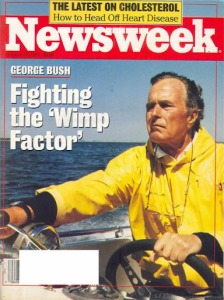
Back to Tomasky:
In some respects, he’s more weenie than wimp—socially inept; at times awkwardy ingratiating, at other times mocking those “below” him, but almost always getting the situation a little wrong, and never in a sympathetic way. The evidence resonates across too many years to deny. What kind of teenager beats up on the misfit, sissy kid, pinning him down and violently cutting his hair with a pair of school scissors—the incident from Romney’s youth that The Washington Post famously reported (and Romney famously didn’t really deny) back in May? The behavior extends, through more sedate means, into adulthood. The Salt Lake Olympics remains his greatest triumph, for which he wins deserved praise. But to many of those in the know, Romney placed a heavy asterisk next to his name by attacking the men he replaced on the Olympic Committee, smearing them in his book, even after a court threw out all the corruption charges against them.
And what kind of presidential candidate whines about a few attacks and demands an apology when the going starts to get rough? And tries to sound tough by accusing the president who killed the world’s most-wanted villain of appeasement? That’s what they call overcompensation, and it’s a dead giveaway; it’s the “tell.” This guy is nervous—terrified—about looking weak. And ironically, being terrified of looking weak makes him look weaker still.
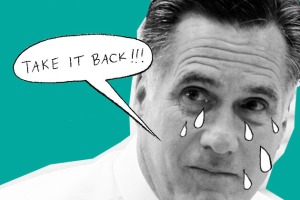
Romney claims the Newsweek cover doesn’t bother him even a tiny little bit. It’s the first time he’s been called a wimp, he says. Really? See here and here. The meme is catching on. If Willard weren’t a wimp, he’d release his tax returns tomorrow and dare the media to find anything to be ashamed of. But he can’t, because he’s terrified.
Psychoanalyst Justin Frank, author of the books Bush on the Couch and Obama on the Couch, provided a first pass on Romney’s psychology at Salon. Frank notes the way Romney frequently responds to situations by seemingly speaking without thinking ahead.
When Brian Williams asked him what he thought about the London games, Romney first tried to answer the question directly – something most politicians usually don’t do. He said, “It’s hard to know just how well it will turn out.” He then began to talk about his own work running the 2002 SLC winter Olympics in what seemed like a canned response. What strikes me is the confidence with which he spoke and the remarkable lack of thought he exhibited. This has become a pattern for him, and not just on this trip. But it is more noticeable than before because he is largely left to his own devices, without prepared remarks that he could use in informal conversation.
In many cases, Romney ends up having to walk back his initial comments as he did in London with his criticisms of Britain’s preparations for the Olympics. Frank’s assessment of Romney so far (emphasis added):
I think the force behind this behavior is massive anxiety, pure and simple. He is anxious about revealing who he is and about interacting with people he doesn’t know. He appears to have much less experience than Obama in interacting with people from all walks of life. Basically, he is uncomfortable except within his own family and in the presence of those who share his wealthy background and Mormon faith. There are many ways to defend against overwhelming anxiety, one of which is to act certain about every answer given.
What comes out besides this sense of smiling certainty are signs of anxious contempt toward others – whether it is how the British run their Games or saying that kids who can’t afford college should borrow money from their parents. Put together, these and many similar statements – his pleasure at firing people or his belief that corporations are people (is that why he can comfortably bankrupt some?) – are all evidence of a hostility not dissimilar to stories about his bullying of others during his prep school days. At this stage, I suspect Mitt Romney is too anxious to be an effective president.
The Meme That Just Won’t Die: Hillary as VP
Posted: May 23, 2012 Filed under: U.S. Politics | Tags: Barack Obama, gender gap, Hillary Clinton, Joe Biden, Michael Tomasky, Mitt Romney, Secretary of State, Vice President 50 Comments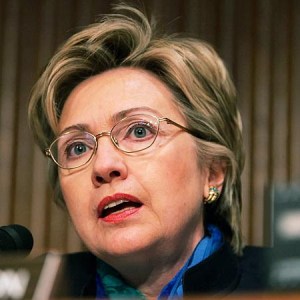
Here we go again. Today Michael Tomasky discusses the possibility that Hillary could switch jobs with Joe Biden. Tomasky was reacting to a snarky piece in the Washington Times, so take it with a large grain of salt. Tomasky writes:
Clinton’s positive numbers are off the charts. Biden’s are so-so—both approval and disapproval sit in the 40s. Biden’s putative asset, that he helps a bit with white working-class and Catholic voters, is even truer of Clinton, the famous drinker of shots in those proletarian Pennsylvania bars. And women—forget about it. An Obama-Clinton ticket would pulverize any Romney ticket on the distaff side (is that insulting? I’m just trying to avoid repeating the word “women” too much). It wouldn’t matter if he put Carrie Underwood on his ticket.
I know, I know. It’s silly. I can right now picture the friends reading this who will write me to say, “Mike, that’s silly.” It probably is. But here are a few points for your consideration that aren’t silly at all.
Actually, I don’t see anything silly about the idea, but then I’m “on the distaff side.” Tomasky notes that in the recent NYT-CBS poll, Romney is actually leading among women. Is it really possible that Romney has narrowed the gender gap. If so, Obama would be in big trouble.
In other words, it may well be that Romney could close the gender gap. And if he could close it to 5 points, it will be an extremely close election.
Now bring in Hillary. Forget about it. The most consistently admired woman in America over the last 20 years? The gender gap would be 20 points. And the Obama and Clinton machines fused like that—it’s like Secretariat and Zenyatta breeding. And the signal sent to Democrats and women across the country that the whole thing is being teed up for her in 2016. This would be a blowout.
And Biden, you ask? Well, the gay-marriage thing might finally have been the straw that made Obama think it’s not so great having Joe around. But don’t feel bad for him. He benefits from the fact that the White House would have to do this smoothly, which means Biden can’t possibly just be hung out to dry. So he’s going to be landing on a $300 goose-down pillow. He gets to be secretary of state—the job he’s dreamed of for years anyway!
It makes a lot of sense, but it probably won’t happen–not because it’s a “silly” idea, but because Obama doesn’t have the guts to do it. If he did, it would be a real “game changer.” Suddenly this deadly dull election season would become very exciting. And Hillary would be teed up to run in 2016.
What do you think?
Beltway Bob Rationalizes Obama’s Blunders, while Michael Tomasky Sees a “Scared President”
Posted: September 19, 2011 Filed under: Medicaid, Medicare, Social Security, Team Obama, U.S. Economy, U.S. Politics, voodoo economics | Tags: "grand bargain", Bagdad Bob, Barack Obama, Beltway Bob, Confidence men, deficit reduction speech, Ezra Klein, John Boehner, Medicaid, medicare, Michael Tomasky, Ron Suskind, Social Security, Tea Party 25 Comments
Beltway Bob
Okay, I realize that is a silly title, but after reading Beltway Bob’s Ezra Klein’s latest post and then reading the transcript of Barack Obama’s Rose Garden speech from this morning, I was feeling a little bit punchy.
Dakinikat recently called Ezra Klein “Beltway Bob,” or the Bagdad Bob of the Beltway. That’s a perfect name for Klein, who is apparently way too young to remember anything about politics before about 1990. The guy is naive beyond belief. Lately he seems to see his role as explaining away all of Obama’s blunders, usually by arguing that the President is just too good and moral for the rough and tumble of politics.
This morning, Klein set out to explicate the “deficit reduction plan” that Obama announced in his speech this morning. Specifically, Klein wanted to explain “why the White House changed course.”
President Obama’s deficit-reduction plan (pdf)
is most interesting for what’s not in it. It does not cut Social Security by “chaining” the program’s cost-of-living increases. It does not raise the eligibility age for Medicare from 65 to 67. Nor does it include any other major concessions to Republicans. Rather, the major compromise it makes is with political reality — a reality that the White House would prefer not to have had to acknowledge.Since the election, the Obama administration’s working theory has been that the first-best outcome is striking a deal with Speaker John Boehner and, if that fails, the second-best outcome is showing that they genuinely, honestly wanted to strike a deal with Speaker John Boehner.
That was the thinking that led the White House to reward the GOP’s debt-ceiling brinksmanship by offering Boehner a “grand bargain” that cut Social Security, raised the Medicare age, and included less new revenue than even the bipartisan Gang of Six had called for. It was also a theory that happened to fit Obama’s brand as a postpartisan uniter and his personal preferences for campaigning on achievements rather than against his opponents. But though it came close to happening, the “grand bargain” ultimately fell apart. Twice.
The collapse of that deal taught them two things: Boehner doesn’t have the internal support in his caucus to strike a grand bargain with them, and the American people don’t give points for effort.
Very likely you’re asking yourself, “What the heck does that mean?” I certainly was when I first read it. Is this guy trying to tell us that no one in the White House understood until recently that Boehner had a bunch of looney-tunes tea party reps to deal with? Is he really trying to convince us that–after all those years in Illinois politics and his admittedly short time in national politics–that Obama and/or his advisers actually did not understand that voters expect results, not “just words?”
The answer is “yes.” Beltway Bob does expect you to believe that. The rest of his column is devoted to explaining in great detail that Obama and his advisers actually believed that voters would be thrilled if he made nice with Republicans even if it meant selling out every Democratic ideal–that if the President “looked like a nice guy,” the voters–especially Independents, I guess–would rush to the polls to reelect him.
But now, according to Beltway Bob, the White House staff and the President understand that they made a huge mistake: “the second-best outcome isn’t necessarily looking like the most reasonable guy in the room. It’s looking like the strongest leader in the room.” So that’s why Obama threatened to veto any plan that cuts Medicare or Medicaid and he has for now supposedly taken Social Security off the table. It’s all so sad, according to Beltway Bob–poor Barack has had to go back on all his ideals (those ideals apparently being that he wanted to a great compromiser, while caring nothing about the effects of his compromises) and accept “politics as usual.” Boo-hoo-hoo.
Rather than emphasizing his willingness to meet Boehner’s bottom lines, which was the communications strategy during the debt ceiling showdown, he’s emphasizing his unwillingness to bend on his bottom lines.
That isn’t how the White House would prefer to govern. It’s not how they would prefer to campaign. It is, let’s admit it, politics-as-usual. It’s the triumph of the old way of doing things, an admission that Washington proved too hard to change. But it’s also the only option they have left.
Ezra Beltway Bob can’t seem to recall the hundreds of times that Obama has vowed to draw lines in the sand and then quickly backtracked–not to mention all the Campaign promises he went back on. But why on earth should anyone with a functioning memory believe this hogwash?
Frankly, IMHO, if Obama has in fact taken Social Security, Medicare, and Medicaid changes off the table–which I strongly doubt–it’s probably because he’s scared silly that Americans are finally seeing through his lies.
If you read the transcript of Obama’s speech, you’ll see that he sounds defensive, hesitant, scared of his own shadow. This morning he called for the wealthy to pay at least 20% of their income in taxes. We are supposed to buy that that is a tax increase. Yet under Bush, the wealthiest Americans were supposed to pay 35%, already an unconscionably low rate–why not make them pay that much at least?

Michael Tomasky
Because our President is a scaredy cat, that’s why! I think the change–if it’s real–has everything to do with the news that has come out about Ron Suskind’s new book Company Men, which will be released tomorrow. The news reports about the book make Obama sound like a weak, passive, detached executive who lets his underlings push him around. Michael Tomasky at the Daily Beast calls him “The Scared President.”
Tomasky notes that he was persuaded by what Suskind wrote about the Bush administration in a previous book.
I’m on record as taking Suskind at his word in such matters. In early 2004, when Suskind and Bush Treasury Secretary Paul O’Neill produced The Price of Loyalty, I reviewed it for The New York Times and found it persuasive.That book was the first to confirm what everyone knew anyway: that the Bush White House was run according to politics, not policy. Confidence Men also confirms what we knew about Obama’s White House: that the president appointed the wrong economic team from the start, failed to crack down on the banks, and was Solomonic to a fault when formulating responses to the financial crisis (oh, and news flash: Larry Summers is hard to work with!).
That would be interesting without being shocking. But the indictment goes one mortifying step deeper: Geithner and Summers and Rahm Emanuel, and perhaps others, sometimes ignored Obama, refused to carry out his orders, and, in Summers’s case, mocked him, saying at one point to then-Budget Director Peter Orszag that “there’s no adult in charge” in the White House. And while I don’t yet know whether Suskind emphasizes this point, let’s carry the critique one step further: They did so, as far as we know, without suffering any consequences at all.
No matter how much the White House tries to deny the details that have come out on Suskind’s book, the overall takeaway is that Obama is weak and indecisive. And that is the impression that most Americans have about him already, so why should they disbelieve it? Tomasky:
That’s the problem the book reveals. Adam Moss and Frank Rich of New York magazine did get an early copy and read it, and in an online dialogue posted over the weekend, they home in on what Rich calls Obama’s “intellectual blind spot.” Obama even recognized it himself, telling Suskind he was too inclined to look for “the perfect technical answer” to problems; Rich quotes Suskind as writing that Obama always favored policies that were “respectfully acknowledging opponents’ positions, even those with thin evidence behind them, that then get stitched together into some pragmatic conclusion—but hollow.”
That sounds awfully apt to me. Obama was afraid to be the president. He listened to a dozen viewpoints and tried to come up with something that made everyone happy. Unfortunately, “everyone” included people on his team who were looking out for the banks more than for the public (or for their own boss), and it included people on Capitol Hill whose clear agenda was Obama’s political destruction. It’s the central—and depending on how the next election turns out, possibly decisive—paradox of this president: In trying way too hard to look presidential in the sense of “statesmanlike,” he has repeatedly ended up looking unpresidential in the sense of not being a leader.
Obama wasn’t ready to be President in 2008, and he still isn’t. Tomasky claims to have hopes that Obama can turn it around, but I think it’s just too late. There have been too many lies, too many betrayals of campaign promises, too many sellouts to Wall Street and the Republicans, and too many reversals of supposed lines in the sand.
Perhaps if Obama were capable of followingJames Carville’s advice and fired most of his staff and stood up to Wall Street and the Republicans, as Tomasky hopes. But Obama simply can’t do it. He’s too weak and inexperienced.
Whether you look at Obama through the eyes of Beltway Bob and conclude that this President is just too good and holy for “politics as usual” or through the eyes of Tomasky and conclude that Obama is scared of his own advisers and of Republicans in Congress, this man is simply not qualified for the office he holds. Obama must go. There is no other realistic solution to the country’s problems.

 peej
peej Carissa
 bostonboomer
 dakinikat
 ecocatwoman
 mablue2
 Mama Lopez
 peggysue22
 quixote
 skydancingguestblogger
 Mona (aka Wonk the Vote)



 Sky Dancing
Recent Comments