
Thursday Reads: Media Ignorance and Brian Williams’ Flashbulb Memory
Posted: February 5, 2015 Filed under: Hillary Clinton, Media, morning reads, The Media SUCKS, U.S. Military | Tags: Brian Williams, flashbulb memories, IRAQ, memory errors, retroactive interference 34 Comments
Edvard Munch, Winter landscape at Hvitsten, 1918
Good Morning!!
I’m still snowed in. I’ve been shoveling for two days, but 40+ inches of snow in a week was just too much for me to handle alone. My sister-in-law was going to come down from New Hampshire today to help me dig out, but it’s snowing again, so she may have to wait until tomorrow. My cold is still hanging on too, so this post may be a little disjointed. I’m going to focus on a “shocking” story about newscaster Brian Williams that broke over the past couple of days. The illustrations I’m are paintings of winter scenes by Edvard Munch.
Yesterday, NBC News anchor Brian Williams was caught telling a false story about being shot down in a helicopter in Iraq. From Politico:
On Friday night’s broadcast, Williams cited “a terrible moment a dozen years back during the invasion of Iraq when the helicopter we were traveling in was forced down after being hit by an RPG. Our traveling NBC News team was rescued, surrounded and kept alive by an armor mechanized platoon from the U.S. Army 3rd Infantry.”
One crew member responded to the story on Facebook the following day, writing to Williams, “Sorry dude, I don’t remember you being on my aircraft. I do remember you walking up about an hour after we had landed to ask me what had happened.”
This week, crew members of 159th Aviation Regiment’s Chinook helicopter also told Stars and Stripes that Williams had not been in the shot-down helicopter but had arrived an hour later.
On Wednesday, Williams conceded that he was not onboard the shot-down helicopter, but he told Stars and Stripes he did not intentionally make the mistake.
“I would not have chosen to make this mistake,” Williams said. “I don’t know what screwed up in my mind that caused me to conflate one aircraft with another.”
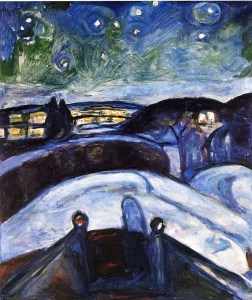
Edvard Munch, Winter Night with Stars
From Stars and Stripes’ exclusive: NBC’s Brian Williams recants Iraq story after soldiers protest.
Williams made the claim about the incident while presenting NBC coverage of the tribute to the retired command sergeant major at the Rangers game Friday. Fans gave the soldier a standing ovation.
“The story actually started with a terrible moment a dozen years back during the invasion of Iraq when the helicopter we were traveling in was forced down after being hit by an RPG,” Williams said on the broadcast. “Our traveling NBC News team was rescued, surrounded and kept alive by an armor mechanized platoon from the U.S. Army 3rd Infantry.”
Williams and his camera crew were actually aboard a Chinook in a formation that was about an hour behind the three helicopters that came under fire, according to crew member interviews.
That Chinook took no fire and landed later beside the damaged helicopter due to an impending sandstorm from the Iraqi desert, according to Sgt. 1st Class Joseph Miller, who was the flight engineer on the aircraft that carried the journalists.
The Daily Beast’s Lloyd Grove: Brian Williams’ War Story Is FUBAR.
Unfortunately for Williams, this is not the first time he has made “this mistake” on network television. On the March, 26, 2013 episode of CBS’s Late Show With David Letterman, he told the host (at the 3-minute, 50-second mark): “Two of our four helicopters were hit by ground fire, including the one I was in.”
“No kidding!” Letterman exclaimed.
“RPG and AK-47,” Williams elaborated.
“What altitude were you hit at?” Letterman asked.
“We were only at 100 feet doing 100 forward knots…”
“What happens the minute everybody realizes you’ve been hit?” Letterman asked.
“We figure out how to land safely—and we did,” Williams answered. “We landed very quickly and hard…”
Stars and Stripes left open the possibility that Williams also misreported the incident initially on March 26, 2003, but it turns out that back then, at least, he never claimed to have been aboard the attacked chopper—during two different broadcasts on that date. Television news analyst Andrew Tyndall dipped into his videotape library and screened the Nightly News segment in which Williams said “he was in a convoy of helicopters, one of which got hit,” Tyndall told The Daily Beast.
NBC News, meanwhile, unearthed a March 26, 2003 Dateline segment in which Williams reported: “On the ground, we learn that the Chinook ahead of us was almost blown of the sky.”
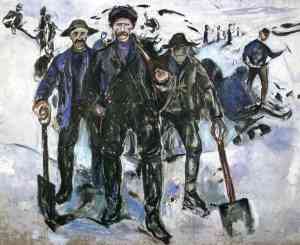
Edvard Munch, Workers in the Snow
Grove compared Williams’ conflation of events with a story Hillary Clinton told in 2008.
2008 presidential candidate Hillary Clinton’s false assertion that, as first lady in March 1996, she came under sniper fire during a trip to Tuzla, Bosnia. “I remember landing under sniper fire,” Clinton said during a speech. “There was supposed to be some kind of a greeting ceremony at the airport, but instead we just ran with our heads down to get into the vehicles to get to our base.” CBS News video of Clinton’s arrival showed no such thing; instead she alighted on the tarmac and greeted a welcoming child who offered her a poem.
I would compare Williams’ flub to tales that then presidential candidate Ronald Reagan told about events he recalled that never happened. A famous example from memory expert Daniel Schacter:
In the 1980 presidential campaign, Ronald Reagan repeatedly told a heartbreaking story of a World War II bomber pilot who ordered his crew to bail out after his plane had been seriously damaged by an enemy hit. His young belly gunner was wounded so seriously that he was unable to evacuate the bomber. Reagan could barely hold back his tears as he uttered the pilot’s heroic response: “Never mind. We’ll ride it down together.” …this story was an almost exact duplicate of a scene in the 1944 film “A Wing and a Prayer.” Reagan had apparently retained the facts but forgotten their source (Schacter 1996, 287).
An even more dramatic error by Reagan was his claim to have been present at the liberation of Auschwitz.
In November 1983, he told Israeli Prime Minister Yitzhak Shamir during a White House visit that while serving in the U. S. Army film corps, his unit had shot footage of the Nazi concentration camps as they were liberated. He repeated the same tale to Nazi hunter Simon Wiesenthal and other witnesses. Reagan had indeed served in the Army and worked on morale-boosting movies for the War Department. But he had done so without ever leaving Hollywood for the entire duration of the war.
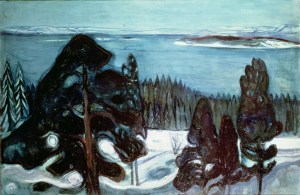
Edvard Munch, Winter Night
And then there was the story about 9/11 that George W. Bush was repeatedly criticized for–he claimed on that morning he had seen the first plane hit the World Trade Center twin towers before he went into a school for a photo op of him reading to children. But that was impossible, because film of the first tower being hit was not aired until the next day later that day. Here’s Bush’s story quoted in a piece at e-Skeptic by memory expert Daniel Greenberg
I was in Florida. And my chief of staff, Andy Card — actually I was in a classroom talking about a reading program that works. And I was sitting outside the classroom waiting to go in, and I saw an airplane hit the tower — the TV was obviously on, and I use[d] to fly myself, and I said, “There’s one terrible pilot.” And I said, “It must have been a horrible accident.” But I was whisked off there — I didn’t have much time to think about it, and I was sitting in the classroom, and Andy Card, my chief who was sitting over here walked in and said, “A second plane has hit the tower. America’s under attack.”
Two weeks later Bush’s story had evolved:
Bush remembers senior adviser Karl Rove bringing him the news, saying it appeared to be an accident involving a small, twin-engine plane. In fact it was American Airlines Flight 11, a Boeing 767 out of Boston’s Logan International Airport. Based on what he was told, Bush assumed it was an accident. “This is pilot error,” the president recalled saying. “It’s unbelievable that somebody would do this.” Conferring with Andrew H. Card Jr., his White House chief of staff, Bush said, “The guy must have had a heart attack”… At 9:05 a.m., United Airlines Flight 175, also a Boeing 767, smashed into the South Tower of the trade center. Bush was seated on a stool in the classroom when Card whispered the news: “A second plane hit the second tower. America is under attack.”

Edvard Munch, Yellow Log
The fact is that memory errors like these are quite common. Human memory is not perfect–we tend to get basic facts right, but when we retell a memory again and again or even go over it in our minds, specific details can change. There are a number of ways this can happen. We can forget the source of a memory, as Ronald Reagan did with the movie scene he believed to be real. It’s also comment to retroactively alter a memory, as Bush did with his 9/11 flashbulb memory. That is caused by “interference.” I doubt that Williams deliberately lied about his flashbulb memory from Iraq. Why would he put his reputation at risk in that way? Most likely, he conflated his memories with other things he learned later about the event that made a strong impression on him at the time.
You can read more about false flashbulb memories in this scholarly article by Greenberg (pdf): President Bush’s False ‘Flashbulb’ Memory of 9/11/01. A flashbulb memory is a very vivid recall of a dramatic event in which we have a sense “remembering” exactly where we were and who we were with when we experience or heard about the event.
Back to the Williams story.
At Slate, Ben Matthis Lilly provides a detailed timeline of the various stories Brian Williams has told about his 2003 experience over the years. The initial story Williams told in 2003 was also inaccurate, according to soldier witnesses, but Williams still claims his original report was true.
In the initial account (given on both the Nightly News and a Dateline episode on March 26, 2003), Williams clearly states that he was part of a group of helicopters that was fired upon while performing a mission:
We are one of four Chinook helicopters flying north this morning, third in line. As we head toward the drop point the Iraqi landscape looks quiet. We can see a convoy of American troop carriers and supply vehicles heading north.
This 2003 account, like Williams’ apology, implies the helicopters landed together after ground fire:
All four choppers dropped their load and landed immediately.
However, Stars and Stripes‘ piece says unequivocally that Williams’ helicopter was not part of the group that was fired upon—not third in line, and not part of the line at all.
…Crew members on the 159th Aviation Regiment’s Chinook that was hit by two rockets and small arms fire told Stars and Stripes that the NBC anchor wasnowhere near that aircraft or two other Chinooks flying in the formation that took fire. Williams arrived in the area about an hour later on another helicopter after the other three had made an emergency landing, the crew members said.
The soldiers quoted by Stars and Stripes say that they recall being upset at the time by the inaccuracies in this 2003 version of events.

Edvard Munch, New Snow on the Avenue
But do these soldiers really recall being upset in 2003? We can’t know for sure, because they didn’t tell their stories in public at the time.
I’m sure Brian Williams will continue to be attacked for his false memory. He might even lose his job over it, because lazy reporters would never consider consulting a psychologist who actually conducts research on human memory errors and their causes. Here’s Eric Wemple’s evaluation of Williams’ apology at the Washington Post:
That’s a very nice admission, though “conflating” the experience of taking incoming fire with the experience of not taking incoming fire seems verily impossible.
It might seem “verily impossible” to Wemple, but it isn’t impossible at all. It’s not even surprising to anyone who knows anything about how human memory works. I have no way of knowing for sure whether Williams lied or not; but if I had to guess, I think it’s more likely that he inadvertently created a false memory.
What stories are you following today? Please post your thoughts on the Brian Williams story and/or your recommended links in the comment thread.
Embarrassing Tales Told by Politicians
Posted: February 27, 2012 Filed under: 2012 primaries, just because, psychology, U.S. Military, U.S. Politics | Tags: Barack Obama, George W. Bush, memory errors, Mitt Romney, Ronald Reagan 8 Comments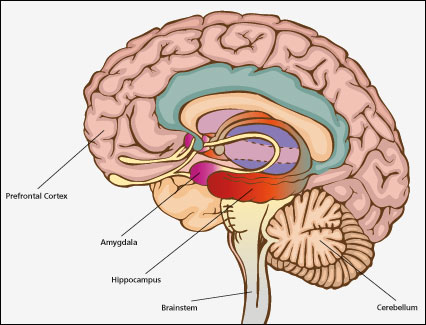
Brain areas involved in memory
Human memory can be amazingly accurate and detailed. It is possible for people to accurately recall events that happened in the decades previously. Yet humans are also subject to numerous memory errors, which are actually adaptive for most purposes, but can be embarrassing when they happen to people in the public eye.
On Saturday it happened to Mitt Romney. During his speech to a Tea Party rally in Flint, Michigan, Romney described a vivid childhood memory
Romney recalled he was “probably 4 or something like that” the day of the Golden Jubilee, when three-quarters of a million people gathered to celebrate the 50th anniversary of the American automobile.
“My dad had a job being the grandmaster. They painted Woodward Ave. with gold paint,” Romney told a rapt Tea Party audience in the village of Milford Thursday night, reliving a moment of American industrial glory.
The Golden Jubilee described so vividly by Romney was indeed an epic moment in automotive lore. The parade included one of the last public appearances by an elderly Henry Ford.
But Romney couldn’t possibly have been a the Golden Jubilee, because it happened in 1946–about 9 months before baby Willard was born. Was he lying? No, of course not. He probably formed this false memory based on stories told by family members, and perhaps family photos. This is a very common type of memory error–confusion about the source of a memory. Romney probably heard this story many times and perhaps rehearsed it by thinking about it and talking about it to family and friends.
Most theorists now believe that memories are stored in various locations in the brain and have to be reconstructed each time we recall them. Confusion can develop if we have memories of several events that happened in the same place–people can get mixed up about which time a specific event happened.
As you might expect, memory errors become more common with age. There are a number of famous stories about Ronald Reagan’s outrageous memory errors. He repeatedly told a heartrending story about a World War II bomber pilot who ordered his crew to bail out after the plane was hit by enemy fire. His young belly gunner was wounded so seriously that he was unable to evacuate the aircraft. Reagan could barely hold back tears as he related the pilot’s heroic response: “Never mind. We’ll ride it down together.” Supposedly the pilot had received the Congressional Medal of Honor, awarded posthumously.
Journalists searched in vain to learn about the war hero. They could find no Medal of Honor winner whose story matched the one told by Reagan. Finally the source of the story was identified as a scene from a Hollywood movie, “A Wing and a Prayer.” Reagan had recalled the “facts,” but not their source.
Another famous example is Reagan’s oft-repeated tale about how he had helped to liberate Auschwitz after World War II ended. In fact Reagan event repeated this “memory” to Israeli prime minister Yitzhak Shamir, explaining that he had
returned to Hollywood with film footage of the ghastly scenes he had witnessed, and if in later years anyone controverted the reality of the Holocaust over the Reagan dinner table, he would roll the footage till the doubts were stilled.
Of course no Americans were involved in the liberation of Auschwitz, which was a Russian operation. And although Reagan was in the Army, he never left California where he was involved in making propaganda films. Interestingly, Barack Obama also told a story about the liberation of Auschwitz back in 2008. Speaking to a New Mexico audience about the need for mental health care for veterancs, Obama recalled a family story about his uncle.
“I had a uncle who was one of the, who was part of the first American troops to go into Auschwitz and liberate the concentration camps,” Obama said, slowly and methodically. “And the story in my family is that when he came home, he just went into the attic, and he didn’t leave the house for six months. Alright? Now, obviously something had affected him deeply, but at the time, there just weren’t the kinds of facilities to help somebody work through that kind of pain.”
It turned out that Obama’s Uncle actually was involved in the liberation of a concentration camp, but it was Buchenwald, not Auschwitz. This was probably a story that was told repeatedly in Obama’s family, and he simply forgot the name of the camp and substituted a famous name–Auschwitz.
And then there was the 2007 speech in which Obama seemed to suggest that his parents had been brought together because of the Civil Rights march in Selma, Alabama in 1965. Obama was born in 1961. The speech actually had two doozies in it. Obama also claimed that the Kennedy family had been responsible for bringing his father to the U.S. Here’s the relevant quote:
What happened in Selma, Alabama and Birmingham also stirred the conscience of the nation. It worried folks in the White House who said, “You know, we’re battling Communism. How are we going to win hearts and minds all across the world? If right here in our own country, John, we’re not observing the ideals set fort in our Constitution, we might be accused of being hypocrites.” So the Kennedy’s decided we’re going to do an air lift. We’re going to go to Africa and start bringing young Africans over to this country and give them scholarships to study so they can learn what a wonderful country America is.
This young man named Barack Obama got one of those tickets and came over to this country. He met this woman whose great great-great-great-grandfather had owned slaves; but she had a good idea there was some craziness going on because they looked at each other and they decided that we know that the world as it has been it might not be possible for us to get together and have a child. There was something stirring across the country because of what happened in Selma, Alabama, because some folks are willing to march across a bridge. So they got together and Barack Obama Jr. was born. So don’t tell me I don’t have a claim on Selma, Alabama. Don’t tell me I’m not coming home to Selma, Alabama.
I’m here because somebody marched. I’m here because you all sacrificed for me. I stand on the shoulders of giants. I
Actually, the Kennedy family did donate $100,000 to the airlift program, but not until Barack Obama, Sr. was already in the U.S. As for how his parents got together, Obama’s campaign staff claimed that he had meant that the Civil Rights movement generally was responsible, but I think it was probably just an honest mistake. Certainly his speechwriters should have done some more careful fact-checking, but Obama was probably reporting what he “remembered.”
I’ll just share one more interest example of a high-profile false memory. This one from George W. Bush. Bush was in Orlando, Florida at a town hall meeting where he took questions from the audience. A young boy asked Bush how he felt on 9/11.
QUESTION: One thing, Mr. President, is that you have no idea how much you’ve done for this country, and another thing is that how did you feel when you heard about the terrorist attack?
….
Well, Jordan (ph), you’re not going to believe what state I was in when I heard about the terrorist attack. I was in Florida. And my chief of staff, Andy Card — actually I was in a classroom talking about a reading program that works. And I was sitting outside the classroom waiting to go in, and I saw an airplane hit the tower — the TV was obviously on, and I use to fly myself, and I said, “There’s one terrible pilot.” And I said, “It must have been a horrible accident.”
But I was whisked off there — I didn’t have much time to think about it, and I was sitting in the classroom, and Andy Card, my chief who was sitting over here walked in and said, “A second plane has hit the tower. America’s under attack.”
But Bush could not have seen the plane hit the first tower, because there was no footage shown on TV until the next day. Bush obviously watched the footage later and became confused about when he had first seen it.
We all make errors like this–we just don’t often do it in front of a crowd of people and then end up getting fact-checked afterwards. The fact is, our memories are quite reliable for most daily purposes. It wouldn’t be adaptive for us to remember every single detail of what happens to us. But it pays to be aware that our memories can fail us is predictable ways.

 peej
peej Carissa
 bostonboomer
 dakinikat
 ecocatwoman
 mablue2
 Mama Lopez
 peggysue22
 quixote
 skydancingguestblogger
 Mona (aka Wonk the Vote)



 Sky Dancing
Recent Comments