
Remember When We Had Democratic Presidents?
Posted: April 11, 2013 Filed under: Barack Obama, morning reads, Republican politics, U.S. Economy, U.S. Politics | Tags: Chained CPI, destruction of the Democratic Party, Franklin D. Roosevelt, Great Society, John F. Kennedy, Lyndon B. Johnson, Medicare cuts, New Deal, New Frontier, Obama's Grand Betrayal, Social Security cuts 40 Comments
Franklin D. Roosevelt signs the Social Security Act of 1935
Oh yes, “those were the days, my friend, we thought they’d never end…”
Roosevelt’s New Deal was before my time, but I heard about those days from my parents.
The New Deal was a series of economic programs enacted in the United States between 1933 and 1936. They involved presidential executive orders or laws passed by Congress during the first term of President Franklin D. Roosevelt. The programs were in response to the Great Depression, and focused on what historians call the “3 Rs”: Relief, Recovery, and Reform. That is, Relief for the unemployed and poor; Recovery of the economy to normal levels; and Reform of the financial system to prevent a repeat depression.
The New Deal produced a political realignment, making the Democratic Party the majority (as well as the party that held the White House for seven out of nine Presidential terms from 1933 to 1969), with its base in liberal ideas, the white South, traditional Democrats, big city machines, and the newly empowered labor unions and ethnic minorities. The Republicans were split, with conservatives opposing the entire New Deal as an enemy of business and growth, and liberals accepting some of it and promising to make it more efficient. The realignment crystallized into the New Deal Coalition that dominated most presidential elections into the 1960s, while the opposition Conservative Coalition largely controlled Congress from 1937 to 1963. By 1936 the term “liberal” typically was used for supporters of the New Deal, and “conservative” for its opponents. From 1934 to 1938, Roosevelt was assisted in his endeavours by a “pro-spender” majority in Congress (drawn from two-party, competitive, non-machine, Progressive, and Left party districts). As noted by Alexander Hicks, “Roosevelt, backed by rare, non-Southern Democrat majorities — 270 non-Southern Democrat representatives and 71 non-Southern Democrat senators — spelled Second New Deal reform.”
Many historians distinguish between a “First New Deal” (1933–34) and a “Second New Deal” (1935–38), with the second one more liberal and more controversial. The “First New Deal” (1933–34) dealt with diverse groups, from banking and railroads to industry and farming, all of which demanded help for economic survival. The Federal Emergency Relief Administration, for instance, provided $500 million for relief operations by states and cities, while the short-lived CWA (Civil Works Administration) gave localities money to operate make-work projects in 1933-34.
The “Second New Deal” in 1935–38 included the Wagner Act to promote labor unions, the Works Progress Administration (WPA) relief program (which made the federal government by far the largest single employer in the nation), the Social Security Act, and new programs to aid tenant farmers and migrant workers. The final major items of New Deal legislation were the creation of the United States Housing Authority and Farm Security Administration, both in 1937, and the Fair Labor Standards Act of 1938, which set maximum hours and minimum wages for most categories of workers.
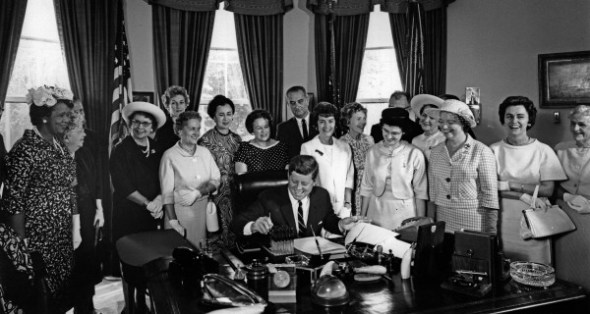
John F. Kennedy signs the Equal Pay Act of 1963
I do clearly Recall John F. Kennedy’s The New Frontier. There’s a popular myth that JFK didn’t accomplish that much legislatively before his death in 1963, but that’s what it is–a myth.
The term New Frontier was used by liberal Democratic presidential candidate John F. Kennedy in his acceptance speech in the 1960 United States presidential election to the Democratic National Convention at the Los Angeles Memorial Coliseum as the Democratic slogan to inspire America to support him. The phrase developed into a label for his administration’s domestic and foreign programs.
[W]e stand today on the edge of a New Frontier -— the frontier of 1960s, the frontier of unknown opportunities and perils, the frontier of unfilled hopes and unfilled dreams. … Beyond that frontier are uncharted areas of science and space, unsolved problems of peace and war, unconquered problems of ignorance and prejudice, unanswered questions of poverty and surplus.
In the words of Robert D. Marcus: “Kennedy entered office with ambitions to eradicate poverty and to raise America’s eyes to the stars through the space program”.Amongst the legislation passed by Congress during the Kennedy Administration, unemployment benefits were expanded, aid was provided to cities to improve housing and transportation, funds were allocated to continue the construction of a national highway system started under Eisenhower, a water pollution control act was passed to protect the country’s rivers and streams, and an agricultural act to raise farmers’ incomes was made law. A significant amount of anti-poverty legislation was passed by Congress, including increases in social security benefits and in the minimum wage, several housing bills, and aid to economically distressed areas. A few antirecession public works packages, together with a number of measures designed to assist farmers, were introduced. Major expansions and improvements were made in Social Security (including retirement at 62 for men), hospital construction, library services, family farm assistance and reclamation. Food stamps for low-income Americans were reintroduced, food distribution to the poor was increased, and there was an expansion in school milk and school lunch distribution. The most comprehensive farm legislation since 1938 was carried out, with expansions in rural electrification, soil conservation, crop insurance, farm credit, and marketing orders. In September 1961, the Arms Control and Disarmament Agency was established as the focal point in government for the “planning, negotiation, and execution of international disarmament and arms control agreements.” Altogether, the New Frontier witnessed the passage of a broad range of important social and economic reforms.
According to Theodore White, under John F. Kennedy, more new legislation was actually approved and passed into law than at any other time since the Thirties. When Congress recessed in the latter part of 1961, 33 out of 53 bills that Kennedy had submitted to Congress were enacted. A year later, 40 out of 54 bills that the Kennedy Administration had proposed were passed by Congress, and in 1963 35 out of 58 “must” bills were enacted. As noted by Larry O’Brien, “A myth had arisen that he (Kennedy) was uninterested in Congress, or that he “failed” with Congress. The facts, I believe, are otherwise. Kennedy’s legislative record in 1961–63 was the best of any President since Roosevelt’s first term”.
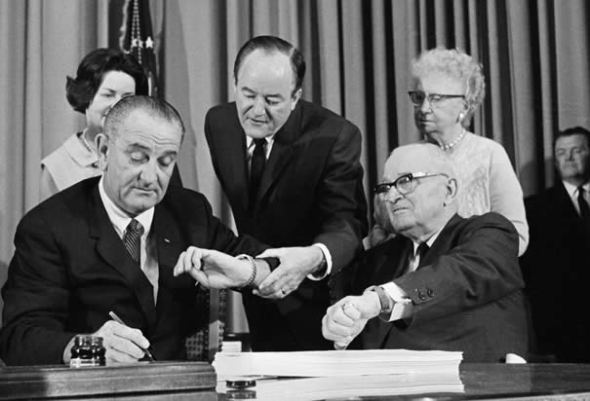
Lyndon B. Johnson signs the Medicare Act of 1964, with Harry Truman by his side
LBJ’s presidency was marred by his escalation of the war in Vietnam, but the domestic legislative accomplishments of his “Great Society” were stunning.
The aftershock of Kennedy’s assassination provided a climate for Johnson to complete the unfinished work of JFK’s New Frontier. He had eleven months before the election of 1964 to prove to American voters that he deserved a chance to be President in his own right.
Two very important pieces of legislation were passed. First, the Civil Rights Bill that JFK promised to sign was passed into law. The Civil Rights Act banned discrimination based on race and gender in employment and ending segregation in all public facilities.
Johnson also signed the omnibus ECONOMIC OPPORTUNITY ACT OF 1964. The law created the Office of Economic Opportunity aimed at attacking the roots of American poverty. A Job Corps was established to provide valuable vocational training.
Head Start, a preschool program designed to help disadvantaged students arrive at kindergarten ready to learn was put into place. The VOLUNTEERS IN SERVICE TO AMERICA (VISTA) was set up as a domestic Peace Corps. Schools in impoverished American regions would now receive volunteer teaching attention. Federal funds were sent to struggling communities to attack unemployment and illiteracy.
As he campaigned in 1964, Johnson declared a “war on poverty.” He challenged Americans to build a “Great Society” that eliminated the troubles of the poor. Johnson won a decisive victory over his archconservative Republican opponent Barry Goldwater of Arizona.
– American liberalism was at high tide under President Johnson.
– The Wilderness Protection Act saved 9.1 million acres of forestland from industrial development.
– The Elementary and Secondary Education Act provided major funding for American public schools.
– The Voting Rights Act banned literacy tests and other discriminatory methods of denying suffrage to African Americans.
– Medicare was created to offset the costs of health care for the nation’s elderly.
– The National Endowment for the Arts and Humanities used public money to fund artists and galleries.
– The Immigration Act ended discriminatory quotas based on ethnic origin.
– An Omnibus Housing Act provided funds to construct low-income housing.
– Congress tightened pollution controls with stronger Air and Water Quality Acts.
– Standards were raised for safety in consumer products.
I’m in tears right now after reading again about the accomplishments of these three great Democratic presidents. I’m in mourning today for my party and my country. For the first time, a supposedly Democratic president has proposed not only Social Security benefit cuts but also massive cuts to Medicare that will force seniors to pay higher deductibles and discourage them from buying medigap plans to cover co-pays.
I’ve known this was coming since 2007 when I read Obama’s book, The Audacity of Austerity Hope. He couldn’t have made it any clearer in the chapter on the domestic economy that he was an enthusiastic supporter of privatization and/or cuts in social programs. But although I’ve expected this for years, the reality of it has still hit me very hard. I feel both heartbroken and ashamed of President Obama.
I’ll post something else later on; but for now, please use this as a morning open thread and post your recommended links freely in the comments.
This is a sad day, but I believe Obama’s gambit will be a dismal failure. IMO he already looks foolish and ineffectual as the Republicans make hay by accusing him of trying to balance the budget on the backs of seniors. We need to understand that it is fruitless to expect him Obama stand up to the Republicans, the corporate media, or the bankers. We are on our own.
I admit, I had begun to believe that Obama had grown in office–that he had begun to realize that standing up for liberal values would serve him in good stead. But his addiction to “bipartisanship” and his fantasy of a “grand bargain” won out in the end. I still believe Romney would have been far worse, but let’s face it we still got a Republican president in 2008 and 2012. We need to fight tooth and nail to keep him from destroying the proud legacies of FDR, JFK, and LBJ.

 peej
peej Carissa
 bostonboomer
 dakinikat
 ecocatwoman
 mablue2
 Mama Lopez
 peggysue22
 quixote
 skydancingguestblogger
 Mona (aka Wonk the Vote)



 Sky Dancing
Recent Comments