Posted: August 29, 2023 | Author: bostonboomer | Filed under: Afternoon Reads, American Fascists, Congress, Donald Trump, Joe Biden, just because | Tags: Catholic reactionaries, Franklin Foer, government shutdown, Mark Meadows, Pope Francis, Rep. Andrew Clyde, UNC Chapel Hill shooting |
Good Afternoon!!
As a lapsed Catholic, I was surprised and heartened yesterday to read that Pope Francis has criticized right wing American Catholics–several of whom sit on the Supreme Court.
From the AP via Yahoo News: Pope says some ‘backward’ conservatives in US Catholic Church have replaced faith with ideology.
Pope Francis has blasted the “backwardness” of some conservatives in the U.S. Catholic Church, saying they have replaced faith with ideology and that a correct understanding of Catholic doctrine allows for change over time.
Francis’ comments were an acknowledgment of the divisions in the U.S. Catholic Church, which has been split between progressives and conservatives who long found support in the doctrinaire papacies of St. John Paul II and Benedict XVI, particularly on issues of abortion and same-sex marriage.
Many conservatives have blasted Francis’ emphasis instead on social justice issues such as the environment and the poor, while also branding as heretical his opening to letting divorced and civilly remarried Catholics receive the sacraments.
Francis made the comments in a private meeting with Portuguese members of his Jesuit religious order while visiting Lisbon on Aug. 5; the Jesuit journal La Civilta Cattolica, which is vetted by the Vatican secretariat of state, published a transcript of the encounter Monday.
More details:
During the meeting, a Portuguese Jesuit told Francis that he had suffered during a recent sabbatical year in the United States because he came across many Catholics, including some U.S. bishops, who criticized Francis’ 10-year papacy as well as today’s Jesuits.
The 86-year-old Argentine acknowledged his point, saying there was “a very strong, organized, reactionary attitude” in the U.S. church, which he called “backward.” He warned that such an attitude leads to a climate of closure, which was erroneous.
“Doing this, you lose the true tradition and you turn to ideologies to have support. In other words, ideologies replace faith,” he said.
“The vision of the doctrine of the church as a monolith is wrong,” he added. “When you go backward, you make something closed off, disconnected from the roots of the church,” which then has devastating effects on morality.
“I want to remind these people that backwardness is useless, and they must understand that there’s a correct evolution in the understanding of questions of faith and morals,” that allows for doctrine to progress and consolidate over time.
I’m surprised this pope has lasted this long. I hope he has supporters in the hierarchy.
The Daily News added more specifics:
He said it was an “error” to consider the Church’s stances on issues a “monolith,” citing how it had changed positions in the past on issues like slavery.
“In other words, doctrine also progresses, expands, and consolidates with time and becomes firmer but is always progressing,” he said.
In regards to LGBTQ issues, he said, “It is apparent that perception of this issue has changed in the course of history.”
Well, that’s a breath of fresh air. Unfortunately, I doubt if the reactionaries in the Supreme Court and the Federalist Society will be swayed by Francis’ arguments.
NBC News has some specifics on the shooting at the University of North Carolina Chapel Hill yesterday.
NBC News: UNC-Chapel Hill graduate student charged with murder in fatal shooting of faculty member.
A graduate student at the University of North Carolina-Chapel Hill was charged with first-degree murder after the fatal shooting of a professor in his research department.
Tailei Qi, an applied physical sciences major, was apprehended Monday afternoon following the shooting at Caudill Labs, a science building on the UNC campus, which prompted an hourslong lockdown that forced students and faculty to barricade themselves in classrooms and dorms as authorities searched for a suspect.
Qi, 34, was booked Tuesday in the Orange County Detention Center in Hillsborough and also charged with possession of a gun on an educational property, a felony.
The incident, which occurred in the second week of the fall semester at UNC, began when students were alerted to an armed and dangerous person after 1 p.m. The university issued another alert at 2:24 p.m. that the suspect remained at large. A photo of an unnamed person was released, and the suspect was later apprehended in a residential neighborhood near campus.
It sounds like the victim–a faculty member–might have been targeted, but that’s just my speculation.
The victim was initially described as a university faculty member, and was not immediately identified pending notification of family. The arrest warrant names the shooting victim as Zijie Yan, an associate professor in the applied physical sciences department.
A university department web page that has since been removed had listed Qi as being a member of Yan’s lab group.
On his LinkedIn profile, Qi says he enrolled at UNC’s flagship campus in January 2022 as a graduate student and research assistant, and shared links to papers on his research. One paper published last month
in the journal Advanced Optical Materials was co-authored by Yan.
So the two were well known to each other. We’ll probably learn more in the coming days.
At The Daily Beast, attorney Shan Wu has a piece on Mark Meadows’ choice to testify under oath yesterday: Mark Meadows Just Took an Enormous Risk. Will It Pay Off?
Meadows wants out of the Fulton County court so badly that on Monday, he took the enormous risk of testifying in his own criminal trial and subjecting himself to cross-examination by the Fulton County District Attorney’s Office.
Meadows’ longing for federal court may seem puzzling because switching is but a change of courthouses. In federal court, Meadows will face the same charges, under the same state laws (including the Georgia RICO Act), brought by the same prosecutor.
However, Meadows may be counting on the fact that a federal trial would give him a broader geographic jury pool which might be more favorable to him. He also may think that a federal court would be more sympathetic to his argument that his position as a federal official should automatically make him immune from a state criminal prosecution.
Theoretically, Meadows’ removal argument under 28 U.S. code § 1442 doesn’t look that hard to make, since he only needs to show that he was a federal official at the time and that he can raise a “colorable legal defense.” Meadows was a federal official at the time as Trump’s White House chief of staff, so he can meet that part of the legal standard.
He also has a “federal defense” to raise based on so-called “Supremacy Clause Immunity,” meaning that as a federal officer he cannot be criminally prosecuted by a state for actions performed in his official federal capacity. The question though is whether that defense is a “colorable one” in these circumstances. In plain English, a “colorable defense” is just one that passes the smell test. That may prove challenging for Meadows.
The problem for Meadows is that he needs to convince federal judge Steve C. Jones–a former state judge appointed to the U.S. District Court by President Obama–that his actions in allegedly conspiring with Trump and 18 other co-defendants to overturn the election results in Georgia were part of his job description as White House chief of staff.
Holding aside the fact that the Hatch Act bars a federal official from using their office to engage in partisan political activity, Meadows must prove that his involvement in such acts as the phone call to Brad Raffensberger, in which Trump pressured the Georgia secretary of state to find votes for Trump, were just part of doing his job.
The federal government does not have the power to regulate presidential elections. A strict reading of Article II, Section 1, clause 4 of the Constitution would allow only regulation of the “time” of choosing presidential electors and certainly there is no known precedent for a White House chief of staff overseeing any aspect of a state election process.
Read more at the link.
Republicans are trying to find a way to shut down the prosecutions of Trump by any means necessary.
From NBC News:
WASHINGTON — Four criminal indictments of Donald Trump have ignited his followers and spurred his House Republican allies to try to use the upcoming government funding deadline of Sept. 30 as leverage to undermine the prosecutions.
The bad news for them: A government shutdown wouldn’t halt the criminal proceedings against the former president.
Trump’s indictments in New York and Georgia would not be affected, while his federal indictments — for allegedly mishandling classified documents and for his role in the Jan. 6 insurrection — are criminal matters that have been exempted from shutdowns in the past. The Justice Department said in a 2021 memo that in a shutdown, “Criminal litigation will continue without interruption as an activity essential to the safety of human life and the protection of property.” The Justice Department’s plans assume that the judicial branch remains fully operational, which it has said in the past can carry on for weeks in the event of a funding lapse.
Special counsel Jack Smith’s office is funded by a “permanent, indefinite appropriation for independent counsels,” the department said in its statement of expenditures. Given its separate funding source, the special counsel would not be affected by a shutdown and could run off of allocations from previous years.
So how are these idiots planning to stop the prosecutions?
As a result, Republicans are looking at ways to insert provisions in government funding legislation that would hinder federal and state prosecutors who have secured indictments of Trump, based on unproven claims that he’s being politically targeted.
It won’t be easy to achieve. The demands, spearheaded by hard-right Republicans, have sparked internal party divisions over reining in law enforcement power and will struggle to pass the House. The Justice bill is one of two appropriations measures the House GOP hasn’t yet passed, out of 12 total, a Democratic aide noted, which could signify splits about how to proceed. And Democrats, who control the Senate and the White House, are pushing back on those calls to derail law enforcement as interference in Trump’s cases….
Rep. Andrew Clyde, R-Ga., a Trump ally who sits on the Appropriations Committee, said Monday he will introduce two amendments to eliminate federal funding for all three of Trump’s prosecutors — Smith, Fulton County District Attorney Fani Willis and Manhattan District Attorney Alvin Bragg. His office said the measures would block their prosecutorial authority over “any major presidential candidate prior to” the 2024 election.
“Due to my serious concerns about these witch hunt indictments against President Trump, I intend to offer two amendments to prohibit any federal funds from being used in federal or state courts to prosecute major presidential candidates prior to the 2024 election,” Clyde said in a statement.
These so-called legislators have done nothing this session except “investigate” Hunter and Joe Biden and try to protect Trump.
A new book on the Biden administration by Franklin Foer is coming out on September 5. You can read an excerpt that focuses on the withdrawal from Afghanistan at The Atlantic.
This is from today’s Politico Playbook: A first look at the big new Biden book.
Atlantic staff writer FRANKLIN FOER originally set out to write an account of Biden’s first one hundred days in office, focusing on the Biden team’s response to the pandemic and the undoing of Trump’s major policies. But Foer kept reporting as the story of the American Rescue Plan, the Inflation Reduction Act, the Afghanistan withdrawal, Ukraine and ultimately the midterm elections unfolded.
Along the way he conducted nearly 300 interviews from November 2020 to February 2023. The result is his eagerly anticipated 407-page tome about Biden world: “The Last Politician: Inside Joe Biden’s White House and the Struggle for America’s Future” ($30).
In recent days Biden aides have been scrambling to secure a password-protected PDF of the book that has been sent to select journalists and reviewers, some of whom were required to sign nondisclosure agreements and promise not to share the contents with newsroom colleagues.
A major media rollout of the book is set to kick off this week. (In fact, we’ll be recording a conversation with Foer this afternoon for next week’s episode of the Playbook Deep Dive podcast.)
In the publishing world, “The Last Politician” is seen as a test of the market for political books about figures other than DONALD TRUMP. In Washington, the book will be a test for how a generally leak-proof White House grapples with the first detailed excavation of its successes and failures from the Inaugural through the midterms.
Minutes ago, the first excerpt of the Foer book was posted at the Atlantic and will appear across 13 pages in the magazine’s October issue. The piece — “The Final Days” — is a gripping history of America’s withdrawal from Afghanistan during August 2021, a month that marks one of the low points for a team that was elected for its competence. Foer’s account is notable both for his deep reporting as well as his shrewd insights into how Biden thinks, including the president’s unsentimental views on his decision to end America’s longest war.
Read more Politico-style analysis at the link.
That’s all I have for you today. Here’s hoping that Hurricane headed for Florida won’t cause too much damage. Take care everyone.
Did you like this post? Please share it with your friends:
Posted: August 22, 2023 | Author: bostonboomer | Filed under: Crime, Criminal Justice System, Donald Trump, just because | Tags: Georgia election interference case, Jack Smith, January 6 case, Jeff Clark, John Eastman, Judge Tanya Chutkan, Mark Meadows |
Good Afternoon!!
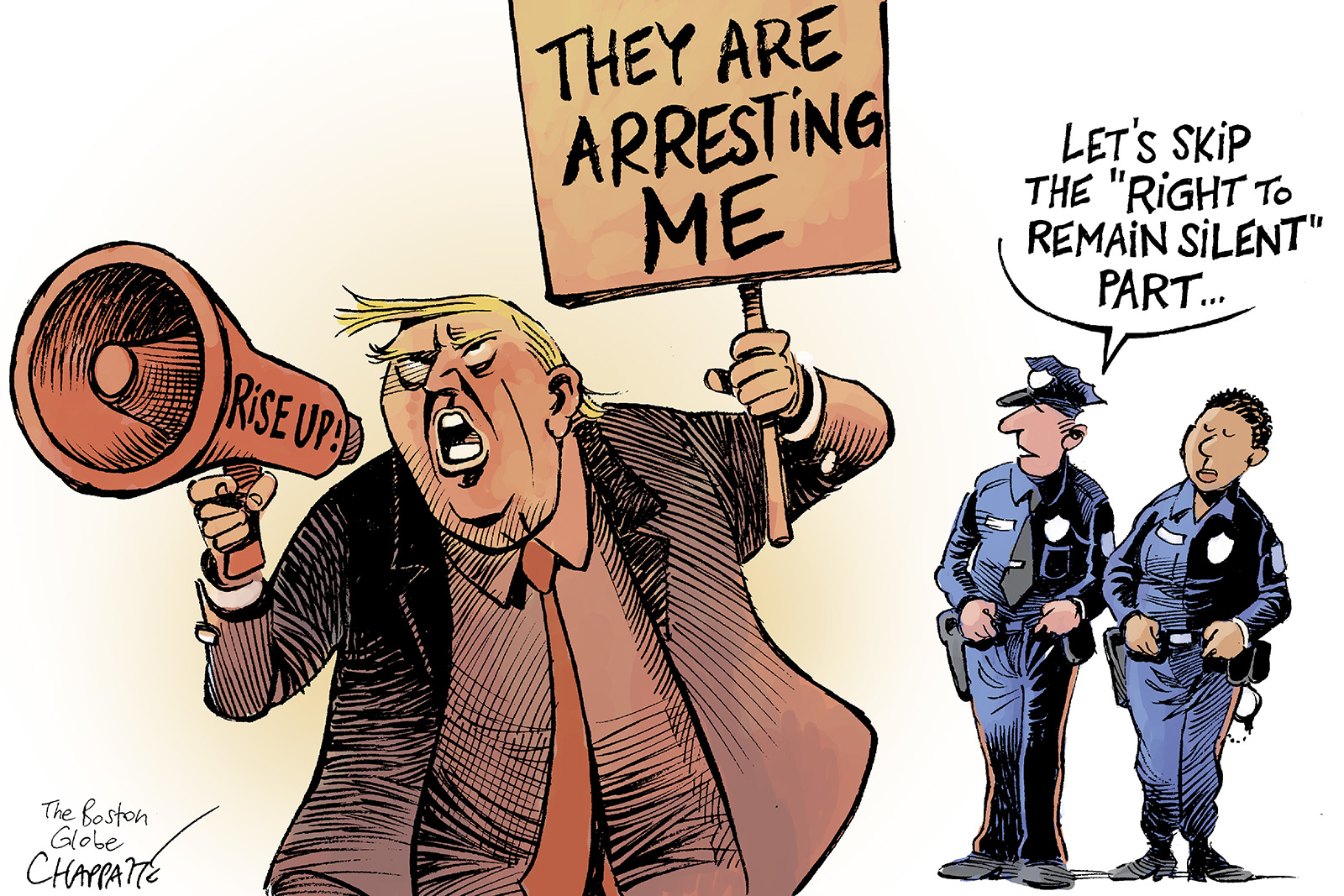 Now that Trump has been indicted and arrested 3 times, the 4th arrest on Thursday seems sort of old hat. Ho hum . . . Trump will surrender at Fulton County Jail in Georgia on Thursday; his bail has been set at $200,000.
Associated Press: Trump says he will surrender Thursday on Georgia charges tied to efforts to overturn 2020 election.
Former President Donald Trump says he will surrender to authorities in Georgia on Thursday to face charges in the case accusing him of illegally scheming to overturn his 2020 election loss in the state.
“Can you believe it? I’ll be going to Atlanta, Georgia, on Thursday to be ARRESTED,” Trump wrote on his social media network Monday night, hours after his bond was set at $200,000.
It will be Trump’s fourth arrest since April, when he became the first former president in U.S. history to face indictment. Since then, Trump, who remains the leading candidate for the Republican presidential nomination, has had what has seemed like an endless procession of bookings and arraignments in jurisdictions across the country. His appearances in New York, Florida and Washington, D.C., have drawn enormous media attention, with news helicopters tracking his every move.
Trump’s announcement came hours after his attorneys met with prosecutors in Atlanta to discuss the details of his release on bond. The former president is barred from intimidating co-defendants, witnesses or victims in the case — including on social media — according to the bond agreement signed by Fulton County District Attorney Fani Willis, Trump’s defense attorneys and the judge. It explicitly includes “posts on social media or reposts of posts” made by others.
This morning, two of Trump’s co-defendants surrendered in the Georgia election interference case.
Atlantic News First, via NBC29 VA:
ATLANTA (Atlanta News First/Gray News): First co-defendants in Trump indictment surrender at Fulton County jail.
The first co-defendants in a sweeping indictment out of Fulton County, Georgia, has surrendered to the jail.
Shortly before 10:30 a.m. Tuesday, former President Donald Trump’s attorney John Eastman turned himself in. A bond agreement for $100,000 was reached Monday in his case.
Eastman, prosecutors say, was deeply involved in some of his efforts to remain in power after the 2020 election. He wrote a memo arguing that Trump could remain in power if then-Vice President Mike Pence overturned the results of the election during a joint session of Congress where electoral votes would be counted. That plan included putting in place a slate of “alternate” electors in seven battleground states, including Georgia, who would falsely certify that Trump had won their states.
In a social media statement, Eastman said he was surrendering “to an indictment that should never have been brought.”
“It represents a crossing of the Rubicon for our country, implicating the fundamental First Amendment right to petition the government for redress of grievances,” Eastman said. “As troubling, it targets attorneys for their zealous advocacy on behalf of their clients, something attorneys are ethically bound to provide and which was attempting here by ‘formally challeng[ing] the results of the election through lawful and appropriate means.’ An opportunity never afforded them in the Fulton County Superior Court.”
A $10,000 bond agreement was reached Monday for Scott Hall, the Atlanta-area bail bondsman who was allegedly involved in commandeering voting information that was the property of Dominion Voting Systems from Coffee County in south Georgia.
On Tuesday, just before 9 a.m., Hall surrendered to authorities, and was booked and processed on charges that include conspiracy to commit a felony, conspiracy to commit election fraud, conspiracy to defraud the state of political subdivision, and violation of the Georgia Racketeer Influenced And Corrupt Organizations Act (RICO).
Jeff Clark, the DOJ official who wanted to send letters to the swing states saying that the DOJ believed there was significant voter fraud in their states, is trying to avoid going to Atlanta to be booked.
https://twitter.com/petestrzok/status/1694008924863602918?s=20
Jeff Clark on the morning his house was searched by the FBI:
This is going to enrage Trump. The New York Times just posted an article on Mark Meadows, another of Trump’s co-defendants in Georgia: How Mark Meadows Pursued a High-Wire Legal Strategy in Trump Inquiries.
This winter, after receiving a subpoena from a grand jury investigating former President Donald J. Trump’s attempts to overturn the 2020 election, Mark Meadows commenced a delicate dance with federal prosecutors.
He had no choice but to show up and, eventually, to testify. Yet Mr. Meadows — Mr. Trump’s final White House chief of staff — initially declined to answer certain questions, sticking to his former boss’s position that they were shielded by executive privilege.
But when prosecutors working for the special counsel, Jack Smith, challenged Mr. Trump’s executive privilege claims before a judge, Mr. Meadows pivoted. Even though he risked enraging Mr. Trump, he decided to trust Mr. Smith’s team, according to a person familiar with the matter. Mr. Meadows quietly arranged to talk with them not only about the steps the former president took to stay in office, but also about his handling of classified documents after he left.
The episode illustrated the wary steps Mr. Meadows took to navigate legal and political peril as prosecutors in Washington and Georgia closed in on Mr. Trump, seeking to avoid being charged himself while also sidestepping the career risks of being seen as cooperating with what his Republican allies had cast as partisan persecution of the former president.
His high-wire legal act hit a new challenge this month. While Mr. Meadows’s strategy of targeted assistance to federal prosecutors and sphinxlike public silence largely kept him out of the 45-page election interference indictment that Mr. Smith filed against Mr. Trump in Washington, it did not help him avoid similar charges in Fulton County, Ga. Mr. Meadows was named last week as one of Mr. Trump’s co-conspirators in a sprawling racketeering indictment filed by the local district attorney in Georgia.
Interviews and a review of the cases show how Mr. Meadows’s tactics reflected to some degree his tendency to avoid conflict and leave different people believing that he agreed with them. They were also dictated by his unique position in Mr. Trump’s world and the legal jeopardy this presented.
Read all the juicy, gossipy details at the NYT link.
There’s also news about the January 6 case against Trump in DC.
The Washington Post: Justice Dept. pushes back against Trump’s bid for a 2026 trial in D.C.
The Justice Department pushed back Monday on former president Donald Trump’s claims that he cannot be ready to go to trial in January on charges that he illegally sought to subvert the results of the 2020 election.
A trial in D.C. federal court in April 2026, which Trump’s attorneys requested, “would deny the public its right to a speedy trial,” attorneys working for special counsel Jack Smith wrote in Monday’s filing. In arguing for its preferred Jan. 2, 2024, date, the office said they do not intend to use classified information against Trump in this case….
In arguing for more time, Trump also made misleading comparisons to trials that were delayed by the coronavirus pandemic, superseding indictments adding defendants, and disputes over incarceration, the government said.
Trump’s legal team argued in a court filing last week that it needs years to prepare for the “unprecedented case” and that the January date proposed by the government would create conflicts with the five other criminal and civil trials Trump faces in the next nine months. They told the court that the 11.5 million pages of material already handed over by the special counsel took over two days to download and if printed out would be eight times taller than the Washington Monument. To read it all before the government’s proposed jury selection date of Dec. 11 would be like reading “Tolstoy’s War and Peace, cover to cover, 78 times a day, every day,” they said.
Smith’s office called those comparisons “neither helpful nor insightful,” because attorneys don’t read evidence cover to cover — they review it online using electronic keyword searches. Much of what was shared with Trump is already in the public domain, the special counsel said, including social media posts, transcripts of interviews with the House committee that investigated the Jan. 6 attack, and court records from legal challenges to the election results. Other documents came from the National Archives, meaning they were already known to Trump. There are also duplicates of documents within the production, the Justice Department said, and likely irrelevant papers handed over “in an abundance of caution and transparency.”
Read the rest at the WaPo.
This is interesting from attorneys Frederick Baron and Dennis Aftergut at The Bulwark: Trump Shoots Himself in the Foot with Demand for Trial Date in 2026.
ON THURSDAY, DONALD TRUMP FIRED his first shot in Judge Tanya Chutkan’s courtroom—straight into his own foot. His lawyers proposed to the district court judge that his federal trial on conspiracy and obstruction charges related to the aftermath of the 2020 election and the events of January 6th should not occur until April 2026.
“I’ll eat my hat if Judge Chutkan agrees with Trump to start this trial in 2026,” tweeted Neal Katyal, the former acting solicitor general of the United States. “He’s just afraid to stand trial. Nothing more.”

Judge Tanya Chutkan
Katyal’s hat is safe. Trump’s proposal on the all-important trial date sends an unintended message: that Trump is pressing his lawyers to take legal positions so extreme that they will be entirely disregarded.
Credibility with judges is the coin of the realm for trial lawyers. Squander it early and it’s hard to retrieve.
Trump’s past pattern is that his lawyers lose credibility by kowtowing to his absurd, uninformed demands. Then he tosses them like bad pennies. Sooner or later, it’s tough attracting the gold standard in the legal profession.
The Trump team’s tissue-thin pretext for their ludicrous trial date request was the volume of discovery materials they need to read.
They wrote that reviewing millions of documents and electronic communications that the government already gave them would be like reading “the entirety of Tolstoy’s War and Peace, cover to cover, 78 times a day” in order to finish by the January trial date proposed by Special Counsel Jack Smith.
The authors explain why that is bullshit:
Sounds daunting. But in the modern litigation world, a high-tech industry has grown up specializing in managing big-document cases. Entire firms exist to tackle discovery jobs like this.
Huge volumes of documents can be scanned rapidly, and put in a single database alongside digital communications and other information. The database is then “deduped” (that is, duplication is reduced) and organized to allow instant retrieval of any important piece of evidence. A lawyer need only search for specified keywords, dates, subjects, titles, witnesses, senders, receivers, contact information, and so on. For example, a search for documents or data related to “January 6/electors/certification” will quickly bring up the relevant items for review, highlighting, organizing, and sharing with team members.
Former U.S. Attorney Joyce Vance, speaking on MSNBC on Friday, mocked the misleading analogy to Tolstoy’s 1,200-page epic. “You don’t need to read War and Peace 78 times a day. You simply search for ‘Natasha,’” Vance said, referring to the novel’s lead female character.
Read more at The Bulwark.
One more interesting story from CNN: Several key cases that could bear on special counsel Jack Smith’s election case against Trump await DC Circuit rulings.
As the US Circuit Court of Appeals in Washington, DC, gets ready to begin its new term next month, the next two weeks could usher in several consequential rulings from the federal appeals court, often called the second most powerful court in the country, that could bear on the federal investigation into and prosecution of former President Donald Trump for his 2020 election reversal schemes.
At least three court cases touching legal issues that could affect special counsel Jack Smith’s approach are ripe for rulings from the DC Circuit. The rulings, once they come, will likely shape how US District Judge Tanya Chutkan may view the law and the charges against the former president in the criminal election subversion proceedings over which she is presiding.
In one case, Trump ally and Republican Rep. Scott Perry is challenging the access federal investigators can have to his phone in the 2020 election subversion probe. Another dispute is over Trump’s sweeping immunity claims in the civil lawsuits that have sought to hold him accountable for his actions and leading up to the January 6, 2021, Capitol assault. The third matter relates to the obstruction statute that has been a central charge in the Capitol riot prosecutions; Smith’s indictment of the former president in the election case includes two charges based on the provision in question.
There’s no guarantee that the rulings will come out in the coming weeks. But the start of the new DC Circuit term in early September puts additional pressure on the circuit judges to clear out their opinions in lingering cases. Regardless, the cases highlight the ongoing uncertainty in the legal terrain the special counsel is navigating as he advances toward a historic trial of the former president while wrapping up the rest of the federal criminal election subversion investigation, which Smith says is ongoing. No matter what the ruling is in each of the cases, the losing party will have the option to appeal it, setting up that the US Supreme Court might ultimately get involved.
Read details of the cases at the CNN link.
That’s it for me today. I guess I’m still mainly obsessed with seeing Trump tried, convicted, and imprisoned. I’ll add more links in the comment thread.
Did you like this post? Please share it with your friends:
Posted: August 15, 2023 | Author: bostonboomer | Filed under: 2020 Elections, 2024 presidential Campaign, Crime, Criminal Justice System, Donald Trump | Tags: conspiracy, Fani Willis, Georgia grand jury, Mark Meadows, racketeering, RICO laws, Trump 4th indictment |
Good Afternoon!!
As you know, the Georgia grand jury handed down multiple indictments of Trump and many of his cronies for a conspiracy to overturn the state’s 2020 presidential election. He has now been indicted 4 times for a total of 91 criminal charges. I tried to stay up until the bitter end last night, but I fell asleep before Fani Willis finally made her announcement.
David Kurtz at Talking Points Memo: Fani Willis Lowers The Boom On Donald Trump In Massive Indictment.
After a marathon session Monday, a Georgia grand jury returned a monster 41-felony-count, 97-page indictment against a total of 19 defendants, including former President Donald Trump; Trump White House Chief of Staff Mark Meadows; Trump lawyers Rudy Giuliani, Sidney Powell, John Eastman, Kenneth Chesebro, and Jenna Ellis; and Trump DOJ official Jeff Clark.
It was a strange day of uncertainty and expectation, with moment-by-moment reporting from the Fulton County courthouse. The duty judge would poke his head into the courtroom of waiting reporters to do check-ins. Grand jury witnesses scheduled to testify today made public that they had been called in a day early and offered regular updates as to where they stood in the line of witnesses paraded before the grand jury. The presentation of the indictment to the duty judge was televised live. Reporters were taking photographs from the inside of the clerk of court’s office as they waited an agonizing couple of hours for the paperwork to be processed and the indictment made public.
The day was punctuated by what appeared to be the accidental posting then quick takedown from the clerk’s website of a document seemingly related to the case that listed Trump as a defendant. That sparked an initial round of excitement and panic, then confusion. The clerk’s office later issued a statement calling the document “fictitious.” But it remained unclear exactly what had happened and why.
As the drama stretched deep into the evening, it became increasingly clear that District Attorney Fani Will was pushing to finish the indictment the same day. The duty judge kept the courtroom open late to accept the indictment, should it come. It finally did, just before 9 p.m. ET. The indictment became public just before 11 p.m. ET.
Read more of the basic facts at the TPM link.
From Aaron Rupar’s Public Notice, Lisa Needham breaks down the charges: Trump’s Fulton County indictment, unpacked.
The latest Trump indictment is out, and it’s a blockbuster. Let’s start with the numbers, shall we? A grand jury in Fulton County, Georgia, returned an indictment that has:
- 19 defendants, including the former president of the United States and 6 lawyers in his orbit
- 41 criminal counts across all defendants
- 13 criminal counts against the former president himself
- 8 types of manners and methods used to further a criminal enterprise
- 161 overt acts of racketeering activity
Many of the defendants are already familiar. Rudy Guiliani, John Eastman, Jeffrey Clark, and Sidney Powell are all attorneys who are likely some of the unindicted co-conspirators in the federal January 6 case. Others are people whose names have surfaced repeatedly during the various 2020 election investigations, such as Trump’s former chief of staff Mark Meadows, former Trump attorney Jenna Ellis, and attorney Ken Chesebro, who wrote the first memo suggesting the fake elector scheme. Others, like fake electors Shawn Still and David Shafer, aren’t household names….
If you’ve ever watched a mob movie set after 1970, when the law was first passed, you’ve probably heard of the federal RICO Act. It was designed to charge people for acting in concert with one another in furtherance of a criminal act. This was a big breakthrough because in sprawling criminal enterprises, people at the top — gang leaders, mob capos, etc. — could insulate themselves from criminal liability by having other people do their dirty work. But the advent of RICO meant that if you helped mastermind the heist but didn’t do the burglary, for example, you could still be held liable. The law isn’t just used against the Mafia but has also formed the basis for prosecuting people who run Ponzi schemes and gangs, among other things….
According to the indictment, Trump and his co-defendants used at least eight methods to try to undermine the election: (1) Making false statements to members of state legislatures, including Florida, Arizona, Michigan, Pennsylvania, and Georgia; (2) Making false statements to high-ranking state officials in Georgia, such as the secretary of state and the governor; (3) creating a slate of fake electoral voters; (4) harassing and intimidating a Fulton County election worker; (5) soliciting high-ranking members of the United States Department of Justice to make false statements to government officials in Georgia; (6) soliciting Mike Pence to reject electoral college votes properly cast by Georgia’s electors; (7) unlawfully accessing voter equipment and voter data; and (8) making false statements and committing perjury to cover up the conspiracy.
The first public act in furtherance of the conspiracy started the day after the election when Trump gave a speech falsely declaring victory. Trump had discussed a draft speech to that effect three days before the election, in which he planned to declare victory and claim voter fraud. In other words, Trump was already prepared to attempt to overturn the election before election night even happened.
Read the rest at Public Notice. It’s a very good summary of the case.
For a quick summary of the various kinds of charges in the indictment, check out this uncharacteristically short post by Marcy Wheeler at Emptywheel: The Various Kinds of Georgia Crimes in the RICO indictment.
I was very happy to see that Mark Meadows was among the Trump allies who were indicted. Insider: Mark Meadows, Trump’s former White House chief of staff, will face his first post-2020 election-related indictment in Georgia.
Mark Meadows, a Freedom Caucus conservative who rose to become Donald Trump’s final chief of staff, will face a criminal indictment in Georgia alongside former president.
Fulton County District Attorney Fanni Willis unveiled her sprawling indictment late Monday evening, ending Meadows’ run thus far of successfully ducking some of the legal serious legal liability that others in Trump’s orbit have faced stemming from their actions that took place during the waning weeks of his presidency.
It means Meadows may soon join HR Haldeman, Nixon’s self-dubbed “son of a bitch,” in infamy among those who held one of the most powerful posts in the federal government, Chief of Staff. Haldeman, of course, faced prison time over his role in trying to cover up the Watergate break-in.
According to the indictment, Meadows, like each one of his fellow co-defendants, is facing a violation of Georgia’s RICO law. He is also facing an additional count related to his participation in Trump’s January 2, 2021 call with George Secretary of State Brad Raffensperger during which Trump pressured Raffensperger to “find” enough votes so he could win.
Meadows’ other conduct is mentioned throughout the indictment. In particular, Willis zeroed in on Meadows’ efforts to reach state lawmakers in Pennsylvania. Willis later told reporters that the grand jury believed conduct outside of her jurisdiction helped furthered the conspiracy she alleged.
Meadows was not one of the unindicted co-conspirators in special counsel Jack Smith’s indictment related to conduct after the election, leading to speculation that the former chief of staff could be assisting the federal investigation.
Of course, Trump can’t keep his big mouth shut. He announced on Truth Social that he has proof of election fraud in Georgia which he will announce next Monday.
It’s not clear why he didn’t reveal this information before he was indicted.
One more article on Trump’s obvious first delay tactic in the Georgia case:
Kyle Cheney at Politico: An early test for Georgia prosecutors: Trump’s likely bid to take the case to federal court.
One of the first big battles in the new racketeering case against Donald Trump is likely imminent: Should the former president face a jury in state or federal court?
Although the charges were filed in state court in Fulton County, Ga., Trump is sure to attempt to “remove” the case to federal court, where he would potentially have a friendlier jury pool and the chance of drawing a judge whom he appointed to the bench.
To try to get the case into federal court, Trump is expected to argue that much of the conduct he’s been charged with was undertaken in his capacity as an officer of the federal government, because he was still president during the critical period when he and his allies attempted to subvert the 2020 election results. A federal law, known as a “removal statute,” generally allows any “officer of the United States” who is prosecuted or sued in state court to transfer the case to federal court if the case stems from the officer’s governmental duties.
Trump has already attempted to make this move in New York, where he’s facing state charges for falsifying business records to cover up an affair with a porn star. A federal judge there rejected the effort and directed the case back to state court, noting that the charges there didn’t really implicate Trump’s powers as president.
“There is an ‘outer perimeter’ to a President’s authority and responsibilities beyond which he engages in private conduct,” U.S. District Judge Alvin Hellerstein ruled, sending the case back to New York state court. Trump is appealing the ruling.
But Georgia could be different: Most of the charges Trump is facing — sweeping allegations of using his office to corrupt the 2020 election — involve his presidential authorities and his efforts to manipulate the federal processes he was charged with overseeing. That makes removal a more viable option in Georgia than New York.
The judge in the case has even less experience than Aileen Cannon.
Those are the basics on the Georgia indictments. We will learn much more in the days ahead.
Did you like this post? Please share it with your friends:
Posted: July 22, 2023 | Author: bostonboomer | Filed under: 2024 presidential Campaign, cat art, caturday, Crime, Donald Trump, Economy, education, Florida, Joe Biden, just because | Tags: Agnes Miller Parker, Arizona, Bidenomics, Brian Kemp, Doug Ducey, Fani Willis, Georgia, Judge Aileen Cannon, Kamala Harris, Mark Meadows, Ron De Santis, slavery, Special Counsel Jack Smith, Trump trial dates, women's liberation, Women's Rights |
Happy Caturday!!

The Uncivilized Cat, 1930, by Agnes Miller Parker
Today I’m highlighting the work of Scottish artist Agnes Miller Parker. She is best known for her wood engravings of animals, often used as book illustrations. She was also a woman’s right activist. “The Uncivilized Cat” was an illustration for the book “Love’s Creation,” by Marie Stopes, published in 1928, the year women won the right to vote in the UK. The the image is filled with symbols of women’s liberation. Read about them at this link.
We are still waiting for the expected indictment of Donald Trump in the January 6 case. Special Counsel Jack Smith is till conducting grand jury interviews in the investigation, so maybe it won’t happen right away–or maybe it will come next week. Meanwhile, there is some Trump legal news.
The Latest on the Trump Investigations
Alan Feuer at The New York Times: Trial in Trump Documents Case Set for May 2024.
The federal judge overseeing former President Donald J. Trump’s prosecution on charges of illegally retaining dozens of classified documents set a trial date on Friday for May 2024, taking a middle position between the government’s request to go to trial in December and Mr. Trump’s desire to push the proceeding until after the 2024 election.
In her order, Judge Aileen M. Cannon said the trial was to be held in her home courthouse in Fort Pierce, Fla., a coastal city two and a half hours north of Miami that will draw its jury pool from several counties that Mr. Trump won handily in his two previous presidential campaigns.
Judge Cannon also laid out a calendar of hearings, throughout the remainder of this year and into next year, including those concerning the handling of the classified material at the heart of the case.
The scheduling order came after a contentious hearing on Tuesday at the federal courthouse in Fort Pierce where prosecutors working for the special counsel, Jack Smith, and lawyers for Mr. Trump sparred over when to hold the trial.
The timing of the proceeding is more important in this case than in most criminal matters because Mr. Trump is now the front-runner for the Republican presidential nomination and his legal obligations to be in court will intersect with his campaign schedule.
The date Judge Cannon chose to start the trial — May 20, 2024 — falls after the bulk of the primary contests. But it is less than two months before the start of the Republican National Convention in July and the formal start of the general election season.
Mr. Trump’s advisers have been blunt that winning the presidency is how he hopes to beat the legal charges he is facing, and he has adopted a strategy of delaying the trial, which is expected to take several weeks, for as long as possible.

The Challenge, Agnes Miller Parker, 1934
Analysis by Aaron Blake at The Washington Post: Trump’s trial date conjures GOP’s nightmare scenario.
When the trial date for Donald Trump’s Manhattan hush money case was set for March — during the GOP presidential primary schedule — the former president and leading 2024 Republican candidate shook his head.
The Republican Party as a whole might have that reaction to Trump’s latest trial date.
U.S. District Judge Aileen M. Cannon on Friday set Trump’s Florida classified documents case to begin on May 20, 2024. Cannon wound up more or less splitting the difference between the government’s request to begin in December and Trump’s lawyers’ preference to begin after the 2024 election.
The date could still be pushed back, especially given that Cannon has labeled the case “complex.” But it means we’re currently looking at this for a schedule of Trump’s upcoming trials:
- Oct. 2: New York civil fraud trial
- Jan. 15: Second E. Jean Carroll civil defamation trial
- March 25: Manhattan hush-money trial
- May 20: Federal classified documents trial in Florida
That’s a lot of legal issues to face in the heart of a campaign, keeping Trump or at least his lawyers in court for a huge chunk of time he’s supposed to be on the trail. But Trump’s most serious bit of legal jeopardy — at least for now, with potential Jan. 6-related indictments looming federally and in Georgia — won’t fully play out until the end of the primary season.
Nomination contests are often effectively wrapped up by March or April at the latest, with the final contests held in June but generally not consequential to the outcome. Republican National Committee rules effectively require every state to hold its contest by May 31, meaning a two-week classified documents trial would place the meat of the proceedings beyond the window for any GOP voters making their decisions.
More commentary from Bess Levin at Vanity Fair: That Sound You Hear Is Donald Trump Screaming, Crying, and Throwing Up in a Mar-a-Lago Bathroom.
Donald Trump received some no good, extremely bad legal news on Friday, when The Guardian reported that Fani Willis, the Fulton County district attorney criminally investigating his attempt to overturn the 2020 election in Georgia has “developed evidence to charge a sprawling racketeering indictment next month,” according to people familiar with the matter. Obviously, being charged with racketeering would be exactly as bad as it sounds—and yet somehow, that wasn’t even the worst news the ex-president received today.
Instead, it was likely the decision by Aileen Cannon—a federal judge Trump himself appointed—to set a trial date of May 20, 2024, for Trump to face off with the federal government in the classified-documents case, that had staffers and aides hiding in hallways and coat closets to avoid Trump’s ire (and whatever ketchup bottles he could get his hands on). While the spring date is several months later than prosecutors had requested, it is very much well before the postelection one Team Trump had been angling for in the hopes of putting it off until the ex-president could have won a second term and made all of his legal problems—on the federal level, that is—go away.
Of course, just because Cannon issued a ruling that Trump will undoubtedly be very unhappy about today does not mean she won’t, as many fear, blow up the case in his favor when the trial finally kicks off. (As The Washington Post notes, “In her role, Cannon can have a significant impact on the case, including by ruling on what evidence can be included and deciding on any potential motions challenging the charges.”) On the other hand, the government’s indictment against Trump is said to be extremely strong: After the charges were unveiled last month, former attorney general Bill Barr opined: “I was shocked by the degree of sensitivity of these documents and how many there were, frankly. If even half of it is true, he’s toast.” As one Fox News legal analyst noted, “All the government has to do is stick the landing on one count, and he could have a terminal sentence. We’re talking about crimes that have a 10- or 20-year period as a maximum.” (Trump, along with his alleged co-conspirator, has pleaded not guilty.)

Siamese Cat, 1950, by Agnes Miller Parker
The news about Georgia prosecutor Fani Willis came from Hugo Lowell at The Guardian: Fulton county prosecutors prepare racketeering charges in Trump inquiry.
The Fulton county district attorney investigating Donald Trump’s efforts to overturn the 2020 election results in the state of Georgia has developed evidence to charge a sprawling racketeering indictment next month, according to two people briefed on the matter.
The racketeering statute in Georgia requires prosecutors to show the existence of an “enterprise” – and a pattern of racketeering activity that is predicated on at least two “qualifying” crimes.
In the Trump investigation, the Fulton county district attorney, Fani Willis, has evidence to pursue a racketeering indictment predicated on statutes related to influencing witnesses and computer trespass, the people said.
Willis had previously said she was weighing racketeering charges in her criminal investigation, but the new details about the direction and scope of the case come as prosecutors are expected to seek indictments starting in the first two weeks of August.
The racketeering statute in Georgia is more expansive than its federal counterpart, notably because any attempts to solicit or coerce the qualifying crimes can be included as predicate acts of racketeering activity, even when those crimes cannot be indicted separately.
The specific evidence was not clear, though the charge regarding influencing witnesses could include Trump’s conversations with Georgia’s secretary of state, Brad Raffensperger, in which he asked Raffensperger to “find” 11,780 votes, the people said – and thereby implicate Trump.
For the computer trespass charge, where prosecutors would have to show that defendants used a computer or network without authority to interfere with a program or data, that would include the breach of voting machines in Coffee county, the two people said.
The breach of voting machines involved a group of Trump operatives – paid by the then Trump lawyer Sidney Powell – accessing the voting machines at the county’s election office and copying sensitive voting system data.
More details at The Guardian.
Special Counsel Jack Smith is also interested in 2020 election interference in Georgia as well as Arizona. The Hill reports that: DOJ special counsel contacts Kemp, former Arizona governor in Jan. 6 probe: reports.
Georgia Gov. Brian Kemp (R) has been contacted by the federal special counsel investigating former President Trump’s attempts to overturn the 2020 election, Kemp’s office confirmed Friday.
Former Arizona Gov. Doug Ducey (R) was also contacted for the investigation, according to CNN reports.
Special Counsel Jack Smith is investigating Trump’s efforts to overturn the election and his actions related to the Jan. 6 insurrection. He served Trump a target letter on Sunday, informing the former president that he is the target of the probe.

By Agnes Miller Parker
The move shows overlap between Smith’s federal investigation and Fulton County District Attorney Fani Willis’s investigation into the same conduct in Georgia.
A spokesperson for Kemp’s office confirmed that he had been contacted by Smith, but did not give further details, the Atlanta Journal-Constitution reported.
Smith’s probe in Arizona is questioning lawsuits brought by the Trump campaign against the state which alleged that the election was fraudulent. Smith subpoenaed the Arizona Secretary of State’s office earlier this month and subpoenaed state lawmakers in February.
Trump called Ducey multiple times to pressure him to overturn Arizona’s election results. President Biden won Arizona, the first time the state voted for a Democratic presidential candidate since 1996.
At The Washington Post, some tidbits about Mark Meadows: Before Jan. 6, Mark Meadows joked about Trump’s election claims.
Mark Meadows joked about the baseless claim that large numbers of votes were fraudulently cast in the names of dead people in the days before the then-White House chief of staff participated in a phone call in which then-President Trump alleged there were close to 5,000dead voters in Georgia and urged Secretary of State Brad Raffensperger to overturn the 2020 election there.
In a text message that has been scrutinized by federal prosecutors, Meadows wrote to a White House lawyer that his son, Atlanta-area attorney Blake Meadows, had been probing possible fraud and had found only a handful of possible votes cast in dead voters’ names, far short of what Trump was alleging. The lawyer teasingly responded that perhaps Meadows’s son could locate the thousands of votes Trump would need to win the election. The text was described by multiple people familiar with the exchange.
The jocular text message, which has not been previously reported, is one of many exchanges from the time in which Trump aides and other Republican officials expressed deep skepticism or even openly mocked the election claims being made publicly by Trump, according to people familiar with the investigation, who spoke on the condition of anonymity due to the sensitivity of the criminal investigation.
Special counsel Jack Smith, who is leading a Justice Department investigation of Trump’s activities in the weeks leading up to the Jan. 6, 2021, attack on the U.S. Capitol, has focused on exploring whether Trump and his closest advisers understood that claims of fraud in the election were baseless, even as they pressed state officials and others to overturn Biden’s victory and convinced Trump’s millions of supporters that the election had been stolen, people familiar with the probe have said.
The text message is a small part of a broader portrait of Meadows that Smith appears to be assembling as he weighs the actions of not just Trump but a number of his closest advisers, including Meadows.
Ron DeSantis’s Struggles
The New York Times: DeSantis Faces Swell of Criticism Over Florida’s New Standards for Black History.
After an overhaul to Florida’s African American history standards, Gov. Ron DeSantis, the state’s firebrand governor campaigning for the Republican presidential nomination, is facing a barrage of criticism this week from politicians, educators and historians, who called the state’s guidelines a sanitized version of history.

Siamese cats, Agnes Miller Parker
For instance, the standards say that middle schoolers should be instructed that “slaves developed skills which, in some instances, could be applied for their personal benefit” — a portrayal that drew wide rebuke.
In a sign of the divisive battle around education that could infect the 2024 presidential race, Vice President Kamala Harris directed her staffers to immediately plan a trip to Florida to respond, according to one White House official.
“How is it that anyone could suggest that in the midst of these atrocities that there was any benefit to being subjected to this level of dehumanization?” Ms. Harris, the first African American and first Asian American to serve as vice president, said in a speech in Jacksonville on Friday afternoon.
Ahead of her speech, Mr. DeSantis released a statement accusing the Biden administration of mischaracterizing the new standards and being “obsessed with Florida.”
Florida’s new standards land in the middle of a national tug of war on how race and gender should be taught in schools. There have been local skirmishes over banning books, what can be said about race in classrooms and debates over renaming schools that have honored Confederate generals.
Cleve R. Wootson, Jr. at The Washington Post: Harris, on DeSantis’s turf, blasts Florida curriculum on Black history.
Vice President Harris, taking aim at Gov. Ron DeSantis’s “war on woke” on Friday in his home state, blasted Florida politicians for making changes to the public school curriculum that she said amounted to little more than a “purposeful and intentional policy to mislead our children,” especially when it comes to slavery.
Harris never mentioned DeSantis (R) by name, referring only to “extremists” and people who “want to be talked about as American leaders.” But her fiery speech in Jacksonville focused squarely on the policies of the Florida governor and presidential candidate, as well as on the state’s Board of Education and its Republican-controlled legislature.
Florida’s new standards on Black history lay out numerous benchmarks, but one has especially caught critics’ attention — a statement that “slaves developed skills which, in some instances, could be applied for their personal benefit.” Since the guidelines were approved on Wednesday, many civil rights leaders have denounced the notion that slavery benefited its victims in some ways.
“Come on — adults know what slavery really involved,” Harris said. “It involved rape. It involved torture. It involved taking a baby from their mother. It involved some of the worst examples of depriving people of humanity in our world.”

By Agnes Miller Parker
She added, “How is it that anyone could suggest that in the midst of these atrocities, that there was any benefit to being subjected to this level of dehumanization?”
Since DeSantis announced his bid for the presidency in May, polls have cast him as former president Donald Trump’s top competition for the Republican nomination, at least for now. As DeSantis makes his pitch in early-voting primary states, he has blasted what he calls “woke indoctrination” in schools and said recent legislative changes in Florida could be a model for the rest of the nation.
Harris’s trip to the governor’s home state to rip into his policies could be a pivotal moment both for the Biden campaign, which has generally resisted going after the GOP presidential hopefuls, and for the vice president, who has sometimes seemed to cast about for a resonant issue.
Read more at The WaPo.
Bidenomics News
It’s difficult to understand why President Biden isn’t more popular. He has really delivered on his promises. What more do voters want? Are people really stupid enough to fall for GOP propaganda about the economy?
Christina Wilke at CNBC: Morgan Stanley credits Bidenomics for ‘much stronger’ than expected GDP growth.
Morgan Stanley is crediting President Joe Biden’s economic policies with driving an unexpected surge in the U.S. economy that is so significant that the bank was forced to make a “sizable upward revision” to its estimates for U.S. gross domestic product.
Biden’s Infrastructure Investment and Jobs Act is “driving a boom in large-scale infrastructure,” wrote Ellen Zentner, chief U.S. economist for Morgan Stanley, in a research note released Thursday. In addition to infrastructure, “manufacturing construction has shown broad strength,” she wrote.
As a result of these unexpected swells, Morgan Stanley now projects 1.9% GDP growth for the first half of this year. That’s nearly four times higher than the bank’s previous forecast of 0.5%.
“The economy in the first half of the year is growing much stronger than we had anticipated, putting a more comfortable cushion under our long-held soft landing view,” Zentner wrote.
The analysts also doubled their original estimate for GDP growth in the fourth quarter, to 1.3% from 0.6%. Looking into next year, they raised their forecast for real GDP in 2024 by a tenth of a percent, to 1.4%.
“The narrative behind the numbers tells the story of industrial strength in the U.S,” Zentner wrote.
Morgan Stanley’s revision came at a pivotal time for the Biden White House. The president has spent the summer crisscrossing the country, touting his economic achievements. “Together we are transforming the country, not just through jobs, not just through manufacturing, but also by rebuilding our infrastructure,” Biden said Thursday during a visit to a Philadelphia shipyard.
Read more at CNBC.
Have a fabulous Caturday and a great weekend, everyone!!
Did you like this post? Please share it with your friends:
Posted: June 1, 2023 | Author: bostonboomer | Filed under: Donald Trump, just because | Tags: Carlos Deoliveira, iran, James Trusty, Mar-a-Lago security footage, Margo Martin, Mark Meadows, Mark Milley, Special Counsel Jack Smith, stolen documents case, Susan Glasser, Tim Parlatore, Walt Nauta, Yuscil Taveras |

The Balcony in Vernonnet, 1920, Pierre Bonnard
Good Morning!!
The evidence against Trump keeps coming out bit by bit. Yesterday was a big day for news about the stolen documents case. CNN first broke the news that Trump was caught on tape discussing a classified document that he retained after leaving the White House. Then The New York Times, The Guardian, and The Washington Post added more information to the story.
CNN: EXCLUSIVE: Trump captured on tape talking about classified document he kept after leaving the White House.
Federal prosecutors have obtained an audio recording of a summer 2021 meeting in which former President Donald Trump acknowledges he held onto a classified Pentagon document about a potential attack on Iran, multiple sources told CNN, undercutting his argument that he declassified everything.
The recording indicates Trump understood he retained classified material after leaving the White House, according to multiple sources familiar with the investigation. On the recording, Trump’s comments suggest he would like to share the information but he’s aware of limitations on his ability post-presidency to declassify records, two of the sources said….
Special counsel Jack Smith, who is leading the Justice Department investigation into Trump, has focused on the meeting as part of the criminal investigation into Trump’s handling of national security secrets. Sources describe the recording as an “important” piece of evidence in a possible case against Trump, who has repeatedly asserted he could retain presidential records and “automatically” declassify documents.
Prosecutors have asked witnesses about the recording and the document before a federal grand jury. The episode has generated enough interest for investigators to have questioned Gen. Mark Milley, one of the highest-ranking Trump-era national security officials, about the incident.

Ramo de gladiolos, lirios y margaritas (1878), Claude Monet
It’s interesting and significant that the meeting at which Trump talked about the document was at his Bedminster golf club in New Jersey. The incident took place at a meeting with two ghost writers who were working on Mark Meadows’ autobiography. Other attendees were “communications specialist” Margo Martin, and other Trump aides. It appears that Martin may be the source of the recording.
Back to the CNN story:
Meadows’ autobiography includes an account of what appears to be the same meeting, during which Trump “recalls a four-page report typed up by (Trump’s former chairman of the Joint Chiefs of Staff) Mark Milley himself. It contained the general’s own plan to attack Iran, deploying massive numbers of troops, something he urged President Trump to do more than once during his presidency.”
The document Trump references was not produced by Milley, CNN was told….
The meeting in which Trump discussed the Iran document with others happened shortly after The New Yorker published a story by Susan Glasser detailing how, in the final days of Trump’s presidency, Milley instructed the Joint Chiefs to ensure Trump issued no illegal orders and that he be informed if there was any concern. The story infuriated Trump.
Glasser reported that in the months following the election, Milley repeatedly argued against striking Iran and was concerned Trump “might set in motion a full-scale conflict that was not justified.” Milley and others talked Trump out of taking such a drastic action, according to the New Yorker story.
Glasser reported that in the months following the election, Milley repeatedly argued against striking Iran and was concerned Trump “might set in motion a full-scale conflict that was not justified.” Milley and others talked Trump out of taking such a drastic action, according to the New Yorker story.
Trump appeared to be holding the secret document he was describing because the recording picked up the “sound of paper rustling.” Even if he didn’t show it to the others, he never should have had the document in an unsecured meeting room with people without security clearances.
Some observers were wondering if Trump could be charged with espionage if this recording is “top secret,” because then it might not be able to be used in court. But Hugh Lowell reports at The Guardian that it is only classified as “secret”: Trump regretted not declassifying retained military document in recording.
The document at issue is understood to be classified as “secret” – significant as the justice department typically prefers to charge espionage cases involving retention of materials at that level, rather than “top secret” papers that might be too sensitive or “confidential” papers that are too low.
The recording was made at Trump’s Bedminster golf club in July 2021, when the former president met with people helping his former chief of staff Mark Meadows write a book, by his aide Margo Martin who regularly taped conversations with authors to ensure they accurately recounted his remarks.

Apple Tree In Blossom, 1898c, Carl Larsson (Swedish 1853-1919
For several minutes of the audio recording, the sources said, Trump talks about how he cannot discuss the document because he no longer possesses the sweeping presidential power to declassify now out of office, but suggests that he should have done so when he was still in the White House.
But the previously unreported suggestion that he should have declassified the document presents a potentially perilous moment, as it indicates Trump knew that he had retained material which remained sensitive to national security – as well as the limitations on discussing it with unauthorized people. CNN earlier reported that prosecutors had the recording.
Prosecutors in the office of special counsel Jack Smith appear to have obtained the recording around March, as the criminal investigation targeting Trump intensified and numerous Trump aides were subpoenaed to testify before the federal grand jury hearing evidence in the case in Washington.
The tape was played to multiple witnesses, including Martin, when she testified in mid-March after having her laptop and phones imaged by prosecutors, the sources said. The first time the Trump lawyers learned about the tape was after Martin testified, one of the sources said.
As I suggested earlier, it appears that Martin’s laptop was the source of the recording. The New York Times also reported that Martin attended the meeting and doesn’t quite claim she is the source, but it seems pretty likely, since prosecutors had her laptop. A bit more from The New York Times story:

Bouquet de Mimosa sur la Table 1938, Édouard Vuillard
In an interview with CNN on Wednesday night, James Trusty, a lawyer representing Mr. Trump in the case, indicated that the former president was taking the position that he had declassified the material he took with him upon leaving office.
“When he left for Mar-a-Lago with boxes of documents that other people packed for him that he brought, he was the commander in chief,” Mr. Trusty said. “There is no doubt that he has the constitutional authority as commander in chief to declassify.”
Mr. Trusty said officials could prove that Mr. Trump had declassified material. But when pressed on whether Mr. Trump had declassified the document in question at the Bedminster meeting, Mr. Trusty declined to say.
That’s pretty weak.
Here’s The Washington Post story, which you can read if you’re interested. It’s mostly a recap of the other reports and background on the investigation: Prosecutors have recording of Trump discussing sensitive Iran document.
One more Trump stolen document investigation story from The New York Times: Prosecutors Scrutinize Handling of Security Footage by Trump Aides in Documents Case.
For the past six months, prosecutors working for the special counsel Jack Smith have sought to determine whether former President Donald J. Trump obstructed the government’s efforts to retrieve a trove of classified documents he took from the White House.
More recently, investigators also appear to be pursuing a related question: whether Mr. Trump and some of his aides sought to interfere with the government’s attempt to obtain security camera footage from Mar-a-Lago that could shed light on how those documents were stored and who had access to them.
The search for answers on this second issue has taken investigators deep into the bowels of Mar-a-Lago, Mr. Trump’s private club and residence in Florida, as they pose questions to an expanding cast of low-level workers at the compound, according to people familiar with the matter. Some of the workers played a role in either securing boxes of material in a storage room at Mar-a-Lago or maintaining video footage from a security camera that was mounted outside the room.
Two weeks ago, the latest of these employees, an information technology worker named Yuscil Taveras, appeared before a grand jury in Washington, according to two people familiar with the matter.
 So now we know the name of the aide who helped Walt Nauta move the boxes around.
Mr. Taveras was asked questions about his dealings with two other Trump employees: Walt Nauta, a longtime aide to Mr. Trump who served as one of his valets in the White House, and Carlos Deoliveira, described by one person familiar with the events as the head of maintenance at Mar-a-Lago.
Phone records show that Mr. Deoliveira called Mr. Taveras last summer, and prosecutors wanted to know why. The call caught the government’s attention because it was placed shortly after prosecutors issued a subpoena to Mr. Trump’s company, the Trump Organization, demanding the footage from the surveillance camera near the storage room.
The call also occurred just weeks after Mr. Deoliveira helped Mr. Nauta move boxes of documents into the storage room — the same room that Mr. Deoliveira at one point fitted with a lock. The movement of the boxes into the room took place at another key moment: on the day before prosecutors descended on Mar-a-Lago for a meeting with Mr. Trump’s lawyers intended to get him to comply with a demand to return all classified documents.
The Trump Organization ultimately turned over the surveillance tapes, but Mr. Smith’s prosecutors appear to be scrutinizing whether someone in Mr. Trump’s orbit tried to limit the amount of footage produced to the government.
They asked Mr. Taveras an open-ended question about if anyone had queried him about whether footage from the surveillance system could be deleted.
The Times doesn’t know what Taveras told the grand jury. Read more at the link.
Today, Hugo Lowell has another story at The Guardian on the turmoil among Trump’s many lawyers: Months of distrust inside Trump legal team led to top lawyer’s departure. And get this: Lowell learned all this because he was sitting at the next table in a restaurant.
Donald Trump’s legal team for months has weathered deep distrust and interpersonal conflict that could undermine its defense of the former president as the criminal investigation into his handling of classified documents and obstruction of justice at Mar-a-Lago nears its conclusion.
The turmoil inside the legal team only exploded into public view when one of the top lawyers, Tim Parlatore, abruptly resigned two weeks’ ago from the representation citing irreconcilable differences with Trump’s senior adviser and in-house counsel Boris Epshteyn.
But the departure of Parlatore was the culmination of months of simmering tensions that continue to threaten the effectiveness of the legal team at a crucial time – as federal prosecutors weigh criminal charges – in part because the interpersonal conflicts remain largely unresolved.
It also comes as multiple Trump lawyers are embroiled in numerous criminal investigations targeting the former president: Epshteyn was recently interviewed by the special counsel, while Parlatore and Trump lawyer Evan Corcoran testified to the grand jury in the classified documents inquiry.
The turmoil has revolved around hostility among the lawyers on the legal team who have come to distrust each other as well as their hostility directed at Epshteyn, over what they regard as his oversight of the legal work and gatekeeping direct access to the former president.
In one instance, the clashes became so acute that some of the lawyers agreed to a so-called “murder-suicide” pact where if Parlatore got fired, others would resign in solidarity. And as some of the lawyers tried to exclude Epshteyn, they withheld information from co-counsel who they suspected might brief him.
Read all the details at The Guardian link.
So . . . that’s the latest on just one of the Trump investigations. Will we learn more today? Drip, drip, drip.
Did you like this post? Please share it with your friends:


 peej
peej Carissa
 bostonboomer
 dakinikat
 ecocatwoman
 mablue2
 Mama Lopez
 peggysue22
 quixote
 skydancingguestblogger
 Mona (aka Wonk the Vote)



 Sky Dancing
Recent Comments