
Judges are prohibited from accepting gifts from anyone with business before the court. Until recently, however, the judicial branch had not clearly defined an exemption for gifts considered “personal hospitality.”
Finally Friday Reads: Bye Bye Wade!
Posted: March 15, 2024 Filed under: just because | Tags: @repeat1968, Are you better off without the Covid-19 disaster?, Elise Stefanik, Fulton County DA Fani Willis, John Buss, Manhattan DA, SCOTUS and social media, TikTok, tRump lies lies lies 1 Comment
Good Day, Sky Dancers!
It’s another busy news week and Friday. The most consequential headline this morning is on the decision of Fulton County Superior Court Judge Scott McAfee on the “appearance of impropriety” brought about by Willis’ romantic relationship with special prosecutor Nathan Wade. This analysis is from NBC News.
A Georgia judge ruled Fridaythat Fulton County District Attorney Fani Willis should not be disqualified from prosecuting the racketeering case against former President Donald Trump and several co-defendants — with one major condition.
Fulton County Superior Court Judge Scott McAfee found the “appearance of impropriety” brought about by Willis’ romantic relationship with special prosecutor Nathan Wade should result in either Willis and her office leaving the case — or just Wade, whom she’d appointed to head the case.
The choice is likely to be an easy one: If Willis were to remove herself, the case would come to a halt, but having Wade leave will ensure the case continues without further delay.
The judge said the prosecution “cannot proceed” until Willis makes a decision.
Trump attorney Steve Sadow said in a statement that, “While respecting the Court’s decision, we believe that the Court did not afford appropriate significance to the prosecutorial misconduct of Willis and Wade.”
“We will use all legal options available as we continue to fight to end this case, which should never have been brought in the first place,” he added.
Willis’s office did not immediately comment on the ruling.The judge found there was no “actual conflict” brought about by the relationship, a finding that would have required Willis to be disqualified. “Without sufficient evidence that the District Attorney acquired a personal stake in the prosecution, or that her financial arrangements had any impact on the case, the Defendants’ claims of an actual conflict must be denied,” the judge wrote.
“This finding is by no means an indication that the Court condones this tremendous lapse in judgment or the unprofessional manner of the District Attorney’s testimony during the evidentiary hearing. Rather, it is the undersigned’s opinion that Georgia law does not permit the finding of an actual conflict for simply making bad choices — even repeatedly — and it is the trial court’s duty to confine itself to the relevant issues and applicable law properly brought before it,” he added.
The judge did, however, also find “the prosecution is encumbered by an appearance of impropriety.”
“As the case moves forward, reasonable members of the public could easily be left to wonder whether the financial exchanges have continued resulting in some form of benefit to the District Attorney, or even whether the romantic relationship has resumed,” he wrote. “As long as Wade remains on the case, this unnecessary perception will persist.”
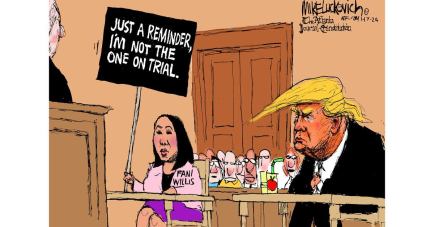
The Manhattan D.A. has joined the list of Judiciary officials letting Trump delay trials on frivolous and specious arguments. This is from the New York Times. “As Trump Seeks Trial Delay, N.Y. Prosecutors Offer 30-Day Postponement. The Manhattan district attorney’s proposal came in response to Donald J. Trump’s request for a 90-day delay to allow his lawyers time to review a new batch of records.”
Less than two weeks before Donald J. Trump is set to go on trial on criminal charges in Manhattan, the prosecutors who brought the case proposed a delay of up to 30 days, a startling development in the first prosecution of a former American president.
The Manhattan district attorney’s office, which accused Mr. Trump of covering up a sex scandal during and after the 2016 presidential campaign, said the delay would give Mr. Trump’s lawyers time to review a new batch of records. The office sought the records more than a year ago, but only recently received them from federal prosecutors, who years ago investigated the hush-money payments at the center of the case.
In response to the records — tens of thousands of pages of them — Mr. Trump’s lawyers requested that the trial be delayed 90 days. Although the former president frequently requests such delays, prosecutors consenting to any postponement makes one far more likely.
Mr. Trump, who clinched the Republican presidential nomination for the third time this week, faces four criminal trials and several civil lawsuits. The Manhattan case had been the only one of the four criminal cases not mired in delays.
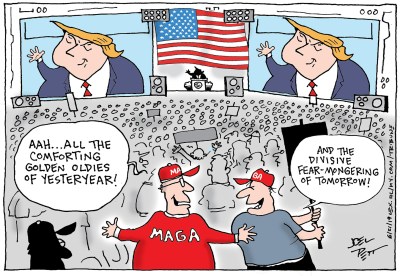 “Mired in delays” is the understatement of the year-to-date. Meanwhile, Trump gets more incoherent by the day. His appearance is more startling than usual. Susan B. Glasser of The New Yorker has this analysis. “I Listened to Trump’s Rambling, Unhinged, Vituperative Georgia Rally—and So Should You. The ex-President is building a whole new edifice of lies for 2024.”
And yet, like so much about Trump’s 2024 campaign, this insane oration was largely overlooked and under-covered, the flood of lies and B.S. seen as old news from a candidate whose greatest political success has been to acclimate a large swath of the population to his ever more dangerous alternate reality. No wonder Biden, trapped in a real world of real problems that defy easy solutions, is struggling to defeat him.
This is partly a category error. Though we persist in treating the 2024 election as a race between an incumbent and a challenger, it is not that so much as a contest between two incumbents: Biden, the actual President, and Trump, the forever-President of Red America’s fever dreams. But Trump, while he presents himself as the country’s rightful leader, gets nothing like the intense scrutiny for his speeches that is now focussed on the current occupant of the Oval Office. The norms and traditions that Trump is intent on smashing are, once again, benefitting him.
Consider the enormous buildup before, and wall-to-wall coverage of, Biden’s annual address to Congress. It was big news when the President called out his opponent in unusually scathing terms, referring thirteen times in his prepared text to “my predecessor” in what was, understandably, seen as a break with tradition. Republican commentators grumbled about the sharply partisan tone of the President’s remarks and the loud decibel in which he delivered them; Democrats essentially celebrated those same qualities.
Imagine if, instead, the two speeches had been covered side by side. Biden’s barbed references to Trump were all about the former President’s offenses to American democracy. He called out Trump’s 2024 campaign of “resentment, revenge, and retribution” and the “chaos” unleashed by the Trump-majority Supreme Court when it threw out the decades-old precedent of Roe v. Wade. In reference to a recent quote from the former President, in which Trump suggested that Americans should just “get over it” when it comes to gun violence, Biden retorted, “I say: Stop it, stop it, stop it!” His sharpest words for Trump came in response to the ex-President’s public invitation to Russia to do “whatever the hell they want” to nato countries that don’t spend what Trump wants them to on defense—a line that Biden condemned as “outrageous,” “dangerous,” and “unacceptable.”
Trump’s speech made little effort to draw substantive contrasts with Biden. Instead, the Washington Post counted nearly five dozen references to Biden in the course of the Georgia rally, almost all of them epithets drawn from the Trump marketing playbook for how to rip down an opponent—words like “angry,” “corrupt,” “crooked,” “flailing,” “incompetent,” “stupid,” and “weak.” Trump is, always and forever, a puerile bully, stuck perpetually on the fifth-grade playground. But the politics of personal insult has worked so well for Trump that he is, naturally, doubling down on it in 2024. In fact, one of the clips from Trump’s speech on Saturday which got the most coverage was his mockery of Biden’s stutter: a churlish—and, no doubt, premeditated—slur.
 Trump still is unhinged when it comes to Hillary Clinton. This analysis was written by Phillip Bump for the Washington Post. “Trump goes on a weird riff about acid — again. The former president claimed that Hillary Clinton destroyed some emails with acid, an assertion that is not only untrue but has been debunked countless times.”
For his interview with Newsmax’s Greg Kelly, Donald Trump didn’t stray far from home. The two sat down in uncomfortable-looking, formal chairs in one of Mar-a-Lago’s self-consciously ornate rooms for a discussion about how inept President Biden is.
“We have a man that can’t talk,” Trump said of Biden. “He can’t negotiate. He doesn’t know he’s alive.” As a result, the former president concluded, “this is a very dangerous time for our country.”
All of this came shortly after Trump claimed that Hillary Clinton had destroyed some emails with acid — an assertion that is not only untrue but has also been debunked countless times over the past eight years. But it’s still lodged in his brain, somehow, and he is unable or unwilling to dislodge it.
Because this claim is so old and because it has been debunked so many times (for example), we’ll just run through this quickly. In August 2016, after House Republicans investigating Clinton had stumbled onto her use of a private email server, former South Carolina congressman (and current Fox News host) Trey Gowdy announced that Clinton’s team had used free software called BleachBit to erase a hard drive that once contained her emails. (Messages determined by her attorneys to pertain to her government work had already been turned over.)
…
In his most recent telling, the claim is very specific. Clinton used “acid testing,” or, I guess, “essentially acid that will destroy everything within 10 miles.” This is very Trumpian, the effort to take a minor detail and inflate it to apocalyptic proportions. Not only has debunking this claim not had an apparent effect, he is now so used to making this nonsensical assertion that he feels like the baseline misinformation isn’t enough for his audience.
This is common behavior from Trump, certainly, in the abstract and the specific example. But it is more fraught now than it used to be, given the extent to which Trump and his allies have focused on mental sharpness as a necessary qualification for the presidency. Americans are asked — as Trump endeavors in his conversation with Kelly — to view Biden as muddled and addled.
That has triggered some blowback, including from Biden’s campaign team, focused on elevating moments in which Trump himself seems to be confused. Just this week, Democratic lawmakers responded to criticism of Biden’s memory by compiling clips showing Trump misspeaking or misidentifying people.
Meanwhile, the TikTok and social media battle continues. We have a Supreme Court Decision plus an interest by MAGA cultists to buy TikTok to use as a propaganda tool. NBC News reports on the latest SCOTUS foray into social media control. “In shadow of Trump tweets, Supreme Court outlines when officials can be sued for social media use. Former President Donald Trump’s frequent use of Twitter lurked in the background as the justices weighed whether an official’s online activities can constitute government action.” This analysis is written by Lawrence Hurley.
The Supreme Court ruled Friday that members of the public in some circumstances can sue public officials for blocking them on social media platforms, deciding a pair of cases against the backdrop of former President Donald Trump’s contentious and colorful use of Twitter.
The court ruled unanimously that officials can be deemed “state actors” when making use of social media and can therefore face litigation if they block or mute a member of the public.
In the two cases before the justices, they ruled that disputes involving a school board member in Southern California and a city manager in Michigan should be sent back to lower courts for the new legal test to be applied.
In a ruling written by Justice Amy Coney Barrett, the court acknowledged that it “can be difficult to tell whether the speech is official or private” because of how social media accounts are used.
The court held that conduct on social media can be viewed as a state action when the official in question “possessed actual authority to speak on the state’s behalf” and “purported to exercise that authority.”
While the officials in both cases have low profiles, the ruling will apply to all public officials who use social media to engage with the public.
During October’s oral argument, Trump’s use of Twitter — before it was renamed X — was frequently mentioned as the justices considered the practical implications.
The cases raised the question of whether public officials’ posts and other social media activity constitute part of their governmental functions. In ruling that it can, the court found that blocking someone from following an official constitutes a government action that could give rise to a constitutional claim.
But the court made it clear that conditions have to be met for a claim to move forward, with Barrett noting that government officials are also “private citizens with their own constitutional rights.”
Determining whether a claim can move forward is not based simply on whether the person is a government official, but on the substance of the conduct in question, she added.
Factors such as whether the account is marked as official and the official is invoking his or her legal authority in making a formal announcement can be taken into account, Barrett said.
“In some circumstances, the post’s content and function might make the plaintiff’s argument a slam dunk,” she added
The TikTok story just keeps getting weirder and weirder.
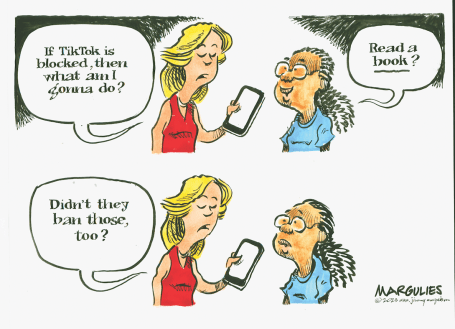 The Washington Examiner had this screaming Op-Ed today by someone named Jeremiah Poff. “TikTok needs a conservative US buyer.” Yup, just what we need; more Rupert Murdoch and Elon Musk to create a more violent and unhinged right wing.
The prospect of TikTok needing a U.S. buyer increased this week after the House of Representatives passed a bill that would require the social media app’s parent company, ByteDance, to divest from the app or face a ban.
On a 352-65 vote on Wednesday, the House showed unusual bipartisanship and passed a bill that would force the app to decouple from China or be banned in the United States. The app’s connection to the Chinese Communist Party has raised serious national security concerns that have motivated the legislative action.
While the bill’s fate is uncertain in the Senate despite President Joe Biden pledging to sign it, there needs to be some consideration about what will happen to the app if the bill becomes law and TikTok is sold to a U.S. investor.
Social media companies such as Meta and Google are dominated by the Left. As was evidenced by the 2020 election, they have a sizable influence on what content people see and their political perceptions. A similar concern was obvious with Twitter until it was bought by Elon Musk and rebranded as X.
TikTok has an enormous user base of 170 million in the U.S. Its potential for influencing the population at large is vast, which means Silicon Valley tech companies with an overrepresentation of left-wing views must not be allowed to buy it, lest censorship and liberal propaganda replace Chinese government propaganda.
So, that last sentence is why we don’t need right-wing hysterical and culturally nasty propaganda replacing Chinese government propaganda. You heard it from me first.
My last word is, please remember where and who we were four years ago with President (sic) Trump and his bumbling management of Covid-19. I think it’s an excellent answer to Stefank’s question with a loud YES. The media should remind us how awful it was. Refrigerator trucks with dead bodies and no toilet paper are just two reminders. This is from Mediaite. “Hannity Claims Democrats’ Cannot Run on, Are You Better Off Than You Were Four Years Ago?” Michael Luciano has the lede. Hannity is still carrying Trump’s diseased water.
Sean Hannity said President Joe Biden and Democrats will be unable to make the case that Americans are better off in 2024 than they were four years ago.
Biden is seeking a second term and will face former President Donald Trump as congressional Democrats try to retake the House of Representatives and undertake the tall order of holding the Senate.
“They spread fear, hysteria, all things hate Trump, hate Trump 24/7,” Hannity said of Democrats during his opening monologue Thursday on Fox News. “And of course, Democrats will call Republicans racist, sexist, xenophobic, homophobic, Islamophobic, transphobic that want dirty air and water. In other words, Democrats are using fear and division to mask what has been a terrible four years under Biden.”
Hannity then invoked an election refrain made famous by Ronald Reagan during a 1980 debate with then-President Jimmy Carter: “Are you better off today than you were four years ago?”
“I repeat, they cannot run on, ‘Are you better off than you were four years ago?’” Hannity said. “This is all they have left.”
Some quick, back-of-the-napkin math indicates that four years ago, the year was 2020. History buffs may recall that this period in time was marred by a once-in-a-century global pandemic that wound up killing more than one million Americans and torpedoed the economy. Trump’s handling of the country’s pandemic response arguably cost him reelection.
In the early days of the pandemic, Trump sought to downplay the threat posed by Covid-19. In February 2020, he reacted to the news that a handful of Americans had been diagnosed with the virus by saying, “And again, when you have 15 people, and the 15 within a couple of days is going to be down to close to zero, that’s a pretty good job we’ve done.”
This headline made me giggle. It’s from Raw Story. It’s written by Kathleen Culliton. “‘
The Republican National Committee’s new chair Friday gave a resounding “No” to a question he asked himself on nationally broadcast television: Was the nation better off under former President Donald Trump?
Whoops.
Michael Whatley appeared on Fox News to promote the presumptive Republican nominee and the RNC’s co-chair Lara Trump’s father-in-law in his bid to reclaim the White House in 2024.
Have a great weekend! We’re about to get a rainstorm, and I’m getting ready to make a good-sized meatloaf and potatoes, which was basically my mother’s weekly recipe.
What’s on your reading and blogging list today?
Thursday Reads
Posted: April 6, 2023 Filed under: corruption, Donald Trump, morning reads, SCOTUS | Tags: Alvin Bragg, Bohemian Grove, Clarence Thomas, Ginni Thomas, Gloria Johnson, Harlan Crow, Harry Litman, Jed Shugerman, Justin Jones, Justin Pearson, Manhattan DA, Margaret Renkl, Tennessee House of Representatives 24 CommentsGood Morning!!
Everyone is talking about the shocking story about Clarence Thomas published early this morning at ProPublica. We knew that Thomas was corrupt, but the scale of the corruption revealed by authors Joshua Kaplan, Justin Elliott, and Alex Mierjeski is beyond mind-boggling. And they provide plenty of photos of Thomas enjoying luxury accommodations alongside the wealthy and powerful. Thomas never reported any of these gifts.
IN LATE JUNE 2019, right after the U.S. Supreme Court released its final opinion of the term, Justice Clarence Thomas boarded a large private jet headed to Indonesia. He and his wife were going on vacation: nine days of island-hopping in a volcanic archipelago on a superyacht staffed by a coterie of attendants and a private chef.
If Thomas had chartered the plane and the 162-foot yacht himself, the total cost of the trip could have exceeded $500,000. Fortunately for him, that wasn’t necessary: He was on vacation with real estate magnate and Republican megadonor Harlan Crow, who owned the jet — and the yacht, too.
For more than two decades, Thomas has accepted luxury trips virtually every year from the Dallas businessman without disclosing them, documents and interviews show. A public servant who has a salary of $285,000, he has vacationed on Crow’s superyacht around the globe. He flies on Crow’s Bombardier Global 5000 jet. He has gone with Crow to the Bohemian Grove, the exclusive California all-male retreat, and to Crow’s sprawling ranch in East Texas. And Thomas typically spends about a week every summer at Crow’s private resort in the Adirondacks.
The extent and frequency of Crow’s apparent gifts to Thomas have no known precedent in the modern history of the U.S. Supreme Court.
These trips appeared nowhere on Thomas’ financial disclosures. His failure to report the flights appears to violate a law passed after Watergate that requires justices, judges, members of Congress and federal officials to disclose most gifts, two ethics law experts said. He also should have disclosed his trips on the yacht, these experts said.
Get this: Thomas even went with Crow to the legendary Bohemian Grove.
More from the ProPublica article:
In a statement, Crow acknowledged that he’d extended “hospitality” to the Thomases “over the years,” but said that Thomas never asked for any of it and it was “no different from the hospitality we have extended to our many other dear friends.”
Through his largesse, Crow has gained a unique form of access, spending days in private with one of the most powerful people in the country. By accepting the trips, Thomas has broken long-standing norms for judges’ conduct, ethics experts and four current or retired federal judges said.
“It’s incomprehensible to me that someone would do this,” said Nancy Gertner, a retired federal judge appointed by President Bill Clinton. When she was on the bench, Gertner said, she was so cautious about appearances that she wouldn’t mention her title when making dinner reservations: “It was a question of not wanting to use the office for anything other than what it was intended.”
Virginia Canter, a former government ethics lawyer who served in administrations of both parties, said Thomas “seems to have completely disregarded his higher ethical obligations.”
“When a justice’s lifestyle is being subsidized by the rich and famous, it absolutely corrodes public trust,” said Canter, now at the watchdog group CREW. “Quite frankly, it makes my heart sink.”
ProPublica uncovered the details of Thomas’ travel by drawing from flight records, internal documents distributed to Crow’s employees and interviews with dozens of people ranging from his superyacht’s staff to members of the secretive Bohemian Club to an Indonesian scuba diving instructor.
https://twitter.com/petestrzok/status/1643944883785289731?s=20
I haven’t finished reading the article yet, but I definitely will go back to it today.
This is from John Wagner at The Washington Post: Justice Thomas accepted luxury travel for years from GOP donor, report says.
Federal law mandates that top officials from the three branches of government, including the Supreme Court, file annual forms detailing their finances, outside income and spouses’ sources of income, with each branch determining its own reporting standards.
Revised rules adopted by a committee of the Judicial Conference, the courts’ policymaking body, seek to provide a fuller accounting. The rules took effect March 14.
Gifts such as an overnight stay at a personal vacation home owned by a friend remain exempt from reporting requirements. But the revised rules require disclosure when judges are treated to stays at commercial properties, such as hotels, ski resorts or corporate hunting lodges. The changes also clarify that judges must report travel by private jet….
While the wide scope of Crow’s funding of Thomas’s travel has not been previously reported, the largesse of the billionaire donor directed at the justice has provoked controversy previously.
In 2011, the New York Times reported that Crow had done many favors for Thomas and his wife, notably financing the multimillion-dollar purchase and restoration of a cannery in Pin Point, Ga., that was a pet project of the justice.
The Times also reported that Crow helped finance a Savannah, Ga., library project dedicated to Thomas, presented him with a Bible that belonged to Frederick Douglass and reportedly provided $500,000 for Ginni Thomas to start a tea-party-related group.
Thomas, who joined the court in 1991, has drawn scrutiny on other ethical issues in recent years, several related to the political activism of his wife. She has been allied with numerous people and groups that have interests before the court, and she has dedicated herself to right-wing causes involving some of the most polarizing issues in the country.
In other news, reporters and legal experts are busy critiquing Manhattan District Attorney Alvin Bragg’s case against Donald Trump. Here’s one of the worst:
Shugerman writes: The Trump Indictment Is a Legal Embarrassment.
Tuesday was historic for the rule of law in America, but not in the way Alvin Bragg, the Manhattan district attorney, would have imagined. The 34-count indictment — which more accurately could be described as 34 half-indictments — was a disaster. It was a setback for the rule of law and established a dangerous precedent for prosecutors.
This legal embarrassment reveals new layers of Trumpian damage to the legal foundations of the United States: Mr. Trump’s opponents react to his provocations and norms violations by escalating and accelerating the erosion of legal norms.
The case appears so weak on its legal and jurisdictional basis that a state judge might dismiss the case and mitigate that damage. More likely, the case is headed to federal court for a year, where it could lose on the grounds of federal pre-emption — only federal courts have jurisdiction over campaign finance and filing requirements. Even if it survives a challenge that could reach the Supreme Court, a trial would most likely not start until at least mid-2024, possibly even after the 2024 election.
Instead of the rule of law, it would be the rule of the circus.
Let’s start with the obvious problem that the payments at issue were made around six years ago. The basic facts have been public for five years. There are undoubtedly complicated political reasons for the delay, but regardless, Mr. Bragg’s predecessor, Cyrus Vance Jr., had almost a year to bring this case after Mr. Trump left office, but did not do so, and Attorney General Merrick Garland’s Justice Department also declined. To address the perception of a reversal and questions of legitimacy, Mr. Bragg had a duty to explain more about the case and its legal basis in what’s known as a “speaking indictment,” which the team of former counsel Robert Mueller made famous in its filings.
Legal experts have been speculating about the core criminal allegation in this case, because the expected charge for “falsifying business records” becomes a felony only “when his intent to defraud includes an intent to commit another crime or to aid or conceal the commission thereof.”
Astonishingly, the district attorney’s filings do not make clear the core crime that would turn a filing misdemeanor into a felony. Neither the 16-page indictment nor the accompanying statement of facts specifies, though the statement of facts does drop hints about campaign laws. In a news conference, Mr. Bragg answered that he did not specify because he was not required to by law. His answer was oblivious to how law requires more than doing the minimum to the letter — it demands fairness, notice and taking public legitimacy seriously.
Phew! Now that’s a smackdown!
Here’s different point of view from high profile attorney Harry Litman:
From the Los Angeles Times: Column: Don’t underestimate the strengths of Alvin Bragg’s case against Donald Trump.
Manhattan Dist. Atty. Alvin Bragg’s indictment of former President Trump takes an open-ended approach to the charges that some critics of the unprecedented prosecution see as a weakness. What the detractors have overlooked are the substantial and unanticipated legal and factual strengths in the case Bragg outlined.
A key question in advance of Tuesday’s unsealing of the indictment concerned how Bragg would augment the easily proven misdemeanor charges of falsifying business records. Under New York law, those offenses become felonies only if they’re in furtherance of another crime. Many theories were circulating as to what second crime Bragg would allege, and most of the possibilities had noteworthy shortcomings.
Bragg’s answer was essentially “I’ll tell you later.” He took advantage of the wording of the state law, which requires only that the misdemeanor be done in service of “a crime,” to buy himself maximum time and flexibility.
Bragg may have to pick his crime down the line, perhaps in answer to an expected defense motion for a “bill of particulars” — that is, a fleshing out of the Delphic indictment to enable Trump’s team to prepare an appropriate defense.
On the other hand, the prosecutor may not have to specify a second crime. The jury instructions on falsification of business records say it’s a felony if the defendant acted “with intent to defraud that included an intent to commit another crime or to aid or conceal the commission thereof.” It’s therefore not clear that they require the jury even to agree on what the augmenting crime is.
But Bragg this week also added a potent possible second crime beyond what many observers expected. It emerges from the fact that in making his lawyer Michael Cohen “whole” for the hush money he paid to Stormy Daniels, Trump included enough to compensate Cohen for the taxes he would have to pay on the “income” — that is, on the phony legal retainer that camouflaged the hush money.
It’s not clear whether Cohen in fact declared and paid taxes on the reimbursement or whether the Trump Organization declared it as a business expense. The Bragg team’s insight is that it doesn’t matter: The language that elevates business record falsification to a felony only requires “an intent to commit another crime or to aid or conceal the commission thereof.”
That purposely encompasses what lawyers call “inchoate” crimes. The law would plainly be satisfied by the inclusion of money intended to commit or conceal another crime — namely, a false tax filing — whether or not that crime occurred.
Importantly, this theory could be a way around the legal questions inherent in alleging that the second crime was a state or federal campaign finance violation.
Read the rest at the LA Times.
Another big and disturbing story is happening in Tennessee.
From Reuters: Tennessee Republicans likely to expel three Democratic lawmakers from statehouse.
Republicans who control the Tennessee House of Representatives will vote on Thursday on whether to expel three Democratic members for their role in a gun control demonstration at the statehouse last week.
Last Friday’s protest saw hundreds of demonstrators flood into the statehouse, four days after a Nashville school shooting ended with three 9-year-old children and three school staff members dead.
Three Democratic lawmakers stood on the House floor and used a bullhorn to lead protesters in chanting demands for stricter gun laws. In the resolutions calling for their expulsion, Republicans accused the three of engaging in “disorderly behavior” and said they “did knowingly and intentionally bring disorder and dishonor to the House of Representatives through their individual and collective actions.”
The expulsion vote is likely to easily pass in the Republican-dominated House and lead to the ouster of Rep. Gloria Johnson, Rep. Justin Jones and Rep. Justin Pearson. They say they were within their First Amendment rights to take part in the protest.
“It’s morally insane that a week after a mass shooting took six lives in our community, House Republicans only response is to expel us for standing with our constituents to call for gun control,” Jones wrote on Twitter this week. “What’s happening in Tennessee is a clear danger to democracy all across this nation.
Republicans Rep. Andrew Farmer, Rep. Gino Bulso, and Rep. Bud Hulsey filed three resolutions on Monday to expel their Democratic colleagues. The resolutions on Monday passed in a preliminary vote along party lines, 72-23.
Imagine if this insanity spreads to other Republican-controlled legislatures–and it very likely will, if it’s successful.
Commentary from Margaret Renkl at The New York Times: As Young People March for Their Lives, Tennessee Crushes Dissent and Overrides Democracy.
NASHVILLE — Yesterday the eyes of the country were on the indictment of a former president, along with the all too real possibility that political or public chaos would erupt as a result. Here in Tennessee, we were watching a different kind of chaos unfold as our state government doubled down on its love affair with guns, even in the immediate aftermath of a horrific school shooting. I wish I could tell you that guns were the worst of it.
Last Thursday, in the wake of the shooting, peaceful protesters at the Tennessee State Capitol rallied for gun reform. Activists waved signs in the statehouse gallery, and Representatives Justin Jones, Gloria Johnson and Justin J. Pearson, all Democrats, led them in chants from the House floor during breaks. Between bills, the lawmakers also approached the podium to speak. They did not wait to be formally recognized.
On Monday, statehouse Republicans stripped all three of their committee memberships and deactivated their ID badges. The Democrats “did knowingly and intentionally bring disorder and dishonor to the House of Representatives,” the formal resolutions against them read. Tomorrow, the House will vote on whether to expel the three lawmakers for talking out of turn.
Expulsion is extremely rare in Tennessee history. As the Politico reporter Natalie Allison pointed out on Twitter, the Tennessee House didn’t even vote to expel a Republican legislator who had been accused of sexually assaulting three teenage girls.
The resolutions against Mr. Jones, Ms. Johnson and Mr. Pearson were filed against a backdrop that highlights the absurdity of the actions Republicans have taken against them.
On Monday at 10:13 a.m., one week to the minute after a shooter armed with military-style weapons entered the church-affiliated Covenant School and murdered three children and three adults, more than 7,000 Nashville students staged a walkout to demand gun reform. It was a sight to behold: Vanderbilt University students marching down one street, Belmont University students marching down another, all of them joining a large crowd of high school and college students from around town. They were determined to speak as one voice directly to their government — to the only people with any power to reduce the risks they take just by going to class.
No place in this firearm-besotted country is safe from gun violence, but Tennessee students are at particular risk, and not just in school. They live in a state with some of the nation’s most permissive gun laws, as well as the highest rate of gun theft — and perhaps unsurprisingly, one of the highest rates of gun deaths.
Read the rest at the NYT.
Those are the top stories today, as I see it. I’ll add a few more in the comment thread. What do you think? What other stories have captured your interest?
Lazy Caturday Reads
Posted: February 4, 2023 Filed under: cat art, caturday, Donald Trump | Tags: Alvin Bragg, carless handing of sensitive materials, Chinese spy balloon, conspiracy theories, Extreme cold temperatures, Manhattan DA, Mark Pomerantz, Mt Washington, New Hampshire, Rep. James Comer, Supreme Court, wind chill 20 Comments
By Glenn Harrington
Happy Caturday!!
As predicted, it got really cold here yesterday and overnight. It got down to -9 where I am, lower in other parts of Massachusetts and New England. My newly installed air heat pump worked very well. I had it set at 72, and it stayed very warm in my apartment. The temperature is back up to -1 now (feels like -16) and will continue rising into the teens today. Tomorrow we will be back up to warmer than normal temperatures in the 40s and 50s for the rest of the week. Pretty freaky. Of course, my parents, who grew up in North Dakota, wouldn’t have thought these temperatures were a big deal.
The really dramatic weather was at Mt. Washington in New Hampshire. It’s not that big a mountain, but it gets the “worst weather in the world.” They get hurricane-force winds up there all the time. Once in the 1930s, Mt. Washington recorded 231 mph winds! Last night it got to a wind chill of -109 degrees, the lowest ever recorded in the U.S.
From The Washington Post: ‘Historic Arctic outbreak’ crushes records in New England.
Parts of the Northeast woke up to the coldest morning in decades on Saturday, with temperatures 30 degrees or more below average and wind chills in the extremely dangerous category. Virtually the entirety of New England was included in wind chill warnings, while Mount Washington’s minus-109 degree wind chill set a record for the entire United States.
The National Weather Service office serving the Boston region described the cold as “a historic Arctic outbreak for the modern era,” and warned that “this is about as cold as it will ever get.”
In Boston, the morning low fell to minus-10 degrees at 5:15 a.m., the coldest reading observed in the city since Jan. 15, 1957, when Boston hit minus-12. The episode resembled the brutal Arctic blast on Valentine’s Day 2016, when Logan Airport dropped to minus-9 degrees.
Coupled with winds gusting near 40 mph, Boston witnessed its lowest wind chill ever recorded at minus-39 degrees. Records date back to 1944. Wind chill is an index that attempts to quantity the combined impact of cold and wind on the human body, since strong winds blow away one’s body heat.
By Robin Freedenfeld
The temperatures were so extreme in Maine that residents reported “frost quakes,” or cryoseisms. The earthquake-like tremors are caused by rapidly plummeting temperatures, which cause water trapped in cracks in the ground to expand.
The city of Portland, Maine, recorded its all-time lowest wind chill at minus-45 degrees. A weather balloon launched by the National Weather Service in Gray, Maine, reported the all-time lowest 850 millibar (an air pressure level corresponding to approximately 5,000 feet in altitude) temperature ever observed by that office at minus-35.5 degrees.
Farther north in Maine, Frenchville Airport in Aroostook County recorded a wind chill to minus-61 degrees, while Cadillac Mountain in Hancock County had a minus-62 degree wind chill. Even Bar Harbor, on the coast, logged a wind chill of minus-48. Greenville in Piscataquis County faced a wind chill of minus-58.

So that was interesting for those of us who are excited by extreme weather; now we go back to unseasonably warm daytime temperatures in the 40s and 50s. Freaky.
Yesterday, the right wing nuts on Twitter–including Congressional Republicans–were totally losing their minds over that Chinese balloon that was spotted over the U.S. The wingnuts demanded that the government shoot the thing down. Of course it’s flying way up in the atmosphere, beyond reach of any kind of weapon, plus it’s huge and would probably kill people if it came down, but whatever. It’s Biden’s fault. This moron is chairman of the House Oversight Committee.
Justin Baragona at The Daily Beast: GOP Rep Warns That Chinese Balloon May Have ‘Bioweapons’ From ‘Wuhan.’
House Oversight Chairman James Comer (R-KY) casually suggested to Fox News on Friday that the suspected Chinese spy balloon floating over the United States could contain “bioweapons” from “Wuhan,” invoking the “lab leak theory” that’s been embraced by Republicans.
After a Chinese surveillance balloon was spotted over the northern U.S. this week, Republicans have lashed out at President Joe Biden over his perceived “weakness” in his administration’s policy towards China. Calling for the president to “shoot down” the craft, some in the GOP called the president “Beijing Biden” while claiming this is further proof that “Communist China” doesn’t “fear or respect” Biden.
By Bruce Bingham
While the Pentagon has balked over conservative demands to take down the balloon, noting that falling debris could injure or kill civilians, the Biden administration has postponed Secretary of State Antony Blinken’s upcoming trip to China. China, meanwhile, has insisted the suspected spycraft is really just a “civilian airship” that “deviated far from its planned course.”
Amid the Republican handwringing over the Chinese balloon, Comer appeared on Fox News’ The Faulkner Focus to react. And he immediately jumped into conspiratorial waters.
“I have concern this will be another example of the Biden administration’s weakness on the national scale,” he declared. “You look at what happened in Afghanistan. That hurt the reputation of America’s military strength. That hurt the reputation of our commander-in-chief. And now we have China clearly playing games with the United States.”
After saying the balloon “never should have been allowed” to cross over into the U.S., the Kentucky lawmaker then fear-mongered that the craft could be loaded down with weaponized viruses. “My concern is that the federal government doesn’t know what’s in that balloon,” he asserted. “Is that bioweapons in that balloon? Did that balloon take off from Wuhan?”

Um . . . Okay.
For some actual news about the situation, here’s Lily Kuo at The Washington Post: China rushes to cap damage over suspected spy balloon as Blinken delays trip.
Beijing on Saturday offered a subdued rebuttal to Washington’s decision to delay a high-level visit after a suspected Chinese spy balloon was discovered hovering over the United States, derailing China’s recent efforts to repair its most important bilateral relationship.
Hours before U.S. Secretary of State Antony Blinken was to take off, Washington postponed the trip, saying it “would not be appropriate” after the discovery of the airship floating around 60,000 feet above the central United States.
The Chinese Foreign Ministry said in a statement Saturday that the presence of a Chinese airship in U.S. airspace was “completely an accident,” and was caused by westerly winds knocking the balloon off course. It reiterated claims that the balloon was for scientific research such as collecting weather data, and accused “some U.S. politicians and media” of taking advantage of the situation to discredit China, which “firmly opposes this.” [….]
Blinken had been expected to meet Chinese leader Xi Jinping on the trip, and while few expected concrete results, officials on both sides hoped it would start the process of capping tensions over issues such as Taiwan, U.S. sanctions targeting Chinese tech companies, human rights and China’s friendship with Russia. The trip would help pave the way for a potential visit to the United States by Xi when San Francisco hosts an Asia-Pacific Economic Cooperation leaders’ meeting in November.
The balloon incident, on the eve of such a critical meeting, raises questions over whether it was an accident or a deliberate effort by Beijing to send a message to Washington. (The Pentagon said Thursday that the air vehicle is not currently considered a threat to people on the ground.) In either case, it is a setback for China’s leadership.

By Linda Lee Nelson
Ariane de Vogue has a scoop at CNN on the Supreme Court’s careless handling of sensitive information: Exclusive: Supreme Court justices used personal emails for work and ‘burn bags’ were left open in hallways, sources say.
Long before the leak of a draft opinion reversing Roe v. Wade, some Supreme Court justices often used personal email accounts for sensitive transmissions instead of secure servers set up to guard such information, among other security lapses not made public in the court’s report on the investigation last month.
New details revealed to CNN by multiple sources familiar with the court’s operations offer an even more detailed picture of yearslong lax internal procedures that could have endangered security, led to the leak and hindered an investigation into the culprit.
Supreme Court employees also used printers that didn’t produce logs – or were able to print sensitive documents off-site without tracking – and “burn bags” meant to ensure the safe destruction of materials were left open and unattended in hallways.
“This has been going on for years,” one former employee said.
The problem with the justices’ use of emails persisted in part because some justices were slow to adopt to the technology and some court employees were nervous about confronting them to urge them to take precautions, one person said. Such behavior meant that justices weren’t setting an example to take security seriously.
The justices were “not masters of information security protocol,” one former court employee told CNN.
In a statement attached to the final report, the court called the leak a “grave assault” on the court’s legitimacy and the marshal of the court issued a road map to improve security.
More details at the CNN link.
We’re getting more information about what’s in that new tell-all book by Mark Pomerantz, a former prosecutor in the Manhattan District Attorney’s office–one of the two who resigned in disgust when incoming DA Alvin Bragg decided not to prosecute Trump.
Former prosecutor Andrew Weissman reviews the book at The New York Times: An insider’s critical view of an investigation of Donald Trump.
In February 2022, Mark Pomerantz was a lead attorney in the Manhattan district attorney’s investigation of former president Donald Trump and his business practices when he abruptly resigned. He cited frustration over what he saw as the office’s flagging commitment to the inquiry. Pomerantz, a renowned former prosecutor and defense lawyer, had been recruited in February 2021 by then-district attorney Cyrus Vance to assist in the long-running investigation. In his resignation letter, Pomerantz asserted that the new DA, Alvin Bragg, had “suspended indefinitely” the investigation and said that Pomerantz did not want “to become a passive participant in what I believe to be a grave failure of justice.”
Elena Berezina – Portrait of K.F. Venevtseva
Pomerantz has now expanded on his views in a book, “People vs. Donald Trump: An Inside Account.” However, in the time between Pomerantz’s resignation and the book’s publication, Bragg’s investigation of Trump has taken another turn. The district attorney’s office has impaneled a grand jury and begun hearing evidence in a sharp ramping up of its inquiry into, among other things, Trump’s role in payments to adult-film star Stormy Daniels during the 2016 presidential campaign. As the office pushes forward on work that could lead to criminal charges against Trump, Bragg has publicly raised concerns that Pomerantz’s book could jeopardize any subsequent prosecution.
It is in this climate that Pomerantz’s book lands next week. His intent is to reveal what happened within the district attorney’s office during his year there. As he frames the question: “Why had the investigation, which by all accounts had been gaining steam and seemed likely to lead to criminal charges against the former president, come to a sudden stop?”
His assessment of the inner workings of the Manhattan district attorney’s office is brutal. Pomerantz contends that no criminal case emerged against Trump because the DA’s team of career prosecutors was simply not up to the task. He paints an unflattering portrait of the career assistant district attorneys, particularly the many who disagreed with his own assessment of the potential criminal case. “They spoke about the need to follow the evidence,” Pomerantz writes, “but to my knowledge they had not actually looked at much of it.”
In his telling, the prosecutors come across as fainthearted, lacking “energy” and “enthusiasm,” and “relentlessly negative.” The team was faced with a possible first-of-its-kind prosecution of a former president, and, Pomerantz writes, the prosecutors were perhaps “a bit fearful about bringing charges against Trump,” given his well-known penchant for public retaliation. “They seemed to me,” Pomerantz observes, “to be exactly the kind of traditional, ‘let’s do things the way we have always done them’ prosecutors that kept the district attorney’s office from being resourceful and successful in white-collar cases.” Pomerantz reveals that Vance had “privately complained many times to me … about the slow-moving and ‘gun shy’ culture in the office.” Pomerantz believed the office needed a chief of staff, “a drill sergeant,” as he puts it, to “keep the team moving.” But out of the hundreds of assistant district attorneys, he argues, “there was no suitable candidate from within the office.”

Read the rest at the NYT.
Also at The New York Times, William K. Rashbaum, Ben Protess, and Jonah E. Bromwich write: Trump Likened to Mob Boss John Gotti in Ex-Prosecutor’s New Book.
Donald J. Trump grew his business, fortune and fame “through a pattern of criminal activity,” according to a new book by a veteran prosecutor, who reveals that the Manhattan district attorney’s office once considered charging the former president with racketeering, a law often used against the Mafia.
The prosecutor, Mark F. Pomerantz, resigned in protest early last year after the newly elected district attorney, Alvin L. Bragg, decided not to seek an indictment of Mr. Trump at that time. By then, the inquiry was more narrowly focused on whether the former president had fraudulently inflated the value of his assets to secure loans.
But for months beforehand, Mr. Pomerantz had mapped out a wide-ranging possible case against the former president under the state racketeering law, according to the soon-to-be published book, “People vs. Donald Trump.” That broader approach was based on the theory that Mr. Trump had presided over a corrupt business empire for years, a previously unreported aspect of the long-running inquiry.
Girl with cat, by Merle Keller
Mr. Pomerantz and his colleagues cast a wide net, examining a host of Trump enterprises — including Trump University, his for-profit real estate education venture, and his family charitable foundation.
“He demanded absolute loyalty and would go after anyone who crossed him. He seemed always to stay one step ahead of the law,” Mr. Pomerantz, a prominent litigator who has prosecuted and defended organized crime cases, writes of Mr. Trump. “In my career as a lawyer, I had encountered only one other person who touched all of these bases: John Gotti, the head of the Gambino organized crime family.”
The book, a copy of which was obtained by The New York Times, is a chronicle of the complicated and circuitous investigation, which produced charges against Mr. Trump’s longtime chief financial officer and his family business, but has yet to yield formal accusations against the former president himself.
Mr. Pomerantz’s book arrives as the investigation is ramping up once again, with prosecutors impaneling a new grand jury to hear evidence about Mr. Trump’s role in paying hush money to a porn star, Stormy Daniels, during the 2016 presidential campaign. Mr. Bragg’s administration, which has raised ethical and legal concerns about Mr. Pomerantz’s revealing details of the inquiry, is also applying additional pressure on the former chief financial officer, Allen H. Weisselberg, seeking to secure his cooperation against the former president.

That’s it for me today; what stories have piqued your interest? Have a great Caturday, Sky Dancers!!

 peej
peej Carissa
 bostonboomer
 dakinikat
 ecocatwoman
 mablue2
 Mama Lopez
 peggysue22
 quixote
 skydancingguestblogger
 Mona (aka Wonk the Vote)



 Sky Dancing
Recent Comments