
New Year’s Day Reads
Posted: January 1, 2025 Filed under: just because | Tags: french-quarter, Louisiana, New Orleans, NOLA, travel 10 Comments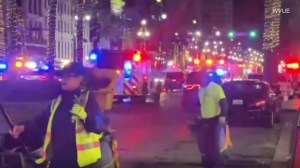
Scene of New Orleans vehicle attack At least 10 people were killed after a pickup truck rammed through a crowd on New Year’s Day in New Orleans.
Happy New Year!!
Here’s hoping we survive Trump 2.0.
I woke up this morning to the news of a terror attack in New Orleans during New Year’s celebrations. From The Boston Globe: Suspect in New Orleans crash that killed 10 people is dead after firefight with police, officials say.
10 people were killed and 30 injured after a vehicle drove into a crowd on New Orleans’ Canal and Bourbon Street
The suspect in the New Orleans truck crash that killed 10 people and injured 30 revelers in New Orleans on New Year’s Day was killed after a firefight with police, law enforcement officials told the AP.
The officials were not authorized to discuss details of the investigation publicly and spoke to AP on condition of anonymity.
The suspect rammed a vehicle at high speed into a crowd of pedestrians in New Orleans’ bustling French Quarter district at 3:15 a.m. Wednesday along Bourbon Street, known worldwide as one of the largest destinations for New Year’s Eve parties, and with crowds in the city ballooning in anticipation for the Sugar Bowl college football playoff game at the nearby Superdome later in the day.
At a news conference, New Orleans Mayor LaToya Cantrell described the killings as a “terrorist attack” and the city’s police chief said the act was clearly intentional. But an assistant FBI agent in charge declared that it was “not a terrorist event.” The news conference ended before authorities could reconcile the two characterizations.
Alethea Duncan, an assistant special agent in charge of the FBI’s New Orleans field office, said officials were investigating the discovery of at least one suspected improvised explosive device at the scene.
Police Commissioner Anne Kirkpatrick said police officers would work to ensure safety at the Sugar Bowl, indicating that the game would go on as scheduled.
“He was hell-bent on creating the carnage and the damage that he did,” Kirkpatrick said. “It was very intentional behavior. This man was trying to run over as many people as he could.”
Two police officers who were shot after the driver emerged from the truck are in stable condition, she said.
The New York Times has a photo and video report: Scenes From New Orleans After Attack on New Year’s Day.
Officials in New Orleans were assessing the damage in the city’s French Quarter on Wednesday morning after an attack left at least 10 people dead and at least 35 injured, including two police officers.
A man drove a pickup truck at high speed into the crowds on Bourbon Street around 3:15 a.m. before crashing and opening fire, according to police officials. The attacker died in a shootout with the police.
“He was hellbent on creating the carnage and the damage that he did,” the New Orleans police superintendent, Anne Kirkpatrick, said.
The F.B.I. said it was investigating the attack as an act of terrorism, and officials urged the public to stay away from the area.
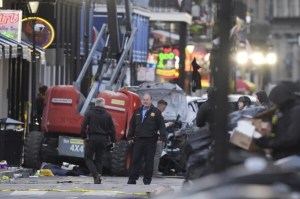
Security personnel investigate the scene on Bourbon Street after a vehicle drove into a crowd on New Orleans’ Canal and Bourbon Street. Wednesday, Jan. 1. 2024. (AP Photo/Gerald Herbert)
Also from The New York Times: What We Know About the Attack in the French Quarter of New Orleans.
At least 10 people were killed and dozens more were hurt in the early hours of New Year’s Day after a man drove a pickup truck into crowds in the French Quarter of New Orleans and then opened fire. Officials called it an attack, and the F.B.I. said it was investigating it as a potential act of terrorism….
Here’s what we know so far about what happened.
The man sped a truck into crowds on Bourbon Street around 3:15 a.m. After crashing, he opened fire, officials said. At least 10 people were killed and about 35 were injured.
Investigators said they later found what appeared to be improvised explosive devices in the truck and were trying to determine whether the devices were viable. It is not clear if any such devices were detonated….
The carnage occurred in the area of the intersection of Canal and Bourbon Streets in the city’s historic French Quarter, one of its most crowded areas and the heart of its tourism industry.
Officials asked the public on Wednesday morning to stay away from a half-mile stretch of Bourbon Street as the F.B.I. investigated….
Officials have not yet released the man’s name. He crashed the truck and died after a shootout with police officers, according to the F.B.I.
Background from The New York Times: The French Quarter is New Orleans’s most famous tourist attraction.
The attack on New Year’s Day targeted New Orleans’ most recognizable tourist destination.
The French Quarter is the historic colonial heart of the city and the center of its tourism industry, one of New Orleans’s leading economic engines. The six-by-13 block area on the curving bank of the Mississippi River is known for its colorful buildings and ornate balconies. Vibrant festivals and parties along famed Bourbon Street, where the attack took place, attract revelers from across the United States and abroad.
“You’re talking about one of the most iconic cities, and one of the most recognizable streets in the world,” Oliver Thomas, a New Orleans city councilman, said on Wednesday after the attack.
“So when you think about it, this isn’t really a message and a shot at New Orleans. This is at America. It’s the world and the environment we live in right now.”
Mr. Thomas said that New Orleans often hosts more people per capita than some of the largest cities in the world and that it was crucial that the city not shut down.
The city’s annual Mardi Gras, with its marching bands and beads flung from floats and balconies, is perhaps the most popular and celebrated event on the calendar, but New Orleans hosts more than 135 festivals each year, according to city figures, and attracted more than 18 million visitors in 2018.
Hours before the attack, the annual Allstate New Year’s Eve Parade moved through the French Quarter, attracting huge crowds. The parade is a buildup to one of the city’s largest annual sporting events — the Sugar Bowl — which falls on Jan. 1 this year and has now been overshadowed by the violence.
The Washington Post has live updates: 10 killed in New Orleans as driver plows truck into crowd.
From local station WDSU in New Orleans: WATCH: Explosions heard in French Quarter after deadly terror attack.
Explosions were heard early Wednesday morning in the French Quarter after a terror attack on Bourbon Street left 10 dead and dozens injured….
“Woah, they just detonated something,” WDSU Reporter Fletcher Mackel says as explosions are heard. “There it is again, they just blew something else.”
This comes as agents responded to what was believed to be “suspicious devices” found in the area.
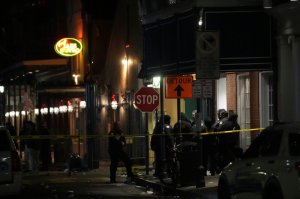
Emergency services attend the scene after a vehicle drove into a crowd on New Orleans’ Canal and Bourbon Street, Wednesday, Jan. 1, 2025. (AP Photo/Gerald Herbert)
More detail from Harry Howard at New Orleans WLLL4: 10 Dead, 35 injured after driver targets Bourbon Street crowd.
The suspect’s gun was described as a “long gun” and had a suppressive device attached.
In a statement, the FBI confirmed its lead role in the investigation.
“This morning, an individual drove a car into a crowd of people on Bourbon Street in New Orleans, killing a number of people and injuring dozens of others. The subject then engaged with local law enforcement and is now deceased. The FBI is the lead investigative agency, and we are working with our partners to investigate this as an act of terrorism.”
After plowing through the crowd, the suspect crashed his vehicle and shot two responding officers. The officers fired back and struck the suspect.
An improvised explosive device was also discovered at the scene, prompting the FBI to take over the investigation.
“We are working on confirming if this is a viable device or not,” FBI Special Agent Alicia Duncan said.
Moreno said the suspect was able to drive down Bourbon Street because the bollards were down for repairs.
I’m going to post this as is. I made a mistake, and WordPress has changed the post to “block mode.” There isn’t a way to indent news articles, so I hope this makes sense. We will have some updates in the comment thread.
Take care everyone. Somehow, we will make it through 2025 together. I love you all.
Mostly Monday Reads: “I was entitled.”
Posted: January 8, 2024 Filed under: just because | Tags: "presidential immunity", @repeat1968, Ijeoma Oluo, Jeff Landry, John Buss, Louisiana, Mediocre Bill Ackman, Mediocre Kavanaugh, Mediocre Landry, Mediocre Trump, mediocre white man, New Orleans, Walt Handelsman my home town political cartoonist, White Christian Nationalists 11 Comments“Carry yourself with the confidence of a mediocre white man.”
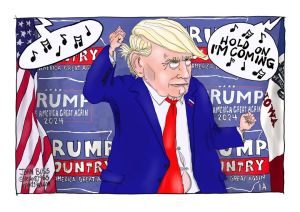
“The only thing great about a trump rally is the end. I always laugh and laugh.” John Buss @repeat1968
Good Day, Sky Dancers!
The entire eastern half of the United States seems inundated with some kind of precipitation. New Orleans has pretty much shut down while awaiting an afternoon and evening of heavy rains and likely tornadoes. I’m sitting in the very dark, quiet before the storm. It’s a bit of a metaphor for what’s going to be a tumultuous year. I started with this quote today because mediocre white men are still ruining the country. Louisiana inaugurated one as its Governor yesterday, who’s a pallbearer for the Christian White Supremacists we already have terrorizing the country. LSU–supposedly our flagship university–is already cleansing itself of professors who are experts in climate change and white-washed its student recruitment outreach through its renamed Office of Diversity and Inclusion and its Mission.

Jeff Landry with the Sword of Mediocre White Men. The sword was his prop for his inaugural speech.
Former AGA Landry, now Governor, was elected by only 10% of the Louisiana electorate. A low voter turnout handed him the office. He gave his inaugural address from behind a sword. It’s going to get ugly here. There were literally a handful of people at the ceremony. Speaker of the House Ayatollah Mike Johnson was there. So was Sleazy Steve. All the short little bully guys were there. This is from the AP.
Louisiana Gov.-elect Jeff Landry, a Republican endorsed by former President Donald Trump and known for his conservative positions on issues like abortion, was inaugurated Sunday evening — marking a political shift of leadership in a state that has had a Democratic governor for the last eight years.
During his 30-minute speech, Landry called for unity and expressed his love for the Bayou State while also laying out some of his priorities, including an aggressive response to addressing “uncivilized and outrageous” violent crime and safeguarding schools from “the toxicity of unsuitable subject matter.”
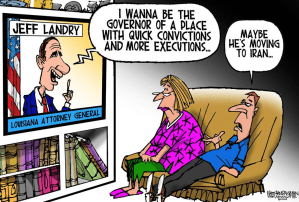
Walt Handelsman, political cartoonist for The Advocate and Times Picayune, has some really great takes on the radicalism of Landry
We know him. He hates New Orleans and will likely throw the state’s power into eliminating the independence that our charter provides. He does not want unity. He wants compliance and complacency. The First Amendment means nothing to him. You already see LSU scramble to be compliant.
Landry has vowed to call a special legislative session in his first few months in office to address the issue. He has pushed a tough-on-crime rhetoric, calling for more “transparency” in the justice system and continuing to support capital punishment. Thank goddesses that my LSU alumni daughters have left the state.
“I pledge to do all I possibly can to make our state safer and to bring an end to the misguided and deadly tolerance for crime and criminals that plague us,” Landry said Sunday.
Landry, who has served as the state’s attorney general for eight years, won the gubernatorial election in October, beating a crowded field of candidates and avoiding a runoff. The win was a major victory for the GOP, reclaiming the governor’s mansion. Edwards was unable to seek reelection due to term limits.
Landry, 53, has raised the profile of attorney general since taking office in 2016, championing conservative policy positions. He has been in the spotlight over his involvement and staunch support of Louisiana laws that have drawn much debate, including banning gender-affirming medical care for young transgender people, the state’s near-total abortion ban and a law restricting children’ access to “sexually explicit material” in libraries, which opponents fear will target LGBTQ+ books.
“Our people seek government that reflects their values,” Landry said Sunday. “They demand that our children be afforded an education that reflects those wholesome principles, and not an indoctrination behind their mother’s back.”
 Ever notice how these guys just ooze white male privilege while screaming they are the most persecuted people on the planet? WBUR interviewed author Ijeoma Oluo in 2020 to explain the Mediocre White Man Syndrome. She also explains how dangerous it is.
White male mediocrity protects the belief that white men are perceived as stronger and more successful than women and people of color regardless of skill or achievements, she says.
“It’s a system that protects mediocrity, that sets [mediocrity] as the goal,” she says. “And the idea that anything would ask for more of our systems — let alone the people within these systems — becomes a threat to the status quo and to our systems of power.”
This ideology serves as one of capitalism’s primary protections by convincing people to participate in the system, she says.
White men believe that greatness and prosperity are coming despite the realities of their financial situation or career, she says. But when the paycheck doesn’t come, white men often blame women and people of color for taking it away.
Every person deserves to feel safe and thrive, she says, but society’s leaders need to show they can make that happen.
“Who leads us and [who] we reward for their contributions should actually be making meaningful contributions that improve the lives of people in our society,” she says, “should be leaders that can effectively lead and bring prosperity to everyone, regardless of race and gender or skill or talent.”
In the book, Oluo highlights key moments to show how this system works from the way women were kicked out of the workforce after the Great Depression, to how women of color in politics are challenged for holding different views on equity than their white male colleagues.
While she says she could write 100 books on this topic, Oluo started by asking “fundamental questions about white male identity in America as a political and social construct” throughout history. She collected hundreds of stories and looked for common threads.
 So, I buried the lede. Yes! I did. That quote up top is from the former guy for whom even mediocre is a struggle. This is from USA Today. “‘I was entitled’: Donald Trump previews his Tuesday courtroom appeal on presidential immunity. Trump is juggling court hearings in criminal and civil cases while also campaigning for the White House.”
Donald Trump is opening 2024 in what is likely to be a familiar place for him this election year: the courtroom.The former president and 2024 GOP frontrunner previewed on social media Monday his reasons why he should be shielded from charges of election interference. The crux of his argument, which his lawyers will make in a D.C. appeals court hearing Tuesday: he was president when the events occurred, so he is immune.
“Of course I was entitled, as President of the United States and Commander in Chief, to Immunity,” Trump said in a post Monday on Truth Social.
The case just one of the matter’s on Trump’s courtroom docket for the week. On Thursday, lawyers will make their closing arguments in the New York real estate fraud case in which $370 million in damages are at stake.
Don’t expect Trump himself to take the stand in either case this week. That’s for the lawyers, with lots of questions from the judges. But Trump may weigh in outside the courtroom, and most certainly will make his case on social media.
Given that, expect a fiery rebuttal Tuesday from one of Trump’s chief legal adversaries. Justice Department special counsel Jack Smith has argued that Trump’s logic would allow a president to commit crimes like bribery, murder and treason without consequence.
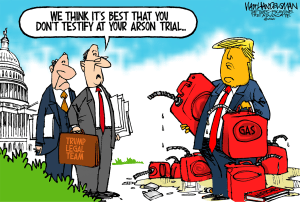
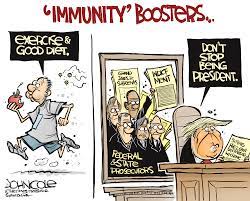 This argument is basically the mantra of the mediocre white man. This is from CNN. “Trump wants Georgia election subversion case dismissed, arguing he has presidential immunity.” If anyone would’ve thought this was a rational, legal argument, it would’ve been Richard Nixon. He just up and quit in the face of charges. Trump seems to be confused between the DOJ policy of avoiding election cycles and the U.S. Constitution. He seems to think he has a “Get out of Jail Free” card. It does appear that way with all of the things he’s done the normal person out awaiting trial would not.
Former President Donald Trump is seeking to have the sweeping criminal conspiracy case against him in Georgia thrown out by arguing he is protected from prosecution under presidential immunity.
Trump’s immunity claims in the Georgia case, filed on Monday as part of a motion to dismiss state-level criminal charges against the former president, are similar to those argued by his defense team in the federal election subversion case.
“The indictment in this case charges President Trump for acts that lie at the heart of his official responsibilities as President. The indictment is barred by presidential immunity and should be dismissed with prejudice,” the motion filed by Trump’s lawyer in the Georgia case reads.
Monday’s filing in the Georgia case reiterates what the former president’s lawyers have repeatedly asserted – that Trump was working in his official capacity as president when he allegedly undermined the 2020 election results and therefore has immunity.
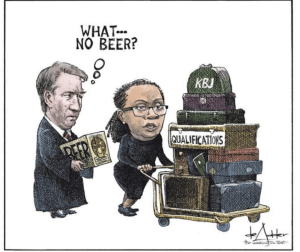 Entitlement just oozes from these guys. This is from the Washington Post. “Business Insider story on Harvard antagonist’s wife draws owner’s scrutiny. The news site’s German owner, Axel Springer, plans to review a story about alleged plagiarism by former MIT professor Neri Oxman, whose billionaire husband, Bill Ackman, sought to oust Harvard’s president for similar academic transgressions. Its editor defends the story.” The hypocrisy is evident when the spotlight is turned on them.
Business Insider and its German parent company appear to be at odds over its reporting on plagiarism allegations against the wife of a high-profile hedge fund manager.
The financial news site published two stories last week alleging that Neri Oxman, a prominent former Massachusetts Institute of Technology professor, had plagiarized repeatedly in her academic work, including lifting from Wikipedia more than a dozen times in her dissertation.
Those stories came after her husband, billionaire investor Bill Ackman, spent weeks pressuring his alma mater, Harvard University, to oust its president — initially over his contention that she had mishandled incidents of antisemitism on campus but later over reports that she had committed plagiarism earlier in her career. At one point, Ackman wrote that a Harvard student who committed “much less” plagiarism than Claudine Gay would be forced out of the university. Gay resigned from the presidency last week.
But when Business Insider raised plagiarism concerns about his wife’s work, Ackman excoriated the publication, accusing it of unethical journalism, promising to review its writers’ work and predicting that it would “go bankrupt and be liquidated.” In one social media post, he implied that Business Insider’s investigations editor (whom he called “a known anti-Zionist”) may have been “willing to lead this attack” because Oxman is Israeli.
Neither Ackman nor Oxman, whose companies didn’t respond to requests for comment, have pointed to any factual errors in the articles.
 Remember this? It’s like the patented hand shake of thee Mediocre White Man Club. This is from Newsweek. “Donald Trump Moves To Cash In on Brett Kavanaugh.”
Donald Trump’s lawyer Alina Habba has said that Supreme Court Justice Brett Kavanaugh would be among the judges to throw out the decision disqualifying the former president from the ballot in Colorado as Trump “went through hell” to get him to the bench.Speaking to Fox News‘ Sean Hannity, Habba singled out Kavanaugh as one of those on the SCOTUS bench who will “step up” for Trump after the Colorado Supreme Court made a historic ruling in December to ban Trump from running for president in the state over violating the Constitution’s insurrection clause around the January 6 attack.
Trump has appealed the decision to the Supreme Court and has denied that his actions related to the Capitol riots violated Section 3 of the 14th Amendment. The section, brought in after the Civil War, states that a person who “engaged in insurrection or rebellion” after taking an oath of office to support the Constitution cannot run for office again.
The conservative majority Supreme Court bench, which includes three justices nominated to the bench by Trump—Kavanaugh, Amy Coney Barrett, and Neil Gorsuch—is expected to take on the case, and rule on whether to allow or throw out the Colorado decision.
Habba predicted that the Supreme Court would make a “slam dunk” ruling in Trump’s favor while suggesting Kavanaugh is one of the nine justices who will want to overturn the decision to ban Trump from running for office in Colorado.
“People like Kavanaugh, who the president fought for, who the president went through hell to get into place, he’ll step up,” Habba said.
“Those people will step up, not because they’re pro-Trump, but because they’re pro-law, because they’re pro-fairness and the law on this is very clear.”
 Here are legal sources with annotations on Article 2, Section 3 of the U.S Constitution on the idea of Presidential Immunity from Judicial Direction. This has been a topic considered the Court for some time. Some of the Presidents who have taken the concept to court include Richard Nixon, Bill Clinton and Andrew Johnson. These are annotations from Justia. on the Johnson case and the Nixon case. It’s elucidation in the court on Article Two, Section 3 of the U.S. Constitution about Presidential responsibilities which includes the State of the Union Address from Court Cases.
In Mississippi v. Johnson,807 in 1867, the Court placed the President beyond the reach of judicial direction, either affirmative or restraining, in the exercise of his powers, whether constitutional or statutory, political or otherwise, save perhaps for what must be a small class of powers that are purely ministerial.808 An application for an injunction to forbid President Johnson to enforce the Reconstruction Acts, on the ground of their unconstitutionality, was answered by Attorney General Stanberg, who argued, inter alia, the absolute immunity of the President from judicial process.809 The Court refused to permit the filing, using language construable as meaning that the President was not reachable by judicial process but which more fully paraded the horrible consequences were the Court to act. First noting the limited meaning of the term “ministerial,” the Court observed that “[v]ery different is the duty of the President in the exercise of the power to see that the laws are faithfully executed, and among these laws the acts named in the bill. . . . The duty thus imposed on the President is in no just sense ministerial. It is purely executive and political.”
“An attempt on the part of the judicial department of the government to enforce the performance of such duties by the President might be justly characterized, in the language of Chief Justice Marshall, as ‘an absurd and excessive extravagance.’”
“It is true that in the instance before us the interposition of the court is not sought to enforce action by the Executive under constitutional legislation, but to restrain such action under legislation alleged to be unconstitutional. But we are unable to perceive that this circumstance takes the case out of the general principles which forbid judicial interference with the exercise of Executive discretion.” . . .
“The Congress is the legislative department of the government; the President is the executive department. Neither can be restrained in its action by the judicial department; though the acts of both, when performed, are, in proper cases, subject to its cognizance.”
“The impropriety of such interference will be clearly seen upon consideration of its possible consequences.”
“Suppose the bill filed and the injunction prayed for allowed. If the President refuse obedience, it is needless to observe that the court is without power to enforce its process. If, on the other hand, the President complies with the order of the court and refuses to execute the acts of Congress, is it not clear that a collision may occur between the executive and legislative departments of the government? May not the House of Representatives impeach the President for such refusal? And in that case could this court interfere, in behalf of the President, thus endangered by compliance with its mandate, and restrain by injunction the Senate of the United States from sitting as a court of impeachment? Would the strange spectacle be offered to the public world of an attempt by this court to arrest proceedings in that court?”810
Rare has been the opportunity for the Court to elucidate its opinion in Mississippi v. Johnson, and, in the Watergate tapes case,811 it held the President amenable to subpoena to produce evidence for use in a criminal case without dealing, except obliquely, with its prior opinion. The President’s counsel had argued the President was immune to judicial process, claiming “that the independence of the Executive Branch within its own sphere . . . insulates a President from a judicial subpoena in an ongoing criminal prosecution, and thereby protects confidential Presidential communications.”812 However, the Court held, “neither the doctrine of separation of powers, nor the need for confidentiality of high-level communications, without more, can sustain an absolute, unqualified Presidential privilege of immunity from judicial process under all circumstances.”813 The primary constitutional duty of the courts “to do justice in criminal prosecutions” was a critical counterbalance to the claim of presidential immunity, and to accept the President’s argument would disturb the separation-of-powers function of achieving “a workable government” as well as “gravely impair the role of the courts under Art. III.”814
Present throughout the Watergate crisis, and unresolved by it, was the question of the amenability of the President to criminal prosecution prior to conviction upon impeachment.815 It was argued that the Impeachment Clause necessarily required indictment and trial in a criminal proceeding to follow a successful impeachment and that a President in any event was uniquely immune from indictment, and these arguments were advanced as one ground to deny enforcement of the subpoenas running to the President.816 Assertion of the same argument by Vice President Agnew was controverted by the government, through the Solicitor General, but, as to the President, it was argued that for a number of constitutional and practical reasons he was not subject to ordinary criminal process.817
Oops, I’m down a history rabbit hole now. I guess it’s time to close. I love the song “Call me Rose” by Bruce Cockburn because of it’s implied karmic rebirth of Richard Nixon as a single woman on welfare with a child.
Anyway, this week should be another show stopper. Take care! I see the rain has started here. I wonder if BB is still getting that snowstorm. Bet thing to ponder is when exactly is this Former Guy shitstorm ending?
What’s on your reading and blogging list today?
Mostly Monday Reads: Cyberattack down in the Reeds
Posted: March 27, 2023 Filed under: just because | Tags: cyberattacks, hacks, Louisiana, malware, phishing, ransomware, universities and schools 24 Comments Good Day Sky Dancers!
Today’s topic comes from the Gret state of Lousyana, where many things are backward, including our Senators and most of our Congressional Representatives. There’s so much news that sometimes something important can sneak up and slap you and ya momma. I had no idea that Higher Education institutions worldwide were increasingly targeted for ransomware and malware attacks. This is especially true since many universities had to go exclusively online during the Covid-19 shutdowns. Now you know too!
Our first attack in this state was last November at a Historically Black College in New Orleans. Xavier is one of the premier universities in the state. The second big hit came at the beginning of March at Southeastern Louisiana University, where I taught for a few years while finishing my doctorate. Friday, the University of New Orleans got hit. The cybersecurity folks shut down everything. I lost access to my students while posting some graded items and assignments. My first thought was, why would anyone target universities in a poor state like Louisiana? Evidently, that was on the minds of a few reporters at the Times-Picayune as I talked to one of their reporters yesterday who had found my Facebook post and my frantic efforts to figure out how to return to pre-internet reality. Why HBC Southern near Shreveport and not the one here in New Orleans or over in Baton Rouge? Would we lose three weeks of everything like SELU? Michael Richmond is the director of technology services for the accounting and technology firm Postlethwaite & Netterville.
Richmond said there isn’t enough information publicly available to tell exactly what kind of attack Southeastern would be facing — whether that be someone accidentally falling for a phishing scam and causing a ransomware attack or some sort of intentional, targeted attack intended to gather specific information.
When it comes to ransomware and phishing scams, Richmond said, the attack is about gathering information valuable to the victim and holding it ransom until they’re paid off, or selling that information off. In the case of a higher education institution, that information could be personal or financial student data.
The reason I’m bringing this up is that I found out that it really is a widespread problem. There are also significant implications for every state and country if this continues. It may already be in your country or state, and only the techiest are on top of the problem.
Higher education has suffered from rising cyber attacks in recent years — the most common type being ransomware attacks, according to Forbes. These attacks cost universities an average of $112,000 in ransom payments, though experts say ransom demands can go into the millions.
Xavier University in New Orleans was hit by a cyber attack last November. The group responsible said it obtained personal data belonging to students and faculty, which it then leaked on the dark web. An email from the university sent to students and faculty after the incident said they’d notify those who might have had their data stolen.
“It can happen to anybody,” Richmond said. “It’s one of the things we see across higher ed, because the collaborative nature [of universities] and the services they provide is counterproductive from a security standpoint. It’s very difficult to walk that fine line between the collaborative nature and cybersecurity.”

A decrepit old abandoned house located in a swamp in Louisiana.
If there is one entity with documentation on everything there is to know about me, it is UNO. I imagine that’s the same for many faculty, staff, and students. But UNO is also a research university. Some of their work includes quite sensitive information, including one program that focuses on shipbuilding for the US Navy and another that partners with ATT to make progress in three-dimensional simulations.
I went down the rabbit hole, and you’re coming with me if you’d like. Cyberattacks on Universities all over the world are on the rise. The first source of documented information I found came from the UK, home to some of the most prestigious and oldest universities. “Ransomware attacks are hitting universities hard, and they are feeling the pressure. Cyber criminals are targeting universities with ransomware attacks that are costing millions of pounds, while IT departments are feeling overstretched.”
Schools and universities are facing an unprecedented level of ransomware attacks as incidents continue to severely impact the education sector.
The warning comes from Jisc, a not-for-profit organisation that provides network and IT services to higher education and research institutions. Jisc’s ‘Cyber Impact 2022’ report suggests there’s an increased threat of ransomware attacks against education.
According to the report, dozens of UK universities, colleges and schools have been hit with ransomware attacks since 2020, causing disruptions for staff and students, and costing institutions substantial amounts of money. In some incidents, Jisc says impact costs have exceeded £2 million.
And the attacks keep coming, as the report details how two universities and a further education and skills (FES) provider were hit by separate ransomware attacks during March 2022.
The institutions aren’t specified, but the report says each incident caused a significant impact as systems were taken down to prevent further spread of malware, and to safely recover and restore data. In one case, a third party was called in to help the organisation fully recover from the incident.
According to Jisc, higher education views ransomware and malware as the top cybersecurity threat, followed by phishing and social engineering.
The report suggests that one of the reasons universities have become such a common target for ransomware attacks is because of the pandemic-induced sudden shift to remote working for staff and students that inadvertently left institutions open to attack.
For example, the switch to remote education led to a big rise in the use of remote desktop protocol, which can provide ransomware attackers with a route into networks.
 This article elucidates the top 5 sources of cyberattacks on Schools and Universities. The section on Ransomware gave me the answer to one of my questions.
Ransomware is another major challenge facing colleges and universities today. Ransomware is a type of malicious software that locates valuable data on a target system and holds it for a ransom sum. Colleges and universities hold a large amount of valuable student data, and they also conduct valuable high-level research, which is why so many hackers use ransomware to target them.
A ransomware attack can have devastating consequences for any university. Ransom sums for these attacks can be extremely high and are often financially devastating. Additionally, these attacks compromise valuable data and can even shut down your systems for an extended period of time, making it very difficult to conduct normal operations. On top of that, ransomware can negatively affect a university’s reputation for years to come.

The rougarou, the Cajun cryptid said to haunt Louisiana’s wetlands, is the mascot of a conservation effort for its traditional habitat.
So, a small state with many tight-fisted legislators that would instead do constant tax cuts than infrastructure improvement and protection is just ripe for out-of-date system protections. In our case, the state cybersecurity folks helped UNO to reopen some systems this morning. I have contact with my students now and access to my Moodle class support system and the Zoom classroom structure, which I may have to use and keep everyone at home. I’m not entirely sure if we have physical access to the internet in classrooms.
I was in contact with friend and colleague Dayne Sherman, a library professor and man of many talents like author and saddle restoration, at the start of the SELU cyberattack. I later discovered that the same type of breach impacted Michigan-based Lansing Community College and Tennessee State. He’s been quite vocal about how vulnerable the University was to this type of action and how the administration and the Louisiana University System were unprepared. Today, he announced that he’s running for SELU President. You may listen to him and, coincidentally, Phillip Bump of WAPO on political things at Talk Louisiana. He’s working to take on the political cronyism rampant at many universities in the state.
So, here’s the reporter I spoke with, Joni Hess, on “Frustration mounts, questions raised over possible cyber-security breach at five Louisiana schools”
Kathryn Huff, UNO’s finance instructor, said all her students have her personal phone number and the first thing she’ll do Monday morning is collect alternative email addresses to use while the email network is down.
Students will have to submit paper copies of their work for now, rather than uploading it to Moodle, the popular education platform used to access recorded lectures and monitor grades.
In addition to potential exposure of personal records, Huff hopes she and others quickly regain access to their research and papers loaded into the system over the years.
Nunez Community College spokesperson, Jason Browne, said classes will meet remotely Monday, but the school anticipates a return to normal operations by Tuesday.

Chemin-a-Haut State Park Cypress Cathedral Tree
I am part of this story. I can only imagine the frustration of students. There have been attempts to grab money from student debit accounts with a university or student loans using the old round-up methods devised by in-house hackers in financial institutions back in my banker days. Now, these attacks can come from anywhere.
UNO relayed the news after 6 p.m. Friday evening and said it would provide updates via social media and Privateer alerts, but the school community is raising questions about possible compromises to personal and financial information.
“I wish they’d be more direct,” said Shelby Oliver, a graduate student in the sociology department. Oliver said that although not being able to communicate with all of her instructors is worrisome, she’s mostly concerned about what type of information has been threatened to trigger the response.
State police said “more information may be forthcoming when all forensic investigative efforts are complete.”
Anyway, these kinds of things bring out Miss Marple in me. Perhaps your alma mater has been breached or will be?
What’s on your reading and blogging list today?
Lazy Caturday Reads
Posted: August 28, 2021 Filed under: morning reads | Tags: Afghanistan drone strike, Afghanistan terrorist attack, caturday, Enhanced unemployment ends, Evictions, Hurricane Ida, hurricane katrina, ISIS-K, Joe Biden, Louisiana, Major Biden, NBC clickbait, New Orleans, SCOTUS, U.S. service members killed in Afghanistan 27 Comments
Gathering Storm, by Karen Comber
Good Morning!!
Hurricane Ida is bearing down on Louisiana on the anniversary of Hurricane Katrina. Fortunately, the seawall protections are better now and Joe Biden is president instead of George W. Bush.
AP News: Ida aims to hit Louisiana on Hurricane Katrina anniversary.
NEW ORLEANS (AP) — Hurricane Ida struck Cuba on Friday and threatened to slam into Louisiana with devastating force over the weekend, prompting evacuations in New Orleans and across the coastal region.
Ida intensified rapidly Friday from a tropical storm to a hurricane with top winds of 80 mph (128 kph) as it crossed western Cuba and entered the Gulf of Mexico. The National Hurricane Center predicted Ida would strengthen into an extremely dangerous Category 4 hurricane, with top winds of 140 mph (225 kph) before making landfall along the U.S. Gulf Coast late Sunday.
“This will be a life-altering storm for those who aren’t prepared,” National Weather Service meteorologist Benjamin Schott said during a Friday news conference with Louisiana Gov. John Bel Edwards.
The governor urged residents to quickly prepare, saying: “By nightfall tomorrow night, you need to be where you intend to be to ride out the storm.”
New Orleans Mayor LaToya Cantrell ordered a mandatory evacuation for a small area of the city outside the levee system. But with the storm intensifying so much over a short time, she said it wasn’t possible to do so for the entire city. That generally calls for using all lanes of some highways to leave the city.
Orange Cat, by Vicky Mount
“The city cannot order a mandatory evacuation because we don’t have the time,” Cantrell said.
City officials said residents need to be prepared for prolonged power outages, and asked elderly residents to consider evacuating. Collin Arnold, the city’s emergency management director, said the city could be under high winds for about ten hours.
Other areas across the coastal region were under a mix of voluntary and mandatory evacuations. The storm is expected to make landfall on the exact date Hurricane Katrina devastated a large swath of the Gulf Coast exactly 16 years earlier.

More from CNN: Gulf Coast braces for Sunday arrival of Hurricane Ida, potentially a Category 4 storm.
Ida is anticipated to reach at least Category 4 strength before landfall, the National Hurricane Center said, maintaining its earlier forecast.
“Ida is expected to be an extremely dangerous major hurricane when it approaches the northern Gulf Coast on Sunday,” National Hurricane Center forecasters said Saturday morning. At 8 a.m. ET, the storm sustained winds of 85 mph.
Officials throughout the state implored people to evacuate, with some issuing mandatory orders to do so.
A dangerous storm surge of 10 to 15 feet is expected from Morgan City, Louisiana, to the mouth of the Mississippi River on Sunday as Ida makes landfall, the NHC said.
Hurricane conditions are likely in areas along the northern Gulf Coast beginning Sunday, with tropical storm conditions expected to begin by late Saturday night or early Sunday morning. These conditions will spread inland over portions of Louisiana and Mississippi Sunday night and Monday.
Rainfall can amount to 8 to 16 inches, with isolated maximum totals of 20 inches possible across southeast Louisiana and southern Mississippi through Monday– which will likely lead to significant flash and river flooding impacts.
A hurricane warning remains in effect from Intracoastal City, Louisiana, to the mouth of the Pearl River and includes Lake Pontchartrain, Lake Maurepas and New Orleans.
In Louisiana, a hurricane watch is in effect from Cameron to west of Intracoastal City and the mouth of the Pearl River to the Mississippi-Alabama border. Tropical storm warnings and watches are also issued stretching east to the Alabama-Florida border.
The city is anticipating impacts from damaging winds of up to 110 mph, according to Collin Arnold, director of the New Orleans Office of Homeland Security and Emergency Preparedness.
I found this article at Yahoo News interesting: EXPLAINER: Is New Orleans protected from a hurricane?
Storm has passed, by Robert Tracy
New Orleans finds itself in the path of Hurricane Ida 16 years to the day after floodwalls collapsed and levees were overtopped by a storm surge driven by Hurricane Katrina. That flooding killed more than 1,000 people and caused billions in damage. But Ida arrives at the doorstep of a region transformed since 2005 by a giant civil works project and closer attention to flood control.
The system already has been tested by multiple storms, including 2012’s Isaac, with little damage to the areas it protects….
The federal government spent $14.5 billion on levees, pumps, seawalls, floodgates and drainage that provides enhanced protection from storm surge and flooding in New Orleans and surrounding suburbs south of Lake Pontchartrain. With the exception of three drainage projects, that work is complete.
“The post-Katrina system is so different than what was in place before,” said U.S. Army Corps of Engineers spokesperson Matt Roe.
Starting with a giant surge barrier east of the city, the system is a 130-mile (210-kilometer) ring built to hold out storm surge of about 30 feet (9 meters). The National Hurricane Center on Friday projected Ida would bring a surge of 10 feet to 15 feet (3 to 4.6 meters) on the west bank.
At that level, it could come over the levees in some areas, said emergency manager Heath Jones of the Army Corps of Engineers’ New Orleans District.
“They’re designed to overtop in places” with protections against worse damage, including armoring, splash pads and pumps with backup generators, he said.
“We’ve built all that since Katrina,” and they’re designed for a worse storm than the Ida is expected to be, he said.
Governments as of Friday were not ordering people protected by the levees to evacuate, showing their confidence in the system.
A number of floodgates are being closed as the storm approaches. That includes massive gates that ships can normally sail through, such as ones that close off the Inner Harbor Navigation Canal near the Lower 9th Ward. That has reduced the risk of flooding in an area long viewed as among the city’s most exposed. At least one smaller floodgate on land has been removed for maintenance, though, with officials planning to close the gap with sandbags.

Read more at the Yahoo link.
Afghanistan News
The Guardian: Afghanistan drone strike targeted Islamic State ‘planner’ in car, US says.
The US drone strike in Afghanistan targeted a mid-level “planner” from the Islamic State’s local affiliate who was travelling in a car with one other person near the eastern city of Jalalabad, US official sources said on Saturday.
The strike came two days after Islamic State in Khorasan Province (ISKP) claimed responsibility for a suicide bombing outside Kabul airport, as western forces running the airlift braced for more attacks.
The US president, Joe Biden, has promised to hunt down those responsible, striking in a place and time of his choosing.
The drone strike is likely to be in part aimed at reassuring a shaken US public that its government’s counter-terrorist capabilities in Afghanistan remain intact despite the chaotic withdrawal.
There is no indication that the target of the drone was involved in Thursday’s blast, which killed around 180 people, including 13 US marines.
The attack focused attention on ISKP, which had previously been seen as only a minor actor in Afghanistan and one of the weaker IS affiliates around the world.
The group was founded in 2014 by a few dozen disaffected Taliban commanders and defectors from other militants from the region and made early gains in districts close to the border with Pakistan in the eastern Nangarhar province, where the drone strike occurred around midnight on Friday night. The name Khorasan was given by medieval Islamic imperial rulers to a region including modern Afghanistan.
Read more about ISKP at the Guardian link.
The Washington Post: The 13 U.S. service members killed in the Kabul airport attack: What we know so far.


https://twitter.com/coreyreynoldsLA/status/1431489566574219264?s=20
What’s happening in your neck of the woods? If you’re in the path of Ida, please stay safe!
Tuesday Reads: The Long War Against Covid-19
Posted: August 3, 2021 Filed under: Afternoon Reads | Tags: Centers for Disease Control, coronavirus pandemic, Covid-19, Delta variant, eviction moratorium, Florida, Joe Biden, Louisiana, Mississippi, Texas 12 Comments
Without Hope, 1945, by Frida Kahlo
Good Afternoon!!
Thanks to the Delta variant, and people refusing to be vaccinated, Covid-19 cases are rising around the country, particularly in Florida, Texas, Mississippi, and Louisiana. At least Louisiana’s Democratic Governor John Bel Edwards is trying to get the situation under control. But in the other three states, governors are working against public health.
The Advocate: ‘Do you give a damn?’ John Bel Edwards reissues mask mandate in dire COVID surge update.
When Gov. John Bel Edwards lifted Louisiana’s mask mandate at the end of April, he warned that loosening restrictions wasn’t a “one way street” and that he would reimpose the rules if COVID-19 came roaring back.
On Monday, as hospitals statewide buckled under an unprecedented surge in patients, Edwards followed through on his word.
Schools, businesses, universities, churches, and any other indoor public settings in Louisiana will require a face mask for entry beginning on Wednesday, under a proclamation Edwards signed that expires September 1.
“It has become extremely clear that our current recommendations on their own are not strong enough to deal with Louisiana’s fourth surge of COVID. In fact, nobody should be laboring under the misapprehension that this just another surge,” Edwards told reporters Monday in announcing the order he had already signed. “This is the worst one we’ve had thus far.”
The return to restrictions comes as the pandemic enters a new stage defined by the delta variant, a highly contagious strain of COVID-19 first identified in India that now accounts for most new cases in Louisiana. On Monday, the state reported 11,109 new confirmed and probable infections of COVID-19. More than 2,000 of those cases were among children.

Tree of Hope, Remain Strong, 1946, by Frida Kahlo
CNN: Florida and Texas had one-third of all US Covid-19 cases in past week, official says.
One-third of all US Covid-19 cases reported in the past week were in just two states – Florida and Texas – according to White House Covid-19 response coordinator Jeff Zients.
The cases are mainly in areas where vaccination rates remain low, Zients said at a briefing Monday.
“In fact, seven states with the lowest vaccination rates represent just about 8- 1/2% of the US population, but account for more than 17% of cases, and one in three cases nationwide occurred in Florida and Texas, this past week,” Zients said.
In the past two weeks, daily case rates have gone up fourfold, according to Dr. Francis Collins, director of the National Institutes of Health.
The increase comes as the Delta variant spreads and the percentage of fully vaccinated Americans hovers around 49.7%, according to the US Centers for Disease Control and Prevention. Hospitals are once again filling up with patients as the virus tears through the unvaccinated population.
“There are still about 90 million eligible Americans who are unvaccinated,” Zients said. “And we need them to do their part, roll up their sleeves and get vaccinated. Each and every shot matters.”
It doesn’t seem to matter to some Republican Governors.
Mother Jones: COVID Is Spiking in Florida and Mississippi. Their GOP Governors Are Waging War Against Masks.
On Saturday, Florida recorded 21,683 new cases of COVID-19, breaking its one-day record for new cases. But even as the state swells with fresh infections, Republican Gov. Ron DeSantis remains hellbent on his war against mask mandates. He even recently barred school districts from instituting mask mandates when classes reconvene in August.
The Sick Child, 1907, by Edvard Munch
DeSantis feels so good about his war on masks, he’s even laughing about it. “Did you not get the CDC’s memo?” DeSantis joked to a largely maskless crowd at a conference for the American Legislative Exchange Council in Utah last week, referring to the Centers for Disease Control and Prevention’s updated guidelines recommending mask-wearing amid the surge of the Delta variant. “I don’t see you complying.”
He continued, prompting applause, “I think it’s very important that we say unequivocally, ‘No to lockdowns, no to school closures, no to restrictions, and no mandates.’ Floridians are free to choose and all Americans should be free to choose how they govern their affairs, how they take care of themselves and our families.”
The governor, who is reportedly eyeing a bid for president in 2024, has spent most of the pandemic fiercely opposing COVID safety measures—a stance public health officials say has allowed the virus to run rampant across the state and has now made Florida the epicenter of the pandemic in this country. To DeSantis’ sort-of credit, he has made recent efforts to boost vaccinations, though at the same time he’s selling anti-Anthony Fauci merchandise on his website.

In Mississippi:
In Mississippi, where ICU beds are nearing capacity with a surge of unvaccinated individuals, Republican Gov. Tate Reeves blasted the CDC’s mask guidelines as “foolish” and claimed that it reeked of “political panic.”
“It has nothing, let me say that again: It has nothing to do with rational science,” Reeves said on Thursday.
Except that it does. As Dr. Fauci warned on Sunday, “Things are going to get worse.” The country’s top expert on infectious diseases told ABC’s This Week, “You want them to wear a mask so that if in fact they do get infected, they don’t spread it to vulnerable people, perhaps in their own household, children, or people with underlying conditions.”
In Texas, Governor Abbott is also trying to kill his constitutents. The New York Times: Gov. Greg Abbott bars mandates for vaccinations and masks in Texas.
In an executive order issued on Thursday, Gov. Greg Abbott, the Republican governor of the nation’s second-largest state, prohibited local governments and state agencies from mandating vaccines, saying that protection against the virus should be a matter of personal responsibility, not forced by a government edict.
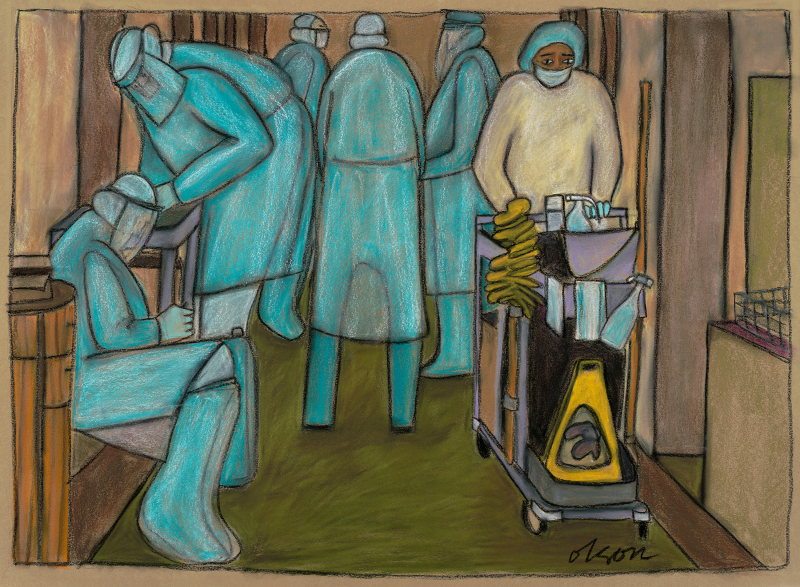
Hospital Workers, by Carolyn Olson
The order also reinforced his prior directive prohibiting local officials from requiring face masks, despite growing calls from city leaders for greater flexibility to reverse the renewed spread of Covid.
The daily average of cases in Texas as of Friday was 8,820, according to a New York Times database, a 209 percent increase over the past 14 days. Cities across the state are facing a surge in hospitalizations reminiscent of the alarming spikes that occurred before Covid cases began nosing downward with the arrival of vaccines.
With 56 percent of the state’s population unvaccinated — including nearly five million children under 12 who are not eligible — health officials have expressed concern about the state’s vulnerability.
It was always going to be a long battle against the coronavirus, but many Americans didn’t want to face that fact. At STAT News, Megen Molteni writes: For many, the belated realization that Covid will be ‘a long war’ sparks anger and denial.
In May, when the CDC said fully vaccinated people could ditch masks and social distancing, it seemed to signal a return to normalcy. But epidemiologists cautioned at the time that the move wasn’t likely to be permanent, and shouldn’t be interpreted as the end of Covid-19 as a daily concern. Colder weather or a right hook in the virus’s evolution could bring restrictions right back.
Still, Americans seem shocked by the recent turn of events. Last week, the Centers for Disease Control and Prevention advised everyone — even those who’ve gotten Covid-19 shots — to go back to indoor masking, a decision driven by new data showing the hyper-contagious Delta variant colonizes the nose and throat of some vaccinated people just as well as the unvaccinated, meaning they may just as easily spread this new version of the virus, while stilling being protected against the worst manifestations of the disease.
The prospect of contending with a prolonged outbreak phase — and adjusting again to a constantly evolving roster of restrictions — has brought back another feature of pandemic living in America: anger.
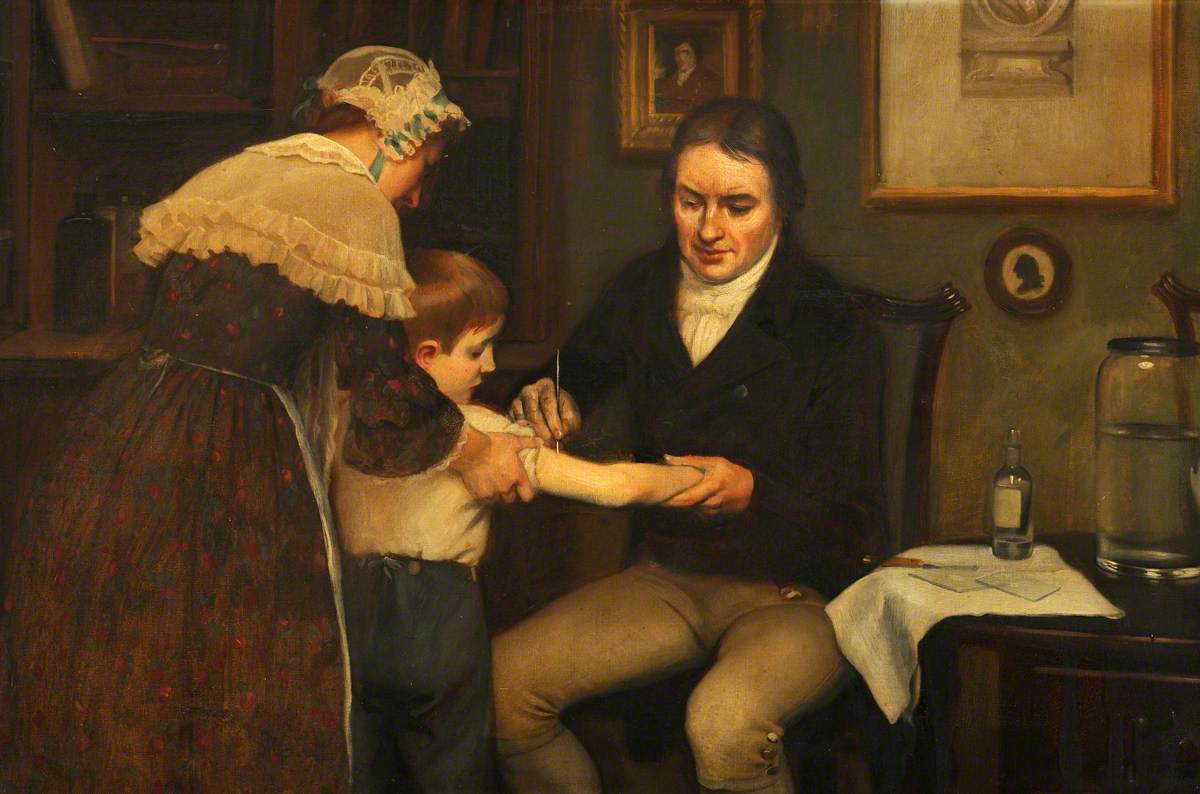
Board, Ernest; Vaccination: Dr Jenner Performing His First Vaccination, 1796
This time it’s not just the mostly Republican anti-masking refrain rearing its defiant head (though fights over school mask mandates have returned with a vengeance). Coast to coast, and across the political spectrum, contempt for unvaccinated people is rising. “It’s the unvaccinated folks that are letting us down,” Alabama Governor Kay Ivey, a Republican, said on July 22, as her state, with one of the lowest vaccination rates in the country, reeled from a 530% rise in Covid-19 hospitalizations in just three weeks.
Among the vaccinated, there’s a sense that the freedoms they gained by getting the shots — travel, eating out, concerts, sports, school, seeing friends — are now being jeopardized by those who are still holding out.
Though this new flavor of outrage might look and sound like righteous indignation, mental health professionals say that what’s behind it is fear.
“It’s scary to admit that somebody else has power over you and you’re at their mercy and you’re afraid of them, but showing that is not a very American ideal,” said David Rosmarin, an associate professor of psychiatry at Harvard Medical School and a clinician at McLean Hospital. “Instead of expressing that fear, it’s a lot more comfortable to blame somebody else.”
Anger is what people in his profession refer to as a “secondary emotion.” It’s a feeling that arises in response to a more primal emotion, like fear and anxiety over having some aspect of your life threatened. “The reality is that there are millions of people who are miseducated about something, they’re making a big mistake that will have massive consequences that might affect you and your family and that makes you scared,” Rosmarin said. “But nobody is saying that.”
Unfortunately, there’s another looming disaster caused by the pandemic: the CDC eviction ban is expiring, and in Washington everyone is accusing everyone else of being responsible for dealing with the situation. And it’s complicated by a Supreme Court ruling.
Yahoo News: White House says it has been unable to find way to extend eviction moratorium.
The White House said Monday that it was unable to find a legal means to extend the eviction moratorium, despite the fact that millions of Americans could soon lose their homes even as the Delta variant of COVID-19 continues to spread.
The Centers for Disease Control and Prevention has “been unable to find legal authority for a new, targeted eviction moratorium,” White House press secretary Jen Psaki said in a statement. “Our team is redoubling efforts to identify all available legal authorities to provide necessary protections.”
The Garden of Death, Hugo Simberg, 1897
Citing a Supreme Court decision issued in late June, the White House said it was unable to unilaterally extend the moratorium for evictions. Late last week, Psaki issued a statement pressuring Congress to act, but the House went into recess before a vote could be held. Were it to pass the House, it is unclear if an extension of the moratorium would be able to pass the Senate.
The federal eviction moratorium expired over the weekend, yet more than 6.5 million U.S. households are currently behind in rental payments totaling more than $20 billion, according to a study by the Aspen Institute and the COVID-19 Eviction Defense Project. Without federal protections in place, many renters will now need to pay months of back rent.
“On this particular issue, the president has not only kicked the tires, he has double, triple, quadruple checked,” Gene Sperling, the White House COVID-19 economic relief coordinator, said at a briefing on Monday, adding, “The rise off the Delta variant is particularly harmful for those who are most likely to face evictions, and as that reality became more clear going into the end of last week, I think all of us started asking what more can we do.”

Mark Joseph Stern at Slate: The Supreme Court Caused the Looming Eviction Disaster. Why Won’t Democrats Say So?
On July 31, the federal government’s eviction moratorium expired, potentially forcing millions of Americans out of their homes during yet another COVID surge. In the days before the eviction cliff, House Democrats attempted to extend the moratorium, but Republicans easily blocked their measure. Democratic lawmakers then spent the weekend arguing over who was to blame for the looming catastrophe.
Curiously, most Democrats chose not to focus on the primary culprit: the Supreme Court. In late June, five conservative justices signaled that they would not let the White House extend the eviction ban beyond July 31 absent further congressional authorization. These Republican-appointed justices set the terms of the debate, yet were largely absent from Democrats’ blame game. As a result, most vulnerable Americans will likely not understand they face homelessness in a pandemic because of SCOTUS. This strange dynamic is symptomatic of a deeper pathology in contemporary American politics: Democrats appear incapable of explaining how the Supreme Court stymies their own agenda—and the resulting confusion shields the court from criticism, consequences, and accountability when its decisions wreak havoc.
Vaccination by Adolfo Flores
When House Speaker Nancy Pelosi urged Biden to extend the eviction moratorium on his own, she framed the issue as a matter of morality. But the president’s inaction was almost certainly a legal calculation. To understand his hesitation, it’s key to remember that the recently expired moratorium was not the same policy that had been in effect since the start of the pandemic. Congress passed its first eviction ban in March 2020, explicitly prohibiting landlords from kicking out tenants who could not afford rent because of the pandemic. After this provision expired that August, Donald Trump issued an executive order asking the CDC to take action. The CDC responded in September with its own eviction moratorium set to run through the end of 2020. It was rooted in a federal law that allows the agency “to make and enforce such regulations” that are “necessary to prevent” the “spread of communicable diseases” between states. In December, Congress passed legislation that explicitly extended the CDC’s moratorium through Jan. 31, 2021. The agency then extended the ban several more times.
While the CDC kept the moratorium in place, a group of landlords sued to block it, claiming it exceeded the agency’s authority. On May 5, U.S. District Judge Dabney Friedrich sided with the plaintiffs against the ban but stayed her order. One month later, the U.S. Court of Appeals for the District of Columbia Circuit court refused to block the ban. The plaintiffs then appealed to SCOTUS, which came within an inch of ending the moratorium. Five justices—Clarence Thomas, Sam Alito, Neil Gorsuch, Brett Kavanaugh, and Amy Coney Barrett—believed it violated the law. But Kavanaugh, who cast the decisive fifth vote, wrote separately to explain that although he believed the CDC had “exceeded its existing statutory authority,” he would not invalidate the ban. Instead, weighing the “balance of equities,” he would allow it to remain for “a few weeks.”
“In my view,” the justice declared, “clear and specific congressional authorization (via new legislation) would be necessary for the CDC to extend the moratorium past July 31.”
Kavanaugh’s analysis is dubious at best. (Maybe that’s why Chief Justice John Roberts didn’t join it, instead quietly voting to keep the moratorium in place.) Congress already gave the CDC expansive powers to fight the “spread of communicable diseases” between states. The agency acted pursuant to this law when it determined that mass evictions would force many Americans to live unhoused or crammed together in close quarters, transmitting the virus more widely. Crucially, when Congress chose to extend the moratorium, it simply passed a law extending the CDC’s own ban. By doing so, lawmakers chose “to embrace” the agency’s action and “expressly recognized” that it had the authority to issue the ban, in the words of the D.C. Circuit. It would not make a lick of sense for Congress to extend the CDC’s moratorium if it did not believe the CDC had authority to issue it.

More eviction reads:
The Washington Post Editorial Board: Opinion: There’s plenty of money to avoid evictions. States just have to spend it.
NPR: White House Calls On States To Do More After Federal Eviction Ban Expires.
The Washington Post: Liberals erupt in fury at White House over end of eviction moratorium. [the “liberals” referred to in the headline are actually far left Bernie bro types]
The New York Times: Yellen and Pelosi will discuss rental assistance as an eviction crisis looms and Democrats demand answers.
That’s it for me today. Sorry this post is such a downer. As always, this is an open thread.

 peej
peej Carissa
 bostonboomer
 dakinikat
 ecocatwoman
 mablue2
 Mama Lopez
 peggysue22
 quixote
 skydancingguestblogger
 Mona (aka Wonk the Vote)



 Sky Dancing
Recent Comments