
Tuesday Reads: Tim Geithner in Control of Obama’s Economic Policy, and Other News
Posted: February 15, 2011 Filed under: Bailout Blues, Barack Obama, Economic Develpment, Egypt, financial institutions, Foreign Affairs, Global Financial Crisis, Gulf Oil Spill, Iran, U.S. Economy, U.S. Politics, unemployment, Yemen | Tags: Barack Obama, Financial Markets, Larry Summers, Noam Scheiber, The New Republic, Timothy Geithner, Wall Street 22 Comments
Good Morning!! The snow is slowly melting outside my house, and I’ve come down with Spring fever! No more snowstorms please, Mother Nature. Anyway, at least for this week, we are getting temperatures in the 40s and 50s. It is going to be chilly again tomorrow, but after that–springlike! After the frigid winter we’ve lived through, these temperatures feel amazing. Maybe this will make the bad news from DC a little more bearable. I hope so.
This morning I want to focus on an important article that comes via David Dayen at FDL. It’s a piece at The New Republic about Timothy Geithner, written by Noam Scheiber. First a little aside.
Back in November, I wrote a post about the axing of Obama’s economic team and noted that Geither was the last man standing.
In that post, I quoted Andrew Cockburn of Counterpunch:
If Barack Obama needed any help in guiding the Democratic Party over the cliff he certainly got it from Treasury Secretary Timothy Geithner. Voters have told pollsters that the state of the economy, their own in particular, was their principle concern. Though impelled by the specter of unemployment and homelessness, the image of Geithner, toady to the bankers, can only have encouraged them in their fury. A sensible president would therefore already be running out the plank prior to giving this disastrous financial overseer an encouraging shove between the shoulders. But in this case, we may not be that lucky. CounterPunch can reveal the crucial role played in these matters by a group close to the President but unknown to the outside world.
A knowledgeable insider told Cockburn that despite Larry Summers’ reputation as a corporate tool,
“Larry has some idea that there is more to the economy than just the welfare of large banks,” this official suggests. “He did push for a larger stimulus and more jobs programs, for example. Tim just cares about banks.”
I then went on to indulge in a little conspiracy theorizing based on Cockburn’s information. But that’s beside the point right now. The point is that after writing that post, I came to the conclusion that Geithner was running economic policy in the Obama administration.
Getting back to the article at TNR, Scheiber purports to explain how Geithner survived the massacre of the economists. One interesting tidbit in the lengthy article is about Geithner’s relationship with Larry Summers, who acted as Geithner’s mentor and patron early on.
In 1993, Geithner caught the attention of [a] prominent patron—Larry Summers—whom Bill Clinton had appointed as his treasury undersecretary. Summers took a personal interest in Geithner’s career and promoted him each time he rose through the Treasury ranks.
And then during the Obama administration, Geithner apparently stabbed his patron in the back, becoming President Obama’s primary economic adviser–even though Geithner isn’t an economist. (Neither is anyone else on Obama current “economic team,” as Dakinikat frequently points out.)
Geithner actually sounds a lot like Obama–he’s really good at sucking up and convincing people he’s on their side–until he slides in the knife. Regarding Geithner’s time at the IMF, Scheiber writes:
According to former co-workers, Geithner was deft at bringing skeptical colleagues on board. One technique involved homing in on possible dissidents and absorbing their suggestions into his proposals.
Sound familiar? A bit more:
Perhaps most important, Geithner was scrupulously attuned to the temperament of the boss. Like Obama, he evinced a strong aversion to blather. During meetings with the president, he would say little, and usually not until the end, when his opinion was solicited. “I thought [Geithner] got the president really well,” says a former administration official who interacted with him on nonfinancial matters. “When he was in trouble, I said to someone, ‘He just needs to hold on. He’ll be fine with Obama. Once they get to know each other, they’re like the same person.’”
Scheiber describes an epic struggle between Geithner and Summers over how to deal with the banks that had crashed the U.S. economy. Summers argued for some form of nationalization, while Geithner claimed the banks just needed more capital and they could recover.
If Geithner was right, the capital shortfall was much more manageable than Summers feared. The banks might be able to fill it with minimal government help, simply by selling shares to investors. But, if he was wrong, the banks would stumble along in a kind of vampire state, sucking credit from the economy and exacerbating the recession. In the worst case, fears of insolvency could trigger a modern-day version of Depression-era bank runs.
Hey, wait a minute. That sounds like what is happening to our economy right now. But, never mind, Geithner won the battle that counted–the battle for Obama’s favor.
Part of what Geithner convinced Obama of was “that it was ultimately better politics to risk a backlash with unemployment at 10 percent than to feed the backlash and watch the economy shrink further.” So it’s Geithner we have to thank for the new normal of high unemployment, poverty, and suffering among the middle, working, and lower classes.
Finally, what horrified David Dayen was Geithner’s out-front claim that–in Dayen’s words, “what’s good for Wall Street is good for America.” Geithner:
“I don’t have any enthusiasm for … trying to shrink the relative importance of the financial system in our economy as a test of reform, because we have to think about the fact that we operate in the broader world,” he said. “It’s the same thing for Microsoft or anything else. We want U.S. firms to benefit from that.” He continued: “Now financial firms are different because of the risk, but you can contain that through regulation.” This was the purpose of the recent financial reform, he said. In effect, Geithner was arguing that we should be as comfortable linking the fate of our economy to Wall Street as to automakers or Silicon Valley.
In response, Dayen writes:
I don’t even know what to say about this. We’re just a few years removed from the financial oligarchs destroying the global economy through their own greed and negligence. And the man put in charge of regulating them, who had a front-row seat to all this destruction and who has been given expanded powers under Dodd-Frank to see to it that never happens again, thinks that there’s a great “financial deepening” about to take place where the demand for sophisticated financial innovations will jump. Therefore, the financial sector will need to grow and become the most reliable spur of the US economy. That’s his feeling. And regulation can reduce the risk, even though the new regulations barely put a dent into Wall Street’s core business, and are being systematically defunded besides.
Financialization of the economy has led to practically nothing but pain for the average worker and risk for the taxpayer. It has turned the allocation of capital into the placing of bets at a casino, and the stock market into a particularly sophisticated video poker game. This territory was all covered before in the run-up to the Great Depression as well, and we know the precise causes and remedies involved. Geithner prefers not to address the plutocracy he’s really advancing here – where elites provide “financial deepening” services abroad and amass ridiculous profits that they wall off.
This incredibly amoral conman is partnering with our conman chief executive to sell out our country, our lives, and those of our children and grandchildren. There’s lots more of interest in the article, particularly the information about Geithner’s upbringing.
I’ll wrap this up with a few other stories, and then throw the floor open to your links and opinions. Did you hear that Stephen Baldwin is suing Kevin Costner over Costner’s oil-eating invention?
It seems Baldwin sold his shares in Costner’s company right before BP shelled out $50 million for the machines.
Jane Hamsher offers a flow-chart of the principle players in the scandal over US Chamber of Commerce’s attempts to discredit Wikileaks, Glenn Greenwald, Brad Friedman, David House, and others who have supported wikileaks and Bradley Manning. Joseph Cannon has also been covering this story.
Brad Friedman’s post especially is a must read. Get this, the Chamber paid 2 million dollars a month for dirt on Friedman, and got completely inaccurate information. And that inaccurate information came from corporations who are paid billions by our government “to target terrorists.” But Obama wants to cancel heating assistance for poor people to save money.
Mitt Romney is ahead in the latest NH poll, at 40%, for whatever that’s worth. Romney was always going to win NH. They always vote for New Englanders up there. The real test for Romney will be Iowa.
The Patriot Act extension has been passed by the House on the second try. I think the Egyptians will probably get rid of their emergency law before we get rid of ours.
There are “massive” protests in Iran, inspired by the dramatic events in Egypt. There have also been more protests in Yemen and in Bahrain. When will it happen here?
What are you reading and blogging about today?
Late Night Drift
Posted: January 19, 2011 Filed under: Barack Obama, U.S. Economy, U.S. Politics | Tags: Barack Obama, Christina Romer, jobs, Larry Summers, New York Times Magazine, Obama economic team, U.S. Economy, U.S. Politics, unemployment 16 Comments
I’ll bet Dakinikat can’t wait to start plowing through the New York Times Magazine’s cover story this week: The White House Looks for Work: Inside Obama’s Struggle to Bring Down Unemployment, by Peter Baker.
Who knew Obama was involved in a struggle over jobs? As far as I can tell jobs are about the last thing on Obama’s mind. But what do I know? Apparently, there has been a life and death struggle going on within the President’s economic team over jobs.
Let me just buy them a clue: the answer isn’t cutting the deficit and wiping out the social safety net. Anyway, back to the Caucus blog’s preview of the upcoming NYT mag story and some of the “surprisingly newsy nuggets” we can look forward to reading on Sunday morning.
Mr. Baker writes that the president’s economic team “fractured repeatedly over philosophy (should jobs or deficits take priority?) and personality (who got to attend which meetings?), resulting in feuds that ultimately helped break it apart.”
Wait…that’s news?
The most sensible “tidbit” in the article comes from Christina Romer.
“In Washington, she said, ‘you’re not supposed to say the obvious thing, which is that in retrospect of course it should have been bigger. With unemployment at 10 percent, I don’t know how you could say you wouldn’t have done anything different. Of course you would have made it bigger.’”
— In the article, Ms. Romer said the Obama administration should have gone back to Congress for more stimulus money to bolster the economy when it was clear how bad things really were.
He writes: “‘In my mind,’ she said, ‘the problem was not in the original package; it was in not adjusting to changed circumstances.’ Once it was clear that the situation was deteriorating, she said, the White House should have gone back to Congress for more stimulus money. ‘That was where we could have been bolder,’ she said.”
Duh. For that kind of truth-telling, you get sent to Siberia UC Berkeley.
There’s a supposedly funny story about Larry Summers that I don’t understand. Can someone explain it to me?
Mr. Baker offers this fun tidbit about Mr. Summers: “Tan from a holiday in Jamaica and trying to get his bearings again at Harvard, where he plans to teach a course on Obama’s economic policy and write a book, Summers sat at a corner table and ordered bisque and — from the lighter-fare menu — a steak ‘as rare as your chef will make it.’”
On second thought, maybe Dak should skip the NYT mag article. If these are the highlights, it sounds like a crashing bore. And I didn’t see anything about jobs in there either.
Feel the Bern!
Posted: August 25, 2009 Filed under: Bailout Blues, Equity Markets, Global Financial Crisis, U.S. Economy | Tags: Ben Bernanke, Federal Reserve Bank, Larry Summers Comments Off on Feel the Bern!While I stuck the announcement into the morning links, you had to know that I’d front page this announcement some time today. So you also probably knew that I breathed a quiet sigh of relief last night when I found out we were not getting La La Summers for Fed Chief. President 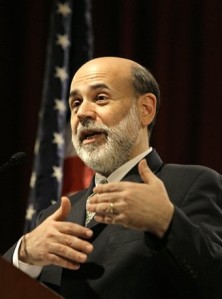 Obama has decided to re-appoint Fed Chairman Ben Bernanke to another term.
I awakened this morning to the bleating of the bloggies on this move. Of course, I have this tendency to look at folks’ credentials before I decide to take their opinions seriously. It also helps to know their political agendas and frames. Chairman Bernanke has probably had the most challenging time at that job since Paul Volcker took over the Fed helm back in the days of rampant inflation and Carter malaise. So many blogs have come to criticize Bernanke, but I’m just glad we’re not here to bury him. He may not be perfect, but he’s a damn sight better than just about everything else out there. Ben Bernanke is an economist’s economist.
Wall Street and academic economists in recent weeks showed enthusiasm for giving Mr. Bernanke a second term, and some administration insiders felt similarly even though Mr. Bernanke was appointed by — and served in the White House of — President George W. Bush. Appointing a Democrat such as Janet Yellen, president of the Federal Reserve Bank of San Francisco, or Alan Blinder, former Fed vice chairman — both former advisers to President Bill Clinton — would have been popular with many Democrats. But a move by Mr. Obama to install his own person at the Fed might have have rattled markets and unsettled the foreign investors.
Phil Izza at the WSJ has a pretty good line up of comments from both political and financial folks on the Bernanke appointment. Some of the performance the financial markets today(so far, all up) could be linked to the decision as the Fed Chair heads up the Federal Open Market Committee and sets its agenda. It is a rare FOMC that will go against the recommendations of their chair when setting monetary policy(primarily levels of interest rates, exchange rates, and bond offerings) although there is usually a healthy amount of debate and exchange or so I’ve heard since the meetings are top secret.
- I think it’s good news for the Federal Reserve. It’s good news for the country. It’s a great choice. Chairman Bernanke has done a terrific job in bringing openness to the Fed. He has been bold and creative in dealing with the financial crisis… It was not clear to most people that the crisis was going to be as broad-based, and that the excesses in the financial markets and in lending were as broadly based as they turned out to be. Even at the start, he was willing to consider all options to deal with what appeared to be more a liquidity than a solvency crisis. As it began to become more clear that it was a crisis of solvency and leverage and a classic credit crunch, he didn’t flinch in bringing enormous creativity to bear in mitigating the problem –Richard Berner, Morgan Stanley
- Having a new chairman come in at this late date would put the Fed engineered solution to both the recovery and the exit strategy at risk. The Federal Reserve made a hasty exit from easy money stimulus in the 1930s and we know how that worked out… Mistakes have been made at many regulatory institutions during this crisis, but all the Fed’s mistakes would have been made by any man according to the prudent man rule. Bernanke is a true prudent man who calls them as he sees them, and knows the ins and outs of policymaking… If he can pull off this recovery that still needs nurturing, he could well go down as one of the greatest Fed Chairmen in history. –Christopher Rupkey, an economist with Bank of Tokyo-Mitsubishi
What’s That Lassie? Little Timmy’s in the Well AGAIN?
Posted: August 4, 2009 Filed under: Bailout Blues, Equity Markets, Global Financial Crisis, president teleprompter jesus, The Bonus Class, The Great Recession, U.S. Economy | Tags: Ben Bernanke, CNBC, FDic, FED, Larry Summers, Mary Schapiro, Naked Capitalism, SEC, Sheila Bair, Timothy Geithner, Wall Street Cheerleaders, Zero Hedge Comments Off on What’s That Lassie? Little Timmy’s in the Well AGAIN? Wow, it looks like Turbo Tax Timmy has gone rogue! We better send the press up to Alaska to chase down another Palin rumor. First, there’s that nastiness over the weekend with the Stephanapolous show on ABC where he explicitly said that the administration wasn’t ruling out new taxes on the middle class. (Something Larry-the-la-la Summers also inkled, but hey, he’s not a cabinet officer, he’s something akin to a Czar that has to be overthrown by something other than scandal and public displays of stupidity.) I believe that gave Robert Gibbs Excedrin headaches number 349-357 during yesterday’s presser.
Now, there’s rumors of a temper tantrum in the presence of all the nation’s topic economists and financial regulators outlined here in the WSJ. It seems he’s not getting the Obama way on this one. The ladies in the room have taken exception to his granting Ben Bernanke (possibly later, this year, La-la Summers) all the fun and power. I guess being an independent regulator with an agency all to yourself just isn’t what it used to be; especially when you have scary lady parts and a huge brain.
Mr. Geithner told the regulators Friday that “enough is enough,” said one person familiar with the meeting. Mr. Geithner said regulators had been given a chance to air their concerns, but that it was time to stop, this person said.
Among those gathered in the Treasury conference room were Federal Reserve Chairman Ben Bernanke, Securities and Exchange Commission Chairman Mary Schapiro and Federal Deposit Insurance Corp. Chairman Sheila Bair.
Friday’s roughly hourlong meeting was described as unusual, not only because of Mr. Geithner’s repeated use of obscenities, but because of the aggressive posture he took with officials from federal agencies generally considered independent of the White House. Mr. Geithner reminded attendees that the administration and Congress set policy, not the regulatory agencies.
Mr. Geithner, without singling out officials, raised concerns about regulators who questioned the wisdom of giving the Federal Reserve more power to oversee the financial system. Ms. Schapiro and Ms. Bair, among others, have argued that more authority should be shared among a council of regulators.
This current turf battle is only the latest move by a group within government possibly thwarting the Treasury’s plans to continue uploading tax dollars to the bonus class in the guise of saving the financial sector. If there’s still disagreement about this point, can you imagine what other things are going on in complete disarray behind the scenes? Who is really in charge of solving this overt act of sibling rivalry? Well, if you have figured out where the buck stops in this administration, you’re doing better than me. (Hint: these folks are ALL presidential appointments).

 peej
peej Carissa
 bostonboomer
 dakinikat
 ecocatwoman
 mablue2
 Mama Lopez
 peggysue22
 quixote
 skydancingguestblogger
 Mona (aka Wonk the Vote)



 Sky Dancing
Recent Comments