
Lazy Saturday Reads: Two Republican Candidates in Trouble
Posted: August 30, 2014 Filed under: morning reads, Republican politics, U.S. Politics | Tags: abortion, Allison Lundergan Grimes, felony charges, food banks, Greg Abbott, guns, indictment, Iowa primary 2012, Jesse Benton, Kent Sorenson, Kentucky Senate race, Koch Brothers, Koch Industries, Mitch McConnell, Rick Perry, Ron Paul, Tea Party, Texas National Guard, Wendy Davis 28 Comments  Good Afternoon!!
Poor Rick Perry. He just can’t seem to catch a break. First there was his indictment on two felony charges. Then he had to face the further indignity that being indicted on felony charges means he can no longer swagger around with a concealed weapon on his person. According to the Washington Times,
Texas Gov. Rick Perry’s indictment on felony corruption charges means he can no longer carry a concealed weapon under state law.
Federal law also prohibits him from being able to buy more guns or ammunition, as long as the indictment is pending, Reuters reported.
I wonder if he knows that? Because when he was in New Hampshire last week, he told voter he didn’t understand the charges against him. From ABC News last Friday, Aug. 22:
PORTSMOUTH, N.H. – Texas Gov. Rick Perry returned to New Hampshire Friday for the first time since 2012, as he tries to rehab his political image after a failed presidential bid.
Speaking to a group of business leaders here, Perry tried to focus on substance, talking about issues like economic development and the border crisis, but his recent indictment on two felony charges was hard to ignore.
Asked about his indictment during a question-and-answer session with business leaders, Perry was a little unclear when explaining what felony charges were issued against him.
“I’ve been indicted by that same body now for I think two counts, one of bribery, which I’m not a lawyer, so I don’t really understand the details here,” Perry said of the grand jury that indicted him.
A grand jury indicted Perry last week on two felony counts – abuse of official capacity and coercion of a public official – over a 2013 veto threat.
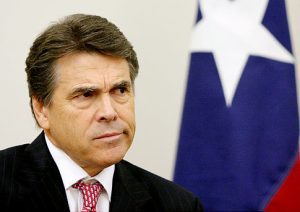
At The Wire, Arit John has a funny post in which he describes Perry’s confusion as just one step in the grief process over the indictment, Rick Perry Enters the Final Stage of Indictment Grief: Confusion.
Maybe Rick Perry should have read up on his indictment charges before he started using them as a campaign talking point. During a speech last week, the Texas governor said he was being indicted for bribery, which isn’t actually true.
“I’ve been indicted by that same body now for I think two counts, one of bribery, which I’m not a lawyer, so I don’t really understand the details here,” he said,according to the Houston Chronicle. But Perry is actually being indicted for abuse of power and coercing a public official, after he threatened to veto District Attorney Rosemary Lehmberg’s budget if she refused to resign after her drunk driving conviction.
This is another oops moment for Perry, but it also signaled his transition into the 5th and, likely for him, final stage of indictment related grief: confusion. After grinning mugshot denial, angry ads “setting the record straight,” bargaining over who should pay the lawyers and depression over a loss of Second Amendment privileges, all that’s left for Perry is to be slightly unsure of what, exactly, people are accusing him of doing.
Read the details at the link.
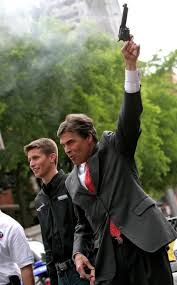
Then there are the embarrassing stories about how Perry hasn’t paid the National Guard troops that he sent to guard the Texas-Mexico border. From Gawker:
When Texas Gov. Rick Perry sent National Guard soldiers to the Mexico border to much fanfare earlier this summer, he couldn’t say how long they’d be there. It turns out he also couldn’t pay them: At least 50 soldiers haven’t seen a paycheck and are getting sustenance and vehicle fuel from a local food bank.
Via KGBT News, the sudden call-up took those weekend warriors away from their day jobs and deposited them in the Rio Grande valley, but the service hasn’t covered their losses yet….
Perry—who’s busy being indicted for criminal abuse of power—and the National Guard didn’t respond to reporter queries earlier this week, but the pay lag could be related to the governor’s refusal to fund the mobilization he ordered, and his insistence that the federal government cover it. (In the meantime, Perry was supposedly attempting to finance the deployment “by diverting $38 million in public safety funds earmarked for emergency radio infrastructure,” the L.A. Times has reported.)
Yesterday afternoon, the Austin Statement reported that unnamed “National Guard officials” were claiming the stories about hungry troops were exaggerated, but it sounds like they may be just trying to clean up Perry’s mess.
The Guard said it had identified 50 service members who, because of their early August start date, weren’t going to be paid until Sept. 5.
None of those 50 troops have notified leaders that they had used the food bank, officials said.
According to the Guard, troops receive one meal while on duty, plus a $32 per diem food reimbursement that is included in their paychecks.
According to Omar Ramirez, Food Bank RGV’s manager of communications and advocacy, the food bank made extra preparations after being contacted by someone from the Texas National Guard Support Foundation, but that he wasn’t aware of any troops being served.
“Maybe they come in and they just don’t tell us they’re National Guard,” he said.
OK, but if the $32 dollars is included in their paychecks, then that means the troops have to front the money for two meals a day until Sept. 5, right? Read the rest at the link.
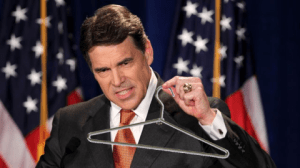
Finally, yesterday Perry learned that his latest anti-abortion bill–the one that Wendy Davis filibustered–has been struck down by a federal judge. From AP:
U.S. District Judge Lee Yeakel sided with clinics that sued over one of the most disputed measures of a sweeping anti-abortion bill signed by Republican Gov. Rick Perry in 2013. The ruling stops new restrictions that would have left seven abortion facilities in Texas come Monday. There are currently 19 abortion providers in the state, according to groups challenging the law.
“The overall effect of the provisions is to create an impermissible obstacle as applied to all women seeking a previability abortion,” Yeakel wrote in his 21-page ruling.
The trial in Texas was the latest battle over tough new abortion restrictions sweeping across the U.S.
The law would have required clinics “to meet the building, equipment and staffing standards of hospital-style surgery centers,” according to The New York Times.
Adopted as part of a sweeping anti-abortion measure last year, the rule would have forced the closing of more than a dozen of Texas’ remaining abortion clinics because they were unable to afford to renovate or to open new facilities that met the standards for such things as hallway width, ceiling height, advanced ventilation equipment, staffing and even parking spaces.
The closings would have left Texas, the second-biggest state by population and by size, with seven or eight abortion clinics, all in major cities like Houston and Dallas. Women in El Paso in West Texas and in the Rio Grande Valley in the south would have lived more than 150 miles — a distance ruled constitutional by a federal appeals court — from the closest clinic in the state, in San Antonio.
Fortunately for Texas gubernatorial candidate Wendy Davis, her opponent Greg Abbott plans to appeal the decision.
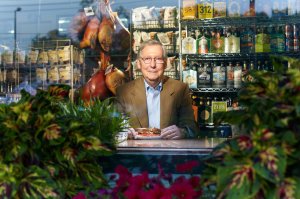
Mitch McDonnell at Morris’ Deli in Louisville, KY
Mitch McConnell is also experiencing some difficulties in his Senate reelection campaign in Kentucky. He has been in a close race with Democratic challenger Allison Lundergan Grimes–they’ve been running neck-and-neck for a long time now. And recently McConnell has had a couple of setbacks. First there was the secretly recorded audiotape released by The Undercurrent Youtube channel, of McConnell’s remarks at a “meeting for millionaire and billionaire donors hosted by the Koch brothers,” in which he promised to continue blocking Obama proposals and emphasized his opposition to raising the minimum wage. The contents of the tape were first reported in The Nation.
Last week, in an interview with Politico, Senate minority leader Mitch McConnell (R-KY) outlined his plan to shut down President Obama’s legislative agenda by placing riders on appropriations bills. Should Republicans take control of the Senate in the 2014 elections, McConnell intends to pass spending bills that “have a lot of restrictions on the activities of the bureaucracy.”
What McConnell didn’t tell Politico was that two months ago, he made the same promise to a secret strategy conference of conservative millionaire and billionaire donors hosted by the Koch brothers. The Nation and The Undercurrent obtained an audio recording of McConnell’s remarks to the gathering, called “American Courage: Our Commitment to a Free Society.” In the question-and-answer period following his June 15 session titled “Free Speech: Defending First Amendment Rights,” McConnell says:
“So in the House and Senate, we own the budget. So what does that mean? That means that we can pass the spending bill. And I assure you that in the spending bill, we will be pushing back against this bureaucracy by doing what’s called placing riders in the bill. No money can be spent to do this or to do that. We’re going to go after them on healthcare, on financial services, on the Environmental Protection Agency, across the board [inaudible]. All across the federal government, we’re going to go after it.”

The article notes that the McConnell campaign has received $41,800 from Koch Industries in addition to outside groups who get funding from the Kochs.
“And we’re not going to be debating all these gosh darn proposals. That’s all we do in the Senate is vote on things like raising the minimum wage [inaudible]—cost the country 500,000 new jobs; extending unemployment—that’s a great message for retirees; uh, the student loan package the other day, that’s just going to make things worse, uh. These people believe in all the wrong things.”
In late April, Senate Republicans, led by McConnell, successfully filibustered a bill to increase the minimum wage to $10.10 an hour, a widely popular measure that would increase wages for at least 16.5 million Americans. Earlier in the year, McConnell also led a filibuster of a three-month extension of unemployment insurance to some 1.7 million Americans. At one point in the negotiations, he offered a deal to extend unemployment only if Democrats agreed to repeal the Affordable Care Act, even though the ACA does not add to the federal deficit.
The [Undercurrent] channel released audio of three other Republicans in tough Senate races — Representative Tom Cotton of Arkansas, Representative Cory Gardner of Colorado and Joni Ernst, a state senator in Iowa — all of whom praised Charles G. and David H. Koch and the millions of dollars they have provided to help Republican candidates….
Republicans said the recordings were insignificant. Josh Holmes, a senior McConnell campaign aide, said the senator was in no way suggesting a strategy to shut down the government unless Mr. Obama capitulates.
Nonetheless, the audio recordings are likely to become fodder for the campaigns in Arkansas, Colorado, Iowa and Kentucky. Democrats, most notably Senator Harry Reid of Nevada, the majority leader, have tried to demonize contributions by the Koch brothers as corruptive to the political system.
In Arkansas, especially, the audio could touch a nerve. Mr. Cotton, a freshman House member, skipped a popular political event in his state, the Bradley County Pink Tomato Festival, to attend the Koch brothers’ meeting in California. According to the audio, he was repaid with praise for his willingness to hew to the most conservative line, even if it meant voting against legislation popular in his state.
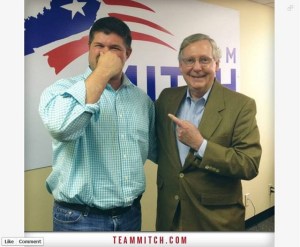
Then yesterday, McConnell’s campaign manager Jesse Benton was forced to resign because of a scandal involving his work for the Ron Paul campaign in Iowa in 2012. From CBS News:
Benton’s resignation, effective Saturday, comes barely two months before Kentucky voters choose between McConnell, a five-term incumbent and the top-ranking Senate Republican, and Democratic challenger Alison Lundergan Grimes.
In Iowa this week, former state Sen. Kent Sorenson pleaded guilty to federal charges stemming from his switch of support from one Republican presidential candidate to another before the 2012 Iowa caucuses. He received thousands of dollars in “under the table payments” before switching loyalties from candidate Michele Bachmann, whose Iowa campaign he headed, to candidate Ron Paul, then lied to federal investigators about the money, the Justice Department said.
Prosecutors refused to say which campaign paid Sorenson. A representative for Bachmann didn’t immediately return voice and email messages seeking comment Friday. A phone message for Paul also wasn’t immediately returned.
Benton, a tea party insider, worked as a top aide to Paul. On Friday he said that he has been the target of “inaccurate press accounts and unsubstantiated media rumors” about his role in past campaigns that are “politically motivated, unfair and, most importantly, untrue.”
Benton had been hired to help McConnell appeal to Tea Party extremists in Kentucky. Is it possible McConnell misjudged his constituents? I sincerely hope so.
So I’ve ended up focusing this post on just two struggling Republicans–but there are plenty of others I could write about. I don’t think we should give up on Democrats holding the Senate yet. I know there is plenty of other news, but I thought I’d shift the focus to electoral politics today. What else is happening? Please post your thoughts and links in the comment thread, and have a great Labor Day weekend!!
Beyond Influence: Buying US Law
Posted: August 11, 2011 Filed under: Big Pharma, Civil Liberties, Civil Rights, collective bargaining, Corporate Crime, Domestic Policy, Economy, Environmental Protection, financial institutions, Global Financial Crisis, Gulf Oil Spill, Health care reform, Labor unions, legislation, Surreality, The Bonus Class, We are so F'd | Tags: ALEC, Bayer, ExxonMobil, Koch Industries, PFizer, VISA, Wal-Mart 23 Comments“Corporations are people, my friends.”
Mitt Romney, in a speech today in Iowa
I’ve wanted to write about ALEC for awhile. I tripped across this very succinct explanation in my print copy of Bloomberg Business Week that made me revisit my plans. Ever wonder why a bunch of weird ass bills suddenly show up simultaneously in a bunch of legislatures that say things that are basically against the positions of modern science, medicine, and economics? Well, chances are that some huge corporation has written that bill that will become law in no one’s interest but their own, and it was penned by some member of ALEC.
Kim Thatcher, a Republican state representative in Oregon, introduced a sharply worded anti-cap-and-trade bill this year that said, “There has been no credible economic analysis of the costs associated with carbon mandates.” Apparently, that view is widely shared. Legislation with that exact language has been introduced in dozens of states, including Montana, New Hampshire, and New Mexico.
It’s not plagiarism. It’s a strategy. The bills weren’t penned by Thatcher or her fellow legislators in Helena, Concord, and Santa Fe. They were written by a little-known group in Washington with outsize clout, the American Legislative Exchange Council. Corporate benefactors such as Koch Industries and ExxonMobil (XOM) help fund ALEC with membership dues and pay extra for a seat at the legislative drafting table.
Among ALEC’s prominent members are Pfizer (PFE), Wal-Mart (WMT), Bayer (BAYZF), and Visa (V), according to ALEC annual meeting documents provided by an attendee. The organization’s legislative agenda includes limiting the power of unions, fighting environmental regulations, and overturning President Obama’s health-care reform law. ALEC says it gets about 200 state laws passed each year. The corporate influence is hard to trace and can produce a return on investment that would make a hedge fund manager drool.
“This is just another hidden way for corporations to buy their way into the legislative process,” says Bob Edgar, president of Common Cause, which seeks to reduce money in politics. Reagan Weber, an ALEC spokeswoman, says the group simply facilitates the sharing of information and “good conservative policy.”
ALEC was founded in 1973 by two of the conservative movement’s intellectual midwives, both now dead: Representative Henry Hyde of Illinois and activist Paul Weyrich, who also was a founder of the Heritage Foundation. As a tax-exempt organization, ALEC doesn’t disclose its corporate donors or its member lists beyond those who serve as committee chairmen.
In exchange for annual membership dues of as much as $25,000 plus a fee of $3,000 to $10,000 to get on a bill-writing “task force,” Koch and ExxonMobil representatives sat beside elected officials and policy analysts at an ALEC meeting in April 2010, helping them write model energy legislation that would later be introduced in statehouses around the country, according to the documents. The legislators pay $100 for a two-year membership. The task force bills are considered finished only after the legislators and private-sector members vote separately to approve them, giving each side a veto. Once a model bill is complete, it’s up to ALEC’s legislator members to go back to their home states and shepherd it into law.
ALEC is on the radar of many organizations including the American Association for Justice who keeps track of their activities and publishes white papers on this group of bill-writers for profit, greed and the destruction of public resources.
(W)hile the membership appears to be public sector, the bankroll is almost entirely private sector. In fact, public sector membership dues account for only around one percent of ALEC’s annual revenues. ALEC claims to be nonpartisan, but in fact its free-market, pro-business mission is clear.
The result has been a consistent pipeline of special interest legislation being funneled into state capitols. Thanks to ALEC, 826 bills were introduced in the states in 2009 and 115 were enacted into law.
Behind the scenes at ALEC, the nuts and bolts of lobbying and crafting legislation is done by large corporate defense firm Shook, Hardy & Bacon. A law firm with strong ties to the tobacco and pharmaceutical industries, it has long used ALEC’s ability to get a wide swath of state laws enacted to further the interests of its corporate clients.
ALEC’s campaigns and model legislation have run the gamut of issues, but all have either protected or promoted a corporate revenue stream, often at the expense of consumers. For example, ALEC has worked on behalf of:
- Oil companies to undermine climate change proponents;
- Pharmaceutical manufacturers, arguing that states should be banned from importing prescription drugs;
- Telecom firms to block local authorities from offering cheap or free municipally-owned broadband;
- Insurance companies to prevent state insurance commissioners from requiring insurers to meet strengthened accounting and auditing rules;
- Big banks, recommending that seniors be forced to give up their homes via reverse mortgages in order to receive Medicaid;
- The asbestos industry, trying to shut the courthouse door to Americans suffering from mesothelioma and other asbestos-related diseases; and,
- Enron to deregulate the utility industries, which eventually caused the U.S. to lose what the Securities and Exchange Commission (SEC) estimated as $5 trillion in market value.
The Koch brothers and Koch Industries are all over ALEC. Their Charitable foundations and businesses provide a lot of funding. ExxonMobile is also a huge source of funds. There are several companies representing the interests of Big Pharma. ALEC looks like a who who of corporate America’s worst corporate citizens. The Center for Media and Democracy’s PR Watch put out a Special Report on ALEC’s funding last month.
According to ALEC’s IRS filings, over the past three years it has raised $21,615,465 from corporations, foundations, and other sources, and just over $250,000 in dues paid by state legislators, amounting to slightly more than 1 percent of its income. The gigantic gap between what legislators pay and what ALEC spends is the direct result of the reality that legislators pay a mere $50 a year to be a member, while a corporation can pay up to $25,000 a year or more to be a member of ALEC plus additional fees to be on a task force where corporations get the same right to vote as legislators. They just pay hundreds of times more for that vote.
…
For example, the foundations controlled by the billionaire Koch brothers gave ALEC over $200,000 in 2009. (The Claude R. Lambe Foundation, which Charles Koch, his wife and kids help run, donated $125,000 to ALEC. His own Charles G. Koch foundation kicked in an additional $75,000.) That $200k is before whatever is the undisclosed amount of membership “dues” paid by Koch Industries, which is run by Charles and David Koch. There is no public disclosure of annual gifts the company gives to take part in the one-stop shopping ALEC conventions provide to meet with legislators from every state about their wish list…
Other right-wing foundations have also supported ALEC, far beyond the “dues” paid by any legislator. For example, the Castle Rock Foundation, which is run by right-wing beer heir Peter Coors, gave $50,000 last year and in prior years. The right-wing John M. Olin foundation has also been a donor to ALEC. Another of the big right-wing foundations, the Lynde and Harry Bradley Foundation, has been a funder and, for example, gave ALEC $50,000 in 2009 to fund “budget reform” work. Similarly, right-winger Richard Scaife has given ALEC over half a million dollars the past decade or so, through his Allegheny Foundation. Some of the organizations that support ALEC, like Scaife’s, are also deeply invested in the profits of corporations that sit on ALEC’s board. The Allegheny Foundation has held over $11 million of ALEC board member Altria‘s stock, along with major stock holdings in other ALEC corporate board members like Kraft, Coca Cola, AT&T, GlaxoSmithKline, Johnson & Johnson, and Exxon.
ALEC is a major voice for climate change denial, responsible for the recent spate of voter disenfranchisment laws, and continually pushes for extreme tort reform. There’s a really good primary on ALEC at People for the American Way. ALEC is the well-funded voice of corporate special interests. Here are two recent examples of state legislature originating from ALEC.
ALEC was influential in crafting and passing a Texas law, dubbed the “Successor Asbestos-Related Liability Fairness Act, that shielded Crown Cork and Seal, a business that in 1966 acquired a company that used asbestos in its products, from lawsuits from the company’s workers. Even though Crown agreed to pay the company’s liabilities, it wanted immunity from paying damages to workers facing asbestos-related diseases. Crown Cork and Seal turned to ALEC to help shape the Texas law, which put an extremely low cap on liability for companies like Crown who acquired companies which committed wrongdoing, known as a “successor immunity” law.” Mark Behrens, an attorney for Shook Hardy, worked as a lobbyist for both ALEC and Crown to encourage allied lawmakers to introduce and pass the bill. The American Association for Justice writes that “this so-called ‘successor immunity’ has all the hallmarks of an ALEC special interest bill. It is plainly designed not with public policy in mind, but rather a specific industry (or in this case, a specific company).” The Texas Supreme Court ultimately found the cap to be an unconstitutional retroactive protection for Crown that inhibited the rights of people to rightfully sue corporations for damages, but similar ALEC-derived laws are still on the books in other states.
In Arizona, an investigative report by NPRfound that ALEC significantly helped one of its clients, the Corrections Corporations of America (CCA), influence the state’s new immigration law. The CCA is a for-profit prison company whose “executives believe immigrant detention is their next big market,” and thought that a law which “could send hundreds of thousands of illegal immigrants” to prison would “mean hundreds of millions of dollars in profits to private prison companies responsible for housing them.” As a dues-paying member of ALEC, the CCA was able to write, present and lobby Arizona policymakers for a draconian immigration bill at an ALEC-hosted conference. “Four months later, that model legislation became, almost word for word, Arizona’s immigration law,” and many of the bill’s cosponsors later received significant campaign contributions from the CCA. ALEC also helped the CCA by pushing “truth in sentencing” laws that restrict parole eligibility for felons, and consequently increase the number of prisoners.
You name the spurious law, and ALEC is likely behind it. They write laws that push private school vouchers, strip workers of their right to organize, make it more difficult to generate revenues to fill budget shortfalls in states, and undercut healthcare reform efforts.
After the passage of health care reform, ALEC’s top priority has been to challenge the law by encouraging members to introduce bills that would prohibit the law’s insurance mandate. ALEC’s Health and Human Services task force is led by representatives of PhRMA and Johnson & Johnson, and representatives of Bayer and GlaxoSmithKlein sit on ALEC’s board. The group’s model bill, the “Freedom of Choice in Health Care Act,” has been introduced in forty-four states, and ALEC even released a “State Legislators Guide to Repealing ObamaCare” discussing a variety of model legislation including bills to partially privatize Medicaid and SCHIP. The legislative guide utilizes ideas and information from pro-corporate groups like the Heritage Foundation, the Goldwater Institute, the James Madison Institute, the Cato Institute, the National Center for Policy Analysis and the National Federation of Independent Business.
Expanding the disproportionate power of corporations in the legislative process is central to ALEC’s goals. ALEC is responsible for some of the worst outcomes in government we’ve seen in decades. It is pure influence peddling. Any legislator that relies on ALEC for services should be subject to immediate recall. ALEC represents what’s wrong with this country today. It is at the heart of single issue, special interest politics that are not in the public’s interest. They are a perversion of the democratic political process.
Mitt Romney is wrong. Corporations are not people. The profit motive is the sole determinant of corporate behavior. No household or family would put profits before everything else nor should any government that purports to represent its people. I suggest finding out as much about how ALEC influences your state legislature as soon as possible. A good place to start is with The Nation‘s series ‘ALEC Exposed’. The first in this series shows the role of the Koch’s in ALEC’s model bills. I’ve pumped this thread up with a lot of juicy links. Please take some time to visit the research of all the nonprofits that have carefully researched this shadowy organization.

 peej
peej Carissa
 bostonboomer
 dakinikat
 ecocatwoman
 mablue2
 Mama Lopez
 peggysue22
 quixote
 skydancingguestblogger
 Mona (aka Wonk the Vote)



 Sky Dancing
Recent Comments