
Tuesday Reads: A Mashup of Recent Stories I Liked
Posted: March 12, 2013 Filed under: Crime, morning reads, U.S. Economy, U.S. Politics | Tags: "grand bargain", Alex Pareene, Auschwitz, budget deficits, Jeffrey Sachs, Joe Scarborough the stimulus, Josef Mengele, Keynesian Economics, Mark Thoma, media hacks, Menachem Bodner, Millennium Villiages, Milton Friedman, Paul Krugman, Ryan Cooper, shock therapy 35 Comments
Good Morning!!
Over the weekend, I came across this amazing story in The Daily Beast, and I just had to share it: An Auschwitz Survivor Searches for His Twin on Facebook. It’s the story of Menachem Bodner who was just four years old when the Nazi prison camp was liberated. He is now 72 and is now trying to find his twin brother whom he last saw when they were being used as experimental subjects by the infamous Josef Mengele.
It’s most likely that Menachem Bodner last saw his identical twin in 1945, in Dr. Josef Mengele’s gruesome Auschwitz laboratory. He was 4 then and doesn’t remember his time in the notorious death camp. But in the 68 years that have followed, Bodner says he’s “always” been certain he was one of a pair. He just didn’t have any proof until this past year. Now, he’s searching for Jeno, a man who probably looks just like him, and who has a distinctive “A-7734” tattoo on his forearm. And 1 million Facebook users are helping him look.
Mengele, known among prisoners as “the Angel of Death,” was deeply fascinated with twins and used them for research experiments in his macabre Auschwitz lab. Thankfully, Bodner, now 72, has no recollection of the cruelty he most certainly endured while undergoing experiments, though he can remember a sense of paralyzing fear. Unfortunately he also has few impressions of his family’s prewar life in a small town east of Munkacs, Hungary, which is now in the Ukraine. But despite the lack of memories from a war-marred childhood, Bodner says that throughout his life he’s felt a deep connection with his twin—and is positive he’s still alive and out there. But where?
Until last May, Bodner didn’t even know that his own name was once Elias Gottesmann. Now he knows that. And he knows for certain that he has a twin—thanks to the Nazis’ dogged, pathological documentation of their crimes. Ayana KimRon, a professional genealogist in Israel, found the evidence, clearly written in a record put together by the organization Candles, of twins who were “identified as having been liberated at Auschwitz or from a subcamp”:
A-7733, Gottesmann, Elias, 4
A-7734, Gottesmann, Jeno, 4
Incredible! As a result of his search, Bodner has already found family members that he never knew were looking for him, but his dream is to find his brother. What a story it would be if they could be reunited!
I don’t know if you have been following the latest episode in the ongoing battle between Joe Scarborough and Paul Krugman. Scarborough somehow got together with Jeffrey Sachs of The Earth Institute at Columbia University to publish an op-ed in the Washington Post last Friday: Deficits Do Matter. In the op-ed, they attacked Paul Krugman by setting up a series of straw men and then knocking them down–mainly the false claim that Krugman thinks deficits are never a problem for governments. Here’s the introductory paragraph:
Dick Cheney and Paul Krugman have declared from opposite sides of the ideological divide that deficits don’t matter, but they simply have it wrong. Reasonable liberals and conservatives can disagree on what role the federal government should play yet still believe that government should resume paying its way.
It has become part of Keynesian lore in recent years that public debt is essentially free, that we needn’t worry about its buildup and that we should devote all of our attention to short-term concerns since, as John Maynard Keynes wrote, “in the long run, we are all dead.” But that crude interpretation of Keynesian economics is deeply misguided; Keynes himself disagreed with it.
However, if you read Krugman piece that Sachs and Scarborough link to, you’ll see that it doesn’t say what they pretend it does. It says that deficits don’t matter in the short term, but it’s not true that they never matter. Krugman in the quoted column from March 2011:
Right now, deficits don’t matter — a point borne out by all the evidence. But there’s a school of thought — the modern monetary theory people — who say that deficits never matter, as long as you have your own currency.
I wish I could agree with that view — and it’s not a fight I especially want, since the clear and present policy danger is from the deficit peacocks of the right. But for the record, it’s just not right.
The key thing to remember is that current conditions — lots of excess capacity in the economy, and a liquidity trap in which short-term government debt carries a roughly zero interest rate — won’t always prevail. As long as those conditions DO prevail, it doesn’t matter how much the Fed increases the monetary base, and it therefore doesn’t matter how much of the deficit is monetized. But this too shall pass, and when it does, things will be very different.
I guess Sachs and Scarborough assumed their WaPo readers wouldn’t bother to click on the link. Anyway, Mark Thoma wrote an epic takedown of the Sachs-Scarborough op-ed at his Economist’s View blog: Crude Sachsism.
Frankly, I doubt that Scarborough had anything to do with writing the op-ed, and I think it would be really hilarious if someone would ask him to explain it on his show. Why is Scarborough so obsessed with proving Krugman wrong? As for Jeffrey Sachs, he is a follower of Milton Friedman and The Chicago School of Economics who is famous for his failed “Millennium Villages” project and his so-called “shock therapy” in Latin America, Russia, and Eastern Europe. Judge for yourself whether you want to buy into his neoliberal, modified supply-side arguments.
I know I’m kind of a weirdo, but I had a blast reading all this stuff over the weekend, including this post by Ryan Coooper (filling in for Ed Kilgore at The Washington Monthly) questioning why Sachs doesn’t even know what was in the stimulus.
Jeff Sachs has long been known as the celebrity-hobnobbing economist with the seriously flawed “shock therapy” plan for economic development. Lately he’s taken a weird turn in the public debate, coauthoring an op-ed piece with Joe Scarborough of all people, attacking Paul Krugman.
Today he’s back with one of the most bizarre pieces of economic analysis I’ve seen, arguing among other things that 1) the stimulus was too focused on short-term stuff like tax cuts which 2) aren’t effective stimulus anyway (huh?) and 3) should have had much more long-term investment.
Wrong again! Read all about it at the link.
The back and forth quieted down yesterday, but today Cooper–who is filling in for Ed Kilgore at The Washington Monthly–brought it up again with this post: How Does Jeffrey Sachs Explain The Great Recession?
I need to read it carefully and follow the links and responses to today–my idea of fun! I guess it’s partly the psychologist in me–I’m fascinated by these human interactions and the verbal battles over important issues of the day.
Continuing the economics theme, Alex Pareene has a great piece at Salon on The competitive advantage of deficit hacks. It’s all about how the media helps the false Village memes and tries to marginalize people like Paul Krugman who actually know something about economics. The gist:
I think a lot about contemporary political debates makes a great deal more sense when you realize that hacks, especially hacks shilling for awful ideas, have a competitive advantage over non-hacks: They do not care if they constantly repeat themselves, even if what they are constantly repeating is wrong.
For a writer or pundit who actually feels some sort of responsibility to inform and/or entertain his or her readers, writing the same damn thing over and over again seems wrong (it is also boring). But bad ideas are constantly being repeated by people who feel absolutely no shame about saying the same things over and over and over again. Indeed, “shamelessness” is in general a defining characteristic of hacks. Also, frequently, people are being paid to repeat the same awful ideas over and over again, and unfortunately usually there’s more money to be made repeating bad ideas than good ones. (Hence: Lanny Davis.)
Arguably, American conservatives are better at sticking to their pet causes in general, as liberals move from fight to fight. Look at how contraception “suddenly” became a matter of national public debate last year, years after liberals thought it a well-settled question. Or look at how long the movement spent trying to roll back the majority of the New Deal, a project that continues to this day!
And on the question of the deficit and the “grand bargain,” Pete Peterson and a few others have spent hundreds of millions of dollars and decades of their lives making the exact same argument, and setting up organizations that pay others to make the exact same argument, until a majority of Beltway centrists internalized the argument and began making it themselves, over and over again. When it comes to centrist pundits, the unsophisticated brainwashing technique that has utterly failed to move the public at large over the last 25 years has worked perfectly. (Because centrist pundits are simple, credulous people, by and large, and also because they will not rely on “entitlements” to survive, when they retire from their very well-compensated jobs.)
Plus— another must read from Alex Pareene: The undead, unnecessary, unhelpful Grand Bargain.
Washington has Grand Bargain fever, again. Thanks to the sequestration, Republican government-shrinking mania and Barack Obama’s apparently sincere desire to get some sort of huge long-term debt deal done, the Grand Bargain is looking more possible than at any point since the heady days of the National Commission on Fiscal Responsibility.
For some reason, the options for dealing with sequestration — a self-inflicted made-up austerity crisis — are being purposefully and pointlessly limited to a) spending cuts, either those in sequestration or different ones, or b) spending cuts and tax increases. “Let’s just not do this, everyone” is rarely presented as a viable option. Instead, the single best end result, according to lots of pundits, Democrats and even Republicans, is tthe Mythical Grand Bargain.
This is awful news, for most people. A “grand bargain” is not going to be good. But after Barack Obama had fancy dinners with some Republicans last week, everyone is again hopeful. The president is hopeful. John Boehner is hopeful. David Gergen is probably hopeful. They can all taste the Bargain. Ooh, it’ll be so great when we get that Bargain!
Read it, and you’ll laugh and cry at the same time!
Now a few more reads that tickled my fancy–in link dump fashion:
LA Times: Harvard faculty outraged after administration spies on emails
WBZ Boston: Harvard University Issues Explanation Of Resident Deans Email Search
The Guardian: World’s top 100 universities 2013: their reputations ranked by Times Higher Education
The Daily Mail: Meet the former Harvard University admin assistant who built up a multimillion-dollar empire… selling sex toys
Cleveland Plain Dealer: Steubenville rape trial will center on issue of consent
New York Daily News: Mike Bloomberg’s supersized ego does in planned soda ban
Now it’s your turn. What’s on your reading list today? Please share your links in the comments.
Have a fabulous Tuesday!!
Our Future is Calling
Posted: December 29, 2011 Filed under: Economic Develpment, Economy | Tags: aggregate demand problems, infrastructure, Keynesian Economics 9 CommentsThe massive loss of economic value that has occurred so far this century should give us pause when we hear about both austerity agendas and slightly improved conditions. Economist Dean  Baker reminds us that we’re not looking at clear steering ahead even if we slowly mend. Here are some things to consider. The incredible loss of wealth on the kinds of investments made by average Americans and from the collapse of the housing market has severely weakened millions of Americans and decreased their net worth. Statistics like these are likely to keep older workers on the jobs far past their prime. Baker responds to Daily Beast writer Zachary Karabell.
The unemployment rate for the year is likely to average above 9.0 percent. The number of people who are involuntarily underemployed has generally been 8.5 and 9.0 million, close to double the pre-recession level. Millions more have given up looking for work altogether. Real wages have been stagnant or falling for the last 4 years, with little prospect of turning around any time soon as the high rate of unemployment continues to depress wages.
In addition, tens of millions of baby boomers are approaching retirement with almost nothing to support themselves other than their Social Security. According to a recent study by the Pew Research Center, the median older baby boomer (ages 55-64) had just $162,000 in wealth. This is roughly enough to buy the median home. This means that if this household took all of their wealth, they can pay off their mortgage. They would then be completely dependent on their Social Security to support them in retirement. And, half of older baby boomers have less wealth than this.
In short, most of the country is looking at a situation where they are desperate for work or fearful about losing their job. Older workers are looking at a retirement where they are not far above the poverty level, even after spending a life working in middle class jobs. The bad attitudes toward this situation are not the result of “groupthink” as the column asserts, they are the conclusion of people better able to understand the economy than Karabell.
For extra credit in the acting up department Karabell throws in a few broad assertions that are simply wrong. For example he tells us that:
“Overall growth for the next year is shaping up to be 2 percent, give or take. That is pretty lame compared to the heady days of the 1990s or even the mid-2000s. But those seemingly halcyon periods benefited from bubbles, whether the stock market and telecom spending in the 1990s or the housing and debt-inflated growth of the mid-2000s. So while activity now doesn’t look so good by those comparisons, it is actual economic activity undistorted by bubbles. It’s as if the economy of the past 20 years was wearing platform shoes (“Wow, she’s like 6 feet tall”); it looked a lot bigger than it was.”
Actually 2.0 percent annual growth would look bad compared to the 80s, the 70s, the 60s, and the 50s. It is simply a very bad growth rate. Trend productivity growth in the U.S. is between 2.0 and 2.5 percent. Labor force growth is averaging around 0.7 percent. This means that we need growth of around 2.5 -3.0 percent just to keep even with the growth of the labor force. At a 2.0 percent growth rate unemployment will be rising, not falling. This has nothing to with platform shoes, it’s arithmetic.
Furthermore, given the severity of the downturn we should be seeing growth in a 5-8 percent range to get the economy back to its potential level of output. People should be outraged at the thought that the economy might only grow at a 2.0 percent rate.
Lengthened work lives and growth too small to replace jobs lost over the last five years is likely to keep pressure on younger workers. Even younger workers that are well educated and should have decent job skills are not able to find decent, well-paying jobs in this economy. They also have made huge investments in their educations and are carrying high levels of student loan debt. The Atlantic Wire says that we may have a ‘lost generation’ in the making.
During the last decade, the unemployment rate for young people spiked to the highest levels since World War II–only 55 percent of Americans aged 16 to 29 have jobs, a 12 percent drop from the employment rate in 2000. Faced with a grim outlook, many young people aren’t leaving home until their 30s–the number of Americans aged 25 to 34 living with their parents jumped 25 percent during the recession. Last month, The New York Timescalled the collective youth “Generation Limbo,” but after seeing the new census data, Harvard economist Richard Freeman takes it a stage further. “These people will be scarred, and they will be called the ‘lost generation’–in that their careers would not be the same way if we had avoided this economic disaster,” Freeman told The Associated Press. The world has seen a number of lost generations in the past century. Gertrude Stein first coined the term in 1920s in reference to the Europeans who grew up during World War I, but it’s most recently referred to Japanese youth who grew up during that country’s recession in the 1990s. In Japan, the lost youth are referred to as the hikikomori, and the decade of widespread unemployment meant that many of them never had the chance to start careers. In the 10 years of recession in Japan the number of young people working temporary or contract jobs doubled, and the collective hopelessness lead to a sky-rocketing suicide rate.
A country with an economy that relies heavily on household spending cannot thrive and grow under these scenarios. It is well known in macroeconomic research that high, sustained levels of unemployment have a multiplying impact on the rate of economic growth. An economic forecast prepared by Goldman Sachs considers government policy an “impediment to growth”. Fiscal tightening on both the state and national level will make things much worse.
Given the fiscal outlook remains difficult, we believe we’re unlikely to get further stimulus, and that government will continue to be a modest drag on growth. We believe we will see an increase in the rate of fiscal tightening at the federal level over the next couple of years. Fiscal policy was a boost in 2009, roughly neutral in 2010, and in 2011, roughly a 1 percentage point drag. In 2012, the impact depends on upcoming policy decisions. At best from a short-term perspective, if the Obama administration’s package passed, which seems quite unlikely, fiscal drag would be neutralized; at worst, if all temporary stimulus expires, we’d expect a fiscal drag of more than 1 1/2 percentage points of growth in early 2012. The more likely, middle ground outcome: the administration and Congress agree on tax-related proposals and probably extend the one-year payroll tax cut for one more year. There will be a bigger problem in 2013 with the expiration of the Bush tax cuts, as well as any fiscal stimulus measures.
I think it’s rather telling to characterize our government as a drag on economic growth. It’s clear that partisan politics have put elections and ideology ahead of any concern for the future of our country. Nothing we’re talking about here is something that shouldn’t be known by folks who had an introductory university economics courses. We’re unfortunately captured by a group of people in power that have no concern for the good of the country as a whole. 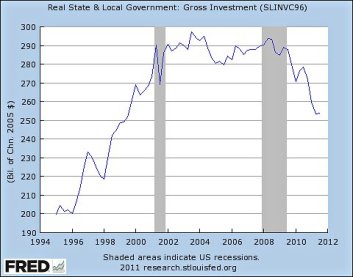
Paul Krugman put up this graph showing the level of Gross Investment by State and Local Governments. This would be the kinds of infrastructure that support modern life as we know it and include things like roads, bridges, new school buildings, sewers, airports, and other things that also drive local business growth. As you can see, there is a serious lack of infrastructure investments by state and local governments this century. Since interest rates are cheap, now is a good time to do these kinds of long term projects that would provide jobs and incentives for local businesses to expand. The majority of our states have balanced budget amendments which disallow deficit spending and in some cases, borrowing. Long term investment is nearly impossible in many states. Krugman argues that the timing is right to invest in roads, bridges, airports, and other important public projects. It’s a perfect time to look at an Infrastructure Bank which had broad bipartisan support during the Bush/Cheney years. President Obama has proposed such an institution.
The proposal, modeled after a bipartisan bill in the Senate, would take $10 billion in start-up money and identify transportation, water or energy projects that lack funding. Eligible projects would need to be worth at least $100 million and provide “a clear public benefit.” The bank would then work with private investors to finance the project through cheap long-term loans or loan guarantees, with the government picking up no more than half the tab — ideally, much less — for any given project.
There is still this insane argument out there that the US is going broke and can’t afford to spend any money. This confuses the institution of government with households and businesses. A government has the ability tax and the national government has the ability to print money and borrow in perpetuity. This country spent far more of its future output during the Great Depression and World War 2 and the results speak for themselves. We’ve had most of this decade’s fiscal policy using taxes to encourage gambling for paper profits, not actual production of goods and services. Europe’s policy makers are stuck in the same mindset. You would think that the experiences between the two world wars would’ve made an impression on them. We’ve spent trillions of dollars propping up the world’s gambling houses without telling them they must lend for productive purposes as a condition of those bailouts. I have no idea how many more years that economists will have to scream that it’s the aggregate demand stupid at policy makers, but I have a feeling we won’t be stopping any time soon.
Saturday Reads: a little readin’ and writin’ and rhythmetric
Posted: August 20, 2011 Filed under: just because, morning reads | Tags: Althea Gibson, animal migrations, austrian school, Climate change, dominionism, extremist christians and anti-environmental policies, Hayek, Keynesian Economics, Siberian Dog Skeleton, voodoo econmics, zombie memes 18 CommentsSo, I’m still fascinated about how much history, science, and just plain reason seems to have gone out the window this political season. It undoubtedly has something to do with the caliber of candidates that are out stumping about right now. So bad are they that John Huntsmen felt the need to tweet out to people that he wasn’t crazy!!! So, I’m gonna have a little salute today to knowledge, literacy, history, economics, science, and just plain ol’ rationale thought.
First, some history. On August 22, 1950, Althea Gibson became the first African American on the US Tennis Tour. Gibson paved the way for  today’s Williams sisters who are tennis super stars.
Growing up in Harlem, the young Gibson was a natural athlete. She started playing tennis at the age of 14 and the very next year won her first tournament, the New York State girls’ championship, sponsored by the American Tennis Association (ATA), which was organized in 1916 by black players as an alternative to the exclusively white USLTA. After prominent doctors and tennis enthusiasts Hubert Eaton and R. Walter Johnson took Gibson under their wing, she won her first of what would be 10 straight ATA championships in 1947.
In 1949, Gibson attempted to gain entry into the USLTA’s National Grass Court Championships at Forest Hills, the precursor of the U.S. Open. When the USLTA failed to invite her to any qualifying tournaments, Alice Marble–a four-time winner at Forest Hills–wrote a letter on Gibson’s behalf to the editor of American Lawn Tennis magazine. Marble criticized the “bigotry” of her fellow USLTA members, suggesting that if Gibson posed a challenge to current tour players, “it’s only fair that they meet this challenge on the courts.” Gibson was subsequently invited to participate in a New Jersey qualifying event, where she earned a berth at Forest Hills.
On August 28, 1950, Gibson beat Barbara Knapp 6-2, 6-2 in her first USLTA tournament match. She lost a tight match in the second round to Louise Brough, three-time defending Wimbledon champion. Gibson struggled over her first several years on tour but finally won her first major victory in 1956, at the French Open in Paris. She came into her own the following year, winning Wimbledon and the U.S. Open at the relatively advanced age of 30.
Gibson repeated at Wimbledon and the U.S. Open the next year but soon decided to retire from the amateur ranks and go pro. At the time, the pro tennis league was poorly developed, and Gibson at one point went on tour with the Harlem Globetrotters, playing tennis during halftime of their basketball games.
Next up, a little anthropology and biology! The National Geographic reports on how an ancient dog skull shows how early humans paired up with some of their first pets.
It took 33,000 years, but one Russian dog is finally having its day.
The fossilized remains of a canine found in the 1970s in southern Siberia’s Altay Mountains (see map) is the earliest well-preserved pet dog, new research shows.
Dogs—the oldest domesticated animals—are common in the fossil record up to 14,000 years ago. But specimens from before about 26,500 years ago are very rare. This is likely due to the onset of the last glacial maximum, when the ice sheets are at their farthest extent during an ice age.
With such a sparse historical record, scientists have been mostly in the dark as to how and when wolves evolved into dogs, a process that could have happened in about 50 to a hundred years.
“That’s why our find is very important—we have a very lucky case,” said study co-author Yaroslav Kuzmin, a scientist at the Russian Academy of Sciences in Novosibirsk.
In the case of the Russian specimen, the animal was just on the cusp of becoming a fully domesticated dog when its breed died out.
 So, it wouldn’t be me without some economics. Economist Greg Ip has a great post up at the WP on how Republicans’ new voodoo economics is worse than the old brand because the new brand isn’t based in economics at all. It’s a nice common sense essay on how fiscal and monetary policy work and how today’s crop of Republicans ignore about 90 years of economic theory and empirical studies
The new GOP views actually have a much longer pedigree: They are rooted in an intellectual contest that raged during the 1930s and 1940s, and had long been settled by the opposing side.
Before then, orthodox economics held that the economy was self-correcting. Just as the price of wheat or the wages of carpenters would always adjust to eliminate surpluses or shortages of either, so would wages throughout the economy adjust to eliminate temporary bouts of high unemployment.
The Great Depression shattered that orthodoxy, as high unemployment became entrenched in the United States and around the world. British economist John Maynard Keynes convincingly argued that when interest rates were zero — a condition he termed a “liquidity trap” — the economy’s self-correcting properties did not operate. The best solution, he argued, was a burst of public spending to restore demand and employment.
Ip goes on to explain how the competing view–Hayek’s Austrian school–was long discredited but has now made some kind of zombie comeback. This is especially true with Tea Party zealots and Ron Paul fans. What these folks talk about is not even taken seriously among any of the world’s economists. The Hayek-style alternatives were tried in South America and led to disaster. No main stream university teaches anything remotely resembling Austrian school “economics” and no serious peer-reviewed journals accept their work because it’s empirical evidence-free.
So, I couldn’t be remiss and leave out some climate science! Climate change has animals heading for the hills! That goes for plants too!
Regardless of what Rick Perry and the rest of Republican presidential candidate field believe (except for you, Jon Huntsman), climate change is real and it’s happening. The questions for the 98% of climate researchers who accept the consensus on man-made global warming is how fast the climate is changing, and what impact it will have on humanity and the planet.
Here’s one effect of warming scientists are already seeing: plants and animals migrating to cooler climates to escape hotter temperatures. In a study published in the August 18 Science, researchers in Britain and Taiwan found that species are moving in response to global warming up to three times faster than previously believed. Analyzing studies covering over 2,000 responses from plants and animals, the scientists found that on average, species have moved to higher elevations to escape warmer temperatures at 40 ft per decade, and moved to higher latitudes (ie, further away from the equator) at 11 miles per decade.
So, here’s a real shocker and it’s from a DKos diary. Today’s lesson in journalism shows us that we have a very uniformed commenteriat. Evidently Wolf Blitzer and Jack Cafferty had never heard of dominionisim until just recently. That’s the extreme christian belief that’s overtaking a lot of republican circles these days. Michelle Bachmann oozes it out of every pore. We’ve discussed it here considerably and Bostonboomer and I have written several posts on it.
You could probably hear my dropping jaw hitting the floor when I heard Jack Cafferty and Wolf Blitzer say they had never heard of dominionism until they read Michelle Goldberg’s article on The Daily Beast. They apparently had never heard of Christian Reconstructionism or the New Apostolic Reformation either. Goldberg’s article on Rick Perry and Michelle Bachmann’s relationship to all of this was certainly well done. But it is amazing that no other journalist of any prominence had looked into it before Goldberg’s revelations. There are many, and ever-more prominent pols with similar ties. And the failure of our national media and political culture to come to grips with this has been astounding. At least to me. As someone who has written about the Religious Right in its various dimensions for about 30 years, I’ve watched with horror as too many (but not all) mainstream media missed or misreported the stories of one of the most significant political movements of our time.
Blitzer and Cafferty et al have had plenty of opportunities to learn about dominionism and Christian Reconstructionism. They could have read Michelle Goldberg’s New York Times best-selling book Kingdom Coming: The Rise of Christian Nationalism, in 2006. They could have read my 1997 book, Eternal Hostility: The Struggle Between Theocracy and Democracy, or Sara Diamond’s 1989 classic, Spiritual Warfare: The Politics of the Christian Right. — to name but a few that deal specifically with dominionism and Christian Reconstructionism. We were all widely in the media, including national broadcasts talking about this stuff. They could also read material from such well established and well known organizations that study and counter the American right, as Americans United for Separation of Church & State and People for the American Way, and Political Research Associates. (PRA published my studyof Christian Reconstructionism in 1994.) Religion Dispatches reports on these things all the time as well. They have been discussed in wider context in books by such scholarly best selling authors as Gary Wills, Harvey Cox, Jeff Sharlet and Kevin Phillips, to also name but a few, and in major articles in magazines as diverse as Reason and Mother Jones. (I even discuss Christian Reconstructionism on camera in the 2007 Hollywood film documentary on the politics of abortion, Lake of Fire. Watch it for free, here.)
You really cannot have been awake in American public life for the past few decades and not have encountered dominionism and Christian Reconstructionism. Blitzer and Cafferty are far from alone in snoozing comfortably through this part of our national life. They are just more startlingly honest that this is no dream.
Now for a little SciFi lit. What if E.T. thinks we’re evil?
A study that reviews a host of sci-fi scenarios for contact with extraterrestrials stirred up such a ruckus today that NASA had to step in and distance itself from the research. The controversy focuses on the idea that E.T. could well decide that we’re a threat to interstellar order, and therefore we have to be stopped before we spread.
The report itself, published in the journal Acta Astronautica, covers ground that’s familiar to dedicated fans of E.T. lore. For example, the premise of the 1951 sci-fi classic “The Day the Earth Stood Still” is that universalist-minded aliens see our civilization as so rooted in violence that it’s better to snuff us out than let us ruin the neighborhood. (The 2008 remake, starring Keanu Reeves, recycled that idea with an environmental theme.)
Then there’s the “Hitchhiker’s Guide to the Galaxy” scenario, in which Earth is destroyed merely to make way for a new stretch of intergalactic infrastructure.
“At the heart of these scenarios is the possibility that intrinsic value may be more efficiently produced in our absence,” the researchers write.
The most familiar sci-fi scenario is the one in which the aliens are as selfish and territorial as we are, and want to wipe us out or enslave us and take our stuff. Think “War of the Worlds” or “Independence Day.” In such cases, the researchers note that there’s the potential for big payoffs … if we prevail.
Last up is our music lesson and ABCs rolled into one with this great song from kidhood by the Jackson five! Have a great Saturday and be sure to share what’s on your blogging and reading list today!!!
MacroEconomic Malpractice
Posted: July 20, 2009 Filed under: Global Financial Crisis, Team Obama, The Great Recession, U.S. Economy, Voter Ignorance | Tags: Banking, Economic Forecasts, Keynesian Economics, Larry (LaLaLand) Summers, Mergers and acquisitions, Monopoloy, Supply Side Economics Comments Off on MacroEconomic MalpracticeIf the U.S. economy was a patient, I’m sure we all would be talking medical malpractice by now. After having 8 years of nothing to lecture on during the Clinton years other than, yes Keynesian economics works, we are now on our 9th year of wtf? (Feel sorry for my poor undergrads.) We’re still dealing with the spinning of the complete failure of Voodoo Economics, Trickle-down economics, Reaganomics or Supply Side economics from the free spending, tax dollar giveaway as success story with no real point other than supporting faith based economic hypotheses and the rights of the ultrarich to stay that way in to something it was not. I simply cannot believe that any REAL democratic administration with some roots in the Clinton years could possibly be choosing to continue the failed policies of the right.
So, since I’ve been on a populist rant over Wall Street Bonuses, let me just fuel the fire some more with this little piece in the Washington Post website today with the unsurprising title “Bailout Overseer Says Banks Misused TARP Funds”. No kidding cupcake. Why do you suppose the same risk happy folks that got their bonuses last year are getting big ones this year? We might as well funded a national road trip to Vegas.
Many of the banks that got federal aid to support increased lending have instead used some of the money to make investments, repay debts or buy other banks, according to a new report from the special inspector general overseeing the government’s financial rescue program.
The report, which will be published Monday, surveyed 360 banks that got money through the end of January and found that 110 had invested at least some of it, that 52 had repaid debts and that 15 had used funds to buy other banks.
 So, we’re basically funding a real time game of monopoly. Okay, Republicans, let me just explain this to you ONE more time. MONOPOLY is the antithesis of market capitalism. It isn’t Socialism. Socialism is NOT an economic concept any more than GOD is a Buddhist one. It’s the difference between, I buy houses in Houston and I buy All the houses in Houston. We actually prove markets are efficiently working by comparing competitive markets to centrally planned ones and find the same result when they are. However, that’s IFF (if and only if) things in both circumstances are perfect (which they NEVER are). We live in a land of frictions and 30 years of research shows that we’ve just about got as much chance of having the Pure Capitalist dream as we do the Pure Marxist dream. Zip, Zilch, nada, no way! Our lives our lived in imperfect markets where government sometimes steps in to make things worse, and some times steps in to make things better. We’re basically in the search for the middle path.
Right now, we’re funding and sustaining a financial market structure that perpetuates extraordinary profits for the capital owners, less products available to the market, and higher prices for every one. It is also well-researched that bigger institutions do not bring efficiencies of scale to the market so how is this a good thing? Just pick up any basic microeconomics book and study market structures. The bottom line is a welfare loss for the market as resources will be inefficiently used, quantities will be reduced, prices will be higher, and the demand side of the market will experience a loss of welfare. (Sorry, I keep having to remind myself I have the summer away from theory, but I’m an old dog and that’s a new trick for me.) The empirics on this have supported these theories for hundreds of years!

 peej
peej Carissa
 bostonboomer
 dakinikat
 ecocatwoman
 mablue2
 Mama Lopez
 peggysue22
 quixote
 skydancingguestblogger
 Mona (aka Wonk the Vote)



 Sky Dancing
Recent Comments