



“This last week has taken the demonstrations to a different level,” Daley said. “It portends that you have the potential for big demonstrations. Whether they get violent — that’s more imaginable today than it was a year ago.”
Lazy Caturday Reads
Posted: May 4, 2024 Filed under: cat art, caturday, Donald Trump, Israel-Hamas war, Joe Biden | Tags: 1968 Democratic convention, 2024 Democratic convention, abortion rights, Access Hollywood tape, BF Borgers, Chicago, Hope Hicks, Karen McDougal, Mark Meadows, Michael Cohen, Stormy Daniels, Trump Hush Money trial, Trump Media & Technology Group 6 Comments
Thophile_Alexandre_Steinlen, The Sleeping Cat
Happy Caturday!!
As Dakinikat wrote yesterday, the Trump hush money trial had a marquee witness yesterday in Hope Hicks, who was very close to Trump during the his 2016 campaign and his four years as “president.” A couple of reports/reactions:
CNN: Takeaways from Day 11 of the Donald Trump hush money trial as Hope Hicks testifies.
Donald Trump’s former campaign press secretary and White House communications director Hope Hicks took the stand Friday, sitting feet away from her former boss as she described the fallout from the “Access Hollywood” tape and the Trump White House response to stories about hush money payments.
Hicks was visibly nervous, and she mostly avoided eye contact with Trump while answering questions from prosecutors for more than two hours. When prosecutors finished with their questions and Trump’s attorney took the podium, Hicks began crying and appeared to become overwhelmed; she finished her testimony after a brief break.
Through Hicks’ testimony, prosecutors showed jurors the transcript of the infamous “Access Hollywood” tape that upended Trump’s campaign – and, according to the Manhattan District Attorney’s Office, fueled Trump’s concern about keeping Stormy Daniels quiet in the days before the November 2016 election….
After sitting in the witness box, Hicks looked visibly uncomfortable and quickly acknowledged as much when she began answering questions.
“I’m really nervous,” she said, adjusting herself and the microphone in front of her.
Trump often had a scowl on his face, occasionally looking at Hicks and frequently passing notes with his attorneys while watching the proceedings play out on the television above him. Hicks, for her part, looked nearly always at assistant district attorney Matthew Colangelo and the jury, not at the defendant’s table.
Much of Hicks’ testimony focused on her role on the Trump campaign in October 2016, just before Election Day. Prosecutors asked what happened when the “Access Hollywood” tape came out.
“The tape was damaging. This was a crisis,” Hicks said.
Tranquility, by Dora Hathazi Mendes
The aftermath of the tape then informed how the campaign responded when the Wall Street Journal reported on Karen McDougal’s deal with American Media, Inc. not to speak about an alleged affair as part of a $150,000 agreement
In the report, which also mentioned Daniels, Hicks, then a Trump campaign spokesperson, denied that Trump had had affairs with either woman.
Hicks was asked about her conversations with Trump as well as Michael Cohen when reporters came to her for comment.
“What I told to the Wall Street Journal is what was told to me,” Hicks said of the denial she gave about the Daniels allegations.
When cross-examining Hicks, Trump attorney Emil Bove elicited testimony that Trump was also concerned about what his wife would think. Trump asked for the newspapers not to be delivered to his residence the day the story published, Hicks testified.
“I don’t think he wanted anyone in his family to be hurt or embarrassed by anything that was happening on the campaign trial. He wanted them to be proud of him,” Hicks said.
Read more at CNN.
Marina Villaneuve at Salon: “More credible”: Legal experts say Hope Hicks’ testimony “ties everything more closely to Trump.”
Hicks discussed her key role in meetings and made clear that she “reported to Mr. Trump,” who, she said, closely managed his communications strategy. Multiple news outlets, including The New York Times, reported that Hicks said she was “very concerned” about the “Access Hollywood” tape in which Trump bragged about grabbing women by their genitals. The audio clip was published in October — a month before the election.
“I was concerned,” Hicks said Friday. “Very concerned. Yeah. I was concerned about the contents of the email, I was concerned about the lack of time to respond, I was concerned that we had a transcript but not a tape. There was a lot at play.”
Trump’s defense, meanwhile, used their cross examination to ask Hicks questions about Cohen’s informal role with the campaign and Trump’s concern about his wife Melania’s reaction to the “Access Hollywood” tape.
“He liked to call himself a fixer, or Mr. Fix-it, and it was only because he first broke it,” Hicks said, according to The Times. Hicks also said of Cohen: “He would try to insert himself at certain moments.” [….]
New York prosecutors have cited text messages, witness testimony, phone calls and other records to allege that Trump schemed to pay off adult film star and director Stormy Daniels, model Karen McDougal as well as a doorman who falsely claimed Trump had an affair with a housekeeper. The scheme allegedly involved a $130,000 payment to Daniels described as “legal expenses” in Trump Organization records. Bragg said the scheme “mischaracterized, for tax purposes, the true nature of the reimbursements” for that payment.
According to The Times, prosecutors asked Hicks if Cohen would have paid Daniels without alerting Trump. Hicks said that would have been out of character for Cohen.
Prosecutors on Friday asked Hicks about an email she wrote saying “Deny, deny, deny” concerning the Washington Post’s email seeking comment about the Access Hollywood tape. She described that reaction as a “reflex.” She also said the campaign was concerned about a Wall Street Journal article about McDougal.
“One of the defining characteristics of Hope Hicks, both in the campaign and in her time in the White House, was that Mr. Trump wanted to have her in the room as often as possible,” Hofstra University constitutional law professor James Sample said. “Hope Hicks is a witness who will heighten the connection between what the jury has already heard and the prosecutors need to establish that part of the reason for these deals was to influence the election.”
Two more Trump-related stories:
Brandi Buchman at Law and Crime: Mark Meadows unmasked in Arizona fake electors indictment, faces 9 felony charges: Report.
Charges have formally been made public against Mark Meadows, the onetime chief of staff to former President Donald Trump, in the expansive fake electors case now underway in Arizona.
Trump is not charged in Arizona but is considered an unindicted co-conspirator.
As Law&Crime recently reported, 18 fake electors in the state were indicted by a grand jury on April 24 for their alleged efforts to overturn the legitimate results of the 2020 election. Though several Republicans were named directly in the fraud and forgery indictment including, among others, leaders of the state’s Republican party and two incumbent state lawmakers, some of those charged had their identities redacted, including Meadows and Trump’s former attorney also facing indictment in Georgia, Rudy Giuliani.
Formal charges have still not been confirmed for Giuliani in Arizona.
The Associated Press reported first on Wednesday that the state’s attorney’s general office confirmed Meadows was being charged with nine felony counts and has been served.
An attorney for Meadows did not immediately respond to a request for comment to Law&Crime on Friday.
Those charged with trying to pass off bogus elector slates in 2020 and named openly when the indictment first went public included Arizona GOP chair Kelli Ward, her husband Michael Ward, Tyler Bowyer, Nancy Cottle, Jacob Hoffman, Anthony Kern, James Lamon, Robert Montgomery, Samuel Moorhead, Lorraine Pellegrino, and Gregory Safsten.
More at the Law and Crime link.
CBS News: Trump Media’s accountant is charged with “massive fraud” by the SEC.
BF Borgers, the independent accounting firm for Trump Media & Technology Group, is facing allegations of “massive fraud” from the Securities and Exchange Commission, which on Friday claimed the auditor ran a “sham audit mill” that put investors at risk.
Henriette Ronner-Knip, Cat Nap
The SEC said Borgers has been shut down, noting that the company agreed to a permanent suspension from appearing and practicing before the agency as accountants. The suspension is effective immediately. Additionally, BF Borgers agreed to pay a $12 million civil penalty, while owner Benjamin Borgers will pay a $2 million civil penalty.
Neither the SEC statement nor its complaint mentioned Trump Media & Technology Group. Borgers didn’t respond to a request for comment.
In an email, Trump Media said it “looks forward to working with new auditing partners in accordance with today’s SEC order.”
The SEC charged Borgers with “deliberate and systemic failures” in complying with accounting standards in 1,500 SEC filings from January 2021 through June 2023, a period during which Borgers had about 350 clients. Trump Media’s March debut as a public company came after that time period, but the social media company said in its 2023 annual report that it had worked with Borgers prior to going public on the Nasdaq stock exchange.
There could be some progress in the Israel-Hamas cease fire talks, but there are still substantive disagreements. Both Haaretz reports that Hamas has agreed to the current proposal, but only if Israel withdraws from Gaza. Of course Netanyahu won’t agree to that.
BBC: Israel-Gaza war: Ceasefire talks intensify in Cairo.
Efforts have intensified to secure a deal for a ceasefire in Gaza and the release of hostages, with talks resuming in Cairo on Saturday.
Hamas said its delegation was travelling in a “positive spirit” after studying the latest truce proposal.
“We are determined to secure an agreement in a way that fulfils Palestinians’ demands,” it said.
US Secretary of State Antony Blinken said “taking the ceasefire should be a no-brainer” for the militant group.
Hamas’s negotiators have returned to the Egyptian capital to resume long-running talks – brokered by Egypt and Qatar – that would temporarily pause Israel’s offensive in Gaza in return for freeing hostages.
In a statement released last night, Hamas said it wanted to “mature” the agreement on the table, which suggests there are areas where the two sides still disagree.
The main issue appears to involve whether the ceasefire deal would be permanent or temporary.
Hamas is insisting any deal makes a specific commitment towards an end to the war, but Israel is reluctant to agree while the group remains active in Gaza. It’s thought the wording being discussed involves a 40-day pause in fighting while hostages are released, and the release of a number of Palestinian prisoners being held in Israeli jails.
Israel’s Prime Minister Benjamin Netanyahu has repeatedly insisted there will be a fresh military ground operation in the southern Gazan city of Rafah, even if a deal is agreed. Israeli media reported on Saturday that his position remained unchanged despite the latest round of talks.
But the US – Israel’s biggest diplomatic and military ally – is reluctant to back a new offensive that could cause significant civilian casualties, and has insisted on seeing a plan to protect displaced Palestinians first. An estimated 1.4 million people have taken shelter in Rafah after fleeing the fighting in the northern and central areas of the strip.
I certainly hope so. IMHO, Biden should cut off weapons support to Israel unless they start paying attention to his recommendations.
Jonathan Landay at Reuters: Democratic lawmakers tell Biden evidence shows Israel is restricting Gaza aid.
Scores of lawmakers from U.S. President Joe Biden’s Democratic Party told him on Friday that they believe there is sufficient evidence to show that Israel has violated U.S. law by restricting humanitarian aid flows into war-stricken Gaza.
A letter to Biden signed by 86 House of Representatives Democrats said Israel’s aid restrictions “call into question” its assurances that it was complying with a U.S. Foreign Assistance Act provision requiring recipients of U.S.-funded arms to uphold international humanitarian law and allow free flows of U.S. assistance.
The White Cat, Franz Marc
Such written assurances were mandated by a national security memorandum that Biden issued in February after Democratic lawmakers began questioning if Israel was upholding international law in its Gaza operations.
The lawmakers said the Israeli government had resisted repeated U.S. requests to open enough sea and land routes for aid to Gaza, and cited reports that it failed to allow in enough food to avert famine, enforced “arbitrary restrictions” on aid and imposed an inspection system that impeded supplies.
“We expect the administration to ensure (Israel’s) compliance with existing law and to take all conceivable steps to prevent further humanitarian catastrophe in Gaza,” the lawmakers wrote.
Biden’s memorandum requires that Secretary of State Antony Blinken report to Congress by Wednesday on whether he finds credible Israel’s assurances that its use of U.S. arms adheres to international law.
At least four State Department bureaus advised Blinken last month that they found Israel’s assurances “neither credible nor reliable.”
The Democratic convention is in Chicago this year, and it’s looking like we could see a repeat of 1968, when Mayor Daley unleashed his storm troopers on Vietnam war protesters as the whole world watched. That ended with Richard Nixon finally getting into the White House. This year the results could be even worse.
Tyler Pager at The Washington Post: Democrats bracing for massive protests at party’s August convention.
As protests over the Israel-Gaza war sweep college campuses, pro-Palestinian activists are ramping up plans for a major show of force at the Democratic National Convention in Chicago, increasingly worrying Democrats who fear the demonstrations could interfere with or overshadow their efforts to project unity ahead of the November election.
If unruly protests unfold during the four days of the convention on Aug. 19-22 — especially if they feature inflammatory rhetoric, property damage or police intervention — they could strike at the heart of the Democratic message that President Biden represents competent and stable leadership, while presumptive Republican nominee Donald Trump is an agent of chaos and confusion.
William Daley, a native Chicagoan who co-chaired the 1996 Democratic convention in the city and later served as President Barack Obama’s chief of staff, said he has heard more angst in recent days from fellow Democrats about the scenes that might unfold at this year’s party gathering. The convention, with more than 4,500 delegates set to formally nominate Biden for president, will serve as a starting gun for the final sprint to Election Day on Nov. 5.
Still, Daley, who attended the 1968 convention in Chicago with his father, then-Mayor Richard J. Daley, strenuously pushed back against comparisons to that notoriously violent event, saying the country is not facing the same kind of angry, anarchic violence. In 1968, the streets of Chicago were engulfed in riots and bloodshed, prompting the activation of the National Guard, as the convention nominated Hubert H. Humphrey just months after the assassinations of Martin Luther King Jr. and Robert F. Kennedy.
“To analogize what’s going on in the country today with 1968 is ridiculous,” Daley said. “Only people who weren’t alive in ’68 have that idiotic perception.”
He’s right about that, but there are lot of people now who don’t remember 1968. Of course in those days, college students actually had skin in the game–they were in danger of being drafted and sent to Vietnam.
I’ll end with some Abortion rights stories. There is good news and bad news.
The New York Times: Missouri and South Dakota Move Toward Abortion Rights Ballot Questions.
Two more states with near-total abortion bans are poised to have citizen-sponsored measures on the ballot this year that would allow voters to reverse those bans by establishing a right to abortion in their state constitutions.
Sleeping Cat, by Kawanabe Kyosai
On Friday, a coalition of abortion rights groups in Missouri turned in 380,159 signatures to put the amendment on the ballot, more than double the 172,000 signatures required by law. The Missouri organizers’ announcement followed a petition drive in South Dakota that announced on Wednesday that it, too, had turned in many more signatures than required for a ballot amendment there.
Both groups are hoping to build on the momentum of other states where abortion rights supporters have prevailed in seven out of seven ballot measures in the two years since the United States Supreme Court overturned Roe v. Wade, which had established a constitutional right to abortion for nearly five decades.
Groups in about 10 other states have secured spots on the ballot for abortion rights measures or are collecting signatures to do so. Those include Arizona and Nevada, swing states where Democrats are hoping that voters who are newly energized around abortion rights will help President Biden win re-election.

Politico: With 6-week abortion ban in place, Florida eyes ‘Safe Haven’ expansion.
Florida’s six-week abortion ban officially went into effect this week. But another bill also intended to lower the number of abortions could soon quietly become law as well.
An expansion of Florida’s “Safe Haven” policy — which decriminalizes surrendering unwanted infants, as long as they are given up to specific agencies like hospitals, fire stations and EMS services — faces just one more hurdle to becoming law. It has long been a piece of legislation in the toolbox of anti-abortion supporters who view legal infant surrenders as a way to encourage more women to carry their pregnancies to term.
The bill’s fate still hangs in the balance, because it has yet to be sent to Republican Gov. Ron DeSantis’ desk by legislative leaders. The governor’s office did not respond to a request for comment on the bill, but a sponsor of the bill, state Rep. Mike Beltran, said he doesn’t anticipate a veto.
But unlike many proposals considered alongside outright abortion bans — like “fetal personhood” or funding decisions — the Safe Haven bill in Florida attracted bipartisan support during the legislative session earlier this year. It’s found success with anti-abortion lawmakers supporting it in hopes of further reducing abortions, and with frustrated pro-abortion rights lawmakers who view it as a triage to help a desperate person with no other options.
“This was a way of doing something that was pro-life without making the left agitated,” Beltran, a Republican from Apollo Beach, said in an interview. “It was a good way to find common ground on the life issue when options were more limited.”
State law currently allows for a surrender up to 7 days after the child was born. This bill would more than quadruple the amount of time to 30 days and also authorize 911 responders to arrange an infant drop-off location in case the child’s guardian has no transportation to an agency’s site.
You’d have to be insane or just plain evil to believe that it would be less painful to dump a baby in a box at the fire department than to have an abortion early in a pregnancy.
The Washington Post: Texas man files legal action to probe ex-partner’s out-of-state abortion.
As soon as Collin Davis found out his ex-partner was planning to travel to Colorado to have an abortion in late February, the Texas man retained a high-powered antiabortion attorney — who court records show immediately issued a legal threat.

Lazy Saturday Reads: What Does the Allen Weisselberg Immunity Deal Mean?
Posted: August 25, 2018 Filed under: Afternoon Reads, U.S. Politics | Tags: Allen Weisselberg, David Pecker, Donald Trump, Fox News, Karen McDougal, Michael Cohen, Rudy Giuliani, use immunity 14 Comments
Summer Afternoon (Tea in the Garden), Théo van Rysselberghe
Good Afternoon!!
This has been a disastrous week for Trump. The Guardian summarizes: Trump’s terrible week: stunning news and whispers of impeachment.
…even by the standards of the Trump universe, this week has been a blur. And at its heart was a single, devastating hour on Tuesday 21 August that effectively turned the president of the United States into an unindicted co-conspirator in a federal crime….
…first, there was Rudy Giuliani. Trump’s lawyer, the former New York mayor, set the tone last Sunday with an Orwellian comment on the NBC network’s Meet the Press. Asked whether the president would give his version of events in testimony to Robert Mueller, the special counsel who is investigating Russian interference in the 2016 presidential election, Giuliani warned of a perjury trap and said: “Truth isn’t truth.”
Monday passed with just an embarrassing White House event to celebrate ICE during which Trump
…said that a border patrol agent, who is Latino, “speaks perfect English” as he beckoned him to the stage. He also misstated the acronym for US Customs and Border Protection at least eight times, referring to it as “CBC”, as in Canadian Broadcasting Corporation.
On Tuesday, the shit really hit the fan.
But then came, to use primary election parlance, Super Tuesday. At around 4.30pm, in courtrooms 200 miles apart, a pair of Trump associates delivered a one-two punch that stunned the White House and revived whispers of impeachment.
In New York, Trump’s longtime lawyer and “fixer” Michael Cohen implicated the president in a crime to influence the 2016 presidential election. Pleading guilty to dodging taxes and campaign finance violations, he alleged that Trump directed him to pay hush money to prevent two women – a Playboy model and pornographic actor – speaking out about extramarital affairs.
In Alexandria, Virginia, Paul Manafort, Trump’s former campaign chairman, was found guilty of eight tax and bank fraud charges and could now spend the rest of his life behind bars – unless Trump chooses to pardon him.
On Wednesday morning, Fox aired Trump’s interview in which he claimed that the campaign finance violations Cohen had pleaded guilty to were not crimes and that it should be illegal for people accused of crimes to turn states evidence in order to reduce their sentences. Then on Wednesday night he watched Tucker Carlson’s show.
There he saw a spurious Tucker Carlson report pushing a white nationalist conspiracy theory that white farmers in South Africa are being persecuted and murdered in Zimbabwe-style land grabs. Trump tweeted his outrage and promised to consult the state department, whose own human rights report on South Africa had made no mention of the issue.
It was one more white grievance dog whistle to add to all the rest. The South African government issued a swift rebuke and summoned US officials. Patrick Gaspard, the former US ambassador to South Africa, described the intervention as “astounding and deeply disturbing”. He said: “I can draw a line from the irresponsible statements he made in the wake of the violence in Charlottesville and him lifting up tropes from white nationalists in South Africa.”
 On Thursday,
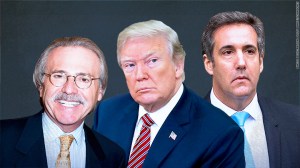
It emerged that David Pecker, chairman of American Media Inc, which owns the pro-Trump National Enquirer, had been granted immunity to provide information about Cohen and Trump’s involvement with payments to the two women who allege sexual affairs. The Associated Press added fuel to the fire by reporting thatthe Enquirer kept such secrets locked in a safe, lending it extraordinary power.
That night, the New York Times reported that the Manhattan district attorney’s office was considering pursuing criminal charges against the Trump Organization and two senior company officials in connection with one of the hush money payments.
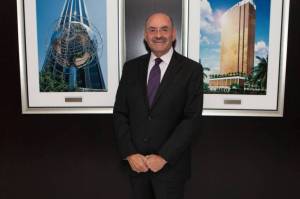
The coup de grâce came with the news that Allen Weisselberg, the CFO of the Trump Organization had been given immunity to testify against Trump’s former personal lawyer Michael Cohen.
Clearly the news about Weisselberg is the most damaging to Trump, but it’s not clear exactly kind of immunity the long-time “financial gatekeeper” has. According the The New York Times, it’s limited to the case against Cohen .
The person briefed on the deal said that it was narrow in scope, protecting Mr. Weisselberg from self-incrimination in sharing information with prosecutors about Mr. Cohen, Mr. Trump’s former personal lawyer, who pleaded guilty on Tuesday to tax and campaign finance charges. The latter charges stemmed from payments during the campaign to two women who said they had affairs with Mr. Trump. It was not, the person said, a blanket immunity extending beyond the information he shared, and Mr. Weisselberg remains in his job at the Trump Organization.
Allen Weisselberg
Mr. Weisselberg figured into the charges filed against Mr. Cohen this week, having facilitated the processing of what prosecutors described as “sham invoices” at the Trump Organization, through which Mr. Cohen was reimbursed for the money he had paid to quiet one of the women alleging an affair with Mr. Trump, the pornographic film actress Stephanie Clifford.
It sounds like it’s use immunity, which protects Weisselberg from being prosecuted based on the specific information he provided about the hush money deals. It’s likely that Weisselberg indicated he would take the fifth and prosecutors used immunity to force him to talk. Weisselberg could still be charged with a crime if investigators find independent evidence that he was involved in criminal activities. If he’s eventually charged with a crime, Weisselberg might agree to cooperate fully with prosecutors, but so far that doesn’t seem to be happening.
Nevertheless, the fact that prosecutors have gotten testimony from the man who supposedly “knows where the bodies are buried” in the Trump Organization is huge. And some knowledgeable writers are claiming Weisselberg has agreed to cooperate fully and are speculating about what he could reveal about Trump.
On Twitter, Renato Mariotti says he would be surprised if Weisselberg only got use immunity.
Obviously he knows a hell of a lot more than I do.
Luppe B. Luppen (AKA @NYCsouthpaw) and Hunter Walker at Yahoo News: For Trump, Allen Weisselberg may be the man who knew too much.
Prosecutors investigating Trump’s inner circle reportedly now reportedly have a limited deal with Weisselberg, who has provided testimony against former Trump lawyer Michael Cohen. If his cooperation expanded, it could play a crucial role in multiple ongoing investigations.
According to the Wall Street Journal, federal prosecutors granted immunity to Weisselberg in exchange for information about payments to Cohen, which were made to two women during the 2016 presidential campaign in order to suppress their stories of alleged affairs with Trump….
The Associated Press subsequently reported that the immunity deal was “restricted to Weisselberg’s grand jury testimony last month in the Cohen case.”
What could Weisselberg reveal if he were forced to cooperate fully?
If Weisselberg decided to fully open his kimono and reveal all he knows, the federal investigation in the Southern District of New York would be the most obvious potential beneficiary. However, in some ways, the nature of that office’s interest in Trump is the most mysterious. As of Friday afternoon, it is not known what other subjects that federal investigation is pursuing. If Trump Organization executives, or even the president, are in its cross hairs, then Weisselberg could offer key insights.
Special counsel Mueller’s investigation, headquartered in Washington, D.C., is another potential beneficiary. For Mueller’s investigators, Weisselberg could detail the nature and extent of the financing the Trump Organization has received from sources connected to Russia. He could also offer them insight into any investments or potential investments Trump has made either in Russia or with Russian partners. A spokesperson for the special counsel’s office declined to comment for this story.
Weisselberg could also potentially be a valuable material witness in the New York attorney general’s state-level investigation into President Trump’s charitable foundation. In June, New York Attorney General Barbara Underwood filed a lawsuit against the Trump Foundation alleging a “pattern of illegal conduct,” including “willful self-dealing.” Weisselberg has long been the treasurer of the Trump Foundation. In preparation for its lawsuit, the attorney general’s office conducted a lengthy interview with Weisselberg and obtained his emails. The investigators allege that Weisselberg collaborated with Trump and campaign officials in advance of the 2016 Iowa primary to use the charity’s funds to benefit the campaign.
At The New Yorker, the very knowledgeable Adam Davidson has more:
As the C.F.O., Weisselberg tracked the money that came into the Trump Organization and the money that went out of it, former employees told me. I often found myself wondering what the Weisselberg part of the operation looked like. (I called and e-mailed him a few times, but, not surprisingly, never heard back.) Some told me he had a couple of bookkeepers, but that he personally handled most of the paperwork. Weisselberg knew who was paying or lending money to Trump, and he knew to whom Trump was giving money. When Trump became President, he placed his business interests in a revocable trust overseen by his son Donald Trump, Jr., and Weisselberg….
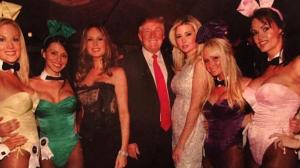
Trump with his wife, daughter, Karen Mcdougal (far right) and other playboy models.
This summer…Weisselberg’s role in the organization came into sharper focus. In a recording that Michael Cohen made of a conversation he had with Donald Trump about a payment to keep secret an affair, Cohen described setting up a shell company to pay hush money during the 2016 campaign to Karen McDougal, a woman who claimed to have had an affair with Trump. This week, Cohen pleaded guilty to violating campaign-finance laws, in part by setting up this secretive payment. He said that he knew at the time that it was illegal to secretly make a payment for campaign-related activity, but he did so anyway at Trump’s direction. Strikingly, Cohen makes it clear on the tape that Weisselberg also knew about the shell company and payment. “I’ve spoken to Allen Weisselberg about how to set the whole thing up,” Cohen explains to Trump.
It is difficult to hear the tape and not wonder how Weisselberg developed this particular expertise and whether he had deployed it before.
Here’s what Davidson has to say about Weisselberg’s immunity deal:
The Journal story and other news coverage suggest that Weisselberg has narrow immunity, related, solely, to the payments that Michael Cohen made to silence two women with whom Trump had affairs. With evidence of that crime in hand, prosecutors can subpoena other records from the company. If they have a reasonable basis to believe another crime has been committed, they can ask Weisselberg about it. Weisselberg, fearing jail time himself, could broaden his coöperation. The fact that Weisselberg has “flipped”— and may flip further—could shift the calculus of other figures in the Trump orbit as well. Weisselberg is a big fish—perhaps the biggest fish of all. Fearing that Weisselberg might implicate them in a crime, any cronies, dealmakers, attorneys, and others who might want to exchange information for leniency from prosecutors, will now do so.
If you’re interested in what kinds of crimes Weisselberg might know about, I’d suggest reading the entire article as well as Davidson’s other New Yorker pieces about Trump’s business dealings.
What else is happening? What stories have you been following?

 peej
peej Carissa
 bostonboomer
 dakinikat
 ecocatwoman
 mablue2
 Mama Lopez
 peggysue22
 quixote
 skydancingguestblogger
 Mona (aka Wonk the Vote)



 Sky Dancing
Recent Comments