
Incestuous Relationships: That’s Our Oligarchy!
Posted: March 26, 2013 Filed under: Barack Obama, Foreign Affairs, morning reads, U.S. Politics | Tags: 2008 presidential campaign, Ben Rhodes, Benjamin Netanyahu, CBS, David Rhodes, James M. Rhodes, Jon Favreau, Russ Baker, speechwriters 43 Comments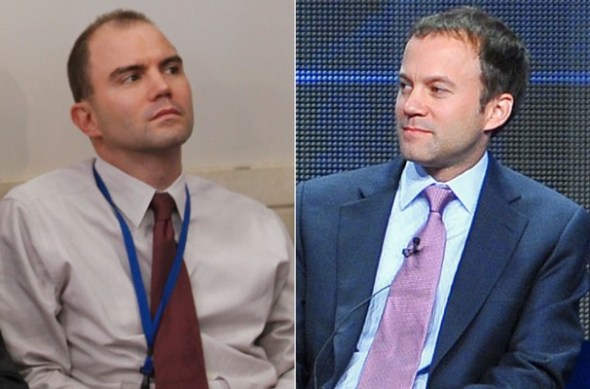
Ben and David Rhodes
On March 15, The New York Times ran a puff piece on Obama foreign policy adviser and speechwriter Ben Rhodes, by Mark Landler. Landler tells us that not so long ago, Rhodes was “[a]n aspiring writer from Manhattan [with] unfinished novel in a drawer, “Oasis of Love,” about a woman who joins a megachurch in Houston, breaking her boyfriend’s heart,” and that
worked briefly for Mayor Rudolph W. Giuliani’s re-election campaign in 1997, was living a writer’s life in Queens on Sept. 11, 2001, when he watched from the Brooklyn waterfront as the World Trade Center towers collapsed. The trauma of that experience, he said, led him to move to Washington in 2002.
Mr. Rhodes went to work for a Democratic foreign-policy elder, former Representative Lee Hamilton, helping draft the 9/11 Commission report as well as the Iraq Study Group report. That report was a template for the anti-Iraq war positions taken by Barack Obama, then a senator, whose campaign Mr. Rhodes joined as a speechwriter in 2008.
Wow! A Star is born!
Landler writes that Rhodes attends National Security Council meetings and has a powerful influence on Obama’s policies. He credits Rhodes for helping convince Obama to stop supporting Egyptian dictator President Hosni Mubarak and to intervene in Libya, as well as pushing the President to engage with Myanmar. At the moment, Landler says, Rhodes is trying to convince Obama to get more involved in Syria.
Jack Shaafer at Reuters calls the Landler’s story a “beat sweetener.
A beat sweetener, as press-watchers know, is an over-the-top slab of journalistic flattery of a potential source calculated to earn a reporter access or continued access. They’re most frequently composed on the White House beat when a new administration arrives in Washington and every Executive Office job turns over, but they can appear any time a reporter is prepared to demean himself by toadying up to a source in exchange for material.
As a beat sweetener, the Rhodes piece excels on so many levels that I’ll bet the subject’s parents have framed and hung the clipping over the family mantel. Landler portrays Rhodes as a young fella with “old man” wisdom; as possessing a “soft voice” that delivers “strong opinions”; as one whose “influence extends beyond what either his title or speechwriting duties suggest”; and as someone who “cares” to the point of “anguish” but is “very realistic.”
The information content of these testimonials, made by both Landler and his sources, is just about zero.
According to Shafer, the purpose of the “beat sweetener” isn’t just to make Ben Rhodes happy.
Sucking up to Rhodes won’t necessarily earn Landler or other journalists covering the White House an automatic scoop. But beat sweeteners aren’t written with anything so crass in mind as scoops. They’re designed to keep the information conveyor lubricated (“source greaser” is another term for the practice) with journalistic goodwill. As someone who is inside the White House decision loop, Rhodes is a much better friend than an enemy.
Getting back to the NYT puff piece: two-thirds of the way through, Landler mentions offhandedly that that Ben’s older brother David (who is 38) is the president of CBS News, a job he landed in February of 2011.
Landler provides no background on brother David, never mentioning that he previously held influential positions at Bloomberg and Fox News. In fact David is the first top CBS executive who previously worked for Fox News, and he’s the youngest president in CBS history. Shouldn’t this relationship between merit more than a throwaway line in a fawning profile of an influential adviser to the President of the U.S.?
Even Benjamin Netanyahu seemed a bit startled when he was told about it during Obama’s visit to Israel.
During a receiving line on the airport tarmac, Obama and Netanyahu stopped briefly to chat with Obama’s deputy national security, Ben Rhodes.
Obama noted that Rhodes’ brother, David, is president of CBS News.
“Sounds like a very incestuous relationship,” Netanyahu observed, chuckling at the idea of siblings in power roles within the administration and the news media.
“Not if you watch CBS News,” Obama replied.
There’s video of the interaction at Politico. Netanyahu may have been “chuckling,” but I’m not. How many times has Obama appeared on 60 Minutes? Has there ever been a mention of this relationship during those interviews? I haven’t checked, but I don’t recall it happening.
Of course relationships between media powerhouses and influential politicians and their advisers aren’t unusual. Here’s a short piece on this problem at TV Newser. Alex Weprin writes:
Let’s get this out of the way: conflicts of interest are rife in the TV news business.
CBS News president (and former Fox News executive) David Rhodes is the brother of one of President Obama’s advisers Ben Rhodes. NBC News anchor Andrea Mitchell is married to former Fed chairman Alan Greenspan. Bob Schieffer‘s brother Tom Schieffer was President Bush’s Ambassador to Japan.
In other words: potential conflicts happen all the time. The question is when should they be disclosed? Typically subjects with a conflict aren’t allowed to cover anything related to that conflict. If they do, a disclosure is a must….
In Washington, the journalists, the politicians and the lobbyists hobnob at the same parties, and many of them are friends. If everything was disclosed then just about every story from every reporter in DC would end with “I am a friend of a friend of this person” or “I hooked up with this person at 3 AM after the White House Correspondents Dinner.” Obviously that doesn’t happen, but sometimes a story does hit a little too close to home.
But isn’t this also an important reason why we don’t have an independent or serious news media?
Thinking about the incestuous nature of our Washington-New York oligarchy also leads to questions about how a young guy like Ben Rhodes–he’s just 35 now, so he was barely 30 when he began working for Obama in 2008–managed to come so far so fast.
Investigative reporter Russ Baker was stimulated to ask these and other questions after he read the Lindler’s NYT article. He notes that Rhodes appears to have come out of nowhere directly to the halls of power, just as his boss seemingly did. Baker writes:
What’s especially strange about the article is that, for those of us who continue to wonder how a virtual cipher rose so quickly from the Illinois legislature to become the most powerful person in the world, we end up wondering the same thing about an aspiring novelist from New York City who fairly catapults to enormous influence in shaping policy regarding some of the most complex and sensitive matters facing this country….
Though the Times never underlines this, the careful reader comes to realize that Rhodes’s guiding philosophy is as hard to discern as the precise reasons that he has the president’s ear. In 1997, he briefly worked on the re-election campaign of New York City Mayor Rudy Giuliani, a Republican. Shortly after 9/11, the aspiring novelist suddenly decided to do his part for society, moving in 2002 from Queens to Washington, and quickly found himself “helping draft the 9/11 Commission report as well as the Iraq Study Group report.” [….]
We are never even told what kind of education Rhodes got, or where, or whether he has ever been anything beyond an aspiring novelist. There’s no indication of what he did on Giuliani’s campaign (he would only have been about 19 or 20 at the time) or whether his preference for the mayor who presided over the 9/11 response had anything to do with his going to Washington, or miraculously being hired by Democrat Lee Hamilton to explain 9/11 to the public.
From these improbable beginnings, Rhodes is suddenly a speechwriter on Obama’s presidential campaign. How did he come to Obama’s attention? The article doesn’t say. However, it does note that the Iraq Study group report on which Rhodes worked “was a template for the anti-Iraq war positions taken by Barack Obama” as a senator and candidate.
Baker sums up his suspicions as follows:
Once we start asking questions about Benjamin Rhodes, this leads to questions about Obama, about the Times and CBS and journalism in general. And it leads to questions about how much we, the most smugly self-assured people on earth, understand about how anything of significance actually works.
In this case, it’s not unreasonable to wonder whether some particular faction or other might have spotted “talent” and “agreeability” in Rhodes, and helped hasten his rapid ascent to the top.
Baker located answers to some of these questions. From a very stunted Wikipedia entry, Baker learned that Ben Rhodes got his undergraduate degree from Rice University. He pulled together a timeline of the twin careers of Ben and his brother David:
Searching sources other than the Times, we find that David Rhodes was a production assistant at the fledgling Fox News Channel around the same time Benjamin was volunteering for Giuliani—and was the conservative channel’s news desk Assignment Manager when the planes struck the Twin Towers. Highly trusted by Fox’s chairman Roger Ailes, he managed Fox’s coverage of three presidential elections, including the one where his brother was writing Obama’s speeches, was hired by Bloomberg TV right after Obama’s election, and in 2011 was named president of CBS News.
It was Baker’s article that got me started I found Googling for more background on the very successful and powerful Ben Rhodes. In fact I spent much of the day yesterday searching for more background on the very successful and powerful Ben Rhodes. I’ll put that into a second post that I hope to put up later today.
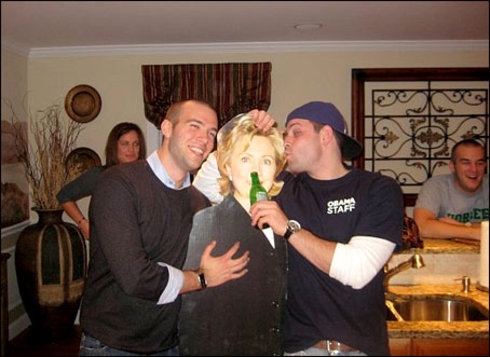
Oh, and I admit I was also inspired by my memory of this photo that I know you’ll also likely recall from early in Obama’s first term. The smiling guy sitting at the table in the back on the right side is Ben Rhodes. After head speechwriter Jon Favreau (on the left of the Hillary cardboard image) posted it on his Facebook page, Dak and I figured out who the other speechwriters in the room were and wrote a little about them.
You can treat this as a regular morning post and put your links in the comments as always. But I do hope some folks will wade through this post and discuss what I think are serious issues about the incestuous relationship between the corporation media and the government.

 peej
peej Carissa
 bostonboomer
 dakinikat
 ecocatwoman
 mablue2
 Mama Lopez
 peggysue22
 quixote
 skydancingguestblogger
 Mona (aka Wonk the Vote)



 Sky Dancing
Recent Comments