
Thursday Reads
Posted: October 15, 2020 Filed under: just because | Tags: Democratic fund-raising, Donald Trump, Joe Biden 50 CommentsGood Morning!!
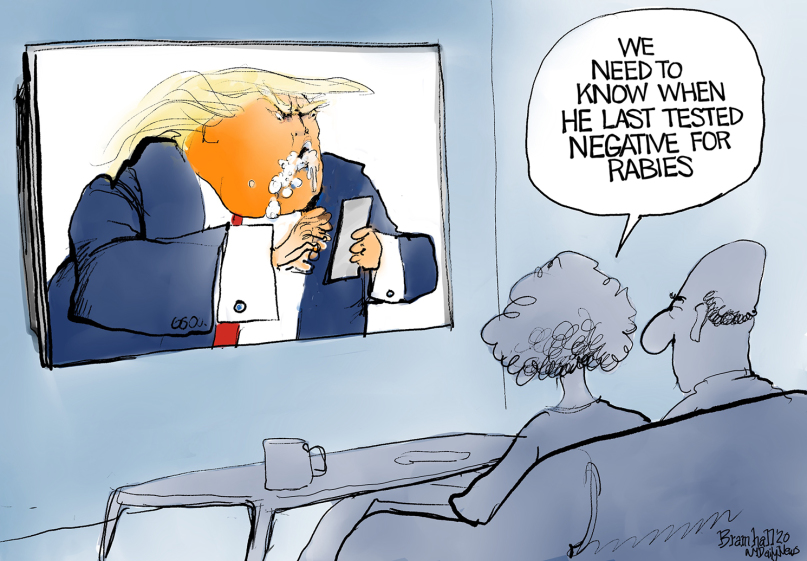 Everything is still awful in the land of Trump, but the election is only 19 days away. Meanwhile, there is some good news: Joe Biden and Democrats in general are rolling in money and Democrats are voting early in massive numbers.
Politico: Biden raised whopping $383M in September.
Joe Biden announced Wednesday evening that his campaign and affiliated committees raised $383 million in September, breaking a record he had just set the prior month as his campaign continues to ride a surge of online donations.
Biden, the Democratic National Committee and the campaign’s joint fundraising committees started the final 34 days of the campaign with $432 million in the bank, Biden campaign manager Jen O’Malley Dillon tweeted.
Politico: ActBlue’s stunning third quarter: $1.5 billion in donations.
Democratic candidates and left-leaning groups raised $1.5 billion through ActBlue over the last three months — a record-smashing total that reveals the overwhelming financial power small-dollar donors have unleashed up and down the ballot ahead of the 2020 election.
From July through September, 6.8 million donors made 31.4 million contributions through ActBlue, the Democratic Party’s favored online donation platform, averaging $47 per donation. More than 14,223 campaigns and organizations benefited from the surge in donations, the largest single quarter in the platform’s 15-year history, according to figures shared first with POLITICO. Just in September, ActBlue processed $758 million.
 The Washington Post: Across the country, Democratic enthusiasm is propelling an enormous wave of early voting.
The picture is so stark that election officials around the country are reporting record early turnout, much of it in person, meaning that more results could be available on election night than previously thought.
So far, much of the early voting appears to be driven by heightened enthusiasm among Democrats. Of the roughly 3.5 million voters who have cast ballots in six states that provide partisan breakdowns, registered Democrats outnumber Republicans by roughly 2 to 1, according to a Washington Post analysis of data in Florida, Iowa, Maine, Kentucky, North Carolina and Pennsylvania.
Additionally, those who have voted include disproportionate numbers of Black voters and women, according to state data — groups that favor former vice president Joe Biden over President Trump in recent polls.
The bad news is that the coronavirus pandemic is getting worse, not better, as we head into winter and flu season; and it’s becoming clear that Amy Coney Barrett is more extreme than any of the current “conservative” SCOTUS justices.
Deborah Birx may have been even worse than I thought. Science: The inside story of how Trump’s COVID-19 coordinator undermined the world’s top health agency.
On the morning of 13 July, more than 20 COVID-19 experts from across the U.S. government assembled in a conference room at the Department of Health and Human Services, steps from the Capitol. The group conferred on how best to gather key data on available beds and supplies of medicine and protective gear from thousands of hospitals. Around the table, masks concealed their expressions, but with COVID-19 cases surging out of control in some parts of the country, their grave mood was unmistakable, say two people who were in the room.
Irum Zaidi, a top aide to White House Coronavirus Task Force Coordinator Deborah Birx, chaired the meeting. Zaidi lifted her mask slightly to be heard and delivered a fait accompli: Birx, who was not present, had pulled the plug on the Centers for Disease Control and Prevention’s (CDC’s) system for collecting hospital data and turned much of the responsibility over to a private contractor, Pittsburgh-based TeleTracking Technologies Inc., a hospital data management company. The reason: CDC had not met Birx’s demand that hospitals report 100% of their COVID-19 data every day.
According to two officials in the meeting, one CDC staffer left and immediately began to sob, saying, “I refuse to do this. I cannot work with people like this. It is so toxic.” That person soon resigned from the pandemic data team, sources say.
Other CDC staffers considered the decision arbitrary and destructive. “Anyone who knows the data supply chain in the U.S. knows [getting all the data daily] is impossible” during a pandemic, says one high-level expert at CDC. And they considered Birx’s imperative unnecessary because staffers with decades of experience could confidently estimate missing numbers from partial data.
“Why are they not listening to us?” a CDC official at the meeting recalls thinking. Several CDC staffers predicted the new data system would fail, with ominous implications. “Birx has been on a monthslong rampage against our data,” one texted to a colleague shortly afterward. “Good f—ing luck getting the hospitals to clean up their data and update daily.”
And that’s just the beginning. Read the entire sad story at the link.
The New York Times: As Virus Spread, Reports of Trump Administration’s Private Briefings Fueled Sell-Off.
On the afternoon of Feb. 24, President Trump declared on Twitter that the coronavirus was “very much under control” in the United States, one of numerous rosy statements that he and his advisers made at the time about the worsening epidemic. He even added an observation for investors: “Stock market starting to look very good to me!”
But hours earlier, senior members of the president’s economic team, privately addressing board members of the conservative Hoover Institution, were less confident. Tomas J. Philipson, a senior economic adviser to the president, told the group he could not yet estimate the effects of the virus on the American economy. To some in the group, the implication was that an outbreak could prove worse than Mr. Philipson and other Trump administration advisers were signaling in public at the time.
The next day, board members — many of them Republican donors — got another taste of government uncertainty from Larry Kudlow, the director of the National Economic Council. Hours after he had boasted on CNBC that the virus was contained in the United States and “it’s pretty close to airtight,” Mr. Kudlow delivered a more ambiguous private message. He asserted that the virus was “contained in the U.S., to date, but now we just don’t know,” according to a document describing the sessions obtained by The New York Times.
So the White House gave a heads up to wealthy donors, who then told their friends, allowing the superrich to protect themselves financially before the public understood how bad the pandemic would be.
The New York Times: 8 Million Have Slipped Into Poverty Since May as Federal Aid Has Dried Up.
After an ambitious expansion of the safety net in the spring saved millions of people from poverty, the aid is now largely exhausted and poverty has returned to levels higher than before the coronavirus crisis, two new studies have found.
The number of poor people has grown by eight million since May, according to researchers at Columbia University, after falling by four million at the pandemic’s start as a result of an $2 trillion emergency package known as the Cares Act.
Using a different definition of poverty, researchers from the University of Chicago and Notre Dame found that poverty has grown by six million people in the past three months, with circumstances worsening most for Black people and children.
Significantly, the studies differ on the most recent month: While the Columbia model shows an improvement in September, the Chicago and Notre Dame analysts found poverty continued to grow.
“These numbers are very concerning,” said Bruce D. Meyer, an economist at the University of Chicago and an author of the study. “They tell us people are having a lot more trouble paying their bills, paying their rent, putting food on the table.”
Gee, no kidding. And Republicans don’t care. They’re just thrilled with their latest addition to SCOTUS.
Amy Coney Barrett’s Joke of a Confirmation Hearing
Jennifer Rubin at The Washington Post: Barrett seeks refuge in ignorance and evasion.
Barrett was certainly less poised on Wednesday than during previous days. She seemed irritated with Harris, saying she did not know where Harris’s line of questioning was heading. (It didn’t matter. She needed to answer the questions.) She also sounded testy when Sen. Amy Klobuchar (D-Minn.) grilled her on the Affordable Care Act. The Post reported:
“I have no animus or agenda for the Affordable Care Act,” she insisted under questioning from Sen. Amy Klobuchar (D-Minn.), who was citing the judge’s past comments and writings on the ACA and noting that Barrett’s apparent stance was that the law’s individual mandate was unconstitutional.Like many panel Democrats before her, Klobuchar at one point raised Barrett’s 2017 law review article criticizing Chief Justice John G. Roberts Jr.’s opinion upholding the health-care law, asking whether she had been aware that Trump wanted to overturn the ACA when she wrote it.This time, Barrett seemed to have lost her patience.“You’re suggesting this was like an open letter to President Trump,” Barrett protested. “It was not.”
Actually, Klobuchar was pointing out that everyone in the hearing room perfectly understood why Barrett was picked: because she has been an outspoken critic of precedent on abortion, the ACA and other conservative policy targets.
There’s more at the WaPo link.
In keeping with her evasive answers on other key issues—from voting rights to reproductive rights to climate change—President Donald Trump’s Supreme Court nominee Amy Coney Barrett on Wednesday refused to say whether she believes Social Security and Medicare are constitutional, prompting progressive advocacy groups and lawmakers to warn the judge’s confirmation could pose an existential threat to the programs.
“Social Security has been law of the land for 85 years, Medicare for 55,” Sen. Bernie Sanders (I-Vt.) said in response to Barrett’s comments. “Tens of millions are dependent upon these programs for retirement security and healthcare. And Judge Barrett doesn’t know if they are constitutional. Really? That’s what right-wing extremism is all about.”
“This is Republicans’ end game: confirm conservative judges who will undermine overwhelmingly popular programs like Social Security and Medicare and rip away healthcare from millions.”
—Sen. Ron WydenQuestioned by Sen. Dianne Feinstein (D-Calif.) during Wednesday’s Senate Judiciary Committee hearing, Barrett would not say whether she agrees with a right-wing scholar who has argued that Medicare and Social Security are unconstitutional because they exceed the spending powers of Congress. The Supreme Court deemed the Social Security Act of 1935 constitutional in a series of rulings in 1937.
Bess Levin at Vanity Fair: Amy Coney Barrett Says She Hasn’t Yet Committed to Letting Millions of Americans Die a Miserable Senseless Death.
When Republicans inevitably announced they were going to ram through Amy Coney Barrett’s Supreme Court confirmation before the November election, after they blocked Merrick Garland’s nomination because of the made-up “election-year” rule, it wasn’t just because they’re colossal hypocrites. Oh sure, they are, but the actual reason they’re doing so is because in Barrett they have found a judge who they can reliably expect will, given the opportunity, help overturn Roe v. Wade, ax the Affordable Care Act, gut voting rights, protect guns, scrap same-sex marriage, and potentially deliver Donald Trump a second term. They know this because in her work as a judge and law professor, she has made her positions abundantly clear. Really, it’s not a secret! It’s all right there with her name on it! Yet even though Barrett’s confirmation is in the bag, on Tuesday, she felt the need to pretend she might not actually strip health care for millions of Americans or reverse the landmark abortion decision or do a solid for Trump should the 2020 election be litigated in court, as the president has said it should be. Whether this was to give Republicans cover or because she knows a clip of her saying, for example, “Why yes, I look forward to forcing women into back-alley abortions” wouldn’t be a great look, Barrett went to absurd lengths to act like her opinions aren’t already widely known.
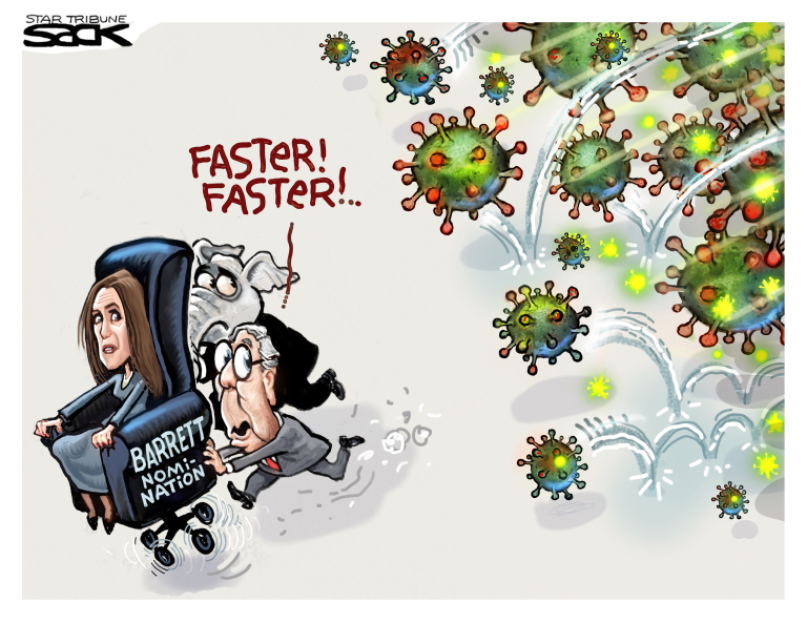 More from Bess Levin: Amy Coney Barrett, Mother of Seven, Not Sure if Separating Migrant Children from their Parents is Bad.
Despite being a mother, Barrett is expected to help overturn the Affordable Care Act. (After she was asked about this possibility, which would strip health insurance from millions, Grassley raged at his Democratic colleagues that “As a mother of seven, Judge Barrett clearly understands the importance of health care.”) She will also very likely go after Roe v. Wade, if given the chance, which some mothers would point out prevents their daughters—or even women they didn’t give birth to!— from being forced into back alley abortions. And even though she’s a mom of seven children, she apparently thinks the jury is still out on whether or not it’s bad to separate small children from their parents, if they happen to be from another country:
This woman is truly a monster, and she responds with crazy evasions in a whiny seven-year-old’s voice. I feel for the other justices who will have to keep straight faces when she presents her “legal arguments.”
Yes, it’s another ghastly day in Trump world, but there’s a good chance we can get rid of him in less than three weeks. Hang in there and vote!
Thursday Reads: Dumpster Fire Debate Aftermath
Posted: October 1, 2020 Filed under: morning reads, U.S. Politics | Tags: addiction, anti-semitism, art museums, Beau Biden, Donald Trump, First 2020 presidential debate, Hunter Biden, Joe Biden, Ku Klux Klan, Philip Guston, Racism, vigilante poll watchers, White supremacists 34 Comments
Central Avenue, by Philip Guston
Good Morning!!
The paintings and drawings in this post are by Philip Guston, a painter who shocked the art world in the late 1960s by abandoning his abstract expressionism and turning to cartoonish representations of KKK-like figures that to him reflected the culture of America under Richard Nixon. These works also reflected his childhood memories of scenes of the Klan marching openly in Los Angeles, where his Jewish family lived.
Four major museums have decided to call off a retrospective of Guston’s work for fear of negative reactions to the racial justice content of the paintings. From The New York Times:
In an open letter published Wednesday in The Brooklyn Rail, nearly 100 artists, curators, dealers and writers forcefully condemned the decision last week by the National Gallery of Art in Washington and three other major museums to pull the plug on the largest retrospective in 15 years of one of America’s most influential postwar painters.
The show, after years of preparation, will be delayed until 2024. The stated reason is to let the institutions rethink their presentation of Guston’s later figurative paintings, which feature men in hoods reminiscent of Ku Klux Klan members, and which, a National Gallery spokesperson said, risked being “misinterpreted” today.
Philip Guston – Dawn, 1970 (oil on canvas)
In the open letter, the artists, “shocked and disappointed,” accuse the museums — the National Gallery, Tate Modern in London, the Museum of Fine Arts, Boston, and the Museum of Fine Arts, Houston — both of betraying Guston’s art and of patronizing the public they are supposed to serve.
The postponement, they write, is an admission of the museums’ “longstanding failure to have educated, integrated, and prepared themselves to meet the challenge of the renewed pressure for racial justice that has developed over the past five years.” They demand that the Guston exhibition take place as scheduled, and that the museums “do the necessary work to present this art in all its depth and complexity.”

Surely these paintings are as relevant in the Trump years as they were in Nixon’s America. Postponing the exhibition until 2024 guarantees that public discussions of their import won’t happen until after Trump’s second term if he is reelected. This reminds me of the many efforts to ban Mark Twain’s profoundly anti-racist novel Huckleberry Finn because of Twain’s use of the N-word.
Read more at Art News: Controversial Philip Guston Show Postponement Met with Shock and Anger from Art Community. See also this statement (and more art works) from Guston’s daughter Musa Mayor: Philip Guston: The Danger is in Looking Away.
Now on to today’s news. Trump’s dumpster fire of a debate performance on Tuesday night is still drawing reactions.
The New York Times Editorial Board: A Debate That Can’t Be Ignored. Americans need to face the man who is their president.
President Trump’s was a national disgrace. His refusal to condemn white supremacists, or to pledge that he will accept the results of the election, betrayed the people who entrusted him with the highest office in the land. Every American has a responsibility to look and listen and take the full measure of the man. Ignorance can no longer be a tenable excuse. Conservatives in pursuit of long-cherished policy goals can no longer avoid the reality that Mr. Trump is vandalizing the principles and integrity of our democracy.
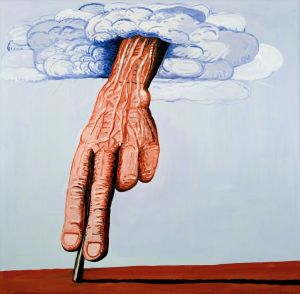
Philip Guston The Line, 1978
It’s a tired frame, but consider how Americans would judge a foreign election where the incumbent president scorned the democratic process as a fraud and called on an armed, violent, white supremacist group to “stand by” to engage with his political rivals.
The debate was excruciating to watch for anyone who loves this country, because of the mirror it held up to the United States in 2020: a nation unmoored from whatever was left of its civil political traditions, awash in conspiratorial disinformation, incapable of agreeing on what is true and what are lies, paralyzed by the horror of a pandemic that has killed hundreds of thousands and beholden to a political system that doesn’t reflect the majority of the country.
The debate featured one politician trying his best to do his job, trying to bring some normalcy to America’s battered public square, and one politician who seemed incapable of self-control — petulant, self-centered, rageful.
Read the rest at the NYT.
Adam Serwer at The Atlantic: The Most Illuminating Moment of the Debate. Donald Trump sees everything—even his own children—as a reflection of himself.
Shortly after Donald and Ivana Trump’s son was born, however, the future president had an unusual concern for a parent: What if this kid grows up and embarasses me?
“What should we name him?” Donald asked, according to Ivana’s memoir, Raising Trump. When Ivana suggested Donald Jr., the real-estate heir responded, “What if he is a loser?”
That anecdote helps explain one of the more memorable exchanges in Tuesday night’s presidential debate, as well as Trump’s approach to governance. The president’s Democratic rival, Joe Biden, sought to criticize Trump’s remarks about U.S. service members being “losers,” as first reported by The Atlantic. In doing so, Biden brought up his late son, Beau, who died of a brain tumor after earning a Bronze Star in the Army National Guard.
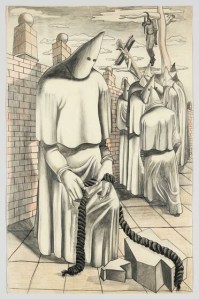
Philip Guston, Drawing for Conspirators, 1930
“My son was in Iraq and spent a year there,” Biden said to Trump, raising his voice. “He got the Bronze Star. He got a medal. He was not a loser. He was a patriot. And the people left behind there were heroes.”
In an attempt to neutralize the attack, Trump changed the subject—to Biden’s other son, Hunter. “Hunter got thrown out of the military; he was thrown out, dishonorably discharged for cocaine use,” he spat out.
To a person who feared sharing his name with his son at the moment of his birth, because the child might turn out to be a “loser,” that attack must have seemed devastating. But normal parents don’t stop loving their children because they do bad things. They love them anyway. That’s what being a parent is.
Biden responded by reaffirming his love for his surviving son. “My son, like a lot of people, like a lot of people you know at home, had a drug problem,” Biden responded. “He’s overtaken it. He’s fixed it. He’s worked on it. And I’m proud of him. I’m proud of my son.” [….]
More than any other moment of the debate, Trump’s response to Biden’s invocation of his dead son—attempting to make him ashamed of his surviving one—threw the dispositions of the two men into sharp relief. I wondered how Hunter must have felt to see his father speak of his pride in his brother, only for his own name to be brandished as a weapon to inflict shame on his father. And I thought about Biden’s response, which was to reaffirm his pride in Hunter, the troubled son living in the indelible shadow of a departed war hero. In the midst of being attacked by a president trying to wield his own family against him, Biden’s instinct was to reassure Hunter that he is also loved, that nothing could make his father see him as a loser.
Read more at The Atlantic.
At The Washington Post, Eric Garcia wrote about his own struggle with addiction and how Trump’s words will affect other recovering people: Trump’s attack on Hunter Biden will only increase the stigma of addiction.
As saccharine as it sounds, the president of the United States is also the president of screw-ups, addicts and hopefuls like me and Hunter Biden. But Trump’s comments made clear that he believes that an addict’s actions can be used against our families to attack their character.
Philip Guston – Courtroom, 1970 (oil on canvas)
That will make us less willing to talk about our problems and get the help we need. The National Institute on Drug Abuse says explicitly that stigma can make people with substance abuse disorders less willing to seek treatment. And that makes sense. If your addiction is going to be used against you, why try to get better?
Hunter Biden’s problems with alcohol, drugs and women have been well-documented. (News reports show that, contrary to what Trump said Tuesday, Hunter was not dishonorably discharged from the Navy Reserve when he tested positive for cocaine in 2014.) Those demons were enough of an issue that when the former vice president began running last year, the New Yorker published a piece asking whether they would “jeopardize his father’s campaign.” That story ran a few days before I finally hit bottom myself.
I don’t know Hunter Biden, but I do know that worrying that your own actions could hurt the people you love is one of the things that tears an addict up inside.

I hope you’ll read the rest.
The debate also raised fears about Trump stealing the election, by suppressing votes, encouraging white supremacist violence, and using the courts.
The Daily Beast: Trump’s Crew of Far-Right Vigilante Poll Watchers Is Coming.
The truck-revving, banner-waving, loudspeaker-blaring pro-Trump rally took place, conveniently, on Sept. 19, the first Saturday of early voting in the swing state of Virginia, in a parking lot where voters in Democratic-leaning Fairfax County were lined up to cast their ballots. Some Trump supporters drove circles around the voters while others—many without face masks—mingled with the line, chanting and waving flags.
“We had a couple poll observers there that had to actually escort voters in because we saw people that would get to the edge of the parking lot, and see this giant group of Trumpers yelling and screaming,” Jack Kiraly, executive director of the Fairfax County Democratic Committee, told The Daily Beast, adding that the scene reminded him of the volunteers who escort people past anti-abortion protesters outside women’s health clinics.
Philip Guston, 1930 or 31
So during Tuesday night’s remarkably unhinged presidential debate, when President Donald Trump urged his supporters to take unsanctioned actions at polling places, Kiraly was reminded of what Fairfax County voters had witnessed earlier this month.
During the debate, Trump appeared to tell the far-right paramilitary group the Proud Boys to “stand by” and urged fans to “go into the polls and watch very carefully” for voter fraud, an exceedingly rare phenomenon Trump has crafted into a cornerstone of his political identity. For close observers of the far right, as well as officials like Kiraly, the remarks amounted to the latest warning that an embattled president might use his supporters to impede fair elections, or to cast the results of those elections in doubt.
If the prospect of election-related violence was already looming over the first presidential contest since Trump effectively welcomed the paramilitary far-right into the Republican Party, the debate made the alarm bells ring even louder.

David Sanger at The New York Times: Tuesday’s Debate Made Clear the Gravest Threat to the Election: The President Himself.
President Trump’s angry insistence in the last minutes of Tuesday’s debate that there was no way the presidential election could be conducted without fraud amounted to an extraordinary declaration by a sitting American president that he would try to throw any outcome into the courts, Congress or the streets if he was not re-elected….
Mr. Trump’s unwillingness to say he would abide by the result, and his disinformation campaign about the integrity of the American electoral system, went beyond anything President Vladimir V. Putin of Russia could have imagined. All Mr. Putin has to do now is amplify the president’s message, which he has already begun to do….
The president began the debate with a declaration that balloting already underway was “a fraud and a shame” and proof of “a rigged election.”
Philip Guston – By the Window, 1969 (oil on canvas)
It quickly became apparent that Mr. Trump was doing more than simply trying to discredit the mail-in ballots that are being used to ensure voters are not disenfranchised by a pandemic — the same way of voting that five states have used for years with minimal fraud.
He followed it by encouraging his supporters to “go into the polls” and “watch very carefully,” which seemed to be code words for a campaign of voter intimidation, aimed at those who brave the coronavirus risks of voting in person.
And Mr. Trump’s declaration that the Supreme Court would have to “look at the ballots” and that “we might not know for months because these ballots are going to be all over” seemed to suggest that he would try to place the election in the hands of a court where he has been rushing to cement a conservative majority with his nomination of Judge Amy Coney Barrett.
And if he cannot win there, he has already raised the possibility of using the argument of a fraudulent election to throw the decision to the House of Representatives, where he believes he has an edge because every state delegation gets one vote in resolving an election with no clear winner. At least for now, 26 of those delegations have a majority of Republican representatives.

And of course Trump’s final backstop could be to trigger mass violence by his white supremacist supporters.
I’m running out of space, but I’ll post more links in the comment thread. Have a nice Thursday, and please check in with us if you have the time and inclination. We love to hear from you!
Tuesday Reads: Double Trouble for Trump
Posted: September 29, 2020 Filed under: morning reads, U.S. Politics | Tags: coronavirus pandemic, Donald Trump, evangelical Trump supporters, First 2020 presidential debate, Florida seniors, Joe Biden, reality TV, The Apprentice, Trump as national security threat, Trump debts, Trump taxes 25 CommentsGood Morning!!
The New York Times has published the second installment in its ongoing series on Trump’s taxes. But first, a recap of the revelations from the first blockbuster story and reactions from other sources.
Just Security has a good breakdown of the main revelations from the the first NYT article: Ten Quick Takeaways from the New York Times’ Bombshell Article on Trump’s Tax Returns. This is takeaway 2:
Trump appears to be an absolutely terrible businessman. This is a man who netted $606 million over nineteen years (from 2000 to 2018) through The Apprentice, licensing and endorsements, and investments and businesses run by others, and yet has created enormous financial peril for himself by buying prestige business properties for high prices, and then pouring cash into them without thereby generating positive net returns. Even with the cash infusions, his personally run businesses have continued to lose a great deal of money (even leaving aside depreciation deductions that might or might not be accompanied by actual declines in economic value). One therefore suspects that he is simply funding the negative cash flow, not creating new value that might pay off in the future. (Even the enhanced revenues at some U.S. properties from their being used by lobbyists have failed to eliminate the pattern of losing a great deal.)
Meanwhile, perhaps to fund the ongoing cash infusions, he has been taking out loans and making one-time asset sales that imply a danger of simply running out of money soon if there is no turnaround. The $421 million in personal liability debts that the Times says are due soon add to the impression of an approaching risk of financial breakdown. However, beyond just the financial peril that he may be facing, the pattern looks like one of recklessly and improvidently burning through one’s cash for as long as it lasts, rather than of investing prudently to create future value.
Adam Davidson of The New Yorker posted an interesting Twitter thread yesterday:
https://twitter.com/adamdavidson/status/1310556455674802176?s=20
https://twitter.com/adamdavidson/status/1310557474374778881?s=20
Davidson concludes: “Until we know who, we don’t know who this man owes and what they know about him.”
This is from Andrew Weissmann, one of the top prosecutors on the Robert Mueller team:
From The Washington Post: Trump’s debts and foreign deals pose security risks, former intelligence officials say.
ecurity teams at U.S. spy agencies are constantly scouring employee records for signs of potential compromise: daunting levels of debt, troubling overseas entanglements, hidden streams of income, and a penchant for secrecy or deceit to avoid exposure.
President Trump would check nearly every box of this risk profile based on revelations in the New York Times from his long-secret tax records that former intelligence officials and security experts said raise profound questions about whether he should be trusted to safeguard U.S. secrets and interests.
The records show that Trump has continued to make money off foreign investments and projects while in office; that foreign officials have spent lavishly at his Washington hotel and other properties; and that despite this revenue he is hundreds of millions of dollars in debt with massive payments coming due.
“From a national security perspective, that’s just an outrageous vulnerability,” said Larry Pfeiffer, who previously served as chief of staff at the CIA. Pfeiffer, who now serves as director of the Hayden Center for Intelligence at George Mason University, said that if he had faced even a fraction of Trump’s financial burden, “there is no question my clearances would be pulled.”
The disclosures show that Trump’s position is more precarious than he has led the public to believe, and he faces the need for a substantial infusion of cash in the coming years to avert potential financial crisis.
As a result, officials and experts said that Trump has made himself vulnerable to manipulation by foreign governments aware of his predicament, and put himself in a position in which his financial interests and the nation’s priorities could be in conflict.
Moving on, here’s today’s New York Times dispatch: How Reality-TV Fame Handed Trump a $427 Million Lifeline, by Mike McIntire, Russ Buettner and Susanne Craig
From the back seat of a stretch limousine heading to meet the first contestants for his new TV show “The Apprentice,” Donald J. Trump bragged that he was a billionaire who had overcome financial hardship.
“I used my brain, I used my negotiating skills and I worked it all out,” he told viewers. “Now, my company is bigger than it ever was and stronger than it ever was.”
It was all a hoax.
Months after that inaugural episode in January 2004, Mr. Trump filed his individual tax return reporting $89.9 million in net losses from his core businesses for the prior year. The red ink spilled from everywhere, even as American television audiences saw him as a savvy business mogul with the Midas touch…
But while the story of “The Apprentice” is by now well known, the president’s tax returns reveal another grand twist that has never been truly told — how the popularity of that fictional alter ego rescued him, providing a financial lifeline to reinvent himself yet again. And then how, in an echo of the boom-and-bust cycle that has defined his business career, he led himself toward the financial shoals he must navigate today.
Mr. Trump’s genius, it turned out, wasn’t running a company. It was making himself famous — Trump-scale famous — and monetizing that fame.
The show’s big ratings meant that everyone wanted a piece of the Trump brand, and he grabbed at the opportunity to rent it out. There was $500,000 to pitch Double Stuf Oreos, another half-million to sell Domino’s Pizza and $850,000 to push laundry detergent.
There were seven-figure licensing deals with hotel builders, some with murky backgrounds, in former Soviet republics and other developing countries. And there were schemes that exploited misplaced trust in the TV version of Mr. Trump, who, off camera, peddled worthless get-rich-quick nostrums like “Donald Trump Way to Wealth” seminars that promised initiation into “the secrets and strategies that have made Donald Trump a billionaire.”
Just as, years before, the money Mr. Trump secretly received from his father allowed him to assemble a wobbly collection of Atlantic City casinos and other disparate enterprises that then collapsed around him, the new influx of cash helped finance a buying spree that saw him snap up golf resorts, a business not known for easy profits. Indeed, the tax records show that his golf properties have been hemorrhaging millions of dollars for years.
Read the whole long, detailed article at the NYT.
I doubt if Trump’s base supporters read The Atlantic, but maybe they’ll get wind of this on Facebook or Twitter. McCay Coppins writes: Trump Secretly Mocks His Christian Supporters. Former aides say that in private, the president has spoken with cynicism and contempt about believers.
One day in 2015, Donald Trump beckoned Michael Cohen, his longtime confidant and personal attorney, into his office. Trump was brandishing a printout of an article about an Atlanta-based megachurch pastor trying to raise $60 million from his flock to buy a private jet. Trump knew the preacher personally—Creflo Dollar had been among a group of evangelical figures who visited him in 2011 while he was first exploring a presidential bid. During the meeting, Trump had reverently bowed his head in prayer while the pastors laid hands on him. Now he was gleefully reciting the impious details of Dollar’s quest for a Gulfstream G650.
Trump seemed delighted by the “scam,” Cohen recalled to me, and eager to highlight that the pastor was “full of shit.”
“They’re all hustlers,” Trump said.
The president’s alliance with religious conservatives has long been premised on the contention that he takes them seriously, while Democrats hold them in disdain. In speeches and interviews, Trump routinely lavishes praise on conservative Christians, casting himself as their champion. “My administration will never stop fighting for Americans of faith,” he declared at a rally for evangelicals earlier this year. It’s a message his campaign will seek to amplify in the coming weeks as Republicans work to confirm Amy Coney Barrett—a devout, conservative Catholic—to the Supreme Court.
But in private, many of Trump’s comments about religion are marked by cynicism and contempt, according to people who have worked for him. Former aides told me they’ve heard Trump ridicule conservative religious leaders, dismiss various faith groups with cartoonish stereotypes, and deride certain rites and doctrines held sacred by many of the Americans who constitute his base.
As world-wide coronavirus deaths pass 1,000,000, with more than 205,000 in the U.S., another source of political support for Trump appears to be weakening. Politico: ‘He just lies’: Florida’s senior voters suddenly are in play.
TALLAHASSEE, Fla. — Florida seniors, long an unflinching bloc of reliable GOP votes, are suddenly in play as President Donald Trump’s handling of the coronavirus has his reelection campaign on the defensive.
The pandemic and anxiety about possible cuts to entitlement programs have eroded the GOP’s once-solid advantage with the battleground state’s retirees, recent polls show, a demographic Republicans have won by double digits in recent presidential races.
“I really got sick of him when he did not wear a mask, and he took the control totally away from the governors. It was a very bad situation,” said Joy Solomon, a 65-year-old from Boca Raton who voted for Trump in 2016 largely because that’s who her husband supported, but who has now turned against the president. “I want this place to come back to some sense of normalcy.”
“He just lies about everything,” she said.
Retirees have long flocked to Florida’s warm climate and white sandy beaches, where they’ve gained outsized political sway in the nation’s largest swing state. In the 2012 presidential election, voters 65 and older comprised 26 percent of all votes, a number that jumped to 30 percent in 2016.
Now recent polls show Trump’s comfortable cushion with Florida seniors eroding in a state where campaigns are won on the thinnest of margins.
Read about the latest polls at the link.
With all this happening, you have to wonder how Trump can face participating in a debate with Joe Biden tonight, but that is what he’s scheduled to do tonight at 9PM. I expect he’ll be even crazier than ever–lashing out in all directions. I hope Biden can handle it. Here’s some info on tonight’s political cage match from Vanity Fair: How to Watch the First Presidential Debate Between Trump and Biden.
On Tuesday night, for the first time this election cycle, President Donald Trump and his challenger, former vice president Joe Biden, will come face-to-face to tackle a wide range of issues during the first presidential debate of 2020. Based on just the last few days alone—during which Trump suggested Biden take a drug test before the debate and the New York Times released bombshell reporting on Trump’s federal income tax returns—viewers should expect fireworks between the septuagenarians. Here’s what to know about the first presidential debate, including where to watch or stream, who will moderate, and what the candidates will actually debate….
For those interested in seeing Trump versus Biden, it will be almost impossible to miss Tuesday night’s debate. The event will broadcast live on all the major networks (ABC, CBS, and NBC), as well as cable news channels such as CNN, MSNBC, and Fox News. The debate also airs via CSPAN, which will provide a live-stream on YouTube for the proceedings as well.
Fox News anchor Chris Wallace will be the moderator.
I plan to watch. How about you? If you’re watching tonight, please stop by and share your reactions. In the meantime, I hope you’ll check in here during the day and let us know how you’re doing and what you’re reading and hearing.
Lazy Caturday Reads: We Survived Another Wild Week in Trump World
Posted: September 26, 2020 Filed under: morning reads, U.S. Politics | Tags: 2020 presidential debates, 2020 presidential election, Amy Coney Barrett, coronavirus pandemic, Donald Trump, Hitler comparisons, Joe Biden, Reichstag fire, SCOTUS 18 Comments Good Morning!
We’ve reached the end of another wild week in Trump World. The 2020 election is only 38 days away; on Tuesday Biden will meet Trump in the first presidential debate; and we’re still in the first wave of an out-of-control pandemic and the resulting economic meltdown. Today Trump nominates a woman to the Supreme Court who will vote to end the Affordable Care Act and Roe v. Wade. On top of all that, the fake “president” suggests he won’t accept the results of the election if he loses, and he’s counting on the election being decided the newly far right SCOTUS. That’s where we are right now.
Last night at his super-spreader rally in Virginia, Trump doubled down on his promise to disrupt the election. Raw Story: Trump tells supporters he won’t be ‘stupid’ enough for peaceful transition of power if he loses.
President Donald Trump continued to spread debunked conspiracy theories about the 2020 presidential election during a Friday night campaign rally in Virginia.
Trump argued that it was impossible for him to lose the election, thus concluding he would be “stupid” to hand over power peacefully should he lose.
“We not gonna lose this, except if they cheat,” Trump falsely claimed about the 2020 campaign, where he trails Joe Biden in national and battleground polling.
“That’s the only way we’re gonna lose is if there’s, uh, mischief,” he argued. “And it will have to be on a big scale.”
“And we do want a very friendly transition, but we don’t want to be cheated and be stupid and say, ‘oh, let’s transit — we’ll go and we’ll do a transition’ and we know that there were thousands and thousands of ballots that made the difference through cheating,” he said, repeating the debunked conspiracy theories.
“We’re not going to stand for it,” he vowed. “We’re not going to stand for it.”
Yesterday at The Washington Post, Dana Millbank brought out the Hitler comparisons: This is not a drill. The Reichstag is burning.
By Ernst Ludwig Kirchner
With his repeated refusals this week to accept the peaceful transfer of power — the bedrock principle that has sustained American democracy for 228 years — President Trump has put the United States, in some ways, where Germany was in 1933, when Adolf Hitler used the suspicious burning of the German parliament to turn a democracy into a totalitarian state.
Overwrought, you say? Then ask Yale historian Timothy Snyder, a top authority on Nazism and Stalinism. “The Reichstag has been on a slow burn since June,” he told me. “The language Trump uses to talk about Black Lives Matter and the protests is very similar to the language Hitler used — that there’s some vague left-wing conspiracy based in the cities that is destroying the country.”
Trump, as he has done before, has made the villain a minority group. He has sought, once again, to fabricate emergencies to justify greater powers for himself. He has proposed postponing elections. He has refused to commit to honoring the results of the election. And now, he proposes to embrace violence if he doesn’t win.
“It’s important not to talk about this as just an election,” Snyder said. “It’s an election surrounded by the authoritarian language of a coup d’etat. The opposition has to win the election and it has to win the aftermath of the election.”
If not? There won’t be another “normal” election for some time, he said. But that doesn’t have to happen, and Snyder is optimistic it won’t. To avoid it, we voters must turn out in overwhelming numbers to deal Trump a lopsided defeat. The military must hold to its oath. Homeland Security police must not serve as Trump’s brownshirts. And we citizens must take to the streets, peacefully but indefinitely, until the will of the people prevails.
“It’s going to be messy,” Snyder said. “He seems pretty sure he won’t win the election, he doesn’t want to leave office,” and he appears to Snyder to have “an authoritarian’s instinct” that he must stay in power or go to prison.

There’s more at the link.

My Father, by Marc Chagall
Trump has announced that he will nominate Amy Coney Barrett to replace Supreme Court Justice Ruth Bader Ginsburg. The New York Times: To Conservatives, Barrett Has ‘Perfect Combination’ of Attributes for Supreme Court.
…Judge Barrett…would be the sitting justice with the least courtroom experience, but one viewed as a home run by conservative Christians and anti-abortion activists.
“She is the perfect combination of brilliant jurist and a woman who brings the argument to the court that is potentially the contrary to the views of the sitting women justices,” said Marjorie Dannenfelser, the president of the Susan B. Anthony List, an anti-abortion political group….
Liberal groups have been sounding the alarm over Judge Barrett for two years because of concerns over how she might rule on abortion and the Affordable Care Act.
“Amy Coney Barrett meets Donald Trump’s two main litmus tests: She has made clear she would invalidate the A.C.A. and take health care away from millions of people and undermine a woman’s reproductive freedom,” said Nan Aron, the president of Alliance for Justice, a liberal group.
Jay Michaelson at The Daily Beast: Kiss Your Rights Goodbye When Amy Coney Barrett Joins SCOTUS.
Like Judge Garland, who was denied even a hearing, Judge Barrett is unquestionably qualified. She has written numerous scholarly articles on a wide variety of legal and philosophical issues, and unlike some recent Trump nominees, appears to have a spotless ethical record.
But Barrett is also an arch-conservative who has espoused troubling views about the intersection of her personal beliefs with her role as a judge, and who will fundamentally alter the American legal landscape on a number of issues.
Obviously, abortion is the highest-profile of these, and it’s easy to see why every major anti-abortion organization in America hailed Barrett when she was appointed to the Seventh Circuit. She has criticized Roe v. Wade as “judicial fiat” and an “erroneous decision.”
By Paul Gauguin
And at a Notre Dame Law School event 2013, she asked, rhetorically, “Would it be better to have this battle in the state legislatures and Congress rather than the Supreme Court?”
That, of course, is intrinsically an anti-choice position. We don’t ask whether it would be better or worse for a state to violate constitutional rights–for Mississippi to outlaw Islam, for example, or Vermont to ban the Republican party. If a constitutional right is at issue–as the Supreme Court held in Roe–then the whole point of judicial review is that it doesn’t matter if it would be “better” for legislatures to fight it out.

Barrett has made similar remarks about same-sex marriage and is a guaranteed vote against Obamacare. On Monday, Dakinikat discussed Barrett’s extreme religious beliefs. From the Daily Beast article:
On its own, none of that matters since Barrett’s religious beliefs should have no bearing on her fitness as a Supreme Court justice.
However, Barrett has made several troubling statements regarding how religious belief impacts the roles of lawyers and judges. Most famously, she said in 2006 that a legal career should be “a means to an end,” namely “building the Kingdom of God.” Now, despite much liberal hand-wringing over this comment, it, alone, is not so problematic. It may simply mean to build a more just and equitable world, as the Bible requires. Indeed, Justice Ginsburg herself had Biblical injunctions to pursue justice on her chamber walls.
But when Barrett’s “means to an end” statement is placed in the context of other statements she has made, it raises questions. For example, in her first law review article, published in 1998, Barrett wrote that “Catholic judges (if they are faithful to the teaching of their church) are morally precluded from enforcing the death penalty.”
That is an unusual position, suggesting that a judge cannot discharge her public duty if she has a personal religious belief regarding it. Ironically, if that principle is applied to all cases in which the Catholic Church has stated moral positions, it might require Justice Barrett to recuse herself from cases regarding abortion and homosexuality, as well as the death penalty.

By Franz Marc
On next Tuesday’s debate, The Washington Post’s Sean Sullivan and Josh Dawsey anticipate vicious Trump attacks: Trump readies a debate onslaught — and Biden allies worry.
President Trump is gearing up to launch blistering personal attacks on Joe Biden and his family in the first presidential debate on Tuesday, while Biden is bracing for an onslaught and worried allies are warning the Democratic nominee not to lose his temper and lash out, according to people with knowledge of the strategies in both camps.
Trump has told associates he wants to talk specifically about his opponent’s son Hunter Biden and mused that the debates are when “people will finally realize Biden is just not there,” according to one adviser. The president is so eager to lay into his rival that he has called aides to test out various attacks, focusing on broadsides that cast Biden as a longtime Washington insider with a limited record of accomplishment, said another adviser, who like many interviewed for this story spoke on the condition of anonymity to candidly describe private talks.
Biden and his advisers are anticipating a venomous barrage, according to a person with knowledge of their thinking, and they are preparing to counter with an affirmative case for a Biden presidency. The Democrat wants to stay focused on how he would address the coronavirus pandemic and the country’s economic problems, which he blames Trump for worsening.
The prospect of a cage match between a president for whom no subject is off-limits and a challenger who can be openly emotional is making some Biden advisers nervous. They see a fine line between Biden’s passion and empathy, which can appeal to voters, and the raw anger that sometimes gets him in trouble and could undercut his pitch as a calming alternative to a president who thrives on chaos.
“When you go at his family, he becomes hotter than hell, which is part of the thing I worry about,” said John Morgan, a Florida trial lawyer and major Biden donor. “I think what Biden has to be careful about is not letting his Irish temper blow when that happens.”
Would it really be so awful for Biden to give Trump a tongue-lashing? I’m not so sure.

Girl with Rabbit, Paula Modersohn-Becker
Philippe Reines writes, also at The Washington Post: I played Trump in Clinton’s debate prep. Here’s what Biden can expect.
Donald Trump is a very bad debater. Donald Trump is very difficult to debate.
These two seemingly contradictory statements are equally true. He’s a dangerous opponent. In 2016, it was because he had nothing to lose. Now, it’s because he has everything to lose.
I would know. In the last cycle, I had a unique assignment: playing Trump’s stand-in during Hillary Clinton’s mock debates. Before donning the ill-fitting suit I had tailored, my preparation included studying the 11 Republican primary debates in which Trump participated, watching each three times: once start to finish; then only exchanges involving Trump; and finally only Trump, standing at a lectern in my living room with the sound off to focus entirely on his gestures and body language.
Mimicking his appearance, gesticulations and histrionics aside, my overall approach meant zeroing in on the four topics that obsessed Trump: immigration, Obamacare, trade and “the swamp.” When he was on offense, his attacks on (and nicknames for) Clinton were honed and simple by the time the debates began in September. But he rarely, if ever, defended himself. No matter the attack against him — and there were some doozies — he dispensed with them quickly. And in the GOP primary debates, his answers involved three parts: I am great; you are terrible; and a nonsensical digression that often changed the subject entirely.
Four years later, Trump is not different, but the circumstances are. The Trump we see at the first presidential debate in Cleveland on Tuesday may be even harder to debate than last time, because whatever ability he possessed to engage has been subsumed by a constant need to launch into tirades over grievances. (“I sort of prepare every day by just doing what I’m doing,” he told “Fox and Friends” about his pre-debate regimen.) He exists in a double bubble — isolated in the Oval Office, consuming and regurgitating nothing but friendly right-wing media and Twitter bile. And he’s desperate: The debate presents the first big chance to shake up a race he’s losing, but he doesn’t seem to have a plan to turn things around other than to hope for Joe Biden to collapse.
Read Reines’ suggestions for Biden at the link.
Finally, at The New York Times, Hannah Beech reports that the world pities the USA: ‘I Feel Sorry for Americans’: A Baffled World Watches the U.S.
by Suzanne Valadon
BANGKOK — Myanmar is a poor country struggling with open ethnic warfare and a coronavirus outbreak that could overload its broken hospitals. That hasn’t stopped its politicians from commiserating with a country they think has lost its way.
“I feel sorry for Americans,” said U Myint Oo, a member of parliament in Myanmar. “But we can’t help the U.S. because we are a very small country.”
The same sentiment prevails in Canada, one of the most developed countries. Two out of three Canadians live within about 60 miles of the American border.
“Personally, it’s like watching the decline of the Roman Empire,” said Mike Bradley, the mayor of Sarnia, an industrial city on the border with Michigan, where locals used to venture for lunch.
Amid the pandemic and in the run-up to the presidential election, much of the world is watching the United States with a mix of shock, chagrin and, most of all, bafflement.

Click the link to read the rest.
That’s it for me. What’s happening from your point of view? I hope you all have a great weekend, and please check in at Sky Dancing blog if you have a moment free.
Thursday Reads: “Get Rid of the Ballots” — Donald Trump
Posted: September 24, 2020 Filed under: morning reads, U.S. Politics | Tags: "get rid of the ballots", 2020 presidential election, Donald Trump, Joe Biden, peaceful transfer of power, voting by mail 22 CommentsGood Morning!!
The U.S. may finally have reached peak banana republic status. Can it possibly get any worse? Probably.
Axios: Trump refuses to commit to peaceful transfer of power if he loses.
President Trump repeatedly refused to say on Wednesday whether he would commit to a peaceful transition of power if he loses the election to Joe Biden, saying at a press briefing: “We’re going to have to see what happens.”
The big picture: Trump has baselessly claimed on a number of occasions that the only way he will lose the election is if it’s “rigged,” claiming — without evidence — that mail-in ballots will result in widespread fraud. Earlier on Wednesday, the president said he wants to quickly confirm a replacement for Justice Ruth Bader Ginsburg because he believes the Supreme Court may have to decide the result of the election.
The exchange:
REPORTER: “Win, lose, or draw in this election, will you commit here today for a peaceful transferral of power after the election? There has been rioting in Louisville, there has been rioting in many cities across the country. Your so-called red and blue states. Will you commit to make sure there’s a peaceful transferral of power after the election? ”
TRUMP: “We’re going to have to see what happens, you know that. I’ve been complaining very strongly about the ballots, and the ballots are disaster.”REPORTER: “I understand that, but people are rioting. Do you commit to make sure that there’s a peaceful transferral of power?”
TRUMP: “Get rid of the ballots and you’ll have a very peaceful — there won’t be a transfer, frankly. There will be a continuation. The ballots are out of control. You know it. And you know who knows it better than anybody else? The Democrats know it better than anybody else.”Go deeper: Trump says he wants 9 justices in case Supreme Court must decide 2020 election
Fine. But what is the FEC going to do about it? Hasn’t Trump already neutered them?
Yesterday people were talking about a startling article in The Atlantic by Barton Gellman: The Election That Could Break America. If the vote is close, Donald Trump could easily throw the election into chaos and subvert the result. Who will stop him?
There is a cohort of close observers of our presidential elections, scholars and lawyers and political strategists, who find themselves in the uneasy position of intelligence analysts in the months before 9/11. As November 3 approaches, their screens are blinking red, alight with warnings that the political system does not know how to absorb. They see the obvious signs that we all see, but they also know subtle things that most of us do not. Something dangerous has hove into view, and the nation is lurching into its path.
The danger is not merely that the 2020 election will bring discord. Those who fear something worse take turbulence and controversy for granted. The coronavirus pandemic, a reckless incumbent, a deluge of mail-in ballots, a vandalized Postal Service, a resurgent effort to suppress votes, and a trainload of lawsuits are bearing down on the nation’s creaky electoral machinery.
Something has to give, and many things will, when the time comes for casting, canvassing, and certifying the ballots. Anything is possible, including a landslide that leaves no doubt on Election Night. But even if one side takes a commanding early lead, tabulation and litigation of the “overtime count”—millions of mail-in and provisional ballots—could keep the outcome unsettled for days or weeks.
This is what Trump is counting on–that there will be an extended period of confusion and chaos during which we won’t know for sure who has won the presidential election. We already saw something like this in 2000; but in that case, Al Gore conceded and allowed a peaceful transfer of power to George W. Bush. Trump is stating clearly that he will respond differently. Here is what Lindsey Graham told Fox News today:
Returning to the Atlantic article:
“We could well see a protracted postelection struggle in the courts and the streets if the results are close,” says Richard L. Hasen, a professor at the UC Irvine School of Law and the author of a recent book called Election Meltdown. “The kind of election meltdown we could see would be much worse than 2000’s Bush v. Gore case.”
A lot of people, including Joe Biden, the Democratic Party nominee, have misconceived the nature of the threat. They frame it as a concern, unthinkable for presidents past, that Trump might refuse to vacate the Oval Office if he loses. They generally conclude, as Biden has, that in that event the proper authorities “will escort him from the White House with great dispatch.”
The worst case, however, is not that Trump rejects the election outcome. The worst case is that he uses his power to prevent a decisive outcome against him. If Trump sheds all restraint, and if his Republican allies play the parts he assigns them, he could obstruct the emergence of a legally unambiguous victory for Biden in the Electoral College and then in Congress. He could prevent the formation of consensus about whether there is any outcome at all. He could seize on that uncertainty to hold on to power.
According to Gellman, the Trump campaign is already working to convince state legislators in battleground states to ignore the popular vote.
Trump’s state and national legal teams are already laying the groundwork for postelection maneuvers that would circumvent the results of the vote count in battleground states. Ambiguities in the Constitution and logic bombs in the Electoral Count Act make it possible to extend the dispute all the way to Inauguration Day, which would bring the nation to a precipice. The Twentieth Amendment is crystal clear that the president’s term in office “shall end” at noon on January 20, but two men could show up to be sworn in. One of them would arrive with all the tools and power of the presidency already in hand.
“We are not prepared for this at all,” Julian Zelizer, a Princeton professor of history and public affairs, told me. “We talk about it, some worry about it, and we imagine what it would be. But few people have actual answers to what happens if the machinery of democracy is used to prevent a legitimate resolution to the election.”
Please go read the whole thing if you haven’t already. People on Twitter yesterday were calling Gellman’s piece ridiculous scaremongering, but then yesterday evening Trump came right out and said it on national TV.
NewsPressNow.com: A list of the times Trump has said he won’t accept the election results or leave office if he loses. Read the whole list at the link, here’s what he said earlier yesterday:
September 23 Oval Office: “But in terms of time, we go to January 20th. But I think it’s better if you go before the election because I think this — this scam that the Democrats are pulling — it’s a scam — this scam will be before the United States Supreme Court. And I think having a 4-4 situation is not a good situation, if you get that.”
He has made it clear that he expects the Supreme Court to decide the election in his favor, regardless of the how Americans vote.
This from Slate is by Richard Hasan, who is quoted in the Atlantic article:
The Trump strategy of fighting the expansion of mail-in balloting appears to be twofold. To begin with, the campaign appears to have made the calculation that lower turnout will help the president win reelection. This may explain why Pennsylvania Republicans are planning on going to the U.S. Supreme Court to argue against a state Supreme Court ruling allowing the counting of ballots arriving soon after Election Day without a legible postmark. They argue that doing so unconstitutionally extends Election Day beyond Nov. 3 and takes power away from the Pennsylvania Legislature to choose presidential electors.
The first argument is not a particularly strong one: A decision to accept ballots soon after Election Day without a legible postmark does not extend Election Day as much as it implements how election officials determine if a mailed ballot was timely mailed. It recognizes the reality that many ballots have been arriving without postmarks and uses proximity to the election as a proxy for timely voting. Virginia and Nevada recently adopted similar rules, in light of pandemic-related mail delays. The Trump-allied Honest Elections Project is fighting a consent decree over a similar extension in Minnesota.
The argument about the state Supreme Court’s ruling usurping legislative power to set federal election rules echoes a parallel claim that was made during the disputed election in 2000. The question is whether a state supreme court usurps legislative power when it interprets election rules in line with both state statutes and the state constitution. The argument that a state supreme court applying a state constitution in a voting case usurps legislative power is weak to me, but it was convincing enough for the more conservative members of the Supreme Court that decided Bush v. Gore.
The idea is to throw so much muck into the process and cast so much doubt on who is the actual winner in one of those swing states because of supposed massive voter fraud and uncertainty about the rules for absentee ballots that some other actor besides the voter will decide the winner of the election….Indeed, on Tuesday, Vice President Mike Pence suggested that Justice Ruth Bader Ginsburg’s replacement needs to be seated, possibly without so much as a hearing, in order to decide “election issues [that] may come before the Supreme Court in the days following the election,” including questions involving “universal unsolicited mail” and states “extending the deadline” for ballot receipt.
Read more at Slate.
Joe Biden is clearly growing tired of his daily task of having to think up responses to President Donald Trump’s increasingly erratic comments. Asked about Trump’s latest threat, when he blatantly refused to commit to a peaceful transfer of power if he loses the election fair and square, Biden rolled his eyes and sighed. Muffled behind his face mask, he said: “What country are we in?” Biden then briefly lowered his mask to say more clearly to the gathered reporters: “I’m being facetious—what country are we in? Look, he says the most irrational things. I don’t know to say.” During a White House briefing Thursday, Trump was asked if he has any intention of peacefully handing over power if he loses. The president ominously responded: “We’re going to have to see what happens.”
Let’s hope the Democrats and Biden figure out a more substantive response.
Of course we also will have to deal with Trump’s cultish supporters. Stephen Collinson at CNN: Trump’s comments send a signal to his supporters about how to react if Biden prevails.
The President’s comments risked not only dealing another blow to an election in which he has been trailing and has incessantly tarnished, but could send a signal to his supporters about how to react if the Democratic nominee prevails in 41 days. That possibility is especially dangerous given this past summer’s racial and social unrest — which burst forth again on Wednesday evening after police said two officers were shot in Louisville, Kentucky, amid protests about the failure to charge officers in the death of Breonna Taylor, an unarmed Black woman.
Trump’s near simultaneous warning on Wednesday that he thinks the election will end up being decided by the Supreme Court also raises the risk of a constitutional imbroglio likely to be worse than the disputed 2000 election.
His rhetoric escalated as he yet again politicized the effort to quell the pandemic by threatening to override regulators on the question of whether a newly developed vaccine would be safe in a highly irregular move. Taken together, his anti-democratic instincts and prioritization of his own political goals amid a national emergency show he plans to allow nothing — not the health of Americans, the sanctity of US elections or the reputation of the Supreme Court — to prevent him from winning a second term.
And his comments poured gasoline on an already inflamed nominating battle to fill the seat of the late Justice Ruth Bader Ginsburg while threatening to drag the court further into politics in a way that could shred its legitimacy among millions of Americans.
Trump’s latest attempts to create uproar came amid new efforts to subvert the traditional mechanisms of government for his own gain — in what has become an almost daily ritual.
Obviously, there is much more news out there, including the situation in Louisville over the murder of Breonna Taylor. Please feel free to discuss any issue of importance to you in the comment thread. Take care, and I hope you’ll check in sometime today.

 peej
peej Carissa
 bostonboomer
 dakinikat
 ecocatwoman
 mablue2
 Mama Lopez
 peggysue22
 quixote
 skydancingguestblogger
 Mona (aka Wonk the Vote)



 Sky Dancing
Recent Comments