
Tuesday Reads
Posted: August 23, 2011 Filed under: Domestic Policy, income inequality, jobs, morning reads, New Orleans, Regulation, the blogosphere | Tags: Charges dropped against DSK, Dogs identify early stage lung cancer, FCC kills the Fairness Doctrine, Hurricane Katrina anniversary, jobless recovery, New Orleans, Rising Tide 6 31 Comments Good Morning!
I’ll be attending Rising Tide 6 at Xavier on Saturday morning and will try to live blog as many of the seminars I’ll be attending as possible. Last year, I enjoyed the politics and criminal justice panels best. This year, there will be two session running simultaneously including some technical stuff on blogging and fun stuff on brass bands, food, and the HBO series Treme. The conference is a way for activists and bloggers in New Orleans to continue to see that New Orleans makes some progress post-Katrina and that information gets out to the public. Conference attendance has been growing each year.
Alright, so I choose the cute dog picture for a reason. Turns out they are some of our best friends and diagnosticians!! Check this headline out from Forbes: How Dogs Beat Doctors in Identifying Early-Stage Lung Cancer.
A new study in the European Respitory Journal shows that dogs are better at sniffing out the early markers of lung cancer than the latest medical technologies at our disposal. Lung cancer is the second most frequent form of cancer in men and women across the United States and Europe, accounting for approximately 500,000 deaths per year.
Part of the reason for the high mortality rate is that lung cancer is notoriously difficult to identify early. In many cases, the patient doesn’t show any symptoms and detection of the disease happens by chance. If someone isn’t that lucky, the cancer is likely to have already progressed by the time it is found.
The study investigated whether dogs could be trained to reliably identify specific volatile organic compounds (VOCs) that are linked to the presence of lung cancer. The latest medical methods for identifying lung cancer VOCs are generally unreliable because there is a high risk of interference in the results, especially from the residuals of tobacco smoke, and the results can take a long time to process.
Trained dogs were asked to sniff out a study group that included lung cancer patients, chronic obstructive pulmonary disease (COPD) patients, and healthy volunteers. The dogs successfully identified 71 samples of lung cancer out of a possible 100. They also correctly detected 372 samples that did not have lung cancer out of a possible 400 – a 93% success rate.
As impressive, the dogs were able to detect lung cancer markers independently from COPD and tobacco smoke – showing that Fido, unlike our latest technologies, can separate out lung cancer markers from the most confounding variables.
My friend Michelle swears that my late golden lab, Honey, saved her life. Honey kept jumping on her and putting her paws up on her breast until one day, her breast implant popped. We soon discovered it was leaking and she went to the doctor who discovered a tumor underneath the implant. Honey had some other amazing tricks too. She had an uncanny sense of who were criminals and cornered two of them when we lived in the quarter. I’d frequently walk Karma and Honey down to Pirate’s Alley after my gigs to rest and have a bit of wine with friends. Kids and tourists use to pet her, feed her, and roll all over her all the time. She was like a big stuffed toy. Only twice did I here her growl and found out she was nothing to be messed with. Both times she pushed young gutter punks up against the Cathedral until the security guard came around the corner to figure out why she was barking. Both of them were were wanted by the police. One had been stealing tip jars from the local street entertainers and the other was wanted for grabbing plates of food from tourists dining on the street. After that, Honey became one spoiled dog.  Every time she would walk by the galleries or restaurants all the business owners would see her, come out, and give her treats. The restaurant in Pirate’s alley always kept a big serving of pate for her. Honey died suddenly about 8 months after Katrina from a brain aneurysm. She was one heckuva dog. Karma and I miss her lots!! She was blind in one eye as you can see from her picture there to the right.
Politico reports that the FCC has finally killed off the fairness doctrine.
The FCC gave the coup de grace to the fairness doctrine Monday as the commission axed more than 80 media industry rules.
Earlier this summer FCC Chairman Julius Genachowski agreed to erase the post WWII-era rule, but the action Monday puts the last nail into the coffin for the regulation that sought to ensure discussion over the airwaves of controversial issues did not exclude any particular point of view. A broadcaster that violated the rule risked losing its license.
While the commission voted in 1987 to do away with the rule — a legacy to a time when broadcasting was a much more dominant voice than it is today — the language implementing it was never removed. The move Monday, once published in the federal register, effectively erases the rule.
Monday’s move is part of the commission’s response to a White House executive order directing a “government-wide review of regulations already on the books” designed to eliminate unnecessary regulations.
Also consigned to the regulatory dustbin are the “broadcast flag” digital copy protection rule that was struck down by the courts and the cable programming service tier rate. Altogether, the agency tossed 83 rules and regs.
“The nature and number of the complainant’s falsehoods leave us unable to credit her version of events beyond a reasonable doubt, whatever the truth may be about the encounter between the complainant and the defendant,” the papers state. “If we do not believe her beyond a reasonable doubt, we cannot ask a jury to do so.”
At about the same time as the papers were filed, the lawyer for Nafissatou Diallo, the hotel housekeeper who accused Mr. Strauss-Kahn of sexual assault, emerged from a brief meeting with prosecutors to offer harsh criticism of Mr. Vance.
“The Manhattan district attorney, Cyrus Vance, has denied the right of a woman to get justice in a rape case,” the lawyer, Kenneth P. Thompson, said. “He has not only turned his back on this victim but he has also turned his back on the forensic, medical and other physical evidence in this case. If the Manhattan district attorney, who is elected to protect our mothers, our daughters, our sisters, our wives and our loved ones, is not going to stand up for them when they’re raped or sexually assaulted, who will?”
Ms. Diallo stood by his side, but said nothing.
There’s an extremely interesting article up at VoxEU by Economist Dr. Robert Gordan of Northwestern University. It talks in detail about our persistently jobless recovery. One important question is how and why did our economy destroy over 10 million jobs? Basically, we are now a nation of disposable workers.
When the economy begins to sink—like the Titanic after the iceberg struck—firms begin to cut costs any way they can; tossing employees overboard is the most direct way. For every worker tossed overboard in a sinking economy prior to 1986, about 1.5 are now tossed overboard. Why are firms so much more aggressive in cutting employment costs? My “disposable worker hypothesis” (Gordon 2010) attributes this shift of behaviour to a complementary set of factors that amounts to “workers are weak and management is strong.” The weakened bargaining position of workers is explained by the same set of four factors that underlie higher inequality among the bottom 90% of the American income distribution since the 1970s—weaker unions, a lower real minimum wage, competition from imports, and competition from low-skilled immigrants.
But the rise of inequality has also boosted the income share of the top 1% relative to the rest of the top 10%. In the 1990s corporate management values shifted toward more emphasis on shareholder value and executive compensation, with less importance placed on the welfare of workers, and a key driver of this change in attitudes was the sharply higher role of stock options in executive compensation. When stock market values plunged by 50% in 2000–02, corporate managers, seeing their compensation collapse with profits and the stock market, turned with all guns blazing to every type of costs, laying off employees in unprecedented numbers. This hypothesis was validated by Steven Oliner et al (2007), who showed using cross-sectional data that industries experiencing the steepest declines in profits in 2000–02 had the largest declines in employment and largest increases in productivity.
Why was employment cut by so much in 2008–09? Again, as in 2000–02, profits collapsed and the stock market fell by half. Beyond that was the psychological trauma of the crisis; fear was evident in risk spreads on junk bonds, and the market for many types of securities dried up. Firms naturally feared for their own survival and tossed many workers overboard.
So, that will give you some things to think about today!! What’s on your reading and blogging list today?
Monday Reads
Posted: June 13, 2011 Filed under: Barack Obama, Foreign Affairs, morning reads, Republican presidential politics, Syria | Tags: Iowa, Iowa Caucuses, jobless recovery, Larry Summers, Obama reelection, Presidential Politics, protest crackdowns, Refugees, Syria 39 Comments Good Morning!
I’ve been following a few stories recently. Of course, one is about my favorite blood sport: politics. One interesting recent announcement is that the two Mormons contending for the Republican Presidential slot are skipping Iowa. Most of the speculation has to do with the role of religionists in the Iowa Republican party. Law professor Ann Althouse has some interesting observations on what appears to be the unwillingness of evangelical Christians to vote for Mormons.
It’s distressing to see this conflation of conservatism and prejudice. It’s one thing if Iowan Republicans tend to go for someone with a stronger message of social conservatism, quite another if they are hostile to Mormons. Plenty of Mormons are social conservatives, and it just happens that the 2 Mormons in the race are not social conservatives. Can we get some serious research on this point? It’s a dangerous thing to allow insinuations of religious bigotry to seep into the public consciousness. I can’t tell if the Times is really against bigotry or not. If you portray Iowan religious conservatives as anti-Mormon, in one way, it seems anti-bigotry. But it’s also inviting us to feel hostility toward the Iowan evangelicals.
Althouses’ comments are based on this NYT article which states that Iowa may have an ‘ebbing influence’ on national elections.
But there are signs that its influence on the nominating process could be ebbing and that the nature of the voters who tend to turn out for the Republican caucuses — a heavy concentration of evangelical Christians and ideological conservatives overlaid with parochial interests — is discouraging some candidates from competing there.
Mitt Romney, the former governor of Massachusetts, announced Thursday that he would skip the state’s Republican straw poll this summer, saving his resources — and lowering expectations — for the state’s caucuses next year.
Earlier in the week, Jon M. Huntsman Jr., the former governor of Utah, conceded that he was likely to skip the Iowa caucuses altogether, noting that his opposition to ethanol subsidies makes him unpopular in a state where support for the corn-based fuel is all but demanded.
“I’m not competing in Iowa for a reason,” he told The Associated Press. In addition to his stand on ethanol, Mr. Huntsman, who served in the Obama administration as ambassador to China, says he believes in global warming and has not embraced the Tea Party movement like some of his rivals. And like Mr. Romney, Mr. Huntsman is a Mormon, a religion viewed with wariness by some conservative Christians.
Repercussions from the Arab Spring are continuing through Summer. Syria appears to be the latest country where members of the military are having second thoughts about cracking down on civil unrest in the general population.
The escalating military offensive in northwest Syria began after what corroborating accounts said was a shoot-out between members of the military secret police in Jisr al-Shughur, some of whom refused to open fire on unarmed protesters.
A growing number of first-hand testimonies from defected soldiers give a rare but dramatic insight into the cracks apparently emerging in Syria’s security forces as the unrelenting assault on unarmed protesters continues.
Speaking to Al Jazeera from Turkey, having crossed the border on Friday night, an activist based in Jisr al-Shughur and trusted by experienced local reporters described how a funeral on June 4 for a man shot dead by plain-clothes security a day earlier grew into a large anti-government protest.
“As the demonstration passed the headquarters of the military secret police they opened fire right away and killed eight people,” the activist, who was among the crowd, said. “But some of the secret police refused to open fire and there were clashes between them. It was complete chaos.”
There continues to be a mounting human crisis as Syrians fleeing violence pour into nearby Turkey.
As Syrian security forces move in to the besieged town of Jisr al-Shughour, thousands of refugees are fleeing across the Turkish border. More camps are being set up to house the new arrivals. Many of the refugees are in desperate need of medical help.
The emergency ward at Antakya hospital is about to receive its latest casualty from Syria. It is a young girl who has fallen sick and was brought to the Turkish border by her desperate mother, who is also pregnant. The ambulance driver says the violence in Syria means hospitals there are either full with the injured, or the journey is too hazardous.
The clashes in and around the northern Syrian town of Jisr al-Shughour have forced thousands to flee. Many of them have recorded the horrifying scenes on cellphones and cameras. In the border village of Harabjoz, people have set up tents as they wait to cross into Turkey. One refugee, who did not give his name, described the conditions they are facing. “There is no milk for the children,” he says. “We bought some but we have run out. They are targeting homes and yesterday gunmen targeted us. All these people will not survive because they burned all their crops,” he says. “Now it’s become sectarian for sure,” he said.
A spokesman for the United Nations’ refugee agency, Metin Corabatir, has warned of a growing crisis. “The latest figures UNHCR received from the border is 5051 who fled from Syria because of violence and persecution in this country,” he said.
Witnesses believe the true figure could be double that number – including those who have crossed undetected.
The Economist believes Obama is beatable in 2012 but seems dismayed at the Republican field of candidates. This was my Saturday night bath read and I found it interesting so I thought I’d pass it along. They biggest question is that how does a candidate that ran as a change agent and outsider run as ‘Goliath’ this time?
In 2008 Mr Obama represented change. This time he will have to fend off charges that he is to blame for the achingly slow recovery by arguing that it would have been worse without his actions, such as his $800 billion stimulus package and the takeover of GM and Chrysler. That may be true but it is not easy to sell a counterfactual on the stump (as the first President Bush learned). And there are other holes in Mr Obama’s record. What happened to his promises to do something about the environment or immigration or Guantánamo? Why should any businessman support a chief executive who has let his friends in the labour movement run amok and who let his health-care bill be written by Democrats in Congress? Above all, why has he never produced a credible plan to tackle the budget deficit, currently close to 10% of GDP?
Asking these questions will surely give any Republican a perch in this race. But to beat the president, the Republicans need both a credible candidate and credible policies.
I may have to change my opinion of Larry Summers a little bit. In this FT Op-Ed, Summers tries to fight the austerity agenda and a US “lost decade”. Wow.
Beyond the lack of jobs and incomes, an economy producing below its potential for a prolonged interval sacrifices its future. To an extent once unimaginable, new college graduates are moving back in with their parents. Strapped school districts across the country are cutting out advanced courses in maths and science. Reduced income and tax collections are the most critical cause of unacceptable budget deficits now and in the future.
You cannot prescribe for a malady unless you diagnose it accurately and understand its causes. That the problem in a period of high unemployment, as now, is a lack of business demand for employees not any lack of desire to work is all but self-evident, as shown by three points: the propensity of workers to quit jobs and the level of job openings are at near-record low; rises in non-employment have taken place among all demographic groups; rising rates of profit and falling rates of wage growth suggest employers, not workers, have the power in almost every market.
A sick economy constrained by demand works very differently from a normal one. Measures that usually promote growth and job creation can have little effect, or backfire. When demand is constraining an economy, there is little to be gained from increasing potential supply. In a recession, if more people seek to borrow less or save more there is reduced demand, hence fewer jobs. Training programmes or measures to increase work incentives for those with high and low incomes may affect who gets the jobs, but in a demand-constrained economy will not affect the total number of jobs. Measures that increase productivity and efficiency, if they do not also translate into increased demand, may actually reduce the number of people working as the level of total output remains demand-constrained.
I’m beginning to feel like part of a chorus these days. Nearly all economists are telling whatever news source they can that this is your basic demand problem. Now if the TV media would hire some one other than lawyers and political consultants we might get some traction here on getting a conversation about policy solutions.
I’ve got one more interesting link given to me by our resident psychologist, Bostonboomer. TNR has an interesting article up on why poor people can’t escape poverty easily.
In a paper in April 2010, Harvard behavioral economist Sendhil Mullainathan (for whom, full disclosure, I once worked) and MIT’s Abhijit Banerjee applied this same notion to decisions requiring self-control. If a doughnut costs twenty-five cents, they wrote, then that “$0.25 will be far more costly to someone living on $2 a day than to someone living on $30 a day. In other words, the same self-control problem is more consequential for the poor.” And so, in addition to all the structural barriers that prevent even determined poor people from escaping poverty, there may be another, deeper, and considerably more disturbing barrier: Poverty may reduce free will, making it even harder for the poor to escape their circumstances.
All of this suggests that we need to rethink our approaches to poverty reduction. Many of our current anti-poverty efforts focus on access to health, educational, agricultural, and financial services. Now, it seems, we need to start treating willpower as a scarce and important resource as well.
Okay, so what’s on your reading and blogging list this morning?
In Search of a Trough
Posted: July 31, 2009 Filed under: Global Financial Crisis, The Great Recession, U.S. Economy | Tags: BEA, GDP, job markets, jobless recovery, minimum wage, Real economic Growth, wages Comments Off on In Search of a Trough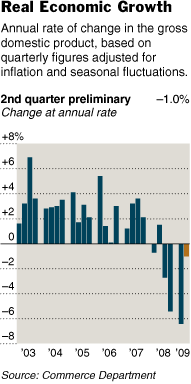 The U.S. economy still shrank in second quarter 2009 but at a much lower pace than was anticipated. That’s a pretty good indicator that the bottom or trough of The Great Recession may be near. Here’s the precise release from the Bureau of Economic Analysis (BEA).
Real gross domestic product — the output of goods and services produced by labor and property located in the United States — decreased at an annual rate of 1.0 percent in the second quarter of 2009, (that is, from the first quarter to the second), according to the “advance” estimate released by the Bureau of Economic Analysis. In the first quarter, real GDP decreased 6.4 percent.
While the many recent indicators show the recession is loosing some of its downward momentum, there are few economists ready to sing Happy Days are Here Again. The NYT’s coverage of the statistical release continues to bring up some of the same concerns we’ve discussed here before.
The economy’s long, churning decline leveled off significantly in the second quarter, as stock markets started to recover, corporate profits bounced back, housing markets stabilized and the rampant pace of job losses tapered off. Declines in business investment leveled off, and the economy was aided by big increases in government spending at the federal, state and local levels.
“We’re in a deep hole, and now we’ve got to dig ourselves out of it, which is a very difficult task,” Diane Swonk, chief economist at Mesirow Financial, said.
But consumer spending fell by 1.2 percent as Americans put more than 5 percent of their disposable income into savings. Economists are concerned that consumer spending, which makes up 70 percent of the economy, will not rebound as long as employers keep cutting jobs and trimming wages.

 peej
peej Carissa
 bostonboomer
 dakinikat
 ecocatwoman
 mablue2
 Mama Lopez
 peggysue22
 quixote
 skydancingguestblogger
 Mona (aka Wonk the Vote)



 Sky Dancing
Recent Comments