
Thursday Reads
Posted: June 14, 2012 Filed under: 2012 presidential campaign, Banksters, child sexual abuse, children, Crime, morning reads, U.S. Politics | Tags: Barack Obama, Bob Shieffer, Catholic Church, Dodd-Frank bill, Face the Nation, first responders, Florida voter purge, Forest boy, Fox News, Grover Norquist, J.P. Morgan, Jamie Dimon, Jeb Bush, Jerry Sandusky, Marco Rubio, Mitt Romney, pedophiles, public employees, Senate, stimulus, teachers 28 Comments
Good Morning!
Wall Street Royal Jamie Dimon deigned to appear before a Senate Committee yesterday, and the Senators mostly sucked up to him. I’m surprised they didn’t ask if he needed a pillow for his chair. MSNBC: Senate treats JPMorgan CEO Dimon with kid gloves
Dimon was expected to receive a frosty reception in his first congressional appearance since he announced the bank sustained a trading loss some analysts now estimate is at least $3 billion. It was a massive loss for the nation’s biggest financial institution.
Instead, Dimon, who has won praise for bringing JPMorgan (JPM) through the financial crisis relatively unscathed, was treated cordially by most of members of the Senate Banking Committee. They peppered him with questions about regulation and risky practices at the bank, but did not press him to give an update on the losses resulting from the trade. JPMorgan is expected to give an update to shareholders when it reports its second-quarter earnings July 13.
“I think it was a pretty favorable day,” David Konrad, a Keefe, Bruyette & Woods banking analyst, told CNBC. Konrad said he was surprised that the questioning of Dimon by lawmakers was so “professional.”
Excuse me, “professional” for a Senator would have been sending this man to the woodshed. NPR’s Marketplace called the treatment of Dimon “a wake for Dodd-Frank.”
Yahoo has named the winner of the “Most Tepid Endorsement of Mitt Romney” contest: it’s a bumper sticker that reads “At least he’s not a communist.”
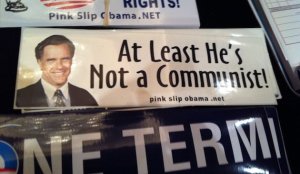
Until recently, it appeared that no one could unseat Indiana Gov. Mitch Daniels as the champion of the tepid Romney endorsement. Since Yahoo News started conducting reader polls on the politicians who supported Mitt Romney in the least enthusiastic terms, Daniels has defeated original champ George Pataki and defended the crown against Newt Gingrich, Rick Santorum and George W. Bush. (The former president came the closest to unseating Daniels.)
We thought the book was closed on the tepid endorsement bracket until Yahoo News reporter Chris Moody spotted a bumper sticker at last weekend’s regional CPAC conference in Chicago bearing these words of praise: “At least he’s not a communist.”
You can read the other tepid endorsements at the link.
First Romney made fun of Obama for wanting to help cities and states pay for cops, teachers, and firefighters. Then he went on Fox News and said it was a “strange accusation” for anyone to say he didn’t want to hire teachers and first responders.
After an extended skewering of President Obama for a gaffe about the private sector last week, ending with the charge that it was proof the president was “out of touch” Romney was asked by Fox and Friends’ Brian Kilmeade for his response to Obama saying it was Romney who was clueless (Romney’s comment comes at about the 1:40 mark) :
[BRIAN] KILMEADE: He says that you’re out of touch. He says you want to cut firefighters and teachers, that you don’t understand what’s going on in these communities. What do you say to that, Governor?
ROMNEY: Well, that’s a very strange accusation. Of course, teachers and firemen and policemen are hired at the local level and also by states. The federal government doesn’t pay for teachers, firefighters or policemen. So, obviously that’s completely absurd.
But of course the federal government does subsidize states and they often use the money to pay for these public employees. In fact, the reason so many teachers, firefighters and cops are getting laid off now is because stimulus money has run out.
Yesterday Greg Sargent pointed out that Romney’s plan would indeed cut billions from cops, firefighters and teachers
Yesterday Mitt Romney claimed that it was “ completely absurd” of the Obama campaign to argue that he favors cutbacks in cops, firefighters and teachers. “The federal government doesn’t pay for teachers, firefighters or policemen,” Romney said, adding that they were paid by states and localities.
What’s getting lost in the back and forth here is that Romney’s actual economic plan would, in fact, cut billions of dollars in federal money that goes to cops, firefighters, and teachers — perhaps more than $10 billion a year, in fact.
This is the conclusion of the Center on Budget and Policy Priorities, which analyzed Romney’s plan through the prism of the debate over public workers at my request.
As Michael McAuliff reported yesterday, despite Romney’s claim, the federal government does give billions of dollars to states and localities through programs like Title 1, the COPS program, FEMA and others — which pay for first responders and teachers.
This is amazing. Romney finally broke down and decided to talk to a media source that isn’t Fox News! He will be on Face The Nation on Sunday morning.
A full year into his presidential campaign, presumptive Republican nominee Mitt Romney will venture out of his Fox comfort zone this Sunday to make his first appearance on a rival network’s political talk show.
Romney has been interviewed several times on ”Fox News Sunday” this campaign cycle, but has declined repeated invitations to appear on any of the other Sunday shows, occasionally drawing scorn from veteran anchors accustomed to interviewing presidential candidates.
Let’s hope Shieffer asks a few tough questions. One thing Shieffer will probably ask about is Romney’s choice of Vice President. One of the leading contenders, Marco Rubio, announced yesterday that he supports the illegal Florida voter purge.
“How can you argue against a state identifying people who are not rightfully on the voter rolls?” he said at a Bloomberg event, according to the Tampa Bay Times.
Rubio’s comments put him in line with Florida Gov. Rick Scott (R) who on Tuesday declared the debate on the merits of the purge “over,” because the probe had supposedly turned up more than 50 non-citizen voters who had cast ballots.
The Department of Justice didn’t agree. Later Tuesday, it announced it was launching a federal lawsuit against Florida over complaints that the purge was taking place within 90 days of its August 14 primary election, as well as over its alleged violation of a voting rights law meant to prevent states from suppressing voters.
That might not help Romney win over Latino voters.
John Avlon has a piece at CNN on Jeb Bush and other “moderate” Republicans who are starting to fight back against Grover Norquist:
This is what happens when politics starts looking like a cult: Jeb Bush gets attacked for being a traitor to the conservative cause.
The former Florida governor has been speaking with the freedom of someone not running for office, saying that both his father and Ronald Reagan would have had a hard time in today’s hard-right GOP and questioning the wisdom of Grover Norquist’s absolutist anti-tax pledge.
That set off a fascinating public fight between Bush and Norquist, two faces of competing factions within Republican Party. It is the latest evidence of a growing GOP backlash against the ideological straitjacket Norquist has attempted to impose on governing in the United States.
And Jeb is not alone.
As it turns out, Norquist has reason to be concerned. It’s not just Jeb Bush. A growing number of Republicans are rejecting his pledge. Oklahoma conservative Sen. Tom Coburn called the pledge’s effective veto of deficit reduction plans “ridiculous” when talking with Erin Burnett on “OutFront.”
Sen. Lindsey Graham of South Carolina on Tuesday declared his independence from the pledge, saying, “We’re so far in debt, that if you don’t give up some ideological ground, the country sinks.”
Add to those voices seven other Republican U.S. senators — from Maine’s Susan Collins to Iowa’s Chuck Grassley to Wyoming’s John Barrasso — and 11 Republican House members, ranging from centrist New Yorker Richard Hanna to tea party Floridian Allen West.
In pedophile news, Jerry Sandusky had another bad day in court yesterday with three victims testifying that he manipulated and threatened them into putting up with his sick sexual behavior.
The trio of young men who testified against Jerry Sandusky on the third day of his sexual-abuse trial couldn’t have been more different in personality and temperament. Yet each of their testimonies was sexually graphic and disturbing—and midway through the prosecution’s fast-tracked arguments, a clear pattern has emerged in their allegations.
I’m not going to quote all of the sordid details–there are too many of them anyway. You can read it all at the link. I’ll just give you one excerpt that shows what Sandusky is all about:
Then, the witness told the jury of a time he visited the Sandusky home.
“We were in the basement. We were wrestling,” he said in a monotone frequently heard from abuse victims who have had to tell their stories multiple times. “The defendant pinned me to the floor, pulled down my gym shorts, and started to perform oral sex on me.” Asked by prosecutor Joe McGettigan what his reaction was at the time, the witness said, “I freaked out.”
“Did he ever say anything to you about it?” McGettigan asked.
“He told me if I ever told anyone I’d never see my family again,” the young man replied. “Later he apologized and said he didn’t mean it, that he loved me.”
I hope Sandusky goes to prison for life, and I want to see prosecutions of his enablers at Penn State. It’s an outrage that he was allowed to go on abusing children for years after many at the school knew about his behavior.
And then there’s the Catholic Church: U.S. Catholics still suspect priests sexually abuse children: Report
The National Review Board said that, a decade after the US Conference of Catholic Bishops issued a child protection charter, there has been a “striking improvement” in the way the Church deals with the abuse of minors by clergy.
“Children are safer now because of the creation of safe environments, and action has been taken to permanently remove offenders from ministry,” said the report, released as the Conference began its annual spring meeting in Atlanta.
But it acknowledged: “Despite solid evidence (to the contrary), many of the faithful believe that sexual abuse by clergy is occurring at high levels and is still being covered up by bishops.”
Well, what did they expect? I’m certainly not surprised. In fact I’d be surprised if there aren’t still pedophile priests abusing children.

Forest boy
I’ll end with the strange story of “Forest Boy.”
Berlin police on Wednesday released photos an English-speaking teenage boy who wandered into the city nine months ago saying he had been living for the last five years in the forest with his father.
Police spokesman Thomas Neuendorf said all attempts to identify the boy since he emerged in the German capital on Sept. 5 have been unsuccessful, and they are now hoping the release of his photo may produce some leads.“We have checked his DNA against all missing person reports, sent the data to Interpol so that they could check it internationally, but unfortunately without any success,” Neuendorf said.
The boy has told authorities his father called him “Ray” and that he was born June 20, 1994, but claims not to know his last name or where he’s from.He said his mother, Doreen, died in a car accident when he was 12 and after that he and his father, Ryan, took to the forest. He said they wandered using maps and a compass, staying in tents or caves overnight.
He told authorities that after his father died in August, 2011, he buried him in the forest and then walked five days north before ending up in Berlin, and showed up at city hall.
As of last night, the identity of the boy was still a mystery even after release of the photos.
What’s on your reading and blogging list today?
Thursday Reads: Romney’s Lies, Debt Ceiling Showdown, and Dimonfreude
Posted: May 17, 2012 Filed under: Barack Obama, Corporate Crime, corporate greed, Economy, House of Representatives, Mitt Romney, morning reads, Surreality, The Media SUCKS, U.S. Economy, U.S. Politics, unemployment, voodoo economics, Voter Ignorance | Tags: Bill Clinton, Bill Moyers, economics, J.P. Morgan, Jamie Dimon, Mary Kennedy, Peter G. Peterson, Robert F. Kennedy Jr., Romney's lies, Simon Johnson 22 Comments
Good Morning!
On Tuesday night I wrote a brief post about the bizarre speech Mitt Romney gave in Des Moines, Iowa earlier that day. I was struck by Romney’s childish effort to get at President Obama by talking about Bill Clinton’s economic policies and claiming that Obama must have ignored those policies because he has some kind of grudge against both Clintons. It was so strange and off key that I thought Romney sounded like a crotchety old busybody gossiping over the backyard fence.
I didn’t really even go into the many baldfaced lies Romney told in the speech–I guess I’ve become so accustomed to his total refusal to confine himself to reality as it is that I almost don’t notice it anymore. Basically, Romney attacked Obama the deficit that was primarily created by Bush, and made his usual claims that he (Romney) will be able to cut taxes by 20 percent, increase defense spending, and at the same time magically balance the budget and dramatically reduce unemployment. Only a moron would buy what he’s selling.
Yesterday, a number of bloggers commented on that speech, so I thought I’d share some of those reactions in this morning’s reads.
Steve Benen at Maddowblog: A peek into an alternate reality.
Mitt Romney delivered a curious speech in Iowa yesterday, presenting his thoughts on the budget deficit, the debt and debt reduction, which is worth reading if you missed it. We often talk about the problem of the left and right working from entirely different sets of facts, and how the discourse breaks down when there’s no shared foundation of reality, and the Republican’s remarks offered a timely peek into an alternate reality where facts have no meaning.
Even the topic itself is a strange choice for Romney. If the former governor is elected, he’ll inherit a $1 trillion deficit and a $15 [trillion] debt, which he’ll respond to by approving massive new tax cuts and increasing Pentagon spending. How will he pay for this? No one has the foggiest idea.
In other words, the guy who intends to add trillions to the debt gave a speech yesterday on the dangers of adding trillions to the debt.
Benen says he doesn’t believe Romney is “stupid,” but he must be “operating from the assumption that voters are stupid.” I’d say that’s true. I think Romney believes that he’s much smarter and more worthy than just about anyone and that poor and middle-class people are beneath contempt.
Jonathan Cohn at The New Republic: Romney’s Make-Believe Story on the Economy. Cohn writes about Romney’s claims that Obama’s failure to reduce the deficit is the cause of the “tepid recovery,” unemployment, and the struggles of seniors to get by on fixed incomes.
Note the way Romney establishes cause and effect here: Obama’s contribution to higher deficits are the reason more people can’t get work and more seniors can’t make ends meet right now. This is an audacious claim and, while I’m no economist, I’m pretty sure it places Romney on the outer edges of the debate among mainstream scholars.
I know of serious conservatives who think the Recovery Act, which has increased deficits temporarily, didn’t ultimately do much to create jobs in the near term. And I know of serious conservatives who think that creating jobs now wasn’t worth the long-term downside of adding to the federal debt, however incrementally. Both viewpoints seem to represent minority views, if a recent University of Chicago survey of leading economists is indicative. But the arguments have at least some logic to them.
But Romney’s suggestion that unemployment today is a consequence of Obama’s contribution to the deficit (real or imagined) requires further leaps of logic. You’d have to argue, for example, that extensions of unemployment benefits have reduced incentives to work (despite research to the contrary) and that such negative effects substantially outweigh the positive effects of traditional stimulus measures. It’s not impossible to make this case. I think Casey Mulligan, also of the University of Chicago, has written things along these lines for the New York Times. But, unless I’m missing something, that argument is even more marginal than suggestions the Recovery Act didn’t help at all.
I suspect that even Cohn’s effort to make sense of Romney’s fantasy economic theory will have Dr. Dakinikat pulling her hair out.
Jonathan Chait at New York Magazine: Romney’s Budget Fairy Tale.
In the real world, the following things are true: The budget deficit was projected to top $1 trillion even before President Obama took office, and that was when forecasters were still radically underestimating the depth of the 2008 crash. Obama did propose temporary deficit-increasing measures, an economic approach endorsed in its general contours, if not its particulars, by Romney’s economists. These measures contributed a relatively small proportion to the deficit, and their effect is short-lived. Obama instead focused on longer-term measures to reduce the deficit, including comprehensive health-care reform projected to reduce deficits by a trillion dollars in its second decade. Obama put forward a budget plan that would stabilize the debt as a percentage of the economy. Obama has hoped to achieve deeper long-term deficit reduction by striking bipartisan deals with Congress, and he has tried to achieve this goal by openly endorsing a bipartisan deficit plan in the Senate and privately agreeing to a more conservative plan with John Boehner, both of which were killed by Republican opposition to any higher revenue.
But Romney doesn’t seem to live in the real world, and Chait suggests that Romney either doesn’t understand how deficits work or doesn’t care if what he says makes any sense at all.
In Romney’s telling, the terms debt and spending are essentially interchangeable. When presented with Obama’s position — that the solution to the debt ought to include both higher taxes and lower spending — he rejects it out of hand. Naturally, Romney has admitted before that his budget plan “can’t be scored.” It’s an expression of conservative moral beliefs about the role of government. While loosely couched in budgetary terms, Romney is expressing an analysis that resides outside of, and completely at odds with, mainstream macroeconomic forecasting and scoring assumptions.
At the Plum Line, Greg Sargent discusses How Mitt Romney gets away with his lying.
If you scan through all the media attention Romney’s speech received, you are hard-pressed to find any news accounts that tell readers the following rather relevant points:
1) Nonpartisan experts believe Romney’s plans would increase the deficit far more than Obama’s would.
2) George W. Bush’s policies arguably are more responsible for increasing the deficit than Obama’s are.
Oh, sure, many of the news accounts contain the Obama campaign’s response to Romney’s speech; the Obama campaign put out a widely-reprinted statement arguing that Romney’s plans would increase the deficit and that he’d return to policies that created it in the first place.
But this shouldn’t be a matter of partisan opinion. On the first point, independent experts think an actual set of facts exists that can be used to determine what the impact of Romney’s policies on the deficit would be. And according to those experts, based on what we know now, Romney’s policies would explode the deficit far more than Obama’s would.
Obviously, the problem is the obsequious corporate media. But the Romney campaign makes it impossible for even the few remaining serious reporters to question his policies by keeping the candidate completely insulated from the press except for occasional appearances on Fox News and lightweight network morning shows like Good Morning America. Yesterday, Politico reprinted tweets from several reporters who were “physically” blocked from talking to Romney on a rope line.
Speaking of Republican ignorance of basic economics, House Republicans are gearing up for another pitched battle on increasing the debt ceiling. Speaker John Boehner met with President Obama at the White House today and they “clash[ed] over” increasing the debt limit, according to The Hill.
The president convened the meeting of the bipartisan congressional leadership to discuss his “to-do list” for Congress, but an aide to the Speaker said the bulk of the meeting was spent on other issues, including a pile-up of expiring tax provisions and the next increase in the federal debt limit.
Boehner asked Obama if he was proposing that Congress increase the debt limit without corresponding spending cuts, according to a readout of the meeting from the Speaker’s office. The president replied, “Yes.” At that point, Boehner told Obama, “As long as I’m around here, I’m not going to allow a debt-ceiling increase without doing something serious about the debt.”
Shortly after the meeting, White House press secretary Jay Carney told reporters that the president warned the leadership that he would not allow a repeat of last August’s debt-ceiling “debacle,” which led to a downgrade in the U.S. credit rating.
Sigh……
In a related story, there’s this piece at Wonkblog about the Pete Peterson summit and how Democrats talked long-windedly about cutting “entitlements,” and Republican refused to talk about tax increases. Read it and weep. I’m not even going to quote from it, because it’s too damn depressing.
So far Jamie Dimon seems to have survived the $2 billion loss recently suffered by J.P. Morgan.
The CEO of JPMorgan Chase survived a shareholder push Tuesday to strip him of the title of chairman of the board, five days after he disclosed a $2 billion trading loss by the bank.
CEO Jamie Dimon also won a shareholder endorsement of his pay package from last year, which totaled $23 million, according to an Associated Press analysis of regulatory filings.
Dimon, unusually subdued, told shareholders at the JPMorgan annual meeting that the company’s mistakes were “self-inflicted.” Speaking with reporters later, he added: “The buck always stops with me.”
Yeah, right. The buck will stop with the taxpayers if Dimon’s bank ultimately crashes and burns. Bill Moyers asked economist Simon Johnson about that.
Moyers: I was just looking at an interview I did with you in February of 2009, soon after the collapse of 2008 and you said, and I’m quoting, “The signs that I see… the body language, the words, the op-eds, the testimony, the way these bankers are treated by certain congressional committees, it makes me feel very worried. I have a feeling in my stomach that is what I had in other countries, much poorer countries, countries that were headed into really difficult economic situations. When there’s a small group of people who got you into a disaster and who are still powerful, you know you need to come in and break that power and you can’t. You’re stuck.” How do you feel about that insight now?
Johnson: I’m still nervous, and I think that the losses that JPMorgan reported — that CEO Jamie Dimon reported — and the way in which they’re presented, the fact that they’re surprised by it and the fact that they didn’t know they were taking these kinds of risks, the fact that they lost so much money in a relatively benign moment compared to what we’ve seen in the past and what we’re likely to see in the future — all of this suggests that we are absolutely on the path towards another financial crisis of the same order of magnitude as the last one.
A number of shareholders have sued Dimon over the losses, according to Bloomberg (via the SF Chroncle). And of course lots of people are gloating over Dimon’s getting temporarily knocked off his pedestal. Jena McGregor writes in the WaPo:
It’s being called Dimonfreude.
There are barely disguised smirks emanating from the canyons of Wall Street and the business press over the fact that Jamie Dimon has had to admit a mistake — and a whale of one, for that matter.
For years, the JPMorgan CEO (and America’s least-hated banker, as he was known) has worn a halo over those pinstripes. Dimon has been called President Obama’s “favorite banker”. Institutional Investor magazine has called him the country’s best CEO for two years running. And his actions during the financial crisis have been painted in patriotic terms: Press reports said he “answered the call” from then-FDIC chairman Sheila Bair to buy Washington Mutual, one of two banks he scooped up during the financial meltdown, and he has cited a patriotic duty to a country in crisis as why he took in $25 billion in government aid.
Yet now, Dimon is in the hot seat as JPMorgan confronts a $2 billion trading loss and the early stages of a criminal probe by the Justice Department.
Finally, some sad news: Estranged Wife of Robert F. Kennedy Jr. Is Found Dead at Home in Westchester
Mary R. Kennedy, the estranged wife of Robert F. Kennedy Jr., was found dead on Wednesday at the family’s home in Bedford, N.Y. She was 52.
Ms. Kennedy’s death was confirmed in a statement from her family, who did not comment on the circumstances. The Bedford Police Department said only that it had investigated a “possible unattended death” in an outbuilding at the home.
Her lawyer, Kerry A. Lawrence, would not say whether foul play was suspected. Kieran O’Leary, a spokesman for Westchester County, said an autopsy was scheduled for Thursday morning.
Born Mary Richardson, Ms. Kennedy joined one of America’s foremost political families in 1994, in a marriage ceremony aboard a boat on the Hudson River, near Stony Point, N.Y. At the time, she was an architectural designer at Parish-Hadley Associates in New York.
Those are my suggested reads for today. What are you reading and blogging about?

 peej
peej Carissa
 bostonboomer
 dakinikat
 ecocatwoman
 mablue2
 Mama Lopez
 peggysue22
 quixote
 skydancingguestblogger
 Mona (aka Wonk the Vote)



 Sky Dancing
Recent Comments