
Mostly Monday Reads: Celebrate Indigenous People’s Day!
Posted: October 9, 2023 Filed under: Foreign Affairs, U.S. Politics | Tags: America's Racist past, and future, Indigenous People's Day, present, Russia to break Nuclear Weapons Treaty 10 Comments Good Day, Sky Dancers!
Today is the day we officially celebrate Indigenous Americans Day! President Joe Biden issued a proclamation this morning.
On Indigenous Peoples’ Day, we honor the perseverance and courage of Indigenous peoples, show our gratitude for the myriad contributions they have made to our world, and renew our commitment to respect Tribal sovereignty and self-determination.
The story of America’s Indigenous peoples is a story of their resilience and survival; of their persistent commitment to their right to self-governance; and of their determination to preserve cultures, identities, and ways of life. Long before European explorers sailed to this continent, Native American and Alaska Native Nations made this land their home, some for thousands of years before the United States was founded. They built many Nations that created powerful, prosperous, and diverse cultures, and they developed knowledge and practices that still benefit us today.
But throughout our Nation’s history, Indigenous peoples have faced violence and devastation that has tested their limits. For generations, it was the shameful policy of our Nation to remove Indigenous peoples from their homelands; force them to assimilate; and ban them from speaking their own languages, passing down ancient traditions, and performing sacred ceremonies. Countless lives were lost, precious lands were taken, and their way of life was forever changed. In spite of unimaginable loss and seemingly insurmountable odds, Indigenous peoples have persisted. They survived. And they continue to be an integral part of the fabric of the United States.
Today, Indigenous peoples are a beacon of resilience, strength, and perseverance as well as a source of incredible contributions. Indigenous peoples and Tribal Nations continue to practice their cultures, remember their heritages, and pass down their histories from generation to generation. They steward this country’s lands and waters and grow crops that feed all of us. They serve in the United States military at a higher rate than any other ethnic group. They challenge all of us to celebrate the good, confront the bad, and tell the whole truth of our history. And as innovators, educators, engineers, scientists, artists, and leaders in every sector of society, Indigenous peoples contribute to our shared prosperity. Their diverse cultures and communities today are a testament to the unshakable and unbreakable commitment of many generations to preserve their cultures, identities, and rights to self-governance. That is why, despite centuries of devastation and turmoil, Tribal Nations continue to thrive and lead in countless ways.
 South Dakota was the first state to recognize Indigenous Americans Day starting in 1990. As U.S. News and World Report reminds us, Colonizer and Mass Murderer Christopher Colombus never set foot on what is now US soil. His legacy is one of mass rape, enslavement, and slaughter. It is offensive to still have this day recognized as a Federal Holiday.
For many Indigenous peoples, Columbus Day is a controversial holiday. This is because Columbus is viewed not as a discoverer, but rather a
a colonizer. His arrival led to the forceful taking of land and set the stage for widespread death and loss of Indigenous ways of life.When did Indigenous Peoples Day come about?
In 1990, South Dakota – currently the state with the third-largest population of Native Americans in the U.S. – became the first state to officially recognize Native Americans’ Day, commonly referred to as Indigenous Peoples Day in other parts of the country.
More than a dozen states and the District of Columbia now recognize Indigenous Peoples Day. Those states include Alabama, Alaska, Hawaii, Idaho, Iowa, Louisiana, Maine, Michigan, Minnesota, New Mexico, North Carolina, Oklahoma, Oregon, South Dakota, Vermont, Virginia and Wisconsin.
How does Indigenous Peoples Day change things?
Indigenous Peoples Day offers an opportunity for educators to rethink how they teach what some have characterized as a “sanitized” story of the arrival of Columbus. This version omits or downplays the devastating impact of Columbus’ arrival on Indigenous peoples. Indigenous Peoples Day is an opportunity to reconcile tensions between these two perspectives.
Research has shown that many schools do not accurately represent Indigenous peoples when they teach history. I think this is true not only on Indigenous Peoples Day, but throughout the school year. Researchers have found that K-12 schools tend to teach about Native Americans as if they existed only in the past. By revising the curriculum to better reflect both past and current histories and stories of Native peoples, educators can more accurately teach students about their cultures, histories and traditions.
Thomas Jefferson was the first US President to establish a policy to interact with Tribal nations. This is from the folks who preserve and run Monticello. If you read President Biden’s policies, you’ll be able to see the differences in policies. The various Nations had differences of opinion on Jefferson’s policy.
It was as President of the United States that Thomas Jefferson had the greatest impact on the Indian nations of North America. He pursued an Indian policy that had two main ends. First, Jefferson wanted to guarantee the security of the United States and so sought to bind Indian nations to the United States through treaties. The aim of these treaties was to acquire land and facilitate trade, but most importantly to keep them allied with the United States and not with European powers, namely England in Canada and Spain in the regions of Florida, the Gulf Coast and lands west of the Mississippi River.
Secondly, Jefferson used the networks created by the treaties to further the program of gradual “civilization.” His Federalists predecessors had begun this program, but it was completely in keeping with Jefferson’s Enlightenment thinking. Through treaties and commerce, Jefferson hoped to continue to get Native Americans to adopt European agricultural practices, shift to a sedentary way of life, and free up hunting grounds for further white settlement.
The desire for land raised the stakes of the “civilization program.” Jefferson told his agents never to coerce Indian nations to sell lands. The lands were theirs as long as they wished, but he hoped to accelerate the process. In a letter to William Henry Harrison, written as the diplomatic crisis leading to the Louisiana Purchase unfolded, Jefferson suggested that if the various Indian nations could be encouraged to purchase goods on credit, they would likely fall into debt, which they could relieve through the sale of lands to the government. The “civilization program” would thus aid the Indians in accordance with Enlightenment principles and at the same time further white interests.
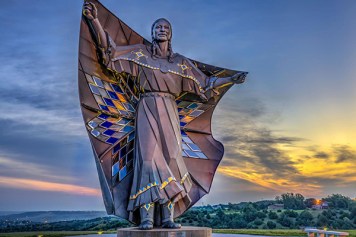 I was born on the Cherokee Strip in Oklahoma, and my earliest experiences were with the Lakota and Kickapoo tribes. My mother always ensured we went to all the Pow Wows around the area and learned as much as possible about Indigenous History. This included the Trial of Tears, the terrible legacy of President Andrew Jackson, and The Removal Act of 1830. This established everything to the east of the Mississippi as land to be taken from Native Tribes in return for land West of the Mississippi. The Cherokee nation resisted his efforts, and the tragedy of the Trial of Tears resulted. We mustn’t let politicians like DeSantis whitewash these tragedies or remove them from our history books.
The Trail of Tears (Robert Lindneux, 1942)
The Cherokee Nation resisted, however, challenging in court the Georgia laws that restricted their freedoms on tribal lands. In his 1831 ruling on Cherokee Nation v. the State of Georgia, Chief Justice John Marshall declared that “the Indian territory is admitted to compose a part of the United States,” and affirmed that the tribes were “domestic dependent nations” and “their relation to the United States resembles that of a ward to his guardian.” However, the following year the Supreme Court reversed itself and ruled that Indian tribes were indeed sovereign and immune from Georgia laws. President Jackson nonetheless refused to heed the Court’s decision. He obtained the signature of a Cherokee chief agreeing to relocation in the Treaty of New Echota, which Congress ratified against the protests of Daniel Webster and Henry Clay in 1835. The Cherokee signing party represented only a faction of the Cherokee, and the majority followed Principal Chief John Ross in a desperate attempt to hold onto their land. This attempt faltered in 1838, when, under the guns of federal troops and Georgia state militia, the Cherokee tribe were forced to the dry plains across the Mississippi. The best evidence indicates that between three and four thousand out of the fifteen to sixteen thousand Cherokees died en route from the brutal conditions of the “Trail of Tears.”
With the exception of a small number of Seminoles still resisting removal in Florida, by the 1840s, from the Atlantic to the Mississippi, no Indian tribes resided in the American South. Through a combination of coerced treaties and the contravention of treaties and judicial determination, the United States Government succeeded in paving the way for the westward expansion and the incorporation of new territories as part of the United States.
 Today’s news is disturbing. Two U.S. congressmen returned to Washington after the massive and deadly attacks on Israel. This is from Politico. “At least 2 members of Congress were in Israel during the attack. “Both Rep. Dan Goldman and Sen. Cory Booker have left the country, their offices say.” They can share first-hand experience as the Biden administration and what’s left of the functional parts of the U.S. Congress decide on possible responses.
Both Rep. Dan Goldman (D-N.Y.), and Sen. Cory Booker (D-N.J.) were in Israel over the weekend while extremist group Hamas launched an unprecedented attack at the country’s border with Gaza. Both congressmen have since left the country, according to their offices.
Goldman was in Israel for a Bar Mitzvah with his wife and three of his children, his spokesperson, Simone Kanter, said. “Congressman Goldman and his family sheltered from Hamas rocket fire in their hotel’s interior stairwell until early Sunday morning, when they were able to safely depart for New York,” Kanter said in a statement.
Booker arrived in Israel on Friday, according to his office, ahead of a summit on the Abraham Accords at which he was scheduled to speak Tuesday.
“Senator Booker and accompanying staff were in Jerusalem when Hamas launched their attacks against Israel on Saturday, and sheltered in place for their safety,” spokesperson Maya Krishna-Rogers said in a statement. “We are grateful that Senator Booker and our colleagues were able to safely depart Israel earlier today.”
The Saturday morning assault blindsided Israeli forces, leaving hundreds dead, wounded and kidnapped, including many civilians. Both congressmen took to social media to condemn Hamas’ actions and offer their support for Israel in the hours and days after the attack.
“At a minimum, Congress must replenish — and expand — the Iron Dome as soon as possible,” Goldman posted on X, formerly Twitter, early Sunday morning, referring to Israel’s defense system against rockets. “I hope Republicans can get their House in order so we can pass emergency legislation to assist Israel in defending herself.”
 The Israeli newspaper Haaretz posted this Op-Ed in response. “Netanyahu Bears Responsibility for This Israel-Gaza War.” Amazingly, we’re beginning to recognize the damage of our Colonial roots–including the huge white right-wing backlash–while Israel continues to put its Palestinian population in what’s been described as a “prison.” It is also unamazing that many white people are upset to lose their fairy tale versions of American history.
The disaster that befell Israel on the holiday of Simchat Torah is the clear responsibility of one person: Benjamin Netanyahu. The prime minister, who has prided himself on his vast political experience and irreplaceable wisdom in security matters, completely failed to identify the dangers he was consciously leading Israel into when establishing a government of annexation and dispossession, when appointing Bezalel Smotrich and Itamar Ben-Gvir to key positions, while embracing a foreign policy that openly ignored the existence and rights of Palestinians.
Netanyahu will certainly try to evade his responsibility and cast the blame on the heads of the army, Military Intelligence and the Shin Bet security service who, like their predecessors on the eve of the Yom Kippur War, saw a low probability of war with their preparations for a Hamas attack proving flawed.
They scorned the enemy and its offensive military capabilities. Over the next days and weeks, when the depth of Israel Defense Forces and intelligence failures come to light, a justified demand to replace them and take stock will surely arise.
- Netanyahu’s government is responsible for the ’23 Israel-Gaza debacle
- October 7, 2023: A date that will live in infamy in Israel
- Netanyahu: First goal is to purge Israel from enemies, then exact huge price
However, the military and intelligence failure does not absolve Netanyahu of his overall responsibility for the crisis, as he is the ultimate arbiter of Israeli foreign and security affairs. Netanyahu is no novice in this role, like Ehud Olmert was in the Second Lebanon War. Nor is he ignorant in military matters, as Golda Meir in 1973 and Menachem Begin in 1982 claimed to be.

Another frightening bit of global war news comes from Putin. This is from the Guardian. “Russia will revoke ratification of nuclear test ban treaty, envoy says’. The US condemns announcement by Mikhail Ulyanov, saying it ‘needlessly endangers the global norm’ against nuclear testing.”
A senior Russian diplomat has said that Moscow will revoke its ratification of the Comprehensive Nuclear Test Ban Treaty (CTBT), in a move Washington denounced as jeopardising the “global norm” against nuclear test blasts.
Mikhail Ulyanov, the Russian representative to the international nuclear agencies in Vienna, was speaking after Vladimir Putin suggested Moscow might resuming testing for the first time in 33 years, signalling another downward turn in relations between the world’s two biggest nuclear powers
Ulyanov said on X, formerly known as Twitter: “Russia plans to revoke ratification (which took place in the year 2000) of the Comprehensive Nuclear-Test-Ban Treaty.
“The aim is to be on equal footing with the #US who signed the Treaty, but didn’t ratify it. Revocation doesn’t mean the intention to resume nuclear tests.”
 Reuters has this “Analysis: Russian nuclear test would send warning signal, prompt others to follow suit.”
Russia may be paving the way to conduct a nuclear test, a move that would sharply raise tensions with the West and likely prompt other world powers to resume testing for the first time this century.
President Vladimir Putin last week said Russia’s parliament should consider withdrawing Moscow’s ratification of the 1996 Comprehensive Test Ban Treaty (CTBT) which prohibits tests involving nuclear explosions. Parliamentary leaders were due to discuss the issue on Monday.
Some Western security analysts now see a growing likelihood of a Russian test, even though Putin said the aim was only to mirror the position of the United States, which has signed but not ratified the treaty.
“A Russian nuclear test is clearly very much on the cards now. I don’t think it’s a certainty, but it shouldn’t surprise anybody if that happens,” said James Acton, co-director of the nuclear policy program at the Carnegie Endowment for International Peace.
Matthew Harries, director of proliferation and nuclear policy at the RUSI think-tank in London, said cancelling Russia’s ratification would create a “legal and presentational framework for Russia to test if it wants to”.
If Moscow did conduct a test, he said, “it would be a strong form of signalling, to put the nuclear threat in people’s minds, to try to signal resolve and to evoke fear”.
Former Soviet and Russian diplomat Nikolai Sokov went further, saying a Russian nuclear test would mark a very serious escalation towards actually using an atomic weapon.
 Fascism is afoot in the world right now. We’re dealing with it here, and it’s depressing and tiring. Here’s a Politico article to help you understand the roots of ours. This fits our history. Notice this ruling comes quickly after the passage of Jackson’s Removal Act. “Authoritarianism Come From a 19th Century Supreme Court Ruling. In 1883, the Supreme Court refused to do away with racial segregation. And that’s helped set the stage for today’s massive resistance to multiracial power.” This is written by Sheryll Cashin.
A new Supreme Court term is upon us and voting rights and race consciousness continue to be contested. Last June, the court issued an opinion that ended race-based affirmative action in college admissions. But it also gave Black voters in Alabama a surprise win in the redistricting case of Allen v. Milligan. And now, with this current session, it will once again consider a redistricting case with strong racial ramifications.
Collectively, these cases have implications for the American slide toward autocracy.
Across America, each decennial census brings the ritual of redrawing Congressional districts to adjust to population changes. Currently in five states — Alabama, Georgia, Florida, Louisiana, and South Carolina — courts are dealing with claims that GOP-dominated legislatures illegally diminished Black voters’ power when they redrew districts to maximize Republican dominance.
In Alabama, the lower court in the Milligan case just approved a new map developed by an independent expert that will likely enable Black Alabamians to choose a second member of Congress in 2024. Alabama Attorney General Steve Marshall, a Republican, says the state will continue to appeal. Ultimately, they hope to get the benefit of the Court’s affirmative action decision and strike down the remedies of the Voting Rights Act as illegal race-consciousness under the Fourteenth Amendment.
These fights over redistricting could shift the balance of power in the House, where Republicans hold a razor-thin majority. In Florida, at the behest of Governor Ron DeSantis, the legislature carved up a district that had been represented by a Black Democrat and moved Black voters into surrounding majority-white districts, which helped Florida Republicans pick up four seats in the 2022 congressional elections. In other Deep South states, Republicans are trying to avoid creating new majority-minority congressional districts that would be competitive rather than locked-in for the GOP.
They claim that they should be able to move Black voters out of certain districts for partisan or other allegedly non-racial reasons — and not have the resulting political marginalization of Black voters be deemed illegal racial discrimination. But as William Faulkner once wrote, “All of us labor in webs spun long before.”
 I live less than a 1/2 mile from where Homer Plessy boarded the train. I’m also within blocks of the school segregated with the arrival of Ruby Bridges. I know her brother, Elton. The impact of slavery and Jim Crow never ends.
The Supreme Court was also hostile to Reconstruction. In 1883, in an 8-1 decision, it struck down the Civil Rights Act of 1875 which would have enabled Black citizens to use the same public spaces and facilities as white citizens. And in 1896, the court once again encouraged the proliferation of Jim Crow laws, this time with magical thinking, proclaiming in Plessy v. Ferguson that separate was absolutely equal.
Had the Court not blocked integration then, habits of supremacy and its attendant “segregation-forever” politics might have been broken long ago. Instead, white supremacy became the central organizing principle of southern politics for nearly a century and any southerner that disliked segregation suffered under one-party autocratic rule. In Alabama, as late as 1965, voters still encountered the Alabama Democratic Party’s long-held motto, “White Supremacy for the Right,” on the ballot in the voting booth.
No wonder the right wants to erase history while claiming the rest want to erase their ‘culture.’ It suits them for us to forget these things. However, our history is what it is. It’s never that far behind us. Here in Louisiana, we’re still waiting to see what redistricting will do to us.
Have a great week! Let’s put racism, nativism, and fascism behind us!
What’s on your reading and blogging list today?
Monday Morning Reads
Posted: October 10, 2011 Filed under: Global Financial Crisis, Marriage Equality, morning reads, Surreality, U.S. Military, U.S. Politics, unemployment, Women's Rights | Tags: Anita Hill, Crackerbox Palace, DOMA, George Harrison, Indigenous People's Day, National Coming Out Day, Native American Day, Occupy, Paul Krugman, plutocracy, Subprime mortgage crisis and the CRA, Taxes and poor people, technology, the Great Depression 25 Comments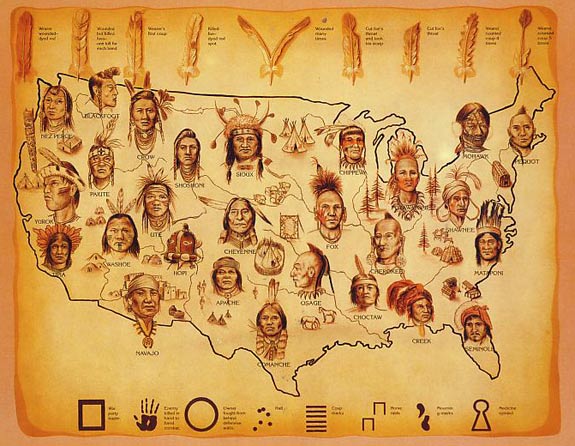 Good Morning!
and Happy Native Americans’ Day!
The second Monday of October annually marks Columbus Day in many parts the United States but not all states or region follow this observance. Instead, they celebrate other events on the day. For example, South Dakota’s official holiday on this date is Native Americans’ Day (also known as Native American Day), while people in Berkeley, California, celebrate Indigenous People’s Day.
 I think it’s a great idea to switch the current federal holiday out to a celebration of indigenous cultures or maybe find a better thing to celebrate!
BTW, National Coming Out Day is Tomorrow. That’s something to remember as you read that Speaker Boehner is threatening to withold funds from the Justice Department if that don’t vigorously enforce DOMA. There he goes again!!! The Republican Jobs Agenda is just always topmost on the priority list.
“We’re going to take the money away from the Justice Department, who’s supposed to enforce it, and we’ll use it to enforce the law,” Boehner told the conservative Value Voters Summit.
Boehner is engaged in an ongoing dispute with Attorney General Eric Holder over his refusal to defend in court the Defense of Marriage Act. President Obama has taken the stance that the law is unconstitutional. While the Justice Department usually defends laws passed by Congress against legal challenges, the Obama administration has stopped defending DOMA while Democrats work to repeal the law.
In March, Boehner announced that if Obama wouldn’t defend DOMA, he would, hiring a private law firm to defend it on behalf of the House.
“As the Speaker of the House, I have a constitutional responsibility. I’ve raised my hand to uphold and defend the Constitution of the United States and the laws of our country,” Boehner said Friday.
You know, he’s all about saving those taxpayer dollars too. True Story.
Here’s a movement I want to join if this California Republican Nutter would only give me the location where they’re taking on volunteers. And yes, it’s a REAL tweet.
@RepJackKimble After Value Voters I am more convinced than ever about the radical atheist agenda to secularize Columbus Day
Okay, I’d like to use the next bit of space to clear up a few right wing memes with actual research. I know, you’re shocked, it’s so unlike me to do so. First, while Fannie and Freddie exacerbated the meltdown and behaved as irresponsibly as any Wall Streeter, there is absolutely no connection between the meltdown and the Community Reinvestment Act. I have never been able to figure out how folks jumped the shark to make this connection, but it happened. I’ll give you the bottom line from the abstract but if you want to chase after the econometrics, feel free to follow the link.
In this paper we examine more directly whether these programs were associated with worse outcomes in the mortgage market, including delinquency rates and measures of loan quality.
We rely on two empirical approaches. In the first approach, which focuses on the CRA, we conjecture that historical legacies create significant variations in the lenders that serve otherwise comparable neighborhoods. Because not all lenders are subject to the CRA, this creates a quasi-natural experiment of the CRA’s effect. We test this conjecture by examining whether neighborhoods that have been disproportionally served by CRA-covered institutions historically experienced worse outcomes. The second approach takes advantage of the fact that both the CRA and GSE goals rely on clearly defined geographic areas to determine which loans are favored by the regulations. Using a regression discontinuity approach, our tests compare the marginal areas just above and below the thresholds that define eligibility, where any effect of the CRA or GSE goals should be clearest.
We find little evidence that either the CRA or the GSE goals played a significant role in the subprime crisis. Our lender tests indicate that areas disproportionately served by lenders covered by the CRA experienced lower delinquency rates and less risky lending. Similarly, the threshold tests show no evidence that either program had a significantly negative effect on outcomes.
Okay, one more meme to shoot down. You know how all those Republican presidential wannabes are trotting around saying about half of Americans don’t pay taxes and the rich are still burdened? I’ve shot down some of that argument before, but here’s some further details. I’m quoting from the executive summary and not the study itself. Again, you can go into the methodology if you want here.
A recent finding by Congress’ Joint Committee on Taxation that 51 percent of households owed no federal income tax in 2009 [1] is being used to advance the argument that low- and moderate-income families do not pay sufficient taxes. Apart from the fact that most of those who make this argument also call for maintaining or increasing all of the tax cuts of recent years for people at the top of the income scale, the 51 percent figure, its significance, and its policy implications are widely misunderstood.
- The 51 percent figure is an anomaly that reflects the unique circumstances of 2009, when the recession greatly swelled the number of Americans with low incomes and when temporary tax cuts created by the 2009 Recovery Act — including the “Making Work Pay” tax credit and an exclusion from tax of the first $2,400 in unemployment benefits — were in effect. Together, these developments removed millions of Americans from the federal income tax rolls. Both of these temporary tax measures have since expired.
In a more typical year, 35 percent to 40 percent of households owe no federal income tax. In 2007, the figure was 37.9 percent. [2]- The 51 percent figure covers only the federal income tax and ignores the substantial amounts of other federal taxes — especially the payroll tax — that many of these households pay . As a result, it greatly overstates the share of households that do not pay any federal taxes. Data from the Urban Institute-Brookings Tax Policy Center show only about 14 percent of households paid neither federal income tax nor payroll tax in 2009, despite the high unemployment and temporary tax cuts that marked that year.[3]
- This percentage would be even lower if federal excise taxes on gasoline and other items were taken into account.
- Most of the people who pay neither federal income tax nor payroll taxes are low-income people who are elderly, unable to work due to a serious disability, or students, most of whom subsequently become taxpayers. (In a year like 2009, this group also includes a significant number of people who have been unemployed the entire year and cannot find work.)
- Moreover, low-income households as a whole do, in fact, pay federal taxes. Congressional Budget Office data show that the poorest fifth of households as a group paid an average of 4 percent of their incomes in federal taxes in 2007 (the latest year for which these data are available), not an insignificant amount given how modest these households’ incomes are — the poorest fifth of households had average income of $18,400 in 2007. [4] The next-to-the bottom fifth — those with incomes between $20,500 and $34,300 in 2007 — paid an average of 10 percent of their incomes in federal taxes.
- Even these figures understate low-income households’ total tax burden, because these households also pay substantial state and local taxes. Data from the Institute on Taxation and Economic Policy show that the poorest fifth of households paid a stunning 12.3 percent of their incomes in state and local taxes in 2010.[5]
- When all federal, state, and local taxes are taken into account,the bottom fifth of households paid 16.3 percent of their incomes in taxes, on average, in 2010. The second-poorest fifth paid 20.7 percent. [6]
I know it’s statistics heavy, but some times that’s the best way to see what is actually going on. Right wing memes seem to thrive on taking things completely out of context and this one about tax dodging poor people is a doozy. See exactly how many taxes that get paid that weren’t counted in that famous figure which is an anomaly as it is.
Here’s an interesting article at NYT by David Leonhardt on how today’s economy makes the Great Depression look like the halcyon days.
Still, the reasons for concern today are serious. Even before the financial crisis began, the American economy was not healthy. Job growth was so weak during the economic expansion from 2001 to 2007 that employment failed to keep pace with the growing population, and the share of working adults declined. For the average person with a job, income growth barely exceeded inflation.
The closest thing to a unified explanation for these problems is a mirror image of what made the 1930s so important. Then, the United States was vastly increasing its productive capacity, as Mr. Field argued in his recent book, “A Great Leap Forward.” Partly because the Depression was eliminating inefficiencies but mostly because of the emergence of new technologies, the economy was adding muscle and shedding fat. Those changes, combined with the vast industrialization for World War II, made possible the postwar boom.
In recent years, on the other hand, the economy has not done an especially good job of building its productive capacity. Yes, innovations like the iPad and Twitter have altered daily life. And, yes, companies have figured out how to produce just as many goods and services with fewer workers. But the country has not developed any major new industries that employ large and growing numbers of workers.
There is no contemporary version of the 1870s railroads, the 1920s auto industry or even the 1990s Internet sector. Total economic output over the last decade, as measured by the gross domestic product, has grown more slowly than in any 10-year period during the 1950s, ’60s, ’70s, ’80s or ’90s.
Perhaps the most important reason, beyond the financial crisis, is the overall skill level of the work force. The United States is the only rich country in the world that has not substantially increased the share of young adults with the equivalent of a bachelor’s degree over the past three decades. Some less technical measures of human capital, like the percentage of children living with two parents, have deteriorated. The country has also chosen not to welcome many scientists and entrepreneurs who would like to move here.
I’m still of the opinion that we should hand out citizenship to any of our highly skill foreign students and do everything we can to keep them here. I have a feeling I’m in the minority on that opinion, however.
If you want to do some time tripping to a really upsetting period of history for women, here’s The Nation on The Legacy of Anita Hill. We’re now stuck with this total jerk on SCOTUS because of people like Joe Biden. I’ll never forget one of those senators that let Clarence Thomas get away with it. They hid the women that could verify her stories and put her squarely in the worst position possible. She handled it with dignity and we all lost.
Anita Hill remains an icon to whom subsequent generations are rightfully indebted. At the same time, she has not remained trapped by her own symbolism or frozen in time. It is sometimes forgotten that she is a respected scholar of contract jurisprudence, commercial law and education policy. She is a prolific author, publishing numerous law review articles, essays, editorials and books. Today, Hill is a professor of social policy, law and women’s studies at Brandeis University. Much of her most recent research has been on the housing market, and her most recent book, published this month, is Reimagining Equality: Stories of Gender, Race, and Finding Home.
It is ironic that the full substance of Hill’s remarkable intellectual presence remains so overshadowed by those fleeting, if powerful, moments of her Senate testimony. If the larger accomplishments of her life aren’t quite as iconic as that confrontation with Clarence Thomas, they nonetheless merit attention by feminists and scholars alike. To begin with, Hill is a remarkably elegant and accessible writer. For those who wish to apprehend the gravitas of her intelligence and dignity, Reimagining Equality would be a good place to start.
Krugman gets the Occupy protestors and has some delightful comments up on the Panic of the Plutocrats. He eloquently lays out the hype coming from the Cantors and the Bloombergs as well as CNBC and Fox that paints every one upset with their behavior as Leninist. The descriptions are a hoot but here’s the meat.
The way to understand all of this is to realize that it’s part of a broader syndrome, in which wealthy Americans who benefit hugely from a system rigged in their favor react with hysteria to anyone who points out just how rigged the system is.
Last year, you may recall, a number of financial-industry barons went wild over very mild criticism from President Obama. They denounced Mr. Obama as being almost a socialist for endorsing the so-called Volcker rule, which would simply prohibit banks backed by federal guarantees from engaging in risky speculation. And as for their reaction to proposals to close a loophole that lets some of them pay remarkably low taxes — well, Stephen Schwarzman, chairman of the Blackstone Group, compared it to Hitler’s invasion of Poland.
And then there’s the campaign of character assassination against Elizabeth Warren, the financial reformer now running for the Senate in Massachusetts. Not long ago a YouTube video of Ms. Warren making an eloquent, down-to-earth case for taxes on the rich went viral. Nothing about what she said was radical — it was no more than a modern riff on Oliver Wendell Holmes’s famous dictum that “Taxes are what we pay for civilized society.”
I have one more offering that is just for pure delight. It’s a short bit from the daughter of George Harrison’s Business Manager on what it was like to run the halls of crackerbox palace as a child.
Harrison’s wife, Olivia, always took good care of us and, like her husband, had a gentle, calming disposition. I loved going up the great gothic staircase in the living room to the recording studio on the first floor. I was fascinated by the recording console and the selection of instruments. Sometimes, Harrison would play new music for us and ask for our feedback.
Adjacent to the recording studio was a room with gold records and awards and an Oscar statuette. I remember the exhilarating sensation I got picking up the Oscar earned for “Let It Be” and feeling it weigh down my hand.
When it got late, and Dad was still in meetings, we would go to bed in one of the guest rooms down the hall from the studio with sounds of Harrison’s sitar lulling us to sleep.
You can see I’m full throttle academic today. What’s on your reading and blogging list today?

 peej
peej Carissa
 bostonboomer
 dakinikat
 ecocatwoman
 mablue2
 Mama Lopez
 peggysue22
 quixote
 skydancingguestblogger
 Mona (aka Wonk the Vote)



 Sky Dancing
Recent Comments