
The First Amendment is Well and Truly Dead.
Posted: September 25, 2011 Filed under: Human Rights, jobs, Labor unions, Patriot Act, The Bonus Class, The Media SUCKS, U.S. Economy, U.S. Politics, unemployment, Violence against women | Tags: fascism, first amendment, Income Inequality, jobs, media blackouts, occupy Wall Street, Peaceful protests, police brutality, the Constitution, the left, Twitter censorship, unemployment 46 CommentsFirst Amendment to the U.S. Constitution: “Congress shall make no law respecting an establishment of religion, or prohibiting the free exercise thereof; or abridging the freedom of speech, or of the press; or the right of the people peaceably to assemble, and to petition the Government for a redress of grievances.”

NYC Policeman reaches over barricade and pulls hair of female protester
From the New York Daily News: Wall Street protesters cuffed, pepper-sprayed during ‘inequality’ march
Hundreds of people carrying banners and chanting “shame, shame” walked between Zuccotti Park, near Wall St., and Union Square calling for changes to a financial system they say unjustly benefits the rich and harms the poor.
Somewhere between 80 and 100 protesters were arrested, and according the Occupy Wall Street website, some of them were held in a police van for more than an hour, including a man with a severe concussion. Back to the Daily News article:
Witnesses said they saw three stunned women collapse on the ground screaming after they were sprayed in the face.
A video posted on YouTube and NYDailyNews.com shows uniformed officers had corralled the women using orange nets when two supervisors made a beeline for the women, and at least one suddenly sprayed the women before turning and quickly walking away.
Footage of other police altercations also circulated online, but it was unclear what caused the dramatic mood shift in an otherwise peaceful demonstration.
“I saw a girl get slammed on the ground. I turned around and started screaming,” said Chelsea Elliott, 25, from Greenpoint, Brooklyn, who said she was sprayed. “I turned around and a cop was coming … we were on the sidewalk and we weren’t doing anything illegal.”
It’s over folks. We live in a police state. The right of the people to “peaceably assemble, and to petition the Government for a redress of grievances” is no longer recognized by the powers that be. In the age of the Patriot Act, peaceful protest is no longer permitted. The government requires that groups have a permit before they can gather on the sidewalks of New York. Oh, and BTW, a number of people were arrested yesterday because they filmed incidents of police brutality.
Via Yves at Naked Capitalism, Amped Status reports that Twitter is now following the example of the corporate media in ignoring or blocking information about peaceful protests in the U.S.
On at least two occasions, Saturday September 17th and again on Thursday night, Twitter blocked #OccupyWallStreet from being featured as a top trending topic on their homepage. On both occasions, #OccupyWallStreet tweets were coming in more frequently than other top trending topics that they were featuring on their homepage.
This is blatant political censorship on the part of a company that has recently received a $400 million investment from JP Morgan Chase.
We demand a statement from Twitter on this act of politically motivated censorship.
It’s all very exciting when Egyptians or Libyans protest their governments, but when it happens here, well, the media pretends its not happening. So much for the First Amendment.
In an op-ed at The New York Times yesterday, Michael Kazin asks: Whatever Happened to the American Left?
America’s economic miseries continue, with unemployment still high and home sales stagnant or dropping. The gap between the wealthiest Americans and their fellow citizens is wider than it has been since the 1920s.
And yet, except for the demonstrations and energetic recall campaigns that roiled Wisconsin this year, unionists and other stern critics of corporate power and government cutbacks have failed to organize a serious movement against the people and policies that bungled the United States into recession.
Instead, the Tea Party rebellion — led by veteran conservative activists and bankrolled by billionaires — has compelled politicians from both parties to slash federal spending and defeat proposals to tax the rich and hold financiers accountable for their misdeeds. Partly as a consequence, Barack Obama’s tenure is starting to look less like the second coming of F.D.R. and more like a re-run of Jimmy Carter — although last week the president did sound a bit Rooseveltian when he proposed that millionaires should “pay their fair share in taxes, or we’re going to have to ask seniors to pay more for Medicare.”
I’m sure Kazin is a good guy–after all he is a co-editor of Dissent Magazine and wrote a book on the changes the American Left has accomplished. His op-ed is a fine historical article, but still, he does mention Wisconsin. It might have been nice if he had noticed that some young people are attempting to organize a peaceful protest on Wall Street and are being victimized by brutal NYC police for their efforts. Perhaps Kazin didn’t know about the NYC protests because of the media blackout.
At the Guardian UK, David Graeber had some kind words for the Wall Street protesters.
Why are people occupying Wall Street? Why has the occupation – despite the latest police crackdown – sent out sparks across America, within days, inspiring hundreds of people to send pizzas, money, equipment and, now, to start their own movements called OccupyChicago, OccupyFlorida, in OccupyDenver or OccupyLA?
There are obvious reasons. We are watching the beginnings of the defiant self-assertion of a new generation of Americans, a generation who are looking forward to finishing their education with no jobs, no future, but still saddled with enormous and unforgivable debt. Most, I found, were of working-class or otherwise modest backgrounds, kids who did exactly what they were told they should: studied, got into college, and are now not just being punished for it, but humiliated – faced with a life of being treated as deadbeats, moral reprobates.
Is it really surprising they would like to have a word with the financial magnates who stole their future?
I salute the young men and women from Occupy Wall Street who are fighting back as best they can against corporate-fascist law enforcement and the corporate-controlled media. I really hope it’s not too late for these young people to make a difference.
Sympathy for the Devil
Posted: September 24, 2011 Filed under: income inequality, just because | Tags: Income Inequality, millionaires, poor little rich boys 13 Comments
“Please allow me to introduce myself
I’m a man of wealth and taste”Mick Jagger sings in “Sympathy for the Devil”
I was raised with a rather limited view of the world in a suburb of Omaha, Nebraska. There were millionaires in my family then and there are many now. I was told I was middle class and I felt actually rather poor when I would go to Kansas City every weekend and play department store in the elevator in my uncle’s library going up and down between the three floors of his very huge mansion there. My aunt’s house was in the same neighborhood and didn’t have an elevator but was pretty much the same size. I thought my house was average. I laughed when my soon to be husband’s friends from Bellevue called my house “the mansion”.
I was told we were middle class much in the same way Mittens Romney thinks he’s middle class albeit he’s got more money than my parents ever did. I was raised in a very good size house in a very good neighborhood and went to very good public schools with nearly every other new car dealer’s kid in the city. I didn’t really think that was an unusual circumstance. I’m not in that form of Kansas any more although all I have to do is choose to visit a family member and I’m back there any time I want. I have limited patience for an environment where the big crisis of the day is the worry that you may not have enough of your special Holiday China to go around a table bearing a perverse amount of food and drinks.
Now, I live in really mixed poor, working, middle class neighborhood. My income basically has matched the US median family income and my house basically matches the median price for houses in the US. I did that on my own by working and it feels good. Happiness to me are paid bills and phone calls from the daughters. I left all the above income stuff when I left my husband. To be honest, people that are very very rich have odd problems and the more I got out in the real world, the more I discovered that. They feel miserable and down about themselves for very odd reasons. This is one of the reasons I dropped out of that entire scene. I always felt a lot more comfortable with my dad’s family that was solidly working/middle class than my mom’s relatives described above. They were all great and loving people, but there was always this tinge of surreality, unreality, or not quite real world about the side of my family that seriously had more money than most people would know what to do with. Most of their days was spent trying to figure out odd ways to spend it.
So, why am I bringing this up? It’s because all of that has tinged my adverse reaction to a WAPO item called “Five myths about Millionaires“. The crux of the article is that a million dollars really isn’t what it used to be, millionaires do pay taxes, and like my family, they don’t really feel rich. They feel just ordinary and middle class, and shucks folks, they’re just likeable people who create jobs and pay their share of taxes. Well, that’s all fine but that shouldn’t be the point. My extremely rich family used their white, educated, WASPY background to the best of their advantage and worked the system well. The system rewarded them. I’ve seen equally sincere and good people have just the opposite happen for factors completely out of their control. The deal is we have to pay for all the benefits of a modern society and who is in the best position to do that?
The very rich don’t need any one defending them at all because, it is what it is and they are what they are. They are mostly nice people for whom the system worked very well because they were precisely poised to take advantage of all that the system offers. Rich people are as diversely nice or bad as any one else. However, having all that money warps your perspective a lot. My thought is that John Steele Gordon–author of the article–probably gets up earnestly and says like Mittens Romney and my family used to do: ” You know, we’re just simple middle class Americans” right before he gets in his new car and goes from his big house to his well paying job. You can insert a lot of private club references into the day too. Yup, that’s all every one does every single day unless they are lazy and want to engage in the president’s class war, right? There is something about having huge amounts of money that puts people in a different frame of mind. They invent struggles where there are none.
“I tell you the truth, it is hard for a rich man to enter the kingdom of heaven. Again I tell you, it is easier for a camel to go through the eye of a needle than for a rich man to enter the kingdom of God.”
Let me just give you a quote from the article about why a million dollars isn’t that much money for poor middle class millionaires.
On Thursday, 44 percent of people voting in an online surveyas part of the GOP debate coverage said that a $1 million annual income made a person “rich.”In a 2008 survey of affluent Chicago households, only 22 percent thought a nest egg of $1 million was rich. In March, four out of 10 millionaires surveyed by Fidelity Investments said they do not feel rich. That same month, a majority of investment advisers surveyed in a Scottrade poll said that $1 million isn’t enough for retirement.
Though the average American family is rich beyond the wildest dreams of the average family in Bangladesh, where per capita income recently rose above $700, it’s not much compared with those who summer on beachfront properties in the Hamptons. When John D. Rockefeller learned in 1913 that the late J.P. Morgan had left an estate of $60 million, including a fabulous art collection, he reportedly said: “And to think — he wasn’t even rich.”
So, here I am in the upper ninth ward of New Orleans thinking that just about every one within a few miles of me would think that life had just about gotten as good as it could get if they could hit that median family income of around $60,000 a year consistently. There would probably be a lot more of them–like me–that actually would own the house in which they live for one. Also, they probably would be overjoyed to see a tax base so healthy that we could actually support good roads, good schools, and better cops for a change. Whatever the house in Southampton equivalent would be down here isn’t even on any one’s wish list on this side of the French Quarter. The daily concerns are: Will I keep my job or find a job? Can I pay all my bills this month? Can I feed my family? Will the car and my health stay together long enough so that I won’t become a homeless person? The thing that makes millionaires different is that real life is not at the top of their lists of concerns every day and believe me it changes your perspective mightily when it is.
Let’s put those survey results in context by using the 2011 Statistical Abstract. I’m going to cut and paste the income distribution table for you. It’s for U.S. families in 2009 stated in 2008 dollars. Okay, so look down there at the percentage of families that make more than $250,000 a year. It’s more than it was a few years ago, but it’s still less than 3% for every one and 4% for whites and Asians. Black and Hispanic families that earn that much are less than 1% of their entire demographic.
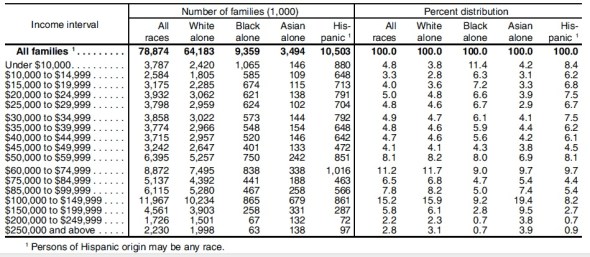
Here’s a slightly broader view of income distribution from the same source.
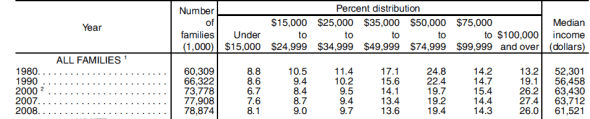
You can see that about 74% of US families don’t even clear $100,000 annually given the median income is $61,521. That’s a skewed distribution if there ever was one. I think the skewed distributions leads to some pretty skewed perspectives too.
I’m reminded of this little news item from one of my state’s Congressman whose math was fuzzy and priorities reflect that of some one whose not worried about the normal things in life. I’m still trying to figure out exactly what he pays the employees at his Subway Shops in Northwest Louisiana given the numbers he provides. As best I can figure, it’s about $12,000 a year. If he feels so put out and poor with an annual income of $400,000 a year that I wonder whatever do his charitable contributions look like?
Taking up the typical GOP talking point, Fleming said raising taxes on wealthy “job creators” is a terrible idea that kills jobs because many of these people are small business owners who pay taxes through personal income rates. Fleming is himself a businesses owner, so Jansing asked, “If you have to pay more in taxes, you would get rid of some of those employees?” Fleming responded by saying that while his businesses made $6.3 million last year, after you “pay 500 employees, you pay rent, you pay equipment, and food,” his profits “a mere fraction of that” — “by the time I feed my family, I have maybe $400,000 left over.”
All of this puts me in mind of F Scott Fitzgerald who was the chronicler of the wealthy point of view during the Gilded Age.
Let me tell you about the very rich. They are different from you and me. They possess and enjoy early, and it does something to them, makes them soft where we are hard, and cynical where we are trustful, in a way that, unless you were born rich, it is very difficult to understand. They think, deep in their hearts, that they are better than we are because we had to discover the compensations and refuges of life for ourselves. Even when they enter deep into our world or sink below us, they still think that they are better than we are. They are different.
F. SCOTT FITZGERALD writes in “The Rich Boy” in 1926
This is the stuff that makes Elizabeth Warren’s video on the stump the other day go viral. This isn’t class warfare. I don’t think there’s an awful lot of people that truly begrudge folks their wealth. Speaking only for myself, I don’t want to have my sense of perspective or priorities that warped any more and am happy when ends meet. I think people only want to feel like they have a decent living and that people that have more than that should pull their own weight and not make these weirdish justifications for wealth that most folks just plain don’t get. Back to the article by the poor little rich boy.
Taxes on the rich are taxes on people who create jobs. And jobs are an unalloyed good thing for an economy. Excessively taxing the capital that makes the economy go is poor public policy. And we have a recent example of how the opposite works well: Unemployment declined by a third in the four years after the Bush tax cuts were fully implemented in 2003, dropping to 4.2 percent from 6.2 percent. Meanwhile, federal revenue increased 44 percent in those years. If these tax cuts put people to work and generated money for the government, shouldn’t Obama consider the possibility that tax increases should be avoided?
Most of this analysis is incredibly disingenuous because it fails to mention that the country was coming out of a recession and a severe macro shock from 9/11. It wasn’t the fiscal policies that did these things at all. Plus, these were the early warning signs of Allan Greenspan blowing a housing bubble and a construction and financing boom about to crash the economy. Economists don’t like to see the rate of unemployment fall significantly below its natural rate. It means the government is doing WAY too much and will probably create some kind of inflation and the economic activity won’t be sustainable. All that war and anti terrorism spending overheated the economy.
The argument of capital gains cuts = job creations is the core argument here that I will never understand from a simple common sense view. That doesn’t even count all that book learning views from the degrees and the doctorate in Financial Economics that sets off alarms in my brain. These were tax cuts that subsidized excessive speculation. The argument that values hoarded wealth over hard work and says that all that money floating around financial markets does is create jobs is a false one.
The deal is this. It’s one thing to put your money into a business like a small or medium sized business owner does but that money is counted as regular income. That is job creating but it has nothing to do with capital gains taxes. Second, if you do buy stock in GE and you put in there for years on end and others do the same then, yes, that’s basically a good source of funding for a business and that resembles business ownership albeit a very detached one. Possibly, you could reward the buy and hold investor but a huge amount of market activity is not buy and hold unless you’re an institution. Also, why does putting your money in a bank and collecting interest– because bank deposits get pooled and loaned to businesses–not get the same treatment? My thought is that it’s because it’s the middle class way of holding wealth and the view is that it is inferior income like wages and salaries. Interest income gets taxed like work income. But, AND MOST OF ALL, how are day traders who bop in and out of investments daily, speculating away on stuff, buying exotic derivatives that have nothing to do with the underlying business create jobs, value or anything else worthy of the label job creators and why do they deserve special tax treatment? Are you prepared to tell me that this form of speculation creates more jobs than say, the gambling casinos on the strip in Las Vegas? At least we can point to cocktail waitresses, bartenders and dealers in Las Vegas style gambling.
A lot of money income that comes from capital gains is just another form of gambling income. It isn’t there long enough to encourage businesses to make long term decisions that would actually help the economy. The only thing it really does is make CEOs short-sighted by forcing them to focus on short term stock prices so they invariably don’t invest in positive net present value projects which means no attendant jobs. That’s what the research says. So, Gordon’s thinking is as fuzzy as gee, since I only get $400,000 a year, I guess I’ll just have to get rid of a few people that are doing the work for me that I pay only $12,000 a year. The “bringing liquidity to the market” isn’t really a great rationalization here either because the wham bam thank you approach of speculators these days doesn’t offset the increased risk and price volatility they bring to markets. They screw up the pricing mechanism when they do all that momentum trading. Recent gas prices and house prices are good examples of speculation gone wild. Also, riddle me this. What value do hedge fund managers bring to the table when they bet against US businesses and the US government? Why do they get special tax treatment for that? What jobs does that create? I’m not reading specifics on those things at all in Gordon’s blessed are the millionaires for they are the job creators spiel. Why subsidize this behavior and these extraordinarily rich people?
So, I’m not in any way shape or form saying that millionaires are bad or evil or whatever the nasty implications are that underlie the class war charge. What I’m saying is that there’s a difference in your perspective when you’ve got hungry kids than some one is whining they can’t make it on $400,000 a year. I don’t think we need articles lecturing us on the proper perspective we should take on millionaires. I think a few millionaires need to develop a different perspective on reality and life and quit whining when some one asks them to pay for the roads they drive on, support the schools they attended, pay for the protection provided by soldiers, cops, and firefighters, and basically pull their fair share of the load of living in a civilized society.
46.2 Million Americans (1 in 6) Now Living in Poverty
Posted: September 13, 2011 Filed under: Barack Obama, income inequality, poverty, U.S. Economy, U.S. Politics, unemployment | Tags: Census Bureau, Income Inequality, jobs, median income, Poverty, unemployment 10 Comments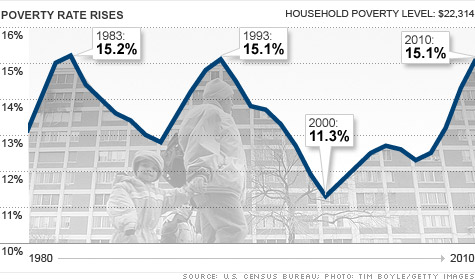
Chart courtesy of CNN Money
As of 2010, 1 in 6 Americans was living in poverty, according to a report from the Census Bureau today. The poverty rate was 15.1%, the highest number of Americans living below the poverty rate since the number has been examined. From the New York Times:
An additional 2.6 million people slipped below the poverty line in 2010, census officials said, making 46.2 million people in poverty in the United States, the highest number in the 52 years the Census Bureau has been tracking it, said Trudi Renwick, chief of the Poverty Statistic Branch at the Census Bureau.
That figure represented 15.1 percent of the country.
The poverty line in 2010 was at $22,113 for a family of four.
“It was a surprising large increase in the overall poverty rate,” said Arloc Sherman, senior researcher at the Center on Budget and Policy Priorities. “We see record numbers and percentages of Americans in deep poverty.”
The middle class has also lost ground in terms of yearly income.
And
…real median household incomes declined by 2.3 percent in 2010 from the previous year, to $49,400. That was 7 percent less than the peak in 1999 of $53,252.
“A full year into recovery, there were no signs of it affecting the well being of a typical American family,” said Lawrence Katz, an economics professor at Harvard. “We are well below where incomes were in the late 1990s.”
According to the census figures, the median annual income for a male full-time, year-round worker in 2010 — $47,715 — was virtually unchanged from its level in 1973, when the level was $49,065, in 2010 dollars, said Sheldon H. Danziger, professor of public policy at the University of Michigan.
As we all know, the rich have gotten much much richer and are continuing to get richer still because of the Bush/Obama economic policies. From CNN Money:
For middle-class families, income fell in 2010. The median household income was $49,445, down slightly from $49,777 the year before.
Median income has changed very little over the last 30 years. Adjusted for inflation, the middle-income family only earned 11% more in 2010 than they did in 1980, while the richest 5% in America saw their incomes surge 42%.
“Over that period of time, it’s not that the American economy has necessarily performed badly,” Osterman said. “As a country we’re richer over that period, but there’s been this real shift in where the income has gone, and it’s to the top.”
Amplifying that trend, the bottom 60% of households saw their income fall last year, while households making $100,000 or more enjoyed a rise in income.
CNN has a chart that shows the poverty level in each state, so you can check to see how people are doing in your neck of the woods. In general, the South is the worst off, and Louisiana and Mississippi have the highest percentages of people living below the poverty line.
I hope someone is showing this data to President Obama, because he needs to either do something about jobs and income inequality or follow LBJ’s example and get out of the way so we can find candidate who is able to show some leadership.
Labor Day Reads
Posted: September 5, 2011 Filed under: morning reads | Tags: Income Inequality, middle class americans 15 Comments Good Morning and Happy Labor Day!
New Orleans didn’t get quit the rain that was expected from TS Lee because of a high over Texas that sent some dry air at us. However, Lee’s still around and it looks like it’s going to bring lots more rain as it makes its way to the NE so others may not be so lucky.
I read a great article by Robert Reich yesterday on the NYT about the plight of the middle class in the US which is one of my favorite topics to follow. I just can’t help but notice some of the astounding statistics that show how much wealth is being confiscated upwards.
THE 5 percent of Americans with the highest incomes now account for 37 percent of all consumer purchases, according to the latest research from Moody’s Analytics. That should come as no surprise. Our society has become more and more unequal.
When so much income goes to the top, the middle class doesn’t have enough purchasing power to keep the economy going without sinking ever more deeply into debt — which, as we’ve seen, ends badly. An economy so dependent on the spending of a few is also prone to great booms and busts. The rich splurge and speculate when their savings are doing well. But when the values of their assets tumble, they pull back. That can lead to wild gyrations. Sound familiar?
The economy won’t really bounce back until America’s surge toward inequality is reversed. Even if by some miracle President Obama gets support for a second big stimulus while Ben S. Bernanke’s Fed keeps interest rates near zero, neither will do the trick without a middle class capable of spending. Pump-priming works only when a well contains enough water.
Look back over the last hundred years and you’ll see the pattern. During periods when the very rich took home a much smaller proportion of total income — as in the Great Prosperity between 1947 and 1977 — the nation as a whole grew faster and median wages surged. We created a virtuous cycle in which an ever growing middle class had the ability to consume more goods and services, which created more and better jobs, thereby stoking demand. The rising tide did in fact lift all boats.
During periods when the very rich took home a larger proportion — as between 1918 and 1933, and in the Great Regression from 1981 to the present day — growth slowed, median wages stagnated and we suffered giant downturns. It’s no mere coincidence that over the last century the top earners’ share of the nation’s total income peaked in 1928 and 2007 — the two years just preceding the biggest downturns.
So, as BostonBoomer wrote last night, the President’s speech on jobs and labor is not expected to be a barn burner. Salon’s Matt Stoller asks “What can Democrats do about Obama? The discussion around here has one answer, fall on your sword and let a real Democrat lead the way.
71 percent of Americans disapprove of how Obama is doing his job. Even among reliably Democratic groups — union households, women and young people — he’s now unpopular.
No one, not even the president’s defenders, expect his coming jobs speech to mean anything. When the president spoke during a recent market swoon, the market dropped another 100 points. Democrats may soon have to confront an uncomfortable truth, and ask whether Obama is a suitable choice at the top of the ticket in 2012. They may then have to ask themselves if there’s any way they can push him off the top of the ticket.
That these questions have not yet been asked in any serious way shows how weak the Democratic Party is as a political organization. Yet this political weakness is not inevitable, it can be changed through courage and collective action by a few party insiders smart and principled enough to understand the value of a public debate, and by activists who are courageous enough to face the real legacy of the Obama years.
Obama has ruined the Democratic Party. The 2010 wipeout was an electoral catastrophe so bad you’d have to go back to 1894 to find comparable losses. From 2008 to 2010, according to Gallup, the fastest growing demographic party label was former Democrat. Obama took over the party in 2008 with 36 percent of Americans considering themselves Democrats. Within just two years, that number had dropped to 31 percent, which tied a 22-year low.
Oh, the other hand, Republicans can say just about anything and the press will not call them out on their absolute insanity in search of some imaginary chalice of fair-mindedness. John Holbo has some interesting thoughts on that. He has a response to an earlier Kevin Drum question wondering if Democrats could get away with as much craziness and used Hillary Clinton as an example.
Kevin points out that if Hilary Clinton wrote a book about how much she wanted to repeal the Second Amendment and ban hate speech everyone would freak out that she was a radical. So what gives?
But the question answers itself: it’s really true that Perry doesn’t mean what he says. Mostly. As Kevin says, these are just the words he has to say to prove to the base he’s one of them.
By contrast, Hilary Clinton would only write that book about wanting to repeal the Second Amendment, etc., if – against all likelihood – she really wanted to repeal the Second Amendment. Because, since she isn’t a conservative, she’s not going to get a Get Out of Crazy Jail Free card. So there is no profit to her in writing such a book. Turning the point around: given that liberals don’t systematically employ a rhetoric of believing things they don’t, but conservatives do, it makes a great deal of sense to give conservatives an endless supply of Get Out of Crazy Jail Free cards. And round we go.
Really it’s more complicated. If people say crazy stuff long enough, they start to believe what they say, and other people do, too. The Overton Window gets dragged all over the place. (Michelle Bachmann really does seem to mean what she says. So she’s unviable, in the eyes of Republican establishmentarians. Even though she isn’t really saying anything absolutely crazier than Perry is saying at this point, and he’s looking pretty ok.) Having the license to say crazy stuff, without getting called on it, prevents serious debate and allows people to conceal any crazy stuff that really do believe, by hiding it in plain sight, as it were. It’s really true, I suspect, that when most conservatives say that they don’t buy this global warming junk science, what they really mean to do is, simply, signal ‘I’m in favor of capitalism’. If you are a conservative, talking to conservatives, and you say you think the scientists might be right, your audience is going to hear you refusing to send an ‘I’m in favor of capitalsim’ signal. Needless to say, this means conservatives can’t have reasonable discussions of global warming unless they are free from worries about what they are signalling, as opposed to saying. Which they never are, at least if they are politicians.
That only holds water when you consider polls that show a lot of the republican base actually believe insane things like the world is less than 10,000 years old. Just look at this Pew poll taken on Darwin’s 200th Birthday. Americans–and fundies in particular–look absolutely ignorant. Here’s a great take on that from LGF scoffing at Erick Erickson’s assertion that not all of his fundie buddies are all that literal. Sorry, Eric, they are.
Even pinning down the creationists’ beliefs more finely, the Gallup survey shows that approximately 44% or so of all Americans believe “God created human beings pretty much in the present form at one time within the past 10,000 years or so.”
Those are surveys that sample from all people living in the US. Since both Pew and Gallup show that only a small number accept the science (evolution over long periods of time), somewhere between 14% and 26%, it seems that those who believe in an old earth creationism process are roughly the same share (or slightly less) than the young earth creationists.
The bottom line is this, Erick: around half of all your fellow creationists are Young Earth Creationists. They even probably have a majority in your religion (American “conservative” Christianity.)
And yes, they are delusional, caught up in magical thinking.
You can read the original Ericson dribble here at the Washington Examiner where he tries to tell us that Michelle Bachmann’s brand of christianity is just misunderstood by the media. There are many christians who believe the bible is metaphor, but your fundie friends–and Michelle Bachmann in particular–are not in their number. I remember the first time I met an older woman that thought that there was a literal Garden of Eden some where on earth and that we actually were sons and daughters of Adam and Eve. I was just speechless. It’s a bit like watching a child talk excitedly about Santa Claus when you know the entire story. You don’t want to crush them, but sheesh, at some point you have to grow and realize that nothing is that simple and that magical thinking does no one any good.
Speaking of Michelle Bachmann, it seems she agrees with Quitterella on the elimination of corporate taxes. Oh, great, not only does she want to eliminate the EPA so they can do whatever they want to our air, water, and environment, now the two Republican women don’t want them even contributing to the roads they over use or anything else.
Republican presidential candidate Rep. Michele Bachmann (R-Minn.) said she was “open to” former Alaska Gov. Sarah Palin’s call to eliminate corporate income taxes.
“I’m open to having that debate,” said Bachmann on CBS’s Face the Nation on Sunday.
But she cautioned that “if we went that route, then we’d have to have a fundamental restructuring of the tax code.” “What we would have to do then is rejigger other elements to define revenue and what revenues would be needed to the economy.”
In the short term, however the Tea Party favorite said President Obama could lower corporate taxes to aid American businesses. “I do believe that the president at minimum should lower the corporate tax rate to 20% so that businesses can see that they will have a more competitive rate,” she proposed.
Bachmann has made tax reform and rolling back regulations the centerpiece of her plan to boost job growth and jump start the economy.
Bachmann said if elected president, the first thing she would do would be to “bring about repatriation of income from American corporations that have earned money overseas … we have over $1.2 trillion in earnings that we could bring immediately to kick-start the economy which would be a true stimulus.”
Wow, for a tax attorney she sure doesn’t know what she’s talking about. Businesses are overseas these days because that’s there’s a growing customer base there. They’re taking advantage of the cheap labor and the fact they don’t have to transport the stuff over there. US corporations just beg a tax loophole out of congress if they want their taxes cut. The effective rate they pay is so low they don’t really care any way about the actual rate.
Speaking of manufacturing, here’s a report that might keep you up all night. Gun manufacturers lose thousands of guns every year.
More than 16,000 guns were “lost” from gun manufacturers’ inventories over the last two years, according to a report by a gun control advocacy group.
The report, released by the Brady Center to Prevent Gun Violence, pulled data from the Bureau of Alcohol, Tobacco, Firearms, and Explosives (ATF) and found that 16,485 guns left the inventories of nearly 4,500 licensed gun manufacturers throughout the country without a record of them ever being sold.
In 2004 Congress passed the Tiahrt amendment – named for its sponsor then-Rep. Todd Tiahrt (R-Kansas) – which prohibited the ATF from requiring gun manufacturers to track their inventory. The Brady Campaign has long advocated for a repeal of the Tiahrt amendment.
“It is shocking that gun makers are so oblivious to public safety that they lose track of thousands of guns every year,” said Dennis Henigan, the acting president of the Brady Center. “ Given the lethality of its product, the gun industry has a special duty to act responsibly. Instead, it has a scandalous record of carelessness.”
The report states that the unaccounted for guns are often used in crimes because a trace of the weapon is not as likely to lead law enforcement officials back to the criminal.
Well, that’ll get things started on this Labor Day 0f 2011. Have a good one and be safe if you’re under the threat of all that severe weather out there!!!
Monday Reads
Posted: August 15, 2011 Filed under: Domestic Policy, income inequality, morning reads, The Great Recession | Tags: Christine Romer, Income Inequality, repeating the 1937 recession, the disappearing american middle class 24 Comments Good Morning!
I’ve been wondering quite a bit recently about what is becoming of the American Middle Class. Some times it seems that the kind of situation that I grew up in is a far grasp from what any potential grandchildren of mine will have. Both of my daughters are highly educated and I still feel this way. While I study so much on the rise of a strong, vibrant middle class in many South East Asian countries, I cannot help but wonder what’s gone so wrong that we seem to be losing ours? This month has been a very violent one here in Louisiana. We’ve had a 7 year old boy with cerebral palsy killed–dismembered actually–by a mother’s boyfriend and a number of gang shootings recently. These kinds of crimes always increase with economic hopelessness and summer heat. It gets to me a lot these days.
Here’s a good question from September’s The Atlantic: “Can the Middle Class be Saved?”
It’s hard to miss just how unevenly the Great Recession has affected different classes of people in different places. From 2009 to 2010, wages were essentially flat nationwide—but they grew by 11.9 percent in Manhattan and 8.7 percent in Silicon Valley. In the Washington, D.C., and San Jose (Silicon Valley) metro areas—both primary habitats for America’s meritocratic winners—job postings in February of this year were almost as numerous as job candidates. In Miami and Detroit, by contrast, for every job posting, six people were unemployed. In March, the national unemployment rate was 12 percent for people with only a high-school diploma, 4.5 percent for college grads, and 2 percent for those with a professional degree.
Housing crashed hardest in the exurbs and in more-affordable, once fast-growing areas like Phoenix, Las Vegas, and much of Florida—all meccas for aspiring middle-class families with limited savings and education. The professional class, clustered most densely in the closer suburbs of expensive but resilient cities like San Francisco, Seattle, Boston, and Chicago, has lost little in comparison. And indeed, because the stock market has rebounded while housing values have not, the middle class as a whole has seen more of its wealth erased than the rich, who hold more-diverse portfolios. A 2010 Pew study showed that the typical middle-class family had lost 23 percent of its wealth since the recession began, versus just 12 percent in the upper class.
The ease with which the rich and well educated have shrugged off the recession shouldn’t be surprising; strong winds have been at their backs for many years. The recession, meanwhile, has restrained wage growth and enabled faster restructuring and offshoring, leaving many corporations with lower production costs and higher profits—and their executives with higher pay.
The entire issue covers the disappearing US middle class and it’s worth checking out. Yes, it was happening prior to the 2007-2008 meltdown, but the acceleration of the decline of the standards of living for most Americans is hard to miss. We shouldn’t forget how that happened. Steven Pearlstein at the WP places blame squarely with the corporate lobby.
When it started out all you really wanted was to push back against a few meddlesome regulators or shave a point or two off your tax rate, but you were concerned it would look like special-interest rent-seeking. So when the Washington lobbyists came up with the clever idea of launching a campaign against over-regulation and over-taxation, you threw in some money, backed some candidates and financed a few lawsuits.
The more successful it was, however, the more you put in — hundreds of millions of the shareholders’ dollars, laundered through once-respected organizations such as the Chamber of Commerce and the National Association of Manufacturers, phoney front organizations with innocent-sounding names such as Americans for a Sound Economy, and a burgeoning network of Republican PACs and financing vehicles. And thanks to your clever lawyers and a Supreme Court majority that is intent on removing all checks to corporate power, it’s perfectly legal.
Somewhere along the way, however, this effort took on a life of its own. What started as a reasonable attempt at political rebalancing turned into a jihad against all regulation, all taxes and all government, waged by right-wing zealots who want to privatize the public schools that educate your workers, cut back on the basic research on which your products are based, shut down the regulatory agencies that protect you from unscrupulous competitors and privatize the public infrastructure that transports your supplies and your finished goods. For them, this isn’t just a tactic to brush back government. It’s a holy war to destroy it — and one that is now out of your control.
Dr. Christine Romer suggests that all we have to do is look to our history for good lessons. Yes, she’s the Obama economic advisor that kept having to explain continually why all those labor market numbers were looking so bad for two years while not having much input into the change that would’ve made things different right now.
One reason the Depression dragged on so long was that the rapid recovery of the mid-1930s was interrupted by a second severe recession in late 1937. Though many factors had a role in the “recession within a recession,” monetary and fiscal policy retrenchment were central. In monetary policy, the Fed doubled bank reserve requirements and the Treasury stopped monetizing the gold inflow. In fiscal policy, the federal budget swung sharply, from a stimulative deficit of 3.8 percent of G.D.P. in 1936 to a small surplus in 1937.
The lesson here is to beware of withdrawing policy support too soon. A switch to contractionary policy before the economy is fully recovered can cause the economy to decline again. Such a downturn may be particularly large when an economy is still traumatized from an earlier crisis.
The recent downgrade of American government debt by Standard & Poor’s makes this point especially crucial. It would be a mistake to respond by reducing the deficit more sharply in the near term. That would almost surely condemn us to a repeat of the 1937 downturn. And higher unemployment would make it all that much harder to get the deficit under control.
A new survey found that 64% of the public doesn’t have enough funds on hand to cope with a $1000 emergency. Wages are falling for 90% of the population. And disabuse yourself of the idea that the rich might decide to bestow their largesse on the rest of us. Various studies have found that upper class individuals are less empathetic and altruistic than lower status individuals.
This outcome is not accidental. Taxes on top earners are the lowest in three generations. Yet their complaints about the prospect of an increase to a level that is still awfully low by recent historical standards is remarkable.
Given that this rise in wealth has been accompanied by an increase in the power of those at the top, is there any hope for achieving a more just society? Bizarrely, the self interest of the upper crust argues in favor of it. Profoundly unequal societies are bad for everyone, including the rich.
First, numerous studies have ascertained that more money does not make people happier beyond a threshold level that is not all that high. Once people have enough to pay for a reasonable level of expenses and build up a safety buffer, more money does not produce more happiness.
But even more important is that high levels of income inequality exert a toll on all, particularly on health. Would you trade a shorter lifespan for a much higher level of wealth? Most people would say no, yet that is precisely the effect that the redesigning of economic arrangements to serve the needs at the very top is producing. Highly unequal societies are unhealthy for their members, even members of the highest strata. Not only do these societies score worse on all sorts of indicators of social well-being, but they exert a toll even on the rich. Not only do the plutocrats have less fun, but a number of studies have found that income inequality lowers the life expectancy even of the rich.
All the economists that I follow have been abuzz about that NYT’s article on Sunday on how politics and not economics is driving Obama’s policy. Here’s some thoughts from Mark Thoma.
When you are arguing that deficit reduction — less spending — creates jobs because it’s politically expedient to make this point and you care more about votes than fixing the economy, the truth can be uncomfortable. Is it so hard to explain that yes, in the long-run deficit reduction can be helpful. When the economy is near full employment and the demand for investment funding is high, the government’s use of funds to finance its deficit can slow investment activity. Near full employment, government spending can crowd out private investment so we need a long-run plan for deficit reduction.
But presently, with so much idle capacity and with so much liquidity looking unsuccessfully for a place to earn profits, no such fear exists. Government spending won’t crowd out private sector investment, it will provide a needed net addition to output and provide jobs for struggling households. Borrowing costs are extraordinarily cheap and there are plenty of infrastructure needs for the government to invest in, so it’s not as though we wouldn’t get something of value for our money over and above the needed help it provides to working class households. It’s a short-run and a long-run win.
Deficit reduction in the short-run makes things worse, not better, and hence harms rather than helps reelection chances. I understand that the administration is doing its best to prevent immediate cuts, and that the recent deficit agreement doesn’t put large cuts into place until 2013. But there are still small cuts endorsed by the administration — we are still going in the wrong direction — and if employment remains sluggish come election time, and if the administration has no public record of trying to do anything about it, what argument will they have? We could have provided more jobs, but we didn’t bother to try because we didn’t think we could explain ourselves to the public? We knew better, but the polls were unfavorable so we didn’t bother to pursue it?
I’ve spent the entire day flummoxed by the obvious cynicism that underlies the idea that it’s easier to sell out all principles than actually elucidate an answer to the problem that we know we have and that we know every one cares about which is lack of jobs and lack of economic growth to due lack of aggregate demand. We should all go to the White House and start pitching macroeconomics textbooks over the fences.
Anyway, that’ll get things started today. What’s on your reading and blogging list?

 peej
peej Carissa
 bostonboomer
 dakinikat
 ecocatwoman
 mablue2
 Mama Lopez
 peggysue22
 quixote
 skydancingguestblogger
 Mona (aka Wonk the Vote)



 Sky Dancing
Recent Comments