
Monday Reads
Posted: October 1, 2012 Filed under: morning reads | Tags: Chris Stewart, crazy republican candidates for office, Income Inequality, Marc Leder, Republican voter registration fraud, Tawdry Tycoon, upward mobility, whack job, young black men in America 26 Comments Good Morning!
It’s the first of October! This is how you know that I most identify with my English heritage because that’s a Brit superstition that my mother used to practice every first day of the month. It came over with my great grandfather from Hastings. I guess family stories from that far back actually do come down to you. I’m a physically obvious Phillips, however, so I guess I would pass Scott Brown’s visual DNAdar for some one with a lot of Brit heritage. A lot of my idiosyncrasies come from my mother through my great grandfather who only contributed 1/8 of my DNA. She was really influenced by him since he lived in their house and she passed lot of stuff on to me and my kids through her time with us. So, I guess Elizabeth Warren probably could relate. Hmmmm….
“Why,” the man in the brown hat laughed at him, “I thought everybody knew ‘Rabbit, rabbit, rabbit.’ If you say ‘Rabbit, rabbit, rabbit’—three times, just like that—first thing in the morning on the first of the month, even before you say your prayers, you’ll get a present before the end of the month.”
I’ve been reading a lot of interesting things recently about the decline in upward mobility in the U.S. Here’s some stories from The Atlantic that pretty much sum up my life since Dubya became president: ‘I’m Working Really Hard, but I’m Not Getting Ahead’: The New Middle Class Trap.
Only twice in U.S. history–in the heyday of the Western frontier and in the post-World War II prosperity–have Americans found it easy to rise. This isn’t one of those times. Middle-skill jobs (read: no college required) are disappearing from America’s sputtering economic engine–in factories, in back offices, even lately in state and local governments. For generations, these jobs were the ticket to a comfortable life for Americans who went directly from high school to work. But increasingly in recent decades, economic research shows, lower-wage workers in foreign lands have taken these jobs or automation has rendered them unnecessary. Today, job growth occurs mainly at the poles of the skills spectrum–in sweeping floors or flipping burgers, which can’t be outsourced, or in sophisticated engineering jobs that drive new industries.
Since 1980, the very lowest- and highest-skill jobs in the United States have each grown sharply as a share of the overall workforce, according to research published last spring by economists David Autor of the Massachusetts Institute of Technology and David Dorn of Spain’s Centro de Estudios Monetarios y Financieros. Meanwhile, the share of lower-middle-skill jobs has shrunk: For example, machine operators and assemblers, a classic storehouse of middle-skill jobs, fell from 13 percent of the workforce in 1950 to 4 percent in 2005. Real hourly wages have stagnated, simply as a matter of supply and demand. When too many workers compete for too few jobs, employers can hire qualified people at lower pay.
“The real question of the [displaced] middle class is: Where do they go?” asked Mark Doms, the chief economist at the Commerce Department’s Economics and Statistics Administration. “Only a few of them are going to go to the tippy-top”–the highest-skilled jobs. “The rest will go to the bottom.”
Another interesting read is this interview with a sociologist who has written a book about young black men in America. The book is called Invisible Men: Mass Incarceration and the Myth of Black Progress and is written by Becky Pettit who is a professor of sociology at the University of Washington. My life in inner city New Orleans and as a professor in its big urban university has really given me a front row seat in seeing the situation. It’s a lot worse than most folks could even imagine. That’s because the unemployment rate and the labor force ignores the populace in prison and young black men are a huge part of that population.
The employment/population ratio for black males aged 16-24 was 33 percent in August, vs. 52 percent for white males of the same age group. But the black number is skewed upward by the exclusion of jail and prison inmates. The white number is also skewed upward, but less so because a smaller share of young white males are incarcerated.
“We’ve developed a distorted idea” of how young, black men are faring, Pettit told reporters on the call, which was hosted by the book’s publisher, the Russell Sage Foundation. The BLS methodology didn’t begin to distort the statistics until the mid-1970s, when the incarceration boom began.
I asked Pettit how this problem can be solved. The first thing she recommended was doing more to help young, black men get an education, since there is a strong link between failure in school and a life of crime and imprisonment.
A further idea is to reduce the penalties for nonviolent drug crimes, recommended another academic on the call, Ernest Drucker, who is a scholar in residence and senior research associate at John Jay College of Criminal Justice and adjunct professor of epidemiology at Columbia University’s Mailman School of Public Health. Imprisoning people for drug offenses can damage their ability to earn a living for the rest of their lives, dooming them to a life of poverty and recidivism, said Drucker, author of A Plague of Prisons.
Indeed, one of the things that this story mentions is the appalling number of young black men trapped in prison over petty things like turn style jumping. There are a number of ‘crimes’ that are applied to young black men more than any other population. They can’t put bankers that stole billions from the economy in jail but they can imprison young people for years on a number of really petty things.
It is becoming appallingly apparent that some of the tactics used to create voter fraud are coming from Republican Operatives. This is not a new story at all. But, it is one that should make every one be very aware of who is registering who in their state. Isn’t it just typical that all these new Republican laws aimed at preventing voter fraud aren’t stopping Republicans from committing voter fraud? This story is about Riverside County in California.
Formal complaints filed with the state by at least 133 residents of a state Senate district there say they were added to GOP rolls without their knowledge, calling into question the party’s boast that Republican membership has rocketed 23% in the battleground area.
More than 27,700 residents of the legislative district have become Republicans since January, according to the California secretary of state’s office — erasing a registration edge long held by Democrats.
The complaints have also shined a light on the political committee behind the registration drive, Golden State Voter Participation Project, and its biggest donor, wealthy GOP activist Charles Munger Jr. Other donors include the California Apartment Assn., Farmers Group Inc. and Pharmaceutical Research and Manufacturing of America.
The problem has also raised anew the question of whether the state should ban firms that pay workers for each voter they register or signature they secure on a petition rather than paying them an hourly rate. Workers have an incentive to cut corners under such arrangements, according to Assemblyman Richard Pan (D-Natomas), who has proposed barring the practice in a bill that is on the governor’s desk.
Just when you think you’ve heard about all the kooky Republicans running for office you find out there’s yet another one crazier than the ones you thought were as crazy as they got. This one is a Beckster with an end-times obsession. This guy writes novels akin to the Left Behind Series. Rapture any one?
In Chris Stewart, the Republican nominee in Utah’s 2nd Congressional District, Beck has found someone he feels pretty damn good about. “If he wasn’t running, I’d be trying to convince him to work for me, to help me stay the course, strategize, and save the country,” he said last winter , as Stewart’s campaign was just getting off the ground. “I’ve actually tried to talk him out of running, because it’s a lion’s den in Washington.”
But, Beck added, “I believe he’s a Daniel.”
Like the Old Testament figure who emerged unscathed from a pit of lions, Stewart—an Air Force pilot turned consultant turned end times novelist—is also a prophet of sorts, and his message is grim: “If we don’t make some difficult decisions now, if we don’t show the courage to do what we have to do to save our country, we won’t make it for another 10 years,” he said in February , in a campaign video that also served to promote a book he’d just published under Beck’s imprint. But there was hope. “At critical times in our history…we literally had miracles where God intervened to save us,” he said. Send me to Congress, Stewart seemed to imply, and it could happen again.
Read the article. There’s all kinds of weirdness around this campaign. The worst thing is that every one thinks this guy is a shoo-in.
Want to learn more about Marc Leder? That’s the guy that held that fundraiser in Boca Raton that was captured in the Mitt 47% moment. We’ve already heard about his orgies. What else could be more “tawdry”? Evidently Leder and Mitt share a penchant for aggressive tax evasion.
Leder has been dogged by tabloid headlines recounting his nasty divorce and wild partying (replete with reported nudity and public sex around the pool at a summer house he rented on Long Island’s East End—for $500,000 a month). What he has in common with Romney, however, isn’t a taste for bacchanalian revels but a record of business and taxation practices that working Americans might find troubling.
At the moment, Leder is under investigation by New York State Attorney General Eric Schneiderman, who subpoenaed internal records from Sun Capital, Bain Capital, and several other private equity giants last July.
Issued by the Attorney General’s taxpayer protection bureau, the subpoenas were evidently designed to probe whether Leder and other executives had misused “carried interest,” a method of reducing tax liability by converting management fees into investment income—which is taxed at the lower capital gains rate of 15 percent that keeps Romney’s taxes lower than the rate paid by many middle-income families. (Tax analysts say that Bain Capital records released last August indicate that the firm may have saved more than $200 million in federal taxes thanks to the carried-interest maneuver.)
If Leder did benefit from such aggressive practices, he would merely be typical of executives in an industry where tax manipulations are not just widespread, but fundamental.
So, that’s my offering this morning. What’s on you reading and blogging list today?
Entitled One-Percenter Bill Keller Wants Baby Boomers to Give Up Social Security and Medicare
Posted: July 30, 2012 Filed under: Catfood Commission, Medicare, Mitt Romney, Social Security, The Media SUCKS, U.S. Economy, U.S. Politics, unemployment, voodoo economics, We are so F'd | Tags: Bill Keller, Charles P. Pierce, Dean Baker, Income Inequality, infrastructure, Iraq War, Judith Miller, one-percenters, Paul Ryan, Simpson-Bowles 32 Comments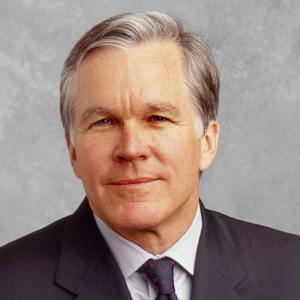
Smarmy former NYT editor Bill Keller
From today’s New York Times: “The Entitled Generation.”
The notion that our generation has been spoiled rotten is not a terribly new thought. A dozen years ago Paul Begala (of Bill Clinton and CNN fame) published in Esquire the classic of boomer-loathing, “The Worst Generation.” “The Baby Boomers are the most self-centered, self-seeking, self-interested, self-absorbed, self-indulgent, self-aggrandizing generation in American history,” he declared. It’s a sturdy genre. Perhaps while Googling yourself you have come across the blog Boomer Deathwatch (“Because one day, they’ll all be dead”), a checklist of famous boomers who hit their actuarial sell-by dates. Even Barack Obama, who styles himself post-boomer though he was born in 1961, complained in “The Audacity of Hope” that today’s hyperpolarized political discourse began with the “psychodrama of the baby boom generation.”
Yeah, we’re all evil just because our parents returned from WWII and proceeded to have lots and lots of babies. Supposedly not one of us ever did a decent thing in our pathetic, useless lives, right? I’m sick to death of hear this crap–and I’ve been hearing it since I was a kid.
See Keller says it’s our fault that the government isn’t rebuilding the infrastructure. He says it won’t do any good to tax super-rich guys like him–we’re going to have to take it out of the hides of old ladies who are trying to eke out a living on $1200 a month or less.
Guys like Bill Keller don’t even have to pay into Social Security on the bulk of their income, but he doesn’t even mention the possibility of changing that. So what does super-rich one-percenter Bill Keller think we should do about it besides learning to loathe ourselves and wish we’d never been born?
So the question is not whether entitlements have to be brought under control, but how. The Republican plan espoused by Mitt Romney and his fiscal lodestar Paul Ryan would cut the cost of entitlements largely by moving toward privatization: personal investment accounts for Social Security, vouchers for Medicare. And it’s not at all clear the Republicans would assign any of the savings to investing in our future.
At least the Republicans have a plan. The Democrats generally recoil from the subject of entitlements. Centrists like those at Third Way and the bipartisan authors of the Simpson-Bowles report endorse a menu of incremental cuts and reforms that would bring down costs without hitting the needy or snatching away the security blanket from those nearing retirement. They include gradually raising the retirement age to compensate for the fact that we now live, on average, 14 years longer than when F.D.R. signed Social Security into law. They include obliging those of us who can really afford it to pay a larger share. They also include technical fixes like aligning the automatic cost-of-living formula with reality.
At least now we know which candidate Keller will be voting for in November. So much for the supposedly “liberal media.” Oh, and about that “technical fix” Keller brushes off so dismissively, Matthew Yglesias explains why it isn’t a “technical fix” and “doing the switch comprehensively would constitute a de facto tax increase.” Furthermore, there was no “Simpson-Bowles report,” because the two co-chairs were unable to get a majority of members of the Catfood Commission to sign off on one.
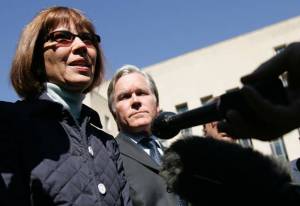
Judith Miller with patron Bill Keller
I have a terrific idea. Let’s hold Bill Keller responsible for his choice to assign Judith Miller to help the Bush administration lie us into the Iraq War. Let Bill Keller pay back the trillions of dollars of taxpayer money those lies cost us. That ought to provide some funds to invest in infrastructure here in the U.S.
Here’s what Dean Baker had to say about Keller’s lying op-ed:
That is really brave for Mr. Keller to stand up and call for sacrifice from his age cohort. Does Keller know that the typical near retiree has total wealth of $170,000. This includes everything in their 401(k), all their other financial assets and the equity in their homes. Another way to put this is that the typical near retiree (between the ages of 55-64) could take all their wealth and pay off their mortgage. After that they would be entirely dependent on their Social Security to cover all their living costs.
Does this situation describe Mr. Keller’s finances? My guess is that it doesn’t. If that is true, how does Keller claim to speak for people who are in a hugely different financial situation than him? Is he really that ignorant of the issues that the NYT gives him a column to write about or is he dishonest? Readers will have to debate that in the months and years ahead.
Baker says the real problem we have is the increase in income inequality over the past thirty years, but he’s not holding his breath for Keller to “appeal to his fellow one-percenters….He probably doesn’t have the courage or integrity to do that.”
I saved the best review of Keller’s op-ed for last. You guessed it, it’s by Charlie Pierce: “The Things Bill Keller Doesn’t Have to Worry About.”
I defy Bill Keller to last a week living only on those benefits available to the greedy boomers, especially after the Simpson-Bowles cargo cult — to say nothing of the zombie-eyed granny-starver Paul Ryan himself — are through with them. I defy him to make it for a day. The “we” sprinkled throughout this bag of pus is probably the most noxious thing about it. Look around, Bill. You and Mitt Romney have far more in common than do you and the overwhelming majority of your “fellow” boomers. One catastrophic illness, and many of our families die on the vine. This is not hyperbole. This is how it works in the world. And, to the surprise of absolutely nobody, Keller signs on with the clowns at Third Way, who assure us that the real problem is that the elderly moochers are the ones keeping us from building new bridges, or flying to the moons of Neptune. Jesus H. Christ on a Lipizzaner, we’ve had forty years of demonized government, and 40 years of quack economics, and tax-cuts until hell won’t have them, and the reason our infrastructure is falling apart is because some retired ironworker gets $1200 a month? How much of a courtier do you have to be before the taste of caviar makes you nauseous?
If we want to invest in infrastructure, which we desperately need to do, then we should just borrow money at the current historically low rates and fix the damn infrastructure…. People Got No Jobs. People Got No Money. Bill Keller never will have to worry about the last two, so I think he should shut up about the first.
Friday Reads
Posted: July 20, 2012 Filed under: morning reads | Tags: Frank Dodd, Income Inequality, Mona Lisa, Ocean Acidity, Regulation, Sheila Bair, Syria collapse 51 Comments Good Morning!
I thought I’d try to focus on some interesting news today and ignore politics. We’ll see how well I do.
BBC News reports that “an iceberg twice the size of Manhattan has broken away from the Petermann Glacier in northern Greenland”. You can see the NASA satellite picture at the link. Is this yet another symptom of global warming?
Scientists have raised concerns in recent years about the Greenland ice shelf, saying that it is thinning extensively amid warm temperatures.
No single event of this type can be ascribed to changes in the climate.
But some experts say they are surprised by the extent of the changes to the Petermann Glacier in recent years.
“It is not a collapse but it is certainly a significant event,” Eric Rignot from Nasa said in a statement.
Some other observers have gone further. “It’s dramatic. It’s disturbing,” University of Delaware’s Andreas Muenchow told the Associated Press.
“We have data for 150 years and we see changes that we have not seen before,” Mr Muenchow added.
Okay, here’s another one of my grave stories. No “seriously”, it’s another story about a grave. This time they think they may have located Mona Lisa’s remains in Florence.
Scientists claim that they might have found the skeleton of the woman who posed for Leonardo Da Vinci’s most famous painting.
Most art historians agree that Lisa del Giocondo was the woman who inspired Da Vinci to create his iconic work.
Now the archaeologists working in Florence are pretty convinced they have found the remains of the lady, merchant Francesco del Giocondo’s wife Lisa Gherardini.
The skeleton was unearthed beneath the medieval Convent of Saint Ursula in Florence. Knowing she became a nun after her husband died and lived in the convent until her death in 1542, a team of archaeologists began excavation works at the abandoned convent last year.
Sheila Bair is still on the stump for financial regulation. She answered some questions on Wednesday on the state of Dodd-Frank.
Horwich: So going after systemic risk suggests safety, it suggests caution. Then we have this other important aspect of our economy where we say financial institutions are supposed to be taking risks on deserving people and businesses. How do you reconcile what seems like a real contradiction there?
Bair: Well, I think we do want banks to take risks but we want them to take risks on economic activities that have some real economic benefit. I mean, trading CDS indexes with a bunch of hedge funds — I don’t know what kind of positive economic benefit we would get from that. It’s the kind of risk you take and whether you’re taking a well-measured, well-understood, well-evaluated risk, that’s really the question.
Horwich: There are many people out there who would have liked to have seen and might still like to see banks fail — especially big banks fail — that they think have been misbehaving. What do you say to them?
Bair: Well, I say that we should have a let a couple fail. It makes me angry that we didn’t and I think there were tools there that could have been used that were not. You know, there were a couple of institutions that were clear outliers in the terms of their mismanagement — the risks that they took — and they should have been put into a bankruptcy-like process and they weren’t. I think if we had done that; that would have been more powerful than all the rules that we’re writing now to try to correct these misbehaviors. Be that as it may it’s a legacy of the bailouts and it’s something we have to deal with now.
Here’s one of my favorite Brit Economists Robert Skidelsky on “The Bad Society”. He raises some interesting points on income inequality.
There is a strange, though little-noticed, consequence of the failure to distinguish value from price: the only way offered to most people to boost their incomes is through economic growth. In poor countries, this is reasonable; there is not enough wealth to spread round. But, in developed countries, concentration on economic growth is an extraordinarily inefficient way to increase general prosperity, because it means that an economy must grow by, say, 3% to raise the earnings of the majority by, say, 1%.
Nor is it by any means certain that the human capital of the majority can be increased faster than that of the minority, who capture all of the educational advantages flowing from superior wealth, family conditions, and connections. Redistribution in these circumstances is a more secure way to achieve a broad base of consumption, which is itself a guarantee of economic stability.
The attitude of indifference to income distribution is in fact a recipe for economic growth without end, with the rich, very rich, and super-rich drawing ever further ahead of the rest. This must be wrong for moral and even practical reasons. In moral terms, it puts the prospect of the good life perpetually beyond reach for most people. And, in practical terms, it is bound to destroy the social cohesion on which democracy – or, indeed, any type of peaceful, contented society – ultimately rests.
Is Syria collapsing and what will this to do its ally Iran? Better yet, what will this do to further instability in the region?
The fall of the Assad government would remove Shiite Iran’s last and most valued foothold in the Arab world, and its opening to the Mediterranean. It would give Saudi Arabia and other Sunni Arab states their long-sought goal of countering Iranian influence in the region, finally splitting the alliance between Tehran and Damascus that has lasted for decades. And it would further erode Iran’s role as a patron of the Middle East’s revolutionaries, a goal that moderate Arabs and the United States have long sought.
Already the militant Palestinian group Hamas, long dependent on Syria and Iran, has thrown its support behind the Syrians in the streets seeking Mr. Assad’s overthrow.
Worse might follow, from Tehran’s point of view. Iran and Syria’s last revolutionary ally, the Hezbollah party that dominates Lebanon, would lose its source of weapons and financial support. And Lebanon’s fragile sectarian balance might be torn apart, raising the threat of another civil war there.
On Wednesday, Hezbollah was quick to respond to the government’s worst day so far to make its strongest declaration yet that it would not abandon Mr. Assad.
Meanwhile, intense global pressure is being brought to bear on Putin and Russia. Russia and China once again vetoed a Syria resolution.
Russia and China again vetoed a Western-backed U.N. resolution Thursday aimed at pressuring President Bashar Assad’s government to end the escalating 16-month conflict in Syria.
The 11-2 vote, with two abstentions from South Africa and Pakistan, was the third double veto of a resolution addressing the Syria crisis by Damascus’ most important allies.
The defeat leaves in limbo the future of the 300-strong U.N. observer mission in Syria, which was forced to suspend operations because of the intensified fighting. Its mandate, to monitor a cease-fire and implementation of international envoy Kofi Annan’s peace plan, expires Friday.
Britain’s U.N. Ambassador Mark Lyall Grant, who sponsored the Western-backed draft, said he was “appalled” at the third double veto of a resolution aimed at bringing an end to the bloodshed in Syria and creating conditions for political talks. The resolution had threatened sanctions if the Syrian regime didn’t quickly stop using heavy weapons.
“The consequence of their decision is obvious,” he said. “Further bloodshed, and the likelihood of descent into all-out civil war.” Activists say more than 17,000 people have been killed since the uprising began in March 2011, most of them civilians.
“The consequence of today’s action is the situation will continue to deteriorate,” U.S. Ambassador Susan Rice told reporters.
The Smithsonian Magazine tell us that Ocean Acidity is just as much of a challenge for us as Climate Change. WTF are we doing to Mother Earth and Mother Nature?
Rising ocean acidity is now considered to be just as much of a formidable threat to the health of Earth’s environment as the atmospheric climate changes brought on by pumping out greenhouse gases. Scientists are now trying to understand what that means for the future survival of marine and terrestrial organisms.
In June, ScienceNOW reported that out of the 35 billion metric tons of carbon dioxide released annually through fossil fuel use, one-third of those emissions diffuse into the surface layer of the ocean. The effects those emissions will have on the biosphere is sobering, as rising ocean acidity will completely upset the balance of marine life in the world’s oceans and will subsequently affect humans and animals who benefit from the oceans’ food resources.
The damage to marine life is due in large part to the fact that higher acidity dissolves naturally-occurring calcium carbonate that many marine species–including plankton, sea urchins, shellfish and coral–use to construct their shells and external skeletons. Studies conducted off Arctic regions have shown that the combination of melting sea ice, atmospheric carbon dioxide and subsequently hotter, CO2-saturated surface waters has led to the undersaturation of calcium carbonate in ocean waters. The reduction in the amount of calcium carbonate in the ocean spells out disaster for the organisms that rely on those nutrients to build their protective shells and body structures.
The link between ocean acidity and calcium carbonate is a directly inverse relationship, which allows scientists to use the oceans’ calcium carbonate saturation levels to measure just how acidic the waters are. In a study by the University of Hawaii at Manoa published earlier this year, researchers calculated that the level of calcium carbonate saturation in the world’s oceans has fallen faster in the last 200 years than has been seen in the last 21,000 years–signaling an extraordinary rise in ocean acidity to levels higher than would ever occur naturally.
So, today we have a moment without US Presidential Politics. Take a deep breath, then tell me what’s on your reading and blogging list today?
Thursday Reads: the Winter Solstice, the Mayan Calendar, “the Kamikazes,” and More
Posted: December 22, 2011 Filed under: 2012 presidential campaign, Mitt Romney, morning reads, Teddy Roosevelt, U.S. Economy, U.S. Politics, unemployment | Tags: "the kamikazes", 2012, Bank of America, Barack Obama, class warfare, Countrywide, December 22, Department of Homeland Security, druids, Fargo, Income Inequality, Jesus, Jim Sensenbrenner, John Boehner, large posterior, Mayan calendar, michelle obama, militarization of police, Mitt Romney, mortgage discrimination, Newt Gingrich, North Dakota, payroll tax bill, Stonehenge, Sun god, Tea Party, wiccans, Winter Soltice 35 Comments
Newsstand in Copley Square, Boston
Good Morning!!
I have a mix of news links for you this morning, but nothing too terribly depressing. As I told you Tuesday, I’ve got a bit of Christmas overload, plus I’ve had a flu bug for a few days. So lets’ start out on a positive note.
Today at 12:30AM ET was the Winter Solstice, and therefore today is the shortest day of the year. That means in a few weeks, it will get dark in the Boston area around 4:30PM instead of 4:00. Right now, twilight begins about 3:30PM. I am so looking forward to longer days. From the WaPo:
If you pay attention to these things, you’ll notice a lag of a few weeks between the time the sun begins to set later in the day and the time it rises earlier. But the 22nd is, nonetheless, in the northern hemisphere, our shortest day, and the one in which the sun hoists itself the most miserly distance above the horizon. To top it off, the daily rate at which the sun sinks lower in the sky has been slowing, until it stops. Hence the word solstice, which means that the sun “stands still.”
It’s only for a theoretical instant, of course, but it can often seem, during these days of dark and cold, as if life itself has ground to a halt. Gardening can take place in the jewel boxes of our cold frames and greenhouses, but with growth so slow that there is little for you to do. The hibernation practiced by some creatures starts to seem like a great idea, and the southern migration of others a possible plan.
Not surprisingly, the human celebrations held in this season are full of light, whether it’s from Hanukkah candles, bonfires or sparkly tinsel draped over trees. You can almost understand why people light up their lawns with electrified reindeer. The longer the nights and the greater the inactivity they foster, the more we need our spirits lifted.
The LA Times has a story about Wiccan celebrations of the Soltice.
“People are celebrating the solstice more than ever in recent memory,” said Selena Fox, who isn’t just any Wiccan priestess. She’s a psychotherapist and the founder of Wisconsin’s Circle Sanctuary, a nonprofit Wiccan church and, according to its website, a 200-acre nature preserve….
Solstice is “widely celebrated today by Wiccans, druids, heathens and other pagans; by indigenous peoples practicing traditional ways in Africa, Asia, Polynesia, Australia, Europe and the Americas; by environmentalists and astronomers; by secular humanists and Freethinkers; by eco-Christians and those of other religions and philosophies,” Fox told The Times in an interview Wednesday….
Humankind has been “observing solstices for thousands of years,” Fox said, but the celestial events have become even more of the moment. Why? Because this is an “age of climate change and a need to have sustainability on the planet,” she said, so it makes sense that a holiday that has “connecting with the cycles of nature” at its core would become popular.
And of course that is why the mythic birth of Jesus was set on December 25, to symbolize rebirth and light coming back to the world. In pagan terms, the birth of the new sun. Here’s a video of the Solstice celebration at Stonehenge in 2009.
One year from now, the 2012 Winter Solstice will mark the end of the Mayan calendar, and we’ll probably have to deal with all kinds of apocalyptic prediction about what is going to happen next. NASA has a page debunking the idea that the end of the world is coming on December 22, 2012. Of course the maniacs in Washington DC might do something that would cause the end of the world as we know it. Let’s hope not.
Yesterday, Dakinikat had a post on John Boehner’s payroll tax fiasco. First Boehner said the House would agree to a 2-month extension of the payroll tax holiday and unemployment benefits, as passed by the Senate. Then suddenly Boehner announced that Republicans wouldn’t vote for the compromise bill–now they wanted a year’s extension or nothing. WTF?!
At the Daily Beast, Patricia Murphy claims to provide the inside story on what happened.
What happened between Boehner’s agreement to follow the Senate’s lead and his tacit admission that his own caucus had overruled him? Aides and House members describe a now-infamous caucus conference call Saturday morning, when rank-and-file members blasted the Boehner-blessed deal, which they felt gave in on too many of their demands and delivered too little in return.
A closed door meeting Monday night revealed more doubts from conservatives over whether Boehner had pushed for the best deal they could have gotten and fueled Democratic frustration that Boehner, who they believe negotiated in good faith, simply cannot speak for his caucus anymore. The debacle capped a tumultuous year for the speaker, reigniting questions about how much longer he can lead the unwieldy GOP coalition, many of whose members clearly have no interest in following him where he wants to go.
Publicly, Boehner and House Republicans presented a united front this week, blaming President Obama for shortening a tax cut they say they have wanted to pass all along. But Democrats blamed a group of Republicans they’ve dubbed “the kamikazes,” the GOP freshmen who arrived in January on a wave of Tea Party anger and have shown time and again that they are willing to blow up their careers and everything around them in service to their cause.
The kamikazes’ casualty list this year is long. They blew up the debt-ceiling vote this summer, sparking a downgrade in the nation’s credit rating. They blew up the appropriations process so thoroughly that routine spending votes morphed into philosophical standoffs that nearly locked down the federal government three times and required seven temporary funding patches just to keep the lights on. And this week, they managed to blow up not just a tax cut that nearly everyone in Washington agrees is a good idea, but also their party’s hard-earned reputation for cutting taxes and, quite possibly, their chances at a long-term majority in the House and future control of the Senate.
Talk about self-immolation! In the meantime, questions are being asked about Boehner’s leadership.
At ABC’s The Note, Jonathan Karl is predicting the Republicans will fold. We’ll see. President Obama is really good at finding ways to give in to the Congressional terrorists. Maybe someone can distract him long enough to let this play out without his intervention.
Also at the the Daily Beast, there’s a creepy, yet semi-humorous story about local cops being militarized by the Department of Homeland Security, this time in my birthplace, the quiet little city of Fargo, North Dakota.
Nestled amid plains so flat the locals joke you can watch your dog run away for miles, Fargo treasures its placid lifestyle, seldom pierced by the mayhem and violence common in other urban communities. North Dakota’s largest city has averaged fewer than two homicides a year since 2005, and there’s not been a single international terrorism prosecution in the last decade.
But that hasn’t stopped authorities in Fargo and its surrounding county from going on an $8 million buying spree to arm police officers with the sort of gear once reserved only for soldiers fighting foreign wars.
Every city squad car is equipped today with a military-style assault rifle, and officers can don Kevlar helmets able to withstand incoming fire from battlefield-grade ammunition. And for that epic confrontation—if it ever occurs—officers can now summon a new $256,643 armored truck, complete with a rotating turret. For now, though, the menacing truck is used mostly for training and appearances at the annual city picnic, where it’s been parked near the children’s bounce house.
“Most people are so fascinated by it, because nothing happens here,” says Carol Archbold, a Fargo resident and criminal justice professor at North Dakota State University. “There’s no terrorism here.”
Read it and weep. If Fargo has that much military hardware, imagine what they’ve got in NYC, Chicago, and LA! Police State Amerika is here.
At the NYT, Charlie Savage reports on the Justice Department settlement with Bank of America over discrimination in mortgage lending by Countrywide.
The Justice Department on Wednesday announced the largest residential fair-lending settlement in history, saying that Bank of America had agreed to pay $335 million to settle allegations that its Countrywide Financial unit discriminated against black and Hispanic borrowers during the housing boom.
A department investigation concluded that Countrywide loan officers and brokers charged higher fees and rates to more than 200,000 minority borrowers across the country than to white borrowers who posed the same credit risk. Countrywide also steered more than 10,000 minority borrowers into costly subprime mortgages when white borrowers with similar credit profiles received regular loans, it found.
Now how about putting some banksters in jail for bringing down the economy? Not holding my breath, but at least BOA has to cough up some bucks.
Newt Gingrich has been accused of illegally profiting from his presidential campaign.
Former House Speaker Newt Gingrich became the target on Monday of a Federal Election Commission (FEC) complaint filed by the non-profit watchdog group Citizens for Responsibility and Ethics in Washington (CREW), which accused the Georgia Republican of illegally profiting off his campaign.
The complaint is based on a revelation by The Washington Post‘s Dan Eggen, who discovered that Gingrich had personally sold a mailing list to his campaign and profited to the tune of $47,005, then failed to report the transaction on a key FEC document. That’s count one, according to CREW.
That mailing list did not belong to Gingrich personally, CREW said. It instead belonged to Gingrich Productions, Inc., a private business that sells Gingrich’s books. Since he paid himself instead of Gingrich Productions, CREW alleged that a second count of using campaign money for personal expenses is called for as well. The treasurer who signed off on the deal is also accused of violating campaign finance laws.
CREW explained in their complaint (PDF) that Gingrich Productions often stages events at the same time as Newt 2012, Inc., his non-profit group and principal campaign committee, which could constitute improper corporate contributions to a political campaign in that the campaign directly benefits from Gingrich Productions’ events.
It goes on to note that the mailing list Gingrich moved from his book company to his campaign was actually a list of people who were waiting at Gingrich events to have their books signed, showing even further how Gingrich Productions and Newt 2012 work in tandem to help each other.
Whoopsie! Everybody’s out to get Newt these days. I’d love to see him end up in jail along with some banksters, but again–not holding my breath.
As you’ve all heard, Ron Paul stalked off the set of an interview at CNN yesterday after he was asked about some racist passages in newsletters he published years ago. But USA today has caught Paul in a serious contradiction about those writings.
Rep. Ron Paul has tried since 2001 to disavow racist and incendiary language published in Texas newsletters that bore his name, denying he wrote them and even walking out of an interview on CNN Wednesday. But he vouched for the accuracy of the writings and admitted writing at least some of the passages when first asked about them in an interview in 1996.
Some issues of the newsletters included racist, anti-Israel or anti-gay comments, including a 1992 newsletter in which he said 95% of black men in Washington “are semi-criminal or entirely criminal.”
Paul told TheDallas Morning News in 1996 that the contents of his newsletters were accurate but needed to be taken in context. Wednesday, he told CNN he didn’t write the newsletters and didn’t know what was in them.
Hmmmm…. I guess Mitt Romney isn’t the only flip-flopper in the Republican presidential race.
Speaking of Romney, that guy has really gone off the deep end in his efforts to court Iowa Tea Party voters. Steve Benen suggests that Romney has “lost his mind.”
Mitt Romney unveiled a brand-new stump speech in New Hampshire last night, reading a carefully-crafted, poll-tested text from two teleprompters. Confident that his Republican primarily rivals simply won’t (or can’t) catch him, the former one-term governor ignored the other GOP candidates in his speech, and focused exclusively on attacking President Obama.
Wow! Two telepromters? Now why does that sound familiar? Anyway, the point is that Romney has been reduced to following the Tea Party meme that Obama is a commie socialist. From the speech:
“Just a couple of weeks ago in Kansas, President Obama lectured us about Teddy Roosevelt’s philosophy of government. But he failed to mention the important difference between Teddy Roosevelt and Barack Obama. Roosevelt believed that government should level the playing field to create equal opportunities. President Obama believes that government should create equal outcomes.
“In an entitlement society, everyone receives the same or similar rewards, regardless of education, effort, and willingness to take risk. That which is earned by some is redistributed to the others. And the only people who truly enjoy any real rewards are those who do the redistributing — the government.
“The truth is that everyone may get the same rewards, but virtually everyone will be worse off.”
ROFLOL! Benen writes:
It stands to reason that Romney, who’s completed the transition from “progressive” views to far-right hysterics, would present a worldview different from the center-left president’s. But this speech was written in a twisted fantasy land, and it ascribes views to Obama that are simply made up. It’s just madness.
And get this: Romney wants Obama’s uncle deported!
ABC News’ Michael Falcone reports:
Presidential candidate Mitt Romney told a Boston talk radio host on Wednesday that he supports the deportation of President Obama’s Kenyan-born uncle who was arrested this fall on drunken driving charges in Massachusetts.
When asked by Boston radio personality Howie Carr whether the president’s relative, Onyango Obama, should be deported, Romney said, “the answer is ‘yes.’”
“Well, if the laws of the United States say he should be deported, and I presume they do, then of course we should follow those laws,” Romney said. “And the answer is ‘yes.’”
And last week, Romney told Sean Hannity that Obama is deliberately and knowingly hurting America for political reasons.
Hannity: The president has been using class warfare as we know. He says Republicans want dirty air, dirty water. Says Republicans want old people, kids with autism and Down’s syndrome to fend for themselves. Pretty outrageous charges.
Romney: Shameful. It’s really shameful.
Hannity: Explain, and how do you counter that if you get this nomination?
Romney: You know, I think the president has gone from being a failed presidency, a guy over his head, to someone who is now so desperate to get re-election that he’s doing things that are very much counter to the interest of the country and he knows it. In the past I think he was just misguided. Now I think he really knows that his decision in Afghanistan to pull the troops out a couple of months earlier than commanders suggested. That was not a wise, not a wise thing for the country. The Keystone pipeline, he knows we need that oil, he knows the consequences.
If Romney is this nuts now, imagine what he’ll be like in the thick of the primaries. Folks, Romney is not the “reasonable” candidate. There is no reasonable candidate on the Republican side. It’s going to be a completely insane candidate vs. a fascist pretending to be a Democrat. Followed by the end of the Mayan calendar. If we’re lucky, the world will end before the next president is inaugurated. Just kidding, I think.
I’ll end with this embarrassing for him, amusing for us, bit of gossip about Wisconsin Rep. Jim Sensenbrenner.
Rep. Jim Sensenbrenner (R-Wisc.), known for his cantankerous ways and for not speaking to media unless it’s his idea, was overheard at the Delta Crown lounge at Reagan National Airport today talking on his cellphone about an incident he said occurred three weeks ago while at an Episcopal church auction. Please note, a church auction.
Our source, a Democratic operative who heard the whole thing, said he was “very loud”. Sensenbrenner was overheard saying that after buying all their “crap” (his word) a woman approached him and praised first lady Michelle Obama. He told the woman that Michelle should practice what she preaches — “she lectures us on eating right while she has a large posterior herself.”
The operative said it sounded like he was on the phone with a staffer who was telling him that someone in the media would likely write about his comments (concerning something) to which he said it was heresy and just liberal media bias to print gossip. But “he stands by his remarks.”
Sensenbrenner is on the pudgy side. Someone should tell him that people who live in glass houses shouldn’t throw stones.
That’s all I’ve got for you today. What are you reading and blogging about?
Once upon a time, there was an American Dream
Posted: October 26, 2011 Filed under: income inequality | Tags: death of the middle class, Income Inequality, infrastructure bank, role of policy in creating income inequatliy 8 Commentsand over the last three decades it has clearly been disappearing. 
The US made incredible strides in the post World War 2 era by bringing huge numbers of American families into the middle class. This has been clearly reversed over the last three decades according to a new report coming from the Congressional Budget Office. The report shows that “the top 1 percent of earners more than doubled their share of the nation’s income over the last three decades”. It also indicates the role of government in creating the vast inequalities and the resultant stagnating economy, joblessness, and unsustainable federal spending. Policy has deliberating pulled the rug out from under the middle class and placed a red carpet out for the very few. The study was commissioned by Senators Max Baucus and Grassley.
In addition, the report said, government policy has become less redistributive since the late 1970s, doing less to reduce the concentration of income.
“The equalizing effect of federal taxes was smaller” in 2007 than in 1979, as “the composition of federal revenues shifted away from progressive income taxes to less-progressive payroll taxes,” the budget office said.
Also, it said, federal benefit payments are doing less to even out the distribution of income, as a growing share of benefits, like Social Security, goes to older Americans, regardless of their income.
The report, requested several years ago, was issued as lawmakers tussle over how to reduce unemployment, a joint committee of Congress weighs changes in the tax code and protesters around the country rail against disparities in income between rich and poor.
In its report, the budget office found that from 1979 to 2007, average inflation-adjusted after-tax income grew by 275 percent for the 1 percent of the population with the highest income. For others in the top 20 percent of the population, average real after-tax household income grew by 65 percent.
By contrast, the budget office said, for the poorest fifth of the population, average real after-tax household income rose 18 percent.
And for the three-fifths of people in the middle of the income scale, the growth in such household income was just under 40 percent.
The findings, based on a rigorous analysis of data from the Internal Revenue Service and the Census Bureau, are generally consistent with studies by some private researchers and academic economists. But because they carry the imprimatur of the nonpartisan budget office, they are likely to have a major impact on the debate in Congress over the fairness of federal tax and spending policies.
Rapid growth in the income of the very few has come from other factors too. Of course, incredible bonuses and executive compensation has played a role. Additionally, the increasing role of the financial services industry in the economy which mostly produces overhead in relationship to useable goods and services is another reason. Another factor is capital gain with the preferential tax treatment it receives, its relationship to asset bubble and its disproportionate role in the incomes of the very wealthy.
The interesting thing is that the very rich can get richer from trade and globalization. Huge businesses and capital can go any where these days. Most Americans rely on their labor and are limited in their mobility. If the KFC in Louisville has no customers, perhaps one in Beijing will. That is why it is essential that any attempt to stimulate the economy or create jobs happen in a way that ensures the money stay within communities. There’s a bill coming up in to create an infrastructure bank in the US which would do just that. It ensures that funds would be used on projects that would create jobs, tax revenues, incomes, and spending that stays within our borders.
On Tuesday, Rep. Marcia Fudge (D-Ohio) offered H.R. 3259, which would create the bank and fund it at $5 billion per year through 2015. Assuming that bill could be approved this year, that would provide $20 billion for the bank, double the initial amount of money Obama requested.
Democrats have said any money provided to an infrastructure bank could be leveraged to provide financial support to infrastructure projected valued at 10 times that initial amount, or more.
“Whether you are a Democrat or Republican, we all have infrastructure that is crumbling, and we have people in our districts who are eager to get back to work,” Fudge said. “This legislation allows us to target the large number of deficient bridges in our communities and other dangerous infrastructure for repair, making travel safer for our residents.”
Fudge said the bill would allow funding for transportation, drinking water and public housing projects. Her bill is the House companion to S. 1550, which Sen. Sherrod Brown (D-Ohio) introduced in September.
Of course, there’s one problem.
While the bill could move in the Democrat-controlled Senate, it would seem to have no chance of being considered in the House. Republicans in the House continue to insist on spending cuts, and no new federal spending programs. Neither bill provides for any offset in spending to create the infrastructure bank, and instead rely on new appropriations.
How did we possibly arrive at the point where elected officials will actively work against the interests of the people that elected them?

 peej
peej Carissa
 bostonboomer
 dakinikat
 ecocatwoman
 mablue2
 Mama Lopez
 peggysue22
 quixote
 skydancingguestblogger
 Mona (aka Wonk the Vote)



 Sky Dancing
Recent Comments