President Donald Trump has made clear Tehran must relinquish control of the vital energy shipping lanes in the Strait of Hormuz. But Iran has weathered previous assaults and still managed to threaten oil shipping with drones and missiles, and it’s not clear how this latest campaign would eliminate that threat.
“I think the president will try to destroy Iran’s capabilities threatening the strait,” said Fred Fleitz, Trump’s former National Security Council chief of staff and vice chair of the American First Policy Institute’s American Security. “I think that we will have to take a so-called mowing the grass strategy, where the U.S. and Israel will respond militarily to provocations, then maybe we simply have to wait until the Iranian people take their country back.”
Trump did offer a concession of sorts on Tuesday when he reversed himself and said the U.S. would not impose a 20 percent fee on countries shipping goods through the strait. Instead, he said the Navy would assist ships through the waterway in exchange for investment deals with the United States.
“Iran made a deal, and they broke it” said White House spokesperson Olivia Wales. “While President Trump’s preference is always peace and diplomacy, the deal is performance-based, and Iran’s actions constitute failure to live up to their commitments.”
The latest about-face is a hallmark of the president’s decision-making process and the minute-by-minute governing policy he favors.
Trump has no authority to impose fees on shipping. But these journalists won’t just say that. And his “minute-by-minute governing policy” is hardly a “policy.” He has no ability rein in any of his impulses control what he says in public.
On the 136th day of his war against Iran, President Trump came up with a new plan. He would impose tolls on ships traversing the Strait of Hormuz in exchange for protecting them from Iranian forces.
But that was then. On Day 137, he had another new plan. No tolls after all.
Mr. Trump’s 180-degree reversal on Tuesday in the face of protests from his Arab allies who were not so excited about paying tolls reflected how adrift he seems to be in prosecuting his war against Iran. What was supposed to be a clean four-to-six-week operation is now in its messy 20th week. Improvisation and impulse are not working.

A banner in Tehran last week threatening President Trump. Credit…Arash Khamooshi, Polaris for The New York Times
A president who has made flexing his power on the world stage a hallmark of his second term has found in Iran an opponent that so far will not bend to his will and a geopolitical conflict that cannot be won through nasty social media posts or tariff threats. The memorandum of understanding that he brokered with Tehran last month to halt the fighting turns out to have been a memorandum of misunderstanding, and Mr. Trump now seems to have neither a clear military nor diplomatic strategy.
“He’s encountered a country that is not willing to play by his set of rules, which is you bend and kiss the ring and tell him how great he is and try to get whatever concession he’s willing to give,” said Vali Nasr, a professor at the Johns Hopkins University School of Advanced International Studies who has advised presidents and secretaries of state on the Middle East.
Mr. Trump’s no-end-in-sight venture in the Middle East has become a fresh lesson in why the region has been a sinkhole for presidential ambition for generations. The instruments of power that help advance U.S. interests elsewhere around the globe do not necessarily work there, as many of Mr. Trump’s predecessors have discovered.
It has been especially frustrating for Mr. Trump, who has reveled in getting his way since returning to office last year and even boasted that he might be the most powerful man in world history. But while he has successfully pressured NATO allies into increasing military spending, extracted concessions from trading partners and essentially took over Venezuela with a one-night surgical commando raid, it is not clear that he can get his way in the Persian desert.
A bit more:
John Hannah, a former national security adviser to Vice President Dick Cheney and now a senior fellow at the Jewish Institute for National Security of America, in the past has supported the limited use of military force to stop Iran from building a nuclear weapon. But he said that by going for “a massive decapitation strike,” Mr. Trump had clearly underestimated the theocratic power structure that took power in the 1979 Iranian revolution and overestimated American capacity to topple it.
“In retrospect, this was clearly a war based on fatally flawed assumptions,” Mr. Hannah said, “none more damaging than the president’s apparent conviction that Iran’s revolutionary regime was a flimsy house of cards ready to collapse in a hail of American airstrikes and bellicose Truth Social posts.”
“Compounding the error,” he added, “there was no rigorous national security apparatus around the president prepared to speak truth to power and subject his wrongheaded assumptions to systematic questioning based on the knowledge and experience of real foreign policy, defense and intelligence professionals.” [….]
Mr. Trump seems uncertain how to proceed. He has turned back to the use of military force and ordered the resumption of a naval blockade in the Strait of Hormuz. He has threatened to take “a nice, big fat shot” at Pickaxe Mountain, a fortified site near one of Iran’s main nuclear facilities. But with popular opinion against the war, he has given little indication that he is willing to resume the sort of full-fledged bombardment that marked the beginning of the war.
At the same time, he has suggested there will be further negotiations but has not articulated how talks that failed before could succeed now. In fact, he has expressed deep skepticism that they could, although of course that might simply be a way of lowering expectations. Instead, Mr. Trump seems to think that he can outlast the Iranians because their economy is in dire shape while the Iranians seem to think that they can outlast him because of the politics of gas prices heading into midterm elections at home.
We are in deep trouble. Remember we don’t have that many weapons left after Trump and Hegseth’s previous bombing raids.
One more on Iran from Paul Krugman at his Substack (This is a transcript of a podcast): The Forever War Gets Scary.
The war with Iran has just reached a very scary phase, and I’m not talking about the bombs and the drones….
If you’re following the news, you know that the sort-of ceasefire with Iran has been called off. Trump has reinstated the blockade. The Iranians are back to hitting things with their drones and missiles.
The U.S. position has been wildly erratic. First, Trump said he was going to impose a 20% toll on all shipping, basically turning the Strait of Hormuz into a U.S. toll booth, which would have been wildly illegal and irresponsible, aside from being impossible. Now he says, no, he’s going to demand that countries invest in the United States, which is also actually wildly illegal. But in any case, it’s never going to happen.

Paul Krugman
And yet, this is extremely scary. The reason to be afraid is not that I think the war is going to come to America. It’s not even that I think the United States is going to seriously try to occupy Iran. We don’t have the troops. We don’t have the missiles. Trump depleted a large share of our weaponry in the course of his failed war so far. So this is likely going to be punitive strikes, maybe some war crimes along the way, but that’s all.
But what is really frightening here is that it does appear as if Trump has given up on trying to extract something that looks like victory. If we go back just a few days ago, it appeared that what was going to happen was that Trump was going to de facto pull out, give up on the project, take advantage of falling oil prices because the strait was sort of kind of open — and try to spin the story about this was truly, this was actually an American victory and the economy is great and look at the stock market.
And, you know, just it was a little bit — more than a little bit —stupid and doomed. It was also kind of amazing because a serious attempt to end the conflict would have required facing up to reality, saying, OK, this war didn’t go well, but America remains great. Sorry about that.
But that was apparently not something Trump emotionally could bring himself to do. He just cannot admit that this venture failed. He can never admit that anything failed. We’re going to be searching for the saboteurs of the reflecting pool for the remainder of his presidency.
But what is really frightening here is that it does appear as if Trump has given up on trying to extract something that looks like victory. If we go back just a few days ago, it appeared that what was going to happen was that Trump was going to de facto pull out, give upon the project, take advantage of falling oil prices because the strait was sort of kind of open — and try to spin the story about this was truly, this was actually an American victory and the economy is great and look at the stock market.
Please read the rest. The point is that now Trump is likely to double down on his “election fraud” story. He’s announced an address to the nation tomorrow night, supposedly about election fraud in 2020, specifically in Georgia. Back to Krugman:
I don’t know how this is going to play out. But we are really now at the point where it’s pretty clear that Trump and the people around him have given up on actually winning the election. They’ve decided instead that somecombination of propaganda, misinformation, disinformation, and possibly massive illegality is their way forward.
And don’t say they wouldn’t do that. That has been famous last words every step of the way. The proposition that there were some things that even Trump and company would not do has been the best way to be wrong about everything, every step of the Trump administration.
So in a peculiar way, the fact that Trump is back to bombing Iran is really bad news, not because of the bombs. Yes, it’s terrible and all that, But not because I have any real fear that America is going to be at risk from a foreign power, but because I think it signals an enormous risk to us from our own president, our own government.
Be afraid, be very afraid.
Now to the war within–between Trump’s ICE shock troops and the American people.
Yesterday, ICE announced there would be no more traffic stops, after ICE agents gunned down two more innocent people. AP: Trump administration orders ICE to suspend most vehicle stops after 2 deadly shootings.
BIDDEFORD, Maine (AP) — Trump administration officials told Immigration and Customs Enforcement officers to suspend most vehicle stops after two deadly shootings within a week, people familiar with the decision said Tuesday.
The policy change came after an ICE officer shot and killed a Colombian driver Monday in Maine and a week after one shot and killed a motorist in Houston, renewing criticism of the agency’s enforcement tactics that were widely condemned last winter after the killings of Alex Pretti and Renee Good in Minnesota.
In Florida on Tuesday, a third man in roughly a week died during an encounter with immigration officers. This time, a 28-year-old man was killed after he was hit by a tractor trailer while running from immigration and other federal officers, authorities said.
The suspension of vehicle stops allows room for exceptions when executing a criminal warrant or working with partner agencies, according to a person who spoke Tuesday on condition of anonymity to discuss sensitive law enforcement operations. Matthew Felling, a spokesperson for Maine Sen. Angus King, said the senator’s office was also told by the Department of Homeland Security that ICE was suspending stops.
But Trump didn’t like that. The Hill: Trump says ICE can’t give up traffic stops: ‘Important and effective.’
President Trump on Wednesday said Immigration and Customs Enforcement (ICE) should continue utilizing traffic stops, calling the tactic one of the agency’s “most important and effective” enforcement tools.
“The men and women of ICE are doing a GREAT job, one that has to be done,” Trump wrote on Truth Social, praising the agency’s efforts to enforce his deportation agenda and taking a swipe at the previous administration’s border policies.
“CRIME IS WAY DOWN IN AMERICA, in many cases with numbers that haven’t been seen in decades,” he said, later adding that “we must be strong, tough, and smart, and we CANNOT give up one of I.C.E.’s most important and effective Crime Fighting tools, THE TRAFFIC STOP! Once we do, we are playing right into the criminal’s hands.”
“The Radical Left Dumocrats would like to see this done, but it won’t happen on my watch. I.C.E., be judicious, fair and smart, and go back and do your very important job,” Trump said.
So apparently, the murders will continue, never mind that ICE has no legal authority to make traffic stops. They aren’t police.
Today the Senate Judiciary Committee is holding a confirmation hearing on Todd Blanche’s appointment to be Attorney General. Here’s what’s happening so far:
The Washington Post: Trump ally Blanche vows to regain senators’ trust at AG confirmation hearing.
Acting attorney general Todd Blanche defended his tumultuous record as the temporary head of the Justice Department on Wednesday as he faced bipartisan scrutiny of his bid to become the nation’s Senate-confirmed chief law enforcement officer.
Blanche, President Donald Trump’s former defense lawyer tapped last year to serve as the Justice Department’s No. 2 official, has held the department’s top job on an interim basis since April, when the president fired his predecessor, Pam Bondi.
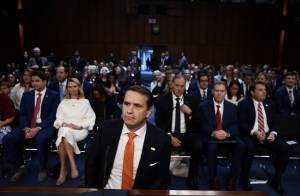
Acting attorney general Todd Blanche takes his seat to testify before a Senate Judiciary Committee hearing on his nomination at the U.S. Capitol on Wednesday. Evelyn Hockstein Reuters
In that time, he has accelerated investigations of the president’s political rivals; defended and then abandoned a controversial plan to create a nearly $1.8 billion fund to pay those who claim they were targeted by political prosecutions; and pushed forward with probes aimed at finding evidence to support Trump’s long-held, baseless claims that the 2020 election was stolen from him.
Though Blanche’s tenure has drawn bipartisan pushback at times and prompted even some Republican senators to question whether they will vote in support of his nomination, he told members of the Senate Judiciary Committee on Wednesday that his ultimate goal is to make America safer.
“I am here today to earn your trust once more,” Blanche said at the top of his confirmation hearing. He added: “In recent years, Americans watched as the Justice Department turned against many of you and a former president, and it damaged the public’s faith in justice. We are fixing that.”
Democrats on the committee, who are unified in their plans to reject Blanche’s nomination, signaled that trust has beenirrevocably broken during Blanche’s months at the Justice Department’s helm.
Sen. Dick Durbin (Illinois), the committee’s ranking Democrat, lambasted Blanche as a “yes-man” who has overseen a hollowing-out of department personnel and never stopped viewing his job as protecting Trump.
“This nation deserves an attorney general who loves the Constitution more than he loves any single president. An attorney general who is focused on keeping Americans safe and combating corruption — not satisfying the president’s personal grievances and filling his bank accounts,” Durbin said.
Blanche also committed a little oopsie:
Blanche, himself, briefly stumbled when describing his relationship to Trump and whether he considers the president a friend.
“I’m his lawyer,” Blanche said, before quickly correcting his statement. “Was his lawyer.”
One more from Politico: Todd Blanche says he can’t meet directly with Epstein victims.
Todd Blanche fended off questions about his handling of the Jeffrey Epstein files at his confirmation hearing Wednesday morning, telling members of the Senate Judiciary Committee that “when it comes to victims of his horrible man, we will never, never not talk to victims.”
But pressed by the top Judiciary Committee Democrat, Dick Durbin of Illinois, to meet with 10 victims present in the hearing room, Blanche suggested he is personally prohibited from meeting directly with them and instead offered to have them meet with one of his deputies.
Durbin replied: “I think you ought to be in the room because you ought to hear this. You have a singular responsibility for these files.”
Earlier in the hearing, Judiciary Committee Chair Chuck Grassley (R-Iowa) handed Blanche an opportunity to defend his work overseeing the disclosure of the files. Blanche told the committee that “if we learn today, if we learn next week, if we learn next month that there’s an individual that we can investigate, indict and prosecute out of the Epstein files, you better believe it we will.”
I’ll believe that when I see it.
That’s it for me today. What stories grabbed your attention today?




 peej
peej Carissa
 bostonboomer
 dakinikat
 ecocatwoman
 jjlo
jjlo mablue2
 Mama Lopez
 peggysue22
 quixote
 skydancingguestblogger
 Mona (aka Wonk the Vote)





Recent Comments