
Caturday Heroines
Posted: June 30, 2012 Filed under: just because | Tags: Hillary Clinton, Jean Patchett, Nora Ephron, Ruth Ginsburg 30 Comments
1950’s Jean Patchett
Morning, news junkies! Okay so not a cat picture, but Jean Patchett qualifies as pretty darn feline in my books… heh. Also, I can’t get this pic to post because it’s copyrighted, but here’s a photo of Hemingway and Patchett in tow with kitties.
Well that’s it in the way of an intro for today. Let’s get right to the links.
First up… by now I’m sure you’ve all read quite a few of the “Hillary makes history” items in the headlines lately, so I won’t reinvent that news wheel. But, in case you missed it…here’s a neat profile on Hillary Rodham Clinton at makers.com, entitled “The Lesson of ‘Hillarycare'”. Includes several video interview clips of Hillary reflecting on her life. Snippet from the write-up:
Wellesley College seniors had never before chosen a commencement speaker from their own ranks when Hillary Rodham stepped to the podium on the last day of May in 1969. Education, she said, must grant “the courage to be whole” and permit people to live “in relation to one another in the full poetry of existence.” The speech received national attention and marked Rodham as a leading light for the young women of her generation.
By now, it’s safe to say that the early promise has been borne out; had Hillary Rodham Clinton “merely” attended Yale Law, served on the staff of the Senate Watergate Committee, become a respected children’s rights advocate, been the first female partner at her law firm, been a mother, and served as First Lady of Arkansas, we would think of her as a leader. And yet she has by now spent two additional decades at the very heart of the national consciousness—as a sometimes-embattled First Lady, as a distinguished senator from New York, as a groundbreaking 2008 Presidential candidate, and now as the 67th Secretary of State. Clinton has outlasted the smears to top Gallup’s “most admired woman in America” a record 16 times since 1993. “The courage to be whole,” indeed.
Next, from the New Yorker’s Amy Davidson… Ruth Bader Ginsburg, Hero:
I am glad that John Roberts, the Chief Justice, voted to uphold almost all of the Affordable Care Act. But the stance of humble gratitude toward Roberts that’s been assumed by many in the past day is beginning to be a bit much. This is especially true since the real hero of the day is Ruth Bader Ginsburg.
On the front page of the late edition of the Times Friday morning, there were four stories on the Supreme Court decision. One talked about Roberts’s “exquisite delicacy,” and how he “considers himself the custodian of the Supreme Court’s prestige, authority and legitimacy.” Ginsburg’s name didn’t appear before the jump in any of them; she only ever appeared in one, seventeen paragraphs in. Her picture and surname were in the infographic—all the Justices were there. There were four pull-quotes: two from Roberts, and two from the joint dissent from Antonin Scalia, Samuel Alito, Clarence Thomas, and Anthony Kennedy.
And yet Ginsburg wrote what would have been the dissent—and a strong one—if Roberts had voted with the four conservatives to throw out the entire health-care law.
Read the rest. It’s worth the click and it’s news you won’t find out from the Dewey Defeats Truman newsrooms of America!
Historiann on Nora Ephron…. I highly recommend clicking on the first link in her post, which I’ve linked here too for your convenience:
From the New York Times obit:
The producer Scott Rudin recalled that less than two weeks before her death, he had a long phone session with her from the hospital while she was undergoing treatment, going over notes for a pilot she was writing for a TV series about a bank compliance officer. Afterward she told him, “If I could just get a hairdresser in here, we could have a meeting.”
Ms. Ephron’s collection “I Remember Nothing” concludes with two lists, one of things she says she won’t miss and one of things she will. Among the “won’t miss” items are dry skin, Clarence Thomas, the sound of the vacuum cleaner, and panels on “Women in Film.” The other list, of the things she will miss, begins with “my kids” and “Nick” and ends this way:
“Taking a bath
Coming over the bridge to Manhattan
Pie.”
And, on that note. I’m gonna go draw a nice soothing bath and bake something yummy this Saturday. You know what to do in the comments, Sky Dancers… Have a lovely weekend!
TBIF Reads
Posted: June 29, 2012 Filed under: Affordable Care Act (ACA), Hillary Clinton, morning reads | Tags: archaeology, Betsy Ross Bridge, Health Care Ruling, Hillary Clinton, Maurits Escher, Nora Ephron 67 Comments Good Morning!!
Here’s some reads to get you started today!
“I haven’t had a chance to read the decision. I literally just heard as we landed that the Supreme Court has upheld the healthcare law. Obviously I want to get into the details, but I’m very pleased. That’s how I hoped it would turn out,” Clinton said in video posted by PSB’s “NewsHour” and reported by Agence France Presse.
The high court ruled to uphold the healthcare law in 5-4 decision that prompted calls for repeal from Republicans and daylong praise by Democrats.
“I think it’s a great moment to just think about what this will mean for the millions and millions of Americans who have already benefited from the Affordable Care Act and some many more who will continue to do so,” Clinton added.
She noted that although there is still a lot of work to do implementing the healthcare law, she was “obviously quite exited to hear the results.”
Most right-wing hacks responded in their normal over-the top way. Rush Limbaugh–why is he still relevant?–said that SCOTUS was a “death panel”. The Aqua Buddha doesn’t understand the role of the Supreme Court in the constitution. He said that just because SCOTUS says it’s constitutional doesn’t mean it is constitutional. Representative “Mean Jean” Schmidt gives all women a bad name with this show of hysteria. (Let’s not even mention Quitterella or “I married a closet case” Michelle Bachmann.) Let’s just say the Teabots are on a rampage.
I’m sure we will find more realistic assessments of the ruling in a few days when constitutional law scholars sift through the thing.
Nobel Prize winning Economist Joseph Stiglitz is out on the interview circuit in support of his new book. Here’s an interesting interview with Stiglitz on the terrible consequences of income inequality.
One of the myths that I try to destroy is the myth that if we do anything about inequality it will weaken our economy. And that’s why the title of my book is The Price of Inequality. What I argue is that if we did attack these sources of inequality, we would actually have a stronger economy. We’re paying a high price for this inequality. Now, one of the mischaracterizations of those of us who want a more equal or fairer society, is that we’re in favor of total equality, and that would mean that there would be no incentives. That’s not the issue. The question is whether we could ameliorate some of the inequality — reduce some of the inequality by, for instance, curtailing monopoly power, curtailing predatory lending, curtailing abusive credit card practices, curtailing the abuses of CEO pay. All of those kinds of things, what I generically call “rent seeking,” are things that distort and destroy our economy.
So in fact, part of the problem of low taxes at the top is that since so much of the income at the very top is a result of rent seeking, when we lower the taxes, we’re effectively lowering the taxes on rent seeking, and we’re encouraging rent-seeking activities. When we have special provisions for capital gains that allow speculations to be taxed at a lower rate than people who work for a living, we encourage speculation. So that if you look at the design bit of our tax structure, it does create incentives for doing the wrong thing.
Basically this means that lowering taxes for the hyper-rich doesn’t create jobs. It creates gambling and influence peddling.
Here’s “Eight Great Lines Written by the Late Nora Ephron” from truthdig.
Even people who don’t like Nora Ephron movies have to concede that she broadened things for women, both the female professionals following in her wake and the female audience members soaking in her stories. She was no bleeding-edge feminist, but in a culture that produces one vapid Prince Charming chick flick after another, Ephron generally focused on characters—Julia Child among them—who had their own force of personality, their own reasons for being.
Truthdig contributor Carrie Rickey remembers on her own blog eight of her favorite Ephron lines. Here are three:
“When your children are teenagers it’s important to have a dog so someone in the house is happy to see you when you get home.” — from the book “I Feel Bad About My Neck”
“Harry, you have to find a way of not expressing every feeling you have, every moment you have them.” — spoken by Meg Ryan in “When Harry Met Sally … ”
“She makes coffee nervous” — spoken by Tom Hanks (of Parker Posey) in “You’ve Got Mail”
I guess I’m going multimedia these days. I have another Youtube for you. This one is kinda kewl. It’s on “mathematics made visible and the art of M.C. Escher. Who hasn’t had at least one of his posters hanging on your dorm or bedroom wall as a kid?
His cool, analytic tendency was apparent from the start. “Maurits Escher is a good graphic artist,” wrote the headmaster of the Haarlem School of Architecture and Decorative Arts in 1922, the year of Escher’s graduation, “but he lacks the right artistic temperament. His work is to too cerebral–neither emotional nor lyrical enough.” Escher’s work became even more cerebral over time, as it grew in geometric sophistication.
There’s a great 1 hour long documentary available too. Follow the link above when you have the time. It’s well worth it.
I also recommend that you read the FT and “A manifesto for economic sense” by Paul Krugman and Richard Layard.
As a result of their mistaken ideas, many western policy makers are inflicting massive suffering on their peoples. But the ideas they espouse about how to handle recessions were rejected by nearly all economists after the disasters of the 1930s. It is tragic that in recent years the old ideas have again taken root.
The best policies will differ between countries and will require debate. But they must be based on a correct analysis of the problem. We therefore urge all economists and others who agree with the broad thrust of this manifesto for economic sense to register their agreement online and to publicly argue the case for a sounder approach. The whole world suffers when men and women are silent about what they know is wrong.
Here’s an interesting archaeological find from the UK. A woman and a cow were found buried together in Cambridgeshire.
The grave was uncovered in Oakington by students from Manchester Metropolitan University and the University of Central Lancashire.
At first it was thought the animal skeleton was a horse.
Student Jake Nuttall said: “Male warriors might be buried with horses, but a woman and a cow is new to us.”
He added: “We were excited when we thought we had a horse, but realising it was a cow made it even more bizarre.”
Co-director of the excavation, Dr Duncan Sayer, from the University of Central Lancashire, said: “Animal burials are extremely rare, anyway.
Grave goods including brooches indicated the woman was of high status
“There are only 31 horse burials in Britain and they are all with men.
“This is the first animal to be discovered with a woman from this period – the late 5th Century – and it’s really interesting that it’s a cow, a symbol of economic and domestic wealth and power.
“It’s also incredibly early to find any grave of a woman buried with such obvious wealth.”
One more totally bizarre dig story. I know. I wanted to be an archaeologist as a kid. I’m still fascinated with it all. This one is from Philadelphia: “How Thousands of Headstones Ended Up Under a Philadelphia Bridge”. Go look at the pictures. They are very haunting and macabre.
The Betsy Ross Bridge in Philadelphia seems like any other. It doesn’t have the grace of the Golden Gate or the history of the Brooklyn Bridge, nor does it draw any acolytes wanting to make the trek across. The structure exists primarily to move people, and this it does well, helping connect Pennsylvania to New Jersey. Most commuters, however, are surely unaware of what the bridge’s foundation is actually built on: a cemetery.
The bridge springs from the headstones of a forsaken graveyard, dumped unceremoniously into the Delaware River. The sunken stones at the base of the bridge came from Monument Cemetery, once located two miles from City Hall. Monument Cemetery, established in 1839, was the second Victorian garden style cemetery in Philadelphia, after Laurel Hill, now a protected historic landmark. Monument was modeled after the Pere Lachaise in Paris, and was created to function both as a final resting place for the dead as well as a green respite from the surrounding urban environment.
That’s my offerings today! Thank Buddha it’s Friday! What’s on your reading and blogging list today?
The Meme That Just Won’t Die: Hillary as VP
Posted: May 23, 2012 Filed under: U.S. Politics | Tags: Barack Obama, gender gap, Hillary Clinton, Joe Biden, Michael Tomasky, Mitt Romney, Secretary of State, Vice President 50 Comments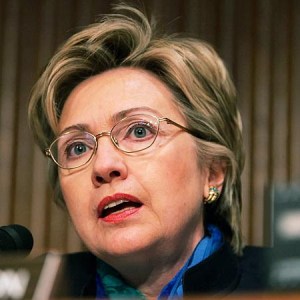
Here we go again. Today Michael Tomasky discusses the possibility that Hillary could switch jobs with Joe Biden. Tomasky was reacting to a snarky piece in the Washington Times, so take it with a large grain of salt. Tomasky writes:
Clinton’s positive numbers are off the charts. Biden’s are so-so—both approval and disapproval sit in the 40s. Biden’s putative asset, that he helps a bit with white working-class and Catholic voters, is even truer of Clinton, the famous drinker of shots in those proletarian Pennsylvania bars. And women—forget about it. An Obama-Clinton ticket would pulverize any Romney ticket on the distaff side (is that insulting? I’m just trying to avoid repeating the word “women” too much). It wouldn’t matter if he put Carrie Underwood on his ticket.
I know, I know. It’s silly. I can right now picture the friends reading this who will write me to say, “Mike, that’s silly.” It probably is. But here are a few points for your consideration that aren’t silly at all.
Actually, I don’t see anything silly about the idea, but then I’m “on the distaff side.” Tomasky notes that in the recent NYT-CBS poll, Romney is actually leading among women. Is it really possible that Romney has narrowed the gender gap. If so, Obama would be in big trouble.
In other words, it may well be that Romney could close the gender gap. And if he could close it to 5 points, it will be an extremely close election.
Now bring in Hillary. Forget about it. The most consistently admired woman in America over the last 20 years? The gender gap would be 20 points. And the Obama and Clinton machines fused like that—it’s like Secretariat and Zenyatta breeding. And the signal sent to Democrats and women across the country that the whole thing is being teed up for her in 2016. This would be a blowout.
And Biden, you ask? Well, the gay-marriage thing might finally have been the straw that made Obama think it’s not so great having Joe around. But don’t feel bad for him. He benefits from the fact that the White House would have to do this smoothly, which means Biden can’t possibly just be hung out to dry. So he’s going to be landing on a $300 goose-down pillow. He gets to be secretary of state—the job he’s dreamed of for years anyway!
It makes a lot of sense, but it probably won’t happen–not because it’s a “silly” idea, but because Obama doesn’t have the guts to do it. If he did, it would be a real “game changer.” Suddenly this deadly dull election season would become very exciting. And Hillary would be teed up to run in 2016.
What do you think?
Dead Silence from Mitt Romney on Chen Guangcheng’s Arrival in U.S.
Posted: May 21, 2012 Filed under: 2012 presidential campaign, China, Foreign Affairs, Human Rights, U.S. Politics | Tags: Chen Guangcheng, diplomacy, Hillary Clinton, Mitt Romney, State Department 31 Comments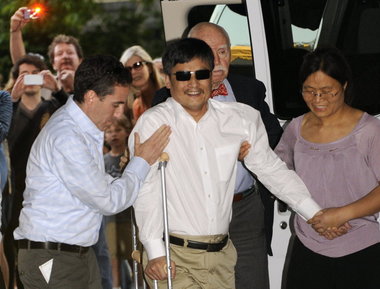
It’s been a couple of days now since blind Chinese activist Chen Guangcheng arrived at Newark on a flight from Beijing. Mitt Romney must have heard about it, but he’s said nary a word about it. I wonder why?
He had plenty to say back on May 3, in the midst of the crisis that took place during Secretary Clinton’s trip to China. Chen had managed to escape from house arrest and make it to the U.S. Embassy to ask for assistance. As State Department and U.S. Embassy staff struggled to negotiate an exit strategy for Chen, Romney, the all-but-official Republican nominee:
condemned the Obama administration’s handling of blind Chinese dissident Chen Guangcheng, calling the episode “a dark day for freedom” and “a day of shame” for President Obama if, he couched, reports are true that American officials communicated threats to Chen’s family….
Several times on Thursday, Romney couched his comments with disclaimers like “if the reports are true,” but the takeaway was clearly intended that the incident is a black eye for President Barack Obama, Secretary of State Hillary Clinton and Treasury Secretary Timothy Geithner.
Despite Romney’s impulsive catastrophizing, Secretary of State Clinton calmly continued her efforts to help Chen and his family get to the U.S. in a way that would also save face for Chinese officials. Chen was offered a law fellowship at New York University and a deal was struck: Chen could leave China on a student visa, and his departure wouldn’t be characterized as seeking asylum.
On May 9 in New Delhi, Clinton told an interviewer:
that the work she and others have done to establish multiple channels for dialogue over the last 3 1/2 years “created a level of personal relationships and understandings between individuals and our government institutions that is absolutely critical.”
Clinton suggested that China’s willingness to agree to a U.S. proposal to assist a prominent critic of the government’s one-child policy is an indication that taking a broader view of the relationship pays dividends in a moment of crisis.
“I’ve invested a lot and argued strongly” for keeping regular channels of communication open so that no one issue “predominates or undermines the potential for reaching agreement on other equally important issues,” the top U.S. diplomat told Bloomberg Radio.
This was a triumph for negotiation as opposed to the kinds of macho chest-pounding that Romney has been preaching so far.
Declining to comment on how the U.S. managed to craft a deal this time in a sensitive case involving a Chinese activist, Clinton said that “every high-level Chinese official that I met” last week “repeated back to me” words from a speech she delivered in Washington reflecting on Sino-U.S. relations in the 40 years since President Richard Nixon’s historic outreach to communist China.
Chinese officials, she said, echoed her view that “what we are trying to do — the U.S. and China — is unprecedented in world history. We’re trying to find a way for an established power and a rising power to coexist.”
Last night, Cheryl Isaac wrote at Forbes:
Chen posed a great challenge for Hillary Clinton because of two competing issues: the economic dialogue in Beijing had been her priority for a couple of years, her pledge to protect human rights—women’s rights nonetheless—another priority.
The confusion of the negotiation process did not help either. After escaping house arrest and seeking refuge at the American Embassy, Chen first decided to stay in China. Then later, he pleaded to be taken to America—putting Clinton in the difficult place of having to renegotiate an agreement that had been reached 24 hours prior; reports the Daily Beast’s Howard Kurtz.
People around the world stated their displeasure. In the U.S., she had Congressman Chris Smith (R-NJ) stating that Clinton did not keep Chen safe within the U.S. Embassy. In this video interview, Smith even admits to telling Chen—in a phone conversation—that the fact that officials were working day and night on his paperwork, was not a good sign…”
But Hillary pushed onward, made the right decisions, and was successful in her goal of helping Chen and his family.
Bravo, Madam Secretary! Where are macho Mitt’s congratulations? Has he apologized yet? I’ve googled, but can’t find any evidence that he has owned up to his bungling or even acknowledged this diplomatic achievement. Why am I not surprised?
Open Thread: Mitt Romney, Busybody
Posted: May 15, 2012 Filed under: 2012 presidential campaign, 2012 primaries, U.S. Economy, U.S. Politics | Tags: Barack Obama, Bill Clinton, busybody, Debt, Federal Deficit, gossip, Hillary Clinton, Mitt Romney 20 Comments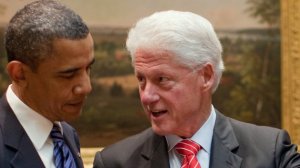
In a speech in Des Moines, Iowa today, Mitt Romney sounded like a fussy old gossip, claiming that President Obama probably has a “beef” with Bill and Hillary Clinton.
Almost a generation ago, Bill Clinton announced that the Era of Big Government was over.
Even a former McGovern campaign worker like President Clinton was signaling to his own Party that Democrats should no longer try to govern by proposing a new program for every problem.
President Obama tucked away the Clinton doctrine in his large drawer of discarded ideas, along with transparency and bipartisanship. It’s enough to make you wonder if maybe it was a personal beef with the Clintons….but really it runs much deeper.
President Obama is an old school liberal whose first instinct is to see free enterprise as the villain and government as the hero. America counted on President Obama to rescue the economy, tame the deficit and help create jobs. Instead, he bailed out the public-sector, gave billions of dollars to the companies of his friends, and added almost as much debt as all the prior presidents combined.
ROFLMAO!! Obama, “an old school liberal?” This guy is a laff riot!
At the Washington Post, Nia-Malika Henderson interpreted Romney’s odd invoking of the good old days of the Clinton administration as another effort to link Obama with Jimmy Carter. Henderson writes:
The strategy, of course, is obvious, if a little heavy handed—paint Obama as more like Jimmy Carter, rather than as a New Democrat in the mold of Clinton.
Clinton has already emerged as one of Obama’s most visible surrogates, appearing in a video marking the death of Osama bin Laden, and will likely be used to gin up support among so-called Reagan Democrats—white, blue collar workers, particularly—and Romney can perhaps mute some of Clinton’s power by suggesting that Clinton isn’t all in with Obama. (It’s a beef, not a bromance, Romney suggests.)
But by invoking Clinton, Romney risks poking the bear in some ways, and perhaps even casting himself as a version of Clinton. Praising Clinton, even in a backhanded way, isn’t exactly a way to solidify support among the religious right.
I don’t know about the reaction from the religious right, but Bill Clinton worked a few digs about Romney into his speech today at the Pete Peterson conference (why Clinton shows up for these things, I’ll never understand, but that’s for another post). According to the National Journal, Clinton said that Romney
shot himself in the foot with the broad tax-cutting budget he suggested during the primary. He said Romney should accept projections that his plan for deep tax cuts would add billions to the deficit while requiring huge cuts to Medicare, Medicaid and non-defense spending.
“If I were in his position I would, I think, use the Congressional Budget Office numbers saying my plan increased the debt and say that no responsible president can pretend an independent analysis of his numbers don’t matter,” Clinton said. “That’s, I think, his his best avenue back to the real world.”
Clinton also offered a few verbal pats on the head to Romney.
“I feel a lot of sympathy for him,” he said. “The whole primary was about finding somebody who was true conservative, but they’re going to vote for him anyway.”
Good one, Bill!

 peej
peej Carissa
 bostonboomer
 dakinikat
 ecocatwoman
 mablue2
 Mama Lopez
 peggysue22
 quixote
 skydancingguestblogger
 Mona (aka Wonk the Vote)



 Sky Dancing
Recent Comments