
Mr Reid, Tear Down This Filibuster
Posted: November 8, 2012 Filed under: U.S. Politics | Tags: Filibuster, Filibuster Reform, gridlock, Harry Reid, Mr Smith Bill 42 Comments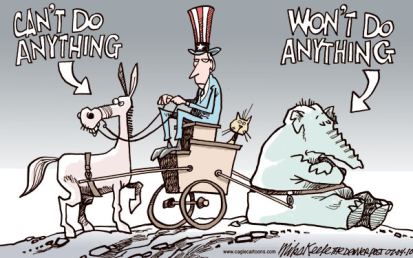 One of the most frustrating things that’s happened in the last few years has been the overuse and misuse of the filibuster. Senate Majority Leader Harry Reid--see the morning post–has decided that one of his top priorities will be to pass legislation to tighten rules on the use of the filibuster in the legislative chamber. The overuse of the lazy Senator’s filibuster has stymied nearly every attempt to get Democratic legislation through the Senate.
Bloomberg has an excellent article on the changes that will be proposed and what impact this could have on an Obama second term. The bill is called “The Mr Smith” bill. It’s be reintroduced by Sen. Frank (D-NJ). The bill would require those who want to filibuster a nomination or a bill to appear on the floor and actually speak. This means that Republican senators can’t just scream filibuster and the go home to dinner and cocktails. The bill was first introduced in 2011.
“The filibuster is being abused to create gridlock and prevent the Senate from doing the people’s business. Instead of being a deliberative body, the Senate has become a deadlocked body,” Lautenberg said in a press release Wednesday. “The ‘Mr. Smith Bill’ would help break the obstruction in Washington, bring transparency to lawmaking and hold senators accountable for their actions. This bill will stop senators from launching a filibuster and then skipping off to dinner, leaving our work in a stalemate.”
The bill — co-sponsored by Sens. Dick Durbin, D-Illinois, and Kirsten Gillibrand, D-New York — also would require that the Senate move for an immediate vote once debate ends and those conducting the filibuster give up the floor.
“Right now, senators are allowed to filibuster and force the Senate to use up a week or more on a single nomination or bill, even if there is no debate occurring on the floor,” Lautenberg’s office said. “Under the Lautenberg proposal, that time could be reduced significantly.”
Typically, a Senate rule change requires a super majority of 67 yes votes, something that will be difficult for Democrats, with their narrow 53-seat majority, to achieve. However, on the first legislative day of a new Congress, a simple majority of senators, just 51 votes, can approve new rules.
According to Lautenberg’s office, 91 cloture votes were taken in the 111th Congress — almost “four times the 24 cloture votes taken 20 years ago and almost double the 54 cloture votes required in the 109th Congress (2005-2006), when Republicans were last in the majority.”
This is the first item that would reform the procedure that became infamous in the Jimmy Stewart movie. It has moved from being a true expression of frustration with a piece of legislation or a process to a systematic way to gridlock. It has increased the polarization that characterizes Congress these days. It isn’t used to either protect the rights of the minority or to force debate. It’s used for pure political gain. The Bloomberg article states that “there were more filibusters between 2009 and 2010 than there were in the 1950s, 1960s, and 1970s combined”. This will give you an idea of what’s become of a symbol of democracy. It’s became a way for Mitch McConnell to hold back progress including help for the unemployed, veterans, victims of domestic abuse, and judicial appointments. Newly elected Senators appear to be on board for reform.
Chris Murphy, the incoming Democratic senator from Connecticut, couldn’t have been clearer: “The filibuster is in dire need of reform,” he told Talking Points Memo. “Whether or not it needs to go away, we need to reform the way the filibuster is used, so it is not used in the order of everyday policy, but is only used in exceptional circumstances.”
Angus King, the independent senator-elect from Maine, said, “My principal issue is the functioning of the Senate.” He backs a proposal advanced by the reform group No Labels that would end the filibuster on motions to debate, restricting filibusters to votes on actual legislation. The group also wants to require filibustering senators to physically hold the Senate floor and talk, rather than simply instigate a filibuster from the comfort of their offices.
And it’s not just the new guys. In an election-night interview on MSNBC, Senator Dick Durbin ofIllinois, the Democrats’ second-in-command, emphasized the importance of filibuster reform. Senate Majority Leader Harry Reid is a committed guardian of institutional prerogatives who put the kibosh on filibuster reform in the previous Congress. But even he has given up protecting the practice. “We can’t go on like this anymore,” he told MSNBC’s Ed Schultz. “I don’t want to get rid of the filibuster, but I have to tell you, I want to change the rules and make the filibuster meaningful.”
That doesn’t go nearly far enough. The problem with the filibuster isn’t that senators don’t have to stand and talk, or that they can filibuster the motion to debate as well as the vote itself. It’s that the Senate has become, with no discussion or debate, an effective 60-vote institution. If you don’t change that, you haven’t solved the problem.
Common Cause actually sued the US Senate this year to end the filibuster.
Enter Common Cause. It argues that a minority in the Senate has used the filibuster to hold up all manner of legislation, including (most importantly, for this suit), the
DISCLOSE Act (to tighten electioneering disclosure requirements in the wake of Citizens United) and the DREAM Act (to create a path to U.S. citizenship for certain aliens). It argues that the 60-vote requirement in Senate Rule XXII violates the default parliamentary majority-takes-all rule, the careful balance of powers in the legislative branch and between the three branches, and the power of the Senate itself to changes its own rules (because along with Rule V (which continues the Senate rules from Senate to Senate) Rule XXII seems to require that 3/5 of Senators vote to change Rule XXII). In particular, Common Cause argues that the filibuster violates the Quorum Clause, the Presentment Clause, the power of the VP to break a Senate tie, the Advice and Consent Clause, and the equal representation of the states in the Senate–all of which in different ways assume majority rule. It also argues that the filibuster is in tension with the eight constitutional exceptions to majority rule.
Again, the Bloomberg article says it best and btw, it’s written by Ezra Klein.
Party polarization has turned the filibuster into a noxious obstacle. Filibusters are no longer used to allow minorities to be heard. They’re used to make the majority fail. In the process, they undermine democratic accountability, because voters are left to judge the rule of a majority party based on the undesirable outcomes created by a filibustering minority.
Ideally, a bipartisan majority of senators would end the filibuster — either immediately or with a delayed trigger six years after a deal is struck — so neither party would know which is poised to benefit. But doing away with the filibuster in the next Congress has some appeal, too. Democrats control the Senate and Republicans control the House; there will be no instant power grab leading to one-party dominance.
So, go Harry. If they’re going to cause gridlock, then at least make them stand on the Senate floor until they drop. The American people deserve explanations instead of secretive political maneuvers.
Tuesday Reads: Romney and Zingers, Environmental Activism, and A Bit of Schadenfreude
Posted: October 2, 2012 Filed under: 2012 presidential campaign, Banksters, Barack Obama, Environment, Environmentalists, Mitt Romney, morning reads, U.S. Politics | Tags: Donald Trump, Eric Schneiderman, federal lands, first presidential debate, Haley Barbour, Harry Reid, James Bruggers, Jamie Dimon, JP Morgan, public lands, Tar Sands blockade, zingers 76 Comments
Good Morning!!
I have some interesting links today–some of them a couple of days old, but even if you’ve seen them, they bear repeating.
First up, there’s just one more day until the first presidential debate. I just can’t wait to hear those “zingers” Mitt Romney’s advisers told the NYT he has been practicing for months.
Mr. Romney’s team has concluded that debates are about creating moments and has equipped him with a series of zingers that he has memorized and has been practicing on aides since August. His strategy includes luring the president into appearing smug or evasive about his responsibility for the economy.
Since August? I hope they haven’t gotten stale. Apparently they’re hoping Obama will have another “likable enough” moment. I doubt that will happen, but we’ll see.
Frankly, as Ezra Klein writes at HuffPo, Romney would be better off to forget the zingers and develop more popular policies.
Behind in the polls and facing mounting panic among his donors, Mitt Romney is readying his secret weapon for the debates: Zingers….Pro tip: If your strategy to turn the presidential election around relies on Romney’s sense of comic timing, you might want to prepare a Plan B, as well.
The idea that this election can be reshaped by a zinger speaks to a deeper problem in the Romney campaign’s fundamental view of the race. As they see it, Obama’s record is an obvious disaster and their job entails little more than pointing that out over and over again. That the polls haven’t seemed responsive to this theory hasn’t dissuaded them. The new explanation for Romney’s difficulties is that the media are in the tank for Obama and that’s why the Romney campaign’s message isn’t breaking through.
But, Klein says, Americans know the economy is bad, but they also think it would have been worse if John McCain had been elected, rather than Barack Obama. Check out the chart.

Anna Marie Cox also addressed the “zingers” story at the Guardian.
The Romney campaign, having already proven able to discover impressive new ways for a nomination to blunder (my jaw still involuntarily drops a little when I hear the phrase “47%”), they have now added yet another type of podiatric wound to their catalogue. According to a report in the New York Times on Saturday, Romney’s staff “has equipped him with a series of zingers that he has memorized and has been practicing on aides since August.”
Already an awkward presence, Romney seems particularly susceptible to the tense stillness and deathless pathos that accompanies a dud punchline. Picturing the forced jocularity around the campaign headquarters has its pleasures, specifically the idea of Mitt trotting out well-worn jokes with the panache of a Catskills stand-up:
“Take my economic policy … please!”
“How lazy is half America? So lazy …”
“Any car-elevator owners in the audience tonight?”
But there’s an awful flipside: my God, what if he actually tries one of them?
Whether you wince or guffaw at the image of Romney attempting and failing to “zing” the president, probably says more about your tolerance for the humiliation of others than your political sensibilities. You’d think covering politics would have inured me to it by now, but in real life, I can’t even watch “American Idol”. I will view the debate on Wednesday through the spaces between my fingers, with a desk nearby to bang my head against.
What I really wish is that Romney would follow Donald Trump’s advice. According to TPM, Trump tweeted that Romney “should ask Obama why autobiography states “born in Kenya, raised in Indonesia.”
Romney will definitely have to watch his tone though, based on the results of a focus group study that TPM reported today. And Republicans will have a hard time saying this one is biased, because it was done by Haley Barbour’s company.
Barbour’s firm Resurgent Republic conducted focus groups of blue collar voters in Ohio and suburban women in Virginia who supported Obama in 2008 but are now undecided. Both are swing demographics that Romney is working to win over in order to flip each state from blue to red.
Their findings? Voters are a lot more willing to believe attacks based around Romney quotes than they are on Obama quotes.
“Whenever we showed direct quotes from President Obama over the last few years, voters consistently say that this is probably taken out of context and they don’t seem to hold that same standard with Governor Romney,” pollster Linda DiVall, who conducted the Virginia focus groups, said in a conference call announcing the findings Monday.
She added that while their reaction struck her as “a little bit unfair,” it was nonetheless “American voters’ right to do that.”
Pollster Ed Goeas said his own Ohio focus groups elicited similar responses, which could make things harder for Romney as he seeks to reverse his comments that 47 percent of Americans consider themselves “victims.”
It sounds like these swing state voters have figured out that Romney is a lying liar who only cares about the needs of the top .01 percent. Voters just aren’t as stupid as the Romney campaign thinks.
Did you see the tough op-ed Harry Reid wrote for the Las Vegas Sun on Sunday? He really ripped Romney a new one.
We learn the most about someone’s character not from what he does when he knows others are watching but from what he does when he thinks they aren’t.
We’ve learned an awful lot of troubling things about Mitt Romney recently. First, his sweeping, closed-door condemnation of President Barack Obama’s supporters revealed the disdain he has for half the population he hopes to serve. Then, the limited tax returns Romney selectively released confirmed that he’s willing to share information about the time he’s been in the public eye and running for president, but not the time he was running the corporation he touts as his sole qualifying credential for the highest office in the land.
When he thought no one was listening, Romney accused 47 percent of Americans of not taking responsibility for their lives, painting them as lounging in government dependency — a conclusion he reached because, for various legitimate reasons, they are exempt from paying federal income taxes.
Romney stands not only on shaky ethical grounds in making that indiscriminate generalization — he’s also on flimsy factual footing. The 47 percent Romney derides as self-pitying “victims” includes seniors who live on a fixed income thanks to the Social Security they paid into and earned over a lifetime of hard work, our troops in combat zones and veterans who have fought for our country. It includes students studying to get the skills that will win them the jobs of the future and decent Americans actively looking for work because their jobs were outsourced by companies such as those Romney specialized in developing. Most of them pay plenty of payroll, property, local and state taxes.
Reid goes on to beat Romney over the head with his secret tax returns one more time. Go read the whole thing if you haven’t already. Reid is turning out to be the Democratic attack dog of the 2012 campaign season.
Just one more Romney link: Romney would put states in charge of federal lands. James Bruggers, a Kentucky reporter who covers environmental issues full-time writes:
Our public lands are a birthright, held in trust for each one of us and managed by a set of laws that were worked out through compromise by Congress and various presidential administrations going back generations.
They provide places for us to hike, ride our mountain bikes, horses, camp, hunt and fish. Many are managed for multiple uses, and they also allow for cattle grazing, timber harvesting, oil and gas development, mining and skiing.
Romney, however, has said he would change all this, putting states in control of lands now under the stewardship of such agencies as the U.S. Forest Service and the Bureau of Land Management, who are charged with making sure all Americans have a say in their management. Often this gets reported simply as an expansion of oil and gas development on public lands, a simplification that fails to acknowledge just how radical of a shift in public policy it would be to turn over federal lands to state control.
From a Romney white paper:
States will be empowered to establish processes to oversee the development and production of all forms of energy on federal lands within their borders, excluding only lands specially designated off-limits;
• State regulatory processes and permitting programs for all forms of energy development will be deemed to satisfy all requirements of federal law;
• Federal agencies will certify state processes as adequate, according to established criteria that are sufficiently broad, to afford the states maximum flexibility to ascertain what is
most appropriate.
I still remember how shocked I was when I heard Romney say this in the Nevada primary debate. This is a huge issue as far as I’m concerned. American is still a beautiful country with many unspoiled wilderness areas. It is vital that we protect those public lands–they belong to all Americans, not to individual state governments.
Here’s another environmental story on the attempts to block the Keystone XL pipeline: BREAKING: Blockader Locks to Underground Capsule to Protect a Family Farm. It’s a live blog of the “Tar Sands blockade.” Here’s their Facebook page.
From Firedoglake blogger Kevin Gosztola:
A Tar Sands Blockader, Alejandro de la Torre, locked his body in a concrete capsule buried in the path of TransCanada’s Keystone XL pipeline to stop a small family farm in East Texas from being destroyed by construction. He blocked demolition for at least six hours before police were able to break off a chunk of concrete is arm was in and arrest him.
Police confiscated cameras of Blockaders that were there to film for Torre’s safety. Tar Sands Blockade spokesperson Ramsey Sprague reported they wanted to keep cameras on him as long as possible but police intimidated observers and took the cameras.
Last week, TransCanada supervisors encouraged police to use torture tactics on protesters to stop their nonviolent direct action.
Sprague recounted the brutality, which was “astounding.” Shannon “Rain” Beebe and Benjamin Franklin locked themselves to TransCanada machinery to stop clear-cutting. The police hung them with their arms behind their backs. They put pressure on their shoulder with their arms twisted. They pepper sprayed a tube connecting their arms. They twisted a tube cutting off circulation to their hands. (One protester is seeking medical attention for nerve damage.)
The police used tasers and planned to keep using tasers on Beebe and Franklin until they released. Cameras were supposed to be on the scene to film the action, but police were directed by TransCanada supervisors to run off those with cameras so they could commit brutality without people seeing video evidence on the evening news.
Continuing the environmental theme, pioneering environmental activist Barry Commoner died on Sunday.
Scientist and activist Barry Commoner, who raised early concerns about the effects of radioactive fallout and was one of the pioneers of the environmental movement, has died at age 95.
Commoner died Sunday afternoon at a Manhattan hospital, where he had been since Friday, said his wife, Lisa Feiner. He lived in Brooklyn.Commoner was an outspoken advocate for environmental issues. He was one of the founders of a well-known survey of baby teeth in St. Louis that started in the late 1950s. The survey assessed the levels of strontium-90 in the teeth and showed how children were absorbing radioactive fallout from nuclear bombs that were being tested.
The survey helped persuade government officials to partially ban some kinds of nuclear testing.
Feiner said Commoner had “a very strong belief that scientists had a social responsibility, that the discoveries would be used for social good and that scientists also had an obligation to educate the public about scientific issues so that the public could make informed political decisions.”Commoner took on that role of educating the public, writing books on environmental issues. Among his works were “Making Peace with the Planet” and “Science and Survival.” He made the cover of Time magazine in early 1970 and ran for president as a third-party candidate in 1980.
Finally, here’s a little bit of schadenfreude for you. Bloomberg reports that New York is “suing JP Morgan for fraud over mortgages securities.”
JPMorgan Chase & Co. (JPM), the biggest U.S. bank, was sued by New York Attorney General Eric Schneiderman over claims that the Bear Stearns business the bank took over in 2008 defrauded mortgage-bond investors.
Investors were deceived about the defective loans backing securities they bought, leading to “monumental losses,” Schneiderman said in a complaint filed today in New York State Supreme Court.
“Defendants systematically failed to fully evaluate the loans, largely ignored the defects that their limited review did uncover, and kept investors in the dark about both the inadequacy of their review procedures and the defects in the underlying loans,” Schneiderman’s office said.
Schneiderman in January was named co-chairman of a state- federal group formed to investigate misconduct in bundling of mortgage loans into securities leading up to the financial crisis. The group includes officials from the U.S. Justice Department, the Securities and Exchange Commission, the FBI and other federal and state officials.
Poor Jamie Dimon. Why don’t people respect his “success?”
Those are my suggestions for today. What are you reading and blogging about?
The Mystery Deepens . . . Who is Harry Reid’s Secret Source?
Posted: August 10, 2012 Filed under: 2012 presidential campaign, Mitt Romney, U.S. Politics | Tags: Greg Sargent, Harry Reid, internet rumors, Jon Huntsman Jr., Jon Huntsman Sr., Joseph Cannon, Romney's tax returns, unnamed sources 22 Comments
Jon Huntsman Sr.
It’s been ten days since Harry Reid first revealed that an unnamed Bain investor told him that Mitt Romney had paid no taxes for a decade. Reid has been attacked by all and sundry–called a “dirty liar” by RNC Chair Reince Priebus, awarded four Pinocchios by WaPo “fact checker” Glenn Kessler, and repeatedly denounced by Romney himself.
Others have tried to figure out who Reid’s mysterious source is. Joseph Cannon has been on the case for awhile now. On Sunday, Cannon hypothesized that the source could have been former presidential candidate Jon Huntsman. Since then, Cannon has written several more follow-up posts.
Then yesterday, Markos at Dailykos suggested the source could be Jon Huntsman Sr.
Jon Huntsman Sr, is business partners with Robert C. Gay, who also happened to be Bain’s managing director between 1989 and 2004. And if anyone knows the machinations Bain used to evade taxes for itself and its partners, well, it would be the guy in charge of the firm’s finances.
Huntsman is also a Republican and a Mormon (like Harry Reid). As governor of next-door Utah, his son (who also served in the Obama administration as ambassador to China) likely developed a close working relationship on regional issues.
Kos also listed a number of donations from Huntsman family members to the Nevada Democratic Party. In a follow-up post today, Kos argued that Reid could be hoping to tempt his source into going public by dribbling out more hints day by day.
This afternoon, Greg Sargent contacted the elder Huntsman and asked him about all the rumors and speculation that he was Harry Reid’s source. Alas, Huntman denied it.
The internet is alive with speculation that the secret source Harry Reid claims to have on Mitt Romney’s tax returns is Utah industrialist Jon Huntsman Sr. He is the founder of Hunstman Corporation and the father of the former GOP presidential candidate — and the speculation is based on the fact that his profile fits with much of what we publicly know about Reid’s presumed confidante.
But I just got off the phone with Huntsman, and he confirmed to me that he is not Reid’s source.
But Huntsman did go on the record about Romney’s refusal to release his tax returns.
Huntsman forcefully called on Romney to release his tax returns. This matters, because Huntsman is a longtime backer of Romney — he has long been close to Romney; he supported his early campaigns; he was the national finance chairman of Romney’s 2008 presidential campaign; and he has raised a lot of money for him over the years. (He backed his own son in the latest GOP primary.)
“I feel very badly that Mitt won’t release his taxes and won’t be fair with the American people,” Huntsman told me. In a reference to Romney’s father, who pioneered the release of returns as a presidential candidate, Huntsman said: “I loved George. He always said, pay your taxes for at least 10 or 12 years.” (See update below.)
“Mr. Romney ought to square with the American people and release his taxes like any other candidate,” Huntsman said. “I’ve supported Mitt all along. I wish him well. But I do think he should release his income taxes.”
Well, that’s interesting and useful. This should keep the talk about Romney’s taxes alive through another weekend and another round of Sunday shows.
But the question remains: who *is* Reid’s secret source?
And here’s another burning question: Does Mitt Romney have a silly walk?
Romney Campaign Sends in the Clowns…er…Attack Dogs
Posted: August 6, 2012 Filed under: 2012 presidential campaign, Republican presidential politics, U.S. Politics | Tags: Harry Reid, John Kerry, John McCain, John Sununu, Lindsey Graham, Mitt Romney, Reince Priebus, Swift Boating, tax evasion, tax returns 27 Comments
You have to hand it to Harry Reid. He has put Mitt Romney in a corner that he can’t get out of. As long as Reid doesn’t back down–and so far he hasn’t–Romney is damned if he does and damned if he doesn’t. If Mitt gives in and releases his tax returns for the past ten years, the media and the Obama campaign will tear them apart to find out what he’s hiding. If Mitt continues to stonewall the speculation will continue to grow and overwhelm his campaign and the upcoming Republican Convention.
Chris Cillizza and Aaron Blake wrote about Romney’s “Harry Reid Problem” this morning.
At its root, the problem for Romney on this matter is that he and Reid are simply not playing by the same set of rules. Here’s why.
1. Reid isn’t up for re-election until 2016 (if he even decides to run again, since he will be 76 years old that year). 2. His allegation against Romney only strengthens his hand among his Democratic colleagues — in and out of the Senate. 3. He’s not running for president and, therefore, isn’t subject to the same sort of transparency demands that Romney is. 4. He’s far less well-known than Romney, meaning that by engaging Reid, the Republican presidential nominee is punching down in a big way.
“He’s fearless and shameless,” said Jon Ralston, the leading political journalist in the state of Nevada and a man who has watched Reid’s career closely. “The most dangerous man is one who does not care.”
The shaming of Reid, which is clearly what Republicans — Romney included — are now set on doing, then, likely won’t work. Several close Reid allies insist he simply will never reveal the alleged source of the Romney tax information and, they argue, politically speaking he won’t ever have to, since the allegation — as we noted above — does little harm to Reid’s political career.
In politics, a charge unanswered is a charge believed. It’s why Massachusetts Sen. John Kerry’s (D) slow response to charges regarding his service in Vietnam — allegations Kerry clearly believed were beneath contempt — wound up playing a major role in his defeat in the 2004 presidential election.
“I just believe that this hurts Romney more,” said one senior Republican strategist who follows Nevada politics closely. “If he doesn’t produce his tax returns, this will probably continue. If he finally relents, then Reid just says ‘thank you.’”
So far, the Romney campaign response to Reid’s accusations has not been impressive. Yesterday, Reid’s accusation was the talk of the Sunday shows. RNC Chairman Reince Priebus called Reid a “dirty liar,” and this morning he said he’s not a bit regretful.
RNC Chairman Reince Priebus said Monday he would “triple down” on his charge that Senate Majority Leader Harry Reid is a “dirty liar” and said the GOP won’t allow Democrats to “manufacture stories” and “steal an election.”
“There’s no triple down in blackjack, but I’ll triple down on my comments yesterday,” Priebus said on “Fox & Friends,” referring to the epithet he first leveled Sunday on ABC’s “This Week.”
“It’s amazing to me that there can be any honor in a position that he holds, that he’s degraded so far down the tubes, Priebus continued. “It is what it is. He’s a dirty liar, and we’re moving on.”
Reince might be moving on, but no one else is. Yesterday, Lindsey Graham said that Reid is “making things up.”
Republican Sen. Lindsey Graham strongly took issue with Senate Majority Leader Harry Reid’s accusations that Mitt Romney has not paid taxes in 10 years, saying Sunday that the Democratic leader was “lying.”
“What he did on the floor of the Senate is so out of bounds. I think he’s lying about his statement, of knowing something about Romney,” Graham said on CNN’s “State of the Union.”
Oddly, the one person who knows for sure what is in Romney’s tax returns didn’t turn up on the Sunday Shows this week–how often does that happen? John McCain got 23 years of Romney’s tax returns during the VP vetting process in 2008. Either McCain or some of his advisers know what’s in there.
So why isn’t McCain standing up and saying, “I saw Romney tax returns and he paid substantial amounts of federal income taxes in every year we looked at”? McCain did join his colleagues on the fainting couch last week, but only to give a weak rejoinder, saying “Reid may have ‘gone over the line.'” Why isn’t he defending the man who will be the Republican Party’s nominee?
Could it be that McCain doesn’t want to get caught in a lie if Romney is eventually forced to the secrets of his tax returns?
This morning Romney released his nastiest attack dog. John Sununu told Politico:
“Look, Harry Reid is a bumbling Senate leader,” the former New Hampshire governor said Monday on Fox News. “He hasn’t been able to pass a budget, he hasn’t been able to do anything about entitlement reform, he’s done nothing worthwhile except the bidding of the Obama administration. They have pointed out that Harry is lying, and the public is beginning to understand that Harry is lying.”
Sorry John, what the public is beginning to understand is that Mitt Romney is a lying tax evader. More whining from Sununu:
“It’s not Harry Reid, it’s President Obama and the Obama campaign doing what they always do,” he said. “The Obama campaign and President Obama are the ones that are behind this dishonesty and misrepresentation because they are trying to hide the failure of this abysmal presidency that we have had in office the last four years.”
He added: “It is, in my opinion, eroding the only asset he ever had, and that was a general, likable feeling that the public had toward him.”
The interesting thing is that all of these Romney defenders are doing the same thing they’re accusing Harry Reid of doing. They have no idea what’s in Romney’s tax returns or who, if anyone, told Reid that Romney didn’t pay federal income taxes for a decade. Only one of these guys knows for sure what’s in those returns, and John McCain isn’t talking–unless he’s the one who whispered in Harry Reid’s ear.
Friday Reads
Posted: August 3, 2012 Filed under: Mitt Romney, morning reads, Syria | Tags: Chavis Carter, Harry Reid, Jonesboro Police, Kofi Annan, Nobody likes Mitt Romney, Romney's taxes 53 CommentsGood Morning!
I want to start with something high-minded today since so much of the political news is the usual crazy season gutter stuff. Kofi Annan has quit his positions at the UN and has left some departing advice at the FT on what to do with disintegrating situation in Syria. As you may know, Syria has real chemical weapons. The regime is committing atrocities and coming apart at the seams. It’s a very disturbing situation. We may have to act just make sure that the very dangerous stockpiles don’t fall into terrorist hands or the hand of a rogue regime. This time, we should act, however, with more than a handful of lapdog allies and with clear support from the Arab League. Hopefully, our commitment would be limited.
Military means alone will not end the crisis. Similarly, a political agenda that is neither inclusive nor comprehensive will fail. The distribution of force and the divisions in Syrian society are such that only a serious negotiated political transition can hope to end the repressive rule of the past and avoid a future descent into a vengeful sectarian war.
For a challenge as great as this, only a united international community can compel both sides to engage in a peaceful political transition. But a political process is difficult, if not impossible, while all sides – within and without Syria – see opportunity to advance their narrow agendas by military means. International division means support for proxy agendas and the fuelling of violent competition on the ground.
This is why I have consistently sought to help the international community to work together to end this destructive dynamic and to focus the minds of the parties on the ground into engaging in a political process. Early in my mandate we won international backing for this, with Security Council resolutions, which authorised UN military observers to deploy in Syria. After a ceasefire on April 12, contrary to some claims, the government’s shelling of civilian communities stopped, demonstrating the impact this unity could have.
Sustained international support did not follow, however. The ceasefire quickly unravelled and the government, realising there would be no consequences if it returned to an overt military campaign, reverted to using heavy weapons on towns. In response I sought to re-energise the drive for unity in June by creating the international Action Group for Syria, establishing a framework for a transition to support Syrians’ efforts to move to a transitional governing body with full executive powers. Transition means a managed but full change of government – a change in who leads Syria and how.
On the Jane Velez Mitchell show Wednesday evening, Jonesboro Police Chief Michael Yates revealed more details about the ongoing investigation into the strange case of Chavis Carter, who allegedly shot himself in the temple while handcuffed in a police car. The chief, who said the situation was “bizarre” and “defies logic at first glance,” has reviewed the car’s dashboard camera and spoken to witnesses who say the officers were outside the car when Carter was shot:
YATES: There’s no indication of any projectiles coming from outside the vehicle. We’ve reviewed the dashcam video and as late as today managed to have some witnesses come forward that observed the incident from start to finish. And their statements tend to support that whatever transpired in the back of that police car transpired in the back with the officers in a different location.
In a private meeting with local black community leaders, Yates reportedly said the FBI is also involved in the investigation.
Here’s the police take on the alleged suicide.
Police said he committed suicide with a gun officers failed to find when they searched him. His family members said they believe he was killed by police who are attempting to cover it up.
Carter suffered a single, fatal gunshot wound to the head. He was detained on Saturday night following a traffic stop in Jonesboro, about 2 1/2 hours north of Little Rock, after officers said they found marijuana and empty baggies. Officers searched him twice, handcuffed him and placed him in the back of a police car, police said. Not long after, police said, he was found slumped over, with his head in his lap and a gunshot wound to the head.
“We’ve been asked to get involved,” Kim Brunell, a spokeswoman for the FBI’s Little Rock office, told The Huffington Post on Thursday. The bureau’s ballistics experts will join the probe, she said.
Police said Carter retrieved a gun that he’d concealed, raised it to his head and pulled the trigger. A clear case of suicide, they said. The handcuffs, they said, were “double locked.”
“Any given officer has missed something on a search, you know, be it drugs, be it knives, be it razor blades,” Sgt. Lyle Waterworth of the Jonesboro police told a local news station. “This instance, it happened to be a gun.”
Several calls to the Jonesboro Police Department were not returned. But Chief Michale Yates told Jane Velez Mitchell on HLN that the death is “definitely bizarre and defies logic at first glance.”
The police report shows that the young black man had $10 of pot on him at the time of arrest and that was about it.
By a 52% to 37% margin, more voters say they have an unfavorable than favorable view of Mitt Romney. The poll, conducted prior to Romney’s recent overseas trip, represents the sixth consecutive survey over the past nine months in which his image has been in negative territory. While Romney’s personal favorability improved substantially between March and June – as Republican voters rallied behind him after the primary season ended– his image has again slipped over the past month.
Barack Obama’s image remains, by comparison, more positive – 50% offer a favorable assessment of the president, 45% an unfavorable one. Even so, Obama’s personal ratings are lower than most presidential candidates in recent elections.
A review of final pre-election surveys of voters since 1988 finds that all candidates enjoyed considerably higher personal ratings going into the final days of their campaigns than does Mitt Romney currently. In fact, only three, Michael Dukakis in 1988, George H.W. Bush in 1992 and Bob Dole in 1996, were not rated favorably by a majority of voters.
Even Nate Silver’s analysis gives Obama a huge edge in the electoral college count.
Barack Obama’s standing in the FiveThirtyEight forecast reached its strongest position to date on Tuesday as a result of favorable polls in a set of swing states. The forecast model now gives Mr. Obama a 70.8 percent chance of winning the Electoral College, up from 69.0 percent on Monday and from 65.0 percent last Tuesday.
Three of the polls were conducted by Quinnipiac University in conjunction with The New York Times and CBS News. The polls gave Mr. Obama leads of 6 points in each of Ohio and Florida, and an 11-point lead in Pennsylvania.
In each state, the polls are at the high end of the range of numbers produced by other polling firms. As we frequently advise, no one set of polls — no matter how reputable the pollster — should be read as gospel. Differences in the numbers from survey firm to survey firm often reflect sampling error or methodological differences rather than any fundamental change in the condition of the race.
Nevertheless, Ohio and Pennsylvania polls are part of a consensus of polls showing Mr. Obama ahead in these states by varying margins. Mr. Obama has led 11 of the 13 polls in Ohio since May 1, and he has led all 11 polls conducted in Pennsylvania during this period.
The Florida polls have been more equivocal: Mr. Obama has held 10 leads, versus six for Mitt Romney.
There is a controversy because the Republican presidential nominee, Governor Mitt Romney, refuses to release his tax returns. As I said before, I was told by an extremely credible source that Romney has not paid taxes for ten years. People who make as much money as Mitt Romney have many tricks at their disposal to avoid paying taxes. We already know that Romney has exploited many of these loopholes, stashing his money in secret, overseas accounts in places like Switzerland and the Cayman Islands.
“Last weekend, Governor Romney promised that he would check his tax returns and let the American people know whether he ever paid a rate lower than 13.9 percent. One day later, his campaign raced to say he had no intention of putting out any further information.
“When it comes to answering the legitimate questions the American people have about whether he avoided paying his fair share in taxes or why he opened a Swiss bank account, Romney has shut up. But as a presidential candidate, it’s his obligation to put up, and release several years’ worth of tax returns just like nominees of both parties have done for decades.
“It’s clear Romney is hiding something, and the American people deserve to know what it is. Whatever Romney’s hiding probably speaks volumes about how he would approach issues that directly impact middle-class families, like tax reform and the economy. When you are running for president, you should be an open book.
“I understand Romney is concerned that many people, Democrats and Republicans, have been calling on him to release his tax returns. He has so far refused. There is only one thing he can do to clear this up, and that’s release his tax returns.”
Romney thinks that he doesn’t have to prove Reid wrong. What a patronizing ass!
Mitt Romney on Thursday said Senate Majority Leader Harry Reid (D-Nev.) needs to “put up or shut up” when it comes to charges the presumptive GOP nominee did not pay his taxes.
Romney also accused the White House of being behind the allegation.
“It’s time for Harry to put up or shut up,” Romney said on Sean Hannity’s radio show. “Harry’s going to have to describe who it is he spoke with because that’s totally and completely wrong. It’s untrue, dishonest and inaccurate. It’s wrong. So I’m looking forward to have Harry reveal his sources and we’ll probably find out it’s the White House.”
The reason Romney’s plan doesn’t work is very simple. The size of the tax cut he’s proposing for the rich is larger than all of the tax expenditures that go to the rich put together. As such, it is mathematically impossible for him to keep his promise to make sure the top one percent keeps paying the same or more.
Romney is reintroducing the five elements of his tax plan: energy independence, skills development, trade that works for America, deficit reduction and championing small business. He has proposed reducing tax rates by 20 percent, eliminating the alternative minimum tax, ending the real estate tax and giving lower- and middle-income families a larger tax break for investment income — all the while keeping it revenue neutral.
A study by the Tax Policy Center estimated unspecified tax exemptions for individuals, deductions and credits would have to be slashed by as much as 66 percent to cover the $360 billion annual cost of the proposed Romney tax code. Campaign economic adviser Kevin Hassett disputed that analysis saying, “Governor Romney has a plan to reduce taxes of all Americans. That’s where the job creation will come from.”
Okay, that’s it for me today. What’s on your reading and blogging list?

 peej
peej Carissa
 bostonboomer
 dakinikat
 ecocatwoman
 mablue2
 Mama Lopez
 peggysue22
 quixote
 skydancingguestblogger
 Mona (aka Wonk the Vote)



 Sky Dancing
Recent Comments