
Mostly Monday Reads: The Chaos Standard
Posted: June 1, 2026 Filed under: #FARTUS, #We are so Fucked, Grifting America 250, Politicizing Science | Tags: Cadet Bonespur's Iran War, Grifting 250. Trump and John Roberts, Trump destroying America's diplomacy, Trump politicizing Science, Trump Vandalizing the Nation's House and Monuments 9 Comments
Good Day, Sky Dancers!
With so much winning, you have to wonder when it’s going to end! Today’s top headline shows we’re seriously losing Cadet Bonespur’s Iran Adventure. We’ve attacked Iran again, and this time we’ve managed to stop missiles aimed at Kuwait. This war got hot really quickly.
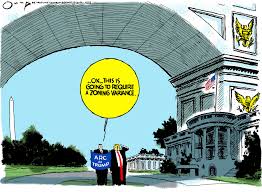
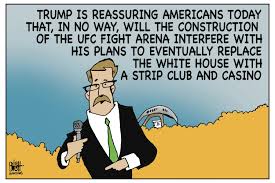
Don’t be distracted by all the bulldozing going on around the White House and the amazing number of has-beens that refuse to sing at his shindig. Although, damn, who asked for all this tacky shit like a Mixed Martial Arts Arena on the White House lawn or another Kid Rock concert? Doesn’t the Reflecting Pool look like it’s been filled with blue Gatorade? Why are we paying for shit we do not need or want? We are just funding Orange Caligula’s wet dreams!
Okay, let’s try Iran first. This is from CNBC’s Kevin Breuninger. I now have a daily ritual of being thankful I don’t have a car, while living on a bus line in an urban area. “Iran stops negotiations with U.S., vows to ‘completely’ block Strait of Hormuz: State media.” This is winning?
Iranian negotiators will stop exchanging messages with the U.S. through intermediaries, and Tehran will move to fully close the Strait of Hormuz, in retaliation for ongoing ceasefire violations, Iran’s state-affiliated news outlet Tasnim said Monday.
The report, in a translated post on the social media site Telegram, homed in on Israel’s military operations in Lebanon against the Iran-backed militia Hezbollah.
“No dialogue will take place” until Israel fully withdraws from occupied areas in Lebanon and stops all attacks in both Lebanon and Gaza, per Tasnim.
“Also, the resistance front and Iran have resolved to completely block the Strait of Hormuz and activate other fronts including the Bab al-Mandeb Strait, in order to punish the Zionists and their supporters,” the report said.
The Bab el-Mandeb Strait is a trade chokepoint that connects the Red Sea to the Gulf of Aden.
Oil prices leapt more than 7% higher following Tasnim’s report, which signaled a breakdown in efforts to reach a diplomatic end to the war that is now in its fourth month.
The AP reports that Iran sent bombs towards Kuwait, just as US Bombs were dropped on some of Iran’s military sites. “US bombs Iranian military sites, then downs missiles Tehran fired at troops in Kuwait.” Jon Gambrell has the lede.
The United States said Monday that it bombed radar and drone sites in Iran after Tehran shot down an American drone over the weekend. Iran then said it targeted American soldiers in Kuwait with missiles, which the U.S. says it shot down.
The nominal ceasefire between Iran and the U.S. has been repeatedly tested with such back-and-forth attacks, even as officials from both countries try to negotiate an end to the war. It’s not clear how close they are to a deal — and there is always the risk that an attack could derail those talks.
In the meantime, Iran has maintained its chokehold on the Strait of Hormuz, disrupting global energy supplies and driving up the price of fuel around the world, with far-reaching consequences. A cargo ship came under attack off Iraq Monday afternoon, the British military said.
Fighting has also escalated between Israel and the Lebanese militant group Hezbollah, despite their nominal ceasefire. Israel has extended its occupation deep into Lebanon, and Hezbollah — which joined the war in support of its main backer, Iran — continues to launch drones into Israel.
The fighting in Lebanon could threaten the emerging deal to extend the Iran war ceasefire. Tehran wants any agreement to include Lebanon.
Are we winning yet? You may read the details of all this at the link. Let’s move over to Slate where Dahlia Litwick and Mark Joseph Stern partner up with a story that’s a must-read. Thank goodness for the independent press. “The John Roberts vs. Donald Trump Story Conceals Something More Sinister.” See what hides behind all that destruction of our nation’s house and its norms?
This is part of Opinionpalooza, Slate’s coverage of the major decisions from the Supreme Court. The best way to support our work—and unlock exclusive legal analysis—is by joining Slate Plus. (If you are already a member, consider a donation or merch!)
On this week’s episode of Amicus, co-hosts Dahlia Lithwick and Mark Joseph Stern kicked off Opinionpalooza by discussing the court’s dangerous game of enabling the president right up until he imperils its own prerogatives. An excerpt of their conversation, below, has been edited and condensed for clarity.
Dahlia Lithwick: The Supreme Court keeps aligning with Donald Trump on this maximalist view of the imperial presidency, both in front of the curtain and behind it. For every case on the merits docket that gives Trump a big win in public, there are shadow docket cases that do the same in secret. It feels like any appearance of conflict between the president and the court is stage-managed, with lots of invisible wires we don’t always pay attention to
The Supreme Court has entered its final stretch of the term, with about two dozen opinions to hand down before the justices flee for their summer break at the end of June. At Slate, we call this mad dash to the finish line “Opinionpalooza,” and we approach it with equal parts fascination, skepticism, and dread every year. These remaining cases have massive implications for democracy, civil liberties, and the fundamental question of who gets to be an American; they include disputes over birthright citizenship, voting rights, immigration, and executive authority. Many will test Donald Trump’s ability to collapse the separation of powers into an autocratic presidency with no real limits on his rule. The justices will likely impose some restraints on Trump’s supersized monarchical ambitions in the weeks ahead, especially when they threaten judicial supremacy. All told, however, they will still hand him more victories in his larger assault on constitutional constraints. And where the ambitions of the MAGA wing of the court dovetail with Trump’s goals, Trumpism will run the table.
Mark Joseph Stern: This is one reason why, if the justices do strike down his attack on birthright citizenship, nobody should say: “Look, they’re putting Trump in his place! He’s really not a king!” Because there are so many other cases where the court is absolutely making him a king. It’s allowing him to consolidate so much power in the executive branch and specifically in the person of the president, and to run roughshod over all of these checks and balances that Congress enacted to prevent a monarchical or authoritarian president from abusing his power. And the Supreme Court is almost entirely aligned with Trump on this stuff, especially over the shadow docket, where that consolidation continues.
John Roberts does this magic trick: Do something small, get people accustomed to it, then do it big. We’ve seen this pattern in cases over the years where the Supreme Court makes a tiny tweak to prepare the country for when you later do the big thing. Then it’s less of a surprise and almost looks like it flows logically from when the court did it in a lesser way. The shadow docket has become the way you do that now, right? You seed the ground on the shadow docket and say: “Well, this is the law now.” This process used to take four or five years—do it small, wait a couple terms, then do it big. Now, with the shadow docket, you can do it within the same term, and make it look as though it’s inevitable or inexorable.
It leads to this interplay between the shadow docket and the merits docket. Roberts’ great gift is that he’s a master of optics and PR. He must know there was a huge outcry against the incredibly fast pace with which questions were being decided on the shadow docket: If Trump wanted something, the court saw it as an emergency; it assumed the president was always harmed, but ignored harm to the other parties. This second half of the term, there has been a pumping of the brakes on deciding big, existential questions over the shadow docket. Why is that?
I have a very cynical view of this: It’s less that the court has learned its lesson or become more solicitous toward lower court judges, and more that the court already accomplished a huge amount of what it wanted in terms of giving Trump what he sought. Trump came in and had expansive ideas about the scope of his executive power—impounding federal funds, firing executive officials, rewriting immigration laws—and by and large, the Supreme Court let him do it. The conservative supermajority issued all these shadow docket orders clearing the way for that to happen. Now it has happened; Trump’s takeover of the federal government is largely complete. So I just don’t think the court needs to issue nearly as many shadow docket orders as it did during that shock-and-awe campaign; it has already achieved its objectives.
You may head to Slate and catch all of the opinions on this very important subject. I have to mention the absolute shit show that was to be Trump’s Freedom 250 music concert. Social Media is just full of all the musicians who were listed but never contacted, dead but couldn’t be contacted, and, of course, wouldn’t be caught dead doing anything positive for Orange Caliguala. It’s meme heaven on there on this topic. Public Notice has this headline up. Paul Waldman has the story. “Trump’s ‘Freedom 250’ concert implodes spectacularly. His quest to dominate culture the way he dominates politics keeps going badly.”
It was going to be so beautiful: A spectacular concert to celebrate 250 years of freedom and democracy, featuring some of the greatest musical acts this nation has produced.
Okay, maybe not the greatest, but they were definitely musical acts! Depending on whether you count Milli Vanilli, or more accurately, one of the two guys who pretended to sing in Milli Vanilli. Along with a guy who was in C+C Music Factory. And Bret Michaels of Poison. For anyone itching to stand outside in the baking Washington summer sun to hear some guys in their 60s wheeze their way through “Girl You Know It’s True” and “Every Rose Has Its Thorn,” the disappointment must be crushing.
It now appears that this concert, part of the Freedom 250 celebration and the most awe-inspiring assemblage of talent since your local middle school’s last Battle of the Bands, will not be taking place after all. One after another, the 1990s-era performers pulled out, many saying that when they booked the event they didn’t know it was going to be political.
In other words, once they realized the event was all about Donald Trump, most of them wanted nothing to do with it.
Despite the fact that Vanilla Ice was still planning to perform, Trump announced on Saturday that he was pulling the plug, and would instead make the event just another Trump rally:
Does this sound like someone who is grounded in reality or sanity?
Max Boot sure has changed since his days of being a staunch movement conservative. He wrote this Op-Ed for the Washington Post. “Trump is taking a wrecking ball to U.S. alliances around the world. Trashing America’s European partners while undermining its Asian allies’ security.” This should be obvious to everyone. But here we are back with the legacy media, finding that they’ll publish something harsh ever so often.
The “secret sauce” of American power in the post-1945 era has been the country’s network of alliances. The Soviet Union had satrapies in Eastern Europe, but few real friends. Russia doesn’t even have satellite states anymore, aside from Belarus. It does have an increasingly warm but still wary relationship with China. Beijing, in turn, is close to just a handful of other countries; North Korea is its only treaty ally.
The United States, by contrast, has 51 treaty allies all over the world. Advantage, America. But good news for America’s enemies: President Donald Trump appears intent on doing to U.S. alliances what he has already done to the East Wing of the White House. Let’s take a tour of the world to see the damage he is inflicting with his wrecking-ball diplomacy.
Start in Europe. Trump did possibly irreparable damage to the transatlantic alliance when he threatened to annex Greenland. In January, Denmark, a NATO ally, was getting ready to fight U.S. troops if they invaded Greenland. After backing off, Trump is now making fresh demands — such as guaranteeing U.S. troops access to Greenland even if it becomes independent — that Greenland officials view as a major imposition on their sovereignty.
Trump has also ratcheted up his attacks on NATO for not doing more to support the reckless war the U.S. and Israel launched against Iran. He focuses on countries such as Italy and Spain that have blocked access to their bases, while ignoring NATO countries such as Britain and Germany that remain major hubs of the U.S. war effort. He has even demanded that NATO countries reopen the Strait of Hormuz — a mission the U.S. Navy hasn’t dared to take on. In late March, Trump said of NATO: “Why would we be there for them, if they’re not there for us?”
Since then, his administration has announced plans to withdraw 5,000 troops from Germany and canceled the deployment of a brigade to Poland, although Trump subsequently said he would send more troops to Poland, perhaps from Germany. There are also reports that the administration wants to substantially reduce the number of U.S. warplanes and warships committed to Europe in a crisis. Trump has blocked new U.S. aid for Ukraine, and hasn’t condemned Vladimir Putin’s recent missile and drone strikes on Ukrainian civilians — and now on an apartment building in Romania. He doesn’t even call out Putin for helping Iran target U.S. forces. How could anyone have any confidence that, if Russia were to start a war with NATO, the U.S. would come to its defense?
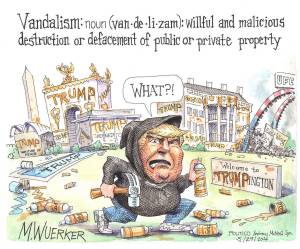
This is my last offering, although wow, this week’s headlines are sure to continue to shock and awe the globe. Don Monihan has this analysis up on his SubStack about the War against Science. This is, again, an important subject. We can always drain the Reflecting Pool of its Blue Gatorade after he’s gone. “The Creep of Politicization. A new assault on science highlights a broader pattern.”
The White House proposed new policies governing the federal funding of American science. You’ve already heard about the funding cuts, de facto impoundments of funds, funding freezes to disfavored universities, and cancelation of grants that include the long list of the Trump’s forbidden words.
So how much worse can the new policy be? Scientists are using apocalyptic terms, like “the end of American science as we know it.”
I think the level of alarm is appropriate, but I also want to place it into a broader context. Instinctively, scientists know this policy is not a stand-alone, but the ratcheting of the vice-grips of politicization. Trump has assembled five distinct tactics of politicization that are now starting to work in tandem with one another.
As Trump’s politicization tactics operate together, they begin to generate more interactive effects, reinforcing one another. The creep of politicization seeps into every office and decision, choking any views other than those of Trump and his army of loyalists.
Politicization can mean different things. The classic pre-Trump and mostly bipartisan Presidential tactics of politicization are:
Tactic #1: Centralization of policymaking into the White House, moving power from agencies
Tactic #2: Strategic use of political appointees, moving power away from distrusted career employees
Trump has developed new modes of politicization by adding three tactics:
Tactic #3: Building a personalist regime centered on loyalty to a single person.
Tactic #4: Governing by fearvia conspiratorial messaging and threat.
Tactic #5: Weakening the protections of civil servants to effectively make them at will employees.
The nature and the scale of these tactics is really without parallel in US history, even in the spoils era. In the spoils era there was real and endemic corruption. That is occurring now, but in a more damaging and extractive way, disproportionately favoring an inner circle looking to get rich(er), not just the loyal partyman looking for a job.
The US government is also doing a lot more now than it was in the spoils era. Science is a good example. The current US scientific empire is the result of the post World War II set of arrangements that Trump and Vought are now seeking to control and corrupt for their own ends.
You may read more at the links. It’s going to be a long, hot summer. I’ve got to get my backyard peace garden into shape. I’m hoping for a more traditional 4th of July with neighbors and friends.
What’s on your Reading, Action, and Blogging list today?

 peej
peej Carissa
 bostonboomer
 dakinikat
 ecocatwoman
 jjlo
jjlo mablue2
 Mama Lopez
 peggysue22
 quixote
 skydancingguestblogger
 Mona (aka Wonk the Vote)



 Sky Dancing
Recent Comments