
Is Goldman CEO Lloyd Blankfein Facing Possible Prison Time?
Posted: August 24, 2011 Filed under: Corporate Crime, Crime, The Bonus Class, U.S. Economy, U.S. Politics | Tags: corporate crime, corruption, Goldman Sachs, Lloyd Blankfein, Naomi Prins, Reid Weingarten, Senate Permanent Subcommittee on Investigations 4 Comments
Lloyd Blankfein
That’s the question Naomi Prins, a former managing director of Goldman Sachs and author of It Takes a Pillage: Behind the Bonuses, Bailouts, and Backroom Deals From Washington to Wall Street, asked yesterday at The Daily Beast.
I posted in a comment yesterday that I’d heard Blankfein hired a well-known Washington criminal defense attorney. Since then, the business media has been buzzing about why Blankfein hired attorney Reid Weingarten.
Big-shot Washington defense attorney Reid Weingarten, of the firm Steptoe & Johnson LLC, has represented former Enron chief accounting officer Richard Causey (who pleaded out), former Rite Aid vice chairman and chief counsel Franklin Brown (found guilty by a jury on 10 counts of conspiring to falsely inflate his company’s value), and former WorldCom CEO Bernie Ebbers (convicted on nine felony counts by a jury). All three are in jail. Two of them, Ebbers and Causey, had undergone congressional panel investigations beforehand. Another of Weingarten’s clients, former Tyco counsel Mark Belnick, was acquitted, though Tyco CEO Dennis Kozlowski, who was not represented by Weingarten, was convicted and remains in jail.
Prins speculates that Blankfein may be in trouble for two possible reasons. The first is because of his own “loose lips,” when he testified before the Senate Permanent Subcommittee on Investigations in April.
Recall that Blankfein emphatically told the subcommittee, “We didn’t have a massive short against the housing market, and we certainly did not bet against our clients.” The 650-page subcommittee report (PDF) presented on April 13, 2011, which cites Blankfein 79 times, begs to differ.
The report accused Goldman of trading against its clients by simultaneously shorting certain subprime mortgage securities (a.k.a. “cats and dogs”) while stuffing them into the collateralized debt obligations it sold. It also suggested that Goldman executives, including Blankfein, misled Congress in testimony surrounding the Abacus CDO, Hudson, Timberwolf, and other deals, by saying it didn’t have a big short.
The second possibility is that Blankfein’s colleagues are distancing themselves from him in order to protect themselves and Goldman Sachs. Prins writes:
The top lesson I learned before leaving Goldman in the wake of Enron was Goldman’s foremost internal policy is to protect Goldman. It’s also to protect the most powerful members. When cracks manifest in the corporate armor, those two policies are at odds.
The executives running Goldman are exceedingly wealthy, not least because when the firm faced its darkest hour and lowest stock price in years during the bank-created crisis of fall 2008, the government provided it billions of dollars in the form of cheap loans, FDIC debt guarantees, TARP, AIG make-wholes, and a late-night moniker change from investment bank to bank holding company, giving the firm access to excessive Federal Reserve aid.
After the news came out that Blankfein had hired Weingarten, Goldman’s shares fell 6%, and according to Prins, that kind of thing is “frowned upon.” So Blankfein may be be trying to protect himself from being stabbed in the back by his co-workers in addition to fighting anything the Justice Department has planned for him.
I doubt if Obama and Geithner will let Blankfein go to prison, but it will be fun to watch him and the wealthy Goldman partners feeling a little bit of discomfort.
Two Reuters columnists speculated about this story today. Leigh Jones writes:
If you need to hire Reid Weingarten, your career has probably hit a rough patch.
The rule now applies to Goldman Sachs (GS.N) CEO Lloyd Blankfein, who Reuters reported on Monday has retained Weingarten, a partner at Steptoe & Johnson in Washington.
With that move, Blankfein becomes the latest in a long line of executives and high-profile people in trouble who have turned to Weingarten for help. They range from Tyco (TYC.N) corporate counsel Mark Belnick, for whom Weingarten won an acquittal, to ex-Enron accounting officer Richard Causey, who pleaded guilty to fraud and conspiracy, to film director Roman Polanski, who tapped Weingarten to fight extradition to the Unites States for sexually assaulting a 13-year-old girl in 1977.
Jones spends most of the piece providing background on Weingarten, but he also points out that Blankfein’s choice of attorney is telling, and like Prins he notes the market reaction:
Blankfein’s choice of Weingarten as his lawyer has raised questions about what kind of trouble the Goldman Sachs CEO might be in. The DOJ, where Weingarten once worked, is investigating the bank for mortgage-related investments it made.
While it is not unusual for company leaders to arm themselves with their own lawyers, Weingarten’s reputation as a litigator — as opposed to a lawyer who guides clients through investigations — is making Goldman investors nervous. The day that Blankfein’s hiring of Weingarten broke, the bank’s stock dropped nearly 5 percent to its lowest level since March 2009. By late Wednesday afternoon, the shares were at $109.92, up 3.2 percent from Monday’s close at $106.51.
Alison Frankel is more sanguine, arguing that Blankfein hiring an outside attorney is really no big deal.
The market assumed the worst on Monday after Reuters’ great scoop on Goldman Sachs (GS.N) CEO Lloyd Blankfein bringing in Reid Weingarten of Steptoe & Johnson to represent him in the Justice Department’s investigation of the bank. Goldman’s share price fell almost 5 percent on the fear that Weingarten’s entrance signals that DOJ is getting serious about its follow-up to the April 2011 Senate subcommittee report on the financial crisis.
In one sense, that’s reading way too much into the mere fact that Blankfein has brought in his own lawyer. It’s standard operating procedure for corporate executives at companies under investigation to have separate counsel. Consider the example of other alleged villains of the financial meltdown. Richard Fuld of Lehman (LEHKQ.PK), Joseph Cassano of AIG (AIG.N), Angelo Mozilo and David Sambol of Countrywide, John Thain of Merrill Lynch, Kenneth Lewis of Bank of America (BAC.N): They all have their own lawyers, and none of them have faced any criminal charges. Only Mozilo and Sambol even had to answer to the SEC.
She provides a number of examples of other executives doing just that. But…
Nevertheless, Blankfein’s choice of Weingarten is very intriguing. Weingarten is a great lawyer with close ties to the Justice Department, where he once worked in the Public Integrity section, and to Attorney General Eric Holder, whom he actually represented when Congress grilled Holder about President Bill Clinton’s eleven-hour pardon of financier Marc Rich. Weingarten is not, however, part of the club of white-collar defense counsel who typically get referrals from New York firms like S&C. (That group includes Andrew Levander of Dechert; Mary Jo White of Debevoise & Plimpton; Patricia Hynes of Allen & Overy; and Gary Naftalis of Kramer Levin Naftalis & Frankel, all of whom represent high-profile Wall Streeters in financial crisis cases.)
One white-collar defense lawyer who gets referrals from Wall Street firms told me it could be significant that Blankfein went outside the usual circle, turning to a lawyer best known for his trial work. “For many people, the choice of Reid Weingarten would be unusual to represent someone in a simple interview,” he said. “He’s often retained when an investigation is going to lead to a case that would go to trial.”
Hmmmm…. Okay, I’ll believe it when I see it, but I can dream, can’t I?
Some juicy gossip about Rep. Paul Ryan and his drinking buddies
Posted: July 10, 2011 Filed under: Corporate Crime, Economy, Psychopaths in charge, Republican politics, the villagers, U.S. Economy, U.S. Politics | Tags: AQR Capital, Barack Obama, Bistro Bis, Brad De Long, Clifford Asness, Elizabeth Fama, Eugene Fama, freshwater economists, Goldman Sachs, hedge fund managers, Jayer-Gilles 2004 Echezeaux Grand Cru, John Cochrane, Paul Krugman, Paul Ryan, Susan Feinberg, Talking Points Memo, University of Chicago, wine 12 Comments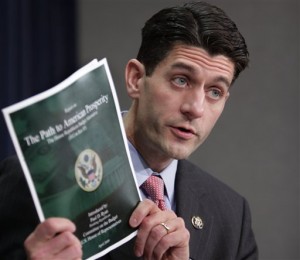
Paul Ryan hawking his plan to throw grandma from the train
You may have seen this gossipy story about Rep. Paul Ryan at Talking Points Memo on Friday. I’ve been meaning to post something about it but just haven’t found the time. Now TPM has a very interesting update. Here’s the background:
Rep. Paul Ryan (R-WI), a leading advocate of shrinking entitlement spending and the architect of the plan to privatize Medicare, spent Wednesday evening sipping $350 wine with two like-minded conservative economists at the swanky Capitol Hill eatery Bistro Bis.
[….]
Susan Feinberg, an associate business professor at Rutgers, was at Bistro Bis celebrating her birthday with her husband that night. When she saw the label on the bottle of Jayer-Gilles 2004 Echezeaux Grand Cru Ryan’s table had ordered, she quickly looked it up on the wine list and saw that it sold for an eye-popping $350, the most expensive wine in the house along with one other with the same pricetag.
Feinberg, an economist by training, was even more appalled when the table ordered a second bottle. She quickly did the math and figured out that the $700 in wine the trio consumed over the course of 90 minutes amounted to more than the entire weekly income of a couple making minimum wage.
Feinberg took some photos with her cell phone, approached the table and asked whether the two men with Ryan were lobbyists. One of the men responded by saying, “F&ck her.” Ryan claimed the two men were economists but refused to provide their names. Ryan then paid for one of the bottles of wine, but when asked about the appropriateness of spending so much when he was going all Dickensian on old people, Ryan avoided answering.
Today, TPM learned the identity of the two men who wined and dined Ryan on Friday night.
TPM has confirmed that the two other men with Ryan were Cliff Asness and John Cochrane. Both men have doctorate degrees in economics and are well-known in the conservative media world as die-hard proponents of the free market’s ability to right itself without government bailouts when the crisis hit in late 2008.
Asness, who ordered the wine and who, according to Feinberg was the one who said “Fuck her,” is better known as a high-profile hedge fund manager. Asness founded and runs AQR Capital, which manages an estimated $26 billion in a variety of traditional products and hedge funds, and his life story has been the subject of numerous books and articles about the rise and fall of Wall Street. He’s also grabbed headlines for being one of the most voluble opponents of President Obama’s economic policies.
[….]
Cochrane, the other, more tempered dinner companion, is the AQR Capital Management Distinguished Service Professor of Finance at the University of Chicago, an apparent tip of the hat to the contributions Asness’ AQR Capital Management has made to the Booth School of Business there.
Before launching AQR Capital in 1997, Asness worked for Goldman Sachs, the most profitable securities firm in Wall Street history, as the director of quantitative research for its Asset Management Division.
Via TPM, in 2009, Asness wrote an open letter to Barack Obama in which he (Asness) complained bitterly about some mildly critical remarks the President had made about hedge fund managers who refused to help out by buying Chrysler bonds. From New York Magazine:
Clifford Asness, the filthy-stinking-rich quant behind AQR Capital Management, [is] publicly engaging with a formidable opponent: The president of the United States. Asness, who supported Obama during the election, was appalled by Obama’s treatment of his colleagues during the Chrysler situation, and although he was not personally involved, he felt he had to make a stand.
Here is a portion of the letter:
Here’s a shock. When hedge funds, pension funds, mutual funds, and individuals, including very sweet grandmothers, lend their money they expect to get it back. However, they know, or should know, they take the risk of not being paid back. But if such a bad event happens it usually does not result in a complete loss. A firm in bankruptcy still has assets. It’s not always a pretty process. Bankruptcy court is about figuring out how to most fairly divvy up the remaining assets based on who is owed what and whose contracts come first. The process already has built-in partial protections for employees and pensions, and can set lenders’ contracts aside in order to help the company survive, all of which are the rules of the game lenders know before they lend. But, without this recovery process nobody would lend to risky borrowers. Essentially, lenders accept less than shareholders (means bonds return less than stocks) in good times only because they get more than shareholders in bad times.
The above is how it works in America, or how it’s supposed to work. The President and his team sought to avoid having Chrysler go through this process, proposing their own plan for re-organizing the company and partially paying off Chrysler’s creditors. Some bond holders thought this plan unfair. Specifically, they thought it unfairly favored the United Auto Workers, and unfairly paid bondholders less than they would get in bankruptcy court. So, they said no to the plan and decided, as is their right, to take their chances in the bankruptcy process. But, as his quotes above show, the President thought they were being unpatriotic or worse.
Well, Duh! But if “filthy, stinking rich” guys like Asness were patriotic, we probably wouldn’t have had a financial meltdown in the first place, now would we?
The other guy with Ryan on Friday, Professor John Cochrane of the University of Chicago, is a freshwater economist and follower of Eugene Fama AKA “the father of modern finance,” and Robert R. McCormick Distinguished Service Professor of Finance a the University of Chicago. Cochrane is also married to Fama’s daughter Elizabeth.
In early 2009, Cochane and Nobel Prize-winning economist Paul Krugman engaged in a legendary on-line debate that also involved Brad De Long and Eugene Fama. The whole thing was too wonky for me, but I gather it had something to do with Fama and Cochrane critiquing the use of fiscal stimulus and Krugman saying that the two freshwater economists wanted to return to the “Dark Ages of macroeconomics.” Here’s Krugman’s introductory paragraph:
Brad DeLong is upset about the stuff coming out of Chicago these days — and understandably so. First Eugene Fama, now John Cochrane, have made the claim that debt-financed government spending necessarily crowds out an equal amount of private spending, even if the economy is depressed — and they claim this not as an empirical result, not as the prediction of some model, but as the ineluctable implication of an accounting identity.
Maybe Daknikat can explain what the “cage match” was all about.
I think Paul Ryan is going to need to be a little more careful in the future if he is going to continue promoting the end of Medicare as we know it.
The Shadow Boys
Posted: April 17, 2011 Filed under: financial institutions, Global Financial Crisis | Tags: Goldman Sachs, Hank Paulson, Money and Power: How Goldman Sachs Came to Rule the World, Steven Friedman, William Cohen 10 Comments
Yond’ Cassius has a lean and hungry look;
He thinks too much: such men are dangerous.
— Julius Caesar
There will be plenty of both academic and journalistic research done trying to figure out what went woefully wrong with finance markets in the first decade of this century. I’ve just co-authored a paper that will be out shortly in a peer reviewed journal on how the bubble in the mortgage market probably passed into the market for Real Estate Investment Trust funds (REITS) that were once considered one of the safest and least volatile investments on the planet. They used to have good patterns of fairly consistent returns too. However, that was then and this is now. Now is a different reality and the three scoundrels in the picture above are part of the reason. These three are part and parcel of how the vampire squid came to rule the world of finance. You’re looking at a young Ex-Treasury secretary Hank Paulson, Steve Friedman, and Jon–was Governor of New Jersey–Corzine. Take a good long look at that trio of dangerous, lean and hungry men.
Their exploits are outlined in the latest who-did-this-to-us book “Money and Power: How Goldman Sachs Came to Rule the World” By William Cohan. I don’t have the book yet but the reviews and articles that its release is spawning are everywhere. The firm started out as man named Goldman who was a simple dealer in commercial paper at the onset of the switch from mercantilism with its emphasis on natural resources and people to capitalism with its emphasis on money. For years, the company was a partnership (the start of IPO move started around 1996 and happened in 1999) and its reputation was that of a firm committed to teamwork and a laser-like focus on serving clientele despite a past riddled with scandals. How this situation went from that corporate identity to a group of hot shot sales egos selling toxic mortgages and derivatives to customers is the focus of the book. Oh, and the most important part is that they did all that selling while having offsetting bets to what they were pushing to customers during the financial crisis that paid of hugely. The Economist’s review of the book explains why Cohan’s book stands out in the recent flurry of Goldman Sachs psychodrama financial novels. Cohan has some fresh material which seems even more revealing given Carl Levin’s latest pronouncement. Basically, Levin argues that Goldman Sachs bet against the stuff they sold clients (Credit Default Obligations) and then lied to congress about it.
Much of the blame for the 2008 market collapse belongs to banks that earned billions of dollars in profits creating and selling financial products that imploded along with the housing market, according to the report. The Levin-Coburn panel levied its harshest criticism at investment banks, in particular accusing Goldman Sachs and Deutsche Bank AG (DB) of peddling collateralized debt obligations backed by risky loans that the banks’ own traders believed were likely to lose value.
In a statement, New York-based Goldman Sachs denied that it had misled anyone about its activities. “The testimony we gave was truthful and accurate and this is confirmed by the subcommittee’s own report,” Goldman Sachs spokesman Lucas van Praag said.
“The report references testimony from Goldman Sachs witnesses who repeatedly and consistently acknowledged that we were intermittently net short during 2007. We did not have a massive net short position because our short positions were largely offset by our long positions, and our financial results clearly demonstrate this point,” van Praag said.
It remains to be seen if the Obama DOJ will pursue any legal action against the firm. The Economist article has a more succinct explanation albeit it with a bit of finance jargon thrown in. Are the actions of the shadow banking behemoth illegal or just maleficent? Given the horrible state of regulatory framework and the abysmal performance of the SEC under Christopher Cox, it appears to be walking both sides of that line that’s frequently called the Chinese Wall. We could also say that the District has not had an active interest in translucent, standardized, and information symmetric-financial markets for decades. Eliot Spitzer–who knows about Wall Street wrongdoing–thinks Holder should prosecute GS or quit. The Economist states that:
Goldman has pushed this envelope further than other investment banks, believing it had the skill to manage the resulting conflicts. It insists that the Chinese walls separating its traders and bankers are always impermeable.
But outsiders are less inclined to trust it these days. Using client information to increase its trading edge—if that is what Goldman does—may not be against the law, but it is hardly honourable. As the author puts it, the scandal may not be what’s illegal but what’s legal.
Controversy also swirls around Goldman’s “marks”, or the prices at which it valued its mortgage holdings during the crisis. These were much lower than those of its rivals, drawing accusations that it was trying to force them to mark their portfolios down to the same level so that it could pick up assets on the cheap in the ensuing wave of firesales.
Goldman’s aggressive stance certainly caused massive pain, speeding the demise of Bear Stearns and AIG. But as mortgage delinquencies ballooned, Goldman’s marks were shown to be more accurate than those of the other big houses. Its longstanding “mark-to-market” discipline meant it was better placed to face the truth. There is no evidence of a conspiracy to post unreasonably low valuations. There was, in fact, a vigorous debate within Goldman about the right level, just as there was over the firm’s overall risk levels. Angry at being reined in by its powerful risk managers, traders dubbed them the “VAR police”, a reference to the value-at-risk models they used to measure how much was on the line.
My late night relaxing in the tub reading of all this started with the book’s adaptation in Vanity Fair. There’s an interview with author William Cohan on its website. I suppose I should mention that Cohan worked at GS. His excerpt in the May issue characterize GS of the 1990s as the stage for an Alpha War. I have to say from what I’ve read to date, John Corzine is the one that comes off the worst for exposure. I pity poor New Jersey. Corzine’s trading positions in fixed income sound like something out of Bonfire of the Vanities and The Black Swan simultaneously. Corzine appears to be the type who won’t stop doubling down, even when he’s losing big time. Cohan’s VF article focuses on the period of around 1994 when Friedman was trying to deal with the loss of Robert Rubin who had headed of to the Clinton Administration to be Secretary of the Treasury. One of the big things that I realized when reading all of this was how many Secretaries of the Treasury over a huge number of years have connections to GS. It makes you believe in secret banking cabals.
Popular at the firm for his genial manner, Corzine also had his critics. “He is charming,” says one partner. “He’s got a really nice style. He comes in an attractive package, so although he has got a huge ego and huge ambition—which far exceeds his ability in both those things—he comes across in a laid-back, low-key, disarming style.”
The partner explains the origin of Corzine’s Goldman nickname: “Fuzzy.” It derived not only from his beard, but also because he was “a fuzzy thinker. He wasn’t crisp and wasn’t black and white. He fuzzed things when he communicated.”
The VF article is a veritable soap opera of tension and struggles between Corzine and Paulson. The one pervasive criticism that I’ve seen of the book as of right now is that the drama still didn’t stop or explain how GS manages to make so much money. Perhaps the Levin Report and its supporting documents have more information that would interest a financial economist. The narrative in this book is from former employees, clients, and just about any one else that would dish the conflicts to Cohan. Many of these remain “unnamed sources”. Goldman’s sketchy history was also fascinating to me.
After all, this is a firm that periodically eviscerates those who trust it most. In the 1920s, Goldman ran a Ponzi-like scheme involving investment trusts. In the 1970s, it peddled soon-to-be-worthless commercial paper for the soon-to-be-bust Penn Central Railroad. And, in 2007, the firm that prided itself on being “long-term greedy” sold gullible clients on the merits of mortgage-backed securities while simultaneously shorting some of those same debt obligations. The firm has succeeded, in part, by ignoring these nastier aspects of its past. In fact, Goldman never misses an opportunity to celebrate the holier-than-thou principles laid down by former senior partner John Whitehead. Rule No. 1: Our client’s interests always come first.
Money and Power suggests the bank does possess a few special powers, starting with its remarkable ability to convince some of the world’s smartest young people that touting stocks, sniffing out arbitrage opportunities, and shaking down corporate clients amount to a noble calling. One illuminating anecdote in Money and Power concerns Robert Rubin, the former Goldman head who would go on to become Treasury Secretary under Bill Clinton. During his third year at the firm, back in 1969, Rubin’s career path may have hit a rough patch. Sandy Lewis, who at the time ran the arbitrage department for a rival bank, tells Cohan that Rubin approached him regarding a job opportunity. Lewis explains that Rubin had grown disgusted with the Goldman way. “It’s a dishonest mess,” Lewis recalls Rubin saying to him, “that’s making honest people dishonest.”
I skipped into this interesting bit of hearsay quoted by the NYT. As you know, GS has friends in high high places so I find this a bit ominous. This is where the book lends credence to the recent Levin pronouncement.
About Goldman Sachs’s present-day business practices, one “private equity investor” says this: “They view information gathered from their client businesses as free for them to trade on … it’s as simple as that. If they are in a client situation, working on a deal, and they’re learning everything there is to know about that business, they take all that information, pass it up through their organization, and use that information to trade against the client, against other clients, et cetera, et cetera.” The speaker stops short of labeling this as insider trading, but only barely, saying, “I don’t understand how that’s legal.”
Mr. Cohan raises the same question as he writes that the firm’s onetime dedication to its clients has evolved into something more ruthlessly self-serving. “Its primary source of profit has shifted from banking to trading,” he writes, “and the firm is intentionally quite vague about how, and precisely where, those trades are made or, equally relevant, from whom the profits are coming.”
Indeed, the GS Big Short” may have been more responsible for the meltdown than any one thought previously and hearing about these behind-the-scene alpha male wars doesn’t enhance the firm’s supposed client-centric claim or its testimony that fell back on its mantel as the role of market-maker. I watched the hearing completely and was appalled at how little Levin’s panel knew of the world it was supposed to regulate. There were few intelligent questions and even fewer cogent responses.
But the key players in enacting the strategy were Dan Sparks, head of the mortgage division, and his most senior traders, Josh Birnbaum and Michael Swenson.
All three were key witnesses called by Levin’s committee a year ago. The trio were quizzed alongside the now notorious trader Fabrice Tourre, who is still defending himself in the American courts against a separate claim by the Securities and Exchange Commission that he duped investors into buying mortgage assets that he expected to collapse in value.
That trade was in fact a sideshow to the wider strategy set in motion by that momentous meeting in December 2006. From that point onwards Goldmans began to cut its exposure to American mortgages and set up a series of short positions to gamble on a housing market crash.
At the same time it began publicly marking down the value of those mortgage securities it held, forcing other banks to do the same. But unlike Goldmans, the others had not taken out short positions and when the crisis came they could not offset the huge losses these markdowns involved.
Within eight months of the December meeting, the storm had broken. Credit was drying up in financial markets, rumours of banks in crisis swept through the world’s financial capitals and by September the squeeze on banks led, in Britain, to the emergency loans to Northern Rock and eventually its collapse into State ownership.
Cohan, who interviewed Birnbaum and many others for his book, claims that in 2007 Goldmans’ mortgage desk made a profit of $4 billion from its shorting, helping the bank turn a total profit for the year of $13.5 billion – $9 billion of which ended up as bonuses for staff. Birnbaum, Cohan claims, had wanted to be even more aggressive but the risk department at Goldmans was frightened of going too far in case the gambles went wrong.
In the end, this saga may well play itself out in the world of researchers outside of the beltway who get access to the Levin committee’s documents. We can always hope that Holder will investigate his boss’s biggest campaign contributor during a campaign cycle in the way that children hope that Santa Claus is real. The White House could make Carl Levin into an old man who tilts at Windmills. What is worrisome is how interconnected the alpha males on Wall Street are with the ones that strut around Pennsylvania Avenue. It’s hard to miss the co-dependency of campaign-fund addict with drug dealer who needs special favors when you read so many sources with similar themes. It makes a mere mortal like me want to put my money some place out of their reach. I don’t think I’d want a stake in anything near New Jersey either. My greatest fear, however, is that we know so much about how all this happens and yet we do nothing. The evidence is out there. There’s no real change afoot. Who will the ghost of Caesar haunt?
Thursday Reads
Posted: January 20, 2011 Filed under: U.S. Economy, U.S. Politics | Tags: Christian fundamentalists, financial regulation, Goldman Sachs, Governor of Alabama, health care reform bill, Jerad Loughner, Robert Bentley, snow, Tucson shooting, U.S. Economy, U.S. Politics, weather 35 Comments
Good Morning!! Let’s see what’s going on out there in the world.
A federal grand jury has indicted Tucson shooter Jerad Loughner.
Jared Loughner was indicted by a federal grand jury Wednesday in Tucson on a three-count indictment for attempting to kill U.S. Rep. Gabrielle Giffords and two of her aides, Pamela Simon and Ron Barber. The announcement came from U.S. attorney Dennis K. Burke’s office.
Burke said, “This case also involves potential death-penalty charges, and Department rules require us to pursue a deliberate and thorough process. [Wednesday]’s charges are just the beginning of our legal action. We are working diligently to ensure that our investigation is thorough and that justice is done for the victims and their families.”
According to the indictment, Loughner, 22, attempted to assassinate Gabrielle Giffords, a member of Congress, and attempted to murder two federal employees, Ron Barber and Pamela Simon.
A conviction for attempted assassination of member of Congress carries a maximum penalty of life in prison, a $250,000 fine or both, according to Burke’s office.
That happened really quickly, didn’t it?
Have you heard there’s more snow coming for the Midwest and Northeast? Oh joy. Right now they are saying 3-5 inches for Boston. That’s not too bad, except for the fact that we already about about 2-1/2 feet piled up everywhere. Oh well… check the story to see what might be coming your way.
According to the Wall Street Journal, poor poor Goldman Sachs is hurting.
Goldman Sachs Group Inc.’s profit slide of 52% in the fourth quarter showed the securities giant’s size and swagger aren’t enough for it to escape the tightening squeeze of a regulatory overhaul and jittery clients and investors.
The New York company suffered its third quarterly profit decline in a row, hurt by lower revenue from its vaunted trading and investment-banking businesses. Fourth-quarter net income fell to $2.39 billion, or $3.79 a share, from $4.95 billion, or $8.20 a share, a year earlier.
Oh those nasty regulations! Is anything like that really happening? I’m confused. Oh wait. It’s not really regulations, it’s just the Wall Streeters’ fears of risk or something.
Like its rivals, Goldman is being hurt by the reluctance of many institutional investors, wealthy individuals, companies and other clients to take risks because they still are reeling from losses during the crisis. Hedge funds are weaning themselves from some of the leverage used to make big bets, and U.S. companies are holding more than $2 trillion in stagnant cash.
As a result, demand for the vast inventory of stocks, bonds and other investments that Goldman buys and sells on behalf of customers, generating commissions and other fees for the firm, fell in the latest quarter. Trading-related revenue shrank 31% to $3.64 billion from $5.25 billion in 2009’s fourth quarter.
Whatever… A bunch of rich people whining. Just what you wanted to hear about with your morning coffee, I’ll bet.
The Governor of Alabama doesn’t consider me among his brothers and sisters. Shock!
Alabama Republican Governor Robert Bentley said in a Martin Luther King Jr. Day message Monday that he does not consider Americans who do not accept Jesus Christ as their savior to be his brothers and sisters.
“There may be some people here today who do not have living within them the Holy Spirit,” Bentley said shortly after taking the oath of office, according to the Birmingham News. ”But if you have been adopted in God’s family like I have, and like you have if you’re a Christian and if you’re saved, and the Holy Spirit lives within you just like the Holy Spirit lives within me, then you know what that makes? It makes you and me brothers. And it makes you and me brother and sister.”
”Now I will have to say that, if we don’t have the same daddy, we’re not brothers and sisters,” he continued. “So anybody here today who has not accepted Jesus Christ as their savior, I’m telling you, you’re not my brother and you’re not my sister, and I want to be your brother.”
Awww… I’m really hurt.
Didja hear the new Republican House voted to repeal the useless Republican style health care non-reform bill?
The vote passed Wednesday 245-to-189 — with unanimous GOP support, plus three Democrats. But the repeal bill is destined to die in the Senate, so Republicans will use their newly acquired power in the House to wage a long-term campaign to weaken the law.
The next steps — hearings, testimony from administration officials, funding cuts — lack the punch of a straight repeal vote, but Republicans said they will keep at it, hoping the end result is the same: stalling implementation of the $900 billion law.
Republicans promise to hold a series of hearings and oversight investigations into the law, attempt to repeal individual provisions and craft an alternative health care plan. Some of the first issues they will tackle are the cost of the law, the mandate on larger employers to provide coverage and the impact of the legislation on the states.
But the GOP is expected to be thwarted at every turn by the Democratic-controlled Senate — and ultimately President Barack Obama, who has said he is willing to “improve” the law but “we can’t go backward.”
{HUGE YAWN}
At least while they’re fooling around with Obamacare, they’re not repealing Social Security….
Sooooo…. what are you reading this morning? Anything cheerful happening?
Monday Reads
Posted: January 10, 2011 Filed under: Civil Liberties, Civil Rights, financial institutions, U.S. Economy, U.S. Politics | Tags: and Civil Liberties, Arizona shooting, buried cemetery, censorship, Civil Rights, Darrell Issa, Facebook, Goldman Sachs, House Oversight Committee. Jerry Nadler, House Subcommittee on the Constitution, Huckleberry Finn, LA Heritage Center, literature, Mark Twain, Morning reads, public employee unions, Racism, Republicans, Shakespeare, slurs, war on unions 42 Comments
Good Morning! It’s been a tough weekend. As usual when dreadful events happen, the cable channels are covering the shooting in Arizona 24/7. Things are still happening in the DC despite the horror of that story. I just don’t know how much more I can read about it. Thinking about senseless hatred and violence is starting to make me feel physically ill.
If you do want to read more about the Arizona tragedy, the Washington Post has special section on it: Special Report: The Tucson shooting rampage. The New York Times also has lots of stories and photos on the front page.
Now I’ll see if I can find any other important stories for you to check out this morning.
On Saturday, I wrote a long piece on Darrell Issa, the man who is going have subpoena power as Chairman of the House Oversight Committee. The man is a thug, and we’d better be paying attention to what he’s doing. I hope when the news about the shooting calms down that people will take a look at that piece. I don’t usually “pimp” my posts, but I feel that this one is important.
Now I see that the Republicans plan to make changes in another important House committee: Republicans banish ‘civil rights’ and ‘civil liberties’ from House subcommittee
Congressman Jerrold Nadler (D-NY) blasted Republicans for planning to change the name of the Subcommittee on the Constitution, Civil Rights, and Civil Liberties to the “Constitution Subcommittee.”
“Once again, the new Republican majority has shown that it isn’t quite as committed to the Constitution as its recent lofty rhetoric would indicate,” Rep. Nadler, who has served as the Chairman of the Subcommittee on the Constitution, Civil Rights, and Civil Liberties since 2007, said.
“It has yet again shown its contempt for key portions of the document – the areas of civil rights and civil liberties – by banishing those words from the title of the Constitution Subcommittee.”
The Subcommittee on the Constitution is one of five subcommittees of the US House Committee on the Judiciary. The subcommittee has jurisdiction over constitutional amendments, constitutional rights, federal civil rights, ethics in government, and related matters.
Nice, huh?
I’ve seen people talking about this in the comments, but can I just say that I’m sick and tired of people tampering with Huckleberry Finn? It’s one of my favorite books. I have read it multiple times, and I happen to think it’s a candidate for the Great American Novel.
Mark Twain wrote the book the way he did to deliver some serious messages, one of which was an argument against racism. He did that by demonstrating in his novel why racism is wrong. There is also a strong message in the book about child neglect and abuse and about alcoholism. It’s a brilliant book, and there is no need to censor it. If it is taught in school, then the context of the language Twain used can be discussed and debated. Huckleberry Finn is not a children’s book. High school students are perfectly capable of understanding the book and its importance.
Here’s a piece at Truthdig that offers 10 Reasons Why the Slurs Should Stay in ‘Huck Finn.’ It’s pretty good.
When I was a senior in high school I read Shakespeare’s plays in my English class. There were two teachers who taught the Shakespeare course. My teacher had us read the plays aloud as written. The other teacher, an elderly woman, had students read the “dirty” parts silently. I’m glad I wasn’t in her class. But at least she didn’t make the students skip over those parts entirely or try to censor the plays.
I say let’s read the greatest works of literature as written.
Here’s a interesting and ironic story at the LA Times: 1800s-era skeletons discovered as crews build L.A. heritage center
Under a half-acre lot of dirt and mud being transformed into a garden and public space for a cultural center celebrating the Mexican American heritage of Los Angeles, construction workers and scientists have found bodies buried in the first cemetery of Los Angeles — bodies believed to have been removed and reinterred elsewhere in the 1800s.
Since late October, the fragile bones of dozens of Los Angeles settlers have been discovered under what will be the outdoor space of La Plaza de Cultura y Artes downtown near Olvera Street. According to archaeologists and the chief executive of La Plaza, they appear to be remains from the Campo Santo, or cemetery, connected to the historic Catholic church Our Lady Queen of Angels, commonly called La Placita. The remains are just south of the church.
Pieces of decaying wood coffins as well as religious artifacts such as rosary beads and medals have also been unearthed.
The cemetery, which officially closed in 1844, was the final resting place of a melting pot of early Los Angeles — Native Americans; Spanish, Mexican, European settlers; and their intermarried offspring. But the repercussions of the discovery outside La Placita have been anything but peaceful.
So digging up the bones of early settlers in order to build a monument to early settlers. Ironic.
Dakinikat sent me this Bloomberg article about Goldman Sachs and their investment in Facebook.
News has leaked out that Goldman, supposedly the smartest Wall Street firm, will buy $450 million of stock in closely held Facebook, with Digital Sky Technologies, which invests in start- ups and is partly owned by Goldman, purchasing another $50 million.
The anonymous folks who put out these numbers said the deal sets a value for Facebook equal to that of Boeing Co. and approaching that of Home Depot Inc.
Goldman clearly is capitalizing on Wall Street’s latest diversion: a semi-public stock market for private companies.
Several firms now offer shares of closely held companies or offer estimates of their value, or both.
It seems that Goldman is hyping Facebook in order to increase the value of its own investment in advance of Facebook going public. Shouldn’t that be illegal?
Dak also sent me this link to the Economist about the war on government unions: It’s a long article and I haven’t been able to read the whole thing yet, but it looks worthwhile. Perhaps Dak will do a longer post on this issue.
[MABlue’s picks]
Bethany McLean from Vanity Fair has a great reportage about Goldman Sachs. These poor guys, they’re so misunderstood.
The Bank Job
One of the biggest disconnects on Wall Street today is between the way Goldman Sachs sees itself (they’re the smartest) and the way everyone else sees Goldman (they’re the smartest, greediest, and most dangerous). Questioning C.E.O. Lloyd Blankfein, C.O.O. Gary Cohn, and C.F.O. David Viniar, among others, the author explores how their firm navigated the collapse of September 2008, why it has already set aside $16.7 billion for compensation this year, and which lines it’s accused of crossing.
There’s more on the heinous crimes of the week-end, violent rhetoric from Right (spare me the “Both-Sides-Do-It”), and intimidation of political figures.
How the Tucson Massacre Rattled U.S. Judges
For a moment, U.S. District Judge John M. Roll seemed as likely the main target of the Tucson massacre as Congresswoman Gabrielle Giffords. In 2009, Roll had come under threats severe enough that he and his family were placed under 24-hour protection by the U.S. Marshals Service. After he ruled that a high-profile suit brought by a group of Mexican immigrants could proceed, his phone lines were deluged with angry callers — including at least four that threatened violence.
At the time, the U.S. Marshal for Arizona told the Arizona Republic that the threats had been egged on by radio talk-show hosts critical of Roll’s decision. Critics began sharing his personal information on Web sites as the rhetoric became more heated. The round-the-clock protection lasted a month, though Roll ultimately decided not to press charges against the callers.
[…]
For some members of the judiciary, the news that Roll was among the six who died during the shooting spree in Tucson was unsettling in ways that went beyond personal grief from those who knew and served with Roll, who had been placed on the bench by President George H. W. Bush in 1991 at the urging of Senator John McCain. Just minutes after learning of the slayings, U.S. District Judge Robert Gettleman of Chicago told TIME in an email that the news of the murder was “very disturbing… Just when we were beginning to feel more secure.”
Or I see. There’s a big difference between men’s tears and women’s tears. As “luck” would have it (or as always in these matters), men’s tears are a turn on for women, but women’s tears are a turnoff for men. Or is it? There’s an interesting study out but not all agree on the interpretation of the results.
Crying, Sex, and John Boehner: Not So Fast
The study is, predictably, getting a lot of media attention (WOMEN’S TEARS SAY, ‘NOT TONIGHT, DEAR’), but experts on tears and crying aren’t so sure the findings mean what the Weizmann scientists say they do. “I like their study very much, and I think their results are fascinating, but I have my doubts about their interpretation,” says Vingerhoets. “I suspect the sexual effect is just a side effect: testosterone, which was reduced when men sniffed the women’s tears, isn’t only about sex: it’s also about aggression. And that fits better with our current thinking about tears.”
Sooooo…. What are you reading this morning?

 peej
peej Carissa
 bostonboomer
 dakinikat
 ecocatwoman
 mablue2
 Mama Lopez
 peggysue22
 quixote
 skydancingguestblogger
 Mona (aka Wonk the Vote)



 Sky Dancing
Recent Comments