
Saturday Reads: Remembering the Soundtrack to the ’60s, and Other News
Posted: June 21, 2014 Filed under: Barack Obama, morning reads, nature, Republican politics, science, U.S. Politics, Violence against women, War on Women | Tags: Carole King, Chris Christie, Eric Cantor, female coders, George Will, Gerry Goffin, Google, GOP scandals, honeybees, music, rape, rock 'n' roll, Scott Walker, sexual assault, the Shirelles, Will You Love Me Tomorrow? 35 Comments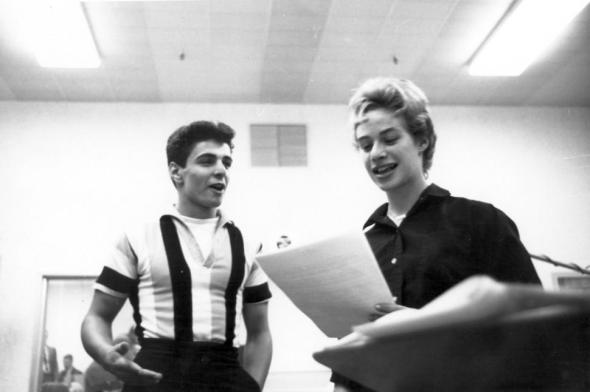
Husband and wife singer songwriting team Goffin and King rehearse during a recording session in a New York studio in 1959. (h/t NY Daily News)
Good Morning
On Thursday we lost another 1960s music great; Gerry Goffin, who wrote lyrics to Carole King’s music died at 75. The talented couple wrote the songs that accompanied my teenage years–so much great music associated with so many memories.
From the Guardian Gerry Goffin: the poet laureate of teenage pop:
Gerry Goffin, a trainee chemist who became the poet laureate of teenage pop, specialised in coming up with a great opening line to grab the audience’s attention. Plenty of people will remember the first time they heard “Tonight you’re mine completely/ You give your love so sweetly,” from Will You Love Me Tomorrow, or “Looking out on the morning rain/ I used to feel so uninspired,” from (You Make Me Feel Like) A Natural Woman. But he didn’t stop there.
Buried a little deeper in those wonderful songs are the lines that really touched his young listeners’ hearts. The words to the bridge, or middle section, of that first Shirelles hit from 1960 were almost like poetry: “Tonight with words unspoken/ You say that I’m the only one/ But will my heart be broken/ When the night meets the morning sun?” And when Goffin presented Aretha Franklin with the second verse of A Natural Woman – “When my soul was in the Lost and Found, you came along to claim it” – he gave countless ordinary lovers a way to express their deepest feelings.
Misleadingly, they are often called “Carole King songs”. She wrote the tunes, and later on she would sing them when, after Goffin and King divorced, she embarked on a hugely successful solo career. But whenever King sang her own, gentler versions of the Chiffons’ One Fine Day or the Drifters’ Up on the Roof, she was still singing Goffin’s words. They were written by the man she had met when she was 17 and he was 20, and with whom she had two daughters while they lived in an apartment in the Queens housing project LeFrak City – and with whom she travelled to work in Manhattan every day at their cubicle in the offices of Aldon Music at 1650 Broadway, where they pumped out hit after hit after hit.

From The New York Times: Gerry Goffin, Hitmaking Songwriter With Carole King, Dies at 75:
Mr. Goffin and Ms. King were students at Queens College when they met in 1958. Over the next decade they fell in love, married, had two children, divorced and moved their writing sessions into and out of 1650 Broadway, across the street from the Brill Building. (The Brill Building pop music of the late 1950s and ‘60s was mostly written in both buildings.)
Together they composed a catalog of pop standards so diverse and irresistible that they were recorded by performers as unalike as the Drifters, Steve Lawrence, Aretha Franklin and the Beatles. They were inducted together into the Songwriters Hall of Fame in 1987 and the Rock and Roll Hall of Fame in 1990. In 2004 the Recording Academy presented them jointly with a Trustees Award for lifetime achievement.
The couple’s writing duties were clearly delineated: Ms. King composed the music, Mr. Goffin wrote the lyrics — among them some of the most memorable words in the history of popular music.
“His words expressed what so many people were feeling but didn’t know how to say,” Ms. King said in a statement on Thursday.
A bit more about Goffin:
Gerald Goffin was born on Feb. 11, 1939, in Brooklyn and grew up in Jamaica, Queens. He began writing lyrics as a boy — “like some kind of game in my head,” he recalled once — but found he was unable to come up with satisfying music to accompany them.
He graduated from Brooklyn Technical High School before enrolling at Queens College. He was three years older than Ms. King, studying chemistry, when they met in the spring of her freshman year.
He asked her to help him write a musical. She was interested in rock ‘n’ roll. They hit it off anyway, and she was pregnant with their first child when they married on Aug. 30, 1959.
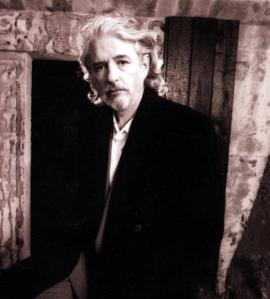
Gerry Goffin
After the couple divorced in 1968, King went on to become a singer and songwriter in her own right, although the two continued to collaborate and maintained a friendship. Goffin married again and and the couple had five children.
In addition to his wife, [Michelle] Mr. Goffin’s survivors include four daughters, Louise Goffin, Sherry Goffin Kondor, Dawn Reavis and Lauren Goffin; a son, Jesse Goffin; six grandchildren; and a brother, Al.
Goffin and King’s first hit was “Will You Love Me Tomorrow,” which they wrote in 1960 for the girl group the Shirelles. After the song hit #1 on the charts in 1961, Goffin quit his job as a chemist and began working full-time as a lyricist.
Goffin’s lyrics deftly touch on the doubt that lurks behind all new romances. As sung by Shirelles’ leader Shirley Owens in unflappable manner, the song doesn’t skimp on the wonder inherent in any fresh coupling. But it’s also unflinchingly realistic about the possibility that the fairy dust will dissolve at dawn.
“Can I believe the magic in your sighs?” Owens pointedly asks her paramour. In the bridge, Goffin’s words flow like champagne even as they fear the possible hangover: “Tonight with words unspoken/You’ll say that I’m the only one/But will my heart be broken/When the night meets the morning sun.” King’s melody plays a big role in the overall effect, arching high in the verses and middle eight while accompanied by strings that elegantly trip across the proceedings like moonlight dancers, before coming back down to Earth for the interrogative refrain.
In other news . . .
At Salon, Simon Malloy writes about the multiplying Republican scandals: GOP’s sudden scandal-mania: Why criminal probes and infighting are taking over the party.
It’s fashionable right now to talk about the premature end of Barack Obama’s presidency. He’s fast approaching the second half of his second term, which is historically the beginning of lame-duck season. His poll numbers aren’t what anyone would call ideal, and Republicans (in concert with some excitable members of the press) are rushing to proclaim the Obama presidency dead. “I saw a commentator today say that these polls, what they reflect, is that the Obama presidency is over,” Sen. Marco Rubio said, referring to NBC’s Chuck Todd. “And I agree with that. I think it is, in general.” Speaker John Boehner told reporters at his weekly press briefing yesterday: “You look at this presidency and you can’t help but get the sense that the wheels are coming off.” ….The funny thing is that as Republicans team up with pundits to chisel out Obama’s epitaph, the Republican Party itself is falling to pieces right before our eyes.
Yesterday’s news that Scott Walker and Chris Christie sinking deeper into their respective scandals is as good a sign as any of the GOP’s political disintegration. After Obama crushed Mitt Romney in 2012, Republicans began casting about for their 2016 redeemer, and Christie and Walker were high on the list. They won conservative hearts with their antagonism toward unions, but they had also found a way to win in reliably Democratic states. If the GOP hoped to take on candidate-in-waiting Hillary Clinton, they’d need someone who could peel away some Democratic voters. Walker had talked about the need to nominate an “outsider” like himself in 2016.
Now Christie and Walker are implicated in criminal investigations. Prosecutors in Wisconsin placed Walker at the center of a “criminal scheme” to coordinate campaign spending with outside groups. In New Jersey, the investigation stemming from the George Washington Bridge scandal is reportedly closing in on Christie himself. For both men, once considered potential saviors of the GOP, the political future looks considerably dimmer.
Read Malloy’s take on it at the link.
At FiveThirtyEightPolitics, David Wasserman has a long article on “What we can learn from Eric Cantor’s defeat.” You really need to read the whole thing, but here’s a small excerpt that deals with the contribution of public distrust of Congress:
Cantor was only the second House incumbent to lose a primary this year (the first was Texas Republican Ralph Hall), but the warning signs of discontent were abundant: Plenty of rank-and-file House incumbents had been receiving startlingly low primary vote shares against weak and under-funded opponents, including GOP Reps. Rodney Davis of Illinois, Lee Terry of Nebraska and David Joyce of Ohio. In fact, just a week before Cantor’s defeat and without much fanfare, socially moderate Rep. Leonard Lance of New Jersey received just 54 percent of the Republican primary vote against the same tea party-backed opponent he had taken 61 percent against in 2012.
Overall, 32 House incumbents have taken less than 75 percent of the vote in their primaries so far this year, up from 31 at this point in 2010 and just 12 at this point in 2006. What’s more, 27 of these 32 “underperforming” incumbents have been Republicans.1
In other words, while Congress’s unpopularity alone can’t sink any given member in a primary, it has established a higher baseline of distrust that challengers can build on when incumbents are otherwise vulnerable. And as the sitting House Majority Leader, Cantor was uniquely susceptible to voters’ frustration with Congress as an institution.
There’s much more interesting analysis at the link.
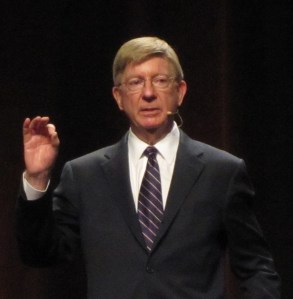
George Will’s recent column on campus rapes is still in the news. From Talking Points Memo, George Will’s Latest: College Rape Charges Fueled By ‘Sea Of Hormones And Alcohol’.
Will explained that he took issue with the practice of adjudicating campus sexual assault cases by a “preponderance” of evidence, rather than hitting the bar of evidence beyond a reasonable doubt. That flies in the face of due process, he argued, and ultimately harms young men’s future prospects.
“What’s going to result is a lot of young men and young women in this sea of hormones and alcohol, that gets into so much trouble on campuses, you’re going to have charges of sexual assault,” he said. “And you’re going to have young men disciplined, their lives often permanently and seriously blighted by this — don’t get into medical school, don’t get to law school, all the rest.”
Four Democratic senators reached out to Will after his column was published to torch the conservative columnist’s “ancient beliefs.” Will said he wrote a letter back to the senators and laid out his rebuttal in the C-SPAN interview.
“What I say is that: A) I take sexual assault more seriously than I think they do, because I agree that society has correctly said that rape is second only to murder as a serious felony,” Will said. “And therefore, when someone is accused of rape, it should be reported to the criminal justice system that knows how to deal with this, not jerry-built, improvised campus processes.”
“Second, I take, I think, sexual assault somewhat more seriously than the senators do because I think there’s a danger now of defining sexual assault so broadly, so capaciously, that it begins to trivialize the seriousness of it,” he added. “When remarks become sexual assault, improper touching — bad, shouldn’t be done, but it’s not sexual assault.”
Well, we can’t have young men’s lives “blighted” by rape charges. Much better for young women to just suck it up and deal with a years of post-traumatic stress on their own and keep their complaints to themselves.
Whatever you do, don’t miss this TBogg post at Raw Story: Gentleman George Will is getting damned tired of having to explain rape to you guttersnipes.
Victorian gas-pipe and Her Majesty’s Curator of Rape To The Colonies, George Will, has just about had it up to here with you people — YES, YOU PEOPLE.
And especially you. Don’t think by closing your laptop he can’t see you, because he can.
Oh yes, he most certainly can, you loathsome wastrel.
t seems that, after explaining the ins and out of rape to you ungrateful curs, he was shocked and dismayed to discover that you promiscuous info-trollops on the intertubes are unable to comprehend the pearls of wisdom that he dispenses to the riff-raff gratis, courtesy of Ye Olde Washminster Poste.
Hush now, let Gentleman George condescend to speak down to you and try, fruitlessly no doubt, to explain once again that rape is what George Will says rape is…
Now go read the rest at the link. You won’t be sorry.
This sounds like it could do some good: Google commits $50M to encouraging girls to code (CNet)
Google wants to see more women in technology, and it’s funding a $50 million initiative to encourage girls to learn how to code in an effort to close the gender gap.
Thursday night the company kicked off the Made with Code initiative here with celebrities former first daughter Chelsea Clinton and actress and comedienne Mindy Kaling.
Kaling, who emceed the event, said she has tons of ideas for apps but no idea to how make them work. She said she’d like to create a “What’s his deal?” app that takes a picture of guy and tells you whether he’s single, married, a weirdo, or what his car is like. Another idea is a Shazaam-like app for perfume.
“People my age have a million ideas for apps,” she said. “But we have no idea how to build them. Last week in the movies, I didn’t even know how to turn off the flashlight on my phone.”
Kaling isn’t alone. Women are woefully under-represented in the technology industry. Only about 20 percent of software developers in the US are women, according to the Labor Department. Last month, even Google admitted only 17 percent of its tech workers are women.
A bit more possible good news from the BBC: US sets up honey bee loss task force.
The Environmental Protection Agency (EPA) and the agriculture department will lead the effort, which includes $8m (£4.7m) for new honey bee habitats.
Bee populations saw a 23% decline last winter, a trend blamed on the loss of genetic diversity, exposure to certain pesticides and other factors.
A quarter of the food Americans eat, including apples, carrots and avocados, relies on pollination.
Honey bees add more than $15bn in value to US agricultural crops, according to the White House.
The decline in bee populations is also blamed on the loss of natural forage and inadequate diets, mite infestations and diseases.
There has also been an increase in a condition called colony collapse disorder (CCD) in which there is a rapid, unexpected and catastrophic loss of bees in a hive.
So . . . what stories are you following today? Please post your thoughts and links in the comment thread.
Monday Reads
Posted: July 9, 2012 Filed under: morning reads | Tags: black americans and finance, charter schools, forced labor, George Will, global warming, marriage equality, New Orleans, subprime crisis, Voter ID laws 47 Comments Good Morning!
There are so many ways that my city and state are being used as an incubator for unholy ideas that it’s not even funny. I’ve got a series of rather depressing links this morning. However, I think we should all think about the common thread here. Didn’t many of our immigrant ancestors come here hoping that this new country would not fall prey to an aristocratic group of assholes who inherit stuff just because of the privilege of birth? Do these news items strike you as something you’d read about in a country founded on the idea of government by the people instead of government over the people? Let’s begin our search for the ways plutocracy is changing our lives.
Our public school system in New Orleans has been decimated and turned into one big charter school education experiment. Part of the “detritus” that the state washed out with the Katrina waters were our teachers. They were just some of the folks that were thrown over when a natural disaster was turned into a way to turn a purple state red. They’re getting their day in court. Will they really get Justice? A recent court decision has given many fired teachers some back pay. But, justice runs deeper than a few dollars to teachers. What about the children set adrift in libertarian, for profit incubators that cherry pick the best and leave the rest far behind?
But aside from recompense for “disaster leave,” New Orleans public schools will remain adrift in a flood of drastic reforms. After Katrina, the city became an incubator for non-unionized charter schoolsand “experimental” restructuring plans.
But rather than “saving” New Orleans schools from failure, the overhaul has aggravated divides between black and white, wealthy and poor, by pushing schools to operate more like corporations.
Maynard Sanders at the Bankstreet College of Education wrote last year about the New Orleans Recovery School District as a case study in de facto segregation between “selective schools” and those serving poor students of color. Often, he added, the charters that many have hailed as an emblem of progress “are run like private schools by self-appointed boards without any parent, community, or teacher representation… There is no transparency in charter school operations, finances or hiring while they receive public money and operate rent free in public school buildings.”
One major plank of the agenda for restructuring New Orleans schools–which reflects national reform trends promoted by the Obama administration–is “decentralization” of the system and the expansion of “choice” of schools across districts. But critics say a decentralized school system can become dangerously fractured, and choice is constrained by feudal social barriers.
Here’s proof that it’s just not enough to elect any woman to an office. Jan Brewer—the throwback governor of Arizona–is at it again. She’s asking SCOTUS to overturn a ruling allowing benefits for same sex partners. Republicans are routinely asking courts to remove rights from citizens and assign them a lesser-than status.
Arizona Governor Jan Brewer (R) has requested that the Supreme Court overturn a ruling that allows state employees to keep their same-sex partners on their benefits, including health insurance.
Brewer filed a petition for a writ of certiorari on July 2, requesting that the high court overturn the United States Court of Appeals for the Ninth Circuit’s September 2011 ruling in Diaz vs. Brewer. The pushback comes three months after the Ninth Circuit denied a request by Arizona state lawyers to re-hear the case with an 11-judge panel.
Last September, the Ninth Circuit’s ruling prevented Arizona from implementing a law that would have barred state employees’ same-sex partners from remaining on their health plans. The ruling affirmed a lower court’s decision to place a preliminary injunction on the law.
Black Americans will likely suffer long term consequences for the financial damage caused by the subprime crisis. Think of all the billions of dollars spent on bailing out banks while huge numbers of families have lost the hope of ever owning their own home again. Will property ownership once again be the province of the aristocrats?
For blacks, the picture since the recession has been particularly grim. They disproportionately held subprime mortgages during the housing boom and are facing foreclosure in outsize numbers. That is raising fears among consumer advocates, academics and federal regulators that the credit scores of black Americans have been systematically damaged, haunting their financial futures.
The private companies that calculate credit scores say they do not consider race in their formulas. Lenders also say it is not a factor when deciding who qualifies for a loan; federal laws prohibit the practice. Still, studies have shown a persistent gap between the credit scores of white and black Americans, and many worry that it is only getting wider.
The impact of strict voter ID laws pushed by ALEC and Republicans is having an impact and could block thousands from voting. It’s all about vote suppression and electing Romney. No better way to ensure your interests are enshrined in law than through disenfranchisement of minorities, the elderly, and the poor, is there?
The numbers suggest that the legitimate votes rejected by the laws are far more numerous than are the cases of fraud that advocates of the rules say they are trying to prevent. Thousands more votes could be in jeopardy for this November, when more states with larger populations are looking to have similar rules in place.
More than two dozen states have some form of ID requirement, and 11 of those passed new rules over the past two years largely at the urging of Republicans who say they want to prevent fraud.
Democrats and voting rights groups fear that ID laws could suppress votes among people who may not typically have a driver’s license, and disproportionately affect the elderly, poor and minorities. While the number of votes is a small percentage of the overall total, they have the potential to sway a close election. Remember that the 2000 presidential race was decided by a 537-vote margin in Florida.
A Republican leader in Pennsylvania said recently that the state’s new ID law would allow Romney to win the state over President Barack Obama.
Supporters of the laws cite anecdotal cases of fraud as a reason that states need to do more to secure elections, but fraud appears to be rare. As part of its effort to build support for voter ID laws, the Republican National Lawyers Association last year published a report that identified some 400 election fraud prosecutions over a decade across the entire country. That’s not even one per state per year.
ID laws would not have prevented many of those cases because they involved vote-buying schemes in local elections or people who falsified voter registrations.
This is how broken, distorted and hackish our public political dialogue has become: George Will, a Pulitzer Prize-winning columnist (his record for coasting on that one accomplishment continues), actually responds to concerns about the national’s killer heat wave with “it’s summer, get over it!”
Not only is this disingenuous, it’s an outright lie. Will knows better (for one thing, in his world, “summer” is a verb, not a noun) but just doesn’t care. His job is to rubber stamp whatever comes out of the right-wing noise machine, no matter how absurd, far-fetched, or (most importantly) harmful. George Will gets his money no matter what, and that’s all he cares about …
Meanwhile, Romney donors are proving as enlightened as ever. Where else but in the Hamptons?
A money manager in a green Jeep said it was time for Romney to “up his game and be more reactive.” So far, said the donor (who would not give his name because he said it would hurt his business), Romney has had a “very timid offense.”
A New York City donor a few cars back, who also would not give her name, said Romney needed to do a better job connecting. “I don’t think the common person is getting it,” she said from the passenger seat of a Range Rover stamped with East Hampton beach permits. “Nobody understands why Obama is hurting them.
“We’ve got the message,” she added. “But my college kid, the baby sitters, the nails ladies — everybody who’s got the right to vote — they don’t understand what’s going on. I just think if you’re lower income — one, you’re not as educated, two, they don’t understand how it works, they don’t understand how the systems work, they don’t understand the impact.”
Gee. I wonder whose child got into the ivies because of legacy slots instead of brains this year? Look Mavis! It’s the Upper Class Twit of the Year show! Can they walk along the straight line without falling over? Don’t forget to kick the beggar!
Speaking of Louisiana, here’s Bobby Jindal’s plantation economy at work.
It is time to banish the idea that forced labor and sweatshop exploitation are problems of bygone eras or distant countries. These conditions exist within America’s borders. On June 29, Wal-Mart said it had suspended one of its seafood suppliers in Louisiana for violating its workplace standards. The action came as an advocacy group for foreign guest workers announced that it had uncovered appalling abuses at the company, C. J.’s Seafood, and at a dozen other Wal-Mart suppliers too.
The workers said the company forced them to work 16- to 24-hour days, and 80-hour weeks, at illegally low rates, sometimes locked in the plant, peeling crayfish until their hands felt dead. Some were threatened with beatings. Federal agencies and Wal-Mart are investigating the charges; C. J.’s Seafood did not respond to The Times’s request for comment.
These workers are not unauthorized immigrants toiling off the books. They came here legally under the H-2B program, which grants visas to low-skilled seasonal workers in industries that supposedly cannot find enough Americans to do the job. The program has been dogged by charges of wage abuses, fraud and involuntary servitude, including in investigations by the Government Accountability Office.
New rules protecting workers’ rights were supposed to have taken effect in April, but have been blocked after business owners sued the Department of Labor and a group of senators from both parties shamefully voted to deny the department funding to enforce them.
Under the rules, employers would be barred from confiscating immigration documents and blacklisting workers who complained about working conditions and consulted with unions. Employers would have to try harder to hire Americans and cover migrants’ transportation costs and visa fees. Though the new rules do not go far enough (they should allow workers to change jobs if employers abuse them), they are a crucial step forward.
So, those are my suggestions this morning. I really didn’t set out to weave this story but rather noticed it evolve as I looked for things. Doesn’t it look like we’re devolving into a lesser country? What’s on your reading and blogging list today?
Thursday Reads
Posted: October 6, 2011 Filed under: #Occupy and We are the 99 percent!, 2012 presidential campaign, U.S. Economy, U.S. Politics | Tags: Christopher Benfry, Elizabeth Warren, Erin Burnett, Ezra Klein, George Will, Glenn Greenwald, Larry McMurtry, Massachusetts Senate race, Mitt Romney, Occupy Boston, occupy Wall Street, Rick Perry, Robert Reich, Scott Brown 21 Comments
Good Morning!! I’m going to be heading back to Boston pretty soon, and I’m looking forward to following developments in Occupy Boston and in the Senate race. They haven’t started an Occupy Muncie protest yet, unfortunately. But you never know. This town is really suffering from the poor economy.
At Mother Jones, there is an interactive map of all the Occupy protests that have sprung up around the country. It’s pretty amazing. Funny thing. A few days ago MJ had a post by Lauren Ellis in which she looked down her nose at the #OccupyWallStreet protesters. Now they have a whole section on the Occupy Movement.
There are still plenty of so-called “journalists” dismissing the protests though. Yesterday, I posted a link to Andrew Ross Sorkin’s piece in the NYT in which he reports his trip to Zuccotti Park at the request of a anonymous nervous Wall Street CEO. Glenn Greenwald skewered Sorkin but good, concluding that Sorkin’s
CEO banking friend is right to be concerned: if not about this protest in particular then about the likelihood of social unrest generally, emerging as a result of their plundering and pilfering. That healthy fear on the part of the oligarchs has been all too absent.
Greenwald also linked to this example of “snotty, petty, pseudointellectual condescension” at The New Republic. Ugh! Read it if you dare.
Yesterday, Greenwald followed up by verbally destroying CNN’s new nighttime host, Erin Burnett.
On her new CNN show on Monday night, host Erin Burnett was joined by Rudy Giuliani’s former speechwriter John Avlon and together they heaped condescending scorn on the Wall Street protests while defending the banking industry, offering — as FAIR documented — several misleading statements along the way. Burnett “reported” that while she “saw dancing, bongo drums, even a clown” at the protest, the participants “did not know what they want,” except that “it seems like people want a messiah leader, just like they did when they anointed Barack Obama.” She featured a video clip of herself explaining to one of the protesters that the U.S. Government made money from TARP, and then demanded to know if that changed his negative views of Wall Street.
This is far from the first time Burnett has served as spokesperson for Wall Street; it’s basically what her “journalistic” career is. She angered Bill Maher a couple years ago when arguing that the rich have suffered along with the poor and middle class as part of the financial crisis, and that it would be wrong to “soak the rich” because they’re already paying so much taxes. She caused Rush Limbaugh to gush over her when she argued on TV in 2007 that all Americans benefit when the rich get richer: “the majority of Americans directly benefit from what happens on Wall Street,” she proclaimed, just over a year before the financial collapse.
In an interview last year with Vanity Fair, she insisted that people on Wall Street do not have private planes and that “there are a lot of stalwart, solid people on Wall Street. There are just a few shady people providing the fodder for big budget movies…”
Meanwhile Beltway Bob Ezra Klein has some advice for #OccupyWallStreet: they should immediately start taking advice from the liberal establishment and focus on developing policy and writing legislation in order to work through the system that they have already rejected.
The Wall Street protests seem to be gathering strength and expanding beyond the geographic limits of downtown Manhattan. The media, too, is finally amplifying the story. Whether they will grow larger and sustain themselves beyond these initial street actions will depend upon four things: the work of skilled organizers; the success of those organizers in getting people, once these events end, to meet over and over and over again; whether or not the movement can promote public policy solutions that are organically linked to the quotidian lives of its supporters; and the ability of liberalism’s infrastructure of intellectuals, writers, artists and professionals to expend an enormous amount of their cultural capital in support of the movement.
There’s lots more, but it’s basically a lecture from someone who just doesn’t get it. And speaking of people who don’t get it, George Will tries to school Elizabeth Warren in his latest column. According to Will, the “liberal project,” which Warren apparently speaks for is designed to destroy rugged individualism.
The project is to dilute the concept of individualism, thereby refuting respect for the individual’s zone of sovereignty. The regulatory state, liberalism’s instrument, constantly tries to contract that zone — for the individual’s own good, it says….
Such an agenda’s premise is that individualism is a chimera, that any individual’s achievements should be considered entirely derivative from society, so the achievements need not be treated as belonging to the individual. Society is entitled to socialize — i.e., conscript — whatever portion it considers its share. It may, as an optional act of political grace, allow the individual the remainder of what is misleadingly called the individual’s possession.
The collectivist agenda is antithetical to America’s premise, which is: Government — including such public goods as roads, schools and police — is instituted to facilitate individual striving, a.k.a. the pursuit of happiness. The fact that collective choices facilitate this striving does not compel the conclusion that the collectivity (Warren’s “the rest of us”) is entitled to take as much as it pleases of the results of the striving.
But isn’t that what Warren is pushing for? For more individuals to have opportunities to make it in America? Really, isn’t it time for George Will to retire?
Meanwhile Warren is leading in the race for the Massachusetts Democratic nomination for Senate, and she appeared in her first debate on Tuesday at my undergraduate alma mater, U. Mass Lowell.
In her first debate as a candidate for U.S. Senate Tuesday night, Harvard law professor Elizabeth Warren declined to criticize her fellow Democratic candidates, taking aim instead at Republican Sen. Scott Brown, whom the Democratic nominee will face, and Wall Street.
“Forbes magazine named Scott Brown Wall Street’s favorite senator. I was thinking that’s probably not an award I’m going to get,” she said to applause and laughter from the audience at the University of Massachusetts-Lowell. Two recent polls put Warren and Brown in a statistical tie.
She also made the audience laugh and applaud with the second question, which asked each candidate how they paid for college, since Brown posed nude for Cosmopolitan to pay.
“I kept my clothes on,” she quipped. She added that she borrowed money to go to a public university and had a part-time job.
Warren also drew applause for her tough talk on Wall Street. “The people on Wall Street broke this country, and they did it one lousy mortgage at a time. It happened more than three years ago, and there has been no real accountability, and there has been no real effort to fix it. That’s why I want to run for the United States Senate,” she said.
Go Elizabeth go!!
Another voice for the middle class, Robert Reich, explains why Wall Street is extremely nervous about the economic crisis in Europe.
If you want the real reason, follow the money. A Greek (or Irish or Spanish or Italian or Portugese) default would have roughly the same effect on our financial system as the implosion of Lehman Brothers in 2008.
Financial chaos….a default by Greece or any other of Europe’s debt-burdened nations could easily pummel German and French banks, which have lent Greece (and the other wobbly European countries) far more.
That’s where Wall Street comes in. Big Wall Street banks have lent German and French banks a bundle.
The Street’s total exposure to the euro zone totals about $2.7 trillion. Its exposure to to France and Germany accounts for nearly half the total.
And it’s not just Wall Street’s loans to German and French banks that are worrisome. Wall Street has also insured or bet on all sorts of derivatives emanating from Europe — on energy, currency, interest rates, and foreign exchange swaps. If a German or French bank goes down, the ripple effects are incalculable.
Read the rest at Huffpo.
There are a couple of interesting reads about Republican candidates at the New York Review of Books. The first is by novelist Larry McMurtry: The Rick Perry Hustle Here’s a brief sample:
What Perry has brought to the Republican muddle thus far is his abundant, if unfocused, energy. He rushes from debate to debate, gives many interviews, gets his picture on the cover of TIME; yet all his politicking is curiously affectless. He makes sounds, but where’s the personality? Hillary Clinton has a personality; so does Sarah Palin. Either of those women could cut Governor Perry off at the knees, and will if given the chance.
It’s not been said so I’ll say it: as a politician Rick Perry is fundamentally lazy, so far as actual governing is concerned, content to run things mainly by sound-bite. He makes lots of decisions but lingers on no issue very long; there’s little follow-through. Clemency, or its absence, is an example. Two hundred thirty-four humans have been executed in Texas on his watch and only recently has he been stirred to a review. He believes that the State Board of Pardons and Paroles is so infallible that there’s no reason for him to lose sleep over the fate of this or that prisoner. The Governor has much more confidence in the Board than the Board has in itself; its members are well aware that even, or especially in Texas shaky verdicts have come down. The Governor, a man with a notably short attention span, has a lot more to think about than the death chamber.
An irony of his sudden emergence as a front-runner is that his few humane decisions—the HPV vaccine, which is safe and helpful, and the tuition credit for the children of illegals, which could help keep gangs of feral children off our streets—are what may sink him with the Tea Party and his own rabid right wing. And this is the wing he has assiduously cultivated his whole political life.
The other NYRB article of interest is by Christopher Benfry: Mitt, We Hardly Knew Ye!
We’re feeling vulnerable and surly these days in western Massachusetts, as the leaves turn yellow, the Red Sox fade, and winter looms. Our corridor of New England along the Connecticut River endured, during the summer months, a ruinous tornado in Springfield, an earthquake, of all things, and Hurricane Irene, which knocked out roads and historic covered bridges in our hill towns and across neighboring Vermont, and left a lot of people homeless and adrift. It’s our Katrina moment, we sometimes think, with slightly grandiose self-pity, as Republicans in Congress demand budget cuts if FEMA is to pay for disaster relief in the blue states.
We don’t see much of Mitt Romney, our ex-governor, in these troubled times. Then again, we never did. Our most indelible memories are of Mitt leaving—“the sight of Mitt’s back,” as a friend of mine put it, as he went off to lay the groundwork for yet another campaign. Mitt ran for the Senate against Ted Kennedy in 1994, lost, and left the state to salvage the Salt Lake City Olympics. When he returned to run for governor in 2002, he had to go to court to prove that he sort of lived in Belmont, outside Boston. Then, after a couple of years in the state house, he left again to campaign for the presidency, spending two thirds of his time out of state in 2006. Mitt has sold his house in Belmont and now lives in the important primary state of New Hampshire (at his estate on Lake Winnipesaukee) or San Diego or maybe Utah—anywhere but Massachusetts.
In the Republican debates, Mitt pretends that his ties to Massachusetts are tenuous. Mitt’s greatest achievement as governor, the Massachusetts health care system (which passed with Ted Kennedy’s support and two dissenting votes in the state legislature), is now his greatest liability among Republicans, who see it as a stalking horse for Obamacare. Mitt now claims it was right for our quirky state but not for the nation. He has yet to explain why.
When Mitt trumpets his experience in American business, he rarely mentions that Bain, the consulting and investment conglomerate in which he amassed his $200 million fortune, is a Boston firm.
And so on…Romney used our state as a springboard and then denied even knowing us.
I’ll end there for today. What are you reading and blogging about?
Indiana’s Mitch Daniels: 2012 Republican Presidential Nominee?
Posted: February 24, 2011 Filed under: 2012 presidential campaign, Anti-War, Barack Obama, Elections, U.S. Economy, U.S. Politics, We are so F'd | Tags: 2012 presidential election, Chris Christie, George W. Bush, George Will, Governor Mitch Daniels, Harley Davidson motorcyles, Jeb Bush, Marlon Brando, short people 28 Comments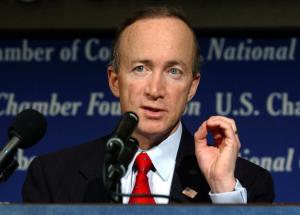
Indiana Gov. Mitch Daniels
Lots of Republicans are urging Indiana Governor Mitch Daniels to run for the Republican presidential nomination in 2012. Will he do it? Can he win?
Who’s touting Daniels? New Jersey Governor Chris Christie loves the guy.
Chris Christie, the governor of New Jersey, said Wednesday that his counterpart in Indiana, Mitch Daniels, is the only prospective Republican presidential candidate who is honestly talking about how to confront the nation’s biggest fiscal challenges.
Jeb Bush thinks Daniels is “the best Republican candidate.”
Jacksonville’s Florida Times-Union reports that former Florida Gov. Jeb Bush favors Indiana Gov. Mitch Daniels for president in 2012.
Bush reportedly told a private reception for business leaders, “Mitch is the only one who sees the stark perils and will offer real detailed proposals.”
Daniels’ speech at CPAC 2011 was very well received, and get this–George Will introduced Daniels to the CPAC audience as “the thinking man’s Marlon Brando,” apparently because Daniels likes to right around the Indiana countryside on a Harley Davidson chopper. Judge for yourself.

Mitch Daniels on his Harley

Marlon Brando in "The Wild One"
Daniels has some other problems too. For one thing he thinks Republicans should forget about social issues and focus on economic ones (cutting deficits, natch). Conservatives are not at all happy with Daniels for asking Indiana Republican legislators to withdraw their proposed “right to work” bill. In addition, he reportedly is a pretty serious policy wonk who likes to talk to his fellow wingnuts as if they were adults.
By far, the most important speech at CPAC was delivered by two-term Gov. Mitch Daniels of Indiana at Friday night’s banquet. It was an eloquently crafted, intellectually compelling call to arms against the red-ink forces of the national debt. Daniels, who was George W. Bush’s budget director, proposed dramatically revamping Social Security and Medicare as he called for “an affectionate thank you to the major social welfare programs of the last century.”
What was most striking about Daniels’ speech, which inspired careful listening rather than pep-rally applause, was that it treated his CPAC audience as adults rather than as just another constituency group demanding pandering. Whether it was dismissing the easy-answer attacks on earmarks (“in the cause of national solvency, they are a trifle”) or suggesting that most voters do not appreciate the sharp-edged rhetoric of the Republican right (“it would help if they liked us, just a bit”), Daniels’ speech was an exercise in speaking truth to conservatives who have the power to derail a presidential candidacy.
Come on, that’s never going to work with Republican primary voters!
On top of that, several media outlets reported today that Daniels was busted for drugs when he was in 1970 when he was a junior at Princeton. And it wasn’t for possession of just a little pot, either.
Read the rest of this entry »

 peej
peej Carissa
 bostonboomer
 dakinikat
 ecocatwoman
 mablue2
 Mama Lopez
 peggysue22
 quixote
 skydancingguestblogger
 Mona (aka Wonk the Vote)



 Sky Dancing
Recent Comments