
That Thick Glass Ceiling and the role of risk aversion, competition aversion, and cooperation
Posted: February 20, 2012 Filed under: just because | Tags: gender differences, risk aversion, Risk Management 6 Comments There’s a short summation of some of the most relevant economic literature on Gender Differences at VOXEU. Strict micro theory labor models have a difficult time dealing with any form of discrimination because they are based on labor getting paid on its marginal productivity. Any feature that doesn’t influence production doesn’t really factor neatly in to this particular view of the labor market. This area has been more ripe for study because behavioral economics is now taking into account things beyond the idea that all economic units are rational players. Theories of rational markets and rational agents do a really bad job of explaining a lot of things including bubbles and busts. Just like many gender-based disciplines and their studies, the focus usually is on gender specific traits and social learning. The most germane traits to economic behavior tend to be risk aversion and attitudes towards competition. Preferences can be modeled through functions and their shape can provide outcomes that vary from the labor market curves of yore. Many authors find that you have to model female preferences different from male and this contributes to many aspects of what we would call success in business.
Risk taking is generally seen as important to entrepreneurship, investment, and many business undertakings. It is the focus of a lot of behavior research, some of which can be found in magazines like the Atlanta Parent.
Only recently have economists begun to explore why women and men might have different risk preferences. Broadly speaking, those differences may be due to either nurture, nature, or some combination of the two. For instance, boys are pushed to take risks when participating in risky or competitive sports while girls are often encouraged to remain cautious. Thus, the riskier choices made by males could be due to the nurturing received from parents or peers. Likewise, the disinclination of women to take risks could be the result of parental or peer pressure not to do so.
In recent research (Booth and Nolen 2012), we present a recent experimental study exploring why girls and boys might have different risk preferences. Using adolescent subjects from two distinct environments or ‘cultures’, we examine the effect on risk preferences of two types of environmental influences – randomly assigned experimental peer-groups and educational environment (single-sex or coeducational). The experimental subjects were UK students in years 10 and 11 who were attending either single-sex or coeducational state-funded high schools. We find that the gender composition of the experimental group, as well as the gender mix of the school the student attended, affected decisions on whether or not to enter a real-stakes lottery. But our experiment was conducted at one point in time, and did not track changes over time.
Some important control studies show how women behave in same sex environments. These studies come from those educational studies that show that many girls do better in girl-only schools because teachers tend to show preferences to boys. The three authors of this article came up with a way to study this issue in terms of economic decisions.
In recent research (Booth and Nolen 2012), we present a recent experimental study exploring why girls and boys might have different risk preferences. Using adolescent subjects from two distinct environments or ‘cultures’, we examine the effect on risk preferences of two types of environmental influences – randomly assigned experimental peer-groups and educational environment (single-sex or coeducational). The experimental subjects were UK students in years 10 and 11 who were attending either single-sex or coeducational state-funded high schools. We find that the gender composition of the experimental group, as well as the gender mix of the school the student attended, affected decisions on whether or not to enter a real-stakes lottery. But our experiment was conducted at one point in time, and did not track changes over time.
The authors wonder if risk taking behavior evolves over time and differently depending on the school and parental environment. Frequently, a measurement of risk-taking behavior occurs while playing some kind of gambling game. The authors set up a study in a co-ed business university as well as a single sex one. They provided a gambling game to students and tested students at before the start and after the start of the academic year. They found differences.
We found that, on average, women are significantly less likely to make risky choices than men at both dates. However, after eight weeks in the single-sex class environment – within the larger coeducational milieu – women were significantly more likely to choose the lottery than their counterparts in coeducational groups. No such result was found for men in the single-sex groups. In other words, after eight weeks, the women in the single-sex classes were no more risk averse than men. Moreover, our results were robust to a number of sensitivity checks, including controlling for cognitive and non-cognitive skills (namely IQ and personality type).
The authors argue that this is an important finding.
The findings suggest, first, that a part of the observed gender difference in behaviour under uncertainty found in previous studies might actually reflect social learning rather than inherent gender traits. Of course this is not to say that inherent gender traits do not exist. Rather it suggests that they can be modified across time by the environment in which a woman is placed. Second, the findings are also relevant to the policy debate on the impact of single-sex classes within coeducational schools or colleges on individuals’ behaviour. Whether or not this outcome carries over into other subject areas apart from economics and business remains a topic for future research.
There’s a list of their references as well as some suggestions as where these authors intend to take their research. Here is one study that’s in one of the more prestigious economic journals. This is a rather ambitious study that looks at risk behavior, bargaining behavior, and view to competition. I searched out some of the more interesting conclusions including their elucidation of three preferences where men and women differ.
We find that women are indeed more risk averse than men. We find that the social preferences of women are more situationally specific than those of men; women are neither more nor less socially oriented, but their social preferences are more malleable. Finally, we find that women are more averse to competition than are men
These authors look for reasons for the differences and find a variety of things in both the nurture and nature category. I suppose the important thing is what can we do about this? Does this mean that women will have to create more opportunities in their own businesses rather than look for success in places where the male risk profiles dominate? I frankly wondered if this accounted for the incredible gender gap in my field of finance where risk taking and competition are rampant and well-rewarded. (As you probably can imagine, even the most pathological risk taking generally is rewarded up to a point.)
Anyway, I found this interesting and thought I’d share it with you.
Thursday Reads: Allergies, French Attitude Adjustments, Neo-Nazi Homicide Update, and More
Posted: May 26, 2011 Filed under: Barack Obama, Foreign Affairs, Great Britain, morning reads, U.S. Politics, Violence against women, Women's Rights | Tags: allergies, Barack Obama, child abuse, Dominiqe Strauss-Kahn, France, gender differences, George Tron, global warming, Jeff Hall, juveniale crime, michelle obama, Neo-Nazis, Nicolas Sarkozy, pollen, Queen Elizabeth, rape, sexual harrassment, Shakespeare, tornadoes, weather 36 Comments
Pollen
I’ve been saying for awhile now that my spring allergies this year are the worst I can remember. Apparently I haven’t been imagining things. From USA Today:
“Everyone always has a reason to think the current year is the worst year ever for allergies,” said Dr. David Rosenstreich, director of the allergy and immunology division at Montefiore Medical Center in New York City.
But this year those complaints really do have some merit, he added.
“It’s been a very unusual allergy season. I don’t know if it’s because of the very wet winter or that it’s been cold longer, but the pollen counts are much higher. This week, it’s been running about 6,000 grains a day, instead of the usual 1,500,” Rosenstreich said of his local area.
I knew it was really bad this year! The Chicago Tribune got the same story from different allergy experts.
“Allergy season came a bit sooner and faster, and that’s what took everyone by surprise,” said Dr. Sonali Majmudar, an allergist and immunologist based in Hoffman Estates, who said many of her patients report that they’ve never struggled with allergies before this season.
[….]
The choppy, indecisive early spring weather for which Chicago is known, with temperatures jumping between balmy and freezing every few days, might also be to blame, Majmudar said. When it warms up and cools down, pollination starts and stops and immune systems don’t know how to react, she said.
Also contributing: one of the rainiest Aprils on record. While that might be great for yard plants, it’s a big problem for people with allergies, said Dr. Joseph Leija.
That’s exactly how the weather has been here in the Boston area: cold one day, warm the next, then back to cold–and constant rain.
Leija, an allergist at Loyola University Health System’s Gottlieb Memorial Hospital in Melrose Park, also called this the most severe allergy season he has seen in years.
Tree allergy season, which usually begins to wane by early May, is still going strong this year, said Leija, who provides pollen counts for the Midwest to the National Allergy Bureau.
Well at least I know I’m not completely crazy (just partly). According this article in USA Today, allergies are “on the rise” and ragweed is mostly responsible. Want to know if your city is one of the worst for ragweed? Here’s a list of the top 30 cities.
1 Phoenix
2 Las Vegas
3 Kansas City
4 Riverside-San Bernardino
5 Dallas
6 Chicago
7 Sacramento
8 Philadelphia
9 Denver
10 Washington, D.C. (tied)
10 Minneapolis/St. Paul (tied)
12 New York
13 Cincinnati
14 Baltimore
15 Cleveland
16 St. Louis (tied)
16 Detroit (tied)
18. Atlanta
19 Boston
20 Pittsburgh
21 Orlando
22 Los Angeles (tied)
22 San Antonio (tied)
24 Houston
25 Seattle
26 San Diego
27 Tampa
28 Portland
29 San Francisco
30 Miami
Weird. I always thought the southwest was good for allergy sufferers. And I can’t believe Indianapolis isn’t even on the list!
Researchers say the increase in allergies is related to climate change.
Apocalyptic images of global climate change include drought, rising sea levels, suffocating coral reefs and emaciated, drowning polar bears. But a new study points to some of the more immediate and mundane side effects of global warming: runny noses, itchy eyes and persistent coughs.
Researchers say allergies are on the rise, and it’s the result of warmer temperatures and happier allergens, like ragweed and mold.
It figures, doesn’t it? Another recent study found that men are more susceptible to allergies than women, which is the opposite of what many people have always assumed.
It appears that French women are becoming more cognizant of their rights to not be sexually harrassed. Now one of Sarkozy’s ministers has been accused of sexually harrassing and/or attacking two former employees.
French prosecutors have opened an inquiry into sexual harassment accusations leveled against a junior minister by two women, one of whom said the arrest of former IMF chief Dominique Strauss-Kahn on sex crime charges encouraged her to speak up.
The two women filed the complaints this week against George Tron, a minister in charge of the civil service in the center-right government of President Nicolas Sarkozy, according to their lawyer, Gilbert Collard.
Prosecutor Marie-Suzanne Le Queau told Reuters in response to a telephone query that a preliminary inquiry had been opened as a result of the accusations. “The inquiry will cover (suspected) counts of sexual assault and rape,” Le Queau said. All types of penetration can be classified as rape in France.
One of the women
said she was driven to break her silence after former IMF chief Strauss-Kahn was arrested and charged with attempted rape on the basis of the accusations of a New York hotel maid in a case that stunned France and the world.
“When I see that a little chambermaid is capable of taking on Dominique Strauss-Kahn, I tell myself I do not have the right to stay silent,”
I don’t care for the “little chambermaid” reference, but I applaud the general spirit of what this woman had to say.
The Washington Post reports that the French are “questioning attitudes” about the sexual behavior of powerful men
The criminal charges prompted the media to revisit little-reported incidents in which Strauss-Kahn was accused of sexual aggressiveness that appeared to cross the line into harassment. Women have come forward with their own stories of unwanted approaches that they felt powerless to do anything about….
Feminists say that, to succeed in France, women in politics, business and the media have to put up with “heavy flirting” bordering on harassment.
One political TV talk show panel titled “The Return of the Feminists” asked: “Are we all chambermaids?’”
Prominent journalist Helene Jouan said last week that as a young reporter she had to put up with politicians “knocking on my hotel-room door” and sending unwanted text messages. She said the behavior made her uncomfortable, but it was something that was not really talked about.
There is a similar article at Bloomberg.
The arrest in New York of former International Monetary Fund chief Dominique Strauss-Kahn on charges of attempted rape is forcing men to watch what they say and emboldening women to challenge the modern-day version of France’s “droit de cuissage,” a feudal practice giving masters the right to have sex with female servants. It’s prompting introspection in the media over whether its laissez-faire attitude toward private lives of those in power helps them act with impunity.
“Since power is often thought of as an aphrodisiac, there was a sort of acceptance of men’s excesses toward women,” said Rachel Mulot, a member of a feminist group called “La Barbe,” or The Beard, which on May 22 joined protests in Paris against the “dominant male.” The Strauss-Kahn case may serve as a trigger to help victims of sexual assaults to break the “taboo of rape” in France, she said.
I wanted to give you an update on the case of the 10-year-old boy who shot and killed his Neo-Nazi skinhead dad. I told you I thought it was highly likely that the father was abusing his kids. It turns out I was right. The guy was beating his wife too.
A 10-year-old boy charged with murdering his white supremacist father told investigators that he shot the man after growing tired of him hitting him and his stepmother, court documents showed on Wednesday.
In the hours after the shooting, the boy told investigators he thought Jeff Hall, 32, was cheating on his stepmother and that he might have to choose who to live with, according to a police declaration filed in Riverside County.
The blonde-haired boy from Southern California told investigators he went into his parents’ closet, pulled a revolver off a low shelf, went downstairs and aimed the gun at his father’s ear while he was asleep and shot him. He later hid the gun under his bed, according to court documents.
“It was right there on the shelf,” the boy told investigators, according to the police declaration filed Tuesday in support of an arrest warrant for his stepmother Krista McCary on nine felony charges of child endangerment and criminal storage of a gun.
Investigators also reported that the house was a pigsty and not a fit place to be raising five children, including a two-month old baby girl.
The tornado season is continuing in Missouri, Kansas, Oklahoma, and all over the midwest. Why are the tornadoes so bad this year? That’s the question this article in the Christian Science Monitor tries to answer.
Nearly 1,200 tornadoes have swarmed the United States this year, according to preliminary numbers from the National Oceanic and Atmospheric Administration (NOAA). Four of these storms have been rated at the highest tornado strength, an EF-5. The death toll from these tornadoes has likely topped 500, a number not seen since 1953.
But why has this year seen so many and such devastating twisters? Scientists point to several large-scale climate factors, some of which have been at work behind the scenes since winter. And at least some of the mind-boggling tornado numbers, believe it or not, can be chalked up to humans — there are more of us around to see them.
The article offers a number of explanations–too much information to excerpt, so read the whole thing if you’re interested.
I’m going to finish with a couple of Obama-family-related stories First, there’s a sex scandal roiling the private elementary school that Malia Obama attended.
The father of a 5-year-old Sidwell Friends School student has filed a $10 million suit against the school for allegedly allowing its staff psychologist to carry on an affair with his wife.
In court filings, Arthur Newmyer claims he and his daughter suffered “severe emotional distress” when then-school psychologist James Huntington carried on a lengthy affair with his wife, Tara Newmyer. Huntington was treating Newmyer’s daughter at the time, and the suit alleges that the girl was routinely present when he and Tara Newmyer would meet to spend time together.
Arthur Newmyer is accusing Sidwell of being aware of the affair and doing “nothing to stop it.”
Finally, as everyone who hasn’t been living under a rock knows, the Obamas are touring Europe right now. Afrocity posted this photo on Facebook. I think she probably did it to make fun of Michelle Obama, but I really loved it. I just can’t help but like Michelle. I even like her outfits. Go ahead and yell at me for it. I don’t mind. So here’s the photo
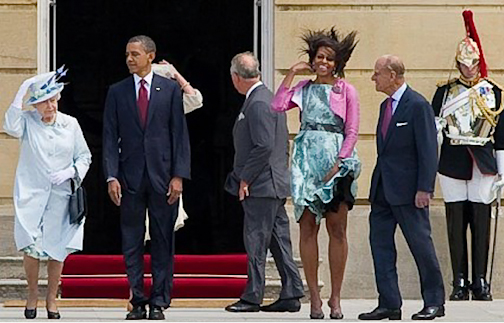
I just love that picture! That woman is a good sport and doesn’t take herself too seriously. I like that. If she were President instead of her husband, I think we’d probably be a lot better off, as you can see below: President Obama talks over “God Save the Queen” and quotes Shakespeare inappropriately. What an embarrassment!
So…. what are you reading and blogging about this morning?

 peej
peej Carissa
 bostonboomer
 dakinikat
 ecocatwoman
 mablue2
 Mama Lopez
 peggysue22
 quixote
 skydancingguestblogger
 Mona (aka Wonk the Vote)



 Sky Dancing
Recent Comments