
Thursday Reads: Crazy Republicans, Nuclear Meltdowns, MLB Follies, and More
Posted: April 21, 2011 Filed under: Gulf Oil Spill, net-neutrality, Psychopaths in charge, the internet, The Media SUCKS, U.S. Economy, U.S. Politics | Tags: Barack Obama, bible, Boston Red Sox, BP Oil Gusher, Charles Manson, Eric Cantor, Frank McCourt, Fukushima nuclear plant, Gulf Of Mexico, JoAnne Kloppenburg, Kindle, LA Dogers, Major League Baseball, meltdown, net neutrality, public libraries, stupid Republicans, U.S. debt ceiling, Wall Street, wetlands. Louisiana, Wisconsin 62 Comments
Good Morning!!
According to Politico, Republicans are escalating their game of chicken with demands they want met before they agree to raise the debt limit.
One day after being named to a presidential task force to negotiate deficit reduction, House Majority Leader Eric Cantor fired off a stark warning to Democrats that the GOP “will not grant their request for a debt limit increase” without major spending cuts or budget process reforms.
The Virginia Republican’s missive is a clear escalation in the long-running Washington spending war, with no less than the full faith and credit of the United States hanging in the balance.
Wait a minute…Obama put ERIC CANTOR on a deficit task force??!! Okay, the joke’s over. This guy cannot legitimately run on a Democratic ticket in 2012.
Cantor says he’s ready to plunge the nation into default if the GOP’s demands are not met. People close to Cantor say that he hopes to make clear that small concessions from Democrats, including President Barack Obama, will not be enough to deliver the GOP on a debt increase….
Republicans are floating a wide range of major structural reforms that could be attached to the debt limit vote, including statutory spending caps, a balanced budget amendment and a two-thirds vote requirement for tax increases and debt limit increases.
Japan’s Nuclear and Industrial Safety Agency has finally admitted that nuclear fuel in reactors 1, 2, and 3 has melted. From reading the article, it isn’t exactly clear what has happened, but I still detect efforts to minimize the damage. There’s a little more detail in an article from the Irish Times:
The head of the Atomic Energy Society of Japan, Takashi Sawada, said yesterday that fuel rods in reactors 1 and 3 have melted and settled at the bottom of their containment vessels, confirming fears that the plant suffered a partial meltdown after last month’s huge earthquake and tsunami.
Engineers have been struggling since to bring four reactors under control by pouring water onto overheating nuclear fuel, and that water is highly contaminated as a result. Mr Sawada warned the condition of the plant could worsen if another strong quake knocks out power to its cooling systems.
“That would destabilise pressure and temperatures inside the reactors and the situation would become extremely unpredictable again,” he said.
The story also says that there was an aftershock yesterday centered around 25 miles from the plant.
All the news outlets are covering the BP oil gusher and the damage it has done to the Gulf, because yesterday was the anniversary of the explosion that killed 11 oil rig workers. Don’t worry, they’ll drop the subject like a hot potato in a couple of days. Here’s an article from the NYT.
Even in the worst days of the BP spill, coastal advocates were looking past the immediate emergency to what the president’s oil spill commission called “the central question from the recovery of the spill — can or should such a major pollution event steer political energy, human resources and funding into solutions for a continuing systemic tragedy?”
That tragedy is the ill and declining health of the Gulf of Mexico, including the enormous dead zone off the mouth of the Mississippi and the alarmingly rapid disappearance of Louisiana’s coastal wetlands, roughly 2,000 square miles smaller than they were 80 years ago. Few here would take issue with the commission’s question, but the answer to it is far from resolved.
Eclipsed by the spill’s uncertain environmental impact is the other fallout: the vast sums in penalties and fines BP will have to pay to the federal government. In addition to criminal fines and restitution, BP is facing civil liabilities that fall roughly into two categories: Clean Water Act penalties and claims from the Natural Resource Damage Assessment process, whereby state and federal agencies tally the damage caused by the spill and put a price tag on it. This could add up to billions, perhaps tens of billions, of dollars.
Awwww, gee. Poor BP. It sounds like the writer feels sorry for them.
In Wisconsin, JoAnne Kloppenburg has asked for a recount in the race for the state supreme court.
JoAnne Kloppenburg arrived at the state Government Accountability Board’s office in Madison barely an hour before the 5 p.m. local time deadline by which she had to ask for a recount or concede defeat. According to the vote count finalized by the state last week, she trails Justice David Prosser by 7,316 votes out of nearly 1.5 million cast in the April 5 election.
“Today, my campaign is asking the Government Accountability Board to conduct a statewide recount,” Kloppenburg said at a news conference. The announcement was met with applause and cheers of “thank you.” She’s requesting the recount “in part to determine what the proper outcome of the election will be and to ensure that elections form this point forward will be fair.
“I do not make this decision lightly … I have weighed the options and I have considered the facts,” Kloppenburg, currently an assistant state attorney general, said. The tight margin — small enough to trigger a provision allowing the state to pay for the recount process — means that “the importance of every vote is magnified and doubts about every vote are magnified as well,” she said.
And in silly Republican news, eight Wisconsin doctorswho wrote excuses for protesting teachers are being investigated.
The state Department of Regulation and Licensing and the Medical Examining Board said Wednesday that they had opened investigations into eight individuals who allegedly wrote doctor excuse notes for protesters at the state Capitol during rallies in February.
Last month, the Department of Regulation and Licensing said it had identified 11 people who may have provided the medical excuses, and it asked them to submit information about their activities at the Capitol.
Three members of the Medical Examining Board reviewed the information and decided to open investigations on eight of the 11, according to a department news release.
The eight being investigated are all licensed physicians, department spokesman David Carlson said.
Are Wisconsin taxpayers going to have to pay for this silliness? How ridiculous.
As a Kindle owner, I’m excited about this news. Amazon’s Kindle Will Offer E-Books From Libraries
Bookworms who own Amazon.com Inc.’s popular Kindle electronic reader will finally be able to borrow digital books from public libraries….
The move is likely to have major repercussions for public libraries and the digital-reading market generally, since Amazon currently dominates the e-book industry and its actions in the space are closely watched. There are an estimated 7.5 million Kindles in the U.S., which gives Amazon a two-thirds share of the $1 billion digital-book market, said Forrester Research analyst James McQuivey.
Many major public libraries, including those in New York, Chicago and San Francisco, offer free digital-book lending. A physical trip to the library isn’t required. Instead, library-card holders can download books from library websites. Each library sets its own digital-book lending policy, but typical lending periods are 14 or 21 days.
Major League Baseball has seized the LA Dodgers and will now control day-to-day operations for the team. Owner Frank McCourt is having financial problems.
The move was prompted by a number of issues surrounding the Dodgers, including owner Frank McCourt’s recent receipt of $30-million personal loan to meet payroll and the parking-lot attack at Dodger Stadium on March 31 that left a San Francisco Giants fan in a coma, according to a league source.
“This has been like watching a soap opera unfold,” said Gary Toebben, the president and CEO of the Los Angeles Area Chamber of Commerce. “We want a financially solvent Dodgers. We want a winning team.”
The league will now have approval rights over every significant expenditure by the team, including a trade or contract extension. This will likely put the franchise on the path to being sold.
The commissioner’s move adds to the turmoil surrounding a team already embroiled in divorce proceedings between McCourt and his wife, Jamie, who is seeking joint ownership.
McCourt tried to buy the Red Sox back when the the former owner died. Thank goodness he didn’t succeed in buying the team–they probably never would have beat the curse and won the World Series twice.
Some nutty right wing talk show host says the Bible forbids net neutrality.
The idea that all Internet traffic should be treated equally is against the teachings of the Bible and America’s Founding Fathers, according to evangelical Christian minister and political activist David Barton.
During his radio show on Tuesday, he said that net neutrality violated the Biblical principle of free markets, a principle upheld by Benjamin Franklin, Thomas Jefferson, and George Washington.
“That is part of the reason we have prosperity,” Barton said. “This is what the Pilgrims brought in, the Puritans brought in, this is free market mentality. Net neutrality sounds really good, but it is socialism on the Internet.”
“This is really, I’m going to use the word wicked stuff, and I don’t use that word very often, but this is wicked stuff,” he added.
Well that settles it then!
Monday was the 40th anniversary of Charles Manson’s conviction, so some media types decided to give him an opportunity to spout a bunch on nonsense. Manson’s new lawyer has asked the president to let the maniac out of prison, but Manson ruined his chances by giving his honest opinion of Obama.
Manson, 76, called Obama foolish in reference to Wall Street, saying he considered the president “a slave of Wall Street.”
“He doesn’t realize what they are doing. They are playing with him,” he said, according to the magazine.
Bla, bla, bla … so what else is new?
That’s about it for me. What are you reading and blogging about today?
Open Thread: Inside Japan’s Evacuation Zone
Posted: April 8, 2011 Filed under: Foreign Affairs, Japan, open thread, We are so F'd | Tags: evacuation zone, Fukushima nuclear plant, Japan, radiation, Tetsuo Jimbo 12 CommentsVia Raw Story, see what it’s really like inside Japan’s evacuation zone–empty streets, abandoned houses, ruined roads from the earthquake, packs of dogs and livestock roaming free–it’s like something out of a science fiction movie.
Japanese journalist Tetsuo Jimbo made a trip inside the restricted evacuation zone near the Fukushima Daiichi Nuclear Power Plant last week. At 17 km from the plant (about 2 minutes into the video), the Geiger counter alarms go off and remain on for the rest of the trip….
Jimbo terminates the mission at about 1.5 km from the nuclear plant, where radiation is thousands of times above normal.
Watch the video:
See dramatic photos at Buzzfeed
Japanese Officials Admit They Are Making No Progress
Posted: March 30, 2011 Filed under: Food, Foreign Affairs, Japan, toxic waste, Water, We are so F'd | Tags: cesium-137, contaminated food, contaminated water, Fukushim Dai-Ichi, Fukushima nuclear plant, Nuclear Contamination, radiation 30 Comments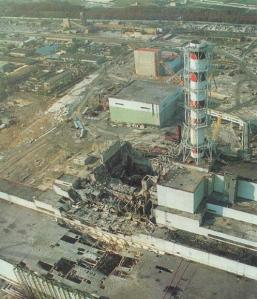
Chernobyl disaster: will it happen again?
The Guardian reports that radiation levels are rising in the ocean near the Fukushima nuclear plant, and Japanese officials admit they basically have no real solution for the apparent meltdown and/or meltdowns of the four damaged nuclear reactors.
The country’s nuclear and industrial safety agency, Nisa, said radioactive iodine-131 at 3,355 times the legal limit had been identified in the sea about 300 yards south of the plant, although officials have yet to determine how it got there.
Hidehiko Nishiyama, a Nisa spokesman, said fishing had stopped in the area, adding that the contamination posed no immediate threat to humans. “We will find out how it happened and do our utmost to prevent it from rising,” he said.
Good luck with that. The battle to control the reactors could go on for years.
The battle to control the slow-motion meldowns could take years, according to this Reuters article.
Plant operator Tokyo Electric Power Co. has conceded it faces a protracted and uncertain operation to contain overheating fuel rods and avert a meltdown.
“Regrettably, we don’t have a concrete schedule at the moment to enable us to say in how many months or years (the crisis will be over),” TEPCO vice-president Sakae Muto said in the latest of round-the-clock briefings the company holds.
Back to the Guardian piece:
Robert Peter Gale, a US medical researcher who was brought in by Soviet authorities after the Chernobyl disaster, said recent higher readings of radioactive iodine-131 and caesium-137 should be of greater concern than reports earlier this week of tiny quantities of plutonium found in soil samples.
But he added: “It’s obviously alarming when you talk about radiation, but if you have radiation in non-gas form I would say dump it in the ocean.”
Wonderful. The Japanese eat a lot of fish, don’t they?
Radiation measured at a village 40 kilometres from the Fukushima nuclear plant now exceeds a criterion for evacuation, the UN nuclear watchdog said.
And a Japanese nuclear expert has warned crews may have to keep pouring cooling water onto the stricken reactors for years.
Years. That is what multiple sources are now saying. It could take years. So how does it end? We hope for new discoveries that will solve the problem, while the reactors continue to melt down and release radioactive elements into the groundwater and the ocean? Or there is a catastrophic explosion?
Yes, I know the “experts” say that won’t happen, but if workers are going to be struggling with these plants for years, there is inevitably going to be human error. Besides, the “experts” have tried to minimize the dangers all along. Only now is the real truth beginning to come out.
From the Union of Concerned Scientists All Things Nuclear blog:
Today the IAEA has finally confirmed what some analysts have suspected for days: that the concentration per area of long-lived cesium-137 (Cs-137) is extremely high as far as tens of kilometers from the release site at Fukushima Dai-Ichi, and in fact would trigger compulsory evacuation under IAEA guidelines.
The IAEA is reporting that measured soil concentrations of Cs-137 as far away as Iitate Village, 40 kilometers northwest of Fukushima-Dai-Ichi, correspond to deposition levels of up to 3.7 megabecquerels per square meter (MBq/sq. m). This is far higher than previous IAEA reports of values of Cs-137 deposition, and comparable to the total beta-gamma measurements reported previously by IAEA and mentioned on this blog.
This should be compared with the deposition level that triggered compulsory relocation in the aftermath of the Chernobyl accident: the level set in 1990 by the Soviet Union was 1.48 MBq/sq. m.
Thus, it is now abundantly clear that Japanese authorities were negligent in restricting the emergency evacuation zone to only 20 kilometers from the release site.
This is bad, folks. Here is a summary of the health effects of cesium-137:
Like all radionuclides, exposure to radiation from cesium-137 results in increased risk of cancer.
Everyone is exposed to very small amounts of cesium-137 in soil and water as a result of atmospheric fallout. Exposure to waste materials, from contaminated sites, or from nuclear accidents can result in cancer risks much higher than typical environmental exposures.
If exposures are very high, serious burns, and even death, can result. Instances of such exposure are very rare. One example of a high-exposure situation would be the mishandling a strong industrial cesium-137 source. The magnitude of the health risk depends on exposure conditions. These include such factors as strength of the source, length of exposure, distance from the source, and whether there was shielding between you and the source (such as metal plating).
Please note that cesium-137, like plutonium doesn’t occur naturally in the environment. When officials and “experts” talk about “background” radiation, they are talking about elements that have been introduced through nuclear tests and nuclear reactor accidents and bi-products. This “background” radiation wasn’t around before the nuclear age, and I personally don’t believe that it has no effect on us.
From NPR: More radioactive material has been found in foods in Japan.
Yesterday, I asked in a comment what is being done with all the contaminated water that is being removed from the Fukushima reactors. Scarecrow addressed this question today at FDL.
They’ve got hundreds of tons of contaminated water preventing workers from getting close enough to pumps, valves, monitors needed to stabilize conditions. So they have to pump this water out and put it somewhere, but where? There are tanks at/near some units that can hold some of it, but not all, and external temporary storage may allow exposure to the atmosphere. Meanwhile, they must keep pumping more fresh water into the reactors and spent fuel storage pools, while more leaks out.
There are large pools of dangerously contaminated water in the turbine buildings adjacent to each reactor buidling, with more leaking in from somewhere, and few places to put it. Just outside the turbine buildings, there are long, deep trenches nearer the ocean and likely filled with water from the tsunami. But they’re now contaminated with radiation and water leaks from the turbine building.
Where can they put all this water? And given varying degrees of contamination, which water should they put where? For example, should they just pump out the least radioactive water in the trenches/pools and dump it in the ocean?
Believe it or not, some people are suggesting putting the water in large ships and letting them float around in the ocean. And what happens if there is a huge storm and the ships are damaged? Honestly, this gets scarier and scarier every day.
Even worse, today smoke was seen at another nuclear plant owned by Tepco!
The company said smoke was detected in the turbine building of reactor No. 1 at the Fukushima Daini nuclear power plant around 6 p.m. (5 a.m. ET).
Smoke could no longer be seen by around 7 p.m. (6 a.m. ET), a company spokesman told reporters.
The Fukushima Daini nuclear power plant is about 10 kilometers (6 miles) from the Fukushima Daiichi nuclear power plant, where workers have been scrambling to stave off a meltdown since the March 11 earthquake and tsunami knocked out cooling systems there….
After the dual disasters, Japanese authorities also detected cooling-system problems at the Fukushima Daini plant, and those living within a 10-kilometer radius (6 miles) of Fukushima Daini were ordered to evacuate as a precaution.
What next? Something tells me whatever happens next won’t be good.
Expert Tells Guardian UK: “Japan may have lost race to save nuclear reactor”
Posted: March 29, 2011 Filed under: A My Pet Goat Moment, Foreign Affairs, Japan, toxic waste, We are so F'd | Tags: Cancer, corporate malfeasance, Fukushima nuclear plant, Japan, nuclear meltdown, plutonium 40 Comments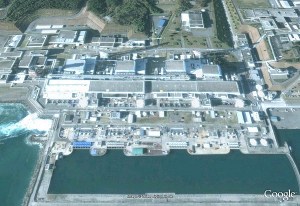
Google photo of Fukushima Nuclear Plant
Ian Sample, science correspondent for the Guardian, writes:
Richard Lahey, who was head of safety research for boiling-water reactors at General Electric when the company installed the units at Fukushima, told the Guardian workers at the site appeared to have “lost the race” to save the reactor, but said there was no danger of a Chernobyl-style catastrophe….
“The indications we have, from the reactor to radiation readings and the materials they are seeing, suggest that the core has melted through the bottom of the pressure vessel in unit two, and at least some of it is down on the floor of the drywell,” Lahey said. “I hope I am wrong, but that is certainly what the evidence is pointing towards.”
The major concern when molten fuel breaches a containment vessel is that it reacts with the concrete floor of the drywell underneath, releasing radioactive gases into the surrounding area. At Fukushima, the drywell has been flooded with seawater, which will cool any molten fuel that escapes from the reactor and reduce the amount of radioactive gas released.
Lahey said: “It won’t come out as one big glob; it’ll come out like lava, and that is good because it’s easier to cool.”….
“The reason we are concerned is that they are detecting water outside the containment area that is highly radioactive and it can only have come from the reactor core,” Lahey added. “It’s not going to be anything like Chernobyl, where it went up with a big fire and steam explosion, but it’s not going to be good news for the environment.”
Last night, ABC News talked to physicist Michio Kaku.
“Apparently, there is a crack, a crack in the vessel by which radiation is escaping,” U.S. physicist Michio Kaku said. “This could mean that if the core begins to melt, we could have a steam explosion, a hydrogen gas explosion like Chernobyl.”
So the nuke guy says it won’t be like Chernobyl, Kaku says it will. I guess we have no choice except to just wait and see.
FYI, here is an earlier interview with Kaku at KATU, Portland, Oregon.
Michio Kaku’s comments came after news that Japanese nuclear experts said they suspect there has been a possible breach at the Fukushima Dai-ichi nuclear complex.
“This is huge. For the first time, they’re using that dreaded word, ‘breach,’ Kaku said during an interview at KATU’s studios. “Plutonium is the most toxic chemical known to science. A speck of plutonium, a millionth of a gram, could cause cancer.”
No matter how much Tepco and pro-nuke “experts” insist there is no danger to humans from the material that has escaped the plant, there simply is no safe level of plutonium.
The Tokyo Electric Company confirmed that AREVA-manufactured fuel assemblies containing plutonium have at least partially melted down when they said that plutonium was found on five separate sites on the reactor grounds, and they had matched the plutonium signature of fuel produced at AREVA’s La Hague facility. The fuel assemblies were first loaded in the reactor at Fukushima last September and were in Reactor 3 when the 14 meter tsunami overwhelmed the nuclear plant.
Despite the fact that plutonium is one of the most deadly substances in existence, TEPCO has insisted there is no health danger from the plutonium found on site. According to health experts, plutonium particles absorbed in the human body vastly increases the chance of dying from a fatal form of cancer.
The former DOE official said, “NNSA was warned this kind of event could happen and they chose to build the MOX plant anyway. Maybe what Japan is going through will wake up people who can call a halt to this.”
Japan, Libya Crises Contribute to Crushing Election Defeat for Angela Merkel
Posted: March 27, 2011 Filed under: Foreign Affairs, Germany, Libya, U.S. Military | Tags: Angela Merkel, earthquake, Fukushima nuclear plant, Germany, Japan, Libya, nuclear disaster, radiation, Tokyo Electric Power Co., tsunami 13 Comments
Angela Merkel
From NPR: Merkel Suffers Historic Defeat In German State
German chancellor Angela Merkel’s conservatives have suffered a historic defeat in a state ballot after almost six decades in power there, partial results showed Sunday, in an election that amounted to a referendum on the party’s stance on nuclear power.
The opposition anti-nuclear Greens doubled their voter share in Baden-Wuerttemberg state and seemed poised to win their first-ever state governorship, according to calculations based on partial results published by public broadcaster ARD….
The Greens secured 24 percent of the vote, with the center-left Social Democrats down 2 percentage points at 23.2 percent, giving them enough form a coalition government in the state, the results showed.
Representatives of all parties said the elections were overshadowed by Japan’s nuclear crisis, turning them into a popular vote on the country’s future use of nuclear power, which a majority of Germans oppose as they view it as inherently dangerous.
Although overseeing a surging economy and falling unemployment, Mrs Merkel attracted withering criticism after she decided to reverse an unpopular decision taken last autumn to extend the lifespans of Germany’s 17 nuclear reactors.
Critics condemned the abrupt u-turn, and the decision to shut down seven of the oldest reactors pending a safety review, as blatant electioneering, claiming that Mrs Merkel hoped to capitalise from rising opposition to nuclear energy in Germany following the disaster engulfing the Fukushima reactors in Japan.
Libya was also an issue for voters:
the government’s refusal to support military intervention in Libya added to Mrs Merkel’s woes.
In comments echoing conservative disquiet with the decision Joschka Fischer, a former foreign minister, said Germany had lost “credibility” on the world stage and had blown its chances of getting a seat at the UN Security Council.
It’s interesting that many Germans apparently wanted to help the Libyan rebels, while so many “progressives” in the U.S. opposed the UN/NATO intervention because Libya is not of much strategic importance to the U.S. and because of the cost.
Germans saw Merkel’s unwillingness to support the intervention in Libya as an embarrassment that could prevent Germany from getting a seat on the UN Security Council.
Here in the U.S., progressives (IMO) missed the importance of the U.S. President making a decision that concurred with the wishes of most of the Arab world–might that not be a better use of our military resources than endlessly pouring them into Afghanistan and Iraq. Just my 2 cents…
Just a couple of quick updates–
Libyan rebels are marching toward Tripoli
The last time the rebels made it as far west as Bin Jawad, it ended in disaster: their fighters ran into a murderous ambush, lost 70 men, and were forced into a terrifying retreat that nearly ended their campaign.
But yesterday, after a stunning sweep across the territory for which they have fought so hard and for so long, they were back.
This time, with Western air power destroying almost all that is left of the regime’s armour and artillery, the mood was very different. The rebels’ eyes were cast towards Sirte, Colonel Muammar Gaddafi’s birthplace and the centre of loyalist resistance.
[….]
The shift in momentum is palpable. Rebels are now back in possession of the two key oil complexes of Ras Lanuf and Brega which handle a sizeable proportion of the 1.5 million barrels a day the country used to export before the uprising. The opposition’s provisional administration in Benghazi stated that Qatar, which had joined the Western coalition in sending warplanes to Libya, would be marketing the oil. However, restarting production will be extremely difficult until the return of the foreigners who ran the plants, but left after the uprising.
In Japan, a 6.5 magnitude aftershock triggered a new tsunami warning, and workers have again left the Fukushima nuclear plant because of dangerously high radiation levels. From the Independent:
It [earthquake and tsunami alert] came after emergency workers fled from one of Fukushima’s stricken nuclear reactors yesterday, after contaminated water in the cooling system was apparently found to be 10 million times more radioactive than normal, only for officials to later say that the reading might have been inaccurate.
The latest confusion in the battle to bring Japan’s nuclear crisis under control came as villagers near the plant complained that they were being kept in the dark over radiation risks.
The technician who took the reading at reactor No 2 yesterday was so alarmed by the numbers that the team fled the building before taking a second measurement. And later, a spokesman for Tokyo Electric Power Co, the operator of the Fukushima plant, said: “There is a suspicion that the reading … is too high, so we are redoing our tests… We are very sorry for the inconvenience.”
Highly radioactive pools of water have formed inside all four of the damaged reactors, officials said. After previously downplaying fears of a serious breach in any of the reactors, Yukio Edano, the cabinet secretary and the face of the government throughout the crisis, said it “almost certainly” had happened.
The world is changing very rapidly, despite our government’s attempts to maintain the status quo. I wonder what dramatic news awaits us tomorrow?

 peej
peej Carissa
 bostonboomer
 dakinikat
 ecocatwoman
 mablue2
 Mama Lopez
 peggysue22
 quixote
 skydancingguestblogger
 Mona (aka Wonk the Vote)



 Sky Dancing
Recent Comments