
Thursday Reads
Posted: January 8, 2015 Filed under: Foreign Affairs, morning reads | Tags: cartoonists, Charlie Hebdo magazine attack, Freedom of Expression, Islam, terrorism, winter weather 14 Comments
painting by Vladimir Tokarev
Good Morning!!
I’m getting a slow start today. I guess it must be because I’m so cold. I’ve been up since 6AM, but I’ve been dawdling around reading the news, sipping hot tea, and writing nothing. It’s still only 66 degrees in my house even though I have the thermostat turned up pretty high. My furnace isn’t build to handle below zero temperatures, and at 9AM it is still -3 degrees where I live.
The local NPR weather reporter warned that frostbite can happen in minutes when the temperatures are this low and the wind chill factor is much lower. Schools around here are closed, as are many schools around the country. I need to go out sometime today, so I’m hoping the temperatures will get into the teens by this afternoon. The good news is, there isn’t any snow out there.
According to Dave Collins of the AP, via the Charlotte Observer things are going to get worse before they get better.
Another Alberta clipper barreling down from Canada is bringing more bad winter weather to the Dakotas.
The National Weather Service has posted a variety of blizzard and winter weather advisories, watches and warnings for the Dakotas through Thursday. Not a lot of snow is expected, but winds gusting to 50 mph will blow around the snow that’s on the ground.
In Minnesota, forecasters expect blizzard conditions to develop in a portion of the River Valley. Weather officials say wind gusts of 40 to 50 mph combined with fresh snow will significantly reduce visibility, especially in open, rural areas. A blizzard warning was posted in an area from Granite Falls southeast to Mankato and Albert Lea.
Thank goodness I live in temperate New England, and not the upper Midwest!
Besides the weather, the big story in the news today is the shooting rampage at Charlie Habdo magazine in Paris yesterday.
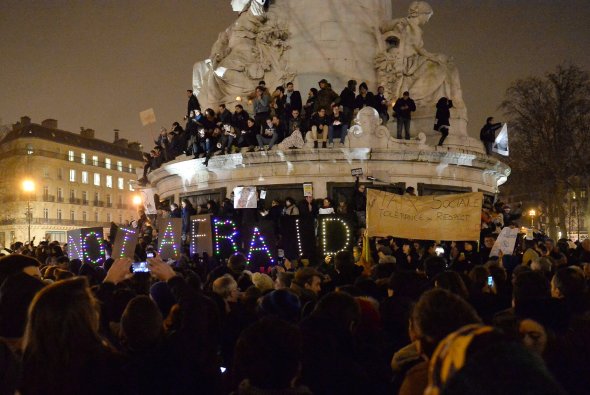
Vigil in Paris for the Charlie Hebdo victims (NPR)
Some background from BBC News:
Charlie Hebdo: Gun attack on French magazine kills 12.
Four of the magazine’s well-known cartoonists, including its editor, were among those killed, as well as two police officers….
The masked attackers opened fire with assault rifles in the office and exchanged shots with police in the street outside before escaping by car. They later abandoned the car in Rue de Meaux, northern Paris, where they hijacked a second car….
Witnesses said they heard the gunmen shouting “We have avenged the Prophet Muhammad” and “God is Great” in Arabic (“Allahu Akbar”)….
Charlie Hebdo editor Stephane Charbonnier, 47, had received death threats in the past and was living under police protection.
French media have named the three other cartoonists killed in the attack as Cabu, Tignous and Wolinski, as well as Charlie Hebdo contributor and French economist Bernard Maris….
The satirical weekly has courted controversy in the past with its irreverent take on news and current affairs. It was firebombed in November 2011 a day after it carried a caricature of the Prophet Muhammad.
The latest tweet on Charlie Hebdo’s account was a cartoon of the Islamic State militant group leader, Abu Bakr al-Baghdadi.
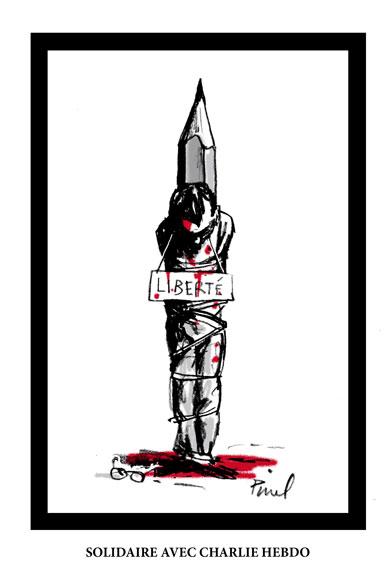
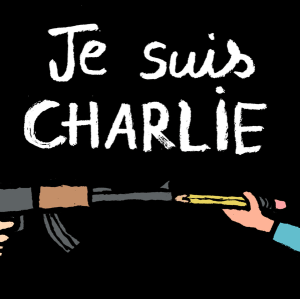
Cartoonists responded to the killings by posting cartoons on twitter. You can see some of them at the links below.
From Euro News, The power of the pen: Cartoonists worldwide react to the Charlie Hebdo attack.
From Buzzfeed, 23 Heartbreaking Cartoons From Artists Responding To The Charlie Hebdo Shooting.
One of the gunmen is in custody, but two are still free, NPR reported yesterday.
French police have taken Hamyd Mourad, 18, into custody after he surrendered to authorities, according to multiple French news outlets. Mourad had been sought in relation to a murderous attack on a satirical magazine’s Paris office Wednesday, but it’s not certain whether he was involved. An ID card belonging to Mourad was reportedly found in the gunmen’s car.
The two central suspects in the attack remain at large; regional police issued a new plea for help in finding two French-born brothers, Said and Cherif Kouachi, both in their 30s.
They’re believed to be the gunmen who used powerful assault rifles to kill journalists and police officers at the office of the weekly Charlie Hebdo around midday Wednesday.
A police bulletin sought the public’s help in finding two suspects in the deadly attack on a satirical magazine’s Paris offices Wednesday. Pictured are brothers Cherif (left) and Said Kouachi.
La prefecture de Police
The Kouachi brothers are said to be French citizens.

This morning, news broke that a policewoman had been killed in Paris, but it was not yet clear that the perpetrators of the magazine attack were involved.
A policewoman was killed in a shootout in southern Paris, but police sources could not immediately confirm a link with Wednesday’s killings at the Charlie Hebdo weekly newspaper that marked the worst attack on French soil for decades.
National leaders and allied states described the assault on Charlie Hebdo, known for its lampooning of Islam and other religions as well as politicians, as an assault on democracy. The bells of Notre-Dame cathedral rang out during a minute’s silence observed across France and beyond….
Montrouge Mayor Jean-Loup Metton said the policewoman and a colleague were attending a reported traffic accident when Thursday’s shooting occurred. Witnesses said the assailant fled in a Renault Clio and police sources said he wore a bullet-proof vest and had a handgun and assault rifle.
But one police officer at the scene told Reuters he did not appear to resemble the Charlie Hebdo shooters.
The Guardian is covering this story heavily, with live updates on the manhunt.
A recent story from The Guardian: Police place security cordon around Paris in hunt for Charlie Hebdo killers.
The French president, François Hollande, has led a minute’s silence for the victims of Wednesday’s attack on the offices of satirical magazine Charlie Hebdo, as police placed a tight security cordon around Paris amid an atmosphere of heightened tension and confusion.
With the search for the gunmen in its second day, there were unconfirmed reports that the suspects had been seen in the Aisne region of north-east France.
In a briefing on Thursday morning, Bernard Cazeneuve, France’s interior minister, said that seven arrests were made overnight, but the two main suspects, brothers Saïd and Chérif Kouachi, were still at large.
There was a heavy police presence at each of the “portes” – the main roads leading into the city – amid unconfirmed reports that the suspects were heading back towards the French capital “at high speed” in a grey Renault Clio.
The two men were reportedly seen in the Aisne region, but the reports were confused. Some French media suggested they had been picked up by cameras at a péage (road toll) stop. Others said they had been identified by the owner of a petrol station near Villers-Cotterêts and a number of reports went even further, suggesting the two men had robbed the petrol station and made off with fuel and food.
The reports suggested that heavy weapons including, allegedly, a Kalashnikov and a rocket launcher, could be seen in the rear of the vehicle.
However, apart from images of areas of Paris, like the north-western suburb of Levallois, completely sealed off and heavily armed police and armoured vehicles at the portes of the city, the reports were unconfirmed and there was no indication that police had located the vehicle.

Two reactions to the Paris killings:
Juan Cole, Sharpening Contradictions: Why al-Qaeda attacked Satirists in Paris.
The horrific murder of the editor, cartoonists and other staff of the irreverent satirical weekly Charlie Hebdo, along with two policemen, by terrorists in Paris was in my view a strategic strike, aiming at polarizing the French and European public.
The problem for a terrorist group like al-Qaeda is that its recruitment pool is Muslims, but most Muslims are not interested in terrorism. Most Muslims are not even interested in politics, much less political Islam. France is a country of 66 million, of which about 5 million is of Muslim heritage. But in polling, only a third, less than 2 million, say that they are interested in religion. French Muslims may be the most secular Muslim-heritage population in the world (ex-Soviet ethnic Muslims often also have low rates of belief and observance). Many Muslim immigrants in the post-war period to France came as laborers and were not literate people, and their grandchildren are rather distant from Middle Eastern fundamentalism, pursuing urban cosmopolitan culture such as rap and rai. In Paris, where Muslims tend to be better educated and more religious, the vast majority reject violence and say they are loyal to France.
Al-Qaeda wants to mentally colonize French Muslims, but faces a wall of disinterest. But if it can get non-Muslim French to be beastly to ethnic Muslims on the grounds that they are Muslims, it can start creating a common political identity around grievance against discrimination.
This tactic is similar to the one used by Stalinists in the early 20th century. Decades ago I read an account by the philosopher Karl Popper of how he flirted with Marxism for about 6 months in 1919 when he was auditing classes at the University of Vienna. He left the group in disgust when he discovered that they were attempting to use false flag operations to provoke militant confrontations. In one of them police killed 8 socialist youth at Hörlgasse on 15 June 1919. For the unscrupulous among Bolsheviks–who would later be Stalinists– the fact that most students and workers don’t want to overthrow the business class is inconvenient, and so it seemed desirable to some of them to “sharpen the contradictions” between labor and capital.
More at the link.

George Packer at The New Yorker, The Blame for the Charlie Hebdo Murders.
The murders today in Paris are not a result of France’s failure to assimilate two generations of Muslim immigrants from its former colonies. They’re not about French military action against the Islamic State in the Middle East, or the American invasion of Iraq before that. They’re not part of some general wave of nihilistic violence in the economically depressed, socially atomized, morally hollow West—the Paris version of Newtown or Oslo. Least of all should they be “understood” as reactions to disrespect for religion on the part of irresponsible cartoonists.
They are only the latest blows delivered by an ideology that has sought to achieve power through terror for decades. It’s the same ideology that sent Salman Rushdie into hiding for a decade under a death sentence for writing a novel, then killed his Japanese translator and tried to kill his Italian translator and Norwegian publisher. The ideology that murdered three thousand people in the U.S. on September 11, 2001. The one that butchered Theo van Gogh in the streets of Amsterdam, in 2004, for making a film. The one that has brought mass rape and slaughter to the cities and deserts of Syria and Iraq. That massacred a hundred and thirty-two children and thirteen adults in a school in Peshawar last month. That regularly kills so many Nigerians, especially young ones, that hardly anyone pays attention.
Because the ideology is the product of a major world religion, a lot of painstaking pretzel logic goes into trying to explain what the violence does, or doesn’t, have to do with Islam. Some well-meaning people tiptoe around the Islamic connection, claiming that the carnage has nothing to do with faith, or that Islam is a religion of peace, or that, at most, the violence represents a “distortion” of a great religion. (After suicide bombings in Baghdad, I grew used to hearing Iraqis say, “No Muslim would do this.”) Others want to lay the blame entirely on the theological content of Islam, as if other religions are more inherently peaceful—a notion belied by history as well as scripture.
A religion is not just a set of texts but the living beliefs and practices of its adherents. Islam today includes a substantial minority of believers who countenance, if they don’t actually carry out, a degree of violence in the application of their convictions that is currently unique.
Click on the link to read the rest.
What else is happening? Let us know in the comment thread and have a great day!
Why Pussy Riot Matters
Posted: August 18, 2012 Filed under: Human Rights | Tags: free speech, Freedom of Expression, Human Rights, Pussy Riot 24 Comments
St. Maria, Virgin, Drive away Putin
Drive away! Drive away Putin!
It is interesting to watch the growing amount of support for Pussy Riot. The women have been sentenced to two years in jail for “hooliganism motivated by religious hatred” for 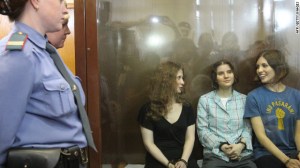 using an orthodox cathedral to do a performance piece in protest of the powerful Vladimir Putin. Vlad the Pussy Jailer’s heavy hand was seen in the recently delivered verdict. Outcry over the harsh sentence is coming from all over the world.
Russia on Saturday faced a storm of international criticism after sentencing three members of the Pussy Riot punk band to two years in prison for a political protest in an Orthodox cathedral.
Speculation mounted that the women, Nadezhda Tolokonnikova, Maria Alyokhina and Yekaterina Samutsevich, could have their sentences cut on appeal after the damaging global reaction, with the Russian public also questioning the sentence.
Judge Marina Syrova said the three young protesters had shown a “clear disrespect toward society” by staging a “Punk Prayer” calling on the Virgin Mary to drive out Vladimir Putin just weeks ahead of his election in March to a third presidential term.
The United States called the sentences “disproportionate”, while Britain, France and the European Union also said the punishment was excessive and questioned Russia’s rights record.
Prominent supporters of the women spoke out to criticise the sentence.
International pressure “may not have secured the outcome many people wanted to see. But we need to keep up the fight,” wrote British member of parliament Kerry McCarthy, who attended the trial, on blog site LabourList.
Newspaper owner Alexander Lebedev, who co-owns Russia’s Novaya Gazeta daily and owns Britain’s Independent daily, called the women “prisoners of conscience” on Twitter.
Yoko Ono, the avant-garde artist and widow of John Lennon, posted a message of support to Samutsevich on Twitter on Saturday, saying: “You have won for all of us women in the world.”
It’s an important reminder of what happens when freedom of expression is not protected. It also puts Russia and Vlad the Pussy Jailer in very bad light.
But international opinion can often have a negative impact in Russia. How the trial and its outcome have affected Russian public opinion may play a much bigger role in coming months, as the anti-Putin protest
movement returns to the streets after a summer hiatusand the political season begins anew.
Public opinion has remained rather staunchly anti-Pussy Riot since the women were arrested in March. The latest poll, released last week by the independent Levada Center in Moscow, shows little change.
According to the survey, 55 percent of Russians did not have their views of the judicial system altered by the trial; 9 percent said it diminished their trust in courts while 5 percent said it increased it, and 12 percent said they have no faith in the courts to begin with. About 36 percent thought the verdict would be based on the facts of the case; 18 percent thought the verdict would be dictated “from the top.” Interestingly, when asked what they thought the punk band’s goal was in staging the protest, about 30 percent of respondents said it was “against the church and its role in politics”; 13 percent thought it was “against Putin” and 36 percent said they could not discern the purpose.
More worrisome, from the Kremlin‘s point of view, is the effect the trial has had on Russia’s more educated and influential social strata. Of course the usual suspects – opposition leaders, artists, liberal intellectuals – have popped up to protest the treatment of the women, who were kept almost six months in pretrial detention and now face more than a year in the harsh conditions of a Russian penal colony.
But unease over a prosecution that carries such obvious political and religious overtones appears to be spreading far beyond Russia’s small liberal and opposition circles.
The fact that we’re seeing this play out in the press suggests some very big changes have been made in the former Soviet Union state since the fall of the Berlin Wall. However, it is also a reminder that the country has not let go of its totalitarian roots. This it what will do the real damage. It will impact Foreign Direct Investment because it shows the Russia Courts can be gamed for political purposes. It will also hurt Russia’s ability to show itself in diplomacy circles as a modern nation. However, I suggest that the lesson is somewhat deeper than that.
The 10 witnesses—security guards, a candle-keeper, and a sacristan—said they suffered “moral damage” and are thus considered victims of the prayer, under the Russian Criminal Code. The lawyers who represent one of the security guards, Vladimir Potan’kin, said that their client was so mentally injured that he now has sleeping problems. Furthermore, in a twist not even worthy of a third-rate paperback, they stated that the Pussy Rioters are connected at the highest level to Satan himself.
The nature of the debate about freedom of speech, religious freedom, and political expression is one that is often misconstrued when that speech is profoundly offensive, crude, vulgar, or even malicious. “Nice” speech seldom requires defense. It is that which causes offense, whether or not it is intended, which must be protected if a society is to remain free. Deny freedom of expression to one and you effectively deny it to all. In those rare instances where restrictions on speech are permissible, they must be relevant, necessary, and pursuant to legitimate democratic aims—usually based on time, place, and manner, not on content. Had the Pussy Riot band interrupted a religious ceremony or had they been making loud noises at 4 a.m. in a neighborhood, there would be grounds for restricting their actions. However, the prosecution of Pussy Riot meets none of these conditions. Parody, irony, and humor are some of the most powerful weapons against established authority, especially the despotic kind. It is why Socrates was sentenced to death; it is why Voltaire’s criticism of the French absolutist monarchy was so disruptive that he was exiled from Paris; it is why Ecuadorean president Rafael Correa, who hypocritically just granted asylum to Julian Assange, sued a journalist and newspaper for $42 million for a column that made fun of him as a tyrant; it is why Hugo Chavez in Venezuela extended the contempt laws to make it a crime to disrespect him, leading to investigations of cartoonists; it is why Manal Al- Sharif fears for her life in Saudi Arabia for driving a car and challenging the ban on female drivers; it is why Ai Weiwei is hit with trumped up tax-evasion charges after mocking China’s dictatorship, and why Aung San Suu Kyi was held under house arrest by the Burmese military junta until just recently. The despotic mind is utterly undone and downright defenseless in the face of creative dissent.
The church, public opinion, and Vlad the Pussy Jailor seem to follow the form of that last line written by Thor Halvorssen for Forbes although now the church’s priests have said they’ve ‘forgiven’ the women. Here’s an article from Truth Out containing the gist of what the church has said about the protest which I find highly disturbing.
But while the case has allowed critics of Mr. Putin to portray his government as squelching free speech and presiding over a rigged judicial system, it has also given the government an opportunity to portray its political opponents as obscene, disrespectful rabble-rousers, liberal urbanites backed by the West in a conspiracy against the Russian state and the Russian church.
The extent of the culture clash was evident this month when Madonna paused during a concert in Moscow to urge the release of the women, who have been jailed since March, and performed in a black bra with “Pussy Riot” stenciled in bold letters on her back. The next day, Dmitry Rogozin, a deputy prime minister, posted a Twitter message calling Madonna a “whore.”
On Friday, the Russian Orthodox Church issued a statement that referred to Nazi aggression and the militant atheism of the Soviet era, and said, “What happened is blasphemy and sacrilege, the conscious and deliberate insult to the sanctuary and a manifestation of hostility to millions of people.”
The fact a church is claiming persecution while using Vlad the Jailor to enforce its own patriarchal agenda is appalling. Free speech does not stop at the steps of a church or the feelings of its believers. This issue,however, is bigger than Russia which brings me to the heavy handed treatment of the Occupy Protestors in the US and to the FBI infiltration of left wing activists with causes like providing humanitarian aid to Palestinians. Exactly how many degrees of separation are they–and we–from the feminist punk rockers? I would argue that we are closer than we’d like to think.

 peej
peej Carissa
 bostonboomer
 dakinikat
 ecocatwoman
 mablue2
 Mama Lopez
 peggysue22
 quixote
 skydancingguestblogger
 Mona (aka Wonk the Vote)



 Sky Dancing
Recent Comments