
Someone Needs to Remind President Obama Who Won the Election
Posted: December 19, 2012 Filed under: 2012 presidential campaign, Barack Obama, Republican politics, U.S. Economy, U.S. Politics | Tags: AARP, AFL-CIO, Bush tax cuts, Chained CPI, debt ceiling fight, fiscal cliff, inner child issues, John Boehner, Markos Moulitsas, Social Security 53 Comments
Barack Obama’s inner child?
In November, President Obama won reelection cleanly and decisively–it was a landslide. Immediately after his victory, Obama appeared determined to stand up to Republican intransigence in the battle over the “fiscal cliff” and the debt ceiling. He “assured a gathering of progressive and labor leaders…”
“I am not going to budge,” he told the group, according to an attendee who relayed material from the meeting on condition of anonymity. “I said in 2010 that I’m going to do this once, and I meant it.”
….two other sources who attended the meeting confirmed the quote. The administration seems to have staked out a firmer position than during the first stand-off over the Bush-era tax cuts, in November and December of 2010, leaving the impression that it won’t sign off on a compromise that doesn’t increase the tax burden on the wealthy as a means of paying down the deficit….
Top Democrats in the Senate have said they would be comfortable letting all the tax rates expire — as they are scheduled to do — at the end of the year, after which they will put together a tax cut bill that would re-establish the Bush-era rates for incomes below $250,000.
As the talks began, the White House emphatically stated that Social Security was not part of the deficit and that cuts in this important program were off the table. But just a few weeks later, the odious New York Post is laughing at Obama for “caving” on Social Security. Why should Boehner negotiate in earnest when he knows his opponent–one of the most powerful men in the world–will eventually give in because of some perverse need to demonstrate “bipartisanship?”
A short time ago Obama gave a press conference in which he admitted,
“I have gone at least half way” to meet Republican concerns, Obama told reporters at the White House after he announced the formation of a special panel to recommend steps to prevent gun violence. “The fact that they haven’t taken it yet is puzzling.”
Obama’s offer includes raising tax rates on income above $400,000; increasing rates on capital gains and dividends to 20% from 15% for incomes above $250,000; and billions of dollars in cuts to health care and other programs.
While Obama has backed off on earlier proposals — including a $250,000 threshold for higher income taxes — Republicans continue to say that the president’s fiscal-cliff plan is flawed.
“It is not ‘puzzling’ to reject an agreement that…fails to remotely meet the test of balance [the president] himself has promised,” said Kevin Smith, a spokesman for House Speaker John Boehner, in a post on Twitter.
He’s sounding whiny again. Why is he so surprised? He’s like Charlie Brown with the football. Obama never seems to finally learn that if he stands strong against Boehner, he not only will defeat the Republicans but also he’ll earn the respect and support of the American people.
Markos has an interesting post at Dailykos that demonstrates this: It wasn’t Obama’s negotiating style that won him reelection. It almost cost him. Markos demonstrates with a chart and timeline that Obama’s approval rating rose and fell dramatically during his negotiations with Boehner over the debt ceiling last year.
President Barack Obama entered the debt ceiling negotiations with a net-negative approval rating. As House Speaker John Boehner became more belligerent and confrontational, Obama soared. The people were firmly behind him! But then he began offering concession after concession, hoping to seem “reasonable” and look like the “adult in the room,” and his numbers simply tanked. That’s a mathematical fact, not opinion.
He didn’t return to net-positive approvals until the Democratic convention this September. People didn’t reward Obama’s conciliatory approach to the negotiations. Rather, they saw it (rightly) as weakness, and reacted accordingly. No one likes a weak president.
Then Markos uses the 2012 exit polls to show that Obama was reelected despite his “leadership style,” because people sensed that the President really cared about their problems.
For those who based their choice on leadership, Obama got killed 61-38. And the president lost the “vision” and “values” questions handily as well. So how did he win? He cleaned up 81-18 with people who voted on which candidate cared about them the most. In other words, voters thought Mitt Romney was an aloof dick and trusted Obama most to look out for them. So maybe he should validate that trust.
Obama isn’t doing himself any favors by drawing lines in the sand and then inevitably capitulating.
Republicans have learned that there isn’t a negotiating stance that Obama won’t compromise. That doesn’t lend itself to smart negotiations. Rather, it creates unbalanced ones, as Republicans simply wait for Obama to cave on his demands. They’ve learned that for Obama, making a deal is more important than what’s in the deal.
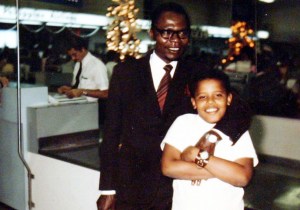
Why does Obama repeatedly do this? I can’t possibly know for sure, but I think he has inner child issues. We all have times when we regress back to a time in childhood when we were weak and had few options. It’s important to learn how to deal with that when it happens.
Obama needs to learn to remind himself that he’s no longer a small child abandoned first by his father and then by his mother–sent away to be raised by his grandparents. That must have been very difficult for him, but he’s not that sad, lonely little boy anymore. He’s the President of the United States, and those of us who voted for him need him to act like it.
Cutting Social Security and backing off the $250,000 income level for those who must pay more taxes is unacceptable. Not only will caving on these issues hurt seniors, disabled people, and force middle class and working class Americans to pay more than their share, but also giving in to Boehner’s demands will hurt Obama’s legacy and the Democratic Party as a whole. As David Johnson of The Campaign for America’s Future points out, “Social Security is Still the Third Rail,” and cutting it would be “political suicide.”
We JUST had an election where the public (not to mention Every. Single. Poll.) overwhelmingly said no cuts to Social Security or Medicare, and raise taxes on income over $250K. That ought to mean something. But the “word” out of DC is that a deal is underway that cuts the Social Security COLA and increases the income level subject to a higher tax from $250K to $400K.
Senators and Representatives who are thinking of touching the “third rail:” How many constituents are calling your office today to say, “Yes, I want you to cut the Social Security COLA”?
Cutting Social Security makes no sense, and is bad politics because it hurts people. Old people depend on this meager benefit and by law Social Security can not contribute to deficits. But never mind the numbers, look at the social and political effects of a deal that cuts the Social Security cost-of-living-adjustment (COLA) immediately after the public voted not to do this.The social effect: Does our society care about people, or just about money? Cuts in Medicare, Medicaid and Social Security hurt PEOPLE. Raising tax rates on the wealthy is just money. What does it tell the public about our society if their government cuts Social Security benefits immediately after we have an election in which the public overwhelmingly votes against cuts in Social Security or Medicare, and to increase taxes on $250K and up? This reported deal raises that $250K to $400K, reduces military cuts, and ignores that the same amount of money could be raised in ways that actually help the country and economy, like a Financial Transaction Tax.
The AARP has come out strongly against applying the chained CPI to Social Security.
“Adopting the chained consumer price index for Social Security benefits will take $112 billion out of the pockets of current Social Security beneficiaries in the next 10 years alone, and is neither fair nor warranted.
“Social Security is currently the principal source of income for nearly two-thirds of older American households, and roughly one third of those households depend on Social Security for nearly all of their income. Half of those 65 and older have annual incomes below $18,500. Every dollar of the average Social Security retirement benefit of about $14,800 is absolutely critical to the typical beneficiary.
“The Chained CPI is a stealth benefit reduction that will compound over time and cut thousands of dollars in retirement income for current beneficiaries. A typical 80-year-old woman will lose the equivalent of 3 months worth of food annually. The greatest impact of Chained CPI would fall on the oldest, eventually resulting in a cut of one full month’s benefit annually. This dramatic benefit cut would push thousands more into poverty and result in increased economic hardship for those trying desperately to keep up with rising prices.”
Labor unions are also warning Obama to “Back off Social Security.”
The AFL-CIO is pushing President Obama to back off from Social Security benefit cuts in the “fiscal cliff” negotiations.
The nation’s largest labor federation sent an email Tuesday to activists asking them to email the White House and lawmakers and oppose the changes to Social Security that the president has offered to Speaker John Boehner (R-Ohio) in deficit-reduction package.
“Boehner has been talking to President Obama about cutting Social Security Cost-of-Living Adjustments (COLAs), which are especially important to keep inflation from eating away the benefits that seniors and people with disabilities depend on,” said the email, signed by Damon Silvers, the AFL-CIO’s director of policy.
“Email President Obama, your member of the House of Representatives and your senators to demand they reject House Speaker Boehner’s proposal to extend tax cuts for the rich and that they oppose COLA cuts and any other cuts to Social Security, Medicaid or Medicare benefits, regardless of who proposes them.”
These are the people who worked in the trenches to get out the vote and get Obama reelected despite the weak economy and high unemployment. But Obama the people-pleaser only seems to care about what the Republicans think of him. He probably knows intellectually that he’ll never get them to like him, but he just can’t help it. It’s as if Boehner somehow represents Barack Obama, Sr., the man who abandoned a little boy decades ago.
Obama needs to listen to the people who got him where he is and stop worrying about pleasing the people who hate him. He needs to listen to the AARP, Labor, and other progressive groups. It’s not too late to withdraw his latest offer–after all, Boehner has already rejected it and moved on to “Plan B.”
Take Social Security off the table, Mr. President. Go back to your original stand on taxing incomes over $250,000. Your place in history and the well being of the American people depend on it.
Monday Reads
Posted: December 17, 2012 Filed under: morning reads | Tags: Bobby Jindal, fiscal cliff, Sandy Hook 67 Comments Good Morning!
The embarrassingly, nakedly ambitious pol that is my governor decided that taking a stab at the birth control issue on the front of the WSJ would bring back national attention to him. The man will do anything for attention. So, I covered his suggestion to make birth control over the counter last week. Here’s some feedback from a blogger at kos.
Ah, yes. Because it’s Democrats who run around like headless chickens, screaming and wailing about “religious liberty” and how making birth control affordable and accessible to women is just like 9/11 and Pearl Harbor day . It’s Democrats who’ve said that only sluts use or want birth control. It’s Democrats who’ve said that even married couples should not use birth control because the whole point of marriage is to pop out babies in the name of Jesus.
Oh, no, wait. That’s actually the Republican Party.
But Jindal, who is also head of the Republican Governors’ Association as well as a possible presidential candidate in 2016, thinks it’s high time Republicans stand up for women and their health care because—Nah. Just kidding. In fact, Jindal manages to completely omit any mention of the benefits of birth control for women and their families. But boy, oh boy, does he see an awful lot of political benefits for Republicans if they’d stop giving Democrats such a good reason to criticize them. And that’s apparently reason enough to support the recommendation of the American College of Obstetricians and Gynecologists to make birth control available over the counter.
Oh, and also, Obama sucks. In fact, it’s his fault women don’t have better access to birth control. No, seriously:
Over-the-counter contraception would be easier to obtain if not for some unfortunate aspects of President Obama’s health-care law.
Ah, yes. Who doesn’t remember how Republicans were demanding that the president’s health care law be bigger and better to provide even greater access to, say, reproductive health care?
Oh, and lest you think that “pro-life” Jindal has suddenly turned away from the Every Sperm Is Sacred ideology of his party, don’t worry. He hasn’t:
As an unapologetic pro-life Republican, I also believe that every adult (18 years old and over) who wants contraception should be able to purchase it. But anyone who has a religious objection to contraception should not be forced by government health-care edicts to purchase it for others. And parents who believe, as I do, that their teenage children shouldn’t be involved with sex at all do not deserve ridicule.
This comes on the heels of Jindal’s embarssingly ignorant response to the problem of the fiscal cliff where he demonstrated he has no idea what he’s talking about. Meanwhile, we’re about to suffer yet another blow to higher education and health down here in Louisiana in the name of Peyush’s search for higher office.
Governor Bobby Jindal’s administration announces sweeping state budget cuts totaling $165.5 million.
The mid-year tax cuts will hit the state’s Department of Children and Family Services and those who receive hospice care, the hardest.
Every Saturday, you can listen to Sue May of Cannon Hospice on the radio, trying to counsel families on end of life decisions for their loved ones.
But today, she has bad news for listeners when she hits the radio airwaves.
Governor Jindal’s cuts include hospice care.
“Bobby Jindal and his crew are telling us that if you have a serious illness you can’t receive any further treatment,” says May. “You can get any assistance at end of life care no symptom management, no pain control, no outreach of compassion.”
The cuts to hospice care affect Medicaid patients who are not in nursing homes.
May says thousands of terminally ill patients so often choose to die at home with dignity might no longer have care.
“Medicaid is also for people who struggled through serious illness and who have gone through all of their savings and their funds to get care and are seeking the assistance of the state to help them,” says May. “Last time they made these changes in Medicaid we found out about it on Friday and they came in effect on Monday, we don’t get any huge notification.”
Yes folks! It’s compassionate conservatism with some southern fried curried hospitality thrown in. Jindal is well know for throwing sick people out on the streets. Now, we’re going to be tripping over dying people too.
Rep. Louie Gohmert, a Republican from Texas, says he wishes Dawn Hochsprung, the principal of the Sandy Hook Elementary School, was armed with an M-4 assault rifle when she confronted Adam Lanza, the shooter who killed 20 children.
“I wish to God she had an M-4 in her office locked up so when she heard gunfire she pulls it out and she didn’t have to lunge heroically with nothing in her hands but she takes him out, takes his head off before he can kill those precious kids,” Gohmert said in an interview on “Fox News Sunday.”
Dawn Hochsprung, Sandy Hook’s principal, was reportedly killed when she confronted Lanza after he forced his way into the school.
The M-4 carbine is a smaller version of the M-16 and AR-15 assault rifles. It was developed for urban combat and its semi-automatic version, which is available to civilians, can fire 45 rounds per minute.
Lanza was armed with a semi-automatic M-4 Bushmaster rifle and two semi-automatic handguns, a Glock and a Sig Sauer.
Dr. H. Wayne Carver II, Connecticut’s chief medical examiner, said all of the victims at the school were killed by a “long gun” rifle, suggesting the Bushmaster was the murder weapon.
Ah yes, the answer to a shoot out at the OK Corral is more guns!!!
Here’s a link to the WAPO coverage of the President’s sermon last night.
President Obama’s speech Sunday night at a memorial service for the victims — mostly children — of a mass shooting in Newtown, Connecticut was a forceful assertion that the politics surrounding guns (and gun control) must change.
“We can’t tolerate this anymore,” Obama said. “We are not doing enough and we will have to change.” (Full transcript of speech here.)
Obama noted that this was the fourth time in his presidency that he has had to grieve with a community after an incident of mass murder with a gun. But, his speech in Connecticut Sunday was a significant departure from the other addresses he had given to communities torn apart by shooting sprees.
Speaking in Aurora, Colorado just days after a gunman opened fire in a movie theater this summer, Obama was somber, subdued — and decidedly apolitical. The closest Obama got to making a statement (of any sort) came in the speech’s last line in which he said: “I hope that over the next several days, next several weeks, and next several months, we all reflect on how we can do something about some of the senseless violence that ends up marring this country, but also reflect on all the wonderful people who make this the greatest country on Earth.”
It was a very different Obama who took the stage at the Newtown memorial Sunday, a president not just saddened by the tragedy but fed up with the lack of forward movement in hopes of preventing the next one.
One sentence in Obama’s speech sums up his state of mind. “I’ll use whatever power this office holds…in an effort aimed at preventing more tragedies like this,” he said — a line the incumbent never came close to uttering in Aurora or, before that, in Tucson in 2011.
Speaker Boehner appears to be warming up to the process of negotiating.
House Speaker John A. Boehner has offered to push any fight over the federal debt limit off for a year, a concession that would deprive Republicans of leverage in the budget battle but is breathing new life into stalled talks over the year-end “fiscal cliff.”
The offer came Friday, according to people in both parties familiar with the talks, as part of the latest effort by Boehner (R-Ohio) to strike a deal with President Obama to replace more than $500 billion in painful deficit-reduction measures set to take effect in January.
With the national debt already bumping up against a $16.4 trillion cap set last year, Congress risks a government default unless it acts to raise the debt ceiling in the next few months. Some Republicans had argued that party leaders should use the threat of default to demand additional spending cuts from Obama.
Boehner’s offer signals that he expects a big deal with sufficient savings to meet his demand that any debt limit increase be paired dollar for dollar with spending cuts. That would permit him to keep a key vow to his party — and head off a potentially nasty debt-limit fight — at least until the end of next year.
So, that’s it from me.What’s on your reading and blogging list today?
Where’s the Beef?
Posted: December 13, 2012 Filed under: 2012 elections, Fiscal Cliff, U.S. Economy, U.S. Politics | Tags: Economists, fiscal cliff, Paul Krugman 54 Comments
Yup, Clara’s question is still germane.
I have a more earthy version of this having do to with lies and morons when I continue to watch the media cover the “fiscal cliff”. The coverage is singularly lacking substance and Media Matters shows us why in a study that shows that “Economists – And Economics – Absent From Media Coverage Of Debt Debate”. Journalists continue to bring politicians in to discuss the politics of the fiscal cliff in a complete vacuum of facts, data, economic theory, and reality or economic perspective. Why are economists absent from the discussion?
A Media Matters study found that economists have been strangely absent from discussions on budget negotiations, following a typical pattern of the media’s inability to host experts to discuss complex issues. This lack of expert analysis has steered the debate toward politics and away from core economic concerns.
In a recently published study of news segments discussing current budget negotiations, Media Matters found that the presence of economists was sorely lacking – out of 503 total guests in the 337 segments analyzed, only 22 were economists. The lack of appearances by economists is spread across all networks …
I’ve watched a lot of the coverage and there are a lot of things coming out of the mouths of people making these decisions that would never come out of the mouth of an economist whatever their voter affiliation. But let me start with one thing that strikes me as really, really, really obscene. The Republican mantra of “Increased Taxes Kill Jobs” is old school Keynes. I mean REAL old school Keynesian economics because the old Keynes model shows us that increasing taxes or decreasing government spending is contractionary fiscal policy. So, why hasn’t any moderator of bloviating pols mentioned this or asked about this as Republicans rant on about the evilness of Keynesian economics?
NeoKeynesians have discovered a lot about the subtleties of the impact of changes in tax rates or government spending since that first bit of insight came from the Keynesian models back in the day. Those subtleties are present in the studies you read that show that changing tax rates for the rich has a different impact that changing tax rates for others. It also has been determined that some government spending is more effective in a variety of ways than others. However, the point remains. That Republican talking point is actually quite old school Keynesian so why doesn’t one Media person ask them why they hate Keynes and say that continually? Is it because they’ve bought into the idea that tax cuts only should be discussed in terms of the republicans adherence to the dismissed Laffer Curve and hypothesis? Where are the economists that can actually ask these questions? There’s plenty of us out there writing, tweeting, blogging, and facebooking? Why not ask one of us?
Previous studies by Media Matters have noted that the lack of economists’ input helps spread conservative misinformation, leaving a substantial impact on public opinion. The most recent study, however, shows that keeping economists out of the debate also eliminates any discussion of economic issues.
One such issue is the so-called “fiscal cliff,” a combination of automatic tax hikes and spending cuts that, according to the Congressional Budget Office, could plunge the U.S. economy into recession in 2013.
However, of the 337 segments analyzed, 209 — 62 percent — failed to address the macroeconomic implications of either tax increases or spending cuts. While some microeconomic issues were discussed (such as the potential impact on healthcare costs), most of the segments were focused on largely non-economic issues, such as political leverage in negotiations, the Grover Norquist pledge, or concessions made by the two parties.
Meanwhile, economists have not been silent on the economic consequences of current budget negotiations. A recent International Monetary Fund study found that for every dollar decrease in government spending, the U.S. would experience as much as a $1.80 decrease in output. Conversely, the Congressional Budget Office noted that if Bush-era tax rates expired for high-income earners, negative effects on economic output would be negligible.
Given the fact that cutting spending and raising taxes are both large components of the so-called “fiscal cliff,” highlighting these findings when discussing budget negotiations would help inform viewers of the real economic stakes. Instead, the media have taken the economics out of a largely economic issue.
Not even Greg Mankiw would risk his reputation in the academic community spreading the lies that get put out there about the economy by Republican Politicians. Chief among the lies are the kinda crap we saw coming from the Republicans. There are all these completely untrue economic lies running around out there. It’s all surrounding ideological things the Republicans are still trying to accomplish. Social Security has nothing to do with the Federal deficit. It’s not going bankrupt. Raising the age of social security and medicare does not solve any economic problems and does not save money. It just costs shifts things to different programs and sectors of government. Higher marginal tax rates on the rich does not kill jobs. Lower marginal tax rates on the rich does not create jobs. Special tax treatment for speculative investment behavior destabilizes financial markets. Regulation of Financial Markets improves their outcomes. There is not a structural deficit problem. There is a cyclical problem that would be solved if real stimulus of the economy occurred. I could go on and on and on and have written extensively on this citing study after study and economic expert after economic expert.
Nobel prize winning Paul Krugman’s facts get attacked as polemics by a political operative on Sunday TV. This is the reality of our public discussion on the most important issues of our time. Krugman is frequently out there on his own. He’s always trying to argue from a fact based, scientific method based, reality gets to argue with pols. Why can’t the media bring on more economists and let us see a real discussion of facts and theories? We have so much obvious data sitting right in front of us. The UK’s recession is a great example. The UK with its conservatives and austerity package has the worst economy in the west right now. It’s due to those policies the Republicans want to enact here being enacted by Tories there. Both Europe and the US are in much better situations–albeit still stale because of the lack of true fiscal stimulus–because they’ve not completely done the austerity thing. He points out that Ben Bernanke and the overly conservative Fed appears to be the only grown up institution in the beltway these days.
Along with its new policy pronouncement, the Fed released its economic projections (pdf). What struck me is that the Fed expects the unemployment rate to be well above its long-run level even in the fourth quarter of 2015, which is as far as its projections go.
This means that the Fed is projecting elevated unemployment nine full years after the Great Recession started. And, of course, the Fed has been consistently over-optimistic.
This is an awesome failure of policy — not solely at the Fed, of course.When I wax caustic about Very Serious People, bear this in mind. Faced with an economic crisis where textbook macroeconomics told us exactly how to respond, people of influence chose instead to obsess over budget deficits and generally punt on employment; and the result has been a huge economic and human disaster.
So much of this is disheartening to me. However, the most disheartening thing is waking up every day for the last 4 years or so realizing that an entire political organization–one of the two in our duopoly–doesn’t care about anything but getting its way. Every day it becomes more obvious that Republicans are not about our country, our country’s economy, or our people. That kind of psychopathy should be punished severely. Over and over they’ve shown they will absolutely tank our economy for their donor base.
But, again, how will the majority of people know this if they’re only allowed political discussion that continually presents lies, ideology, and out and out crap as an ‘alternative’ viewpoint?
The Austerity Plot
Posted: December 7, 2012 Filed under: 2012 elections | Tags: austerity, class war, fiscal cliff, kleptocracy 14 CommentsThe only thing that has lessened my hysteria about the crazy Simpson Bowles plan, the shrieking about a fiscal cliff, the repeated insanity about the US federal government 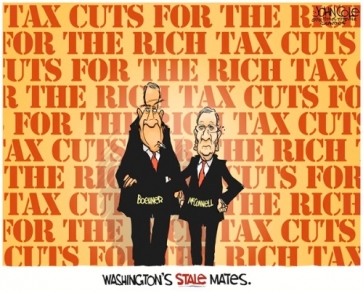 going “bankrupt”, and the continuing insistence that the people that benefited most from unrealistic policy moves over the last 30 years shouldn’t kick in their fair share for our civilization is the conversation that goes on within the community of economists. Economists know it’s insanity. There’s a lot of agreement that most of the media hysteria and political power playing around this entire deficit hysteria is mostly a plot form “obscenely rich men” who just simply want more of everything we have. Here’s some excellent analysis and points by Lynn Stewart Parramore.
New York magazine calls it a “Mass Movement for Millionaires.” The New York Times’ Paul Krugman sums up the idea : “Hey, sacrifice is for the little people.”
The Campaign to Fix the Debt is a huge, and growing, coalition of powerful CEOs, politicians and policy makers on a mission to lower taxes for the rich and to cut Social Security, Medicare and Medicaid under the cover of concern about the national debt. The group was spawned in July 2012 by Erskine Bowles and Alan Simpson, architects of a misguided deficit reduction scheme in Washington back in 2010. By now, the “fixers” have collected a war chest of $43 million. Private equity billionaire Peter G. Peterson, longtime enemy of the social safety net, is a major supporter.
This new Wall Street movement, which includes Republicans and plenty of Democrats, is hitting the airwaves, hosting roundtables, gathering at lavish fundraising fêtes, hiring public relations experts, and traveling around the country to push its agenda. The group aims to seize the moment of the so-called “fiscal cliff” debate to pressure President Obama to concede to House Republicans and continue the Bush income tax cuts for the rich while shredding the social safety net. The group includes Goldman Sachs’ Lloyd Blankfein, JPMorgan Chase’s Jamie Dimon, Honeywell’s David Cote, Aetna’s Mark Bertolini, Delta Airlines’ Richard Anderson, Boeing’s W. James McNerney, and over 100 other influential business honchos and their supporters.
Corporations represented by the fixers have collected massive bailouts from taxpayers and gigantic subsidies from the government, and they enjoy tax loopholes that in many cases bring their tax bills down to zero. Sometimes their creative accountants even manage to get money back from Uncle Sam. For instance, according to Citizens for Tax Justice, Boeing has paid a negative 6.5 percent tax rate for the last decade, even though it was profitable every year from 2002 through 2011.
These CEOs talk about shared sacrifice, but it seems that they don’t intend to share anything but your retirement money with their wealthy friends. As New York magreports:
“Most on-the-record comments are a mishmash of platitudes about shared sacrifice and working together for the good of the country. But interviews with a number of organizers and CEO council members point to a massive networking effort among one-percenters — one that relies on strategically exploiting existing business relationships and appealing to patriotic and economic instincts.”
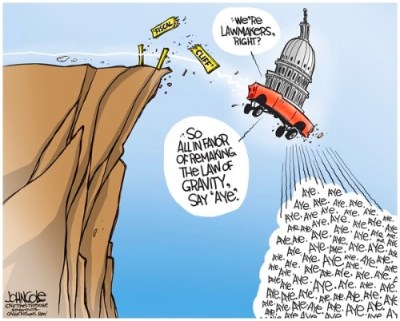 It is outrageous to think that a country that has been suffering from decades of ever increasing income inequality, exorbitant CEO pay, and financial crises triggered by corporate and financial industry corruption should lead to calls that the victims should pay more than perpetrators–who are also the pirates that profiteered–for the damages done to the public treasury. There is a full on assault for everything that’s defined as America progress since the 20th century. The majority of Americans–we poor, huddled masses–are losing the assault. We’ve lost the conversation in the halls of congress and to the media that appears to be joined at the hip with its plutocratic enablers.
It’s obvious Republican leaders have no idea of what they speak and are only talking from points they feel will tingle the fingers of their donor base. The ink is barely dry on the Romney loss and the 2016 Republican candidates are already on the run. All of them are basically running on the same crap rejected just weeks ago with the exception of trying to find a kinder gentler way to spin the obvious hatred of any one that’s not a rich white male. Most of them don’t even care about learning about the issues. They only want to find a message that will sell to their privileged constituents.
As Jonathan Chait points out, Bobby Jindal — who is supposed to be one of the intellectual leaders of his party — has just published an op-ed on the cliff that sure looks as if he has no idea whatsoever what the cliff is about. There’s nothing in that piece even hinting that the looming problem is spending cuts and tax increases that will shrink the deficit too soon; and his big policy ideas would actually make the lurch to austerity worse. It’s not just the idea of a balanced budget amendment, which would force harsh austerity every time the economy goes into recession; putting a cap on spending as share of GDP would do the same, because you’d have to cut spending whenever GDP went down.
You really have to wonder how someone who’s a major political figure could be this uninformed — but you have to wonder even more about the state of mind that induces you to write an op-ed about a subject you don’t comprehend at all.
But this isn’t the first time something like this has happened to a supposed GOP star. In the early stages of the Republican primary, Tim Pawlenty — a supposed thoughtful conservative — published an op-ed based on the premise that public-sector employment was booming; in fact, it was plunging. And, of course, Mitt Romney made statements — about the 47 percent, about Benghazi — that he clearly thought were smart and well-informed, but were in fact flatly false.
I think it comes back to the epistemic closure issue. Even supposedly well-informed people on the right get their “facts” from the likes of the Heritage Foundation. Probably Jindal never talks to anyone who will quietly explain that the fiscal cliff is a problem because, well, Keynesian economics is basically right, and you really don’t want austerity in a depressed economy. So he has some vague notion that it’s about the wages of fiscal irresponsibility, which it isn’t, and apparently believes that he knows enough to pontificate.
Now, there’s talk of doing something very fiscally unsound to give the Republicans a trophy. Will Democrats actually take the imprudent action to increase the Medicare age just to get the Republicans to move on something, anything? Ezra Klein–hosting for Rachel Maddow–points out the incredibly unpopular policy is also terrible fiscal policy because it will cost more to cover the change than it saves.
Despite the fact it’s unpopular, republicans really want to make cuts in medicare and want to raise the age by two years from 65 to 67. that’s also super unpopular…What’s weird is it’s always presented as the height of fiscal responsibility even though it’s fiscally irresponsible. Which brings us to the challenge. why raising the age does not save you very much money and is probably a bad policy idea in under two minutes…The seniors turning to private insurance will have to pay more from the same coverage. 3.7 billion more in the first year of the policy…it’s a terrible policy, but because obama care and employers and others are there to catch a lot of these people, it might get more votes while doing less harm to seniors than the alternatives.
The basic reasoning behind all of this is the continual need by the Republicans to serve their richest of the rich and the inability of the rich to EVER GET ENOUGH MONEY and Power. It’s a zero sum game for them and they seem to want every one else to lose. The worst of these offenders have installed themselves on Wall Street. They still keep pushing the idea that Social Security is insolvent and going bankrupt when it is not. These are also the guys that would love to access that big pool of money for their gambling schemes.
“Fix” means cut : When they say “fix” Social Security, they mean cut Social Security. Fixers want to convince the public that a well-managed, hugely popular program that does not add to the deficit (it’s self-funded) is somehow in crisis and requires intervention in the form of various cutting schemes. They seek this because many of the rich do not want to pay taxes for Social Security, and financiers want very much to move toward privitization of retirement accounts so they can collect fees on such accounts.
It is surreal that any elected official could still hold and trumpet these ideas after they were sincerely stomped on by the electorate just weeks ago. But the deal is that the rich just cannot get enough and they are willing to drive the country into developing country status to get more. The United State continues to nosedive on lists of quality of life. What exactly will it take to get jerks like the Koch Brothers back into their evil box?
Here’s an excellent essay that sums up what’s wrong with the country these days by James Kenneth Galbraith. He mentions the importance of the our stagnant wages but goes one further. The very things that gave us our strong middle class after the Great Depression and up to the Reagan years are our social contracts with each other. These programs are under attack today like never before.
The real threat to the middle class is not there, it’s in the erosion of the programs I just mentioned. That is to say, it’s in the attack on the public schools, it’s in the squeeze on higher education, it’s in the threat to Social Security. When you look at housing, you have a very large unambiguous loss. Millions of people have been displaced, but many, many more have lost the capital value of their homes. They won’t be able to sell and retire on the proceeds.
So I think there is a threat to the middle class, but if I were talking about it in political terms, I wouldn’t be giving an abstract statistical picture of wages. This doesn’t connect to people’s experiences. If I were designing the boilerplate rhetoric of a popular movement, I would take a blue pencil to these statistical formulations. I don’t like the stagnant median wage argument—I think it obscures what actually happened. And I don’t particularly care for the “one percent” argument. I understand it has a certain power, but one can be much more precise about what it is you want to attack, and what it is you want to preserve and to build. I would cut to the chase: we need to tear down the financial sector and rebuild it from scratch in a very different way.
In our current situation, the financial sector makes its money by destroying, not by building. When one frames the issue that way, and when you try to explain to people why that’s so, I think they have a much clearer picture of what they’re facing and what should be done. Occupy Wall Street wasn’t wrong to focus on Wall Street. That was exactly right. But talking in terms of the “one percent”—which, after all, would be about 3.1 million people—doesn’t clarify what is truly at issue. What do people care about? People care about their public services, they care about their schools, they care about the environment in which they live, they care about safety, they care about the terms of student loans, they care about health care and retirement. When one talks about those issues, I think you connect much more effectively than by addressing this in terms of “the middle class,” which is itself a very abstract term.
We are going to come to a point of decision fairly soon as to whether the core institutions of the New Deal and the Great Society survive. It is a straightforward question: do we insure the whole population against old age, disability, or the loss of their income, or not? Do we provide a decent standard of health care and long-term care for the elderly and people in the final phases of life, or not? Is this a community that provides this as a matter of common insurance, or isn’t it?
We need to buck up whoever we can to say no to compromises that include our basic social safety programs. We should go over the fiscal cliff rather than give Republicans trophies that will ruin our society in the long run.
Creating Fiscal Strife
Posted: November 29, 2012 Filed under: Catfood Commission, Economy, Federal Budget, Federal Budget and Budget deficit, George W. Bush, Global Financial Crisis, House of Representatives, Medicare, Politics as Usual, Republican politics, Republican Tax Fetishists, Super Committee, The Bonus Class, the GOP, U.S. Economy, U.S. Politics | Tags: fiscal cliff 15 Comments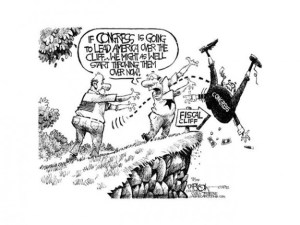 One of the things that drives me crazy as an economist and a citizen looking at this so-called “fiscal cliff” is that our fiscal strife has been created by the people least likely to suffer from its resolution. Congress gave the Bush administration authority to start a series of unfunded, reckless wars that have lasted well over a decade. Congress passed the Bush administration’s reckless tax cuts and generous loopholes that have benefited the few at the cost of the many. The Bush administration’s and Congress’ lack of oversight and deregulation of the financial services’ industry created a low-risk, gambling casino with the national investment and savings accounts and the debt markets. This led to a huge recession. These are the roots of our fiscal problems. But, the discussions around cleaning up messes in the District mostly surround Social Security which has nothing to do with the national debt and deficit and items that have become more necessary to average Americans since Congress and the Bush Administration broke the country with its bad policies.
Here’s some of the latest examples. Closing loopholes and unnecessary deductions for certain constituents is a good idea. However, which of these things are on the chopping block? Inkling its way up the priority list is the major middle and working class deduction and source of household wealth: the mortgage interest deduction. I have no problem with eliminating second mortgages, mortgages on boats, and mortgages on second properties. These benefit very few people and really serve little policy purpose. Capping the deduction–with an annual COLA adjustment to the median price and below-based mortgages is also fine. However, what are we likely to see?
As the Obama administration and lawmakers on Capitol Hill scramble to defuse automatic spending cuts and tax increases set to take effect Jan. 1, a herd of sacred cows — from Social Security and Medicare to deductions for charitable giving and mortgage interest — are in danger of losing their untouchable status.
Members of both parties have largely steered clear of detailed proposals so far. But plans put forth in the past year by President Obama and Mitt Romney to place limits on annual total tax deductions are likely to crimp the mortgage-interest deduction for certain taxpayers. Top congressional Republicans also have expressed openness to limiting total tax deductions as part of an overall budget deal. In addition, the presidentially appointed Simpson-Bowles fiscal commission suggested scaling back the mortgage-interest deduction as part of its own set of tax-related proposals.
Current law allows homeowners to deduct the interest paid on mortgage balances up to $1 million, including on second homes, as well as on $100,000 worth of home-equity loans. The deduction overwhelmingly benefits wealthier families, partly because they tend to have larger mortgages and pay more interest, and partly because most low- and middle-income Americans do not itemize deductions on their tax returns. It also tends to favor homeowners on the East and West Coasts, as well as those in large cities such as Chicago, where average home prices are higher.
Edward Kleinbard, a tax expert and law professor at the University of Southern California, said the mortgage-interest deduction represents the kind of government “extravagance” that the country no longer can justify, given its fiscal troubles.
“We simply cannot afford wasteful government subsidy programs anymore, and this is one of the most important examples of that,” Kleinbard said. “It’s very much a subsidy to those Americans who need it least.”
Mitch McConnell continues to service Grover Norquist and the Club for Growth. He’s back on his high horse for no tax increases for the wealthy. Ending tax cuts for the wealthy endlessly shown to have no ill-impact on the economy. There is also no real benefit to extending them.
Senate Republican Leader Mitch McConnell (Ky.) slammed the door Thursday morning on Democratic demands to raise tax rates on families earning more than $250,000 per year.
“We’re insisting on keeping tax rates where they are, first and foremost, to protect jobs and because we don’t think government needs the money in the first place,” McConnell said on the Senate floor.
“The problem, as I’ve said, is that Washington spends too much. But if more revenue is the price that Democrats want to exact, then we should at least agree to do it in a way that doesn’t cost jobs and disincentivize rates, as we all know raising rates would do,” he said.
McConnell’s comments came a day after Speaker John Boehner (R-Ohio) shot down a proposal by a senior GOP lawmaker, Oklahoma Rep. Tom Cole, to agree to extend tax rates only for families earning below $250,000 and resume the battle against higher tax rates on the wealthy next year.
Boehner said President Obama and Democrats should focus on finding ways to cut spending and reform entitlement programs.
The fate of the Bush-era tax rates — which will expire for all income levels in January — has dominated the debate over the slew of tax increases and spending cuts that are set to begin next year.
McConnell scolded the president Thursday for sticking fast to his campaign pledge to seek higher taxes on the rich, and made clear that raising tax rates on anyone is unacceptable.
The debate over Medicare is likely to be equally absurd. Medicare needs some reworking. Most of its problems comes from the pharmacy benefit which currently allows Big Pharma to price gouge participants and the taxpayers. But, you wouldn’t know that from the conversation. Republicans are playing games with Amercan’s health. They appear to be clinging to the Ryan’s voucher plan which would be disastrous for the majority of retired seniors.
The austerity crisis talks have hit a peculiar impasse. The problem isn’t, as most analysts expected, taxes, where Republicans seem increasingly resigned to new revenue. It’s Medicare. And the particular Medicare problem isn’t that Democrats are refusing the GOP’s proposed Medicare cuts. It’s that Republicans are refusing to name their Medicare cuts.
Politico quotes a “top Democratic official” who paints the picture simply: “Rob Nabors [the White House negotiator], has been saying: ‘This is what we want on revenues on the down payment. What’s your guys’ ask on the entitlement side?’ And they keep looking back at us and saying: ‘We want you to come up with that and pitch us.’ That’s not going to happen.”
That’s partly politics. If nothing else, Republicans are respectful of Medicare’s political potency. Recall that a core Republican message in both the 2010 and 2012 elections was that Democrats, through Obamacare, were cutting Medicare too much. Republicans, already concerned about their brand, don’t want to rebrand themselves as the party of Medicare cuts.
But it’s partly policy, too. The fact is that short of converting the program to a premium support system — a non-starter after they lost the 2012 election — Republicans simply don’t know what they want to do on Medicare.
Scour the various outlets for Democratic policy ideas and you’ll find plenty of proposed Medicare cuts. President Obama’s 2013 budget, for instance, includes hundreds of billions in Medicare cuts (see pages 33-37), and caps the program’s long-term growth at GDP+0.5 percent. More recently, the Center for American Progress released a 46-page proposal for cutting Medicare by almost $400 billion.
Republicans, meanwhile, have focused their energy on a long-term effort to convert Medicare to a premium-support model. Paul Ryan’s 2013 budget kept the Affordable Care Act’s Medicare cuts for the next 10 years and proposed to convert the program to a premium-support model in the future. Mitt Romney’s platform proposed reversing Obamacare’s Medicare cuts and offered a vague framework for converting the program to a premium-support model in the future.
If you dig deep into the Republican think tank world, you can find a few proposals that focus on the near-term.
The current fiscal ‘cliff’ framework appears to place a lot of burden on those least able to take it as well as those least responsible for creating the problems.
Cut through the fog, and here’s what to expect: Taxes will go up just shy of $1.2 trillion — the middle ground of what President Barack Obama wants and what Republicans say they could stomach. Entitlement programs, mainly Medicare, will be cut by no less than $400 billion — and perhaps a lot more, to get Republicans to swallow those tax hikes. There will be at least $1.2 trillion in spending cuts and “war savings.” And any final deal will come not by a group effort but in a private deal between two men: Obama and House Speaker John Boehner (R-Ohio). The two men had a 30-minute phone conversation Wednesday night — but the private lines of communications remain very much open.
No doubt, there will be lots of huffing and puffing before any deal can be had. And, no doubt, Obama and Congress could easily botch any or all three of the white-knuckle moments soon to hit this town: the automatic spending cuts and expiration of the Bush tax cuts, both of which kick in at the end of this year, and the federal debt limit that hits early next.
Go to the Politico story for a concept of what’s at stake and at issue.
Speaker John Boehner (R-Ohio) said Thursday there had been “no substantive progress” in fiscal-cliff negotiations in the two weeks since congressional leaders met with President Obama.
Boehner, addressing reporters after a meeting with Treasury Secretary Tim Geithner in the Capitol, called on the White House to “get serious” about the talks and warned of a “real danger” that Jan. 1 would come without a deal if President Obama did not offer up specific spending cuts he would be willing to accept.
“Despite claims that the president supports a balanced approach, the Democrats have yet to get serious about real spending cuts,” Boehner said. “Secondly, no substantive progress has been made in the talks between the White House and the House in the last two weeks.
“Listen, this is not a game,” he added. “Jobs are on the line. The American economy is on the line, and this is a moment for adult leadership.”
The Speaker criticized the president for holding “campaign-style rallies” instead of engaging in serious talks.

 peej
peej Carissa
 bostonboomer
 dakinikat
 ecocatwoman
 mablue2
 Mama Lopez
 peggysue22
 quixote
 skydancingguestblogger
 Mona (aka Wonk the Vote)



 Sky Dancing
Recent Comments