
Christmas Day Reads
Posted: December 25, 2014 Filed under: Barack Obama, morning reads | Tags: Dies Natalis Solis Invicti, Feast of Juul, Festivus, gender stereotypes, Hanukkah, History of Christmas, Kwanzaa, michelle obama, Mithras, Saturnalia, Toys for Tots, Winter Solstice, yule log 12 Comments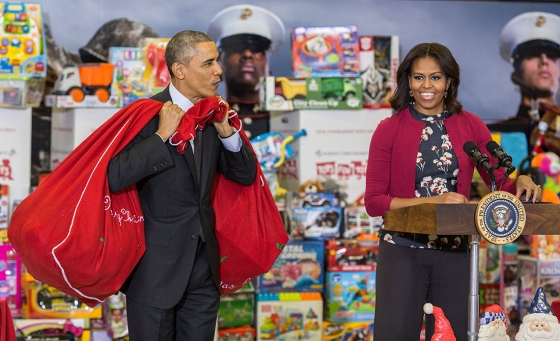
Good Morning!!
Merry Christmas to everyone who celebrates this day. Also, Happy Hanukkah, the festival of lights, which culminated last night. Happy Kwanzaa to those who will begin celebrating it tomorrow. And Happy Festivus “for the rest of us.”
How long have humans been celebrating the return of the light after the darkest day of the year–the Winter Solstice fell on Dec. 21 in 2014–when the days gradually begin getting longer? No one knows for sure, but it has been many centuries. I’ve gathered some articles about some ancient holidays around the solstice that preceded Christmas.
The ancient Romans celebrated the Saturnalia in tribute to the god Saturn, and Roman soldiers marked Dies Natalis Solis Invicti, in honor of the god Mithras.
Here’s a detailed description of the Saturnalia from a University of Chicago website.
In the Roman calendar, the Saturnalia was designated a holy day, or holiday, on which religious rites were performed. Saturn, himself, was identified with Kronos, and sacrificed to according to Greek ritual, with the head uncovered. The Temple of Saturn, the oldest temple recorded by the pontiffs, had been dedicated on the Saturnalia, and the woolen bonds which fettered the feet of the ivory cult statue within were loosened on that day to symbolize the liberation of the god. It also was a festival day. After sacrifice at the temple, there was a public banquet, as well as a lectisternium (a banquet in which an image of the god is placed as if in attendance), which Livy says was introduced in 217 BC. “For a day and a night the cry of the Saturnalia resounded through the City, and the people were ordered to make that day a festival and observe it as such for ever” (History of Rome, XXII.1.19). Afterwards, according to Macrobius (I.10.18), the celebrants shouted Io, Saturnalia at a riotous feast in the temple.
The Saturnalia was the most popular holiday of the Roman year. Catullus describes it as “the best of days” (Poems, XIV), and Seneca complains that the “whole mob has let itself go in pleasures” (Epistles, XVIII.3). Pliny the Younger writes that he retired to his room while the rest of the household celebrated (Epistles, II.17.24). It was an occasion for celebration, visits to friends, and the presentation of gifts, particularly wax candles (cerei), perhaps to signify the returning light after the solstice, and sigillaria. Martial wrote Xeniaand Apophoreta for the Saturnalia. Both were published in December and intended to accompany the “guest gifts” which were given at that time of year. Aulus Gellius relates that he and his Roman compatriots would gather at the baths in Athens, where they were studying, and pose difficult questions to one another on the ancient poets, a crown of laurel being dedicated to Saturn if no-one could answer them (Attic Nights, XVIII.2).
During the holiday, restrictions were relaxed and the social order inverted. Gambling was allowed in public. Slaves were permitted to use dice and did not have to work. Instead of the toga, colorful dinner clothes (synthesis) were permitted in public, as was the pileus, a felt cap normally worn by the manumitted slave that symbolized the freedom of the season (Martial, Epigrams, XIV.1). Within the family, a Lord of Misrule was chosen, a role once occupied by a young Nero, who derisively commanded his younger step-brother Britannicus to sing (Tacitus, Annals, XIII.15).
Slaves were treated as equals, allowed to wear their masters’ clothing, and be waited on at meal time in remembrance of an earlier golden age thought to have been ushered in by the god. In the Saturnalia, Lucian has the god’s priest declare that “During My week the serious is barred; no business allowed. Drinking, noise and games and dice, appointing of kings and feasting of slaves, singing naked, clapping of frenzied hands, an occasional ducking of corked faces in icy water—such are the functions over which I preside.” Statius recounts a “December tipsy with much wine, and laughing Mirth and wanton Wit,” remembering “the glad festival of our merry Caesar and the banquet’s drunken revel” (Silvae, I.6.1ff; also Suetonius, Domitian, IV.1; Dio, Roman History, LXVII.4.4). Figs, nuts, dates and other dainties were showered on the people, women and children, men and senators alike, and bread and wine served among the rows while guests were entertained by women fighting in the arena and cranes were hunted by dwarfs.

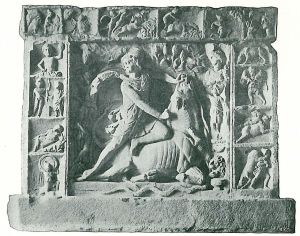
Relief of Mithras as bull-slayer from Neuenheim near Heidelberg, framed by scenes from Mithras’ life (from Wikipedia).
From About.com: Dies Natalis Solis Invicti and Mithras.
Saturnalia may have been responsible for the pageantry of our midwinter festival, but it’s Mithraism that seems to have inspired certain symbolic religious elements of Christmas. Mithraism arose in the Mediterranean world at the same time as Christianity, either imported from Iran, as Franz Cumont believed, or as a new religion which borrowed the name Mithras from the Persians, as the Congress of Mithraic Studies suggested in 1971.
Mithraism radiated from India where there is evidence of its practice from 1400 B.C. Mitra was part of the Hindu pantheon* and Mithra was, perhaps, a minor Zoroastrian deity**, the god of the airy light between heaven and earth. He was also said to have been a military general in Chinese mythology.
The soldiers’ god, even in Rome (although the faith was embraced by male emperors, farmers, bureaucrats, merchants, and slaves, as well as soldiers), demanded a high standard of behavior, “temperance, self-control, and compassion — even in victory”….
The comparison of Mithraists and Christians is not coincidental. December 25 was Mithras’ birthday (or festival before it was Jesus’. The Online Mithraic Faith Newsletter [no longer available] says:
“Since earliest history, the Sun has been celebrated with rituals by many cultures when it began it’s journey into dominance after it’s apparent weakness during winter. The origin of these rites, Mithrasists believe, is this proclamation at the dawn of human history by Mithras commanding His followers to observe such rites on that day to celebrate the birth of Mithras, the Invincible Sun.”

Thor, god of thunder
In Scandinavia the Norse god Thor was honored with the Feast of Juul.
The Feast of Juul was a pre-Christian festival observed in Scandinavia at the time of the December solstice. Fires were lit to symbolize the heat, light and life-giving properties of the returning sun. A Yule or Juul log was brought in and burned on the hearth in honor of the Scandinavian god Thor.
A piece of the log was kept as both a token of good luck and as kindling for the following year’s log. In England, Germany, France and other European countries, the Yule log was burned until nothing but ash remained. The ashes were then collected and either strewn on the fields as fertilizer every night until Twelfth Night or kept as a charm and or as medicine.
French peasants believed that if the ashes were kept under the bed, they would protect the house against thunder and lightning. The present-day custom of lighting a Yule log at Christmas is believed to have originated in the bonfires associated with the feast of Juul.
Click on the link to read about other ancient holidays centered around the Winter Solstice.
Two more articles on this history of Christmas:
From Pacific Standard Magazine, A Brief History of the Christmas Controversy: Can Christmas’ pagan roots explain its increasing secularization today?
During Constantine’s reign the Church Fathers went so far as to associate the “Unconquered Sun” with Jesus, referencing the “sun of righteousness” mentioned in Malachi 4:2 as evidence of Jesus, the true sun. Through this crafty legerdemain early Christians more easily shifted December 25 from the birth of Sol Invictus to the birth of Christ. Eventually several other important religious dates would pivot on Christmas, including the Annunciation, celebrated on March 25, nine months before Christ’s ceremonial birth, the Epiphany, and the Adoration of the Magi. Once Christianity seized December 25, all the other historic moments and their accompanying mythologies fell into place. After emerging out of the husk of Saturnalia, Christmas gathered more and more momentum until it became a vital date inextricably bound to all the other sacred events and consecrated lore of the Christian tradition.
Roughly 1,600 years later, though, things are different. Christmas, at least as it’s celebrated in America, is no longer treated as an exclusively religious holiday. While millions of Americans still attend Christmas services, there are millions more who get swept up in an entirely different set of gratuitous lore: Santa Claus, Christmas trees, Dickensian tableaus, and the lustrous charms of Disneyfication. But look beneath all of the modern flourishes and you’ll see something that looks a lot like Saturnalia: the ceremonial feasts, the singing in the streets (what we now call caroling), the holiday parties. Heck, Saturnalia even had a special day on December 23 reserved for the exchanging of gifts among friends and family—Sigillaria, so named after the wax figurines often given as presents.
The truth is that Christmas has not so much evolved into a secular celebration as it has come full circle, returning to its original incarnation as a sprawling festival more focused on levity and merrymaking than the worship of Jesus Christ….
It’s no blasphemy to declare that the December holiday season has once again become a pagan celebration; it’s an atavistic return to the ritual’s roots. The problem now, as the more devout Christians rightly point out, are those people caught in the middle of this identity crisis—identifying as members of Christianity and claiming belief in its savior, but investing little devotion, solemnity or faith in the embattled date.
Finally, here is an interesting article at a Jewish website on the origins of Christmas. Some excerpts:
In the 4th century CE, Christianity imported the Saturnalia festival hoping to take the pagan masses in with it. Christian leaders succeeded in converting to Christianity large numbers of pagans by promising them that they could continue to celebrate the Saturnalia as Christians….
Christians had little success, however, refining the practices of Saturnalia. As Stephen Nissenbaum, professor history at the University of Massachussetts, Amherst, writes, “In return for ensuring massive observance of the anniversary of the Savior’s birth by assigning it to this resonant date, the Church for its part tacitly agreed to allow the holiday to be celebrated more or less the way it had always been.” The earliest Christmas holidays were celebrated by drinking, sexual indulgence, singing naked in the streets (a precursor of modern caroling), etc.
The Reverend Increase Mather of Boston observed in 1687 that “the early Christians who first observed the Nativity on December 25 did not do so thinking that Christ was born in that Month, but because the Heathens’ Saturnalia was at that time kept in Rome, and they were willing to have those Pagan Holidays metamorphosed into Christian ones.” Because of its known pagan origin, Christmas was banned by the Puritans and its observance was illegal in Massachusetts between 1659 and 1681….
Some of the most depraved customs of the Saturnalia carnival were intentionally revived by the Catholic Church in 1466 when Pope Paul II, for the amusement of his Roman citizens, forced Jews to race naked through the streets of the city. An eyewitness account reports, “Before they were to run, the Jews were richly fed, so as to make the race more difficult for them and at the same time more amusing for spectators. They ran… amid Rome’s taunting shrieks and peals of laughter, while the Holy Father stood upon a richly ornamented balcony and laughed heartily.”
Just some food for thought . . .
A few nice news headlines:
The photo at the top of this post is from Michelle Obama’s Toys for Tots event, at which President Obama sorted toys for boys any girls and took the opportunity to fight gender stereotypes about girls supposedly not liking toys involving sports, science, and legos. Joan McCarter wrote about it at Daily Kos yesterday, President Obama: ‘Girls don’t like toys?’.
See also Amanda Hess at Slate, Watch President Obama Break Down Stereotypes About Toys for Girls and Boys. Watch the video:
More presidential efforts to reach out to women and girls:
The Fix, That time Obama called on only women at a press conference.
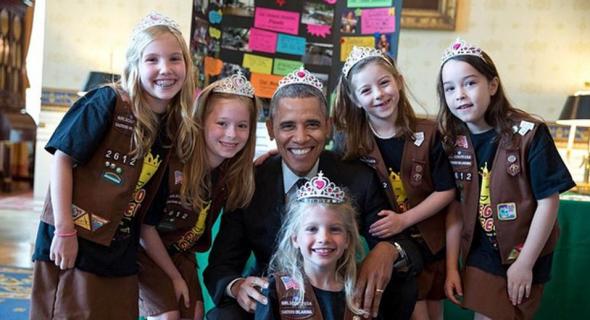
Politico, That time Obama wore a tiara.
White House photographer Pete Souza shared a photo on Instagram on Wednesday of the president donning a tiara with a group of Girl Scouts from the White House Science Fair earlier this year in May. In the caption, Souza wrote the girls from Tulsa “convinced” Obama to join in on the fun.
More news headlines:
I was going to write a big post about the 75th anniversary of the film of Gone With The Wind, but I’ve been too tired from traveling. Here’s a good article from yesterday about the events surrounding the anniversary and about the racism in the book and movie.
75 years later, ‘Gone With the Wind’ never left.
Reuters, Protests flare after Missouri police killing of armed black man.
Reuters, CDC worker monitored for possible Ebola exposure in lab error.
Dave Wiegel at Bloomberg Politics, This Christmas, Be Grateful You Didn’t Put All Your Money in Oil and Gold.
NY Daily News, Putin Calls for Cheaper Vodka as Russian Economy Stumbles.
Bloomberg, Saudi Rulers to Curb Wages as Kingdom Confronts Oil Slump
The Telegraph, Stonehenge discovery could rewrite British pre-history.
More on the discovery: 6,000-year-old encampment found in dig by University of Buckingham.
TPM, Ohio Town Orders Man To Take Down Zombie Nativity Scene.
Raw Story, Indiana lawmaker pushing bill to insulate government Nativity scenes from atheist legal ‘threats’
Raw Story, Ayn Rand helped the FBI investigate whether ‘It’s a Wonderful Life’ was commie propaganda.
Have a wonderful holiday everyone, and please leave a comment and/or a link if you’re so inclined.
Thursday Reads
Posted: December 23, 2010 Filed under: Barack Obama, legalizaton of drugs, morning reads, U.S. Politics | Tags: Christmas, Festivus, George W. Bush, John Boehner, Laura Bush, Marijuana, North Korea, Pat Robertson, Seinfeld, South Korea 96 CommentsHappy Festivus Everyone!!!
A little more about the Festivus tradition from Wikipedia:
Festivus is a secular holiday celebrated on December 23 as “another way” to celebrate the holiday season without participating in its pressures and commercialism[1]. It was created by writer Dan O’Keefe and introduced into popular culture by his son Daniel, a screenwriter for the TV show Seinfeld,[2][1] as part of a comical storyline on the show. The holiday’s celebration, as shown on Seinfeld, includes an unadorned aluminum “Festivus pole,” practices such as the “Airing of Grievances” and “Feats of Strength,” and the labelling of easily explainable events as “Festivus miracles”.
Celebrants of the holiday sometimes refer to it as “Festivus for the rest of us,” a saying taken from the O’Keefe family traditions and popularized in the Seinfeld episode to describe Festivus’ non-commerical aspect.
[….]
The holiday, as portrayed in the Seinfeld episode and now celebrated by many,[1][5] includes practices such as the “Airing of Grievances,” which occurs during the Festivus meal and in which each person tells everyone else all the ways they have disappointed him or her over the past year. After the meal the “Feats of Strength” are performed, involving wrestling the head of the household to the floor, with the holiday ending only if the head of the household is actually pinned.
The original holiday featured more peculiar practices, as detailed in the younger Daniel O’Keefe’s book The Real Festivus. The book provides a first-person account of an early version of the Festivus holiday as celebrated by the O’Keefe family, and how O’Keefe amended or replaced details of his father’s invention to create the Seinfeld episode.
We’re getting really close to that other holiday, Christmas. Through most of my adult years, I found the Christmas season extremely stressful. Frankly some of my happiest Christmases have been years when I spent the day alone. In recent years, I’ve gotten quite a bit closer to my siblings and I’ve enjoyed some family Christmases; but when all of us get together it can still be pretty crazymaking.
This year I’ll be going to my sister’s house with my mom. I’m hoping it will be quiet and peaceful, and I’m hoping the snowstorm we’re expecting won’t be too bad. We lost my dad in March, so this will be the family’s first Christmas without him. I know that will be really hard for all of us, especially my mom.
I’m not going to go through all the legislation that passed yesterday or write about President Obama’s self-congratulatory press conference. I think we should keep it light today. I’m just going to throw out a few links that I found interesting and let you all do the same in the comments.
I really got a kick out this article at Buzzflash by Peter Michaelson, a psychotherapist from Ann Arbor, MI: The Tracks of John Boehner’s Tears.
According to Michaelson, Boehner’s frequent “crying jags” stem from his troubled childhood.
Boehner cries a lot in public, even when debating bills in the House. He cries when he talks about his humble past. Son of a bar owner, he grew up with 11 siblings in a two-bedroom house with a single bathroom. He said recently on “60 Minutes” that he no longer visits schools or even looks at kids playing outside because he immediately starts crying.
[….]
Boehner had a scrappy upbringing, running cases of beer and mopping the floor in his father’s bar. He put himself through school, “working every rotten job there was.” The circumstances of his childhood, along with his manner of describing it, strongly suggest that, at times, he felt unappreciated, disrespected, and lacking in value.
Since Boehner rarely does anything to help deprived children, why does he burst into tears when he sees them? Michaelson see this as a form of projection.
When Boehner cries around kids, he’s not necessarily feeling their pain. He’s not seeing the world through their eyes. Rather, he’s imagining that they’re seeing the world through his eyes, through the self-doubt and pain with which he saw the world as a child. Unconsciously, he experiences himself and his political life in ways that are under the influence of these unresolved negative feelings.
He sees the children through what is unresolved in himself, through the pain he has repressed from his childhood. He’s also likely crying with relief because, unconsciously, he believes that, through his elevation to fame and power, he has liberated himself from those haunting feelings.
It’s an interesting hypothesis. We’ll probably learn a lot more about Boehner when he becomes Speaker of the House–probably a lot more than we ever wanted to to know. I wonder if he’ll cry frequently while going about his Speaker duties? I’ll bet he cries during the swearing in anyway.
Last night some moron drove his Plymouth Barracuda onto the North Dallas lawn of Mr. and Mrs. George W. Bush.
A suspect accused of driving a muscle car erratically onto the lawn at former President George W. Bush’s north Dallas home Wednesday night was detained by the Secret Service.
The former president and former first lady Laura Bush were in the Preston Hollow neighborhood home at the time but were unharmed and never in danger, officials told NBC station KXAS.
That must have been exciting.
Have you heard about the new Broadway sensation, “Spiderman: Turn Off the Dark?” There have been so many mishaps with this production that they had to call off Wednesday’s scheduled performances.
The Broadway musical “Spider-Man: Turn Off the Dark” canceled its two Wednesday performances to test a new safety plan for the show’s 38 aerial and stage maneuvers, which involve actors hoisted or tethered in harnesses, including the maneuver that failed at Monday night’s performance when a stunt actor fell more than 20 feet and broke his ribs.
By canceling the performances at a cost of roughly $400,000 in ticket sales, and by adopting safety measures recommended by state and federal officials, the producers of “Spider-Man” sought to project a sense of urgency and understanding that action was needed to make the show safer. While the producers said that Thursday night’s performance would go on, they also committed, according to state safety officials, not to hold performances until the new measures were in place. The state officials said the plan could be tested successfully by Thursday night.
Under the plan, one offstage crew member will attach the harness and related cables, wires or tethers to the actors, and a second stagehand will verify that the attachments are made. That second stagehand will then verbally notify a stage manager that they are safely connected. The actor will also verify that the attachment is made. Previously, there was no second stagehand to verify or communicate with the stage manager, and the actor was not required to check his harness.
Well I sure hope everything works out okay…
Did you know that “Rev.” Pat Robertson supports legalization of marijuana?
“We’re locking up people that have taken a couple puffs of marijuana and next thing you know they’ve got 10 years with mandatory sentences,” Robertson continued. “These judges just say, they throw up their hands and say nothing we can do with these mandatory sentences. We’ve got to take a look at what we’re considering crimes and that’s one of ’em.
“I’m … I’m not exactly for the use of drugs, don’t get me wrong, but I just believe that criminalizing marijuana, criminalizing the possession of a few ounces of pot, that kinda thing it’s just, it’s costing us a fortune and it’s ruining young people. Young people go into prisons, they go in as youths and come out as hardened criminals. That’s not a good thing.”
Hmmm….could this explain where Robertson gets his wacky ideas about the causes of hurricanes and terrorist attacks?
Here’s one more goofy story, and then I’ll let you guys take over. From The Independent UK: North Korea threatens to attack South over Christmas lights
Seasonal goodwill is in short supply on the divided Korean peninsula, where both sides are again at potentially deadly loggerheads – over a Christmas tree.
North Korea’s military is reportedly preparing to shoot down a floodlit tower decorated with Christmas lights which overlooks the border near the South’s capital, Seoul – home to millions of Christians.
The provincial governor, Kim Moon-soo, has warned that firing at the tree would be a reckless and “provocative” act. The South’s Defence Minister was more blunt. “We’ll retaliate decisively to take out the source of any shelling,” Kim Kwan-jin told parliament yesterday. South Korea’s Yonhap news agency said fighter jets were on standby, ready to strike back.
OK, that’s it for me, except for this gratuitous kitty picture.
What are you reading this morning? Feel free to post links to serious stories, if you must.

 peej
peej Carissa
 bostonboomer
 dakinikat
 ecocatwoman
 mablue2
 Mama Lopez
 peggysue22
 quixote
 skydancingguestblogger
 Mona (aka Wonk the Vote)



 Sky Dancing
Recent Comments