
Sunday: Waking up to being a Woman in America
Posted: July 7, 2013 Filed under: just because | Tags: feminism 51 Comments Good morning, newsjunkies! Here are some reads to nibble on with your morning brew…
The 10 most dangerous places to be a woman in America:
Lately, the preferred strategy for reproductive rights opponents in the United States seems to be: If you can’t beat Roe v. Wade, then simply regulate around it.
Click on over to read Salon’s roundup of the top ten offenders. Not that the list will shock the readership here at Sky Dancing, but it’s a handy little summation of the bullshit that’s gone down just this year.
Snippet:
North Dakota
The spring of 2013 was a busy time for lawmakers in Bismarck. The GOP-controlled Legislature passed four draconian measures with strong majorities, giving North Dakota the dubious distinction of having the most restrictive abortion laws in a country rich with restrictive abortion laws.
Shorter Salon: 2013, What Fresh Hell is This?
Can you guess the other pro-dumb states that share blue Darwin Award ribbons with North Dakota?
And, no “pro-dumb” is not a freudian typo or autocorrect. The male empty suits running this horror show are clearly just pro-dumb at this point.
Case-in-point, from the “four draconian measures” link in the North Dakota snippet above:
The state’s turn to the extreme side of extreme has alienated reproductive rights advocates, women’s health activists, medical professionals and — wait for it — a coalition of Republicans who believe their colleagues have gone too far.
As reported by the Huffington Post:
“It’s to say, hey, this isn’t okay. We have stepped over the line,” said state Rep. Kathy Hawken (R-Fargo) in a phone interview with The Huffington Post… “North Dakota hasn’t even passed a primary seatbelt law, but we have the most invasive attack on womens health anywhere,” she said. “I got a letter yesterday from a pharmacist who said, ‘We don’t want to be in jail because we prescribed something!’ We’re spending an inordinate amount of time on social or personal issues, however you want to put it, but we haven’t done anything on property tax relief, higher education funding, fixing the roads. There are all kinds of other things we need to be doing besides this.”
Hawken said that as a strong fiscal conservative, she is worried that the state will spend millions of dollars that could be put to better use defending these laws in court. “They could fund my childcare bill with what we’re going to spend on lawsuits,” she said. “Can’t we let Arkansas be the poster child for this? Why does it have to be us?”
Hawken, a self-proclaimed pro-life Republican, says her colleagues have also rejected measures to increase prenatal care for minors and childcare for single moms, leaving her to question the motives behind the recent legislative push:
“It seems like we want to get [babies] here,” she said, “but we don’t care if they’re healthy once they get here. That’s just bad policy,” she said.
See. Pro-dumb.
Actually, pro-dumb is really an incarnation of No Profit Left Behind…which brings me to my next read, a radfem piece entitled, “Oppression is always tied to resource extraction” (emphasis in bold, mine):
Abortion restrictions in the US, from the very beginning, were intended to ensure the dominance of white settlers and the dominance of the medical industry. Since the very beginning of patriarchy, the reproductive capacity of women has been regarded by the men in power as a resource, and controlling women is not just a hobby, or a religious directive – it’s a way to control and facilitate the extraction of resources from female bodies.
Any time you see pro-DUMB legislation, remember this. There is a profit motive involved.
It’s not just bad policy. It’s *bad policy by design*.
It is why the”personal responsibility” of “personhood” only ever applies to women, minorities, labor, etc. and never to corporations. Corporations do not want to pay for our roads, higher education, or childcare.
And, on that dour note… Time for a musical interlude:
PLEASE MANSPLAIN TO ME AGAIN, I’d love that ’til the very end.
Bwahahahaha!
Some more fun… Nobel Laureates Doodle Their Discoveries, via PBS:
What do you get when you ask 56 Nobel Laureate scientists to cartoon their greatest discoveries?
Photographer Volker Steger fearlessly tackled the challenge during an annual meeting with Nobel Laureates in the Bavarian town of Lindau. And what resulted was gritty, unpolished and playful — a far cry from the research itself.
See Elizabeth Blackburn’s mess of squiggly lines for example, with the words “Big long chromosomes!” scrawled above them. Blackburn won the 2009 Nobel in medicine for her discovery of the molecular nature of telomeres. The drawing by 2007 Nobel Laureate Sir Martin J Evans features the cartoon head of a mouse — and nothing else. You can view a virtual book of the drawings here and here.
And, here’s a youtube:
Need some more laughs? Then check this out: Feminists Are Savagely Trolling This ‘Masculism’ Hashtag on Twitter.
The stupid, it never-ever ends.
I’ll end with the following, and it’s a really excellent read (on girls gaming and boys whining), so please click over… The Last of Us: Has evil feminism ruined the zombie apocalypse?
Your turn, Sky Dancers. Leave us some links, rants, and raves in the comments if you get a chance. And, enjoy the rest of your weekend!
Caturday: Celebrations and Reflections
Posted: June 29, 2013 Filed under: just because | Tags: caturday, DOMA, feminism, LGBT, Prop8, QueerTalk, Texas, WendyDavis 29 Comments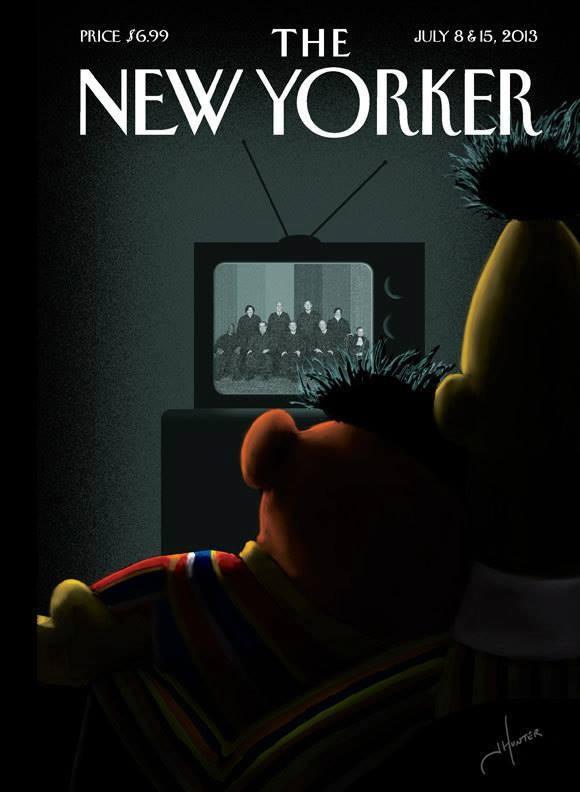 Good afternoon, newsjunkies!
Have you seen next week’s cover of The New Yorker that’s been floating around the internet yet? Well, obviously you have now if you’re reading this post. It’s nothing short of SQUEEEEE! Bert and Ernie nestled together on the couch snuggin’ while watching The Supremes in their robes on the TV.
The Supremes did good on knocking the wind out of DOMA, but it was a long time coming. They’re still in the doghouse for all their other despicable and unreal rulings this week. So while I did pop some champagne to celebrate the good things going on, including the tumbling down of DOMA, no cookies to the Supremes on this. I give the credit to all the grassroots LGBT activists and their growing accumulation of allies who have worked so hard for so many years to bring Wednesday’s ruling to fruition. Well done, everyone! The 21st century is finally starting to arrive…it’s here, it’s queer, and we as a society are not only going to live with it–we are going to live it up! Watch out, y’all, I am so happy for our LGBT sisters and brothers and for all of us as a ONE LOVE-ONE WORLD, I could about start doing some of my inner feminist Pollyanna somersaults all over this page. (I am an absolute klutz with no athletic motor skill coordination whatsoever, so that is truly a feat!)
So, to review:
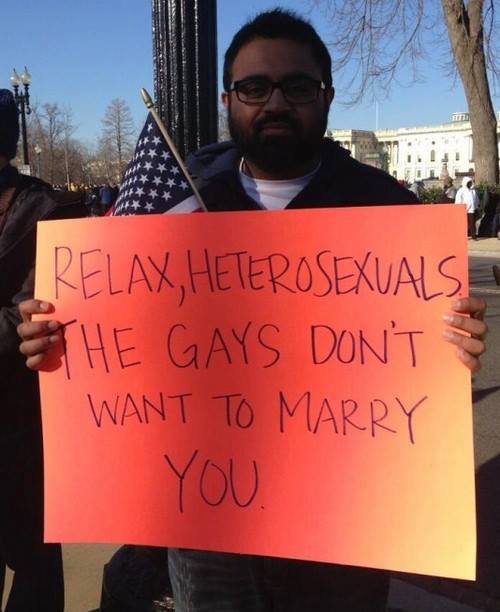
And, via HuffPo, 10 WAYS THE DOMA REPEAL WILL AFFECT ‘TRADITIONAL MARRIAGE’:
After the Supreme Court’s landmark decision that the Defense Of Marriage Act is unconstitutional, it’s time to look at the top 10 ways heterosexual marriage will be affected now that it’s not being defended.
1. Uh…
2. Uhhh…
3. Hmm…
4. Just a sec…
5. It’s like… You know how… It’s like when things… Right?
6. We swear we just had one
7. It’s coming… Wait for it…
8. Hey! Look over there!
9. Wait, where are you going?
10. Global warming?









Here’s what the wonderful Joyce L. Arnold of “Queer Talk” has been blogging over at Taylor Marsh’s, which I think gives a pretty good overview and is instructive in terms of “Where we go from here”…Note: I am only quoting excerpts here, interspersed with a bit of commentary from me, so take the time to click over and read the pieces in full when you get the chance:
The much anticipated Supreme Court rulings on DOMA and Prop 8 were announced this morning.[…] The fight for marriage equality isn’t over. Everyone knows that. But today is huge, and it’s time to do some celebrating.
Post SCOTUS, post DOMA and Prop 8 decisions, the “now what” in LGBT equality question is getting attention, and one response to that question comes by way of the Campaign for Southern Equality. The organization didn’t just come into existence, but they were very ready for this moment. Other LGBT groups are, too, of course, from local to state to national levels. I find the efforts of CSE to be particularly inspiring precisely because they refuse to comply with the “just move to where you’re more accepted” arguments – and we hear them regularly – but stay, and fight for equality. There are a lot of people doing that, in the South and other more “challenging,” but definitely changing toward the better, areas.
About CSE: (emphasis added throughout)
Based in North Carolina, the Campaign for Southern Equality is an effort to assert the full humanity and equality of LGBT people living in the South.
One of their projects is the WE DO Campaign, which
… involves LGBT couples in the Southern communities where they live requesting – and being denied – marriage licenses in order to call for full equality under federal law and to resist unjust state laws.
These WE DO actions serve to make the impact of discriminatory laws visible to the general public; they illustrate what it looks like when LGBT people are treated as second-class… citizens under the law.
Take less than three minutes to watch.
Here is the video Joyce has spotlighted, which is well worth the watch if you haven’t seen it yet. Very inspiring (this roundup continues after the video, so please keep scrolling after you view it):
More from Joyce’s post:
Celebrations continue. Statements agreeing and disagreeing with the decisions are still coming, from the White House to “citizen on the street.” Most likely the next sermon topic was an easy one for many, pro and con marriage equality.
And lots of analysis, which is obviously important, continues being done. It includes wide recognition that while this really is one of those moments we can call “historic,” there are 37 states with no marriage recognition; there are big questions about how same-sex couples are treated in terms of the military and immigration; and among other things, there is no federal employment protection. None of that detracts from the celebration. In fact, equality proponents in all of those “issues,” and more, can be energized by the SCOTUS decisions.
At The Advocate, “Message at Rallies: Celebrate Today, Fight Tomorrow.” At a post-SCOTUS decision rally in West Hollywood, with about 4000 people present, screenwriter Dustin Lanc Black said:
‘(I)t is time for each and every one of us to take that strength you now feel as Californians, and take it to Texas, and take it to Virginia … take it to Holland, Michigan … to Altoona, Pennsylvania. … You need to take your strength to these places, and share this feeling with this nation so we no longer leave a single one of our brothers or our sisters behind, no matter … which state they live.’
From the National Lesbian and Gay Task Force:
‘Today’s historic decisions are a significant leap forward for freedom and justice for same-sex couples and their families, the LGBT community and for our nation — and a lot more work needs to be done to deliver marriage equality to the rest of our nation’s same-sex couples and their families and full equality in every other respect for all LGBT people,’ said Rea Carey, Task Force Executive Director.
Parties continue around the nation, as they should. There’s a lot to celebrate. Statements and analyses will keep coming for a long time, I’d guess, as the impact of the decisions is made clear in practice. And advocacy and actions will continue, in all regions and states of the nation. Look to every region, including the South.
(We Do Campaign via Campaign for Southern Equality)
Dan Cathy, president of Chick-fil-A, tweeted his sadness about the Supreme Court decisions regarding DOMA and Prop 8, but then rather quickly deleted it. That seems a fair representation of Cathy’s efforts to somehow balance an anti-LGBT – at least related to marriage equality – while also, as a spokesperson put it, provide “genuine hospitality to everyone.”
Via Huffington, Cathy’s tweet:
Sad day for our nation; founding fathers would be ashamed of our gen. to abandon wisdom of the ages re: conerstone of strong societies
No word about what the founding mothers would think.
Ok, pardon me but I have to interrupt here to cackle my witchy woman feminist ass off. Joyce goes on to cover the ins-and-outs of Cathy’s trying to have his corporate cake and eat it too while lamenting his sadness over…what seems to me a more perfect union. That appears to be the source of Cathy and his ilk’s lament. They don’t want this union to become more perfect, because that requires giving up their various privileges and twisted means of ‘control.’ (Though it’s always hard not to ask for the most vehement of the homophobic crowd, if they are in control at all or really they are deep in the closet. Because, let’s let the elephant out the room, y’all. That’s the only reason legalizing gay marriage would affect a so-called heterosexual marriage that would need any defending from it.)
Joyce also quotes more whining tweets from Huckabee, et al., via OpEd News:
[Mike Huckabee tweet]: ‘My thoughts on the SCOTUS ruling that determined that same sex marriage is okay: ‘Jesus wept.’ …
‘Today, marriage, children, and the rule of law all suffer.’ Randy Thomassen, Save California. …
[Matt Barber tweet]: In states w/ ‘gay marriage’ there is no longer a legal or ethical defense against multi-party, incestuous or any other twiested ‘marriages’ …
How long before federal agents haul pastors out of the pulpit? – Todd Starnes, Fox News.
To which Joyce’s response is simply awesome:
Founding Fathers, weeping, suffering, children and incest … the familiar “the sky is falling” kind of responses.
As a follow-up to Joyce’s comment, I must insert the following, which I had used elsewhere on the internet (Facebook of course..on the Pink Sneaks support page JJ and I are working on) in reference to Stupakistan’s reaction. (Yes, I’m looking at you, Gov. Goodhair…) to the arrival of what Salon proposes we are now, i.e. a “Wendy Davis Nation.”
Anyhow, here is the graphic because it applies to what Joyce has highlighted about the sad, lamenting reactions to the DOMA/Prop8 reversal:
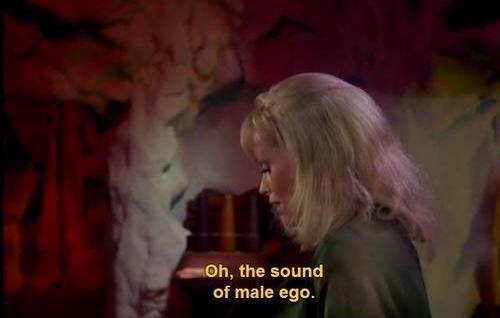
“Oh, the sound of male ego. You travel halfway across the galaxy, and it’s still the same song.” Star Trek: The Original Series, 1×06 (“Mudd’s Women”)
Joyce concludes by saying the following, which I totally agree:
My bet is the founding mothers and fathers just might approve of “liberty and justice for all” efforts. And since we’ve more or less (with some significant “less” moments and issues) been focused on that goal for quite some time, and the sky hasn’t even started falling, we’re safe to keep at it. And in trouble if we don’t.
Last but not least, Joyce reports…
The Respect for Marriage Act (RMA), filed by Sen. Diane Feinstein (D-CA) in the Senate and by Rep. Jerrold Nadler (D-NY) in the House, would completely repeal DOMA (Defense of Marriage Act). The Supreme Court decisions were a big step in that direction, but not complete.
Ok, as I said, please do go read Joyce’s pieces in full whenever you can. Here’s a handy link where you can see her posts archived together in one place.
Pivoting from “gay rights are human rights” (smiles in thoughts of Hillary and Hillary 2016) to “women’s rights are human rights,” I want to touch on that article,“It’s a Wendy Davis Nation Now,” that I briefly linked to above from Salon though, because I have a very revealing excerpt I wanted to highlight from it:
For years — particularly the ones Democrats spent in the wilderness, losing national elections — the party’s pro-choice stance was blamed for losing so-called values voters. Axelrod pointed out how that had changed: “These were motivational issues for people on our side … What’s interesting to me is that these were once wedge issues for Republicans. Now some of them are working as wedge issues against Republicans. And it shows a shift of attitudes.”
Gay rights, of course, have long since lost any traction as a wedge issue in Republicans’ favor in all but the narrowest districts. It remains to be seen how the immigration reform debate will play out politically, but the 2012 election and its “self-deportation” rhetoric is widely seen to have driven away Latinos and Asians. And of course there was defunding Planned Parenthood and Todd Akin. But, Axelrod added, abortion wasn’t part of that. Or, as he put it, “Abortion’s a separate discussion.”
If this week was any indication — along with recent protests in Wisconsin and Ohio, and possibly more to come — that may not prove true.
Thus, if we are truly entering Wendy Davis Nation, then we must be exiting not just Bush country, but also Rove-Axelrod’s understanding of women’s rights as a “separate discussion.” Keeping my ears open and my eyes wide and waiting to see what happens next!
Before I end this post, just for some Caturday fun, and for purposes of smashing the patriarchy with my crazy cat lady pink-ness, here are pictures of my nails that I got done last night (click for larger view):

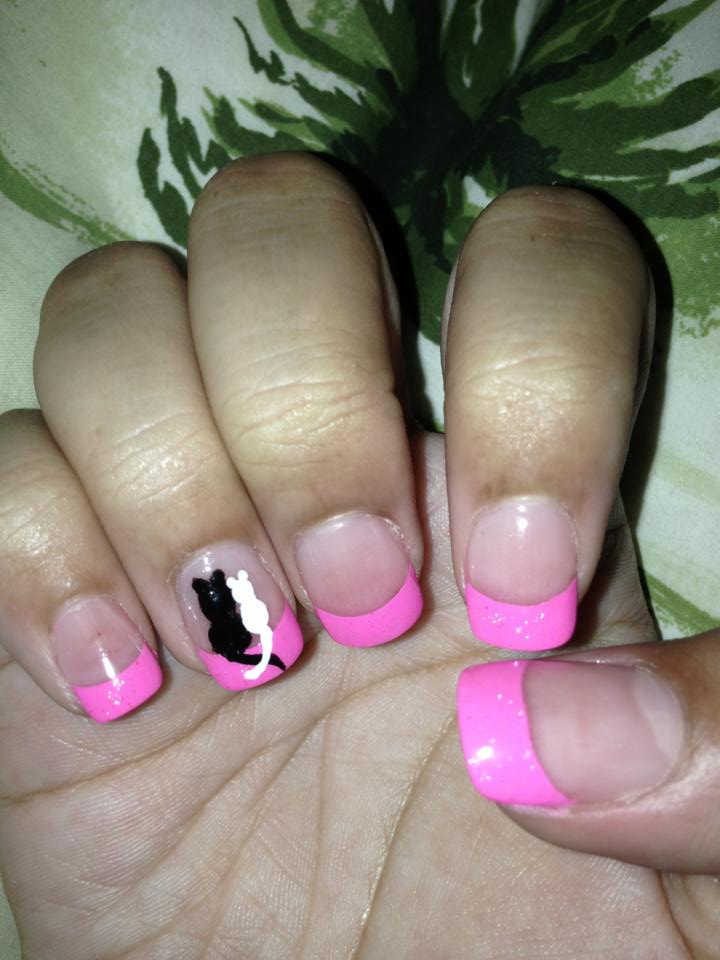
And, on that note, Sky Dancers, I’m going to turn the soapbox over to you. Do the wonderful thing you do in the comments y’all, and have a great weekend!
Sunday Night Kind of Link-a-palooza
Posted: June 23, 2013 Filed under: just because | Tags: feminism 32 Comments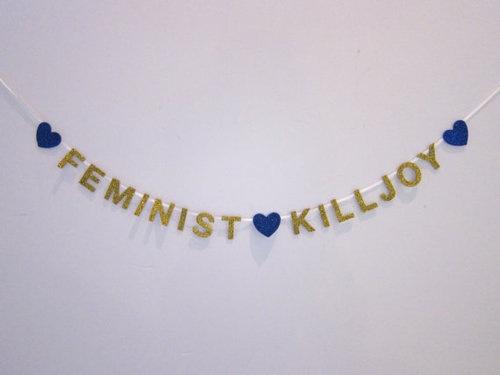
I am a proud feminist killjoy! Unrepentant, unapologetic, and frickin’ hilarious 🙂
Good evening, newsjunkies!
Mona here with some food for thought tonight, since I was absent from my soapbox on Saturday.
First off I want to start off with this blog piece entitled, “My Mom Was An Underground Railroad For Abused Women: What She Taught Me About Feminism And Fear“… I’m going to quote an excerpt, which is brilliant in its own right but really needs to be read in context to appreciate it fully. (if you click over be sure to bring your kleenex if you’re the feminist-verklempt type like me):
As her daughter, it took me nearly 20 years not to pity my mother’s “otherness.” She stopped pitying it herself a long time ago.
It’s taken me longer, still — until writing these words, actually — to develop admiration for the way she turned her seclusion and separation into not just a tool, but a blueprint for that tool; there were other women out there, who also didn’t have anyone to go to, and so she would use her resources to help them.
When I asked my husband to read over my notes, his response was, “Well. Your construction of ‘otherness’ is utterly overwhelmed by the narrative of how awesome your mom is. Is that intentional?”
I didn’t know if it was intentional — and then, suddenly, I did know.
That’s exactly what her life has done: let her personal actions, her very humanity, quietly absorb and subvert any narrative of “other.”
I wasn’t taught the ideas of “sisterhood” and “coalition” and the cognitive dissonance between the two until college, along with a whole host of other academic theory.
And even then, I soaked it up but it didn’t distill and crystallize until I developed a truly adult relationship with my mother — who herself says, “I didn’t even know there was a feminist movement; it just marched right past my front door.”
That wasn’t any real matter to her, the fact that she didn’t know the name for what she was doing; she just went right on doing it anyway.
Oh, the turning of xenophobic fear-of-the-oogadah-boogadah-other on its head! I really cannot recommend reading this one in its entirety *highly enough.* Go. Read. Now. (and don’t forget your tissues, my kindred feminist killjoys!)
Next up is the video I meant to showcase in my last post. Some of you may have already seen me post it in the comments subsequently, but it really deserves a spot on the frontpage…it’s also another one where I cannot do it justice by teasing or describing, though I will say Holly McNish and her inspired practice of the art of the spoken word, in concert with her unabashed feminist voice, is just a an absolute delight to behold… she is a true talent and gem. Her message in this youtube says so much about the ways in which women and girls are routinely socialized to see themselves from a warped perspective… and to live in an ever-dehumanizing world where women are just supposed to exist as playthings first and foremost, not as thinking, living, breathing human beings with appetites, desires, and prerogatives all their own:
…perhaps somewhere out there in the space-time continuum, Sylvia Plath–beloved wordsmith word-seamstress–smiles!
Now for my Sunday art pick…. the official trailer of the documentary Finding Vivian Maier:
I cannot wait to see this. I absolutely adore Vivian Maier’s photography (let’s be honest, it’s hard not to, as her work is visually arresting!) and the story behind her is absolutely fascinating. What a truly delicious enigma!
Finally, I’ll leave you with this:
Isn’t it fantastic? My favorite line: “Now set the foundation with the powdered ashes of Susan B. Anthony.”
Alright, Sky Dancers. Your turn! Open Evening thread.
Saturday: Cassandra
Posted: June 15, 2013 Filed under: just because | Tags: cassandra, feminism, party of nobodies 53 Comments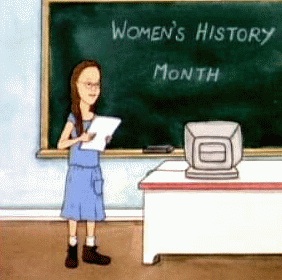
Cassandra, from the Beavis and Butt-head episode, “The History of Women”
Good afternoon, newsjunkies! Sorry for the delay with this morning’s reads. Had some technical issues (kept getting that spinny circle/hourglass thing–haven’t seen that in ages!)
Anyhow, let’s start off with a little HERstory, shall we?
From a neat little stanford.edu student website called “Mortal Women of the Trojan War”:
Hecuba, in Seneca’s play Troades, also compares herself to Cassandra:
Whatever misfortune occurs, and whatever harms the priestess of Apollo (Cassandra), raving, prophesied, the god (Apollo) prohibiting her to be believed, Hecuba, weighed with child (Paris), previously saw, nor did I keep my fear silent and before Cassandra I was the empty prophetess. Neither the cautious Ithacan (Odysseus) nor the nocturnal companion of the Ithacan (Diomedes) has scattered fire among you, nor the false Sinon. That fire is mine, by my torches you are burning.
And…
Today, June 15th, in 1895, Elinore Morehouse Herrick–the first woman (and seemingly only; still researching) appointed as a regional director of the NLRB–was born (emphasis in bold, mine):
As a divorced, 26-year-old mother, Herrick found herself supporting two boys on low wages. She accepted employment at DuPont’s rayon plant in Buffalo, New York, where she rose rapidly from pieceworker to training supervisor. In 1923, she moved south with the company, becoming production manager of its new factory in Tennessee. Under her direction the plant’s output equaled or exceeded those elsewhere, but knowing that she would not be promoted beyond her current level, Herrick moved her family to Ohio. There she attended Antioch College, financing studies in economics by running a boarding house with her mother’s help and taking part-time jobs. After her graduation in 1929, Herrick became executive secretary of the New York Consumers’ League, which monitored labor conditions for women in that state. While with the League, Herrick produced perceptive reports on female workers in canneries, laundries, and candy factories. When the Wagner Act of 1935 created the National Labor Relations Board, she was appointed regional director of the northeast district; the nation’s busiest, it handled twenty percent of all cases to come before the Board. Herrick’s negotiating skills led to the settlement of most disputes without litigation. During World War II, she became personnel director for Todd Shipyards and was responsible for integrating women and minorities into the wartime work force. Recognizing that the arrival of peace would force many women out of industrial jobs, she argued that society should maintain employment opportunities “for all who want to work or for all who must work irrespective of sex.” Her appeals went unheeded, however, as female workers were dismissed from wartime industries when veterans returned home. Herrick left Todd Shipyards to become personnel director for the New York Herald Tribune and continued writing on labor issues during the postwar era.
Here is a kickass image of her at Corbis, entitled “Portrait of Career Women at Tribute Dinner,” dated March 22, 1935. Please check it out. She’s the first person to the left on the front row. (It’s copyrighted or else I’d have included it here.)
And, here’s a PDF of “Why People Strike,” a piece penned by Herrick. Teaser:
Too much reliance has been placed on the ability of industry to govern itself, with the result that codes have been selfishly drawn with an eye toward pleasing selfish and dominant employer interests.
Well, would you look at the prescience on her!
THIS is what the insularity and hegemony of patriarchy does. It shuts out voices like Herrick’s from the center stage of the debate during their times and altogether whitewashes them from the history books pored through by any one other than an archery-goddess-witchy-woman feminist like myself.
Speaking of which… Here’s the iconography that speaks to me as such, photography by Henriette Milelke:
Click photo to view on FB at Henriette Mielke’s page in its full glory.

This gives me a perfect excuse to tell you that I find Henriette Mielke’s photography absolutely mesmerizing. I stumbled upon her work through the graces of facebook, and I haven’t been able to stop looking since! It’s erotic, evocative, and just somehow distinctly feels…feminist. I may be wrong in attributing that to her. I don’t know. But, something about these images of women…seems to be about women, from a women’s point of view. I urge you to click on over and check her work out and view and determine for yourself. I’m merely including that blockquoted image to pique your interest….there’s so much more double x energy from whence it came!
Alright, I’m just going to do the rest of this post in a link-a-palooza fashion:
- An update in the call for Justice for Marco McMillian, slain Clarksdale, MS mayoral candidate…as police there continue to bury their ostrich heads in the sand, Community demands answers from Department of Justice (emphasis in bold, mine):
Wearing Justice for Marco T-shirts, family and friends of the late Marc McMillian are demanding answers and justice.
The family’s attorney, Daryl Parks, said, “Somebody will explain the burn marks on his body; somebody has to explain the torture he went through.”
In late March, the openly gay former Clarksdale mayoral candidate was brutally murdered. The National Black Justice Coalition isn’t convinced the murder wasn’t a hate crime.
Sharon Luttman with the National Black Justice Coalition said, “Society allows it to be some sexual violence or miscommunication when he’s the one that was burned, that was dragged, that was stabbed. The autopsy report shows that.”
- Personally I think the following ad in question needs “MOAR ZEST,” what do y’all say?… Kraft Zesty Dressing Ad Offends ‘One Million Moms,’ Sparks Debate:
A new ad for Kraft Zesty Italian Dressing is a little too spicy for one group of “concerned” women.
A “let’s get zesty” ad showing a naked man with a strategically placed picnic blanket protecting his modesty allegedly ran as a print ad in a recent issue of People, causing conservative group “One Million Moms” to write a press release calling the ad “disgusting” and saying that the company has “gone too far.”

- Caturday pick of the week (well technically the past month, but I just stumbled upon it now): There is now a font made entirely of cats!
Are you a writer? Or maybe just an active Facebook and Twitter-er who misses the good old days of handwritten letters, before digital media destroyed our capacity to express human emotion with words? Either way, are you tired of waiting for all communication to move past the clunky words of generations past and finally metamorphose into the dancing cat GIFs that we all know and love?
Then boy, does the Internet have the thing for you. Meet Neko Font, a web app that will transform text into a new font made entirely out of cats. Well, pictures of cats, to be precise. All you have to do is insert the copy of your choice into the text box and Neko Font (Japanese for “cat font”) instantly hands it back in cat form.

- My goddess pick on spirituality/religion food for thought… a youtube making the circles right now thanks to Upworthy’s recent spotlight of it under the title, “Best Explanation Of Religion I Have Ever Heard, And I’m Practically An Atheist”:
Patty Murray arrived 20 years ago to a U.S. Senate whose “gentlemen” members had a convenient restroom just off the Senate floor, but not the six “gentle ladies.”
“We had to go upstairs and down a long hall,” Murray recalled on Wednesday.
Murray: “We had to go upstairs and down a long hall.”
As the old cigarette ad put it, you’ve come a long way, baby.
The Senate now has 20 women. “Gentle ladies” chair the Senate Appropriations Committee, the Senate Intelligence Committee, the Senate Agriculture Committee and the Senate Indian Affairs Committee. Murray is in the Democratic leadership.
And the “gentle ladies” of Congress’ upper chamber are getting a new, expanded bathroom. While it doesn’t have a glass ceiling, the new restroom will come complete with a window looking out from the U.S. Capitol.
A restroom was carved out of the off-the-floor men’s room, but it was small and cramped.
“It’s no longer convenient: There’s a line,” joked Murray.
Sen. Jeanne Shaheen, D-New Hampshire, excitedly tweeted on Wednesday that the commodious restroom is a “sign of change” in the U.S. Capitol. “It says we are at work and we require equal treatment,” Murray said.

Okay, I’m going to stop there because my computer just isn’t cooperating this weekend. But, I will say I’m reminded here of Rand Paul’s infamous toilet rant… *wink*
Anyhow, what’s on your reading list this weekend Sky Dancers? Please help me fill in the blanks of these abridged Saturday reads!
Saturday Afternoon Reads: The Feminine Mystique
Posted: February 23, 2013 Filed under: just because, U.S. Politics, Women's Rights | Tags: afternoon reads, Betty Friedan, books, education, feminism, psychology, The Feminine Mystique 40 Comments
Betty Friedan
Good Afternoon!
I decided to focus this post on something other than the debt, deficit, sequester obsession that has taken over American politics, so I’m writing about a book I read in high school that changed my life forever. Feel free to use this as an open thread, and post your links freely in the comments.
This week marked the 50th anniversary of a book that truly changed my life, The Feminine Mystique, by Betty Friedan. It was first published on February 19, 1963. I read it in paperback when I was a junior in high school, probably in early 1964.
I already knew I didn’t want to be a housewife like my mom, but there weren’t many alternatives for girls in those days. Ideally, you were supposed to get married and have children and forget about having a career or focusing on your own unique interests. You were supposed to enjoy cleaning house and supporting your husband’s career and if you didn’t enjoy it, there was something wrong with you–you weren’t a real woman.
The main reason for girls to go to college was to find a husband. Oh sure, you could study and learn about things that interest you, but that would all go by the wayside once you found a man. After that, it was all about him. If you couldn’t find a husband, then you might have to work. You could be a teacher, a nurse, or a secretary–that was about it. Women who insisted on being college professors, doctors, lawyers were few and far between and they had a tough time of it.
Then Betty Friedan’s book came out, and it hit a nerve for millions of American women and girls, including me. Here’s the famous opening paragraph:
“The problem lay buried, unspoken, for many years in the minds of American women. It was a strange stirring, a sense of dissatisfaction, a yearning that women suffered in the middle of the 20th century in the United States. Each suburban wife struggled with it alone. As she made the beds, shopped for groceries, matched slipcover material, ate peanut butter sandwiches with her children, chauffeured Cub Scouts and Brownies, lay beside her husband at night—she was afraid to ask even of herself the silent question—‘Is this all?’”
Friedan called it “the problem with no name.”
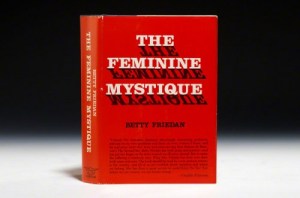
First edition of Friedan’s The Feminine Mystique (Bauman Rare Books)
As I read the book, I began to develop more sympathy for my mother’s plight. During World War II, women had been called upon to go to work to support the war effort and replace men who had been drafted or had enlisted in the military. But when the men came back, they needed the jobs and women were expected to go back to their homes and be satisfied with doing housework, child rearing, decorating, and entertaining for no pay. Friedan wrote about how “experts” had produced reams of propaganda in the effort to get women to find joy and fulfillment in being housewives and mothers. The “feminist mystique” for Friedan said “that the highest value and the only commitment for women is the fulfillment of their own femininity.”
I’ve told this story before, but when I was a senior in high school I wrote an essay for my English class called “Women Are People Too.” My male teacher was somewhat taken aback by my arguments, but he still asked me to read my paper aloud in class. I was jeered and mock for it, of course. Later my economics teacher–a true leftist–found out about the essay and read it in my economic class. Today it seems strange, but most of the other students in my school were horrified by the notion of women being equal to men.
My father, an English professor, had a woman colleague Lucille C.–a full professor who had never married. My mother said that most men would be intimidated by her brilliance and success. Anyway, when I told Lucille about how all the other kids were making fun of me for my essay, she told me to tell them I was a member of FOMA, which stood for “Future Old Maids of America.” I loved it!
Much has changed since 1963. Women now assume they have a right to an education and a career as a well as the right to choose (if they can afford it) whether to stay home with children or work outside the home. But as we have seen in the past four plus years, misogyny is alive and well in the good ol’ USA, and we still have a very long way to go to achieve anything like real gender equality.
Carlene Bauer spoke for me when she wrote at The New York Observer:
When Friedan writes that early feminists “had to prove that women were human,” it is hard not to feel a shock of recognition and indict our own moment as well, especially after the election that just passed. But American women still find themselves struggling against a strangely virulent, insidious misogyny. If our culture truly thought women were human, 19 states would not have enacted provisions to restrict abortion last year. There would be no question whether to renew the Violence Against Women Act. Women would not make 77 cents to every man’s dollar, and make less than our male counterparts even in fields where we dominate. We wouldn’t have terms like “legitimate rape” or “personhood.” Women who decided not to have children would not be called “selfish,” as if they were themselves children who had a problem with sharing. If our culture truly allowed them to have strong, complex, contradictory feelings and believed they were sexual creatures for whom pleasure was a biological right, perhaps adult women would not be escaping en masse into badly written fantasy novels about teenage girls being ravished by vampires.
Bauer also noted that some problems with the book, most notably Friedan’s homophobia.
This book…should seem thrillingly, relievedly quaint. It does not. But it is surprisingly boring in spots—there are many moments where you can see the women’s magazine writer in Friedan giving herself over to breathless exhortation—and astoundingly homophobic. At one point Friedan rails against “the homosexuality that is spreading like a murky smog over the American scene.” Friedan has been criticized for not being as careful a researcher, or as honest a storyteller, or as civil-rights-minded as she could have been. But perhaps these criticisms are somewhat beside the point. There are numerous passages that, if you did not know their provenance, could be mistaken for sentences written in judgment of the present day.
In looking over The Feminine Mystique recently, I realized that I had forgotten how much scholarship and psychological analysis and scholarship Friedan included in the book. She was a psychology major at Smith College, graduating summa cum laude in 1942. For example, The Feminine Mystique contained a brilliant analysis of Freudian theory and its consequences for women. Friedan argued that education at women’s colleges had been dumbed down between the 1940s and 1960s, with educators limiting courses to “subjects deemed suitable for women” and their future roles as housewives. She suggested that girls were prevented from experiencing the normative identity crisis that was the focus of Erik Erikson’s developmental theory. And she argued that women had been kept at the lower, subsistence levels of Maslow’s hierarchy of needs.
How many books truly change society in dramatic ways. Betty Friedan’s book did that. A few more links to articles on the 50th anniversary of The Feminine Mystique.
Michelle Bernard: Betty Friedan and black women: Is it time for a second look?
NYT: Criticisms of a Classic Abound
Mona Gable at BlogHer: How Far Have We Come?
ABC News: ‘Feminine Mystique’: 50 Years Later, Dated But Not Irrelevant
Caryl Rivers: ‘Feminine Mystique’ At 50: If Betty Friedan Could See Us Now
Janet Maslin: Looking Back at a Domestic Cri de Coeur
Alexandra Petri: The Feminist Mystique
Peter Dreier: The Feminine Mystique and Women’s Equality — 50 Years Later
Kathi Wolfe at The Washington Blade: Power of the ‘Feminine Mystique’
A discussion at NPR’s On Point: The Feminine Mystique at 50
This isn’t specifically about The Feminine Mystique, but I think it’s relevant. Allie Grasgreen at Inside Higher Ed: ‘The Rise of Women’ — a “new book explains why women outpace men in higher education.”

 peej
peej Carissa
 bostonboomer
 dakinikat
 ecocatwoman
 mablue2
 Mama Lopez
 peggysue22
 quixote
 skydancingguestblogger
 Mona (aka Wonk the Vote)



 Sky Dancing
Recent Comments