
Melt Down Monday: Another Fine Mess Trumplicans got us into
Posted: March 13, 2023 Filed under: just because | Tags: Bank Runs, Bernie Sanders, CryptoCurrency, Dodd-Frank bill, Elizabeth Warren, FDic, Federal Reserve Bank, Flash Digital Bank Runs, Janet Yellen, junk bond king, Katie Porter, SEC, Silicon Valley Bank, US Treasury 15 Comments My body still tells me to say Good Morning!
I’m only on my second cup of coffee while waiting for my Irish Oats to cook. The clock tells me it’s afternoon, but something about me refuses to believe it. Why am I rudely being pushed into a part of the day rather than enjoying my lazy morning and looking forward to my Night Life? The best thing about teaching Grad school is that I no longer teach morning classes. Thanks to Dubya (wrecked the country) Bush, I only have that sacred space with its full glory for about 4 months a year. I’m grading midterms and wading through a seriously unnecessary set of bank failures in a bit of a fog. This is my version of No Exit.
Every time I teach my Grad Derivatives class in the Spring, some unnecessary financial crisis pops up. It’s not a huge one like another thing for which we can thank Dubya (wrecked the economy), Bush, and his cronies. This will not be the next “Great Recession” creator.
The Republicans under Theodore Roosevelt and Ulysses S Grant determined that you cannot trust huge actors in concentrated markets to regulate themselves. They called them trusts back then. They muck things up worse than the regulations while taking advantage of their customers for extraordinary profits until the jig is up. They also lead to substantial negative spillover costs paid for with taxpayer money. Many times, especially with situations like the Norfolk situation, victims of these costs never fully recover their losses. Real economists know this. It’s why Republicans haven’t had one around since Bernanke.
I wrote extensively about why the financial system ran amok and wrecked the economy around 2008. I am again writing about a very similar situation. Much of it’s rooted in the chipping away of protections set up to protect us from a recurrence of the Great Recession removed by Trump, the Republicans, and any elected official that basically gets vast donations from Wall Street and Banks. NBC News Sahil Kapur follows the ties between that and what’s happening now. “Silicon Valley Bank collapse puts new spotlight on a 2018 bank deregulation law. Democratic Sen. Elizabeth Warren, who led the push against that Trump-era law, now wants to restore those rules on financial institutions. Biden is also calling on Congress to act.”
Five years ago, Warren was the most outspoken opponent of the Republican-led Congress’ push to undo regulations imposed under the 2010 Dodd-Frank law for small and midsize banks. The bill, led by Sen. Mike Crapo, R-Idaho, sought to reclassify the “too big to fail” standard, which came with enhanced regulatory scrutiny. By raising the threshold from $50 billion in assets to $250 billion, medium-size banks were exempted from those regulations.
“Had Congress and the Federal Reserve not rolled back the stricter oversight, S.V.B. and Signature would have been subject to stronger liquidity and capital requirements to withstand financial shocks,” Warren wrote Monday. “They would have been required to conduct regular stress tests to expose their vulnerabilities and shore up their businesses. But because those requirements were repealed, when an old-fashioned bank run hit S.V.B., the bank couldn’t withstand the pressure — and Signature’s collapse was close behind.”
Sen. Bernie Sanders, I-Vt., who also opposed the 2018 law, blamed it for Silicon Valley Bank’s collapse.
“Let’s be clear. The failure of Silicon Valley Bank is a direct result of an absurd 2018 bank deregulation bill signed by Donald Trump that I strongly opposed,” he said in a statement. “Five years ago, the Republican Director of the Congressional Budget Office released a report finding that this legislation would ‘increase the likelihood that a large financial firm with assets of between $100 billion and $250 billion would fail.’”
The 2018 battle featured intense lobbying by banks — including Silicon Valley Bank and an array of smaller community banks — that were seeking regulatory relief.
The bill passed the House 258-159, winning 225 Republicans and 33 Democrats. In the Senate, it needed some Democrats to defeat a filibuster and achieve 60 votes. Warren infuriated some colleagues when she called out some Senate Democrats by name for trying to weaken Dodd-Frank rules.
In the end, 17 Democrats joined a unanimous Senate Republican conference to pass it. Trump signed it into law.
The entire financial industry plays a role in the economy held by no other. The safekeeping role is why rules for bank deposits, the FDIC insurance mandates exist, and capitalization laws are in place. I think no one teaches about the Bank Holidays and Runs we experienced during the Great Depression. The more you chip away at what used to be legal differences and responsibilities between banks with deposits and fiduciary responsibility and their ability to play around with risky loans and investments, the more these things will reoccur. Also, speculative investors like hedge funds’ special tax treatment lower their risk costs and increase their ability to make investment decisions that have a likelihood of implosion. The rollback of substantial sections of Dodd-Frank was integral to last week’s runs.
https://twitter.com/ritujay/status/1634432765692366849
More importantly, the recent failures of financial institutions and companies involved with Cryptocurrencies will be part of the focus as state and federal regulators–including the Fed–do a post-mortem on both Silicon Valley and the Signature Bank in New York. These banks look like Country Clubs for risky and poorly managed loan portfolios. They have many big accounts backed up by cryptocurrency, a highly speculative and risky asset. This is from CNBC. “Regulators close crypto-focused Signature Bank, citing systemic risk.” The reporter is Yun Li.
The banking regulators said depositors at Signature Bank will have full access to their deposits, a move similar to that which was made to ensure depositors at the failed Silicon Valley Bank will get their money back.
“All depositors of this institution will be made whole. As with the resolution of Silicon Valley Bank, no losses will be borne by the taxpayer,” the regulators said.
The regulators shuttered Silicon Valley Bank on Friday and seized its deposits in the largest U.S. banking failure since the 2008 financial crisis — and the second-largest ever. The dramatic moves come just days after the tech-focused institution reported it was struggling, triggering a run on the bank’s deposits.
Signature is one of the main banks to the cryptocurrency industry, the biggest one next to Silvergate, which announced its impending liquidation last week. It had a market value of $4.4 billion as of Friday after a 40% sell-off this year, according to FactSet.
As of Dec. 31, Signature had $110.4 billion in total assets and $88.6 billion in total deposits, according to a securities filing.
To stem the damage and stave off a bigger crisis, the Fed and Treasury created an emergency program to backstop all deposits at both Signature Bank and Silicon Valley Bank using the Fed’s emergency lending authority.
The FDIC’s deposit insurance fund will be used to cover depositors, many of whom were uninsured due to the $250,000 cap on guaranteed deposits.
While depositors will have access to their money, equity and bondholders at both banks are being wiped out, a senior Treasury official said.
The article is written by DDay. “The Silicon Valley Bank Bailout Didn’t Need to Happen. The debate over protecting all deposits in a blink looks past the incompetence that got us here.” Buried in the fine print of the joint statement is something exciting. It states that “certain unsecured debtholders” and shareholders are not protected. Certain unsecured debtholders may likely apply to crypto-tainted accounts used to secure debt. The Fed has been anxious to get more involved with the rogue market. Will today’s Republican Congress let them?
The brightest minds in and around San Francisco Bay had an unadulterated meltdown over the weekend over the failure of Silicon Valley Bank. This was a failure that they themselves caused, mind you, engineering a digital flash bank run that forced SVB to realize heavy losses, mostly from interest rate hikes and the bank’s unbelievable failure to even attempt to manage interest rate risk.
The venture capitalist–led mob quickly moved on to another dire warning: Because over 90 percent of SVB’s depositors exceeded $250,000 in guaranteed FDIC insurance, the government must make them 100 percent whole, immediately, or every regional bank in America will see the same failure. Hedge fund titan Bill Ackman, venture capitalist David Sacks, and angel investor Jason Calacanis led the charge, saying that thousands of startup firms will have trouble making payroll, and other regionals won’t be able to stop a torrent of withdrawals. They essentially took out a match next to a gas pump and demanded that federal regulators not force them to light it.
It worked. Federal officials announced a backstop to “fully protect all depositors” at both Silicon Valley Bank and Signature Bank, which was also closed on Sunday. “Depositors will have access to all of their money starting Monday, March 13,” the joint announcement by Treasury, the Federal Reserve, and the FDIC read. A special bank assessment will offset losses, they say; all shareholders and bondholders “will not be protected,” with senior management fired. A $25 billion fund has been initiated to protect deposits, even though the theory is that no taxpayer funds will be implicated.
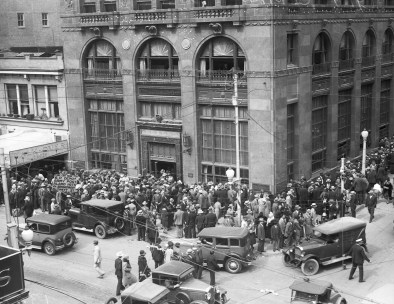
Run on San Antonio’s City-Central Bank and Trust Company during the Depression, 1931
Have I ever mentioned how much I’d admire California Representative Katie Porter?
THE FIRST WORDS OUT OF THE MOUTH of Rep. Katie Porter (D-CA) when I talked to her on Sunday were: “Can you believe we have to talk about this shit again?” She was referring to a conversation we had in 2018, when she was still just a financial expert and a candidate for Congress, about S.2155, which I call the Crapo bill, a reference to its co-author (Idaho Republican Sen. Mike Crapo) and its underlying contents.
Some of these provisions don’t mitigate risk; they encourage it. For depository institutions with fiduciary responsibilities, it’s like giving Bourbon-drenched pecan pie to alcoholics. Remember when Bill Gates sold Tesla short? Anyone with an excellent eye for financial statement analysis can see this stuff coming. But wait, how do you explain that “KPMG Gave SVB, Signature Bank Clean Bill of Health Weeks Before Collapse. Accounting firm faces scrutiny for audits of failed banks“? This is from Jonathan Weil and WSJ.
Silicon Valley Bank failed just 14 days after KPMG LLP gave the lender a clean bill of health. Signature Bank went down 11 days after the accounting firm signed off on its audit.
What KPMG knew about the two banks’ financial situation and what it missed will likely be the subject of regulatory scrutiny and lawsuits.
KPMG signed the audit report for Silicon Valley Bank’s parent, SVB Financial Group SIVB 0.00%increase; green up pointing triangle, on Feb. 24. Regulators seized the bank on March 10 after a surge of withdrawals threatened to leave it short of cash.
“Common sense tells you that an auditor issuing a clean report, a clean bill of health, on the 16th-largest bank in the United States that within two weeks fails without any warning, is trouble for the auditor,” said Lynn Turner, who was chief accountant of the Securities and Exchange Commission from 1998 to 2001.
Two crucial facts for determining whether KPMG missed the banks’ problems are when the bank runs began in earnest and when the bank’s management and KPMG’s auditors became aware of the crisis.
This reminds me of Moody’s, which had no idea how to rate tranches of mortgage-based swaps and completely missed the boat on the Mortgage crisis in 2008. You may also remember Moody’s role during the Junk Bond Kings’ rule in the late ’80s. This was also a time of intense deregulation of the industry.
. Moody’s also missed this current one. “Moody’s Failed to Warn About Silicon Valley Bank’s Problems. The prestigious rating agency still gave the bank of startups an A rating until its collapse on March 10, repeating the same errors of the subprime crisis in 2008.” This is from The Street and Luc Olinga.
Fifteen years after the subprime mortgage crisis which devastated the global economy, rating agencies continue to make the same mistakes.
At least, this seems to be the case with the prestigious rating agency Moody’s Investors Service.
Regulators shut down California’s Silicon Valley Bank on March 10, after its US Treasury bets went awry, due to the interest rate hike by the Federal Reserve.
Consequently, the Federal Deposit Insurance Corporation (FDIC) seized its assets and created a new entity, which will begin operating on March 13.
Created in 1983, Silicon Valley Bank, which presented itself as a “partner for the innovation economy,” offered higher interest rates on deposits than its larger rivals, to attract customers. The company then invested the clients’ money in long-dated Treasury bonds and mortgage bonds with strong returns.
Moody’s Gave Silicon Valley Bank an A Rating
This strategy had worked well in recent years. The bank’s deposits doubled to $102 billion at the end of 2020 from $49 billion in 2018. In 2021, deposits increased to $189.2 billion.
But everything turned upside down when the Federal Reserve began to raise interest rates, which made existing bonds held by SVB less valuable. As a result, the bank had to sell the bonds at a discount to cover withdrawals from its customers. In selling these bond positions, SVB had to take a significant loss of $1.8 billion.
Due to this loss, SVB suddenly announced that it needed to raise additional capital of $2.25 billion, by issuing new common and convertible preferred shares. This decision caused panic and a run on the bank.
While investors saw nothing coming, this is also the case with Moody’s Investors Service, whose role is to assess the intrinsic value of a company and its ability to meet its obligations, including its ability to pay lenders back. Rating agencies must flag the financial risks associated with a company.
But everything turned upside down when the Federal Reserve began to raise interest rates, which made existing bonds held by SVB less valuable. As a result, the bank had to sell the bonds at a discount to cover withdrawals from its customers. In selling these bond positions, SVB had to take a significant loss of $1.8 billion.
Due to this loss, SVB suddenly announced that it needed to raise additional capital of $2.25 billion, by issuing new common and convertible preferred shares. This decision caused panic and a run on the bank.
While investors saw nothing coming, this is also the case with Moody’s Investors Service, whose role is to assess the intrinsic value of a company and its ability to meet its obligations, including its ability to pay lenders back. Rating agencies must flag the financial risks associated with a company.
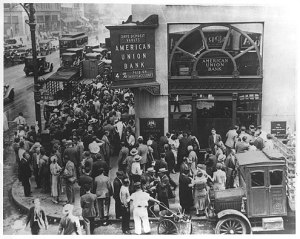
American Union Bank, New York City. April 26, 1932.
I’ve lived through a banking crisis in charge of strategic planning and financial statement forecasting for one of the original too big to fail Savings and Loan Companies in the early 1980s. I was also trying to hedge our loan commitments using GNMA futures which is why Derivatives are real to me. Any time interest rates start moving in the wrong direction and any bank that hasn’t realigned their related risks, like being long on one side of the balance sheet and short on the other, you’ll lose big.
I had to tell the head of Financial Operations there was no way to break even when every rate marks an asset to market with every tick, and you’re mismatched. I was barely 25 at the time. I also saw loan brokers selling mortgages where due diligence was lacking in 2005. A student told me he was being offered a mortgage based on his student loan as income. I can’t imagine any in-house loan officer being that ignorant. That’s what happens when you farm out your core business ou to salespeople earning money by volume. I can’t imagine how Moody’s or major Auditing firms keep missing this. They’re probably as captured by their customers as the politicians are captured by their lobbyists and checks. Right Senator Sinema?

James Stewart and Donna Reed in a scene from the film ‘It’s A Wonderful Life’, 1946. (Photo by RKO Radio Picture/Getty Images)
So, these bank runs don’t exactly look like the ones in those black-and-white photographs from the 1930s. This is a good explanation from Fast Company. What exactly is a Digital Flash Bank Run? It’s not a DC comic. Silicon Valley Bank: An ‘It’s a Wonderful Life’ bank run for the digital age. The downfall of the Valley institution, which has been called “the backbone of the startup economy,” was caused by a good old-fashioned bank run, but one that ran at internet speed.”
The run began on Thursday, after a powerful Silicon Valley VC—Peter Thiel’s Founders Fund—had begun advising its portfolio companies to withdraw their money from SVB, sources told Fast Company. Other VCs soon caught wind of the advisory and began advising their own portfolio companies to withdraw funds from SVB, the people said. As the withdrawals accelerated, the bank began taking steps to stem the tide and preserve its solvency—just like George Bailey did in the 1946 classic It’s a Wonderful Life.
SVB Financial Group CEO Greg Becker seemed to be reading from director Frank Capra’s script when he uttered the fateful words “stay calm” during a Thursday conference call with customers, as fears over the bank’s solvency grew. Those words probably only increased depositors’ anxieties. And the withdrawals likely continued to snowball.
“The whole thing was predicated on a few folks who put out calls to make withdrawals,” Spencer Greene, a general partner at the venture fund TSVC, tells Fast Company. “I think the folks who made those calls weren’t correct on the facts, but once the thing got going it was hard to stop.” In other words, before the run started there was not sufficient evidence to suggest the bank was facing serious solvency issues.
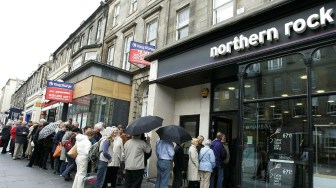
Northern Rock Bank run, September 2007
Just another point, we knew these things could happen. Here’s a 2019 article speculating about a digital bank flash run by Joe McGrath, writing for The Raconteur. “Turmoil, panic and bank runs in a digital future.”
Potentially, cash can now be transferred from accounts in greater amounts, more quickly than before and, even if banks enforce temporary limits on online withdrawals, what effect would the resulting panic have on the banking system as a whole?
“In a world without physical cash, the rules of engagement for situations such as a bank run will require a different framework,” says Simon Fairbairn, director of solution development, western Europe, for Ingenico Group. “The rules and systems of today will need to evolve to accommodate the demands of a run.”
Mr Fairbairn questions whether present digital banking infrastructure is sufficient to cope with sustained pressure of this nature. “Regulation, compliance, technology; processes have all evolved to try and prevent the sins of the past, but until tested, can we really be sure it won’t already be found wanting,” he says.
It may sound like scaremongering, but Mr Fairbairn’s cautious view has broad support from many in the financial services community.
“A digital bank run in a hypothetical future would be much more dangerous as it would happen in seconds and minutes when clients could simply use mobile banking apps to transfer money to another account,” says Susanne Chishti, chief executive of Fintech Circle.
“Such a digital bank run would be much more difficult to contain and an appropriate technical response for such a scenario would have to be coded in at the outset to offer any chance of being effective.”
In 2020, Harvest Finance experienced the first type of digital bank run. “Harvest Finance: $24M Attack Triggers $570M ‘Bank Run’ in Latest DeFi Exploit, Harvest Finance has seen its total value locked drop by more than $500 million in the 12 hours since being hit by a flash loan attack.” DeFi is short for Decentralized Finance, which is based on peer-to-peer finance services on blockchains. Welcome to the Wild West World of cryptocurrency and bitcoins. This should give you pause.
An arbitrage trade exploiting weak points in decentralized finance (DeFi) protocol Harvest Finance led to some $24 million in stablecoins being siphoned away from the project’s pools on Monday, according to CoinGecko.
According to reports, an attacker used a flash loan – a technique that allows a trader to take on massive leverage without any downside – to manipulate DeFi prices for profit. The exploit sent the platform’s native token, FARM, tumbling by 65% in less than an hour, followed by the project’s total value locked (TVL), which dropped from over $1 billion before the exploit to $430 million as of press time.
The funds were eventually swapped for bitcoin (BTC), but not before being swept through Ethereum mixing service Tornado Cash.
The jargon term for this was a “bad harvest.” Stay out of this stuff is the only thing I have to say, which is the advice I would have given to these banks. Unfortunately, Silicon Valley is rife with Elon Musk Clones taking risks for adventure and attention. All traders have their own language. I’m still surprised youngest daughter can keep her department of derivatives traders and products on a leash. They’ve always thought of themselves as Wild West Cowboys. (See Lions of Wall Street.) But then, she and the brokerage firms she’s worked for are licensed and babysat by the SEC to keep the nonsense in check. We both stay out of this market.
So, a part of this and a bit more will be a lecture for me tomorrow. Last year the Game Stop thing did this to me. You’ll be glad to know billionaire Carl Icahn is happy about that crash. Someone always is because there are two sides to every trade. If you’re head’s spinning, you’re doing just fine. I got a Ph.D. and real-life experience in the stuff, plus a daughter that lives it daily and who I consult for a reality check. It still makes my head spin.
What’s on your reading and blogging list today?
And the SEC is far behind
Down in the swamp with the gators and flamingos
A long way from Liechtenstein
I’m a junk bond king playing Seminole Bingo
And my Wall Street wiles
Don’t help me even slightly
‘Cause I never have the numbers
And I’m losing nightly
I cashed in the last of my Triple B bonds
Got a double-wide on the Tamiami Trail
I parked it right outside the reservation
Fifteen minutes from the Collier County Jail
(Warren Zevon, backed up by Neil Young live)
Bernanke nudges the Do Nothing Congress
Posted: November 2, 2011 Filed under: Economy, U.S. Economy | Tags: Federal Reserve Bank, FOMC. Ben Bernanke 10 Comments It’s been interesting watching Bernanke get more shrill with each post FOMC meeting news conference. First, he points out that the right wing meme about the unemployment being structural is wrong headed. He talks about why it’s important to respond to cyclical unemployment. This is something congress has being ignoring while doing important things like passing bills to ensure that trust in imaginary friends is printed on money.
“We believe that a good bit of the unemployment were are seeing is what economists would call cyclical unemployment, that is unemployment arising because of inadequate demand in the economy. If that is the case, then monetary policy by lowering interest rates, making financial conditions more accommodative, should stimulate demand, stimulate spending and over a period of time that should help bring cyclical unemployment down. It’s also possible that some of the increase in unemployment reflects so-called structural factors, mismatches between worker skills and job opportunities, loss of skills, geographical location, etc. If that’s the case then monetary policy is much less effective because only other kinds of labor market policies can make progress against that type of unemployment. But again I do think that a considerable part of the unemployment that we are seeing is cyclical. Final comment, cyclical unemployment left untreated, so to speak, for a long time can become structural unemployment as people lose skills, they lose attachment to the labor force.”
He also asked for a little help from congress. Bernanke basically tired to ask for stimulus without using the word since the Congress has branded it anathema.
“With respect to the current economy we are currently continuing our accommodative monetary policy. We are trying to do our best to support economic growth and job creation. It would be helpful if we could get assistance from some other parts of the government to work with us to help create more jobs. But certainly we are doing our part to create more jobs, more opportunities in America.”
Sorry, Ben, the “other parts of government” are just to busy to help the economy work. They prefer to posture and preen. Bernanke has amped up the volume as pointed out at Political Animal. Kevin Drum thinks that the next presser will be when Bernanke says “Will you guys stop griping about the damn budget, get off your butts, and build a few effin bridges instead? Jesus.”
Saturday Reads: Dr. Martin Luther King’s Dreams, Waiting for Irene, and Bernanke’s Complaint
Posted: August 27, 2011 Filed under: Barack Obama, Civil Rights, Domestic Policy, Economy, jobs, morning reads, poverty, U.S. Economy, U.S. Politics | Tags: Barack Obama, Ben Bernanke, Cornel West, Federal Reserve Bank, Hurrican Irene, I Have A Dream speech, leadership vacuum, Martin Luther King, media frenzy, oligarchy, revolution 63 Comments
By Mr. Fish, Truthdig.org
Good Morning! We are approaching the 48th anniversary of the March on Washington for Jobs and Freedom (remember those?) and Martin Luther King’s “I have a dream” speech. Perhaps it is fitting that the ceremony to be held tomorrow to commemorate the anniversary has been postponed indefinitely. After all, King’s dream of ending poverty in American has certainly been postponed indefinitely. Ironically, we now have a “Black President” who as different from Dr. King as night from day. Oh, if only King were here today to speak truth to this sorry excuse for a President!
A reminder from the Center for American Progress: Dr. King’s Legacy Relevant in Today’s Budget Battles
In the 1960s, Americans had a government that refused to deliver basic human rights to its people. Over time, after battles in the courts and the political arena, laws such as the Civil Rights Act of 1964 and the Equal Employment Opportunity Act of 1972 were passed. But despite these great accomplishments the fight continued because many Americans of all racial backgrounds were still living below the poverty line.
So in 1967, Dr. King and the Southern Christian Leadership Conference decided to organize and lead the Poor People’s Campaign to combat poverty. The goal was to push Congress to create an “Economic Bill of Rights” that would establish how the federal government would address and solve the country’s poverty issues. It called for full employment, affordable housing, reasonable living wages, and equitable education opportunities for the poor. Momentum built up around the country, but unfortunately the campaign ended early due to the tragic assassination of Dr. King and lack of organization to continue the efforts.
Cornel West had a very appropriate op-ed in the NYT a couple of days ago: Dr. King Weeps From His Grave Here is a relevant excerpt:
The age of Obama has fallen tragically short of fulfilling King’s prophetic legacy. Instead of articulating a radical democratic vision and fighting for homeowners, workers and poor people in the form of mortgage relief, jobs and investment in education, infrastructure and housing, the administration gave us bailouts for banks, record profits for Wall Street and giant budget cuts on the backs of the vulnerable.
As the talk show host Tavis Smiley and I have said in our national tour against poverty, the recent budget deal is only the latest phase of a 30-year, top-down, one-sided war against the poor and working people in the name of a morally bankrupt policy of deregulating markets, lowering taxes and cutting spending for those already socially neglected and economically abandoned. Our two main political parties, each beholden to big money, offer merely alternative versions of oligarchic rule.
The absence of a King-worthy narrative to reinvigorate poor and working people has enabled right-wing populists to seize the moment with credible claims about government corruption and ridiculous claims about tax cuts’ stimulating growth. This right-wing threat is a catastrophic response to King’s four catastrophes; its agenda would lead to hellish conditions for most Americans.
King weeps from his grave. He never confused substance with symbolism. He never conflated a flesh and blood sacrifice with a stone and mortar edifice. We rightly celebrate his substance and sacrifice because he loved us all so deeply. Let us not remain satisfied with symbolism because we too often fear the challenge he embraced. Our greatest writer, Herman Melville, who spent his life in love with America even as he was our most fierce critic of the myth of American exceptionalism, noted, “Truth uncompromisingly told will always have its ragged edges; hence the conclusion of such a narration is apt to be less finished than an architectural finial.”
King’s response to our crisis can be put in one word: revolution. A revolution in our priorities, a re-evaluation of our values, a reinvigoration of our public life and a fundamental transformation of our way of thinking and living that promotes a transfer of power from oligarchs and plutocrats to everyday people and ordinary citizens.
Yes we need a revolution. We desperately need to revise our priorities and values and to end the transfer of wealth and power from the people to the oligarchs. Who will lead that revolution? We have never been more in need of strong, honest, caring leaders and yet we have a complete vacuum of leadership. What is to become of our country?
Of course Hurricane Irene is the more immediate focus and the object of the media sharks’ feeding frenzy for today. Nothing so pedestrian as putting people back to work or ending poverty could interest them. Interestingly, big media seems to be ignoring the fact that the hurricane has weakened significantly and that the eye has collapsed, meaning that there is unlikely to be any more intensification of the storm. I suppose it could still do quite a bit of damage along the coastline, but as a Bostonian I’ve seen so many of these huge storms fail to live up to the hype that I’m skeptical of this one. I hope I’m right this time.
Jeff Masters at Weather Underground yesterday:
Satellite data and measurements from the Hurricane Hunters show that Irene is weakening. A 9:21 am EDT center fix by an Air Force Reserve aircraft found that Irene’s eyewall had collapsed, and the central pressure had risen to 946 mb from a low of 942 mb this morning. The highest winds measured at their flight level of 10,000 feet were 125 mph, which would normally support classifying Irene as a Category 3 hurricane with 115 mph winds. However, these winds were not mixing down to the surface in the way we typically see with hurricanes, and the strongest surface winds seen by the aircraft with their SFMR instrument were just 90 mph in the storm’s northeast eyewall. Assuming the aircraft missed sampling the strongest winds of the hurricane, it’s a good guess that Irene is a mid-strength Category 2 hurricane with 100 mph winds. Satellite imagery shows a distinctly lopsided appearance to Irene’s cloud pattern, with not much heavy thunderstorm activity on the southwest side. This is due to moderate wind shear of 10 – 20 knots due to upper-level winds out of the southwest. This shear is disrupting Irene’s circulation and has cut off upper-level outflow along the south side of the hurricane. No eye is visible in satellite loops, but the storm’s size is certainly impressive. Long range radar out of Wlimington, North Carolina, shows that the outermost spiral bands from Irene are now beginning to come ashore along the South Carolina/North Carolina border. Winds at buoy 41004 100 miles offshore from Charleston, SC increased to 36 mph as of 10 am, with significant wave heights of 18 feet.
And from last night: “Irene continues to weaken.”

Satellite data and measurements from the Hurricane Hunters show that Irene continues to weaken. A 1:32 pm EDT center fix by an Air Force Reserve aircraft found that Irene’s eyewall is still gone, and the central pressure had risen to 951 mb from a low of 942 mb this morning. The winds measured in Irene near the surface support classifying it as a strong Category 1 hurricane or weak Category 2. Satellite imagery shows a distinctly lopsided appearance to Irene’s cloud pattern, with not much heavy thunderstorm activity on the southwest side. This is due to moderate southwesterly wind shear of 10 – 20 knots. This shear is disrupting Irene’s circulation and has cut off upper-level outflow along the south side of the hurricane. No eye is visible in satellite loops, but the storm’s size is certainly impressive. Long range radar out of Wilmington, North Carolina, shows that the outermost spiral bands from Irene have moved ashore over North Carolina. Winds at buoy 41004 100 miles offshore from Charleston, SC increased to 47 mph, gusting to 60 mph at 3 pm EDT, with significant wave heights of 25 feet.
New York City has ordered 250,000 people to evacuate from coastal areas.
New York City officials issued what they called an unprecedented order on Friday for the evacuation of about 250,000 residents of low-lying areas at the city’s edges — from the expensive apartments in Battery Park City to the roller coaster in Coney Island to the dilapidated boardwalk in the Rockaways — warning that Hurricane Irene was such a threat that people living there simply had to get out.
Officials made what they said was another first-of-its kind decision, announcing plans to shut down the city’s entire transit system on Saturday — all 468 subway stations and 840 miles of tracks, and the rest of nation’s largest mass transit network: thousands of buses in the city, as well as the buses and commuter trains that reach from Midtown Manhattan to the suburbs.
Underscoring what Mayor Michael R. Bloomberg and other officials said was the seriousness of the threat, President Obama approved a request from Gov. Andrew M. Cuomo of New York to declare a federal emergency in the state while the hurricane was still several hundred miles away, churning toward the Carolinas. The city was part of a hurricane warning that took in hundreds of miles of coastline, from Sandy Hook, N.J., to Sagamore Beach, Mass.
From what I’ve heard, the Jersey Shore may get hit worse than NYC, but who knows? I know we have a few commenters from NJ, so I hope they will keep us updated on the situation there. In Boston, they are getting warnings about the storm surges for people along the coast and the Cape and islands.
BOSTON — As Hurricane Irene began to batter the Carolina Coast on Friday afternoon, a hurricane warning was issued for Cape Cod, Martha’s Vineyard, New York City and coastal Connecticut.
A tropical storm warning was issued for the North and South shores, and a tropical storm watch was issued for areas of southern New England further inland….
Massachusetts Gov. Deval Patrick declared a state of emergency ahead of the storm. He said he is particularly concerned because Irene will likely take a path through central Massachusetts, with fierce, damage-causing winds and storm surges on the eastern, coastal side of the state, and at least 10 inches of heavy rain leading to flooding to the west.
Here’s a little comic relief. Some ESPN guy (a former golfer) got in trouble for mocking President Obama on Twitter (has the First Amendment been repealed or what?)
ESPN is coming down on Paul Azinger for mocking President Obama on Twitter. The golf analyst tweeted Thursday the commander in chief plays more golf than he does — and that Azinger has created more jobs this month than Obama has.
On Friday ESPN ‘reminded” Azinger his venture into political punditry violates the company’s updated social network policy for on-air talent and reporters.
“Paul’s tweet was not consistent with our social media policy, and he has been reminded that political commentary is best left to those in that field,” spokesman Andy Hall told Game On! in a statement.
ESPN’s Hall would not comment on whether Azinger, who won the 1993 PGA Championship, will be fired, suspended or punished in some way. “We handle that internally,” he said.
In economics news, Ben Bernanke gave his eagerly anticipated speech yesterday, and basically said that the politicians have screwed up the economy and he hopes they won’t completely sink it with their insanely stupid policies based on Reagan era fantasies. If you’re interested, here are a few links to reactions to Bernanke’s speech.
Derek Thompson at The Atlantic: Bernanke: The Debt Ceiling Debate Nearly Broke the Recovery
Andrew Leonard at Salon: Bernanke Declines to Commit Treason
Jenine Aversa at Bloomberg: Bernanke Scholar Advises Bernanke Fed Chief to Be Bold on Monetary Policy
Those are my reading recommendations for today. What are you reading and blogging about?
US Financial Regulation and Arbitrage
Posted: January 5, 2011 Filed under: Bailout Blues, commercial banking, Corporate Crime, Equity Markets, financial institutions, Global Financial Crisis, investment banking, Team Obama, U.S. Economy | Tags: Federal Reserve Bank, financial regulation, Obama Financial Reform, OCC, Regulatory Arbitrage, SEC 17 CommentsThere is no doubt that we have had a major world wide financial collapse drastically affecting many innocent people in terms of livelihood and life long savings. It is fair to say that if the regulators had done their job, the country would have not had the hard landing that was experienced in 2008. The 2010 Financial Reform Bill kicked the can down to the Regulators for implementation and the bankers still have influence. This article takes a look at who the regulators were and how they did or did not do their job. The Obama people in the regulator domain are identified along with examples of Bush regulator failures. Hopefully this will give insight into what is being done to preclude another crisis
The financial industry has a gaggle of regulators, each with its politically protected turf.
From Wikopedia: Financial regulation is a form of regulation or supervision, which subjects financial institutions to certain requirements, restrictions and guidelines, aiming to maintain the integrity of the financial system.
Regulation is an unnecessarily a complex subject. It is important to understand that in some cases financial entities can choose their regulator. Some regulators were much more lenient and in many cases banks switched to them, hence the term Regulatory Arbitrage. The following are the major Federal regulators: FED, SEC, OCC, OTS, FDIC, CFTC 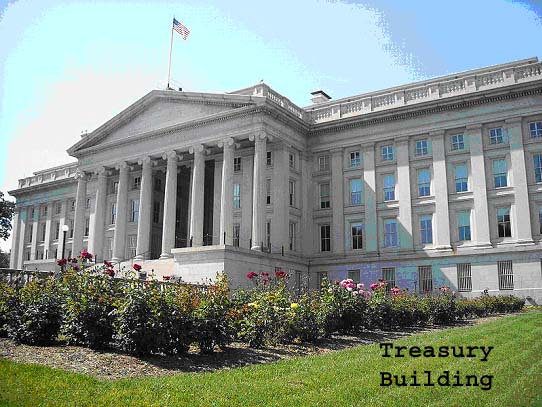 and FINRA described below. Except for the FED, most of these organizations have direct or indirect ties to the Treasury organization.
FED – Federal Reserve System
From Wikopedia: Its duties today, according to official Federal Reserve documentation, are to conduct the nation’s monetary policy, supervise and regulate banking institutions, maintain the stability of the financial system and provide financial services to depository institutions, the U.S. government, and foreign official institutions.Current chairman is Ben Bernanke, the former chairman was Alan Greenspan. Much more on Mr Greenspan later.
SEC – Securities and Exchange Commission
From Wikopedia: It holds primary responsibility for enforcing the federal securities laws and regulating the securities industry, the nation’s stock and options exchanges, and other electronic securities markets in the United States. Mary Schapiro is the current Chair. Predesessors were; Christopher Cox – 2005-2009, William H. Donaldson – 2003-2005, Harvey Pitt – 2001-03
OCC – Office of Comptroller of the Currency
From Wikopedia: US federal agency established by the National Currency Act of 1863 and serves to charter, regulate, and supervise all national banks and the federal branches and agencies of foreign banks in the United States. Current Acting Chairman is John Walsh. Previous Chairman were John C. Dugan – (2005 – 2010) John D. Hawke, Jr. – (1998–2004)
OTS – Office of Thrift Supervision ( recently folded into OCC)
From Wikopedia: United States federal agency under the Department of the Treasury. It was created in 1989 as a renamed version of another federal agency (that was faulted for its role in the Savings and loan crisis). Like other US federal bank regulators, it is paid by the banks it regulates. The OTS was initially seen as an aggressive regulator, but was later lax. Declining revenues and staff led the OTS to market itself to companies as a lax regulator in order to get revenue.
FDIC – Federal Deposit Insurance Corporation
From Wikopedia: United States government corporation created by the Glass-Steagall Act of 1933. It provides deposit insurance, which guarantees the safety of deposits in member banks, currently up to $250,000 per depositor per bank. The FDIC insures deposits at 7,895 institutions. The FDIC also examines and supervises certain financial institutions for safety and soundness, performs certain consumer-protection functions, and manages banks in receiverships (failed banks).
Sheila Bair is the current chairman of the FDIC and is viewed as a serious regulator with the right incentives for all concerned.
CFTC – Commodity Futures Trading Commission
From Wikopedia: The stated mission of the CFTC is to protect market users and the public from fraud, manipulation, and abusive practices related to the sale of commodity and financial futures and options, and to foster open, competitive, and financially sound futures and option markets.
CFTC is considered to be the primary regulator for Credit Default Swaps in the Dodd Frank regulation scheme.
FINRA – Financial Industry Regulatory Authority
From Wikopedia: In the United States, the Financial Industry Regulatory Authority, Inc., or FINRA, is a private corporation that acts as a self-regulatory organization (SRO). FINRA is the successor to the National Association of Securities Dealers, Inc. (NASD). Though sometimes mistaken for a government agency, it is a non-governmental organization that performs financial regulation of member brokerage firms and exchange markets.
Previously run by Mary Shapiro, FINRA has been critisized as being a ineffective regulator. Most notable was their (and SEC) allowing Bernie Madow to continue for 10 years to operate despite being warned by a whistle blower. When testifying before congress, the whistle blower (Harry Markopolos) said SEC was incompetent, FINRA was corrupt.
It must be said that Financial Regulation in the United States is done by committee of political bureauocrats. It is important to be aware of the fact that many of them are funded by fee’s assessed to the agencies they regulate. So opportunity for Regulatory Capture and Regulatory Arbitrage is prevalent in these agencies. The clear example is Office of Thrift Supervision bowing to their clients. The opposite example is that of Sheila Bair who tries to do the right thing for her clients despite critisizm.
Only Bad lawyers and the Certifiably Insane wind up in Congress
Posted: December 15, 2010 Filed under: We are so F'd | Tags: Federal Reserve Bank, Financial Crisis of 2007, Obama-McConnell tax breaks extention, Politicians are Crazy, Ron Paul and other Flat earthers, Spencer Bachus, START 61 Comments I went to Memorandum today to see what was up with the votes on the DADT repeal, the Tax Giveaways to Billionaires Act, and the START treaty. It’s one of the first places I go in the day because it usually groups the day’s relevant economic and political topics and it covers blog reactions from all sides of the political spectrum. I just wanted to know when the votes would be. What I saw was a bunch of headlines that lead to the thought you see above. I don’t even know where to start with this conglomeration of links, but they all seem connected to my hypothesis above.
It’s not that all of us outside the Beltway don’t recognize that there’s very few real people with functional brains in Congress. The proof for that is right there in the middle of the Memorandum page too.
From Gallup Polls:
Congress’ Job Approval Rating Worst in Gallup History :
Thirteen percent approve of the way Congress is handling its job
That headline is coupled with this one from WAPO: Washington Post-ABC poll: Public is not yet sold on GOP
From The Hill: DeMint will force readings of START Treaty and omnibus bill
For some reason, the 2000 pages of the Tax Bonuses for Billionaires plan isn’t germane to discussions of deficits and national security but the START treaty and the ominibus spending bill are fodder for ideological temper tantrums.
From TPM: Kyl: Reid Disrespecting Christians By Suggesting Post-Christmas Senate Votes
(Psst Kyl: the Reason for the Season is Mithros’ the Bull God’s birthday. Read your Roman History. The reason for Sunday services is The Sun God. Read your Roman History. You were had a long time ago by Constantine and the Nicene Council. Read the historical records of the Council set up by Constantine to establish a Roman religion and get off your friggin, butt and do your job!)
Oh, speaking of mythology, try THIS one on for size from the NYTimes: G.O.P. Panelists Dissent on Cause of Crisis. I’m going to spend some time on this because it’s just the best example of what is wrong with POLITICIANS. Congress was completely duplicitous in the crisis and yet, all the want to do is blame Federal Regulators.
Democrats have emphasized factors like fraudulent practices by mortgage lenders and reckless risk-taking by Wall Street banks and other financial institutions, while Republicans have focused on poor oversight of Fannie Mae and Freddie Mac, the entities that supported the secondary market for mortgages, and decades of government efforts to encourage homeownership.
“While the housing bubble, the financial crisis, and the recession are surely interrelated events, we do not believe that the housing bubble was a sufficient condition for the financial crisis,” the document states. “The unprecedented number of subprime and other weak mortgages in this bubble set it and its effect apart from others in the past.”
Unbelievable. Yes, that happened. Yes, it was a problem. But what drove the demand for subprime and weak mortgages was the demand for those wacky unregulated credit derivatives. It was all part of the same pattern of negligence and wishful thinking. You can’t unlink the systemic problems and the symptoms. Fannie and Freddie got into those things and drowned, but it wasn’t exactly their idea to begin with. Congress should’ve stopped them from going there. But the driving factor was still the demand for credit derivatives. Every institution was churning those things out in this country and in others. The delusion is worse than I thought.
From Yves at Naked Capitalism:
This whole line of thinking is garbage, the financial policy equivalent of arguing that the sun revolves around the earth. Yes, the US and other countries provide overly generous subsidies to housing, and curtailing them over time would not be a bad idea. But that’s been our policy for decades. Calling that a major, let alone primary, cause of the crisis, is simply a highly coded “blame the poor” strategy, In reality, both the runup to the crisis and its aftermath were on of the greatest wealth transfers from the citizenry at large to a comparatively small group of rentiers in the history of man. (If you want to read the long form debunking of this thesis, go straight to Barry Ritholtz, a Republican who has shredded this brand of class warfare, or as he calls it, “one giant clusterfuck of imbecility,” repeatedly on his blog.)
The intent is pretty transparent: to discredit an effort at fact finding into the roots of the crisis, what was hoped to be a Pecora Commission, by making it appear partisan and launching an alternative narrative to muddy the waters. And the reason is clear. Even though FCIC is certain not to have the same effect that the Pecora Commission did, of discrediting major financial services industry figures and exposing various forms of chicanery, it appears that even lesser forms of criticism of the banksters must be sandbagged (the bizarre part of this drama is that at least some Democrats and very selectively, Republicans in office are willing to call out the predatory, extractive behavior of the large banks. But no one has the guts to buck an industry that is a major paymaster in a very serious way).
Experts agree that while Fannie and Freddie and the federal government’s push to encourage homeownership played a significant role in causing the crisis, actions by Wall Street magnified the fallout and caused a crisis that led to the Great Recession. Economists from the Federal Reserve, as well as bank regulators first appointed by Republicans, agree that the Community Reinvestment Act played virtually no role in causing the financial crisis.
But the Republicans’ report will largely focus on the role played by the federal government. It will note that a crisis was averted after the government bailed out Bear Stearns and facilitated its absorption by JPMorgan Chase, according to people familiar with the matter. The crisis roared back after the government allowed Lehman Brothers to fail, scaring nervous investors. A bigger and more protracted downturn was avoided when policy makers essentially bailed out the entire financial system.
Exactly. It’s never EVER been the Community Reinvestment Act and to even insert it into the report is odious and false. I never got how the CRA got connected to the Fannie/Freddie mess from the outset other than through political memes. I remember getting blog wacked by some from the left because I said Fannie and Freddie were part of the problem. I never ONCE mentioned the CRA; only that Frannie and Freddie did what all the financial instituions did except on a much larger scale. They packaged and sold poorly underwritten mortgages that were eventually going to make some one homeless sooner or later. Fannie and Freddie’s roll was complicit and huge only because of their size and importance in the mortgage market. They’d have never dreamed of doing what they did if it wasn’t for the fact they could package and sell the things–just like Countrywide and a bunch of other now defunct private entities–to stupid investors who were mislead by high ratings and the belief that due diligence was done on mortgage underwriting. The deal is that Congress could’ve stopped all of that–especially Fannie and Freddie–but they did nothing. They could’ve prevented the underwriting of many of those predator loans.
Couple that with this travesty via the Birmingham News and AL.com.
Bachus, in an interview Wednesday night, said he brings a “main street” perspective to the committee, as opposed to Wall Street.
“In Washington, the view is that the banks are to be regulated, and my view is that Washington and the regulators are there to serve the banks,” he said.
…
In his quiet campaign for the chairmanship, Bachus promoted an agenda to end taxpayer subsidies for mortgage giants Fannie Mae and Freddie Mac, repeal those parts of the Wall Street reforms that he thinks still leave the door open for taxpayer bailouts of financial institutions or their creditors, and increase oversight of President Barack Obama’s administration.
Then, we have Congressman Out-of-touch-with-reality Ron Paul who will be in charge of the subcommittee in Congress that deals with the FED. This is another example of putting some one in charge of oversight that want’s to just plain abolish the reality. He’ll be so stuck in ideologue land that oversight will just go by the way side. It’s like putting a Flat Earther in charge of NASA.
In a move that may seem to some like putting the fox in charge of the hen house, Rep. Ron Paul (R-Texas) has been named to head the House subcommittee that oversees the Federal Reserve.
Paul, 75, is a longtime critic of the central bank and, as Bloomberg pointed out, has even written a book called “End the Fed.” He will lead the domestic monetary policy subcommittee of the House Financial Services panel.
In announcing Paul’s appointment Thursday, chairman-elect Spencer Bachus (R-Ala.) said the Texan would add to the team that “crafted the first comprehensive financial reform bill to put an end to the bailouts, wind down the taxpayer funding of Fannie Mae and Freddie Mac, and enforce a strong audit of the Federal Reserve.”
Paul told Bloomberg last week he plans to call for hearings on U.S. monetary policy and will continue to press for a full accounting of the Fed’s functions. In the past, Paul has introduced legislation to abolish the central bank.
There are a lot of people realizing that Congress is not acting in the interest of the American people. The American Interest journal has a series of articles–including an important one on Income Inequality by Tyler Cowen–on  inequality and democracy. The front page of the Magazine–featured and linked to on the right–asks the most relevant question I can think of today. “Are Plutocrats Drowning our Republic?” A subsidiary question could well be “Why is every one in Congress intent on helping them do it?”
Congress did not get the message from this election. Here’s a clue from another link at that AI site. They just seem intent and recreating the same scenarios and the same problems over and over and over again.
Many Americans are still furious that their government helped the rich and politically connected few while leaving the rest hung out to dry. The government bailed out Wall Street financiers who live in the top tenth of the top hundredth of the income distribution. Meanwhile, almost one quarter of families with mortgages remains stuck with negative equity in their homes.
Let’s return to that bit on the Republicans on the crisis panel. I’ll borrow some analysis from Paul Krugman in his blog thread: ‘Invincible Ignorance’.
So Republican members of the Financial Crisis Inquiry Commission are going to issue their own report, placing primary blame on the government — because it’s always the government’s fault.
And according to reporting at the Huffington Post,
all four Republicans voted in favor of banning the phrases “Wall Street” and “shadow banking” and the words “interconnection” and “deregulation” from the panel’s final report, according to a person familiar with the matter and confirmed by Brooksley E. Born, one of the six commissioners who voted against the proposal.
Yep. It was all Fannie and Freddie, which somehow managed to cause housing bubbles in Ireland, Iceland, Latvia, and Spain as well as the United States; and the repo market had nothing to do with it.
And bear in mind that this wasn’t one Republican; it was all of them.
We consistently get people in congress that appear to live in a reality of their own making. They ignore science. They ignore history. They ignore economics. They ignore nearly everything to push partisan power, curry favor with the donor and the bonus class, and spin tails to deluded followers that have no basis in fact, evidence, or theory. They even run campaigns based on denying scientific theories that are well prove–like evolution–and promoting failed hypothesis–like all of Reaganomics–even when the majority of people who would know try to give them the facts.
What is it about our political process that seems to put policy in the hands of complete whack jobs and unemployable lawyers? My one dash at the Nebraska Unicameral convinced me that only pathological narcissists and liars and ideologues capable of denying reality can get through the process. Those folks are surrounded and supported by equally pathological narcissists, liars, and ideologues and they’re all bought up by a plutocracy that pays to play.
We are so F’d. I am so frightened for and disheartened about the future of this country. How is it that Congress can get such low approval numbers but go right back to ruining the country in the same manner post-elections? Both parties have their on unique style that achieves the same end. What can we do to stop this? It has to be the gerrymandered districts and the money. But, how can we change the laws when the foxes are in charge of all the hen houses?
UPDATE: Senate approves tax cut deal; House Dems weigh amending estate tax
The Senate on Wednesday approved a sweeping tax package negotiated by the White House and congressional Republicans, and House leaders – who were looking to amend the measure in a way that would satisfy liberals without unraveling the deal altogether – said a House vote could follow as soon as Thursday.
The Senate passed the package by a vote of 81 to 19.
Before senators began debating the $858 billion package in late morning, President Obama urged lawmakers in both houses to pass it “as swiftly as possible.” He called the plan “an essential ingredient in spurring economic growth over the short run.”
Speaking before a meeting with business leaders, Obama said: “I am absolutely convinced that this tax cut plan, while not perfect, will help grow our economy and create jobs in the private sector.” He acknowledged that lawmakers of both parties object to different aspects of the plan but said, “That’s the nature of compromise.” He added that “we can’t afford to let it fall victim to either delay or defeat.”
In other news: Obama announces his Faith Based VooDoo economics initiative based on advice from the ghost of Ronald Reagan … We are still so F’d.
that is all.

 peej
peej Carissa
 bostonboomer
 dakinikat
 ecocatwoman
 mablue2
 Mama Lopez
 peggysue22
 quixote
 skydancingguestblogger
 Mona (aka Wonk the Vote)



 Sky Dancing
Recent Comments